



Best Lead Management Software for HVAC Businesses (2026)
Published June 2026 · Updated September 2026 · By the QuoteIQ Editorial Team · Reviewed by Mike Vidan, Co-Founder · 15 min read
Six lead management platforms compared on pipeline depth, revenue forecasting, follow-up automation and what the bill actually looks like at five and fifteen technicians — for HVAC contractors who lose replacement jobs in the gap between the first phone call and the third follow-up.
QuoteIQ is the best lead management software for HVAC businesses in 2026 because its Pipelines & Deals board carries probability-weighted forecasting — weighted value = deal amount × close probability — and sits inside a complete field service platform at a flat $299/month on Elite for 10 users, with no per-technician fee. That flat rate is the real separator. ServiceTitan is the deepest enterprise option but prices per technician and publishes no rates. Housecall Pro ships a Pipeline board and publishes plans from $59/month on annual billing. Jobber lists Lead Management and a Sales Pipeline, from $49/month. FieldEdge is the HVAC-native veteran with QuickBooks Online and Desktop sync. FieldPulse offers custom workflows and Operator AI on seat-based pricing.
TL;DR: QuoteIQ Elite ($299/month, 10 users) wins HVAC lead management on Pipelines & Deals with weighted forecasting, Email & Text Automations for cold-quote follow-up, a 24/7 Virtual Call Team, InstaSchedule self-booking, InstaQuote self-quoting, Options Estimates for good/better/best system tiers and Job Costing — one flat bill, no per-tech scaling, full pricing published at myquoteiq.com/pricing. Every rival here also tracks leads; the split is cost structure and forecasting depth. The Bureau of Labor Statistics projects 11% HVAC employment growth from 2025 to 2035 with about 40,600 openings a year, and the Air Conditioning Contractors of America sets the Manual J load-calculation standard those replacement quotes are built on.
Winners by Category
QuoteIQ
Weighted-forecast pipeline plus the whole platform — estimates, scheduling, invoicing and AI tools — on one flat subscription from $299/month for 10 users.
ServiceTitan
Marketing Pro ties ad spend to booked revenue. Three tiers — Starter, Essentials and The Works — all quoted per technician by their sales team rather than published.
Housecall Pro
A Pipeline workflow board, Customer Portal, Campaigns and CSR AI call handling, with all three plan prices published openly on their site.
Jobber
Clean quoting, Lead Management tagging and a Sales Pipeline, starting at one user per plan with additional seats billed individually.
FieldEdge
Decades in the HVAC trade and the only tool here confirming QuickBooks Desktop as well as Online. Service-agreement automation suits maintenance-heavy shops.
FieldPulse
Custom Workflows, Operator AI for after-hours lead capture, Asset Management for installed equipment, and a Customer Portal — priced per seat by quote.
Why Lead Management Matters for HVAC Businesses
An HVAC business lives or dies on converting inbound calls into booked jobs. A homeowner whose compressor dies on a 95-degree Saturday is calling three companies, and the one that answers first and books on the spot takes the work. That pressure is structural, not seasonal noise: heating and cooling account for as much as half of the energy used in a typical home according to ENERGY STAR, which is why replacement decisions carry both urgency and a large ticket. Losing one of those calls is not a missed appointment — it is a four- or five-figure job that walks down the street.
The difference between a spreadsheet and a real visual sales pipeline is visibility with math attached. A pipeline board shows every opportunity at every stage — new inquiry, appointment set, quote sent, follow-up needed, negotiating, won, lost — with deal values on each card. QuoteIQ multiplies each deal amount by its stage close probability to produce a weighted figure, so a board holding $180,000 in raw open quotes might realistically forecast $58,000. That number is what you staff and order equipment against. Without it you are guessing which quotes are live and which died quietly last Thursday. Pair the board with business analytics and you can see conversion rate and average ticket move week over week.
HVAC lead management is also violently seasonal. Volume that runs fifteen inquiries a week in March can triple in the first July heat wave. A system that handles the March number gracefully and collapses in July is not a system. The Bureau of Labor Statistics counts about 440,900 HVAC mechanics and installers and projects 11% growth to roughly 489,100 by 2035, with a median annual wage of $61,010 as of May 2025. More technicians means more competitors bidding the same replacements — and labor at that wage means a tech idling between poorly sequenced stops is expensive. That is where route optimization, which cuts drive time 15–30%, stops being a nice-to-have.
Five replacement quotes a week that never get a second touch, at an $8,000 average ticket, is $40,000 a week of pipeline you are not working. Across a 26-week cooling season that is $1.04M in quoted work sitting untouched. You will not close all of it — nobody does. But at a 30% close rate on quotes that do get worked versus near-zero on quotes that do not, recovering even a fifth of those touches is roughly $62,400 in closed revenue. QuoteIQ Elite runs $299/month, or $2,990 a year on annual billing with two months free. Run your own numbers with the HVAC cost calculator and the rest of the home service business calculators.
The bundled-versus-standalone question matters more here than in most software categories. A lead tool that does not connect to your scheduling, invoicing and review automation forces somebody to hand-update deal stages every time a lead becomes a booked job. That friction is exactly where leads die — in the handoff between systems, on a Friday, when the office manager is covering dispatch. The platforms that win this list are the ones where a lead moves from board to estimate to scheduled visit to paid invoice to review request without leaving the app, and where the customer record carries the whole history.
How We Ranked Them — and What Changed This Update
Most “best of” lists on the internet are affiliate revenue wearing a lab coat. This one is sorted by what actually wins for HVAC businesses. Every competitor figure below was re-checked on the vendor’s own live pricing and features pages on 23 September 2026 — not on comparison blogs, which is where the previous version of this article went wrong. Anything a vendor does not publish is described without numbers rather than sourced to a third party. QuoteIQ is our product and ranks first; we also name the scenarios where a competitor is the better buy.
Correction applied this update: earlier versions claimed Housecall Pro and Jobber had no sales pipeline. Both ship one — Housecall Pro lists a Pipeline workflow board and Jobber lists Lead Management and a Sales Pipeline. Those claims have been removed. The honest differentiator is forecasting depth and cost structure, and that is what we rank on now.
- Forecasting depth — does the board just hold cards, or does it weight deal value by close probability so you get a number you can plan against?
- Follow-up automation — will the system chase a cold quote on its own, or does it depend on somebody remembering?
- HVAC workflow fit — can it handle the gap between a $250 diagnostic and a $12,000 changeout, including tiered good/better/best options?
- Real cost at 5 and 15 techs — what is the bill once you add the seats, routing and invoicing you actually need?
- Pricing transparency — is the number published, or do you have to sit a sales call to learn it?
- Mobile reality — can a tech in the truck move a deal, add notes and convert it to a booked job from a phone on mobile and web?
- Speed to value — days to a working pipeline, or weeks of onboarding before the first lead lands?
At-a-Glance Comparison: HVAC Lead Management Software (2026)
| Tool | Published Price | Pricing Model | Pipeline Board | Weighted Forecasting | Free Trial |
|---|---|---|---|---|---|
| QuoteIQ | $299/mo Elite · $699/mo Max | Flat per plan, 10 users on Elite | Yes — up to 5 pipelines on Elite, unlimited on Max | Yes — amount × probability | 14 days, chosen plan |
| ServiceTitan | Not published — request pricing | Per technician | Yes — full CRM with Marketing Pro attribution | Not stated on their pricing page | Demo only |
| Housecall Pro | $59 · $149 · $299/mo (annual) | Per plan; 1 / 5 / 8 users, +$35 per extra user on Max | Yes — Pipeline workflow board | Not stated on their features page | 14 days |
| Jobber | $49 · $139 · $199 · $499/mo | Per plan; 1 user (5 on Plus), +$29 per extra user | Yes — Sales Pipeline and Lead Management | Not stated on their features page | 14 days, full Grow access |
| FieldEdge | Not published — request pricing | Quoted per business | Dispatch board is what their pages foreground | Not stated on their pricing page | None — onboarding-led |
| FieldPulse | Not published — custom quote | Seat-based, rate varies by seat access | Yes — Custom Workflows | Not stated on their features page | Not stated on their pricing page |
“Not stated” means the vendor does not make that claim on the page we checked — it is not a claim that the capability is absent. Where a vendor publishes no rate, we leave the cell non-numeric rather than repeat a third-party estimate.
QuoteIQ
Editor’s Choice 2026QuoteIQ’s Pipelines & Deals feature — “Deals” is what you will see in the app menu — turns HVAC lead management from memory into arithmetic. Every lead is a card on a Kanban board with stages you name yourself: New Lead, Appointment Set, Quote Sent, Follow-Up Needed, Negotiating, Won, Lost. Each card carries the deal amount, a close probability and an age, and the board reports six metrics at once: total value, weighted value, open deals, closed-won, new deals and average deal age. Weighted value is the one that matters — amount × probability — because it is the only number on the board you can put in a budget. Deals take multiple assignees, PDF and photo attachments, internal notes kept separate from anything customer-facing, and filters by priority, owner and date range.
Run separate boards for separate motions: residential changeouts, maintenance agreements, light commercial. Elite runs up to five pipelines; Max runs unlimited. That cap is worth knowing before you design your stages — five is comfortable for most residential-and-light-commercial shops, and the shops that need more are usually the ones already sized for Max. Where QuoteIQ separates from the field is what happens on either side of the board. A won deal converts straight to an invoice off estimate data already in the system, the install lands on the calendar, and Review Multiplier queues the review request. No export, no re-entry, no Monday-morning reconciliation.
The rest of the stack is what makes the flat rate hold up. Options Estimates present good/better/best system tiers on one document; Package Estimates bundle multi-system commercial scopes; Quick Estimates handle the $250 diagnostic without ceremony. E-signatures let the homeowner approve on their phone, and contract attachments ride along on the document. Consumer financing through Affirm, Klarna and Afterpay is on every plan including the trial, with Affirm covering up to $30,000 per job over 3–36 months — the contractor is paid in full upfront and the provider owns collections. Job Costing then closes the loop: price minus labor minus expenses equals profit, with labor pulled automatically from time tracking.
Pricing is published in full and does not scale per technician: Essentials $29.99, Beginner $74.99, Pro $149.99, Elite $299 for 10 users, Max $699 for unlimited users. Pipelines & Deals, InstaQuote, InstaSchedule, Route Optimization, Route Density, Mass Campaigns and EmployeeHub all start at Elite. ClientHub, Client Portal, Email & Text Automations and the QuickBooks Online integration start at Pro. Annual billing gives two months free. Every plan carries a 14-day free trial granting full access to the features of the plan you choose.
The honest gap: QuoteIQ does not do marketing-spend attribution — it will not tell you which Google Ads campaign produced which booked call. It does not match ServiceTitan’s membership-program depth, and there is no pricebook-driven iPad sales presentation. For a $5M-plus HVAC operation with a real marketing budget, those three things may be worth the enterprise price. QuoteIQ also does not run payroll; hours export to whatever payroll system you already use, and there is no automatic overtime calculation.
- Probability-weighted forecasting with six board metrics, not just a card wall
- Board connects natively to estimates, invoicing, scheduling and review automation — no manual handoff
- Flat plan pricing with 10 users on Elite; no per-technician or per-seat scaling
- Full pricing published openly — three of the six tools here publish nothing
- Virtual Call Team answers, qualifies and transcribes inbound calls around the clock on every plan via IQ Credits
- MapMeasure Pro with historical aerial imagery and calculated roof pitch for pre-visit scoping
- 4.7-star average across 4,100+ verified App Store and Google Play reviews
- Pipelines & Deals requires Elite ($299/mo) or Max ($699/mo) — not available on lower tiers
- Elite caps at five pipelines; unlimited boards need Max
- No marketing-spend attribution — you cannot trace a booked job back to an ad campaign
- No pricebook-driven in-home iPad presentation flow
- No native payroll and no automatic overtime calculation; hours export instead
- Newer platform than the HVAC-native veterans
If you run an HVAC business with roughly 1–15 people and want weighted pipeline forecasting, automated follow-up, round-the-clock lead capture and a complete field service platform on one predictable bill, QuoteIQ Elite is the pick. Start your 14-day free trial →
QuoteIQ: Essentials $29.99 | Beginner $74.99 | Pro $149.99 | Elite $299 — Pipelines & Deals included | Max $699 · Full pricing →
“I just started a pressure Washing/HVAC business and I use quoteiq.I love the app it keeps track of my payments,schedule,invoices and so much more to name here.I highly recommend this app if you’re running a business”
ServiceTitan
Best Enterprise DepthServiceTitan is the enterprise pick, and it behaves like one. Marketing Pro ties advertising channels to booked calls and booked calls to revenue, which is the single capability nothing else on this list matches. For an HVAC company spending five figures a month across Google Ads, Local Services Ads and direct mail, that attribution is the difference between managing spend and guessing at it. The customer record is deep too: job history, installed equipment, service agreements and follow-up tasks in one view, with technicians presenting tiered options in-home from an integrated pricebook and financing approved before they leave the driveway.
The catch is what you cannot see before you talk to them. ServiceTitan’s pricing page lists three tiers — Starter, Essentials and The Works — and puts a “Request Pricing” button under each. The page states the model is per-technician and explicitly frames it as “designed to fit your business and goals,” but publishes no rate. There is no free trial; the page offers a demo instead. We previously carried third-party per-tech and implementation-fee estimates here and have removed them: they were not verifiable on ServiceTitan’s own pages, and per Section C of our editorial standard an unverifiable competitor number gets stripped rather than sourced to a comparison blog. Budget for a sales conversation and expect the per-technician model to compound as you hire.
- Marketing Pro attributes booked revenue to specific advertising channels
- Pricebook-driven in-home presentation with tiered options on a tablet
- Integrated financing so high-ticket changeouts close in the home
- Membership and service-agreement management built for recurring revenue
- Three defined tiers (Starter, Essentials, The Works) to grow across
- No published pricing — every tier is request-a-quote
- Per-technician model means cost rises with every hire
- No free trial; evaluation runs through a sales demo
- Depth carries setup and training overhead that small shops rarely absorb well
- Hard to size the budget before committing sales-call time
The right call for larger HVAC operations with a dedicated office team and a marketing budget big enough that attribution pays for the platform. If you are under roughly ten technicians, the per-technician model and the sales-led buying process rarely justify themselves.
ServiceTitan: No rates published. Starter, Essentials and The Works, quoted per technician · Verified on servicetitan.com/pricing, 23 September 2026. Estimate your own switching cost with the ServiceTitan pricing calculator.
Housecall Pro
Best Published Mid-Market PricingHousecall Pro is the mid-market generalist most HVAC shops under fifteen people end up evaluating, and it has moved considerably since older buyer’s guides were written. Their features page today lists a Pipeline — described as managing your sales funnel with a workflow management board and converting leads and estimates into jobs with automations. It also lists Voice for call handling with lead-source tracking, a Customer Portal where homeowners see past jobs, approve estimates and pay invoices, Campaigns for automated email and SMS, Online Booking and Estimating. Their pricing page markets AI team members across all plans and a CSR AI that answers calls and chats day or night. Any guide still telling you Housecall Pro has no pipeline and no AI is out of date, and that includes earlier versions of this page.
Pricing is published, which counts for a lot in this category. On annual billing: Basic $59/month for one user, Essentials $149/month for five users, Max $299/month for eight users, with additional Max users at $35/month each. A 14-day free trial is offered. The comparison against QuoteIQ is therefore not “pipeline versus no pipeline” — it is seat math and forecasting. At eight users Housecall Pro Max and QuoteIQ Elite are both $299/month, but Elite includes ten users and QuoteIQ’s board reports weighted value; Housecall Pro’s features page does not describe probability-weighted forecasting. Above eight users Housecall Pro adds $35 per head while QuoteIQ Elite stays flat to ten and Max removes the cap entirely. One more thing worth knowing if your bookkeeper is particular: their pricing page references QuickBooks Online sync and does not mention Desktop.
- Pipeline workflow board for moving leads and estimates through to jobs
- All three plan prices published openly, with a 14-day trial
- CSR AI answers calls and chats outside office hours on every plan
- Customer Portal for approving estimates and paying invoices
- Campaigns for automated email and SMS follow-up
- Basic at $59/month is a single user — most HVAC teams need Essentials or Max
- Additional users past the Max allowance add $35/month each
- Probability-weighted revenue forecasting is not described on their features page
- Pricing page references QuickBooks Online sync; no Desktop mention
- Published rates are annual-billing rates — monthly billing costs more
A genuinely strong option for HVAC teams of roughly two to eight who want published pricing and a capable pipeline without enterprise weight. Compare it to QuoteIQ Elite on seat count and forecasting depth rather than on whether a pipeline exists — it does.
Housecall Pro: Basic $59/mo (1 user) | Essentials $149/mo (5 users) | Max $299/mo (8 users), +$35/mo per extra user — annual billing · Verified on housecallpro.com/pricing, 23 September 2026
Jobber
Best for Solo and Two-Person ShopsJobber is the clean, well-built generalist small HVAC teams gravitate toward, and it earns that reputation. The quoting flow is fast, the interface is learnable in an afternoon, and automated quote follow-ups nudge homeowners toward approval without anyone remembering to call. Their features page lists Lead Management — tagging clients as leads so they are managed separately from active customers — alongside Client Details, Job History and Communication History, and a Sales Pipeline appears in their product menu. As with Housecall Pro, the older claim that Jobber has no pipeline does not survive checking their own site, and we have removed it.
Where Jobber costs HVAC shops money is seat math. Published monthly rates are Core $49, Connect $139, Grow $199 and Plus $499. Core, Connect and Grow each include a single user; Plus includes five. Additional users are $29/month each on every tier. So a five-person HVAC team on Grow is $199 plus four extra seats at $29 — $315/month — and a ten-person team is $199 plus nine seats, $460/month, before add-ons. Their AI Receptionist is a further $99/month. Jobber also runs a promotional annual discount that cuts the first twelve months on every tier before the rate steps up — see their pricing page for the current offer, and model the post-promotional number rather than the headline one if you are committing for a year. The 14-day trial gives full access to Grow-plan features. Against QuoteIQ Elite at a flat $299 for ten users with no per-seat line at all, the crossover arrives early — around five to six people.
- Lowest published entry point on this list at $49/month for Core
- Lead Management tagging plus a Sales Pipeline in the product
- Automated quote follow-up reminders to homeowners
- Aggressive first-year annual discounting across all four tiers
- 14-day trial with full Grow-plan access, and pricing published in full
- One user included on Core, Connect and Grow — seats are $29/month each after that
- A ten-person HVAC team lands near $460/month on Grow before add-ons
- AI Receptionist is a $99/month add-on rather than included capability
- Probability-weighted forecasting is not described on their features page
- Promotional annual rates step up after the first twelve months
An excellent starting point for HVAC solo operators and one-to-three-person shops who want clean quoting and scheduling at a low entry price. Re-run the seat math the month you hire your fourth person — that is usually where per-user pricing stops being the cheap option.
Jobber: Core $49/mo | Connect $139/mo | Grow $199/mo | Plus $499/mo (5 users) · additional users $29/mo each · AI Receptionist $99/mo add-on · Verified on getjobber.com/pricing, 23 September 2026
FieldEdge
Best HVAC-Native LegacyFieldEdge has been building for HVAC, plumbing and electrical contractors for decades, and that shows in the places trade-specific software usually shows it: service-agreement automation for maintenance memberships, a dispatch board built around matching inbound calls to available technicians, and — the genuinely distinguishing item — QuickBooks Online and Desktop, listed across all three of their plans. If your bookkeeper still runs QuickBooks Desktop and will not move, that single line narrows this list to one. QuoteIQ integrates with QuickBooks Online only, from the Pro plan up, and we will not pretend otherwise.
The lead management angle FieldEdge leads with is the dispatch board — what their pages foreground is matching inbound calls to available technicians, not stage-and-probability sales forecasting. As with the other vendors here, that is a description of what they promote rather than a claim about what the product lacks; ask in a demo if a sales-stage view matters to you. FieldEdge publishes no pricing — their page lists Select, Premier and Elite tiers with “Request Pricing” against each — and their FAQ states plainly that they do not offer a free trial, on the grounds that new members do better when their team walks through onboarding. That is a defensible position and also a real evaluation cost: you cannot try it before you buy it. Earlier versions of this page carried third-party per-user rates, setup-fee ranges, an app-store rating and an onboarding timeline; none of those were verifiable on FieldEdge’s own pages and all have been removed.
- QuickBooks Online and Desktop on all three plans — the only tool here confirming Desktop
- Decades of HVAC, plumbing and electrical trade specificity
- Service-agreement automation suited to membership-heavy maintenance books
- Dispatch board built around real-time technician availability
- Guided onboarding rather than self-serve setup, if that is what you want
- No published pricing on any of the three tiers
- No free trial at all — stated explicitly in their own FAQ
- Dispatch-centric rather than a stage-and-probability sales board
- Onboarding-led rollout slows deployment during peak season
- Evaluation requires a sales conversation before you see a number
The right pick for established HVAC shops anchored to QuickBooks Desktop with a large membership base, where dispatch efficiency matters more than sales forecasting. If you want to trial software before buying, or you want a published price, look elsewhere on this list.
FieldEdge: No rates published. Select, Premier and Elite, quoted per business. No free trial offered · Verified on fieldedge.com/pricing, 23 September 2026
FieldPulse
Best Workflow FlexibilityFieldPulse aims squarely at the gap between Jobber’s simplicity and ServiceTitan’s weight, and its strongest card for lead management is Custom Workflows — the ability to configure the platform around how your HVAC business actually sells rather than around how a vendor assumed you do. Their features page also lists Operator AI, an AI product for capturing leads and booking jobs, which handles the after-hours compressor call that would otherwise go to voicemail. Asset Management tracks the equipment installed at each property, which matters for a trade where the next sale is frequently determined by what is already on the pad and how old it is. A Customer Portal lets homeowners book appointments, approve proposals and pay invoices.
Pricing is the friction. FieldPulse states its model is seat-based and that “rate depends on what each seat needs access to,” directing buyers to a custom quote — there are no published tiers, no published rates and no stated trial length on their pricing page. Their Engage phone product is a separate add-on on line- and license-based pricing. That makes budgeting harder than it needs to be for a shop comparing options on a Tuesday evening, and it is the main practical reason a growing team might pick a published-price platform instead. Previous versions of this page listed per-month ranges and a per-vehicle GPS add-on figure; those came from third-party sources and have been removed.
- Custom Workflows configure the platform around your own sales process
- Operator AI captures leads and books jobs outside office hours
- Asset Management logs installed equipment per property
- Customer Portal for booking, proposal approval and payment
- Seat-based model lets you buy lighter access for office-only staff
- No published pricing, no published tiers — custom quote only
- Seat-based rates vary by access level, making the bill hard to predict
- Engage phone capability is a separately priced add-on
- No trial length stated on their pricing page
- Probability-weighted forecasting is not described on their features page
A good fit for growing HVAC teams that want workflow control and AI call handling and do not mind a sales conversation to get a number. If predictable, published pricing is a requirement, QuoteIQ, Housecall Pro and Jobber are the three that give it to you.
FieldPulse: No rates published. Seat-based custom quote; Engage phone add-on priced by line and license · Verified on fieldpulse.com/pricing, 23 September 2026
What Actually Separates These Tools in 2026
For several years the honest answer to “which field service platform has a sales pipeline” was “not many.” That is no longer true, and any HVAC buyer’s guide still selling that framing is selling you a 2023 market. Every platform on this list now offers some way to move a lead through stages. The decision has moved up a level, to three questions that are harder to fake.
1. Does the board produce a number you can plan against?
A card wall tells you what exists. A forecast tells you what is likely. QuoteIQ’s Deals board assigns a close probability to each stage and multiplies it against the deal amount, then reports total value, weighted value, open deals, closed-won, new deals and average deal age together. Average deal age is quietly the most useful of the six for HVAC: a changeout quote that has been sitting at “Quote Sent” for eleven days in July is functionally dead, and the number tells you before your gut does. None of the other five vendors describe probability weighting on the pages we checked, which does not prove they lack it — it means they do not lead with it, and you should ask during a demo.
2. What does the bill do when you hire?
This is where the real money is, and it is entirely knowable in advance. Per-technician and per-seat models are cheap at two people and expensive at twelve. Flat plan pricing is the reverse. Jobber at $199 on Grow plus $29 a seat reaches roughly $460/month at ten people. Housecall Pro Max covers eight users at $299 and adds $35 per head beyond that. QuoteIQ Elite covers ten users at $299 with no per-seat line, and Max removes the cap at $699. ServiceTitan, FieldEdge and FieldPulse all price by quote, so the honest answer for those three is that you cannot model it without calling them. Whatever you choose, model it at the headcount you expect in eighteen months rather than today’s.
At ten users on published monthly rates: Jobber Grow works out near $460/month ($199 + 9 × $29). Housecall Pro Max is $299 for eight users plus $35 for each of two more — about $369/month on annual billing. QuoteIQ Elite is $299/month flat, because ten users is the plan. Over a year that spread is roughly $1,900 versus Jobber and $840 versus Housecall Pro, before either adds AI call handling — which Jobber lists at $99/month extra and QuoteIQ includes via IQ Credits on every plan. ServiceTitan, FieldEdge and FieldPulse cannot be placed on this chart because none of them publish a rate.
3. How many systems does a lead have to survive?
Leads do not usually die inside a pipeline. They die between one and the next thing — between the board and the estimate, between the approved estimate and the calendar, between the completed install and the invoice. Every handoff that requires a human to retype something is a place a July lead evaporates. Count the handoffs in any demo you sit through. In QuoteIQ a won deal produces the invoice from existing estimate data, drops the install on the calendar, and triggers the review request through Review Multiplier — and if the customer needs a payment plan, consumer financing runs at checkout without a separate application system. AI Smart Import handles the other end, mapping a CSV out of whatever CRM you are leaving.
Which Lead Management Tool Fits Your HVAC Business?
Solo HVAC Tech, One Truck
Eight to twelve jobs a week, solo. Leads come from Local Services Ads and word of mouth, and you track them in your head. You need fast quoting and automatic follow-up, not a forecasting board.
Five-Tech Shop, Growing Fast
Twenty-five to forty leads a week in season. You have lost changeout quotes because nobody followed up inside 48 hours, and per-seat billing is starting to sting.
25-Tech Operation, Real Ad Budget
Five figures a month across Google Ads, LSA and direct mail. You need to know cost-per-acquisition by channel, and you have office staff who can run complex software.
Stop Losing HVAC Changeouts to Slow Follow-Up
QuoteIQ’s pipeline shows every open lead, every deal value and every follow-up due date in one weighted view. See why 40,000+ contractors made the switch.
The HVAC Replacement Quote Is a Different Animal
Most field service software is designed around a repeatable service visit. HVAC has two businesses inside it running on completely different clocks, and a lead management system that treats them identically will fail at one of them. The diagnostic call is transactional: someone’s unit is down, you go, you fix or you condemn, you invoice the same day. The replacement is consultative: a four- or five-figure decision, usually with a spouse involved, frequently with financing, and almost never closed on the first visit. Your pipeline has to hold both without the diagnostic volume burying the changeouts.
This is the practical case for separate boards. Run diagnostics through a short pipeline where the stages are effectively scheduled, completed, invoiced. Run changeouts through a longer one — surveyed, quoted, follow-up one, follow-up two, financing pending, won — with realistic probabilities on each stage. QuoteIQ’s Pipelines & Deals supports up to five boards on Elite, which comfortably covers residential diagnostics, residential changeouts, maintenance agreements, light commercial and new construction. Max lifts the cap if you need more. Keeping them apart is what stops a hundred $220 service calls from making your weighted forecast look healthy while three $14,000 changeouts quietly rot.
The quoting mechanics differ too. A replacement quote is a tiered document by nature — a standard-efficiency unit, a two-stage, a variable-speed heat pump — and presenting one number instead of three reliably costs you the upsell. Options Estimates exist for exactly this, letting the homeowner choose rather than accept or decline. Attach the load calculation, the equipment cut sheets and the warranty terms as contract attachments; those documents are what a spouse reads on Tuesday night when they were not home on Monday. Sizing itself should follow the Air Conditioning Contractors of America Manual J, S and D standards — the load calculation, equipment selection and duct design trio that separates a defensible proposal from a guess off square footage.
The U.S. Department of Energy states a modern heat pump can cut electricity use for heating by up to 75% compared with electric resistance heating, and ENERGY STAR-certified geothermal models use 61% less energy than a standard model. Those are the numbers that justify the top option on a three-tier quote, and they come from energy.gov rather than from a manufacturer brochure — which is precisely why a homeowner believes them. Put the operating-cost case in the estimate itself using AI-drafted line-item descriptions and the premium tier stops looking like an upsell and starts looking like arithmetic.
Financing belongs in the same conversation rather than three days later. Consumer financing is included on every QuoteIQ plan, including the trial, and is independent of your payment processor: Affirm covers up to $30,000 per job over 3–36 months, Klarna offers Pay-in-4 and Pay-in-30, Afterpay runs Pay-in-4. The homeowner applies at checkout in about thirty seconds and gets an instant decision; you are paid in full upfront and the provider carries collections and default risk. For a changeout that stalls at “I need to think about it,” converting a $9,400 number into a monthly figure is frequently the whole negotiation.
Surviving Peak Season Without Adding Office Staff
The first genuine heat wave is the stress test. Call volume triples, your best technician is booked nine days out, and the person who normally works the pipeline is answering phones instead. Nearly every lead lost in an HVAC year is lost in about six weeks, and almost none of them are lost because the software lacked a feature — they are lost because nobody had time to use it.
Three mechanisms take load off the office in that window. The first is automated inbound capture: Virtual Call Team answers around the clock, qualifies the caller, filters spam, records and transcribes the call, and notifies you — on every plan, metered through IQ Credits, with minutes limited by your plan’s credit allocation at lower tiers. The second is self-service: InstaSchedule books against your real calendar availability 24/7 and InstaQuote lets homeowners self-quote from a service library you price once, both on Elite and Max. The third is Email & Text Automations from Pro up — event-triggered sequences with personalization tags that chase a cold quote whether or not anyone remembers.
Then there is the drive. Route Density shows you where the day’s work clusters so you can plan the zone; Route Optimization sequences the stops inside it, accounts for appointment windows and durations, recalculates when an emergency add-on lands at 11am, and cuts drive time 15–30%. At a $61,010 median HVAC wage that reduction is real payroll, not a rounding error — and in July it is also one or two more billable calls a day per truck. GPS location tracking and Time Tracker Pro on Elite show the live picture while crews are clocked in, and team communication keeps the reshuffling off personal text threads.
The Bureau of Labor Statistics counts roughly 440,900 HVAC mechanics and installers, projects growth to about 489,100 by 2035 — 11% — and records about 40,600 openings a year over the decade, at a median annual wage of $61,010 as of May 2025. Two things follow. More technicians in the market means more bidders on the same replacement, so response speed compounds in value. And at that wage, every hour a tech spends driving badly-sequenced routes or waiting on a dispatcher costs roughly $29 in direct labor before overhead. Source: BLS Occupational Outlook Handbook.
Maintenance Agreements: The Pipeline Most HVAC Shops Never Build
Ask an HVAC owner about their pipeline and they describe changeouts. Ask about maintenance agreements and you often get a spreadsheet and an apology. That is backwards from a valuation standpoint — recurring maintenance revenue is the most predictable money in the trade and the reason a buyer pays a multiple for the business — but it is understandable, because agreements do not announce themselves the way a dead compressor does. Nobody calls to say their tune-up is due.
Treated as a pipeline, it becomes tractable. Give agreements their own board with stages for due-for-renewal, contacted, renewed and lapsed, and the invisible book becomes a visible one with a weighted value attached. Invoice Subscriptions handle the recurring billing itself with full discount, tax, fee and deposit math, so a renewed agreement bills itself rather than waiting on someone to remember. Reminders and tasks cover the human follow-ups, and Mass Campaigns on Elite segment by tag so the spring tune-up push goes to the right list rather than to everyone.
The visit itself is where the next changeout gets found. A technician standing in front of a sixteen-year-old condenser during a maintenance call is the cheapest replacement lead you will ever generate — but only if the observation survives the drive home. QuoteIQ Cam captures photos and video by job and date with annotations and a customer documentation archive on the contact record, and custom inspection forms turn the walkthrough into a structured PDF the homeowner keeps. Log the unit age and condition against the customer, create a deal in the changeout pipeline dated to next spring, and you have converted a $180 tune-up into a tracked $11,000 opportunity. Expense tracking and job costing then tell you whether the agreement book is actually profitable at the price you set — a question a surprising number of shops have never answered.
For tax years beginning in 2026 the IRS sets the maximum Section 179 expense deduction at $2,560,000, reduced dollar-for-dollar once Section 179 property placed in service exceeds $4,090,000. For an HVAC business buying trucks, recovery equipment or shop tooling, that is the provision that lets you expense qualifying purchases in the year they go into service rather than depreciating them out. Keep purchase records clean in expense tracking with receipts attached and job links intact, and export the year at tax time. Details in IRS Publication 946; confirm your own position with your accountant.
How an HVAC Homeowner Becomes a Closed Deal in QuoteIQ
Lead Captured Automatically
A homeowner calls about a dead AC at 9pm. The Virtual Call Team answers, qualifies and transcribes the call, and a deal lands on the board at “New Lead” with the address attached.
Appointment Booked
Drag the deal to “Appointment Set” and schedule the diagnostic. The homeowner gets a confirmation text through ClientHub, and an on-the-way text goes out the morning of.
Tiered Quote Sent
After the diagnostic, build an Options Estimate with a standard-efficiency system, a two-stage and a variable-speed heat pump. The deal moves to “Quote Sent” with its value and probability attached.
Automated Follow-Up Fires
No approval inside 48 hours and Email & Text Automations sends the follow-up. Rising deal age on the card tells your salesperson which quote to call about first.
Deal Closed, Job Scheduled
The homeowner approves the mid-tier with an e-signature. Drag to “Won”: the invoice generates, the install is scheduled, and Review Multiplier queues the review request.
Profit Checked, Not Assumed
After the install, Job Costing subtracts labor pulled from time tracking and linked expenses from the price, so you see the margin on that changeout rather than guessing at it.
QuoteIQ Pricing for HVAC Lead Management
Pipelines & Deals starts on Elite at $299/month. Lower plans include the core platform but not the pipeline board.
- Estimates & Invoicing
- Scheduling & Calendar
- E-Signatures
- Consumer Financing
- AI Estimator & Virtual Call Team
- Everything in Essentials
- MapMeasure Pro
- QuoteIQ Cam
- Expense Tracking
- Advanced Analytics
- Everything in Beginner
- ClientHub business phone
- Client Portal
- Email & Text Automations
- Job Costing & QuickBooks Online
- Everything in Pro
- Pipelines & Deals — up to 5 boards
- InstaQuote & InstaSchedule
- Route Optimization & Density
- Mass Campaigns & Inventory
- EmployeeHub with GPS tracking
- Everything in Elite
- Unlimited pipelines
- AI Website Builder included
- Sales Team Tracker
- Crew creation, tracking & scheduling
- Priority Support
Annual billing gives two months free on every plan. Every plan includes a 14-day free trial with full access to that plan’s features. See full pricing →
Frequently Asked Questions: HVAC Lead Management Software
The best lead management software for HVAC businesses in 2026 is QuoteIQ on the Elite plan at $299/month, because its Pipelines & Deals board multiplies each deal’s value by its close probability to produce a weighted forecast, and because that $299 covers ten users with no per-technician fee. Elite runs up to five separate pipelines — enough for residential diagnostics, changeouts, maintenance agreements, light commercial and new construction — while Max at $699/month lifts the cap and the user limit entirely. The board feeds straight into estimates, scheduling and invoicing, so a won deal produces an invoice without anyone retyping anything. Housecall Pro, Jobber, ServiceTitan and FieldPulse all ship lead tracking of their own, so the decision is really about forecasting depth and cost structure rather than whether a pipeline exists. With the Bureau of Labor Statistics projecting 11% HVAC employment growth to 2035, more competitors will be bidding the same replacements every year.
A visual sales pipeline shows every open HVAC lead as a card on a Kanban board grouped by stage — typically New Lead, Appointment Set, Quote Sent, Follow-Up Needed, Negotiating, Won and Lost. Each card carries the deal amount, the last contact date and a close probability for its stage. In QuoteIQ you drag cards between stages as work progresses and the board reports six figures together: total value, weighted value, open deals, closed-won, new deals and average deal age. Weighted value is amount multiplied by probability, which is the number you can actually budget against — a board showing $180,000 raw might forecast $58,000 realistically. Average deal age is the early-warning signal: a changeout quote sitting eleven days at “Quote Sent” in July is effectively dead. Run separate boards per service line so a hundred small diagnostics do not bury three large changeouts. The board connects to Options Estimates, invoicing and analytics, and every card links back to the customer record so the full history travels with the deal. Sizing behind those quotes should follow ACCA Manual J.
It depends on size and on whether you need marketing attribution. QuoteIQ Elite at $299/month for ten users is better for HVAC shops of roughly one to fifteen people that want weighted pipeline forecasting, automated follow-up and a complete platform on a flat published rate with no per-technician line, with Pipelines & Deals running up to five boards. ServiceTitan is better for larger operations that need Marketing Pro campaign attribution, pricebook-driven in-home presentations and membership depth — capabilities QuoteIQ does not match, and we say so plainly. ServiceTitan publishes no pricing: its page lists Starter, Essentials and The Works with a “Request Pricing” button on each and describes the model as per technician, with a demo rather than a free trial. QuoteIQ publishes every rate and offers a 14-day trial on any plan. The practical test is your ad budget: if attribution would change how you spend five figures a month, ServiceTitan earns the sales call. If not, the flat rate plus routing and job costing usually wins on total cost — and the U.S. Small Business Administration advises measuring marketing and sales costs against the revenue they generate before you buy the tooling to track them.
Published rates in 2026 run from $29.99/month to $499/month, and three major platforms publish nothing at all. QuoteIQ lists Essentials $29.99, Beginner $74.99, Pro $149.99, Elite $299 for ten users and Max $699 for unlimited users, with Pipelines & Deals starting at Elite and annual billing giving two months free. Every plan carries a 14-day free trial granting full access to that plan’s features; a credit or debit card is required to start. Jobber publishes Core $49, Connect $139, Grow $199 and Plus $499 per month with one user on the first three tiers and additional seats at $29 each. Housecall Pro publishes $59, $149 and $299 per month on annual billing for one, five and eight users, with extra Max users at $35. ServiceTitan, FieldEdge and FieldPulse all require a quote. Model whichever you choose at your expected headcount rather than today’s, and keep equipment purchases documented for Section 179 treatment.
Yes. InstaSchedule lets homeowners self-book HVAC appointments from your website around the clock against your real calendar availability, live-synced, so nobody double-books the 8am slot. It is reachable from all four estimate types and from InstaQuote forms, where a customer selects services from a library you price once, sees a running total and submits — the quote is delivered instantly by email or SMS and they can approve and book from it. Both features are on the Elite and Max plans. Bookings land on your QuoteIQ calendar and the new lead appears on your pipeline automatically. From Pro upward the Client Portal gives each customer a branded, secure link — no app download and no account — where they can view and approve estimates, pay invoices, see appointments and submit service requests. The U.S. Small Business Administration recommends measuring marketing and sales costs against the revenue they generate; self-booking makes that attribution cleaner.
Pipelines & Deals is the strategic view and Email & Text Automations is the tactical engine. The pipeline — labelled “Deals” in the app menu — is a Kanban board tracking every lead through stages you define, with deal values, close probabilities and a weighted forecast, so you can see that $58,000 of a $180,000 raw board is realistically closeable and that one changeout quote has aged eleven days. Automations are event-triggered, multi-step sequences with personalization tags that send the actual follow-up email or text, with timing from immediate out to 24 months, and can be built by describing them in plain language. Together: the pipeline shows the deal stuck at “Quote Sent,” the automation chases it without anyone remembering. They sit on different plans — Pipelines & Deals starts at Elite ($299/month), Automations start at Pro ($149.99/month), so Elite gives you both. For broadcast rather than triggered messaging, Mass Campaigns on Elite segment by tag, and ENERGY STAR seasonal guidance makes good content for a spring tune-up push.
It closes three specific leaks. The first is the unanswered call — the compressor failure at 9pm that goes to voicemail and then to your competitor at 9.06pm. QuoteIQ’s Virtual Call Team answers around the clock on every plan, qualifies the caller, filters spam and transcribes the call, metered through IQ Credits with minutes limited by your plan’s allocation at lower tiers. The second is the cold quote: a changeout proposal typically sits several days while the household decides, and a quote nobody touches loses to one somebody does. Email & Text Automations chase it automatically from Pro up. The third is invisibility — without a weighted pipeline, a $12,000 quote dies quietly because nobody noticed it aging. Five untouched quotes a week at an $8,000 average ticket is $40,000 of unworked pipeline weekly. Add route optimization cutting drive time 15–30% and Review Multiplier compounding your local reputation. With 40,600 HVAC openings projected annually, systematic follow-up is now table stakes.
Yes, and the pipeline limits matter when you plan it. Pipelines & Deals supports up to five separate boards on Elite and unlimited boards on Max, so a typical split of residential diagnostics, residential changeouts, maintenance agreements, light commercial and new construction fits inside Elite exactly. Each board gets its own stages and close probabilities, which is the point — commercial deals close over months at different rates than a residential changeout closes over days. Options Estimates present good/better/best system tiers for residential replacements, while Package Estimates bundle multi-system commercial scopes and Quick Estimates handle diagnostics without ceremony. Commercial work benefits from Invoice Subscriptions for recurring service contracts and Job Costing for per-site margin. QuoteIQ serves HVAC businesses from solo operators to mixed residential and light commercial teams; equipment recommendations on either side should follow Department of Energy efficiency guidance.
Key Takeaways
- Every platform here now has a pipeline. Housecall Pro ships a Pipeline workflow board and Jobber lists Lead Management and a Sales Pipeline — both verified on their own sites on 23 September 2026. The old “we have one, they don’t” framing is dead.
- Forecasting is the real differentiator. QuoteIQ weights each deal by close probability and reports average deal age, so you get a number to plan against rather than a wall of cards.
- Cost structure decides the bill, not the sticker. At ten users, published rates put Jobber Grow near $460/month and Housecall Pro Max near $369/month, against a flat $299 for QuoteIQ Elite.
- Three of six publish no pricing at all. ServiceTitan, FieldEdge and FieldPulse all require a quote; FieldEdge additionally states it offers no free trial.
- Know the pipeline cap before you design stages. Elite runs up to five boards, Max is unlimited — five covers most residential-and-light-commercial shops.
- QuickBooks Desktop narrows the field to one. FieldEdge lists Online and Desktop; QuoteIQ integrates with QuickBooks Online only, from Pro upward.
- Leads die in handoffs, not in pipelines. Count the manual retypes between board, estimate, calendar and invoice in any demo you sit.
- Plan for the season, not the average. With 11% HVAC employment growth to 2035, response speed is the compounding advantage.
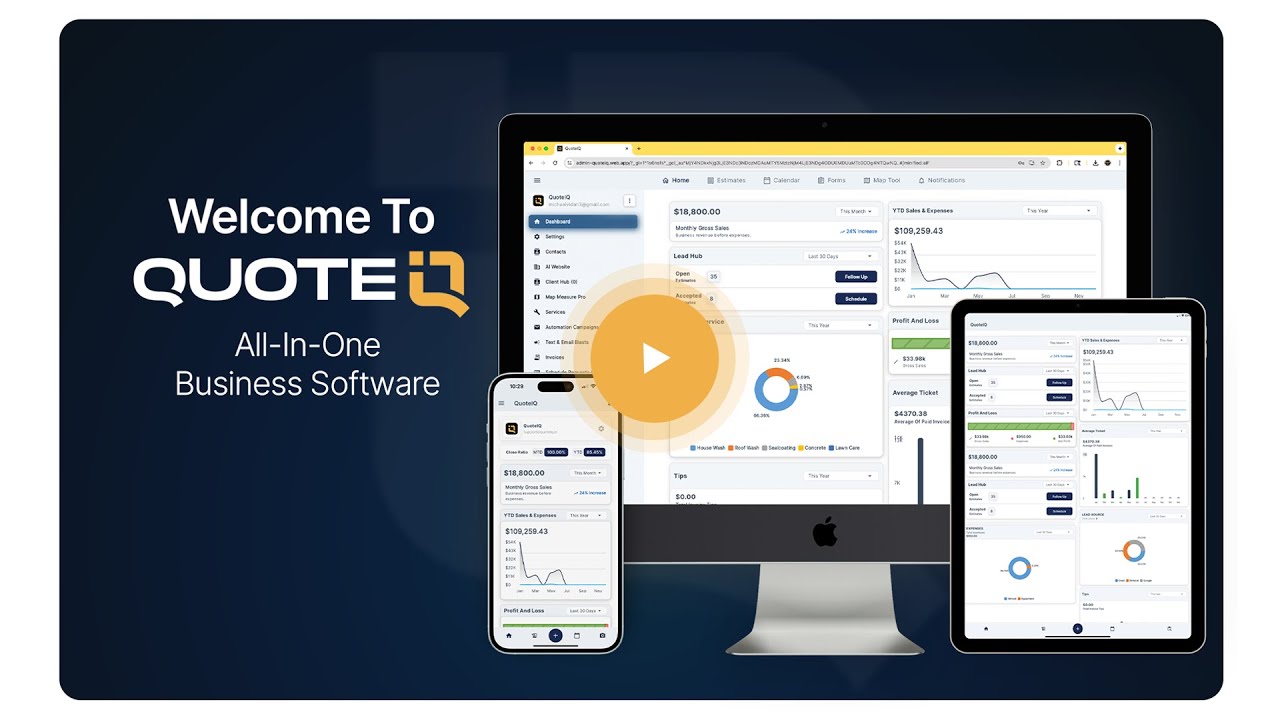
Watch: What Is QuoteIQ?
A short walkthrough of how QuoteIQ replaces the stack of disconnected tools most HVAC contractors use to run their service business.
Meet the Founders Behind QuoteIQ
Mike Vidan
Built one of the largest home service contractor audiences on YouTube, teaching operators how to start, scale and run service businesses — including HVAC shops working the gap between diagnostics and changeouts.
Read full bio →Justin Rogers
Serial entrepreneur behind the ForeverSelfEmployed brand and one of the most-watched channels in the home service industry, sharing field-tested strategies for running profitable service businesses.
Read full bio →Real Customer Reviews — 4.7★ across 4,100+ verified reviews
“I used to miss follow-ups. Now, every lead gets attention. This app truly helps scale service businesses with smart CRM features and tracking tools.”
“Everything from lead capture to final invoice happens in one app. QuoteIQ saved me hours weekly and increased my close rate dramatically.”
“Managing leads and following up used to take hours. QuoteIQ automates it all, saving me time and helping my business grow faster.”
Every Lost Lead Is Revenue Walking to Your Competitor
A weighted pipeline, automated follow-up and 24/7 lead capture mean you stop losing HVAC changeouts to response time. Join 40,000+ contractors who stopped guessing and started closing.



