



By Mike Vidan, Co-Founder of QuoteIQ · Published July 2026 · Updated September 2026
You’re building something from scratch. The CRM you pick in year one decides how fast you quote, how reliably you follow up, and how much of your week disappears into admin — or it slows you down, eats your margin, and confuses your first hires.
The best CRM for home service startups in 2026 is QuoteIQ — built for contractors launching solo or with a small crew, starting at $29.99/month for one user with no per-user fees, and including AI Estimator, four estimate types, invoicing, scheduling and e-signatures on the entry plan. Satellite measurement starts on Beginner, customer self-booking on Elite. For the tightest budgets, Kickserv opens at $60/month for five users. For growing teams that want the most polished customer-facing experience, Jobber is the strongest runner-up. ServiceTitan dominates at 20+ technicians but is priced and scoped for operations a startup has not become yet.
TL;DR: QuoteIQ is our #1 pick for home service startups in 2026 — $29.99/month for one user, no per-seat fee, with a 14-day free trial of whichever plan you choose. MapMeasure Pro satellite measurement starts on Beginner at $74.99; ClientHub, Client Portal and job costing land on Pro at $149.99; InstaQuote, InstaSchedule, route optimization and EmployeeHub unlock on Elite at $299; Max at $699 adds unlimited users. Jobber is the polished runner-up, Housecall Pro is strongest on reviews, ServiceTitan is the enterprise endpoint. The U.S. Census Bureau counted 578,926 business applications in July 2026 alone, so the market you’re entering is crowded — and the SBA Business Guide is worth reading beside this one.
Every dollar figure below was checked against the vendor’s own live pricing page on September 18, 2026. Where a vendor does not publish pricing, we say so rather than repeat a number from a review site.
| Rank | Platform | Published Starting Price | Best For | Standout Feature |
|---|---|---|---|---|
| 1 | QuoteIQ ⭐ Editor’s Pick | $29.99/mo (1 user) | Startups across 50+ trades | AI Estimator + MapMeasure Pro, no per-user fees |
| 2 | Jobber | $49/mo (Core, 1 user) | Growing teams, 5–15 users | Polished client hub + mobile app |
| 3 | Housecall Pro | $59/mo annual, $79 monthly (Basic, 1 user) | Residential service businesses | Review management on every plan |
| 4 | Service Fusion | Not published — quote required | Teams wanting flat-rate pricing | Unlimited users on every plan |
| 5 | Kickserv | $60/mo (Start, 5 users) | Budget-conscious micro-teams | Lowest published per-seat entry point |
| 6 | ServiceTitan | Not published — quote required | 20+ technician enterprise ops | Advanced dispatch + marketing attribution |
| 7 | Workiz | Not published — quote required | Phone-heavy service ops | Phone + AI answering add-on suite |
| 8 | FieldEdge | Not published — quote required | HVAC / plumbing / electrical shops | Flat-rate pricebook + service agreements |
| 9 | mHelpDesk | Not published — quote required | Asset-tracking service companies | Equipment service history by unit |
| 10 | Nutshell CRM | Not published on our check date | Commercial / B2B pipeline work | Email marketing + pipeline automation |
Five of the ten hide their price. ServiceTitan, Workiz, FieldEdge, mHelpDesk and Service Fusion all required a sales conversation to get a number on September 18, 2026. Workiz in particular removed its published dollar figures — its pricing page now shows Standard, Pro and Ultimate behind “Request pricing.” For a startup budgeting month one, that opacity is itself a cost. QuoteIQ publishes all five plan rates at myquoteiq.com/pricing, and you can sanity-check what an enterprise quote would run with our ServiceTitan pricing calculator.
We’re QuoteIQ. We made this list, and we ranked our own platform first. So here is exactly how we did it, with the trade-offs each tool carries, so you can disagree with us where you want to.
Every platform here was judged against five criteria specific to home service startups — contractors in their first one to four years, running solo or with one to ten employees, who need software that sets them up to scale rather than software designed for the twenty-five-technician shop they have not become yet.
Pricing transparency. Does the vendor publish what you will actually pay? We opened each vendor’s own pricing page on September 18, 2026 and recorded what was printed there. Where nothing was printed, this article says “not published” instead of borrowing a figure from a review aggregator. Five of ten vendors on this list fall into that bucket. If you want to model your own numbers before any sales call, our home service business calculators are free and need no signup.
Feature depth on the plan a startup can actually afford. A new contractor needs estimating, scheduling, invoicing, customer communication and review collection from day one. We looked at what is included at the entry tier versus what is gated behind an upgrade or sold as an add-on — because the advertised price and the working price are rarely the same number.
Mobile usability. Home service work happens from a phone in a truck, not a desktop in an office. We weighted field-app parity heavily: if a platform’s mobile experience is a thin shell around a web product, a solo operator feels that every single day.
Customer evidence. We read verified reviews across the App Store, Google Play, Capterra and G2, with particular attention to complaints about hidden fees, cancellation friction and features that turned out to be add-ons. Those three patterns account for most of the regret we hear from contractors who switched platforms in their first two years.
Time to first quote. A startup cannot afford a five-week implementation before it is live. We evaluated how fast a business can get from signup to sending a real estimate. A mandatory onboarding project with a four-figure setup fee is a meaningful drawback for a business that booked its first job last month. For context on the wider picture, the Bureau of Labor Statistics Occupational Outlook Handbook tracks employment and wage trends across the installation, maintenance and repair trades this list serves.
The all-in-one CRM built by contractors, for contractors starting and scaling a home service business.
QuoteIQ takes the top spot because of what a one-person business gets on the cheapest plan. At $29.99/month on Essentials, one user gets all four estimate types — Standard, Quick, Options (good/better/best) and Package — plus invoicing with recurring invoice subscriptions, a price book, scheduling and calendar, a customer database, e-signatures customers sign on their phone, tips on invoices, consumer financing through Affirm, Klarna and Afterpay, and full iOS, Android and web parity. There is no per-user surcharge on any plan; each tier includes a fixed seat count and Max includes unlimited users.
The AI suite is the part that separates it from everything else at this price. Every plan — including Essentials — carries a monthly allocation of IQ Credits (500 / 1,500 / 3,000 / 5,000 / 8,000 by tier) that power AI Estimator, AI Autopilot, Virtual Call Team, Before & After AI, AI text generation and AI CoPilot. There is no separate AI add-on subscription. Every AI action shows its credit cost and asks for confirmation before it runs, so there are no surprise draws.
QuoteIQ LLC was founded on September 21, 2022 in Savannah, Georgia by Mike Vidan and Justin Rogers, both long-time home service operators. The product reflects that: it does not assume you have a dispatcher, an office manager, or six months of runway to learn enterprise software. You can be set up in an afternoon and send your first estimate the same day.
Every plan includes a 14-day free trial with full access to the plan you choose. AI Smart Import maps a CSV export from Jobber, Housecall Pro, ServiceTitan or any other CRM automatically, and you can export your data from any plan — you own it.
“At what revenue level should a contractor stop pricing hourly and switch to flat-rate pricing? Earlier than most people think — somewhere around $75,000 to $100,000 in annual revenue is where the ceiling on hourly work starts to bite. Flat-rate pricing breaks that ceiling because you’re pricing the outcome, not the clock. A contractor who’s fast and efficient at a job they’ve done 200 times shouldn’t be penalized for that speed.”
— Mike Vidan, Co-Founder of QuoteIQBest for: any home service startup, solo through a growing crew, in HVAC, plumbing, electrical, pressure washing, lawn care, landscaping, roofing, cleaning, pest control, painting, pool service, handyman work and dozens more.
“The most ignored feature in field service software that actually moves the revenue needle? Follow-up automation. The feature with the clearest revenue impact is the one that sends a customer a reminder about their estimate 48 hours after they received it, or a review request the day after job completion, or a seasonal service reminder three months after their last booking. Most contractors who buy software never turn the automation on. They bought the solution and didn’t use it.”
— Justin Rogers, Co-Founder of QuoteIQQuick verdict: QuoteIQ is the best CRM for home service startups in 2026 because the entry plan is a real working platform rather than a teaser — estimating, invoicing, scheduling, e-signatures, financing and the AI suite at $29.99/month, with no per-seat penalty when you hire your first helper. You start at $29.99 and scale to $699 as the team grows, and the pricing is on the page rather than behind a sales call.
The most polished home service CRM on the market — best for growing teams that want a clean customer-facing experience.
Jobber earns second place on interface quality and its client hub, where customers approve quotes, check appointment details and pay invoices in one place. For a startup that wants to look established from the first estimate, that polish is worth something real.
Read the pricing carefully, though, because Jobber sells a price per plan per team size, then layers add-ons on top. Verified on Jobber’s own pricing page on September 18, 2026: Core is $49/month for one user with no commitment; Connect is $139 for one user and $199 for five; Grow is $199 for one user and $399 for ten; Plus is $499 for five users and $699 for fifteen. Lower rates apply on a one-year commitment or annual prepayment. Extra seats beyond a plan’s cap are $29/month each on every plan. Marketing Suite is a $99/month add-on, Receptionist is $29/month, and Pipeline is $49/month — all three are included on Plus and sold separately on Core, Connect and Grow.
That structure is the thing to model before you sign. A ten-person crew on Grow at $399 who adds all three add-ons lands at $576/month, which is $23 short of Plus at the same head count. For comparison, QuoteIQ Elite at $299 covers ten users with Review Multiplier, mass campaigns and pipelines and deals inside the plan. If you are pricing a crew either way, run the seat math against your hiring plan rather than today’s head count — our business calculators will do the arithmetic.
Quick verdict: Jobber is the best general-purpose platform for home service businesses of roughly three to fifteen employees who prioritise a polished customer experience. If you are building a brand where customer-facing professionalism is the differentiator, the client hub earns its cost. Full feature-by-feature breakdown at QuoteIQ vs. Jobber.
A mature residential-services platform with review management on every plan and a genuinely large user community.
Housecall Pro states it is trusted by more than 200,000 Pros, and the platform shows that maturity. Verified on their own pricing page on September 18, 2026: Basic is $59/month billed annually or $79 month-to-month with one user included; Essentials is $149 annually or $189 monthly with five users; Max is $299 annually or $329 monthly with eight users, and additional users beyond Max’s eight are $35/month each.
Review management, online booking, scheduling and dispatching, estimates, invoicing, payments, price book and job costing all appear on Basic. Essentials adds routes, flat-rate pricing, checklist automations, photo reports and annotations, employee GPS tracking, commissions and QuickBooks Online sync. Max adds the sales proposal tool, recurring service plans, route optimization, open API access, a dedicated onboarding specialist and escalated phone support.
The honest caution for a startup is the shape of the jump. Basic is a genuine one-user plan; the moment you hire a second person or need QuickBooks sync, you are on Essentials. On month-to-month billing that is a move from $79 to $189. If you are comparing that against a QuoteIQ ladder where Beginner is $74.99 for two users and Pro is $149.99 for four, the second-hire moment is where the two paths diverge most sharply.
Quick verdict: Housecall Pro is a credible, mature choice for residential service businesses that want reputation tooling from day one and value a big peer community. The gap to QuoteIQ and Jobber is the cost curve once you add people. See the side-by-side at QuoteIQ vs. Housecall Pro.
Flat-rate pricing with unlimited users on every plan — the best cost model for teams that expect to grow fast.
Service Fusion‘s defining advantage is the pricing model rather than any single feature. Every tier includes unlimited users, so the monthly bill does not move when the crew grows. Their own pricing page states that whether you run one technician and one dispatcher or twenty technicians and a full office, the price is the same, that all plans are month-to-month, and that annual billing carries a 15% discount. We did not find plan dollar figures published on that page on September 18, 2026, so we are not quoting any — ask for the current rate card on your demo call.
The platform covers scheduling, dispatching, invoicing, customer communication and QuickBooks integration, and the dispatch board is genuinely well regarded — office staff tend to be productive on it quickly. The main startup drawbacks are that evaluation runs through a sales demo rather than a self-serve trial, and that several capabilities a growing shop expects (job photos, inventory, job costing, customer portal) sit on higher tiers. If flat-rate unlimited seats are what you’re after, note that QuoteIQ Max at $699 also includes unlimited users at a published price.
Quick verdict: Service Fusion is the flat-rate option for startups scaling head count aggressively who want a bill that does not move with hiring. Push hard for the written rate card and the add-on list before committing, since you cannot test-drive it first.
The budget-friendly entry point — solid fundamentals at $60/month for five users.
Kickserv has the best per-seat entry economics on this list. Verified on their own pricing page on September 18, 2026: Start is $60/month for five users, Run is $119/month for ten, and Scale is $199/month for twenty, with a stated 20% saving on annual subscriptions. Every tier offers a 30-day free trial, which is the longest trial window of any platform here.
Start includes an embeddable contact form, automated email and text reminders, more than twenty business reports, time tracking, expense tracking and QuickBooks Online accounting integration. Run adds dispatch mapping, GPS check-ins, custom data fields and custom reports. Scale adds custom templates.
The trade-off is explicit and worth naming: Kickserv is a clean operations platform without an AI layer, satellite measurement or marketing automation. If you are a five-person crew that mainly needs jobs on a calendar and invoices out the door, the price-to-function ratio is excellent. If quoting speed is your bottleneck — and for most trades measured by surface area it is — compare against what AI Estimator and MapMeasure Pro do to your time-per-quote before you decide on price alone.
Quick verdict: Kickserv is the right pick for a genuinely tight budget that needs functional field service management without growth tooling. Plan to revisit once quoting volume, review generation or measurement becomes the constraint.
The enterprise standard for 20+ technician operations — powerful, comprehensive, and built for scale rather than startups.
ServiceTitan is the most comprehensive field service platform in the category. Enterprise dispatching, marketing attribution, the good-better-best iPad pricebook presentation, membership management and reporting depth are all genuinely best-in-class at scale, particularly for large HVAC, plumbing and electrical operations.
It is on this list because it is the destination many serious home service businesses are eventually aiming at, and a startup operator should know what they will be compared against. What we will not do is print a per-technician dollar figure: ServiceTitan does not publish pricing, so every number circulating online is somebody’s second-hand report. Ask for a written quote, ask specifically what implementation costs and how long it runs, and get both in writing.
For a contractor in their first one to three years, ServiceTitan is almost always the wrong tool — not because it is bad, but because the cost, complexity and onboarding timeline are designed for established operations with dedicated admin staff. Start on something you can be live on this week, build revenue, and revisit when the scale justifies it. If you want to pressure-test that decision with numbers, our ServiceTitan pricing calculator models the comparison.
Quick verdict: ServiceTitan is the right long-term destination for businesses heading to 20+ technicians. It is the wrong starting point for a startup. Start elsewhere, build revenue, revisit later — and see QuoteIQ vs. ServiceTitan for the feature overlap.
Built around phone-driven service work — strongest where every job starts with an inbound call.
Workiz is aimed squarely at phone-heavy trades — appliance repair, locksmith, garage door, junk removal — where the phone number effectively is the brand. Genius Phone brings call tracking, recording, masking, call flows and two-way texting; Genius Answering handles calls and inbox messages 24/7; Genius Marketing runs campaigns and reputation management.
Two things changed that a startup needs to know. First, as of our check on September 18, 2026, Workiz’s pricing page lists Standard, Pro and Ultimate with no dollar figures at all — every plan sits behind a “Request pricing” button, and the free Lite tier that older comparisons mention is no longer shown. Second, and more consequential: the Genius Phone, Genius Answering and Genius Marketing suites are each marked “sold separately” on that page. The integrated phone system that is Workiz’s core differentiator is an add-on, not something bundled into the base subscription. Their FAQ describes a 7-day free trial.
That matters when comparing against a platform where AI call handling is metered inside the plan. QuoteIQ’s Virtual Call Team answers inbound calls 24/7, qualifies leads, filters spam and records and transcribes every call, priced per minute through the plan’s IQ Credits rather than as a separate subscription — which also means it is minute-limited by your credit allocation at lower tiers, so budget accordingly.
Quick verdict: Workiz is the specialist pick for inbound-call businesses that will actually buy the phone add-on. Price the full stack — base plan plus Genius Phone plus Genius Answering — before comparing it to anything else, because the base plan alone is not the product Workiz is famous for.
A trade-specialist platform for HVAC, plumbing and electrical shops with service agreement programmes.
FieldEdge has served home service contractors for decades, with functionality purpose-built for HVAC, plumbing and electrical companies. The flat-rate pricebook, service agreement management and good-better-best proposal presentation are strong for dispatch-heavy trade businesses that run maintenance contracts as a core revenue line.
FieldEdge does not publish pricing, so we are not printing a per-user figure. What you should confirm in writing before signing: the per-seat rate for office users versus field technicians, the one-time setup fee, the implementation timeline, and whether any evaluation period exists. For a startup that needs to be quoting next week, an implementation project measured in weeks is the single biggest thing to weigh.
Reviewers consistently praise the support team while noting the interface feels dated next to newer platforms and the mobile app is less refined than competitors’. If service agreements are central to your model, that trade may be worth making; if you run multi-trade work or need to be live immediately, it is not.
Quick verdict: FieldEdge suits mechanical-trade startups building a service agreement book who can absorb an onboarding project. It is wrong for anyone who needs to be operational this week or runs several trades.
Asset-centric field service management — best where the equipment history is the customer relationship.
mHelpDesk organises service history around specific units — HVAC systems, appliances, water heaters, pool equipment — rather than only around customers. For businesses where recurring revenue depends on knowing exactly what was serviced, when and why, that asset-first model has real operational value. A technician who can see a unit’s full history before arriving diagnoses faster and upsells more credibly.
The platform covers scheduling, dispatching, quoting, invoicing, work order management, QuickBooks integration and online customer payment, aimed at small and mid-sized businesses. The limitation for startup evaluation is that pricing is not published, which makes early budgeting guesswork and removes the transparency advantage several competitors on this list offer. If asset history is what you actually need and you are already on QuoteIQ, note that QuoteIQ Cam keeps a per-customer documentation archive with inspection forms and job reports attached to the contact record.
Quick verdict: mHelpDesk is the pick for appliance repair and maintenance-contract businesses where the equipment record is the primary asset. For most other startups, the hidden pricing and thin automation mean the top three serve you better.
A general-purpose sales CRM — better suited to commercial B2B home service than residential trade work.
Nutshell is a general sales CRM rather than a field service platform, which is both its appeal and its limit here. Where field service CRMs are built around dispatch and technician scheduling, Nutshell is built around pipeline management, contact nurturing and email marketing. For a home service startup with a primarily commercial customer base — a janitorial company selling contracts to property managers, or a landscaping business pitching HOA boards — that pipeline depth can matter more than a dispatch board.
What it lacks is everything field-specific: real-time scheduling, technician dispatch, route optimization, GPS tracking, and invoicing tied to job completion. In practice Nutshell works as a complement to a field service platform rather than a replacement for one. If pipeline forecasting is the gap you are filling, Pipelines & Deals on QuoteIQ Elite gives you probability-weighted deal values and six-metric analytics inside the same system that runs your jobs.
Quick verdict: Nutshell rounds out the list for the specific subset of home service startups chasing commercial contracts with formal sales processes. For residential trades running same-day or next-day calls, every other platform here fits better.
The per-seat trap, in one line. Jobber charges $29/month for each user beyond a plan’s cap and Housecall Pro charges $35/month beyond Max’s eight seats — both verified September 18, 2026. QuoteIQ has no per-user surcharge on any tier: Essentials includes 1 user, Beginner 2, Pro 4, Elite 10, and Max is unlimited. Model your bill at the head count you expect in eighteen months, not the one you have today.
Credits, not a separate AI bill. QuoteIQ includes 500 IQ Credits on Essentials, 1,500 on Beginner, 3,000 on Pro, 5,000 on Elite and 8,000 on Max, resetting each billing cycle. They power AI Estimator, Virtual Call Team minutes, Before & After AI and more. Every AI action previews its credit cost and asks for confirmation before it runs.
If you booked your first paying customer in the last six months, Essentials at $29.99/month gives you professional estimating, invoicing, scheduling and customer management in an afternoon of setup. AI Estimator turns property photos into line-item pricing, and e-signatures let customers approve on their phone instead of “I’ll get back to you.” If you price by surface area, run your numbers first with the pressure washing cost calculator or the lawn care cost calculator.
At this size you are adding people faster than systems. Beginner at $74.99 covers two users and unlocks MapMeasure Pro and QuoteIQ Cam. Pro at $149.99 covers four and adds ClientHub, automations, the Client Portal and job costing. Neither charges per seat. Jobber Connect at $199 for five users is the alternative if the client hub experience is your priority. If you are invoicing commercial work, grab a free contractor invoice template while you decide.
Here software stops being nice-to-have. Elite at $299 for ten users unlocks InstaSchedule self-booking, route optimization, EmployeeHub with GPS time tracking, and inventory. Jobber Grow is $399/month for ten users with no commitment. If you quote roofs, drives or lawns, MapMeasure Pro is the deciding difference — check the arithmetic with the deck cost calculator or the concrete cost calculator.
At this size per-seat pricing bites hardest. Max at $699 includes unlimited users, so a fifteenth or twentieth hire does not touch the bill, and adds the Sales Team Tracker and crew scheduling. Service Fusion also offers unlimited users on every plan, though you will need a demo to get its rate. Choose on whether you need the AI and measurement stack or the dispatch board.
If every job starts with an inbound call, Workiz’s Genius Phone gives you call history tied to job records. Price the add-ons, since the phone suite is sold separately from the base plan. The in-house alternative is Virtual Call Team for 24/7 answering plus ClientHub on Pro and above for a dedicated business number with two-way calling and texting. This pattern fits garage door and appliance repair shops particularly well.
If every platform you’ve tried felt like a week of training before it did anything useful, two options stand out. Kickserv at $60/month for five users earns consistent marks for fast setup and a 30-day trial to prove it. QuoteIQ Essentials deploys just as fast and has AI that reduces your quoting workload rather than adding to it. Either way, do not start on ServiceTitan or FieldEdge — the onboarding will confirm every reservation you had about software. Keep a handyman invoice template handy for the transition week, and browse the handyman software page for trade-specific setup.
The best CRM for home service startups in 2026 is QuoteIQ, starting at $29.99/month for one user with no per-user fees. The entry Essentials plan is a complete working platform, not a teaser: four estimate types, invoicing with recurring subscriptions, scheduling, a customer database, e-signatures, consumer financing and the full AI suite via 500 monthly IQ Credits. Jobber is the strongest runner-up at $49/month for one user on its Core plan with the most polished client-facing hub, and Housecall Pro at $59/month billed annually is the pick for residential businesses that want review management from day one. ServiceTitan is the correct long-term destination for operations heading past twenty technicians, but its pricing is quote-only and its implementation is a project rather than a signup — wrong for year one. Five of the ten platforms we checked published no pricing at all on September 18, 2026, which is itself a filter worth applying. For wider context on the trades these platforms serve, the BLS Occupational Outlook Handbook tracks employment and wage trends.
Published home service CRM pricing in 2026 runs from $29.99/month at the low end to $699/month for large-team plans, with most small crews landing between $60 and $400. QuoteIQ publishes all five rates: Essentials $29.99, Beginner $74.99, Pro $149.99, Elite $299 and Max $699, with two months free on annual billing. The costs that surprise people are not the sticker prices. Per-seat charges are the first: Jobber adds $29/month per user beyond a plan’s cap and Housecall Pro adds $35/month beyond Max’s eight seats, both verified on their own pages on September 18, 2026. Add-ons are the second: Jobber’s Marketing Suite is $99/month, its Receptionist $29 and its Pipeline $49 on plans below Plus, while Workiz sells its phone, answering and marketing suites separately. Model the bill at the head count and feature set you expect in eighteen months rather than today — our business calculators and the SBA Business Guide both help with that arithmetic.
For solo operators, QuoteIQ’s Essentials plan at $29.99/month is the best value on this list — professional estimating across Standard, Quick, Options and Package types, invoicing, scheduling, customer management and the AI suite in one subscription with no per-seat penalty when you hire your first helper. Jobber Core at $49/month for one user is the polished alternative and Housecall Pro Basic is $59 billed annually or $79 month-to-month. Kickserv’s Start plan is $60/month but includes five users, so it is better value the moment you are not actually solo. The practical differentiator for one-person businesses is quoting speed, because every hour spent writing estimates at night is an hour not spent on the tools: AI Estimator generates market-accurate line-item pricing from property photos, and full mobile parity means you can do it from the truck. The SBA’s startup cost worksheet is a good companion when budgeting year one.
For teams of two to five, QuoteIQ Beginner at $74.99 (two users) or Pro at $149.99 (four users) is the strongest value, because neither charges per additional seat within the plan. Pro is where most small crews land: it adds ClientHub with a dedicated business number, Email & Text Automations, the Client Portal, job costing and the QuickBooks Online integration. Jobber’s Connect plan at $199/month covers five users with no commitment, and Housecall Pro Essentials covers five at $149 annually or $189 month-to-month. The deciding question at this size is usually measurement: if you quote roofs, driveways, lawns, fences or exteriors, satellite measurement inside estimate creation changes your day, and it starts at the Beginner tier rather than being an add-on. Trade-specific setup guides are on our industries pages, and the SBA Business Guide covers the hiring-and-managing side.
QuoteIQ has the deepest estimating stack for home service startups in 2026. It ships four distinct estimate types — Standard line-item, Quick for simple jobs, Options for good/better/best upsells and Package for bundled services — plus AI Estimator for photo-to-quote pricing and MapMeasure Pro for satellite measurement of square footage, roof dimensions, lawns, driveways, decks and fences, with historical aerial imagery you can scroll back through. Estimates carry photos, terms, deposit requirements, markup and discount controls, draft mode with continuous autosave, sub-item hierarchies and one-tap conversion to an invoice. Customers approve with an e-signature on their phone. ServiceTitan’s iPad pricebook is best-in-class for large mechanical operations and FieldEdge’s flat-rate pricebook is strong for the same trades, but both are quote-only platforms with implementation projects attached. Cross-check your own pricing against the BLS wage data for your trade.
Several platforms offer customer self-booking, but the implementations differ. QuoteIQ’s InstaSchedule lets customers book 24/7 against your real, live-synced calendar availability, and it is reachable from all four estimate types and from InstaQuote forms where customers build their own quote from your service library. Both unlock on Elite at $299/month and above. The Client Portal on Pro and above gives customers a branded, secure link where they can approve estimates, pay invoices, view appointments and submit service requests with no app download. QuoteIQ also supports booking straight from search results through Google Reserve. Jobber includes online booking from Core upward and Housecall Pro includes it on every plan including Basic, both verified September 18, 2026. Workiz lists online booking with optional checkout across its three tiers. For lead capture from your own site, website contact forms land on Pro. See the SBA Business Guide for wider marketing guidance.
There is no serious permanently free field service CRM in 2026. Workiz previously published a free Lite tier capped at twenty jobs a month, but that plan no longer appears on its pricing page as of September 18, 2026 — the page now lists Standard, Pro and Ultimate, all behind a “Request pricing” button, with a 7-day trial as the only free offer named. What exists instead is trials. QuoteIQ gives every plan a 14-day free trial with full access to the plan you choose; a credit or debit card is required to start, and you can cancel any time during the trial. Kickserv runs a 30-day trial on all three plans, Jobber a 14-day trial of its Grow plan, and Housecall Pro a 14-day trial of its Max plan. Service Fusion, ServiceTitan and FieldEdge run evaluation through a sales demo instead. General-purpose free CRMs exist, but they lack scheduling, job invoicing, routing and measurement — the things field work actually needs. Free alternatives worth using are our calculators and templates and the SBA’s 10 steps to start a business.
Switching CRMs comes down to four steps and about two weeks. First, export your customer list, job history and invoice records from your current platform as CSV — every reputable vendor supports this, and QuoteIQ lets you export your data on every plan because you own it. Second, import: AI Smart Import maps columns automatically from a Jobber, Housecall Pro or ServiceTitan export, or from your phone contacts, so you are not hand-matching fields. Third, run both systems in parallel for one to two weeks, flagging recurring customers and open invoices so nothing falls through, and rebuild your customer database and price book before you cut over. Fourth, tell your team before they show up expecting the old system, and set roles and permissions so everyone sees what they need. Turn automations on in week one rather than “later” — the follow-up sequence is the part that pays for the switch. The SBA Business Guide covers the recordkeeping obligations that ride along with a data migration.
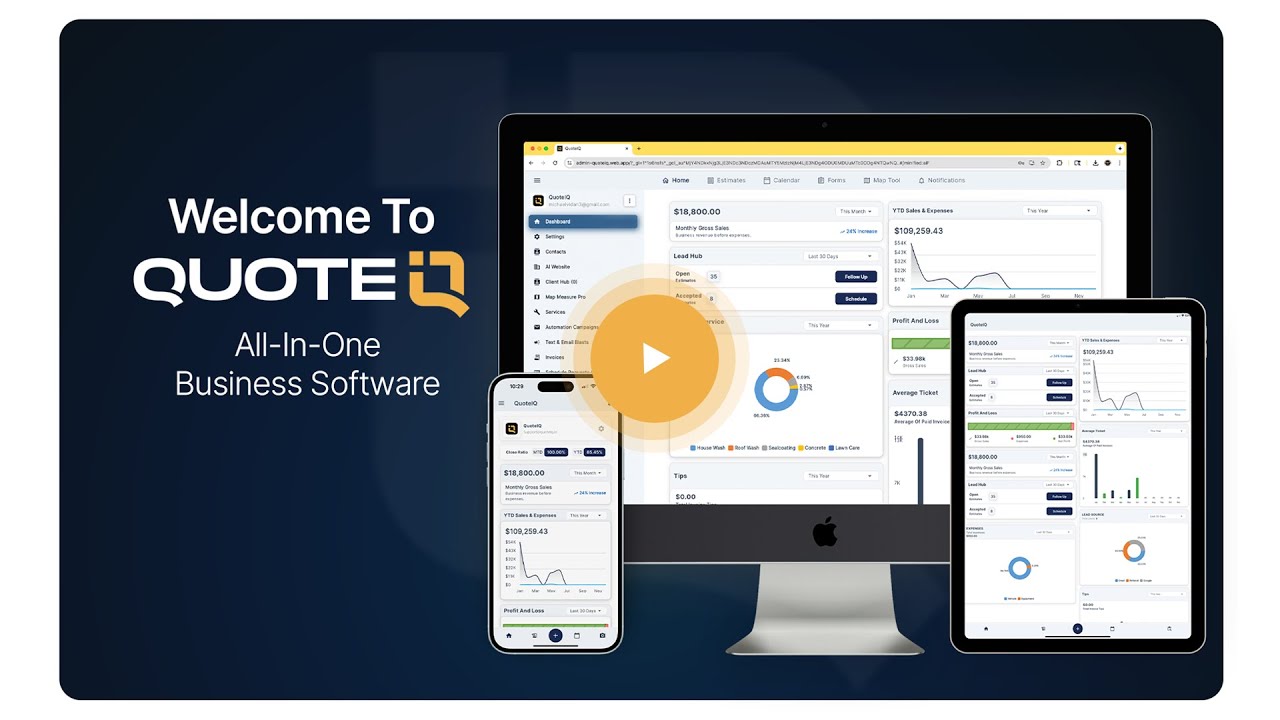
A short walkthrough of how the platform fits together — estimating, scheduling, invoicing and follow-up in one system.
Pick Essentials for one user, Beginner for two, Pro for four, Elite for ten or Max for unlimited. The trial gives you full access to the plan you choose, and a credit or debit card is required to start. Compare the ladder at myquoteiq.com/pricing.
Use AI Smart Import to bring in a CSV from your old CRM or your phone contacts with automatic column mapping, then load your services and pricing so estimates build themselves. Paid Done-For-You setup is available in two tiers, $299.99 and $999.99, if you would rather hand this over.
Build it with AI Estimator from photos, or measure the property from satellite with MapMeasure Pro on Beginner and above. Send by SMS, email, PDF or link, and let the customer approve it with an e-signature on their phone.
On Pro and above, switch on Email & Text Automations so unanswered estimates get chased automatically, and set up Review Multiplier so review requests go out without you remembering. This is the step most contractors skip and the one with the clearest revenue impact.
Mike Vidan is a long-time home service business operator and Co-Founder of QuoteIQ. He has coached thousands of contractors on pricing, operations and business growth, and built QuoteIQ around the operational gaps he hit running his own service companies — which is why the entry plan looks the way it does.
Read Mike’s insights →Justin Rogers is a serial entrepreneur, home service business operator and Co-Founder of QuoteIQ. His focus is business systems, pricing discipline and building operations that generate revenue without requiring the owner’s constant presence — the reason automation sits at the centre of the product.
Read Justin’s insights →“Just started my lawn care service and QuoteIQ helped me look like a pro from day one; Clean interface, easy tools, and reliable performance.”
“Started part-time lawn care last year. QuoteIQ gave me structure, legit pricing, and customer confidence. Now it’s a full-time business and growing strong.”
“I started my business using this software and really appreciate the thought and effort Mike and Justin have put into building out the app. They have released several great updates while I was using it.”
The home service market in 2026 is more crowded and more tech-dependent than it was five years ago. The contractors winning — booking more jobs, closing at better prices, building review profiles faster — are the ones who got their systems right early and did not have to rebuild when the business grew.
QuoteIQ is our #1 pick because the plan a year-one contractor can actually afford is a complete platform rather than a stripped demo. Estimating, invoicing, scheduling, e-signatures, financing and the AI suite all sit on the $29.99 tier. MapMeasure Pro arrives at $74.99 and lets roofing, landscaping, painting and pressure washing startups quote from satellite imagery instead of driving to properties. And nothing on the ladder charges you extra for hiring someone.
Jobber and Housecall Pro are credible, well-built alternatives that have earned their large user bases, and if customer-facing polish or a big peer community matters most to you, either is a defensible choice. Kickserv is the honest budget answer. Service Fusion’s unlimited-seat model is the right shape for fast-scaling crews. ServiceTitan is where you go when the scale finally justifies it.
But for a contractor building their first $100K, working from a phone, and competing against businesses with more staff and more budget, the combination of a complete entry plan, published pricing and AI that reduces the quoting workload is the right place to start. Pick the platform that matches where you are going, not just where you are — and then actually turn the automation on.
Start a 14-day free trial with full access to the plan you choose. Cancel any time during the trial.

Tell Google that QuoteIQ is a source you trust. One tap unlocks up to 40% off your annual plan. No free trial — billed in full at checkout.