



QuoteIQ is the best 24/7 answering service software for tree service businesses in 2026 because its Virtual Call Team answers every call around the clock, qualifies the lead, filters spam, records and transcribes the conversation and sends you a summary notification — inside the same platform you already use for estimates, scheduling and invoicing. Plans start at $29.99/month on Essentials, with calls paid for in IQ Credits.
One honest limit: the Virtual Call Team answers, qualifies and summarizes, but it does not book appointments itself. You confirm the job from the summary, or on the Elite plan and above let customers self-book with InstaSchedule.
Ruby Receptionists is the premium live-human option, AnswerForce is a live-agent service used by emergency-heavy businesses, Smith.ai blends AI and human agents, Goodcall is a lightweight AI phone agent, and Housecall Pro CSR AI is an add-on for crews already on Housecall Pro. We deliberately print no competitor prices — plans change, so check each vendor’s own pricing page.
TL;DR: Missed storm calls are the most expensive leak in a tree service, and after 7pm the next listing answers instead of you. QuoteIQ’s Virtual Call Team answers around the clock, qualifies the lead, filters spam, records and transcribes the conversation and sends you a summary — from $29.99/mo, bundled with estimates, scheduling, invoicing, ClientHub, MapMeasure Pro and AI Autopilot. Calls are metered in IQ Credits at 125 credits per minute, so size the plan to your real after-hours volume instead of buying the biggest tier. One honest limit: it answers and summarizes, but it does not book the estimate visit itself — you confirm that from the summary. Per the BLS, tree trimmers and pruners held about 70,600 U.S. jobs in 2025, and OSHA warns of overhead power lines and falling branches, so whatever script you load has to triage hazards before it ever talks price.
Tree Service Answering by the Numbers
Six figures worth knowing before you pick a tool. Sourced numbers link to the agency that publishes them; the rest come from QuoteIQ’s own plan structure.
The Bureau of Labor Statistics counts about 70,600 jobs — a big, fragmented trade where most companies are small crews answering their own phones.
Per the BLS. A three-person crew is roughly $73.50 an hour in median wages alone — idle crew time is expensive.
The National Weather Service says isolated wind damage is possible at those speeds — a forecast is a lead forecast.
IQ Credits meter the Virtual Call Team. Plans include 500 to 8,000 credits a month.
The BLS outlook for tree trimmers and pruners — steady demand, so competing for every call matters.
Consumer Financing is on every QuoteIQ plan, which helps close big removals once the call is answered.
Winners by Category
Different tree service operations need different answering setups. Here is our pick for each shape of business — the full write-ups follow below. If you want the broader software picture first, our tree care software page and its FAQ cover the whole platform.
Why 24/7 Answering Matters for Tree Service Businesses
Tree work is one of the most call-volume-volatile trades in home services. A clear afternoon means a quiet phone. A wind event at 6pm Tuesday means a stack of voicemails by sunrise — and the operator who answered live usually gets the job. The National Weather Service notes that when winds are sustained at 40-50 mph, isolated wind damage is possible, which is exactly when homeowners start looking at the oak over the garage.
The problem is not only storms. Homeowners call about leaning oaks, dropped limbs over driveways and dead pines after a hot summer, and a lot of those calls land in the evening or on weekends because that is when people are home looking at their yards. If the call goes to voicemail, many callers simply dial the next listing in Google. The competitor down the road may not have a better website — they just had someone pick up.
The trade is also bigger and more competitive than it looks. The Bureau of Labor Statistics counted about 70,600 tree trimmer and pruner jobs in the U.S. in 2025 and projects 4% growth through 2035, with a median wage of $24.50 an hour. Wages are a real cost, so a crew that finishes at 4pm with an empty schedule tomorrow is paying for a gap that a better phone process could have filled.
The Cost of Voicemail
Illustrative math, with your own numbers swapped in: if your average removal or pruning ticket is $1,500 and two calls a week go unanswered after hours, you are walking away from roughly eight calls a month. Even if only three in ten of those would have closed, that is about $3,600 in monthly revenue — and it compounds because a missed first call is a missed repeat customer. You can sanity-check your own ticket size with the free tree removal cost calculator and the wider set of home service business calculators.
Three Different Business Shapes, Three Different Answers
A solo arborist booking pruning jobs needs something affordable that captures every lead. A three-truck crew that gets hammered after storms needs a setup that handles surges without panic and keeps the calendar honest. A premium arboriculture firm doing high-value historic-tree work may want a human voice on every call. The next section explains how we scored each option against those realities, and the stump grinding and landscaping crews who add tree work will recognize the same seasonal swings.
How We Ranked These Tools
We scored each option on six criteria that matter to tree crews. We did not copy competitor price lists into this page: every vendor changes plans, so the safest number is the one on that vendor’s own pricing page. QuoteIQ’s own prices come from its pricing page.
Can the service absorb a sudden flood of after-hours calls during a wind, ice or storm event without dropping leads? We look at how each approach scales: software minutes, human staffing, or a mix.
Does the script handle “leaning oak,” “stump grind,” “ISA certified arborist” and “TCIA member” without making the caller spell it twice? Customizable knowledge bases and scripts score higher.
Does the answering tool stand alone as another monthly bill, or live inside the field service software you already pay for? Fewer vendors means fewer places for a lead to get lost.
How quickly does a captured call become a scheduled estimate? We weigh summaries, transcripts, calendar access and measurement tools that shorten the trip from call to quote.
Is pricing published on the vendor’s own site, and is the cost structure predictable for storm weeks? We link to each vendor rather than printing numbers that go stale.
How fast can you hear the system answer a real call? Trials, guarantees and setup time all count, and you should confirm current terms with each vendor.
Disclosure: QuoteIQ makes the Virtual Call Team and publishes this guide. We rank it first because of the bundled workflow, and we state its limits plainly — it is AI-only, it does not book appointments by itself, and call minutes are metered by IQ Credits.
2026 At-a-Glance Comparison
Best 24/7 answering service software for tree service businesses, October 2026. Competitor pricing is intentionally non-numeric — click through to each vendor’s own page for today’s plans.
| Tool | Pricing | Best for | Type | Bundled with a field service CRM | Trial / guarantee |
|---|---|---|---|---|---|
| QuoteIQ | From $29.99/mo (Essentials); calls use IQ Credits | Crews wanting CRM + AI receptionist on one bill | AI (Virtual Call Team) | Yes — full estimating, scheduling, invoicing and payments platform | 14-day free trial of your chosen plan |
| Ruby Receptionists | Published on Ruby’s site — confirm current plans | Premium arboriculture and high-touch brands | Live human receptionists | Separate vendor from your CRM | Ask Ruby for current terms |
| AnswerForce | Quote- and plan-based — confirm with AnswerForce | Emergency-heavy operations with high call volume | Live agents, 24/7 | Separate vendor from your CRM | Ask AnswerForce for current terms |
| Smith.ai | Published on Smith.ai’s site — confirm current plans | Operators wanting AI first with humans on complex calls | AI + human hybrid | Separate vendor from your CRM | Ask Smith.ai for current terms |
| Goodcall | Published on Goodcall’s site — confirm current plans | Solo and small crews wanting a lightweight AI phone agent | AI | Separate vendor from your CRM | Ask Goodcall for current terms |
| Housecall Pro CSR AI | Add-on to a Housecall Pro plan — confirm with Housecall Pro | Crews already running Housecall Pro | AI add-on | Part of the Housecall Pro platform | Ask Housecall Pro for current terms |
Pricing summary: QuoteIQ starts at $29.99 per month and includes the Virtual Call Team on every plan, metered in IQ Credits (500 to 8,000 a month depending on plan), alongside a full CRM. See the full pricing page or compare plans one by one: Essentials, Beginner, Pro, Elite and Max. For how QuoteIQ stacks up against general field service software, see the comparison hub.
What a Tree Service Call Needs to Capture
Most generic answering scripts collect a name and a number. A tree crew needs more, because the answers decide whether a call is an emergency tonight or a scheduled estimate next week. Use this table as the skeleton for any service you choose — it works for a human receptionist, an AI agent or your own voicemail greeting.
| What to capture | Why it matters on a tree call | Question the script should ask |
|---|---|---|
| Address and site access | Bucket trucks, chippers and cranes need room. A locked gate or a backyard with no vehicle access changes the crew, the equipment and the price. | “What is the address, and can a truck reach the tree from the street or driveway?” |
| What the tree is doing | Leaning, split, dead, hung-up or fallen are different jobs with different urgency. | “Is the tree down, leaning, or still standing but damaged?” |
| What it is touching | A tree on a house, car or fence is an emergency. A tree in a power line is a hazard the homeowner must stay away from. | “Is anything touching it — a house, vehicle, fence or power line?” |
| Urgency window | Separates “tonight” from “this week,” which keeps real emergencies from waiting behind routine pruning. | “Is anyone at risk right now, or can this wait for a morning estimate?” |
| Size and quantity | Trunk size and number of trees drive time and disposal. A caller can usually describe it in plain words. | “Roughly how tall is it, and is it one tree or several?” |
| Photos | Photos let an estimator triage before a truck rolls. Text or email them after the call. | “Can you text us a photo of the tree and the area around it?” |
| Insurance or HOA involvement | Storm claims and HOA rules change documentation and timing. | “Is this going through insurance or an HOA?” |
| Best way to reach them | Callers on a cell phone after dark often prefer a text. | “What is the best number, and is text okay?” |
QuoteIQ’s Virtual Call Team is built around exactly this kind of intake: you customize its knowledge base and the agent’s voice and personality, it qualifies the caller, filters spam, records and transcribes the call, and sends you a summary. The captured details then belong on the customer’s record in your client database, so the estimator opening the lead on Monday is not starting from scratch.
Photos matter more in tree work than in most trades. Once a caller texts pictures, QuoteIQ Cam keeps job photos organized by customer and date, and AI Estimator can analyze property photos, ask targeted follow-up questions and draft line-item pricing for your local area. For a first-pass number before anyone visits, the tree removal cost calculator and the land clearing cost calculator give you a reference range to compare against.
Hazard Triage Comes First
A tree service script has one job that no other trade script has: it must recognize danger. The Occupational Safety and Health Administration states that “overhead power lines, falling branches, and faulty safety equipment are just a few of the dangers” of tree care work, and its inspection guidance for tree care operations shows how seriously those hazards are treated. Your script should tell callers to stay away from any tree touching a power line and to call the utility, and it should never encourage a homeowner to approach a damaged tree.
Industry groups publish the standards behind safe work. The Tree Care Industry Association and the International Society of Arboriculture are the two best places to confirm credentials, safety practices and what “certified arborist” actually means before your script promises it. Whatever service answers the phone, make sure it can read the same list of triggers to every caller.
The 6 Best 24/7 Answering Services for Tree Service Businesses in 2026
Ranked for tree service and arborist businesses specifically. Where we discuss a competitor we describe what it is and the questions to ask it — we do not repeat price lists or feature-gap claims we have not verified today.
QuoteIQ
AI call answering bundled inside a full tree care CRM — from $29.99/mo
Editor’s Choice · Best Bundled ValueQuoteIQ wins the 2026 ranking for tree service because it solves the after-hours problem without adding a second vendor to your stack. The Virtual Call Team answers calls 24/7, qualifies the lead, filters spam, records and transcribes each conversation and sends you a summary notification. You can customize its knowledge base and the agent’s voice, so it can speak to leaning oaks, hazardous limbs, stump grinding, cabling and storm response the way your company does.
It also makes calls. The same team handles outbound calls and call campaigns, which is useful for following up on sent estimates or checking in with storm-damage leads. Because every call is saved with a transcript, the analytics side of the platform and your own review of the transcripts help you see which services and neighborhoods generate calls.
Here is the part competitors’ marketing usually blurs: the Virtual Call Team does not book appointments. It answers, qualifies and summarizes. A person confirms the visit from the summary on the calendar, or — on the Elite plan and above — customers can pick their own slot with InstaSchedule against your real availability, which runs around the clock. If you want the answering and the booking flow in one place, that is a real advantage; if you expect an AI to fill your calendar with no human step, adjust your expectations.
To route calls to it at the right hours, use ClientHub on the Pro plan and above. ClientHub gives you a dedicated business number and call routing and forwarding by time of day, caller or availability — to team members, external numbers or the Virtual Call Team. A typical tree setup rings the office from 7am to 6pm and hands evenings, weekends and overflow to the Virtual Call Team.
Once the lead is real, the rest of the job lives in one system: measure the property with MapMeasure Pro, check access with Property Street View, send a Good-Better-Best options estimate or a package estimate, collect an e-signature with E-Signatures, offer Consumer Financing on large removals, and bill through Invoicing and Online Payments. Nothing gets re-typed on Monday morning.
The cost model is worth understanding. Virtual Call Team time is metered in IQ Credits at 125 credits per minute, and your monthly credits (500 on Essentials up to 8,000 on Max) are shared with other AI features. Lower tiers are minute-limited by design, so QuoteIQ fits best as after-hours and overflow coverage rather than a replacement for a staffed front desk on a very busy line. The section on credits below shows the math.
- Answers, qualifies, filters spam and summarizes every call, inside the same platform you quote and schedule in
- Every call recorded and transcribed, with summary notifications
- Customizable knowledge base and agent voice for tree-service vocabulary
- Outbound calls and call campaigns for estimate follow-up
- ClientHub call routing by time of day on Pro and above
- 14-day free trial of the plan you choose
- AI-only — no live-human option for brands that want a human voice on every call
- Does not book appointments itself; you confirm the visit, or use InstaSchedule on Elite and above
- Minute-limited on lower tiers, so storm-night volume may need a bigger plan or extra credits
- Best value if you also run quoting and scheduling in QuoteIQ; used purely as an answering service it is more platform than you need
Verdict: If you run a tree service and want after-hours answering without adding another vendor, QuoteIQ is the strongest fit — best for solo operators through mid-size crews who want calls, estimates, scheduling and payments in one place. Pair it with a live-agent service only if your storm volume regularly exceeds your credit minutes.
Ruby Receptionists
Premium live-human virtual receptionists for high-touch brands
Best Premium HumanRuby Receptionists is the gold standard to consider if every caller must reach a polished person. Live receptionists work from a script you provide, which suits premium arboriculture firms whose jobs come through landscape architects, property managers and high-end homeowners — the kind of business where the first voice a customer hears is part of the brand.
A human can read a frightened caller, handle a rambling description of a split trunk and know when to patch an emergency through to you. That is the real value of a live service, and it is worth paying for when your average ticket is large enough that one extra booked job covers months of service.
The trade-off is that a live-answer service is a separate vendor from your field service software. Calls and messages reach you through Ruby’s tools, and you will need to confirm exactly how the details land in whatever you use to estimate and schedule. If your team re-enters every lead by hand, that friction grows with call volume.
Questions to ask Ruby before you commit: how are minutes counted on long storm calls, how does the service staff a sudden surge after a wind event, what happens to calls it cannot resolve, and how quickly can a script change go live during a storm week? Confirm current plans and any guarantee directly with Ruby.
- Live human receptionists on every call
- Scripted around your services and brand voice
- Strong fit for high-ticket, relationship-driven arboriculture
- Can patch true emergencies through to you
- A separate vendor from your CRM — confirm how lead details reach your calendar
- Pricing is plan-based; check how long storm calls count against your minutes
- Confirm surge staffing and hold times before relying on it for storm weeks
Verdict: Best for high-touch arboriculture firms with large tickets where a polished human voice is part of the brand. For typical residential crews, compare the all-in cost against a bundled option before you commit.
AnswerForce
Live-agent answering for emergency-heavy businesses
Best Live-Agent CoverageAnswerForce is a 24/7 live-answering service that works with home-service and emergency-driven businesses, including landscaping and roofing. Live agents are a good match when your biggest worry is a flood of storm calls and you want trained people triaging them rather than software.
For a tree service, the practical value is triage: an agent can ask whether a limb is on a house or a vehicle, collect the address, flag urgency and forward true emergencies to your on-call phone. During a storm week, that human judgment is worth more than a clever script.
As with any standalone answering service, the work after the call is yours. Confirm how AnswerForce delivers messages — text, email, a portal or an integration — and whether they land in the calendar and customer records you actually use. Ask also how pricing responds to surges: per-minute, per-call or per-plan billing can behave very differently in the week after a big storm.
Because pricing on services like this is typically quote-based, request a written estimate that models a normal month and a storm month. Compare that against the cost of a bundled option, and decide whether the live human is worth the gap.
- Live agents available 24/7
- Serves emergency-driven home-service trades
- Human triage of urgent storm calls
- Can forward real emergencies to your on-call phone
- Standalone service — confirm how messages reach your calendar and CRM
- Quote-based pricing means you must model normal and storm months yourself
- Confirm tree-specific training and surge staffing before signing
Verdict: The pick if live human triage during storms is the main reason you are shopping. For routine residential work, model the full monthly cost against a bundled AI option first.
Smith.ai
AI receptionist with human agents available for complex calls
Best AI + Human HybridSmith.ai’s distinguishing feature is the hybrid model: AI handles routine intake and human agents can take over when a call gets complicated or the caller asks for a person. For tree service operators who want software efficiency on routine calls and a human on the messy ones, that mix is appealing.
It is a particularly sensible fit for crews that handle both homeowner pruning and more complicated commercial, municipal or insurance-related work, where a nuanced conversation can decide whether you win a larger contract.
The thing to model carefully is how the vendor counts usage. Billing structures that count calls instead of minutes (or the reverse) reward different caller behavior, and a homeowner who describes a leaning oak for ten minutes is a different cost than a ninety-second intake. Ask for pricing worked out on your real call lengths, and confirm which CRM and calendar integrations are supported for your stack.
Also ask about implementation: how long setup takes, who writes the script, and how a change is made when a storm changes your emergency rules overnight.
- AI and human agents in one service
- Good fit for mixed residential and commercial work
- Human escalation for complex or sensitive calls
- Usage-based billing needs modeling against your real call lengths
- Standalone service — confirm integration with your calendar and CRM
- Ask about setup time and how script changes are handled
Verdict: Strong for tree operators who want mostly-AI answering with a human safety net, especially those with commercial or insurance work. Less compelling if you want everything in one platform.
Goodcall
Lightweight AI phone agent for small crews
Best Lightweight AIGoodcall is an AI phone agent aimed at small businesses that want calls answered and basic details captured without hiring anyone. For a solo arborist who has never had after-hours coverage, a lightweight AI agent is a low-friction way to find out how many leads were going to voicemail.
What it offers is simplicity. You describe the business, the agent answers and a summary reaches you. For a one-truck operation with modest call volume, that can be enough to start.
The questions to ask are about growth. As soon as you add a second truck, what do you need beyond a captured lead — a shared calendar, estimate templates, photo storage, invoices? A standalone phone agent does not replace a field service platform, so confirm how its summaries reach your tools and what changes in your workflow as you scale. Also check any caps on callers or usage on the tier you would actually buy.
- Easy to start for a solo operator
- AI answers and sends summaries
- A cheap way to measure after-hours lead volume
- A standalone phone agent — you will still need software to quote, schedule and invoice
- Check plan limits and how summaries reach your tools
- Outgrown once you need shared scheduling and customer records
Verdict: A reasonable starter pick for a solo operator testing whether after-hours leads are worth chasing. Revisit once you run more than one truck.
Housecall Pro CSR AI
AI call-answering add-on for crews already on Housecall Pro
Best for Existing HCP UsersHousecall Pro offers CSR AI, an AI call-answering add-on that sits on top of its field service platform. If your tree crew already runs scheduling, invoicing and customer records in Housecall Pro, adding CSR AI keeps everything under one vendor relationship.
The logic is the same as with QuoteIQ’s own bundle: answering that lives inside the system your team already uses saves re-entry. The difference is the platform underneath. If you are not on Housecall Pro, you would be adopting a whole platform to get the answering layer, and you should weigh that against your current software and migration effort.
Questions to ask: what the add-on costs for your plan and call volume, how it is priced for storm surges, which tree-service scripts and vocabulary it supports, and what it does with calls it cannot handle. Confirm everything on Housecall Pro’s own CSR AI page, since the product has changed quickly.
- Integrated with the Housecall Pro platform
- One vendor if you already use Housecall Pro
- An established field service product behind it
- Only makes sense if you are already on Housecall Pro
- Add-on pricing is separate from the platform — confirm both
- Confirm tree-specific scripting and storm-volume behavior
Verdict: A sensible add-on for crews already running Housecall Pro. If you are choosing fresh, compare it against a bundled alternative before committing to a new platform.
Which Should You Pick? 3 Real Tree Service Scenarios
Tree service operations come in different shapes. Here is our honest pick for three common ones — including the one where we do not pick ourselves.
You run mostly residential pruning and removals and keep losing a few leads a week to voicemail at 7pm. You want after-hours coverage, a clean estimate workflow and one bill.
Pick: QuoteIQ Pro at $149.99/mo. Pro adds ClientHub call routing by time of day, so evenings and weekends go to the Virtual Call Team, plus Job Costing and QuickBooks Online sync. If you only need to test the idea, start on Essentials at $29.99/mo — just remember it includes fewer call minutes.
You run three trucks, get hammered after wind events and need surge capacity plus a calendar your crew already lives in. Volume spikes are your real problem.
Pick: QuoteIQ Elite at $299/mo, with 10 users, 5,000 IQ Credits, InstaSchedule, Route Optimization and mass campaigns for post-storm updates. Five thousand credits is about 40 call minutes if you spend them all on calls, so for the worst storm nights plan on extra credits or a live-agent backup such as AnswerForce.
Average tickets are large, jobs come through landscape architects and high-end homeowners, and brand identity depends on a polished human voice on every call.
Pick: Ruby Receptionists for the front desk — our honest non-QuoteIQ pick for this niche. You can still run estimating on QuoteIQ: branded Proposals, E-Signatures and attached contracts suit large jobs, and Client Portal (Pro and above) gives customers one place to approve and pay.
The Math: What Missed Calls Actually Cost a Tree Service
This is an illustration, not a promise: your call volume, close rate and ticket size will differ, and recovered calls still need a human to follow up and win the job. Swap in your own figures and the answer will tell you how much answering coverage is worth to your business.
| Illustrative input | Value | How it works |
|---|---|---|
| Missed after-hours calls per month | 10 | Count voicemails and missed rings from the last 60 days of phone records |
| Share that would have closed | 30% | Use your own estimate-to-job close rate |
| Average ticket | $1,500 | Size yours with the tree removal cost calculator |
| Recovered revenue per month | $4,500 | 10 × 30% × $1,500 |
| Recovered revenue per year | $54,000 | $4,500 × 12 |
| QuoteIQ Pro, monthly billing | $149.99/mo ($1,799.88/yr) | Annual billing is $1,499.99 a year |
| Revenue-to-cost ratio | About 30x | $4,500 ÷ $149.99 per month |
10 missed calls × 30% close × $1,500 average ticket.
Twelve months of the same assumptions — before you subtract your own job costs.
Monthly recovered revenue divided by the $149.99 Pro price.
Track the result honestly. Tag every lead that came from an after-hours call, follow it through estimates to invoices, and compare against your baseline for 90 days using the analytics dashboard. Keep the underlying records the way the IRS recordkeeping guidance describes, and use the Small Business Administration’s management resources if you want help forecasting staffing and cash flow.
How QuoteIQ Call Minutes and IQ Credits Actually Work
The Virtual Call Team is priced in minutes through IQ Credits: 125 credits equals one minute. Every plan includes a monthly credit allotment that resets each billing cycle, and the same pool also powers AI Estimator, AI Autopilot, AI text tools and other AI features. Every AI action shows its credit cost before it runs. Credits have no cash value and are not refundable, and optional credit purchases exist — the core CRM never requires them.
| QuoteIQ plan | Monthly IQ Credits | Users | Call minutes if every credit went to calls | 3-minute calls that equals |
|---|---|---|---|---|
| Essentials — $29.99/mo | 500 | 1 | About 4 minutes | About 1 call |
| Beginner — $74.99/mo | 1,500 | 2 | About 12 minutes | About 4 calls |
| Pro — $149.99/mo | 3,000 | 4 | About 24 minutes | About 8 calls |
| Elite — $299/mo | 5,000 | 10 | About 40 minutes | About 13 calls |
| Max — $699/mo | 8,000 | Unlimited | About 64 minutes | About 21 calls |
Read that table as a ceiling, not a forecast: most crews will not give calls every credit. The point is to size your plan to your real after-hours volume. A quiet pruning-season month may use a few minutes; a wind event can use dozens.
A Storm-Week Example (Illustrative)
- 20 storm-night calls × 3 minutes = 60 minutes
- 60 minutes × 125 credits = 7,500 credits
- More than Elite includes (5,000), within Max (8,000) only if you spend nothing else on AI that month
That is why we recommend using the Virtual Call Team for after-hours and overflow coverage and keeping a person (or a live-agent service) in the loop for the worst nights. It is also why ClientHub time-of-day routing matters: it sends only the calls you choose to the Virtual Call Team, which protects your credits for the hours you need them.
How to Build a Tree Service Call Script and Knowledge Base
Any answering service, human or AI, is only as good as the information you give it. For QuoteIQ’s Virtual Call Team that means filling in the knowledge base and choosing the agent’s voice and personality. For a human service it means writing the script. Either way, cover the same ground.
1. Services and Service Area
List every service you actually sell — pruning, removals, stump grinding, cabling, deadwooding, lot clearing, storm cleanup — and the ZIP codes or towns you cover. If you also do grinding, link the workflow to your stump grinding process; if you do lot clearing, tell the agent which jobs need a site visit first, and keep the land clearing cost calculator handy for your own rough ranges.
2. Hours and What Counts as an Emergency
Define the emergency in plain words: a tree on a structure or vehicle, a limb blocking the only driveway, a tree in a power line. Decide what happens next for each — page the on-call owner, text the crew lead or take a message for morning. Emergencies are where a fast human decision beats any script, so build a clear handoff to your own phone through ClientHub.
3. Pricing Rules
Decide whether the agent should ever quote. Most tree companies should not: the answer is a free on-site estimate, and a price over the phone is a promise you will have to keep. Let the agent explain how your estimates work and capture the details your estimator needs. You can tune the estimate itself with Quick Estimate for small jobs or Standard Estimates for line-item removals.
4. Safety Language
Write the safety script first. The OSHA tree care hazard page lists electrocution from overhead power lines, struck-by injuries from falling branches and falls among the main dangers. Your agent should tell callers to stay clear of any tree in or near a power line, keep people and pets away from damaged trees and call the utility for downed lines.
5. Follow-Up Rules
Decide what happens after the call: a text with a link to send photos, a calendar hold for the next-day estimate and a reminder for your office. Reminders and tasks keep follow-ups from slipping, AI text tools draft the messages and contact request forms on your website capture the same details from people who prefer to type instead of call.
How to Roll Out 24/7 Answering for Your Tree Service (5 Steps)
A realistic week-by-week plan for going from voicemail-only to fully answered, without dropping the calls you already get.
Pull your phone records for the last 60 days. Count the after-hours and weekend calls that went to voicemail or rang out. That is your baseline, and it feeds the math above. Log each missed number in your client database so you can see who called back.
Bundled AI like QuoteIQ for most operations; a live service like Ruby for premium, high-touch brands; a hybrid like Smith.ai if you want both. Use the scenarios above and the pricing page to size the plan.
Service area, services, hours, what counts as an emergency, safety language, how estimates work and where each lead goes. Load it into the Virtual Call Team knowledge base and set up ClientHub routing for your after-hours window.
Call the line yourself at 9pm. Have a friend call about a leaning oak and another about a limb on a car. Check the summary, transcript, notification and customer record, and fix any gaps before real storms arrive.
Track captured-then-booked leads for 90 days in your analytics and compare against your baseline. If calls regularly exceed your credit minutes, move up a plan or add a live-agent backup for peak nights.
From Answered Call to Signed Estimate: The Rest of the Workflow
Answering the phone is the first third of the job. What you do in the next 24 hours decides whether the call becomes revenue. A tree service that answers instantly and then waits three days to send an estimate has solved the wrong problem. Here is how the pieces fit together when everything lives in one platform.
Measure and Document Before You Drive
Before a truck rolls, an estimator can pull the property up in MapMeasure Pro to measure the lot, check access with Property Street View and scan Zillow Quick Access for property details. On the visit, QuoteIQ Cam captures annotated photos and inspection forms keep a record of what you found — useful documentation when an insurer or HOA asks questions later.
Send the Estimate Customers Can Say Yes To
A tree removal is a decision with a lot of dollars attached, so offer choices. Options estimates present good, better and best scopes (for example, removal only, removal with stump grinding, removal with cleanup and haul-away), and package estimates bundle a recurring pruning program. Customers sign on their phone with E-Signatures, and big jobs can be financed through Consumer Financing, which is available on every plan.
Get Paid and Keep the Customer
When the work is done, invoicing and online payments accept cards, ACH, Apple Pay and Google Pay, with cash and checks recorded in the app. Use Review Multiplier to ask happy customers for a review, and email and text automations on the Pro plan and above to follow up with seasonal pruning reminders.
Run the Crew Efficiently
Once the calendar fills, cutting windshield time pays. On the Elite plan and above, Route Density shows where work is clustering and Route Optimization sequences the day for the least drive time. EmployeeHub adds GPS location tracking, Time Tracker Pro and team chat, and Max adds crew scheduling and the Sales Team Tracker. Track profit job by job with Job Costing and categorize costs with expense tracking.
QuoteIQ Pricing — Virtual Call Team Included on Every Plan
Every plan includes the Virtual Call Team, metered in IQ Credits, plus a 14-day free trial with access to the features of the plan you choose. The Pro plan at $149.99/month is where most one-to-three-truck tree crews land, because it adds ClientHub call routing so the Virtual Call Team covers evenings and weekends. Compare every tier on the pricing page.
per month · or $299.99 per year
1 user · 500 IQ Credits
- Virtual Call Team (limited minutes)
- Estimates, invoicing, scheduling
- E-Signatures and Consumer Financing
- AI Autopilot and AI Estimator
per month · or $749.99 per year
2 users · 1,500 IQ Credits
- Everything in Essentials
- MapMeasure Pro and Property Street View
- QuoteIQ Cam and Zillow Quick Access
- Expense Tracking, Contract Attachments
per month · or $1,499.99 per year
4 users · 3,000 IQ Credits
- Everything in Beginner
- ClientHub call routing
- Automations and Client Portal
- Job Costing and QuickBooks Online
per month · or $2,990 per year
10 users · 5,000 IQ Credits
- Everything in Pro
- InstaSchedule and InstaQuote
- Route Optimization and Route Density
- EmployeeHub with GPS, Pipelines, Mass Campaigns
per month · or $6,990 per year
Unlimited users · 8,000 IQ Credits
- Everything in Elite
- Crew tracking and scheduling
- Sales Team Tracker
- AI Website Builder and Priority Support
Annual billing works out to two months free. Plan features are summarized here — see Essentials, Beginner, Pro, Elite and Max for the full lists and any changes.
FAQs · 24/7 Answering for Tree Service Businesses
Straight answers to the questions tree service owners ask most when they compare answering options.
What is the best 24/7 answering service for a tree service business in 2026?
QuoteIQ is the best fit for most tree service businesses in 2026, because its Virtual Call Team answers calls around the clock, qualifies the lead, filters spam, records and transcribes the conversation and sends you a summary — inside a platform that also runs estimates, scheduling, invoicing and online payments, starting at $29.99 a month on Essentials. Ruby Receptionists is better if you need a live human on every call, AnswerForce suits emergency-heavy volume, Smith.ai mixes AI and human agents, Goodcall is a lightweight AI phone agent, and Housecall Pro CSR AI makes sense mainly if you already use Housecall Pro. The Bureau of Labor Statistics counts about 70,600 U.S. tree trimmer and pruner jobs in 2025, so competition for each call is real. Start with your after-hours call volume and average ticket, then see the tree care software page for the full platform.
How much does 24/7 answering software cost for a tree service?
QuoteIQ plans run from $29.99 to $699 a month: Essentials is $29.99, Beginner $74.99, Pro $149.99, Elite $299 and Max $699, and annual billing gives two months free (Pro is $1,499.99 a year). The Virtual Call Team is included on every plan but metered in IQ Credits at 125 credits per minute, with 500 to 8,000 credits a month depending on plan. Competitor prices change often, so this guide does not print them — check each vendor’s pricing page and model both a normal month and a storm month. As an illustration, ten missed after-hours calls a month that would close 30% of the time at a $1,500 ticket is $4,500 of revenue against the $149.99 Pro plan. Size your own ticket with the tree removal cost calculator, compare tiers on the pricing page and the Elite plan page, and keep records as the IRS recordkeeping guidance describes.
Can an AI receptionist book tree service estimates on its own?
Not with QuoteIQ’s Virtual Call Team: it answers, qualifies, filters spam, transcribes and summarizes calls, but it does not book appointments itself. After the call you confirm the estimate visit from the summary on your calendar. If you want round-the-clock self-booking, the Elite plan and above include InstaSchedule, which lets customers book against your real availability at any hour, and InstaQuote, which lets them request a quote from your website. Google Reserve booking adds booking from Google Search and Maps on every plan. Be wary of any vendor that promises hands-off booking without explaining how it connects to your calendar, and keep a human in the loop for hazardous jobs: the OSHA tree care hazard page lists electrocution, falling branches and falls among the dangers, which is exactly why a person should confirm the visit and the scope.
How do I handle a storm surge of 30 calls in one night without a receptionist?
Plan for surge in three layers: route after-hours calls to the Virtual Call Team with ClientHub call routing (Pro plan and above), size your IQ Credits for the minutes you will actually need and write your emergency rules in advance. At 125 credits per minute, 30 calls of three minutes each is 90 minutes, or 11,250 credits — more than any plan’s monthly allotment (Max includes 8,000), so a true surge needs optional credit purchases or a live-agent backup for the peak. The National Weather Service says isolated wind damage is possible when winds are sustained at 40-50 mph, so watch forecasts and prepare before the storm rather than during it. Afterward, use mass campaigns on Elite and above to update waiting customers and Route Optimization to sequence the cleanup week; see Max for the largest credit pool.
Is an AI or human answering service better for an arborist?
It depends on ticket size and call mix. AI answering such as QuoteIQ’s Virtual Call Team fits routine residential pruning and removal calls, where the goal is to capture the address, tree situation and urgency at a predictable cost. A live human — Ruby Receptionists, AnswerForce or Smith.ai’s human agents — fits premium arboriculture, commercial, municipal or insurance work, where nuance can decide a large contract. Hybrids are common: AI after hours, humans for complex calls. Whichever you choose, check how it handles hazards, since the Tree Care Industry Association exists largely to promote safe practices, and make sure captured details land in your client database so you can send a standard estimate or an options estimate quickly. If you want to see the AI side first, ClientHub routing lets you test it on evenings only.
Does QuoteIQ offer a free trial of the Virtual Call Team?
Yes. Every QuoteIQ plan includes a 14-day free trial with full access to the features of the plan you choose, including the Virtual Call Team, which draws on that plan’s IQ Credits. One free trial is allowed per person, per business and per payment method, and the trial converts to a paid plan at the selected rate unless you cancel before it ends; you can cancel any time during the trial. A credit or debit card is required to start. Pick the plan whose features you actually want to test: Pro for ClientHub call routing, Elite for InstaSchedule, and any plan for mobile and web access. Use the trial to run the one-week test from the rollout plan, and use the Small Business Administration’s guidance on managing a business to set a simple scorecard: calls answered, leads qualified and estimates booked.
How many calls can QuoteIQ’s Virtual Call Team handle per month?
Capacity is measured in minutes, not calls. The Virtual Call Team costs 125 IQ Credits per minute, so if you spent every credit on calls, Essentials (500) covers about 4 minutes, Beginner (1,500) about 12, Pro (3,000) about 24, Elite (5,000) about 40 and Max (8,000) about 64. A three-minute intake call therefore works out to roughly 8 calls on Pro, 13 on Elite and 21 on Max. Credits are shared with AI Estimator, AI Autopilot and other AI tools, so most crews will not give calls every credit, and optional credit purchases exist if you need more. The practical approach is to point the Virtual Call Team at after-hours and overflow only, keep daytime calls on your own line through ClientHub, review your real usage in analytics and the call history each month, and top up credits before storm season rather than during it. Use the SBA’s management resources to forecast staffing as the call volume grows.
What should a tree service after-hours call script ask?
A good script asks eight things in order: address and truck access, what the tree is doing (down, leaning, split or dead), what it is touching (house, car, fence or power line), urgency, size and number of trees, photos, insurance or HOA involvement and the best way to reach the caller. Start with hazard triage — the OSHA tree care hazard page names overhead power lines and falling branches among the dangers — and tell callers to stay clear of any tree in a power line and to call the utility. Load these questions into the Virtual Call Team knowledge base so the summary lands on the customer record in your client database. Then follow up with ClientHub texts drafted by AI text tools, capture web leads with contact request forms and schedule the callback with reminders and tasks. Keep the script short enough that a frightened caller can get through it in three minutes, and end every call the same way: confirm the address, confirm the callback number and tell them exactly when someone will be in touch.
Key Takeaways
- Missed after-hours and storm calls are the most expensive leak in a tree service — answer them or lose them to the next listing.
- QuoteIQ’s Virtual Call Team answers, qualifies, transcribes and summarizes calls from $29.99/mo; it does not book appointments itself.
- Calls are metered at 125 IQ Credits per minute, so size your plan to your real after-hours volume and use ClientHub routing to protect credits.
- Choose a live human (Ruby, AnswerForce) when your ticket size and brand demand it; choose a bundle when you want one platform for calls, quotes, scheduling and payments.
- Write the hazard-triage script first — power lines and falling branches come before price or scheduling.
See QuoteIQ in Action
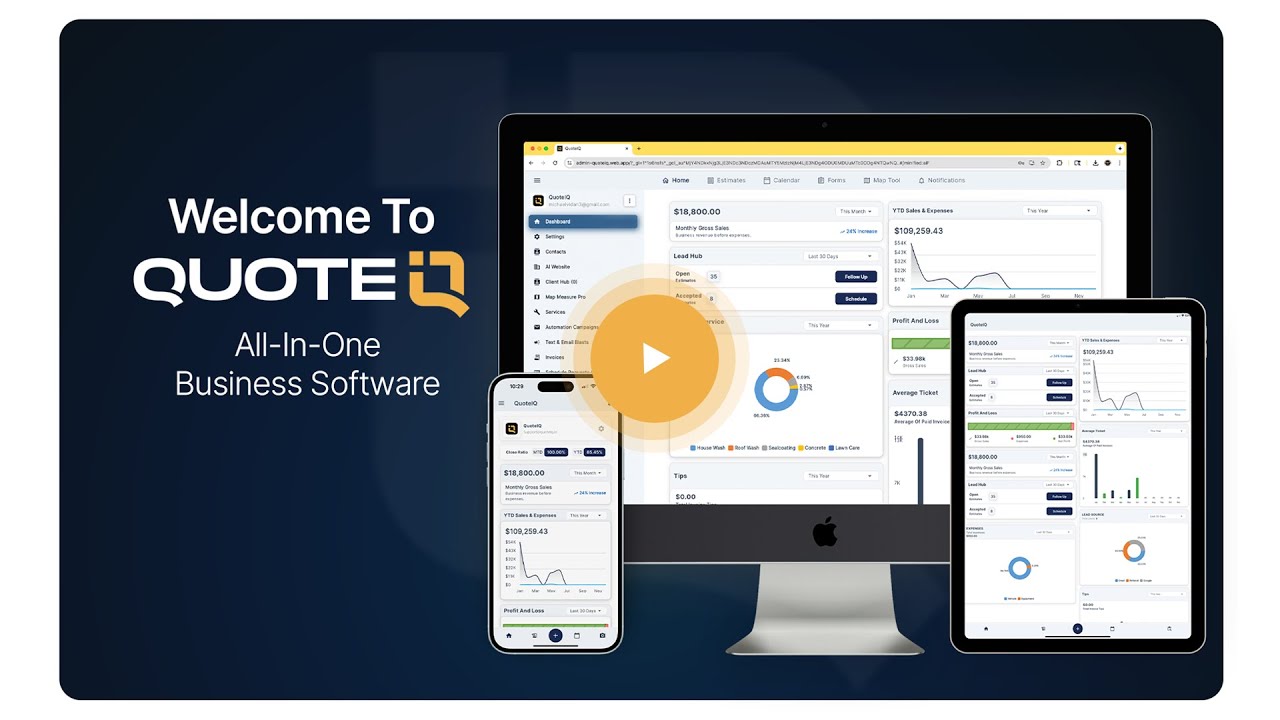
Watch the QuoteIQ Product Walkthrough
See how the Virtual Call Team, mobile scheduling and the full CRM fit together for tree service crews.
Get Started With QuoteIQ’s Virtual Call Team in 4 Steps
Setup takes an afternoon, not a project. Follow these four steps, then compare your first week of summaries to the baseline from your missed-call audit. Details live on the Virtual Call Team page and the ClientHub page.
Create your account and choose the plan you want to test. The trial gives you full access to that plan’s features. A credit or debit card is required to start.
Add your services, service area, hours, emergency rules, safety language and how estimates work, and choose the agent’s voice and personality in the Virtual Call Team settings.
On the Pro plan and above, set ClientHub call routing so evenings, weekends and overflow go to the Virtual Call Team and daytime calls ring your office.
Call at 9pm with a mock storm call, read the transcript and summary, and confirm the estimate visit on your calendar each morning.
Reviewed By
Mike co-founded QuoteIQ in Savannah, Georgia, to build field service software that home service operators actually want to use. He reviewed this guide’s QuoteIQ details. Read more on his insights page.
Justin co-founded QuoteIQ with Mike and works with operators across the home service industry. Read more on his insights page.
What Operators Say About QuoteIQ
“Amazing UI and easy to use! I use this for my landscaping company and it makes it very easy to track projects and payments for projects. The built in picture protection is also fantastic. I would highly recommend this to anyone who is thinking about it!”
— Camden Nagg, Google Play review · 5 stars
“I have a lawncare business, was unorganized, but QuoteIQ changed everything. Estimates, scheduling, billing and invoicing are seamless. Tax prep easier. Best CRM by functionality and price.”
— Elke Staton, App Store review · 5 stars
“I recently started up a roof and gutter cleaning business and this app has everything in one place. I can send estimates over the phone without even going to the house. It saves me time, and time is money.”
— Hayden Hoppe, Google Play review · 5 stars