



Published March 2026 · Updated September 2026
QuoteIQ gives moving companies tiered move pricing, satellite pre-move surveys, packing-supply and truck inventory, per-move job costing, storage and specialty upsells, realtor and corporate relocation pipelines, and an AI suite that runs from the truck cab — starting at $29.99 per month.
QuoteIQ is the best CRM for moving companies in 2026 because it combines the four things a mover actually sells against — tiered estimates, accurate pre-move measurement, supply and crew control, and per-move profit visibility — inside one platform that starts at $29.99 per month and tops out at $699 per month for unlimited users. Local movers, long-distance carriers, office and commercial movers, senior-transition specialists and labor-only crews use Options Estimates to price basic, full-service and white-glove tiers on one document, MapMeasure Pro to size a home from satellite before the survey, Job Costing to see margin on every move, and Pipelines & Deals to run realtor and corporate relocation referral channels. More than 40,000 contractors run QuoteIQ, rated 4.7 stars across 4,103 reviews.
TL;DR: Moving companies lose money in three predictable places — estimates built from guesswork, supplies that vanish between the warehouse and the truck, and moves that close without anyone knowing the margin. QuoteIQ closes all three. Options and Package Estimates put labor-only, full-service and white-glove side by side; MapMeasure Pro measures the property from aerial imagery before you knock; QuoteIQ Cam documents condition in 4K so damage claims die on arrival; Inventory Management tracks blankets, cartons and dollies across warehouse and trucks; Job Costing reports profit per move; and Virtual Call Team answers the 9 PM relocation call. Plans run $29.99 to $699 per month. With roughly one in nine Americans changing residence each year and interstate movers regulated under FMCSA household goods rules, the paperwork and the pipeline both have to be airtight.
A moving company is not a service business with one price and one visit. It is a logistics business that sells labor, materials, equipment, transport and risk in a single transaction, and then has to deliver all five on a date the customer cannot move. The estimate has to hold up when the crew discovers a finished basement full of boxes. The supplies have to be on the truck at 6:45 AM, not discovered missing at 9:15 AM in a customer’s kitchen. The condition of a hardwood floor has to be documented before a piano board touches it. And the profit has to be knowable before the season ends, not after the accountant closes the year.
Generic field service software was written for one-technician, one-visit trades. It assumes a job has a single arrival, a single line item and a single crew member. Moving work breaks all three assumptions on the first pack day. That is why so many movers end up running a spreadsheet for cubic-foot estimates, a second app for photos, a third for storage billing, and a phone number that goes to voicemail during the exact hours relocating homeowners make calls. QuoteIQ was built by contractors to collapse that stack into one system, and its feature set maps cleanly onto how moves actually run.
According to Census Bureau migration data, 8.9% of Americans moved to a different residence within the same state in 2024 and another 2.1% moved to a different state — roughly one in nine households in play every single year. That is a renewable market, but it is also a market where the customer books whichever mover answers, quotes and reassures first.
Speed of response is the whole ballgame in moving. A homeowner who just accepted a job offer in another state is calling three movers in an afternoon, and the one that sends a clear, itemized, professional-looking estimate the same day becomes the anchor every other bid gets compared to. That is why QuoteIQ pairs AI Estimator and satellite measurement with a 24/7 AI phone team and e-signatures: capture the lead, size the job, price the tiers, and get a signature before the competition returns the voicemail.
The second half of the problem is the one nobody sees from the outside — the cost side. A four-bedroom full-service pack consumes wardrobe cartons, dish packs, paper, stretch wrap, tape, floor runners and blankets, plus four crew members for ten or eleven hours, plus fuel, insurance and truck depreciation. Movers who track those inputs job by job in Job Costing and Expense Tracking find out that two moves priced identically can differ by twenty margin points. Movers who do not track them price the next season off a feeling. The free business calculators and the contractor invoice template are a reasonable place to start if you are still on paper, but the point of a CRM is that the numbers accumulate on their own.
Everything below is organized the way a moving company actually thinks: the features that matter for moves, one full day inside the software, how QuoteIQ compares to the other platforms movers evaluate, how to run crews and permissions, how to build referral revenue that does not depend on paid leads, what it costs, and eight questions movers ask before they switch. If you would rather see it live, book a demo; if you would rather poke at it yourself, the 14-day trial gives you the features of whichever plan you pick.
Every CRM claims to work for contractors. What separates a platform that fits moving work from one that merely tolerates it is whether it can price a tier, size a home, count a carton and report a margin. Here are the twelve capabilities movers lean on hardest, with the plan each one unlocks on so you can size your subscription honestly rather than discovering a gate after you have migrated your customer list.
Present labor-only, full-service and white-glove on one document instead of three separate quotes. A three-bedroom local move might read as an hourly labor-only crew, a flat-rate full-service pack with materials and reassembly, or a white-glove tier that adds custom crating for artwork, antiques and instruments. Customers choose a service level rather than choosing between you and the next mover on price alone. Options Estimates run on every plan, alongside Standard, Quick and Package formats, with line-item hiding, markup controls and one-tap conversion to invoice.
MapMeasure Pro measures the property from aerial imagery inside estimate creation — home footprint, driveway length and width for truck positioning, detached garages and outbuildings, and the distance from the parking position to the front door that decides whether you are quoting a long carry. As of the August 2026 release it also scrolls back through years of historical aerial imagery, which settles arguments about what was on the property when. Companions Property Street View and Zillow Quick Access show stairs, grade and interior square footage before you leave the office.
Inventory Management runs five modules — Products, Locations, Suppliers, Orders and Transactions — which is exactly the shape of a moving supply operation. Blankets, wardrobe cartons, dish packs, mattress bags, stretch wrap, paper, tape, runners, jamb protectors, dollies, piano boards and crating stock each carry a SKU, unit cost, reorder point and In Stock / Low / Out indicator, held per location so a warehouse shelf and Truck 2 are separate counts. Materials on estimates link to products so pricing stays current; stock deducts when the invoice is paid, and a deposit alone does not move stock.
The Report tab on every job runs Total Price minus Labor minus Expenses equals Profit, with a margin bar you can read at a glance. Labor pulls automatically from time tracking at each employee’s hourly rate against clocked hours, so an eleven-hour pack-and-load with a four-person crew costs what it actually cost rather than what you assumed. Materials and fuel link through Expense Tracking. Two moves that both invoiced at the same number routinely land twenty points apart on margin, and Job Costing is where that shows up while you can still fix next month’s pricing.
Package Estimates bundle the move with professional packing, fragile-only packing, months of storage, piano and safe handling, appliance disconnect and reconnect, and debris removal into one relocation package with one number. The crew is already staged and the truck is already backed in, so incremental scope carries far less mobilization cost than a second trip. Pair it with Consumer Financing — Affirm covers up to $30,000 per job over 3 to 36 months, with Klarna and Afterpay for smaller balances — and the white-glove tier stops being a budget conversation.
Moving customers are stressed, and stress makes people buy the cheap tier and regret it. Before & After AI generates a realistic “after” image from the actual photo of their cluttered living room — furniture blanket-wrapped, cartons stacked and labeled by room — in about fifteen to twenty seconds, and it attaches to any estimate type or invoice. It is the single fastest way to make a full-service pack feel like relief instead of an upcharge. Regeneration draws credits again, and every AI action previews its credit cost before it runs.
A move is not one appointment. It is a survey, a pack day, a load day, transit days, a delivery and a walkthrough, and Scheduling renders multi-day work as continuous events on day, week, month and employee-timeline views. Drag one occurrence of a recurring series without disturbing the rest, use Schedule Later for a signed move with no confirmed closing date, filter the calendar by employee or crew, and read status from color coding. Automated appointment reminders go out by SMS and email, and Google Calendar sync keeps a two-way copy.
QuoteIQ Cam captures the pre-move condition of floors, jambs, stair walls and furniture, the packed and wrapped state, the loaded truck, and the placed delivery — organized by job and date with unlimited 4K photo and video storage, annotations and customer-facing galleries. Inspection Forms turn that into a signed walkthrough document with customizable PDF sections. In an industry where claims are settled on evidence, a timestamped archive on the customer record is the cheapest insurance you will ever buy.
Household goods work is paperwork-heavy for good reason. Contract Attachments bind valuation coverage elections, liability waivers, inventory checklists, storage agreements and tariff sheets to the estimate itself, and E-Signatures let the customer sign from a phone. Editing an estimate after it has gone out automatically voids the outstanding signature request, which prevents the classic dispute where a customer signs version one and the crew works from version three. Expiration dates on estimates and invoices arrived in the August 2026 release.
AI Autopilot is conversational control of the whole CRM by voice or text — 55 integrated tools across 13 categories, reachable in-app as “Ask AI.” Real commands look like move all of today’s jobs to Friday and text every customer or invoice all of today’s completed jobs and send them, which is precisely the kind of thing a dispatcher does badly on a phone while standing in a driveway. AI CoPilot edits inside a document — add services, adjust tax, set a deposit — and AI Text Generator writes the customer message.
Relocation calls come in at 9 PM on a Thursday. Virtual Call Team answers inbound around the clock, qualifies the lead against a knowledge base you write, filters spam, records and transcribes every call, and pushes a summary to you — and it runs outbound and simultaneous campaigns too. Two honest notes: it answers, qualifies and records, but it does not book the appointment for you, and it is metered at 125 IQ Credits per minute, so call volume is limited by your plan’s credit allowance rather than unlimited.
Pipelines & Deals — named “Deals” in the app — gives you Kanban and list views with close-probability stages, so realtor referrals, corporate HR relocation contracts, property management turnovers, senior-living transitions and direct residential leads each run as their own board. Weighted value multiplies amount by probability for a forecast you can staff against, and six-metric analytics track total, weighted, open, closed-won, new and average deal age. Elite runs up to five pipelines; Max is unlimited.
Hand laborers and material movers held about 7.0 million jobs in 2024, with employment projected to grow 4% through 2034, according to the BLS Occupational Outlook Handbook — which also notes this group carries some of the highest injury and illness rates of any occupation. Crew hours are your largest cost and your largest liability at the same time, which is the argument for tracking both in Time Tracker Pro rather than on a clipboard.
Features read as a list. Work happens as a sequence. Here is a composite day at a two-crew residential moving company — the figures are illustrative examples of how a mover might price and cost this work in their own market, not published rates — showing where each part of the platform actually lands between 6:15 AM and Friday close.
The day opens on the calendar: Crew A on a four-bedroom full-service pack and load, Crew B on a two-bedroom apartment move across town. Because the August 2026 release added multiple contacts on a job, the destination contact and the listing agent both sit on the record, so on-the-way texts and automations fan out to everyone who needs them instead of only the person who signed. Inventory confirms Truck 1 carries sixty A-grade blankets, fourteen wardrobe cartons, fifty mediums, twenty-five dish packs, four rolls of stretch wrap, forty pounds of paper, runners, jamb protectors and the piano board, with Truck 2 loaded lighter for the apartment. Crews clock in through Time Tracker Pro, and GPS location tracking puts both trucks on a live map — a map that shows clocked-in staff only, and drops them the moment they clock out.
The first thing that happens at the origin is not packing. It is documentation. QuoteIQ Cam captures hardwood, jambs, stair walls and the existing condition of every piece the crew will touch, and an inspection form turns it into a PDF the customer initials. Then the kitchen goes into dish packs labeled by cabinet section, the china cabinet gets bubble wrap and a built crate, wardrobes go into the master and guest closets, and stretch wrap locks drawers and protects upholstery. Materials consumed get logged against the job through Expense Tracking as they are used — fourteen wardrobes, forty-eight mediums, twenty-two dish packs, three rolls of wrap, thirty-five pounds of paper, one custom crate — which is the difference between knowing your material cost and estimating it in March from a receipt pile.
While Crew A loads, the owner drives to a survey at a large colonial with a home office, a wine collection and a baby grand. The property was already sized in MapMeasure Pro and checked in Property Street View, so the truck-access question — long driveway fine for a 26-footer, tractor-trailer needs street parking with a shuttle — is answered before the doorbell. The walkthrough is spent counting fragile and special-handling pieces, not measuring rooms. An Options Estimate goes out on the spot with three tiers, a Before & After AI preview attached, and the valuation election, inventory checklist and service agreement bound to the document. The customer signs the white-glove tier by e-signature and pays a deposit through online payments — card, ACH, Apple Pay or Google Pay, with cash and check recorded in-app. The deal moves a stage in Deals.
Halfway through the walkthrough the real scope surfaces: the customer is downsizing, three antique dressers need crating, the wine needs climate-controlled transport, and roughly a room’s worth of furniture has nowhere to go on day one. That is a Package Estimate — months of climate-controlled storage, custom crating, appliance disconnect and reconnect, and debris removal, presented as one relocation-and-storage package rather than five awkward add-ons. If the number stretches the budget, Consumer Financing puts Affirm, Klarna and Afterpay at checkout with an instant decision and pays you in full up front. Job Costing recalculates the moment it is signed, so nobody discovers in October that storage was sold below the wholesale unit rate.
With the pack-and-load closed out, the numbers land on their own. Labor pulls from clocked hours at each crew member’s rate, materials come from the expenses logged during the day, and fuel, insurance allocation and truck depreciation sit against the job as line items. The Report tab prints price, cost and margin percentage for that specific move, and the same view is available for the apartment job Crew B ran. Business analytics roll it up by service, customer, employee and crew, split outstanding from collected, and report quotes sent, conversion rate and average ticket. This is the layer that changes pricing behavior: after one season of per-move margin data, most movers discover their labor-only tier is the least profitable thing they sell.
Delivery day ends with furniture placed, beds rebuilt, electronics reconnected, cartons removed and debris hauled. Final photos go into Cam, the Before & After Photo Editor builds the side-by-side that sells the next twenty moves, and the final invoice goes out with the balance due. Review Multiplier handles the ask two ways — an instant post-payment redirect to your review page, plus an email and SMS review-request automation with four event triggers — and the five-star review that mentions protected floors and zero damage is the one realtors read. Then the week’s real win: a regional employer wants a single mover assigned to every employee relocation. That becomes its own pipeline with weighted forecasting attached.
OSHA’s materials-handling hazards and solutions guidance centers on the same three exposures a moving crew faces daily: manual lifting and musculoskeletal injury, equipment and dolly handling, and clearance at loading points. Time and location data captured through EmployeeHub — clock-in verification, break duration, per-job hours with full edit history — is the record you want when an injury claim or a wage dispute arrives eighteen months later.
QuoteIQ’s AI runs on IQ Credits included monthly with every plan — 500 on Essentials, 1,500 on Beginner, 3,000 on Pro, 5,000 on Elite and 8,000 on Max, reset each billing cycle. A Virtual Call Team minute draws 125 credits, an AI AutoMeasure draws 100, a property or parcel lookup draws 50, and a Proposal send draws 100 — free on trial, Elite and Max. Every AI action shows its credit cost and asks for confirmation before it runs, so there are no surprise draws. Credits carry no cash value and are not refundable once consumed.
Movers usually shortlist QuoteIQ against Jobber, Housecall Pro and ServiceTitan. We deliberately do not publish other vendors’ prices, seat counts or feature gaps on this page: those change constantly, and a stale number in either direction is worse than no number. Check each vendor’s own pricing page on the day you evaluate and price the full stack you would actually need — base subscription, per-user charges, add-on modules, payment processing and any separate photo, phone or marketing tools. Below is the QuoteIQ side, stated plainly with the plan each capability unlocks on, so you have a fixed column to compare against.
| What a moving company needs | How QuoteIQ delivers it | Plan |
|---|---|---|
| Tiered move pricing on one document | Options Estimates plus Package Estimates | All plans |
| Pre-move measurement from satellite | MapMeasure Pro, Street View, Zillow access | Beginner+ |
| 4K condition documentation and inspections | QuoteIQ Cam with Inspection Forms | Beginner+ |
| Packing supply and truck inventory | Inventory Management, five modules | Elite+ |
| Per-move profit reporting | Job Costing with Expense Tracking | Pro+ (expenses Beginner+) |
| Dedicated business line for move coordination | ClientHub two-way calling and texting | Pro+ |
| Customer self-service during the move | Client Portal with estimates, invoices and requests | Pro+ |
| Realtor and corporate referral pipelines | Pipelines & Deals, weighted forecasting | Elite+ (5 pipelines; Max unlimited) |
| Customer self-quoting and self-booking | InstaQuote and InstaSchedule | Elite+ |
| Crew routing across a metro | Route Optimization and Route Density | Elite+ |
| Conversational AI control of the CRM | AI Autopilot — 55 tools, 13 categories | All plans (IQ Credits) |
| 24/7 inbound answering and qualification | Virtual Call Team, metered per minute | All plans (IQ Credits) |
| Accounting sync | QuickBooks Online (Online only — Desktop is not supported) | Pro+ |
| Entry price · recommended plan · top plan | $29.99 · $149.99 Pro · $699 Max, all users included at each tier | See pricing |
Two structural differences matter more than any feature checkbox when you compare. First, QuoteIQ prices by plan rather than by seat, so adding a fourth mover to a Pro plan or a twentieth to Max does not change the invoice. Second, capabilities that other platforms sell as separate modules — photo documentation, a business phone line, AI answering, review generation, pipelines, an AI website builder on Max — are inside the subscription. When you build your comparison spreadsheet, price the whole stack on both sides. The enterprise pricing calculator and the full comparison hub are useful scaffolding, and the features directory lists what each tool actually does.
Migration is the real friction, not the monthly price. AI Smart Import takes a CSV out of any CRM and maps the columns automatically, and phone contacts import directly. Rebuilt CSV and AI imports with reviewable column mapping, previews and duplicate flagging shipped server-side in the August 2026 release and surface in the app in a coming release. You also keep your data: export is available on every plan, and QuoteIQ never stores card numbers — those stay with the processor.
Moving is a crew business, and crew businesses fail on coordination long before they fail on sales. A typical growing operation ends up with a white-glove crew handling full packs, crating, pianos and antiques, a volume crew handling apartments, labor-only jobs and office turnovers, and a sales coordinator running surveys and quotes. Each of those roles needs a different slice of the system, and none of them should see your margins.
EmployeeHub is where that lives from Elite up. It carries the employee database with hourly rates and availability, Time Tracker Pro for GPS clock in and out with per-job hours, break counts and durations in reports and CSV, admin-only manual adjustments and a full edit history, live location tracking that pauses on breaks and stops at clock-out, and Team Communication for one-on-one and group chats with job assignment attached. Roles and permissions got a full overhaul in August 2026 with clearer gates and calendar permissions properly separated, so a coordinator can build estimates and manage the pipeline while never seeing job costs.
Two clarifications worth having before you shop. QuoteIQ assigns work to people from Pro and to crews on Max — crew creation, crew scheduling and crew-level analytics are Max features, as is the Sales Team Tracker with commission percentages per rep. And on payroll: QuoteIQ has no native payroll and no automatic overtime calculation. Hours export cleanly to whatever payroll system you already run, which is the honest answer and the one that avoids an unpleasant discovery in week two. The IRS small business and self-employed center and the SBA’s guide to managing a business cover the employment-tax and recordkeeping side that no CRM should be pretending to handle for you.
Movers who run a moving brand and a junk-removal or storage brand under one roof can hold them as separate businesses. Max includes four additional businesses and unlimited users, and multiple companies under one Max plan share a single pool of IQ Credits with auto-recharge running on the parent account. Multi-business and unlimited users are the two features that decide whether a second location costs you a second subscription.
Paid leads are a rented audience. The moving companies that survive slow winters have four channels that keep producing after the ad spend stops, and all four are pipeline problems before they are marketing problems.
The highest-margin revenue in moving is scope added to a move already scheduled, because mobilization is already paid for. Professional packing by the room, fragile-only packing for china and art, months of storage during a closing gap, piano and safe handling, appliance disconnect and reconnect, and debris removal are all natural additions at the survey. Package Estimates present them as one relocation package rather than a menu of upcharges, visual previews make the value obvious, and financing removes the budget objection. Track the attach rate in analytics and you will know within a season which coordinators are actually pitching it.
Every closing is a move, and the agent is standing next to it. The mechanics are unglamorous: a named list of agents, a stage for each relationship, a follow-up cadence that does not depend on remembering, and a service level that gives the agent a story to tell. Pipelines holds the relationships with weighted forecasting, Email & Text Automations run multi-step sequences with personalization tags — and can be built by describing them in plain language — and reminders and tasks keep the quarterly touch from slipping. Referred customers arrive pre-sold and close faster, which shows up in your average sales cycle before it shows up in revenue.
Employers relocating staff, property managers turning units, and senior-living communities moving residents all want one mover on speed dial with predictable pricing and clean documentation. These sell on responsiveness and paperwork, not on being cheapest. Run them as their own pipeline, answer inbound with the Virtual Call Team when you are on a truck, capture inquiries with website contact forms, and give the account a Client Portal so their coordinator can see estimates, invoices and appointments without emailing you. Interstate work has its own compliance layer — the FMCSA household goods regulations govern estimates, documents and claims handling for interstate household moves, and corporate buyers do check.
A clean delivery is marketing you already paid for. Review Multiplier asks at the moment of maximum goodwill through an instant post-payment redirect and an email and SMS request automation with four event triggers, pointed at Google Business Profile, Facebook, Yelp or Angi. Before and after images from the job become the social proof. InstaQuote and InstaSchedule convert that attention at 11 PM without you, and Google Reserve takes bookings straight from Search and Maps. For seasonal reactivation, mass text and email campaigns segment by tag on Elite and above — note that you connect your own Twilio and SendGrid gateways for those, including A2P 10DLC registration, and carrier fees are yours.
The strongest argument for QuoteIQ is not any single feature — it is that the moving company stops paying for a measurement tool, a photo app, a second phone line, a review service, a proposal tool and a pipeline tracker separately. Everything below is inside the subscription at the plan noted earlier in this guide.
Pricing is per plan, not per seat, and every plan carries a monthly allowance of IQ Credits for AI features. Annual billing multiplies the monthly rate by ten, which is two months free. Most single-truck operations start on Beginner for measurement and documentation, most two-crew companies land on Pro, and companies running supply inventory, self-booking, routing and EmployeeHub move to Elite.
A moving company running two crews and a coordinator typically sits on Pro at $149.99 per month for four users, then moves to Elite at $299 for ten users when supply inventory and customer self-booking start paying for themselves. Max at $699 covers unlimited seats, which matters during peak season when you carry temporary help. Add-ons are short: the AI Website Builder is $34.99 per month and is included on Max, additional businesses are a paid add-on with four included on Max, and Done-For-You setup — contact import, price book build and a one-on-one onboarding session — comes in two tiers at $299.99 and $999.99.
Every plan includes a 14-day free trial with full access to the features of the plan you choose — not a generic feature sample, and not a higher tier than the one you selected. One trial per person, per business, per payment method. It converts to paid at the selected plan’s rate unless you cancel before it expires, and you can cancel at any point during the trial. Start a trial or book a walkthrough if you would rather be shown the moving workflow first.
Most movers are quoting from the app the same week. The order below front-loads the two things that pay off immediately — your price book and your measurement workflow — and leaves reporting for after real jobs have run through the system.
Create the account at the registration page and pick the plan whose user count and features fit how you actually operate — the trial gives you that plan’s features for 14 days. One truck and an owner-operator generally means Beginner; two crews and a coordinator means Pro; supply inventory and self-booking mean Elite. Set your company profile, logo, license number and document branding first so every estimate that leaves during the trial looks finished. Estimated time: about fifteen minutes.
Bring your customer list across with AI Smart Import from a CSV or your phone contacts, then build the price book the way you sell: hourly crew rates by crew size, flat-rate tiers by bedroom count, packing by room, fragile packing by carton, storage by unit size and month, and specialty handling for pianos, safes, hot tubs and appliances. Load your materials — wardrobes, mediums, dish packs, mattress bags, wrap, paper, tape — as line items now so they are one tap on every future estimate. Estimated time: one to two hours.
Take the next lead through the real workflow: measure the property in MapMeasure Pro before the survey, build an Options Estimate with labor-only, full-service and white-glove tiers, attach the valuation election and service agreement, add a Before & After preview, and send it for e-signature with a deposit request. Save the result as an estimate template so the second one takes four minutes. Estimated time: thirty minutes for the first, minutes thereafter.
Before the first crew rolls, set the standard that every job opens with condition photos in QuoteIQ Cam and closes with delivery photos. Have crews clock in through Time Tracker Pro so labor flows into Job Costing automatically, log materials as they are consumed, and switch on Review Multiplier so the ask happens at payment instead of never. After ten completed moves, open analytics and reprice whatever tier is underperforming. Estimated time: twenty minutes to configure.
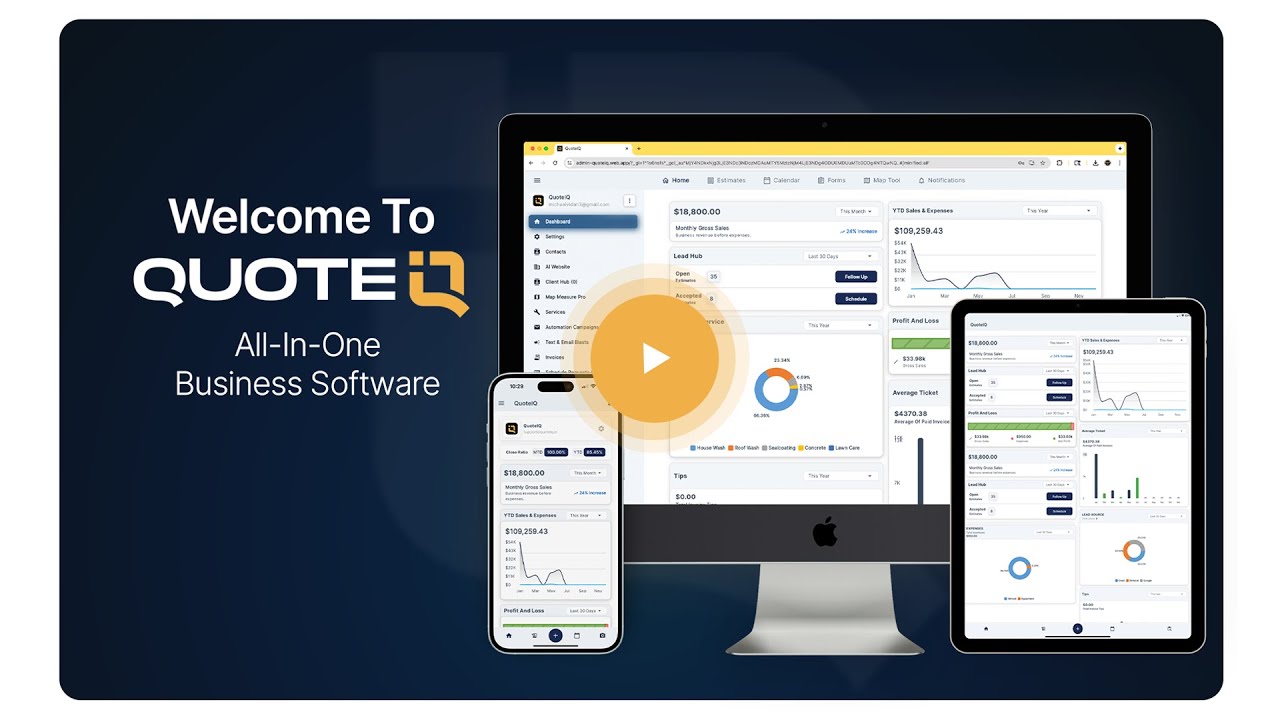
A short walkthrough of estimates, scheduling, payments and the AI tools — the same workflow a moving company runs, with the trade swapped out.
Watch Video →QuoteIQ LLC was founded on September 21, 2022 in Savannah, Georgia by Mike Vidan, Co-Founder, and Justin Rogers, Co-Founder — both home service operators before they were software founders, which is why the plan matrix reads like an operations manual rather than a feature grid. More than 40,000 contractors now run the platform, rated 4.7 stars across 4,103 reviews.
“Same day. Not tomorrow morning — same day. Whoever sends a clear, specific estimate first is the one the customer starts comparing everyone else to. That’s a psychological anchor, and it’s real.”
— Mike Vidan, Co-Founder, QuoteIQ · Full insights →“Around $75,000 to $100,000 in annual revenue is where the invisible cost of manual management typically starts exceeding what software would cost. The most expensive thing in manual management isn’t the time spent on the tasks — it’s the revenue lost to the things that don’t get done.”
— Justin Rogers, Co-Founder, QuoteIQ · Full insights →“I was nervous switching systems, but QuoteIQ made the move seamless. Everything from customer details to quote follow-ups is now automated and stress-free.”
“I have been using quoteiq for a year and a half now and I can’t express enough how easy/User friendly it is to use. I have tried a couple other crm’s and though they also had a lot of features they were hard to navigate and had a poor layout. I get tons of compliments from customers on how professional my quotes look and how easy it is to make payments. Also the cost of quoteiq is second to none, by far most affordable. I highly recommend!!”
“First of all this app saves me so much time,the new updates they do are impactful. I’ve used it for pressure washing, I’ve used it for even doing concrete estimating. The ability to send invoices directly and charge from the app is a win win! I like how it incorporates the ability to keep your customers like a CRM program and it helps me check up on those customers that called, I can call back pretty fast make a note on their file. I also like how everyone can access it from my Crew. App is #1”
QuoteIQ is the best CRM for moving companies in 2026 because it covers the full move lifecycle in one subscription rather than three. Pricing starts at $29.99 per month and runs to $699 for unlimited users, and more than 40,000 contractors use it at a 4.7-star rating across 4,103 reviews. For movers specifically, the load-bearing pieces are Options Estimates for labor-only, full-service and white-glove tiers on one document, MapMeasure Pro for satellite pre-move sizing, QuoteIQ Cam for 4K condition documentation that ends damage disputes, Job Costing for per-move margin, and Pipelines & Deals for realtor and corporate relocation channels. It matters in a market this large: Census migration data shows roughly one in nine Americans changed residence in 2024, and the mover who quotes accurately and fastest wins that household.
QuoteIQ costs $29.99 per month for Essentials with one user, $74.99 for Beginner with two, $149.99 for Pro with four, $299 for Elite with ten, and $699 for Max with unlimited users. Annual billing is the monthly rate times ten, so two months are free. Pricing is per plan rather than per seat, which is the number that usually decides the comparison for a crew business: adding movers does not change the invoice. Add-ons are limited to the AI Website Builder at $34.99 per month (included on Max), additional businesses, and optional Done-For-You setup at $299.99 or $999.99. Other vendors reprice frequently, so check each one’s own pricing page the day you evaluate and total the full stack — base fee, seats, modules and processing. The SBA’s guidance on managing business finances is a reasonable framework for that comparison.
Movers price tiers by service level, not by discount. A single Options Estimate shows three columns — labor-only where the customer packs, full-service where you pack and provide materials, and white-glove that adds custom crating, disassembly and reassembly, electronics setup and debris haul-away — and the customer chooses a level of care instead of hunting for a cheaper bid. Package Estimates then bundle the move with packing, storage months and specialty handling into one relocation package. Photos, notes, terms, deposit requirements, markup controls and line-item price hiding are all built into the estimate, and it converts to an invoice in one tap or to a recurring storage subscription when the customer stores with you. If you are still building your rate card, the business calculators include a national average pricing reference. For interstate work, estimate format and disclosure obligations are governed by FMCSA household goods regulations.
Yes. MapMeasure Pro, included from the Beginner plan up, measures the property from aerial imagery inside estimate creation — home footprint, driveway length and width for truck positioning, detached garages and outbuildings, and carry distance from the likely parking position to the door. Measurements save to the customer profile and export into the quote, and screenshots attach to the estimate as visual proof of measured scope. The August 2026 release added a historical imagery timeline, so you can scroll back through years of aerial photos of the same address. Property Street View and Zillow Quick Access fill in stairs, grade and interior square footage. Roof and pitch capability lives inside the same tool, and AI Estimator can turn property photos into market-accurate line-item pricing alongside it. The practical effect is that the survey stops being a measuring exercise and becomes a scope-and-close conversation, and quotes go out the same day — which, per Census mobility patterns, is when relocating households are actively comparing movers.
Inventory Management, available from the Elite plan, runs five modules that map directly onto a supply operation: Products with SKU, unit cost and reorder point, Locations so the warehouse and each truck hold separate counts, Suppliers, Orders that move Draft to Confirmed to Received, and Transactions that log every receipt, issue, return, damage, loss and adjustment. Blankets, wardrobe cartons, dish packs, mattress bags, stretch wrap, paper, tape, runners, dollies, piano boards and crating stock each carry In Stock, Low or Out indicators with cost, customer price and margin visible in the list. Materials on estimates link to products so pricing stays current, and Expense Tracking ties consumption to the job for costing. Inventory value, usage and category views roll into Business Analytics. One mechanic to know: stock deducts when the invoice is paid, and a deposit does not count as paid. Handling equipment safety guidance is at OSHA.
Per-move profit is Total Price minus Labor minus Expenses, and Job Costing on the Pro plan and above runs that calculation on a Report tab attached to each job, with a profit-margin bar. Labor pulls automatically from Time Tracker Pro — hourly rate times clocked hours, including break durations — so an eleven-hour four-person pack costs what it actually cost. Materials, fuel and subcontracted services link through Expense Tracking with receipts attached. Roll it up in Business Analytics by service, customer, employee or crew to see which tiers and which move types actually pay. Most movers discover their hourly labor-only tier trails their flat-rate full-service tier by a wide margin once truck cost is allocated honestly. Keep the underlying records clean too — the IRS recordkeeping guidance for small businesses is the standard your expense trail should meet.
Yes. Every plan includes a 14-day free trial with full access to the features of the plan you choose — so a trial started on Elite includes inventory, self-booking and EmployeeHub, while a trial started on Beginner includes measurement and documentation. A credit or debit card is required to start. There is one trial per person, per business and per payment method, it converts to paid at the selected plan’s rate unless you cancel before it expires, and you can cancel at any point during the trial. Nothing is locked behind a sales call, and the trial is the same product paying customers use rather than a stripped demo environment. Two weeks is enough to run real moves through it: import your customers with AI Smart Import, build the price book, send tiered estimates, and document a job in Cam. Start the trial, or book a walkthrough and have the moving workflow shown to you first. Business setup basics are covered by the SBA business guide.
Referral revenue is a pipeline discipline, not a personality trait. Run realtors, corporate HR contacts, property managers and senior-living communities as separate boards in Pipelines & Deals with close-probability stages and weighted forecasting — Elite supports up to five pipelines and Max is unlimited. Keep contact cadence automatic with Email & Text Automations and reminders and tasks, capture inbound with website contact forms and the Virtual Call Team when you are on a truck, and give corporate accounts a Client Portal so their coordinator sees estimates, invoices and appointments without emailing you. Close the loop after every completed relocation with Review Multiplier, because the review that mentions protected floors and an on-time delivery is the one an agent forwards to their next seller. Corporate buyers verify carriers, so keep your registration and complaint record clean — both are public through FMCSA’s Protect Your Move database.
Tiered move pricing, satellite pre-move surveys, 4K condition documentation, supply and truck inventory, per-move job costing, storage and specialty upsells, and realtor and corporate pipelines — starting at $29.99 per month with a 14-day free trial on the plan you choose.

Tell Google that QuoteIQ is a source you trust. One tap unlocks up to 40% off your annual plan. No free trial — billed in full at checkout.


