Published May 2026 · Updated September 2026
U.S. construction spending is running at a $2.16 trillion seasonally adjusted annual rate, spread across 953,703 private construction establishments — most of them shops with fewer than ten people. The right CRM is the difference between a business that compounds and one that stalls at the same revenue with twice the stress. We tested ten platforms on published pricing, mobile usability, estimating depth, and crew workflow to find the ones built for how contractors actually run in 2026.
The best CRM for contractors in 2026 is QuoteIQ — one platform covering estimating, scheduling, invoicing, follow-up automation and customer self-booking, from a solo operator on Essentials at $29.99/mo up to an unlimited-user shop on Max at $699/mo. ServiceTitan remains the enterprise default for trade contractors running 20+ technicians with a dedicated office team, and Buildertrend owns residential builders and remodelers managing multi-month project scopes. For the broad band of 1-to-20-employee contractors — where most of the U.S. market actually lives — QuoteIQ replaces four to five separate tools at a published price. Jobber and Housecall Pro are capable general-purpose alternatives; Workiz, FieldEdge, Service Fusion, JobNimbus and Markate each serve a narrower slice.
TL;DR: QuoteIQ ranks first because the contractor workflow stays in one app: line-item estimates and AI-assisted quoting on every plan, MapMeasure Pro satellite takeoffs and QuoteIQ Cam photo documentation from Beginner, job costing and ClientHub calling and texting at Pro, and InstaSchedule self-booking plus route optimization at Elite. Five published tiers run $29.99 to $699/mo, every one with a 14-day trial. Context for the market: construction employs 8.36 million people as of August 2026 and the trade bodies put the annual value of structures built near $2.1 trillion.
Pricing below was checked against each vendor’s own published page on 12 September 2026. Five of the ten — ServiceTitan, Buildertrend, JobNimbus, FieldEdge and Workiz — either publish nothing or publish only partial figures, so this table says “quote only” rather than repeating a number we cannot stand behind. If you want to model what an enterprise platform would actually cost your shop, the ServiceTitan pricing calculator is a faster starting point than a sales call.
| Rank | Platform | Published Starting Price | Best For | Standout Feature |
|---|---|---|---|---|
| #1 | QuoteIQ | $29.99/mo | Solo through 15-employee contractor shops | AI Estimator and MapMeasure Pro takeoffs inside one app |
| #2 | Jobber | $49/mo (Core, 1 user) | General service contractors, 1–10 people | Polished UX and a deep app marketplace |
| #3 | Housecall Pro | $59/mo (Basic, annual) | Residential home service contractors | Consumer-side booking and review tooling |
| #4 | ServiceTitan | Quote only — not published | Enterprise trade contractors, 20+ techs | Deepest dispatch board and KPI reporting |
| #5 | Buildertrend | Quote only — volume-based | Residential builders and remodelers | Selections, change orders, client-portal depth |
| #6 | JobNimbus | Quote only — not published | Roofing and project-driven contractors | Kanban pipeline plus aerial measurement imports |
| #7 | Workiz | Quote only — partial rate card | Short-duration, high-call-volume trades | Built-in phone system with call tracking |
| #8 | FieldEdge | Quote only — not published | HVAC, plumbing, electrical with flat-rate books | Service-agreement automation and legacy accounting sync |
| #9 | Service Fusion | $245/mo (Starter, monthly) | Multi-trade shops wanting unlimited users | Unlimited users on every plan |
| #10 | Markate | $49.95/mo ($39.95 annual) | Side-hustle and budget-conscious solos | Low base price with pay-per-feature add-ons |
Vendor pricing moves constantly — confirm on each vendor’s own site before you sign anything. Where a platform quotes rather than publishes, your rate depends on team size, contract length and negotiation, and it is common for that rate to change at renewal. Before you compare monthly figures at all, it is worth pricing your own work properly: the home service business calculators hub covers hourly-rate and job-cost math that decides whether any subscription is affordable in the first place.
Construction ran a 3.1% unemployment rate in August 2026 with 325,000 open positions reported in July, per BLS Industry at a Glance. When you cannot hire your way out of a backlog, the only lever left is throughput per person — which is exactly what scheduling, route optimization and automated follow-up are for.
We’re QuoteIQ. We made this list, and we ranked our own platform first. That is a conflict of interest and you should read the entry with that in mind — which is why every competitor below gets its real strengths stated plainly and every QuoteIQ limitation is listed in the cons column. Five criteria drove the order:
“The test is simple: can you be unreachable for two weeks without the business falling apart? Not slowing down — falling apart. If your answer is no, the business isn’t running. You are.”
— Justin Rogers, Co-Founder of QuoteIQ
That two-week test is the operational lens behind every ranking here. The platform that helps a contractor pass it — capturing leads, sending quotes, booking jobs and following up while the owner is unreachable — ranked highest. A tool that only stores records is digital paperwork, not a system.
QuoteIQ is the platform we built because nothing else covered the full contractor workflow without bolting on three more subscriptions. Estimating, scheduling, technician GPS, customer follow-up, online booking, AI-assisted quoting and photo documentation all run from one app on web and mobile. For shops between one and fifteen employees — handyman, general contractor, plumber, electrician, roofer, or a mixed-trade operation — it collapses a stack of separate tools into a single published price.
Best for: Solo contractors through 15-employee shops in any trade who want one system rather than a pile of disconnected apps. QuoteIQ ships dedicated workflows for general contractors, handymen, plumbers, electricians, roofers, remodelers, concrete crews and dozens of other trades listed across the industries directory.
Pros
Cons
“Systems and the willingness to stop doing everything yourself. The contractor at $100,000 is usually excellent at the craft and personally executing most of the work. The ceiling is their own hours. The contractor at $500,000 has built processes that other people can execute consistently without needing the owner present for every decision.”
— Mike Vidan, Co-Founder of QuoteIQ
Verdict: Between one and fifteen employees, QuoteIQ replaces four to five separate tools at a published price. Solo operators start on Essentials ($29.99/mo, 1 user, 500 IQ Credits). Growing teams usually land on Pro ($149.99/mo, 4 users) for ClientHub, job costing and automations. Shops that want customers booking themselves move to Elite ($299/mo, 10 users). Contractors past twenty employees should demo Max ($699/mo, unlimited users) against ServiceTitan before committing to either.
Jobber is the most polished general-purpose contractor CRM on the market. The interface is genuinely clean, both mobile apps rate well, and the company has built one of the broadest integration ecosystems in the category. Pricing is published in full and scales by both tier and included seats, so the headline number is only the entry point: Core covers a single user, while the multi-seat versions of Connect, Grow and Plus climb steeply as you add people. Verified against Jobber‘s own pricing page on 12 September 2026.
Best for: General service contractors between one and ten people who want a refined tool and accept paying for add-ons. Strongest fit for landscaping, cleaning and lighter home-service workflows.
Pros
Cons
Verdict: Jobber is a strong pick if a refined interface is your top priority and you are comfortable stacking add-ons to reach parity with an all-in-one. The entry price undersells the real bill — once you add a helper, accounting sync and the marketing tools most growing contractors end up wanting, the monthly total climbs well past the sticker. QuoteIQ Pro at $149.99/mo includes most of those capabilities natively. See the full breakdown in the QuoteIQ comparison hub.
Housecall Pro has built one of the strongest consumer-facing experiences in field service. Online booking, the Google Business Profile connection and the review-request workflow are all easy to set up and genuinely useful. The plan structure was rebuilt in 2026 and is more generous at entry than it used to be: Basic now includes estimates, invoicing, payments, price book, job costing and review management for one user. Accounting sync, routes, flat-rate pricing, photo reports and employee GPS all start at Essentials, which is where most teams end up. Month-to-month billing runs $20 to $40 higher per tier. Verified against Housecall Pro‘s own pricing page on 12 September 2026.
Best for: Residential home service contractors — HVAC, plumbing, electrical, cleaning — who prioritise the customer-facing side. Best fit for one to five employee shops running high-volume, short-duration jobs.
Pros
Cons
Verdict: A strong choice for residential service contractors running short, repeat-customer work. The advertised entry price still undersells the real cost for a team, because the features most shops need sit at Essentials and above. QuoteIQ Pro at $149.99/mo lands at the same price point as Housecall Pro Essentials while including AI estimating, satellite measurement and native photo documentation. Side-by-side detail lives in the comparison hub.
ServiceTitan is the de facto enterprise platform for trade contractors. HVAC, plumbing and electrical shops running twenty or more technicians choose it because the dispatch depth, marketing attribution and reporting are unmatched. The trade-off is opacity and scale: ServiceTitan publishes no pricing, quotes per technician after a sales process, and adds an implementation engagement with a multi-month onboarding period before you go live. Because the numbers are not published, we do not repeat third-party figures here — ask for a written quote that includes implementation, and model it against your own headcount.
Best for: Trade contractors with 20+ technicians, dedicated office staff — CSRs, dispatchers, marketing — and the revenue to absorb both the subscription and the onboarding. Strongest in high-average-ticket trades.
Pros
Cons
Verdict: With 20+ technicians and office staff to operate it, this is the category leader. Below that team size the cost and complexity rarely pencil out. Contractors between five and fifteen should price QuoteIQ Elite or Max against a written ServiceTitan quote before signing — and run the numbers first with the ServiceTitan pricing calculator.
Buildertrend is the dominant platform for residential builders and remodelers — operators whose workflow looks less like “schedule a service call” and more like “manage a six-month kitchen remodel with twelve subs, a selections list, three change orders and a client still deciding on countertops.” Buildertrend removed published pricing from its site in 2026 and now quotes against your annual construction volume, so two builders on the same tier can pay very different rates.
Best for: Residential builders, custom-home builders and major remodeling contractors running multi-month projects with multiple subcontractors and complex client decisions — kitchen and bathroom work especially.
Pros
Cons
Verdict: If you build or remodel houses, Buildertrend is the category leader and the project depth justifies the cost. If you run service calls — HVAC, plumbing, electrical, handyman, pressure washing, lawn care — it is the wrong tool, and QuoteIQ, Jobber or Housecall Pro will serve you better. Mixed shops often run both: Buildertrend for the build side, QuoteIQ for the service side.
JobNimbus built its reputation on roofing, and after absorbing SumoQuote the proposal workflow tightened enough that it became the default pick for roofing-focused shops. The Kanban pipeline lets contractors see every job from lead through final payment, and the integrations with aerial measurement providers and major roofing suppliers are first-class. The catch is cost structure: JobNimbus layers a base plan, per-user fees and a separate texting subscription, and publishes none of the three — so the only way to know your number is a sales conversation.
Best for: Roofing contractors, exterior trades and other project-driven work where the sales cycle runs through multiple touch points — insurance claims, supplements, material orders — before close. Also common among siding and gutter installation crews.
Pros
Cons
Verdict: For a roofer doing insurance restoration work, JobNimbus is purpose-built and worth the price. For a multi-trade contractor, or a roofer focused on retail rather than insurance work, the pricing complexity rarely justifies the depth. QuoteIQ Elite covers the same ground — pipelines, photo documentation, customer texting, accounting sync — at a published flat rate. Roofers pricing tear-offs should also grab the free contractor invoice template.
Workiz built its differentiation around an integrated phone system, which makes it the strongest pick for high-call-volume trades — locksmiths, garage door, appliance repair and on-demand junk removal. Ad-tracking phone numbers, Google Local Services Ads integration and the platform’s AI features turn it into both a CRM and a marketing attribution tool. Workiz offers a capped free tier for evaluation, but does not publish a complete rate card for its paid plans, and the phone system and AI answering service are add-ons on top of whatever base you are quoted.
Best for: Short-duration trades with heavy inbound call volume — locksmith, garage door, appliance repair, junk removal, mobile mechanic. Strongest for one to ten employee teams running five or more jobs per truck per day.
Pros
Cons
Verdict: If inbound calls drive the overwhelming majority of your revenue, Workiz’s phone integration is genuinely best-in-class. For contractors with longer sales cycles, project work, or more estimates than phone calls, the per-seat model and phone-system overhead do not justify themselves. QuoteIQ’s Virtual Call Team handles inbound answering, qualification and outbound campaigns on every plan from $29.99/mo, metered through IQ Credits.
FieldEdge has served HVAC, plumbing and electrical contractors for decades and has deep relationships with shops running service-agreement programmes. The flat-rate pricebook integration and its sync with legacy desktop accounting are meaningful differentiators for established businesses that never migrated to cloud bookkeeping. FieldEdge does not publish pricing; the model is per-user with office and technician seats priced differently, plus a setup fee and a structured onboarding period before go-live.
Best for: Established HVAC, plumbing and electrical contractors with five to thirty technicians running service agreements and flat-rate pricebooks — particularly shops migrating off legacy desktop software.
Pros
Cons
Verdict: Credible for HVAC, plumbing and electrical shops that specifically need desktop accounting sync and service-agreement depth. For everyone else, the per-seat model, setup fee and add-on costs for GPS and reviews push total cost of ownership well past what the quote implies. Contractors who do not need desktop accounting should look at QuoteIQ, Jobber or Service Fusion — and estimate jobs against the HVAC cost calculator before committing to any platform.
Service Fusion is one of the few platforms here with flat-rate, unlimited-user pricing, which makes it genuinely interesting for multi-trade contractors with ten or more users where per-seat models become punishing. Starter includes customer management, estimates and jobs, scheduling, invoicing, payments, accounting integration and text alerts for an unlimited headcount. The trade-off is feature depth: job photo uploads, inventory and job costing are add-ons at Starter and only bundled from Plus, while the customer web portal and recurring billing sit at Pro. Verified against Service Fusion‘s own pricing page on 12 September 2026.
Best for: Multi-trade contractors with ten or more users who find per-seat pricing unworkable — especially shops covering several home-service trades under one roof.
Pros
Cons
Verdict: Unlimited-user pricing makes Service Fusion credible for ten-plus user contractors who would otherwise pay per seat elsewhere. Below ten users the maths usually favours QuoteIQ Pro ($149.99/mo, 4 users) or Jobber’s mid tiers, and the absence of a free trial is a real friction point — ask for an extended sandbox before you commit $245/mo sight unseen.
Markate occupies the budget tier. The core covers estimates, scheduling, invoicing and customer management without the automation depth or integration ecosystem of higher-tier platforms. The base price is genuinely low, but the model is pay-per-feature: online booking, a branded customer portal, review automation, a business phone number, Zapier and photo-documentation integration are each $10/mo on top. Verified against Markate‘s own pricing page on 12 September 2026.
Best for: Solo or weekend contractors, side-hustle operators and price-sensitive shops that need a step up from spreadsheets without committing to a full platform.
Pros
Cons
Verdict: The right pick if you need the cheapest published price and do not expect to grow past solo operator in the next twelve months. Most contractors outgrow it quickly — once you are stacking five add-ons at $10 each, QuoteIQ Essentials at $29.99/mo is both cheaper and more capable, with AI estimating and e-signatures included rather than billed separately.
Every figure below comes from a primary federal source and was checked on 12 September 2026. They matter to a software decision because they set the backdrop: a huge, fragmented market where labour is expensive, hiring is hard, and the operators who win are the ones whose admin does not scale linearly with their job count.
Nearly a million construction establishments, most of them under ten employees, is exactly why software adoption in this market is so uneven. There is a gap between the enterprise platforms that assume you have a dispatcher and a marketing manager, and the budget tools that assume you never will. The middle of that market is where this comparison lives, and it is where most contractors will spend their entire working career.
At the 76¢ per business mile the IRS set from 1 July 2026, a truck driving 40 unnecessary miles a day burns roughly $30 a day, about $7,800 a year, before you count the labour hours attached to it. QuoteIQ’s route optimization — available from Elite — is documented to cut drive time by 15–30%, and route density shows you where work clusters before you plan the day at all.
Construction average hourly earnings hit $41.66 in August 2026, and a construction manager’s median wage sits at $109,160 a year per BLS occupational wage data. Administrative hours are not free hours. Every estimate you write twice, every invoice you chase by phone, is billed at that rate — which is what job costing and Time Tracker Pro exist to surface.
Pick QuoteIQ Essentials at $29.99/mo. You get the full estimating, scheduling, invoicing and customer follow-up loop without paying for capacity you do not need, and the AI tools are not withheld — AI Estimator, AI Autopilot and e-signatures are all included at this tier, metered through the 500 monthly IQ Credits. MapMeasure Pro and QuoteIQ Cam start one tier up at Beginner. Compared to Markate’s base plus five add-ons, or Jobber Core at $49/mo for one user, Essentials is the cheaper and more capable floor. Every plan carries a 14-day trial with access to that plan’s features.
Pick QuoteIQ Beginner ($74.99/mo, 2 users) or Pro ($149.99/mo, 4 users). Beginner adds MapMeasure Pro, QuoteIQ Cam, expense tracking and contract attachments. Pro is where the communication layer arrives: ClientHub calling and texting, the Client Portal, email and text automations, on-the-way texts, job costing and QuickBooks Online sync. Jobber Connect for five users runs $199/mo at the same stage.
Pick QuoteIQ Elite ($299/mo, 10 users). This is the tier where the business starts running without you in the middle of it: InstaSchedule turns your site into a 24/7 booking engine against real availability, InstaQuote lets customers self-quote, route optimization and route density plan the day, and EmployeeHub adds GPS location tracking, Time Tracker Pro and team communication. Jobber Grow for ten users is $399/mo and still does not include native measurement or self-booking.
Compare QuoteIQ Elite ($299/mo) against Max ($699/mo, unlimited users), with Service Fusion Plus ($382/mo, unlimited users) as the outside option. At this headcount per-seat models start to hurt, and both QuoteIQ Max and Service Fusion remove the penalty for hiring. Max also adds the pieces Elite does not have: crew creation, tracking and scheduling, the Sales Team Tracker for commission and conversion metrics, an included AI website builder, four additional businesses and priority support.
Compare ServiceTitan and QuoteIQ Max ($699/mo). ServiceTitan has more depth in dispatch, marketing attribution and enterprise reporting, and a quote-only price tag with a separate implementation engagement attached. QuoteIQ Max gives you the same flat $699/mo whether you run twenty users or two hundred, with a 14-day self-service trial and no setup fee. Get written quotes for both, and include implementation and the first renewal in the comparison — not just month one. Multi-business support matters here too.
Pick Buildertrend. The selections module, change orders, daily logs and client-portal depth are purpose-built for residential construction in a way no field-service CRM — QuoteIQ included — matches. The trade-off is volume-based custom pricing that scales with your revenue and has no self-service trial. For mixed shops doing both builds and service calls, running Buildertrend on the build side and QuoteIQ on the service side is a common and sensible split, because the two workflows genuinely are different. Price your projects first with the drywall, flooring and deck cost calculators.
Pick QuoteIQ Essentials ($29.99/mo) or Markate. Both prioritise simplicity. QuoteIQ leaves you headroom to grow without a platform migration later; Markate is genuinely bare-bones and fine for a side-hustle operator who does not expect to scale. Avoid ServiceTitan and Buildertrend in this scenario — both assume dedicated office staff to operate them properly. If the worry is the setup rather than the software, QuoteIQ’s AI Smart Import maps a CSV from your old system automatically.
Most buyer’s guides get QuoteIQ’s tiers wrong, so here they are plainly: AI Estimator and AI Autopilot are on every plan. MapMeasure Pro and QuoteIQ Cam start at Beginner ($74.99/mo). ClientHub, Client Portal, job costing and automations start at Pro ($149.99/mo). InstaQuote, InstaSchedule, route optimization, pipelines, inventory and EmployeeHub start at Elite ($299/mo). Crew scheduling, the Sales Team Tracker and unlimited users are Max ($699/mo). The full matrix is on the pricing page.
A typical four-person shop on a competing platform pays for the CRM, a separate photo-documentation app, a separate measurement tool, a review-request tool and an email marketing tool. On QuoteIQ Pro at $149.99/mo, photo documentation, measurement, review requests and automated email and text are already in the subscription. That consolidation, not the headline price, is the actual argument.
QuoteIQ is the best CRM for most contractors in 2026. It is built for solo operators through roughly fifteen-employee shops and covers estimating, scheduling, invoicing, follow-up and customer self-booking in one app, with five published tiers from $29.99/mo to $699/mo and a 14-day trial on every one. ServiceTitan remains the default for trade contractors running twenty or more technicians with dedicated office staff, and Buildertrend owns residential builders and remodelers managing multi-month scopes. For the band where most of the market actually sits — and with 953,703 private construction establishments in the U.S., most of them small, that band is enormous — QuoteIQ replaces four to five separate tools. The specifics that decide it are AI Estimator on every plan, MapMeasure Pro takeoffs from Beginner, ClientHub calling and texting from Pro, and InstaSchedule self-booking from Elite. Trade-specific setups exist for general contractors and dozens of other verticals.
Published contractor CRM pricing in 2026 runs from $29.99/mo at the bottom to $699/mo for unlimited users at the top. QuoteIQ publishes all five tiers: Essentials $29.99, Beginner $74.99, Pro $149.99, Elite $299 and Max $699, with annual billing giving two months free. Among competitors, Jobber starts at $49/mo for one user, Housecall Pro at $59/mo on annual billing, Service Fusion at $245/mo for unlimited users, and Markate at $49.95/mo. Five platforms in this guide — ServiceTitan, Buildertrend, JobNimbus, FieldEdge and Workiz — publish no complete rate card, so their real cost depends on headcount, contract length and negotiation. Most contractors between one and fifteen employees land somewhere between $30 and $350 a month. Weigh that against your own hourly rate: construction average hourly earnings reached $41.66 in August 2026, so the subscription pays for itself on a handful of saved admin hours. Model it with the business calculators.
There is no fully featured free CRM that handles estimating, scheduling, invoicing and customer management at real operating scale. Workiz offers a free tier capped at a low monthly job count, which is fine for kicking the tyres and unusable for a working business. The realistic free option is a trial: QuoteIQ gives 14 days with access to the features of whichever plan you select, and Jobber, Housecall Pro and Markate all run 14-day trials of their own. Free tools are a different matter and genuinely useful — the home service calculators hub, the contractor invoice template, the construction invoice template and the handyman invoice template all cost nothing. Paid software earns its place by replacing several subscriptions at once; QuoteIQ Essentials at $29.99/mo typically absorbs three or four tools. For broader free guidance on running a small contracting business, the AGC construction data hub is a solid starting point.
QuoteIQ Essentials at $29.99/mo is the strongest option for a solo contractor. It includes the full estimate-to-invoice loop — standard, quick, options and package estimates — plus invoicing, scheduling, e-signatures and the AI tools, all metered through 500 monthly IQ Credits rather than locked behind a higher tier. Markate at $49.95/mo monthly and Jobber Core at $49/mo for one user are the obvious alternatives, but neither includes AI-assisted estimating at that price and Markate charges separately for online booking, review requests and photo documentation. For a solo operator, the deciding factor is usually how fast a quote goes out — every hour spent writing estimates at night is an hour billed against a wage that BLS occupational data puts well into double digits. Solo handymen and painters get purpose-built setups.
QuoteIQ Beginner at $74.99/mo for two users or Pro at $149.99/mo for four covers almost every two-to-five person contractor operation. Beginner is where measurement and documentation arrive — MapMeasure Pro, QuoteIQ Cam, Property Street View and expense tracking. Pro is where the business stops depending on the owner answering the phone: ClientHub gives you a dedicated business number with two-way calling and texting, the Client Portal lets customers approve and pay without calling you, and job costing finally tells you which jobs actually made money. Jobber Connect for five users is $199/mo and Housecall Pro Essentials is $149/mo on annual billing with five users included, so the price bands overlap closely — the difference is what comes bundled. With construction unemployment at 3.1% in August 2026, getting more out of a small crew beats trying to hire another one.
At twenty-plus employees the real contest is ServiceTitan against QuoteIQ Max at $699/mo for unlimited users. ServiceTitan goes deeper on dispatch and marketing attribution and quotes per technician with a separate implementation engagement, so your cost rises every time you hire. QuoteIQ Max is a flat published rate regardless of headcount and adds crew creation and scheduling, the Sales Team Tracker, multi-business support with four additional businesses included, and priority support. Service Fusion Pro at $627/mo is the third option if unlimited users matter more than feature depth, and Buildertrend is the answer instead if you build houses rather than service them — construction contractor workflows differ from service-call workflows in kind, not degree. Whichever way you lean, demand a written quote covering implementation and the first renewal, and check your true cost per technician against the ServiceTitan pricing calculator. For context on operating at that scale, AGC industry data is worth reading first.
QuoteIQ, Jobber, Housecall Pro and JobNimbus all ship well-rated iOS and Android apps with genuine parity to their web platforms. QuoteIQ holds a 4.7-star average across 4,103 reviews and offers full mobile and web access on every plan — iOS, Android and browser, with the same feature set in each. That parity matters more in the trades than in most industries, because your office staff and your crews are rarely on the same hardware and a stripped-down field app creates a second system of record almost immediately. Things to check on any platform: whether estimates can be built and sent entirely from a phone, whether photo capture attaches directly to the job, whether time tracking works offline, and whether GPS tracking stops when a technician clocks out. With 8.36 million people working in construction, most of them away from a desk, mobile is the product.
QuoteIQ’s InstaSchedule lets customers self-book against your real calendar availability, live-synced, twenty-four hours a day. It is available on Elite at $299/mo and Max at $699/mo, and it pairs with InstaQuote, which lets a customer build their own quote from your service library before booking. Housecall Pro and Jobber both offer online booking on their tiers as well. The distinction worth interrogating is whether booking is genuinely real-time — the customer sees actual open slots and the job lands on your calendar — or whether it is a request form that still needs a human to confirm. InstaSchedule shows real availability; several competitors use the request model. Self-booking also feeds the Client Portal and website contact forms at Pro. In a market with over 950,000 construction establishments competing for the same homeowners, the contractor who answers first usually wins.
QuoteIQ’s AI Estimator analyses job photos, asks targeted follow-up questions and generates market-accurate line-item pricing for your area — and unlike most AI features in this category it is on every plan, not gated to a premium tier. Underneath it sit four estimate types: standard line-item, quick for simple jobs, options for good/better/best upsells and package for bundled services, with draft autosave, sub-items, markup controls and expiration dates. From Beginner you can drop MapMeasure Pro satellite measurements straight into the estimate as visual proof of scope. ServiceTitan and FieldEdge lead on prebuilt flat-rate pricebooks for HVAC and plumbing; JobNimbus leads on visual roofing proposals. For trades pricing by area, pair the estimator with the relevant free calculator — the painting cost calculator, for instance. The IRS mileage rate belongs in your travel line too.
QuoteIQ’s scheduling handles one-to-fifteen employee operations cleanly: drag-and-drop across day, week, month and employee-timeline views, colour coding by status, multi-day jobs as continuous events, schedule-later jobs with no date assigned yet, automated appointment reminders and two-way Google Calendar sync. At Elite it combines with route optimization, which is documented to cut drive time by 15–30%, and route density, which shows where your work clusters before you plan the day. ServiceTitan still has the deepest board once you are assigning twenty or more technicians daily, and Buildertrend’s critical-path Gantt scheduling is the right tool for multi-month builds with linked dependencies. For most contractors in the SMB band, Elite at $299/mo is the sweet spot of scheduling depth against cost. Recurring-service trades like lawn care and pest control benefit most. Tight labour markets — 3.1% construction unemployment — make scheduling efficiency the cheapest capacity you can buy.
QuoteIQ, Jobber and Housecall Pro all support integrated payments with comparable depth. QuoteIQ’s invoicing converts an estimate or job to an invoice in one tap and supports recurring invoice subscriptions, partial payments, deposits, net terms, tips at checkout and invoice templates with expiration dates. Customers pay by credit or debit card, ACH bank transfer, Apple Pay or Google Pay online, with cash and cheque recorded in the app; online payments run through the QuoteIQ Payments Service, which is Whop-powered for new subscribers and Stripe-powered for legacy accounts. Consumer financing through Affirm, Klarna and Afterpay is available on every plan, including trial, and the contractor is paid in full up front. From Pro, automated follow-ups chase unpaid invoices for you. Keep your mileage deductions straight alongside it using the current IRS rate.
Yes. QuoteIQ includes route optimization from Elite at $299/mo — it sequences the day’s stops for minimum drive time, respects appointment windows and job duration, recalculates when a job is added late, and is crew-aware. It is documented to cut drive time by 15 to 30%. Paired with it, route density shows where your work clusters geographically so you can plan zones rather than chase jobs across a metro. ServiceTitan and Workiz both offer routing on their mid and upper tiers; Housecall Pro puts one-click route optimization on MAX; Jobber includes routing across tiers. The saving is real money: at the 76-cent IRS business mileage rate in effect from July 2026, trimming forty miles a day off one truck is roughly $7,800 a year before labour. Route-heavy trades — irrigation, pool service, window cleaning — gain the most.
Most contractor CRMs, QuoteIQ included, accept customer, job and quote data by CSV export from an existing platform. The practical sequence is: export your data, bring it in through AI Smart Import, which maps columns automatically and flags duplicates, then run both systems in parallel for about a week to confirm nothing was lost before cutting over. Most one-to-fifteen employee contractors complete the move inside a couple of days of actual work. Before you export, decide what you want the new system to do that the old one did not — usually that is in-app calling and texting, satellite measurement or customer self-booking — because that answers which tier you need. Rebuild your price book first, not last; it is the piece people underestimate. Full side-by-side detail lives in the comparison hub, and AGC’s resources cover the broader operational context.
QuoteIQ is the closest alternative for most contractors: comparable depth, a lower entry price at $29.99/mo against $59/mo on annual billing, and several capabilities included that Housecall Pro either places on a higher tier or bills as an add-on. AI Estimator is on every QuoteIQ plan; MapMeasure Pro and native photo documentation start at Beginner; route optimization arrives at Elite where Housecall Pro reserves it for MAX. Jobber is the other credible alternative if a refined interface outranks bundled features for you, and Service Fusion is worth a look if unlimited users is the binding constraint. Be careful comparing headline prices: both platforms are cheaper at entry than they are in practice once you add seats. Model the real number against your own labour cost — $41.66 an hour on average in construction as of August 2026.
QuoteIQ Max at $699/mo for unlimited users is the most direct cheaper alternative for trade contractors, with FieldEdge and Service Fusion Pro at $627/mo as the other commonly cited options. The structural difference is the pricing model, not just the number: ServiceTitan quotes per technician with a separate implementation engagement, so a growing shop pays more every time it hires, while Max is a flat published rate no matter how many seats you add. Max includes crew creation and scheduling, the Sales Team Tracker, inventory management, priority support and four additional businesses. What you give up is the deepest enterprise dispatch and marketing attribution — worth paying for above twenty technicians, rarely worth it below. Run your own numbers on the ServiceTitan pricing calculator and read the Census construction spending release for the demand picture behind the decision.
QuoteIQ’s EmployeeHub starts at Elite ($299/mo, 10 users) and bundles GPS location tracking that shows your team on a live map while clocked in and stops entirely at clock-out, Time Tracker Pro for GPS clock in and out with per-job hours and break reporting, and team communication for one-to-one and group chats with job assignment. Roles and permissions control who sees what. Crew creation, crew tracking and crew scheduling — plus the Sales Team Tracker — are Max-only features. Note that hours export to your existing payroll system rather than running payroll natively, and there is no automatic overtime calculation. Service Fusion’s unlimited-user pricing suits crew-heavy shops, and Buildertrend goes deeper on subcontractor coordination for builders. With construction wages at BLS-reported levels, accurate hours are margin.
The contractor CRM market is more fragmented than it looks from the outside. Three platforms — ServiceTitan, Buildertrend and JobNimbus — dominate their respective niches but cost too much and demand too much office staffing for the typical small contractor. Jobber and Housecall Pro have built genuinely good general-purpose tools that lean on add-ons to reach feature parity with an all-in-one. Workiz, FieldEdge and Service Fusion each serve a specific subsegment well — high call volume, legacy desktop accounting, unlimited users — without being a natural default for anyone else. Markate sits at the bottom for solo operators who need a cheap step up from spreadsheets.
QuoteIQ ranks first in this guide because it is the only platform covering the entire contractor workflow — estimating, scheduling, invoicing, follow-up automation, AI-assisted quoting, photo documentation, satellite measurement, routing and customer self-booking — in one app at a published price under $300/mo for the typical team size. It is not the deepest tool at any single capability. It is the one that does everything a contractor between one and fifteen employees actually needs, at a price that matches the businesses that actually exist in this market.
The 2026 market is shifting quickly. AI-assisted estimating has gone from differentiator to expectation. Customer self-booking is moving from premium feature to baseline. Cloud accounting has effectively won. Contractors who choose well this year will not just be more productive — they will be operating with a structural advantage over competitors still running the business from a notes app and a text thread, and that advantage compounds annually. Pick for where the business is going, not where it is today.
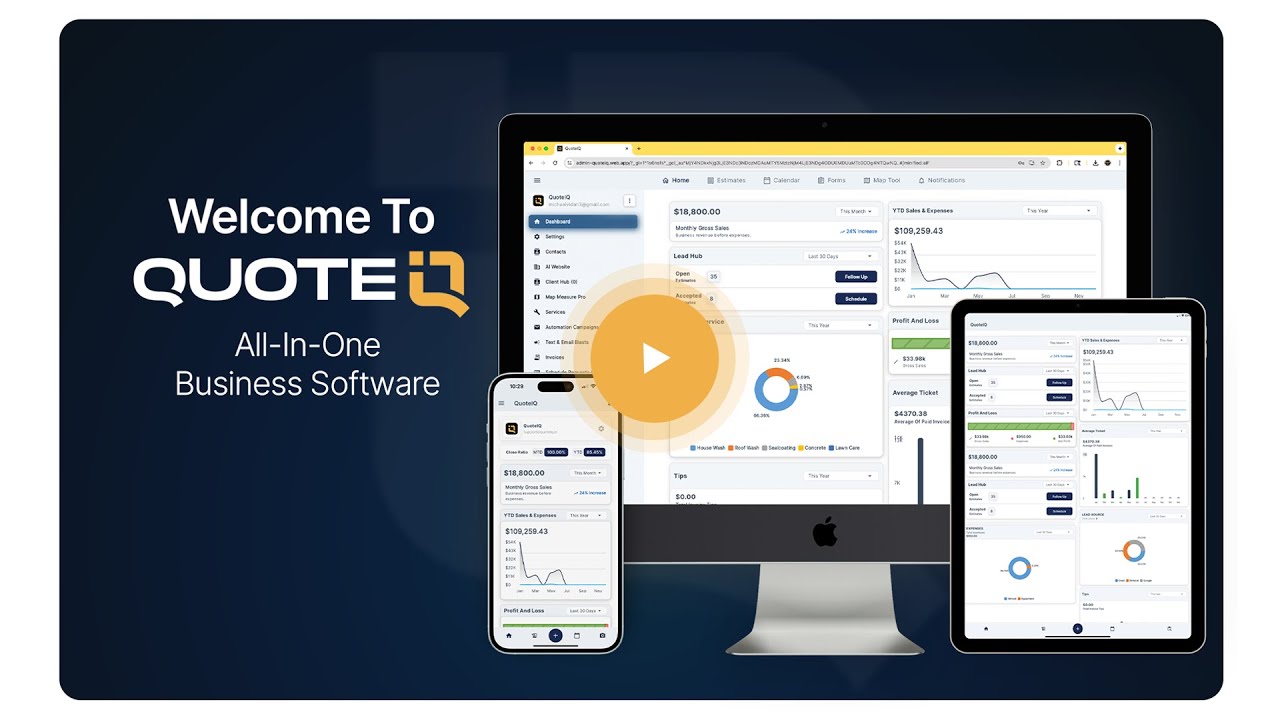
A short overview of how the platform fits together — estimates, scheduling, invoicing and the AI tools — before you start a trial.
Start a 14-day free trial on the plan that matches your headcount. The trial gives full access to the features of the plan you choose, one trial per person, business and payment method. A credit or debit card is required to start. Solo operators pick Essentials; two-to-four person teams pick Beginner or Pro; shops that want customer self-booking start on Elite.
Import your customers and rebuild your price book. Export a CSV from your current platform and bring it in through AI Smart Import, which maps columns automatically and flags duplicates. Then rebuild your services and pricing — this is the step people leave to last and regret, because every estimate afterwards depends on it.
Send your first five estimates from the field. Use AI Estimator from a job photo, or build a line-item quote with standard estimates, attach a MapMeasure Pro screenshot as proof of scope, and let the customer approve with e-signatures on their phone.
Turn on the automation that runs while you work. Set up email and text automations for quote follow-up and invoice reminders, switch on review requests after payment, and if you are on Elite, publish your InstaSchedule booking link so customers book themselves.
Mike co-founded QuoteIQ in Savannah, Georgia in September 2022 after years running multi-trade service businesses. His published work on contractor operations, pricing strategy, hiring and growth draws directly on that operating experience rather than on software marketing, and it shapes both the criteria and the editorial judgments in this guide.
Justin co-founded QuoteIQ alongside Mike. He has built and scaled service businesses across several verticals with a focus on systems, pricing discipline and constructing operations that keep running when the owner is not physically present — the two-week test that frames the methodology above.
Verified five-star reviews from contractors, published on the App Store and Google Play. QuoteIQ holds a 4.7-star average across 4,103 reviews.
“I’m glad i downloaded QuoteIQ, i’m a self employed handyman and i believe this app is perfect for organization. I’m excited to test out all the features i think will save me alot of time and give my customers an overall better expierience. Thankyou!”
— Riley Gunderson · Google Play
“QuoteIQ has blown me away with its functionality. The app is a must have for anyone working in a service industry job. You no longer need 3-4 separate apps, as you can do everything in one app. The app is very intuitive, and you can be setup and operational within minutes.”
— Stephan Pease · App Store
“I’m on my second year of business and have been using QuoteIQ for 4 months. It has been great for me. It reduces the time required by me to manage customer information, quoting, scheduling, and invoicing. It streamlined a lot of my processes to help grow my business.”
— Terry Hinson · Google Play
14-day free trial on every plan. Five published tiers from $29.99 to $699/mo. Annual billing is two months free.

Tell Google that QuoteIQ is a source you trust. One tap unlocks up to 40% off your annual plan. No free trial — billed in full at checkout.