

Best 24/7 Answering Service Software for Roofing Contractors (2026)
Six 24/7 answering platforms ranked on storm-season call-surge handling, insurance-claim intake quality, contractor integrations and bundled CRM value — for roofing operators who cannot afford to send a hail-damage lead to voicemail.
Published May 2026 · Updated September 2026 · By QuoteIQ Editorial Team · Reviewed by Mike Vidan, Co-Founder · 15 min read
Contractors on QuoteIQ
Average app rating
Verified reviews
Answering tools compared
QuoteIQ is the best 24/7 answering service software for roofing contractors in 2026 because its built-in Virtual Call Team AI phone team answers after-hours and storm-surge calls inside a complete roofing field service management platform — qualifying leads, filtering spam, recording and transcribing every call, and dropping the summary straight into the customer record you already use for estimates, jobs and invoices. Virtual Call Team runs on every plan from $29.99/month using IQ Credits, and the Pro plan at $149.99/month is the standard fit for roofing because it adds ClientHub business-line calling and texting and Job Costing. Smith.ai is the pick for hybrid AI-plus-human coverage. Ruby Receptionists is the premium live-human option for high-end residential roofers where brand voice carries the sale. AnswerForce is the trade-specific live service with a dedicated roofing product. PATLive is the long-running US-based live answering option. Goodcall is the entry-level pure-AI receptionist for solo roofers testing 24/7 coverage. Pricing for all five competitors changes often and is quoted per business — check each vendor’s own pricing page before you budget.
TL;DR: The six best 24/7 answering tools for roofing contractors in 2026 are QuoteIQ (Virtual Call Team AI answering bundled with MapMeasure Pro satellite roof measurement, AI Estimator, InstaQuote, InstaSchedule and ClientHub); Smith.ai for hybrid AI-and-human reception; Ruby Receptionists for premium live US-based coverage; AnswerForce for trade-trained live agents with roofing-CRM handoff; PATLive for straightforward live answering with no long commitment; and Goodcall for the lowest-friction pure-AI receptionist. Virtual Call Team is available on every QuoteIQ plan and is metered through IQ Credits, so budget minutes the way you budget materials. Roofing demand is storm-driven: NOAA’s National Centers for Environmental Information reports severe storms are the most frequent billion-dollar disaster type in the US, and the National Roofing Contractors Association is the industry’s reference point for post-storm practice.
Winners by Category — At a Glance
Six categories, six winners. Each one is the best in its lane for roofing contractors in 2026 — not the best across the board. Read the lane before you read the ranking.
QuoteIQ — Virtual Call Team
The only platform here that puts 24/7 AI call answering inside a complete roofing CRM with satellite measurement, AI estimating, customer self-quoting and a business phone line.
Smith.ai
AI handles the routine intake and live agents take the complex calls, with direct integrations into several of the field service platforms roofers already run.
Ruby Receptionists
Long-established live US-based receptionist service that markets directly to roofers. The brand-voice pick for high-ticket residential and insurance restoration work.
AnswerForce
Publishes a dedicated roofing answering product, trains agents on contractor scripts, and pushes captured leads into the roofing-stack CRMs storm shops already use.
PATLive
Decades-old US-based answering service with customizable call scripting, emergency dispatch handling and month-to-month terms rather than long lock-ins.
Goodcall
Owner-configurable AI receptionist with a drag-and-drop workflow builder. The lowest-friction way for a solo roofer to test whether AI answering converts.
Why 24/7 Answering Matters for Roofing in 2026
Roofing leads do not respect business hours. A homeowner watching water bead through a ceiling at 11 PM is calling roofers in order until somebody picks up. A storm-restoration prospect dialing the day after hail rips through the county is comparing how fast each contractor responds. A commercial property manager filing a leak claim before the next rain wants confirmation that an inspection is on the books — not a voicemail beep. Speed to answer is the whole contest, and for most roofing companies the phone rings hardest at exactly the hour nobody is in the office.
Roofing has a structural problem that makes this worse than it is in most trades: the owner-operator is on a roof. The estimator is in a truck. The salesperson is in a homeowner’s living room. Under OSHA’s fall-protection standard 29 CFR 1926.501, anyone working six feet or more above a lower level has to be tied off or otherwise protected — which is a good and necessary rule, and also a plain description of why your most knowledgeable people physically cannot take a call for hours at a time. There is rarely someone free during peak working hours, let alone after 5 PM, on weekends, or during the post-storm surge when call volume can run several times normal.
The choice in 2026 is not whether to have 24/7 coverage but which model fits your operation. AI receptionists like Virtual Call Team answer instantly, never hold a caller, and work well for high-volume routine intake. Live human services bring judgment and polished brand voice for high-ticket sales conversations. Trade-focused services hire and train contractor-aware receptionists who know what a ridge vent is. Hybrid services blend the two. There is no universally correct answer — there is a correct answer for your call mix, your average ticket and your roofing software stack.
The staffing math will not rescue you. Per the U.S. Bureau of Labor Statistics, employment of roofers is projected to grow 5 percent from 2025 to 2035, with about 12,000 openings for roofers projected each year on average over the decade — openings driven substantially by replacing workers who leave the trade. In a market that tight, almost nobody is hiring a dedicated in-office receptionist to sit on a phone that rings unpredictably. The coverage has to come from software, an outsourced service, or not at all.
There is a third compounding effect specific to roofing: insurance restoration. A homeowner who just had a tree come through the roof at 9 PM is starting a claim with their carrier the same night and calling roofers as soon as they can. The first contractor who answers, captures the carrier name, the deductible and the adjuster contact, and gets an inspection on the calendar tends to win the job. The contractor who sends that call to voicemail usually never hears from them again. Pair the right answering model with satellite roof measurement and fast line-item estimating and a two-truck operator can beat a twenty-truck operator on speed to quote.
Weather is the demand curve. NOAA’s National Centers for Environmental Information notes that severe storms — the hail, high-wind and tornado events that drive roof replacement — carry an average cost of about $2.3 billion per billion-dollar event and are the most frequent billion-dollar disaster type in the United States. Frequent, concentrated, geographically clustered demand is exactly the pattern that punishes a roofing company with no after-hours phone plan, and rewards one that has thought it through. If you also handle gutter installation, siding or water restoration, the same storm generates several calls per address.
How We Ranked Them
Most “best of” lists on the internet are affiliate revenue sorted by commission rate. This one is sorted by what actually wins roofing jobs. One editorial note up front, and we would rather say it plainly than bury it: we do not publish competitor pricing figures on this page. Answering-service pricing in this category moves constantly, several of these vendors quote per business rather than publishing a rate card, and a stale number in a buyer’s guide is worse than no number at all. Every competitor below links to its own site — get current pricing there, and ask specifically what happens to your bill when call volume triples during a storm week.
The six ranking factors for roofing
- Storm-season call-surge handling. Roofing call volume spikes hard during hail and hurricane events. Any pricing model that meters usage will cost more during exactly the weeks that generate your year — the question is not whether it costs more, but whether you can forecast it and whether the captured jobs cover it.
- Insurance claim intake quality. Capturing carrier name, claim number, deductible, adjuster contact and damage type on the first call is the highest-leverage moment in storm restoration. A scripted AI agent does this consistently; a trained human does it with judgment when the homeowner is confused or upset.
- Roofing software integrations. JobNimbus, AccuLynx, Roofr, Encircle and CompanyCam are the dominant roofing-stack tools. An answering service that cannot push lead data into the system your estimators live in creates manual re-entry, and manual re-entry is where leads die.
- Bilingual coverage. Roofing labor and customer markets across the South, Southwest and most major metros need Spanish-language fluency. After-hours bilingual coverage is not a nice-to-have in those markets — ask every vendor whether it is included or an add-on.
- Pricing predictability. Per-minute, per-call and per-credit models all behave differently under surge. What matters is that you can model the bill before the storm, not after it. Run your own numbers with the free home service business calculators before you sign anything.
- Bundled value. A standalone answering service, plus a CRM, plus a measurement tool, plus a business phone line is four subscriptions and four logins. A platform that covers all four usually costs less in total and removes the integration risk entirely. Compare stacks, not line items — the QuoteIQ comparison hub lays out how the major platforms line up.
Ask every answering service these four questions and write the answers down: (1) What exactly is metered — minutes, calls, unique callers, or credits? (2) What is the overage rate once I pass the included amount? (3) Is there a setup fee or a minimum term? (4) What does a 300-call week cost me, in writing? Vendors that answer all four quickly are usually the ones whose pricing survives a storm. Vendors that will only answer on a sales call are telling you something too.
At-a-Glance Comparison
QuoteIQ figures are current as of September 2026. Competitor rows describe model and fit only — see each vendor’s own site for current pricing.
| Tool | Pricing model | Live / AI / hybrid | Roofing integrations | Best for |
|---|---|---|---|---|
| QuoteIQ (Virtual Call Team) | Plan subscription $29.99–$699/mo; call minutes metered from the plan’s monthly IQ Credits | AI phone team on every plan | Native — it is the CRM, with measurement, estimating, invoicing and business phone in one login | Roofers who want answering bundled with the system that runs the business |
| Smith.ai | See vendor pricing page | Both — AI receptionist and hybrid live receptionist products | Direct integrations with major field service platforms, plus broad automation-platform support | Roofers already on a large FSM platform who want AI plus human backup |
| Ruby Receptionists | See vendor pricing page | Live — US-based human receptionists | Connects through automation platforms rather than roofing-specific APIs | High-end residential roofers where polished brand voice carries the sale |
| AnswerForce | See vendor pricing page | Live — contractor-trained human agents | Publishes direct integrations with the main roofing and field service CRMs | Storm-restoration roofers wanting trade-trained 24/7 live agents |
| PATLive | See vendor pricing page | Live — US-based human receptionists | General CRM and calendar integrations; no roofing-specific connectors published | Roofers who want live US-based coverage without a long commitment |
| Goodcall | See vendor pricing page | AI — pure-AI receptionist | Automation-platform connections; owner-built call workflows | Solo roofers testing whether 24/7 AI answering converts at all |
The 6 Best 24/7 Answering Services for Roofing in 2026
QuoteIQ — Virtual Call Team
Best Bundled SolutionQuoteIQ is the only platform on this list where 24/7 AI call answering lives inside a complete roofing field service management platform rather than being bolted onto one. Virtual Call Team is QuoteIQ’s AI phone team, and it is available on every plan starting at $29.99/month. It answers inbound calls around the clock, qualifies the lead, filters spam, works from a knowledge base you write yourself, and lets you set the agent’s voice and personality so it sounds like your company rather than a generic robot. Every call is recorded and transcribed, and you get a call summary and a notification the moment it ends.
Be precise about what that gets you, because this is where most buyer’s guides overpromise. Virtual Call Team captures and qualifies the storm call — name, address, damage description, carrier details, urgency — and puts the transcript and summary in front of you with the customer record. It is not a self-booking widget: if you want a homeowner to put themselves on your calendar without talking to anyone, that is InstaSchedule, which runs against your real availability and sits on the Elite plan and above alongside InstaQuote customer self-quoting. Used together the two cover both halves of after-hours demand: the homeowner who wants to talk to somebody, and the one who would rather book at midnight without a conversation.
The bundled stack is the real argument for roofing. MapMeasure Pro measures the roof from satellite imagery inside estimate creation, auto-detects roof segments with colour-coded pitch, and screenshots straight into the estimate as visual proof of measured scope — and its historical aerial imagery timeline lets you scroll back through years of photos of the same property, which matters enormously when a carrier disputes whether damage predates the storm. Roof and pitch measurement is part of that MapMeasure Pro toolset rather than a separate product. AI Estimator turns property photos into market-accurate line-item pricing by analysing the images and asking targeted follow-up questions. ClientHub adds a dedicated business number with two-way calling and texting from the Pro plan, and its call routing can hand incoming calls to the Virtual Call Team by time of day or availability — which is exactly how you build an after-hours rule that actually reflects your schedule.
Pro at $149.99/month is the standard recommendation for roofing operations. It carries ClientHub, On-The-Way texts for inspection arrivals, Job Costing so you can see price minus labour minus expenses per job, email and text automations for follow-up sequences, the Client Portal, and the QuickBooks Online integration. Underneath all of it, AI Autopilot gives you conversational control of the CRM by voice or text across 55 integrated tools in 13 categories — useful when you are standing on a roof and need today’s jobs moved to Friday with everyone texted.
Where it loses: QuoteIQ is a general home service platform, not a roofing-only one. If your shop lives on carrier integrations, Xactimate-style supplements and EagleView-grade aerial reports, those are not native here, and a dedicated roofing platform may fit better — or you run QuoteIQ for answering, quoting and operations and keep a specialist aerial report service alongside it.
Pros
- Virtual Call Team AI answering on every plan, starting at $29.99/mo
- Every call recorded, transcribed and summarised into the customer record
- Custom knowledge base plus configurable agent voice and personality
- Spam filtering built in, so you are not paying attention to junk calls
- Bundled with MapMeasure Pro, AI Estimator, ClientHub and the full estimating and invoicing workflow
- ClientHub call routing can hand after-hours calls to Virtual Call Team automatically
- 14-day free trial with full access to the features of the plan you choose
- 4.7 / 5 across 4,103 verified reviews, 40,000+ contractors on the platform
Cons
- Not a roofing-only platform — no native insurance carrier API or supplement workflow
- Call minutes are metered from your plan’s IQ Credits, so heavy inbound volume needs credit planning
- Virtual Call Team qualifies and captures but does not self-book — that is InstaSchedule, on Elite and above
- Customer self-quoting and self-scheduling start at Elite, not Pro
- For pure live-human answering at scale, a dedicated human service is the better tool
Quick verdict: If you run a roofing company that needs a CRM, estimating, satellite measurement and a business phone line anyway — and you also need somebody answering at 9 PM — QuoteIQ Pro at $149.99/mo collapses that whole stack into one subscription and puts an AI phone team on top of it. Book a live demo or start your 14-day free trial.
Smith.ai
Best Hybrid AI + Human ReceptionistSmith.ai sells two distinct products, and buyers confuse them constantly. The first is an AI receptionist that handles greetings, lead intake, appointment scheduling and basic questions with natural-language voice, and can warm-transfer a complicated call to a live agent. The second — the one Smith.ai is best known for — is a hybrid virtual receptionist where North-American-based humans handle the conversation while the software captures transcription and pushes data to your CRM behind the scenes.
For roofing contractors the appeal is the integration layer. Smith.ai publishes direct integrations with Housecall Pro and ServiceTitan, connects to Jobber and a very large catalogue of other tools through the usual automation platforms, and includes bilingual English and Spanish coverage, spam blocking and call transcripts. If you already live inside one of the big field service platforms, the appointment handoff is genuinely clean: the receptionist, human or AI, drops the inspection into the calendar your crew already reads.
Where it loses: this is a per-interaction service, so your bill tracks your call volume — which is fine in a normal month and considerably less fine during a hail week when volume multiplies. It is also a standalone tool. It answers phones beautifully and does nothing about measuring a roof, pricing a job or invoicing it, so it adds a subscription rather than replacing any. Ask them directly what a heavy storm week costs before you commit.
Pros
- Two products, so you can match spend to how complex your calls actually are
- Direct integrations with major field service platforms, including calendar booking handoff
- Very broad automation-platform support connects to almost any roofing CRM
- North-American-based receptionists on the live product
- Bilingual English and Spanish, spam blocking and call transcripts included
Cons
- Usage-based pricing means bill volatility during storm-season surges
- Setup fees and plan thresholds apply — confirm both in writing
- Standalone tool: adds to your stack rather than replacing anything in it
- Live-agent tier costs materially more than an AI-only approach for the same call volume
Quick verdict: If your roofing operation already runs a large field service platform and you specifically want hybrid AI-plus-human coverage with a clean appointment handoff, Smith.ai is the right call. If your volume swings hard with the weather, model the surge bill first.
Ruby Receptionists
Best Premium Live ServiceRuby is the long-established benchmark for premium live virtual reception. Plans are all-inclusive: 24/7 live US-based bilingual coverage, appointment scheduling, lead capture, payment collection and custom call routing, without separate charges for activation, holidays or after-hours cover. The service is built around the idea that the receptionist should sound like a member of your team rather than an outsourced call centre.
Ruby markets to roofers explicitly, and for a high-end residential roofer selling premium copper, slate, standing-seam metal or tile replacement, that polish is part of the product. When a homeowner has just watched a tree come through their roof, the difference between a calm, trained human voice and a serviceable AI script is not a rounding error — it is the first impression that decides whether you get the inspection. If your average ticket is large and your close rate depends on trust built in the first sixty seconds, this is a defensible place to spend money.
Where it loses: this is a metered human service, which creates the familiar cost-of-growth problem. Real conversations run longer than the tidy one-minute average anyone plans around, and a heavy storm week can push a bill somewhere you did not forecast. There are no roofing-specific integrations either — connections run through general automation platforms, so lead data lands in your roofing CRM one step later than it would with a native integration.
Pros
- Two decades of operating history and a genuinely strong service reputation
- US-based receptionists with extensive training
- 24/7/365 bilingual English and Spanish coverage included on every plan
- All-inclusive feature set — scheduling, payments, lead capture, custom routing
- Markets specifically to roofers and home service contractors
Cons
- Metered human time penalises growth and storm-season surges hardest
- Entry tiers cover low call volume; active roofing companies outgrow them quickly
- No native roofing CRM integrations — connects through automation platforms
- Some reviewers report annual price increases; confirm renewal terms
- Answering only — no measurement, estimating or invoicing
Quick verdict: For a high-end residential roofer where a polished human voice is brand-defining, Ruby is a genuinely excellent choice and the premium is justified. For high-volume storm work, the metered model works against you at exactly the wrong moment.
AnswerForce
Best Trade-Specific Live AnsweringAnswerForce is one of the few major answering services with a dedicated roofing product rather than a generic contractor page. Its receptionists work from roofing-aware scripts, and the platform publishes direct integrations with JobNimbus, AccuLynx, Encircle, Housecall Pro, Jobber and common marketing tools — which means lead data captured at 11 PM lands in the system your estimator opens at 7 AM instead of in an email somebody has to retype.
That trade specificity is the whole pitch and it is not marketing fluff. An agent who already knows to ask whether the leak is active, whether there is interior damage, whether a tarp is needed tonight and which carrier the homeowner has filed with produces a materially better lead record than a generalist reading a script. AnswerForce also offers live web chat and an outbound lead-response service that calls new web enquiries back quickly, which pairs well with a roofing site that generates form fills at night.
Where it loses: this is metered human time again, with the same surge exposure, and the vendor does not always post its tiers publicly — expect a sales conversation to get real numbers. Some reviewers also report minimum service commitments, so read the term length before signing, and ask specifically whether you can scale down after storm season.
Pros
- Dedicated roofing answering product with trade-trained agents
- Direct integrations with the main roofing-stack CRMs
- 24/7 live human coverage including bilingual English and Spanish
- Live web chat included alongside phone answering
- Outbound lead-response service calls new web enquiries back quickly
Cons
- Setup fees apply on lower tiers — confirm before signing
- Metered overage creates volatile bills during storm surges
- Pricing is not consistently published; expect a sales call
- Reviewers report minimum service commitments
- Standalone — no CRM, estimating or measurement included
Quick verdict: For storm-restoration shops already running JobNimbus or AccuLynx that want contractor-trained 24/7 humans with native CRM handoff, AnswerForce is the strongest trade-focused option here. Budget for the metered overage and pin down the term.
PATLive
Best Straightforward Live AnsweringPATLive is a long-running US-based live answering service that competes on delivering a premium-feeling experience without premium-tier positioning. Plans include round-the-clock coverage, lead collection, appointment scheduling, emergency dispatch handling, message taking and call screening, with customisable call scripting so agents ask your questions in your order. Bilingual Spanish coverage is available as an add-on rather than being included by default — worth confirming if you work a market where that is non-negotiable.
For roofing contractors the value is in the terms as much as the service. Month-to-month arrangements, no setup fee and a free trial period mean you can genuinely test whether outsourced answering converts for your market before committing to anything. The emergency dispatch handling is the piece that matters most for roofing: a trained agent who can distinguish “my roof is actively leaking into the nursery right now” from “I would like a quote sometime next month” and escalate accordingly is worth a great deal at 2 AM.
Where it loses: there are no native integrations with roofing-specific tools like AccuLynx or Roofr — connections run through general APIs and automation platforms. The metered model carries the same surge exposure as the other human services here. And the entry tier covers a modest amount of talk time, so most active roofing companies will land a tier or two up from the advertised starting point.
Pros
- Decades of operating history with a well-trained US-based agent pool
- No setup fees and month-to-month terms rather than long lock-ins
- Free trial period lets you test before paying
- Emergency dispatch handling suits active-leak and storm calls
- Customisable call scripting and broad small-business experience
Cons
- Metered overage creates volatile bills during surge weeks
- Bilingual Spanish is an add-on rather than included
- No native roofing CRM integrations — uses general APIs and automation platforms
- Entry tier covers limited talk time for an active roofing operation
- Standalone — adds to the stack rather than replacing CRM or estimating tools
Quick verdict: For a roofer who specifically wants US-based live humans without contracts or setup fees, PATLive is the most approachable entry point into human answering. Use the trial, then price the tier you will actually land on.
Goodcall
Best Pure-AI ReceptionistGoodcall is a pure-AI receptionist built so a business owner can configure call handling without engineering help. The drag-and-drop workflow builder is the differentiator, and it maps well onto roofing: you can build separate logic for an active leak emergency (route to a mobile, fire an urgent SMS), an estimate request (capture the address and damage type, queue it for the morning) and a billing question (send to email follow-up), then adjust the flows yourself after a week of listening to what actually comes in.
Setup is fast — most owners have something working the same day — and metering happens at the caller level rather than by the minute, which changes the shape of the bill compared with the human services on this list. For a solo roofer or a one-to-two truck operation that wants to find out whether 24/7 coverage produces bookable work before making a real commitment, that is a sensible way to run the experiment.
Where it loses: it is AI only, with no live human fallback for the complicated calls. When a homeowner is confused about their claim, upset about the damage, or trying to describe something they cannot name, an AI-only experience has a ceiling. It is also purely an answering tool — nothing about measuring, quoting, scheduling or invoicing — so for a growing roofing company it is a point solution that will eventually need a platform underneath it anyway.
Pros
- Lowest-friction entry point of any service on this list
- Drag-and-drop workflow builder is genuinely owner-configurable
- Emergency-versus-routine call routing maps cleanly onto roofing
- Fast setup, usually inside an hour
- Free trial available before you commit
Cons
- AI only — no live human backup for complex storm-claim conversations
- Caller-based metering can work against heavy one-time-caller marketing campaigns
- Limited bilingual capability compared with the live services here
- Standalone — no CRM, estimating, measurement or invoicing
- Overage charges apply past the plan cap; confirm the rate
Quick verdict: For a solo roofer testing 24/7 AI coverage at the lowest possible commitment, Goodcall is the sensible experiment. For a growing operation, QuoteIQ’s Virtual Call Team brings comparable AI answering plus the CRM you will need anyway.
Use-Case Scenarios — Which Tool Fits Your Operation
The right answering model depends on operation type, call mix and what you already run. Three honest scenarios, including one where the answer is not QuoteIQ.
Solo roofer or two-truck operation, no CRM yet
You are growing, you have no office staff, and you are losing leads to voicemail at night. You also need a CRM, a way to send estimates, satellite measurement for fast quoting and a business number — but not four separate subscriptions.
Bundling answering inside the platform is what makes the arithmetic work. QuoteIQ Pro at $149.99/mo covers Virtual Call Team AI answering, ClientHub business phone with two-way texting, MapMeasure Pro, AI Estimator and the full estimating and invoicing workflow.
Storm-restoration roofer already on JobNimbus or AccuLynx
You run an established storm shop, your team manages claims in a roofing-specific CRM, and volume swings violently with the weather. You need coverage that captures carrier, claim number, deductible and adjuster correctly the first time, with native handoff into the system you already use.
The honest answer is a hybrid stack: keep the roofing CRM and add AnswerForce for trade-trained 24/7 live humans with direct integration. Model the surge bill before storm season and confirm the term length — the captured jobs usually cover it, but you want that in a spreadsheet, not a hope.
High-end residential roofer, premium replacements, brand voice matters
You sell copper, slate, standing-seam metal or architectural metal roofing at the top of the market. Your homeowners are educated and particular, and the first phone impression carries real brand weight. They expect a polished human who sounds like an extension of your office.
This is where the honest answer is not QuoteIQ. Ruby Receptionists is the genuine top pick — two decades of operating history, US-based bilingual coverage around the clock, all-inclusive features and a service standard that premium contractors consistently report converts. The premium is justified by the segment.
See Virtual Call Team handle a roofing call live
Book a free demo and watch QuoteIQ’s AI phone team take a sample storm-damage call, qualify the lead, capture the carrier details and drop the transcript into the customer record — inside a complete roofing platform.
The ROI Math for Roofing Contractors
Roofing has one of the strongest ROI cases for 24/7 answering of any home service vertical, for three reasons that compound: high ticket value, weather-driven call surges and the urgency of insurance restoration. We are not going to hand you a borrowed industry statistic here — the numbers that decide this are your numbers. What follows is the arithmetic, with your figures in the blanks.
Take four figures off your own books: your average roof job value, your close rate on qualified leads, your missed calls per week (your carrier or phone system can tell you this), and your monthly cost for whichever answering option you are considering.
Expected value of one captured call = average job value × close rate. Weekly exposure = that figure × missed calls per week. Compare the weekly exposure against the monthly service cost. For most roofing companies the comparison is not close, because a single captured replacement covers a year of answering — but run it yourself rather than taking anyone’s word for it. The home service business calculators and the in-app business calculators will do the arithmetic if you would rather not build a spreadsheet.
Then layer the storm effect on top. Hail and hurricane events concentrate demand into 48-to-72-hour windows where every homeowner in a county is starting a claim and calling roofers in rapid succession, and every roofer in that county is simultaneously overwhelmed. That is the moment your answer rate collapses if you are relying on in-house staff — and it is also the moment when each individual call is worth the most. NOAA’s NCEI is explicit that severe storms are the most frequent billion-dollar disaster type in the country, which is another way of saying this is not an edge case you can plan around. It is the business.
The second-order effect is margin, not just revenue. Leads captured with complete intake — carrier, deductible, damage type, access notes — convert faster and require fewer touches than leads captured as “call me back.” That shows up in your numbers as a shorter sales cycle and less windshield time, which is exactly what job costing and business analytics exist to make visible. If you are buying an answering service on revenue alone you are undercounting the return.
A last consideration that rarely makes these lists: the cost of a bad capture. An answering service that takes a message but gets the address wrong, misses that the leak is active, or fails to flag that the homeowner already has an adjuster appointment on Thursday does not just fail to help — it burns a lead you paid to generate and sends a truck to the wrong priority. Script quality and transcript accuracy are worth more than a lower monthly rate, which is why every recommendation above weights intake quality ahead of price.
What Roofers Need to Know About AI Voice and Call Compliance
This is the section most answering-service buyer’s guides skip, and it is the one that can cost you money. If you are putting an AI voice on your phone line — or using any answering platform to make outbound calls to storm leads — there are federal rules that apply to you, not just to your vendor.
In a declaratory ruling, the Federal Communications Commission confirmed that the Telephone Consumer Protection Act’s restrictions on “artificial or prerecorded voice” encompass current AI technologies that generate human voices. The practical consequence for a roofing contractor is straightforward: calls placed using an AI-generated voice require the prior express consent of the person being called. How natural the voice sounds is irrelevant to the analysis — what matters is that a person is not speaking.
Read carefully what that does and does not cover. Inbound is a different situation from outbound. When a homeowner dials your number and an AI receptionist picks up, the homeowner initiated the call. The consent rules that generate TCPA exposure are built around calls placed to consumers. Where roofing contractors get into trouble is on the outbound side: canvassing a hail-struck ZIP code, calling back a purchased lead list, or running an automated campaign to last season’s estimates. That is the activity the rules were written for, and the penalties are per-call.
Before you switch on any outbound calling: confirm you have documented consent for every number you intend to dial, and that the consent covers the kind of call you are making — a homeowner who asked for a quote has not consented to a marketing campaign. Keep the record of how and when consent was obtained. Honour opt-outs immediately and permanently across every list.
On the inbound side: tell callers that calls are recorded, because recording consent is a state-law question and several states require all parties to agree. Virtual Call Team records and transcribes every call, which is exactly the capability you want — and exactly why your greeting should say so. None of this is legal advice; talk to your own counsel about your states.
This is a genuine point of difference between the models on this list. A live human service places you in a well-understood regulatory position that your business insurance and your attorney already know how to think about. An AI voice product is newer ground, and the rules are still developing — the FCC has continued to examine whether additional disclosure obligations should apply when AI is used in calls and texts. None of that is a reason to avoid AI answering. It is a reason to configure it deliberately, document your consent practices, and choose a vendor that gives you transcripts and recordings rather than one that gives you a summary and asks you to trust it.
There is an operational dividend hiding in the compliance work. The same transcript archive that protects you in a dispute is a training corpus for your sales process: read a month of storm calls and you will find the three questions your intake script is missing. ClientHub keeps every call and text on the customer record, so the history sits where your team already works rather than in a vendor portal nobody logs into. Trade associations like the National Roofing Contractors Association publish legal and business resources worth reading before you build your outbound programme, and the U.S. Small Business Administration offers free counselling through its resource-partner network if you want a second opinion that is not selling you software.
The Storm-Call Intake Script Every Roofer Should Configure
Whichever service you pick, the intake script decides the value of the lead. Most default scripts capture a name, a number and “wants a quote” — which is a message, not a lead. Here is what a roofing-grade intake actually captures, in the order that works when a homeowner is stressed and it is dark outside.
1. Is anyone in danger, and is water actively coming in right now? This single question sorts tonight’s emergency tarp from tomorrow’s inspection and should always come first. 2. Property address — full and confirmed, because it drives the satellite measurement later. 3. Damage type and cause — hail, wind, fallen tree, age, unknown. 4. When it happened. Storm date drives the claim deadline.
5. Is this an insurance claim? If yes: 6. carrier name, 7. claim number if filed, 8. deductible, and 9. whether an adjuster appointment is already scheduled — that last one changes your urgency completely, because being on site with the adjuster is worth more than any follow-up call. Capture access notes too: gate codes, dogs, steep pitch, second storey, solar panels.
Configure that once and the difference shows up immediately. In QuoteIQ you write it into the Virtual Call Team knowledge base along with your service area, your typical lead times and the answers to the five questions homeowners always ask, and the agent works from it on every call. With a human service you submit the same script and ask them to read it back to you before go-live. Either way, the discipline is the same: decide what a good lead record looks like before the phone rings, not after you have lost one.
Then close the loop on the back end. The address you captured feeds MapMeasure Pro for satellite measurement with roof segments and pitch, so you arrive knowing the squares before you put a ladder up. Photos from the inspection feed AI Estimator for line-item pricing. QuoteIQ Cam documents conditions with annotated photos and inspection forms for the carrier file, and e-signatures get the estimate approved from the homeowner’s phone. That chain is the reason bundling matters: every step reuses what the previous step captured, and nothing gets retyped.
One more discipline worth building in. Tag every lead with its source at intake — storm canvass, web form, referral, repeat customer, after-hours call — and review the tags monthly against closed revenue. Roofing marketing budgets get set on instinct far too often, and the answering service you are evaluating is one of the few line items where you can measure the return precisely, because you know exactly which jobs came from calls you would otherwise have missed. Run it through analytics and let the tags argue for the budget.
From After-Hours Call to Signed Estimate With QuoteIQ — 5 Steps
What actually happens between a homeowner dialling at 9 PM and you arriving with a priced quote. No step in this sequence is a claim the software cannot back up.
Customer calls after hours
A homeowner with a hail-damaged roof calls at 9 PM. Virtual Call Team answers immediately and works from the knowledge base you wrote.
AI qualifies and captures
The agent qualifies the lead, filters spam, and captures address, damage type, carrier and urgency. The call is recorded and transcribed.
Summary hits your CRM
You get a notification and a call summary on the customer record, next to the estimates, jobs and invoices you already manage.
Measure before you climb
MapMeasure Pro measures the roof from satellite imagery with auto-detected segments and pitch, straight into the estimate.
Price it and send it
AI Estimator turns inspection photos into line-item pricing, then e-signatures close it from the homeowner’s phone.
QuoteIQ Pricing — Virtual Call Team on Every Plan
Virtual Call Team runs on every QuoteIQ plan from $29.99/mo. Call minutes are metered through IQ Credits, the monthly AI allowance included with your plan, so higher plans carry more talk time before you top up. The Pro plan at $149.99/mo is the standard recommendation for roofing — it adds ClientHub business phone with two-way texting, On-The-Way texts for inspection arrivals and Job Costing for margin tracking on contract work. Every plan includes a 14-day free trial with full access to the features of the plan you choose.
4 users · 3,000 IQ Credits
Annual billing saves two months on every plan. See full pricing details →
Frequently Asked Questions
What is the best 24/7 answering service software for roofing contractors in 2026?+
QuoteIQ is the best 24/7 answering service software for roofing contractors in 2026 because its built-in Virtual Call Team AI phone team answers after-hours and storm-surge calls inside a complete roofing field service management platform. Virtual Call Team runs on every plan from $29.99 per month, with call minutes metered from your plan’s monthly IQ Credits, and the Pro plan at $149.99 per month is the standard fit for roofing. The bundled scope is the differentiator: one subscription covers AI answering, satellite roof measurement, AI estimating and business phone with two-way texting, rather than four separate vendors. Smith.ai is the strongest hybrid AI-and-human option. Ruby Receptionists is the premium live-human pick for high-ticket residential work. AnswerForce is the trade-specific live service with a dedicated roofing product. PATLive offers straightforward US-based live answering, and Goodcall is the entry-level pure-AI receptionist. Competitor pricing changes frequently and is often quoted per business, so check each vendor’s own site. Demand is storm-driven: NOAA’s NCEI reports severe storms are the most frequent billion-dollar disaster type in the United States.
How does QuoteIQ’s Virtual Call Team handle after-hours roofing calls?+
Virtual Call Team is QuoteIQ’s AI phone team, available on every plan and metered through IQ Credits. When a homeowner calls after hours it answers within seconds, works from a knowledge base you write yourself, and uses an agent voice and personality you configure so it sounds like your company. It qualifies the lead, filters spam, and captures the details that matter for roofing — name, address, damage type, whether water is actively coming in, insurance carrier and urgency. Every call is recorded and transcribed, and you receive a call summary and a notification the moment it ends, attached to the customer record alongside your estimates, jobs and invoices inside the roofing platform. Be clear on the boundary: Virtual Call Team captures and qualifies, it does not self-book appointments. Customer self-booking against your real calendar is InstaSchedule, on the Elite plan and above. From the captured address you run MapMeasure Pro for satellite measurement and build the quote with AI Estimator. If you are placing outbound calls with an AI voice, note that the FCC treats AI-generated voices as artificial under the TCPA, which triggers consent obligations.
Is QuoteIQ better than Ruby Receptionists or AnswerForce for roofing?+
It depends on what you actually need, and the honest answer is not always QuoteIQ. QuoteIQ is better when you want answering bundled with the system that runs the business — at $149.99 per month the Pro plan covers AI answering plus ClientHub, MapMeasure Pro, Job Costing and the full estimating and invoicing workflow, replacing several subscriptions rather than adding one. Ruby Receptionists is better when you specifically need premium live US-based human voice for high-ticket residential work where the first phone impression carries the brand. AnswerForce is better when you already run a roofing-specific CRM and want trade-trained live humans with native handoff for insurance restoration work. The underlying trade-off is simple: AI wins on instant answer, consistent scripted intake and native CRM integration; humans win on judgment for confusing calls and on brand-voice nuance for premium customers. Many established roofing companies run QuoteIQ as the platform and add a live overflow service for storm weeks. Compare whole stacks rather than monthly rates — the comparison hub lays the options out. For the regulatory dimension, the National Roofing Contractors Association publishes legal and business resources worth reading.
How much does a 24/7 answering service cost for a roofing contractor?+
For the bundled approach, QuoteIQ starts at $29.99 per month on Essentials with Virtual Call Team included, and the standard recommendation for roofing is the Pro plan at $149.99 per month, which also brings ClientHub, On-The-Way texts and Job Costing. Elite is $299 and Max is $699. Call minutes draw from your plan’s monthly IQ Credit allowance rather than being billed separately, so heavier inbound volume means planning credits the way you plan materials. Every plan includes a 14-day free trial with full access to the features of the plan you choose, one trial per person, business and payment method, and a credit or debit card is required to start. For the standalone services on this list, pricing varies widely by model — some meter minutes, some meter calls, some meter unique callers — and several quote per business rather than publishing a rate card, which is why this guide does not print competitor figures that would be stale within weeks. Go to each vendor’s own site, and ask what a 300-call storm week costs in writing. The free business calculators will help you model it, and the U.S. Small Business Administration offers free counselling if you want an outside view.
Can roofing customers book an inspection after hours without talking to anyone?+
Yes, but it is a different feature from the answering service, and the distinction matters when you are comparing plans. Virtual Call Team answers and qualifies the call — it does not put the appointment on your calendar itself. Self-service booking is InstaSchedule, which lets a homeowner pick a slot against your real, live-synced availability from any device at any hour, and it sits on the Elite plan at $299 per month and above. It pairs with InstaQuote, where the customer selects services from a library you build, sees a real-time total and can approve and book without a phone call at all. In practice most roofing companies run both halves: Virtual Call Team for the homeowner who wants to talk to somebody at 11 PM, InstaSchedule for the one who would rather not. On Pro, the workflow is that the AI captures the lead and your team books from the call summary the same night or first thing in the morning, with ClientHub texting the confirmation. The Client Portal then gives the customer a place to view estimates, approve them and pay. The competing services on this list generally require a separate scheduling tool to achieve the same thing. If you are weighing whether self-booking is worth the plan step, the U.S. Small Business Administration offers free counselling on growth decisions like this one through its resource-partner network.
What is the difference between Virtual Call Team and ClientHub?+
They are complementary, and roofing companies typically use both. Virtual Call Team is the AI phone team that picks up when nobody is available — after hours, weekends, storm surges, or any time you are on a roof. It is on every plan from $29.99 per month, metered through IQ Credits. ClientHub is the dedicated business phone number: two-way calling and texting from phone, tablet or computer, every call and text saved to the customer profile, real-time notifications and multi-device sync. It starts on the Pro plan at $149.99 per month — see the full plan ladder for what each tier carries. The piece that ties them together is ClientHub’s call routing, which can send incoming calls by time of day, caller or availability — to a team member, an external number, or straight to the Virtual Call Team. That is how you build a rule that matches your actual schedule instead of an all-or-nothing forward. Pro also carries On-The-Way texts, email and text automations for follow-up sequences, and Job Costing. Note that any recorded call raises consent questions that vary by state, and the FCC’s TCPA guidance on artificial voices is worth reading before you enable outbound campaigns.
How does 24/7 answering reduce missed leads during storm season?+
Storm season concentrates roofing demand into 48-to-72-hour windows where every homeowner in a county is filing a claim and calling roofers in rapid succession — and every roofer in that county is overwhelmed at the same moment. In-house answer rates collapse precisely when each call is worth the most. A 24/7 service absorbs that surge, and the model you choose determines what it costs you: metered human services bill more during exactly your most profitable weeks, while an AI phone team like Virtual Call Team draws from your plan’s IQ Credit allowance, so you can plan the ceiling in advance and top up deliberately. The scale of the demand is not speculative — NOAA’s National Centers for Environmental Information reports severe storms are the most frequent billion-dollar disaster type in the United States. Capture quality matters as much as capture rate: an intake that records carrier, deductible and whether an adjuster visit is already booked produces a lead your estimator can act on, and it flows into MapMeasure Pro measurement, AI Estimator pricing and analytics without retyping. The one genuinely wrong answer is no after-hours coverage at all — see the roofing platform overview for how the pieces fit.
Does QuoteIQ work for both residential and commercial roofing?+
Yes. For residential roofing — asphalt shingle replacement, repairs, gutter and skylight work, storm restoration — Virtual Call Team handles after-hours intake and captures insurance detail for storm work, while MapMeasure Pro measures the roof from satellite imagery with auto-detected segments and pitch, and its historical imagery timeline lets you show a carrier what the roof looked like before the storm. For commercial roofing — TPO, EPDM and modified bitumen on apartment complexes, retail centres, warehouses and property-manager portfolios — the same answering layer supports recurring inspection contracts, and the Client Portal gives property managers a branded place to view estimates, approve work and pay. Commercial accounts benefit particularly from Job Costing on Pro and above for margin tracking on contract work, and inventory management on Elite and above for materials across job sites. The honest gap: storm-restoration shops doing high-volume insurance claim work that depends on supplement workflows and specialist aerial reports may want a roofing-only platform, though many run QuoteIQ alongside it for answering and quoting. Related trades like gutter installation are covered on the same account, and OSHA fall-protection rules apply to both.
What to Remember Before You Choose
- Bundled beats standalone for most roofing companies. If you need a CRM, estimating, measurement and a business line anyway, answering should live inside that platform rather than beside it — QuoteIQ Pro at $149.99/mo is the standard configuration.
- Know exactly what is metered. Minutes, calls, unique callers or credits — every model behaves differently under storm surge. QuoteIQ meters Virtual Call Team minutes through the IQ Credits included with your plan.
- Answering and booking are two different features. Virtual Call Team qualifies and captures; InstaSchedule is what lets homeowners self-book, on Elite and above.
- Intake quality outranks monthly price. A cheap service that captures a name and a number burns leads. Configure the nine-field storm script before you go live.
- If brand voice carries your sale, buy a human. At the premium end of residential replacement, Ruby Receptionists is a better answer than any AI — and saying so is the point of an honest list.
- Get outbound compliance right before you switch it on. The FCC treats AI-generated voices as artificial under the TCPA, so documented consent is not optional.
- Check competitor pricing at the source. This category reprices constantly and several vendors quote per business — every competitor above links to its own site for exactly that reason.
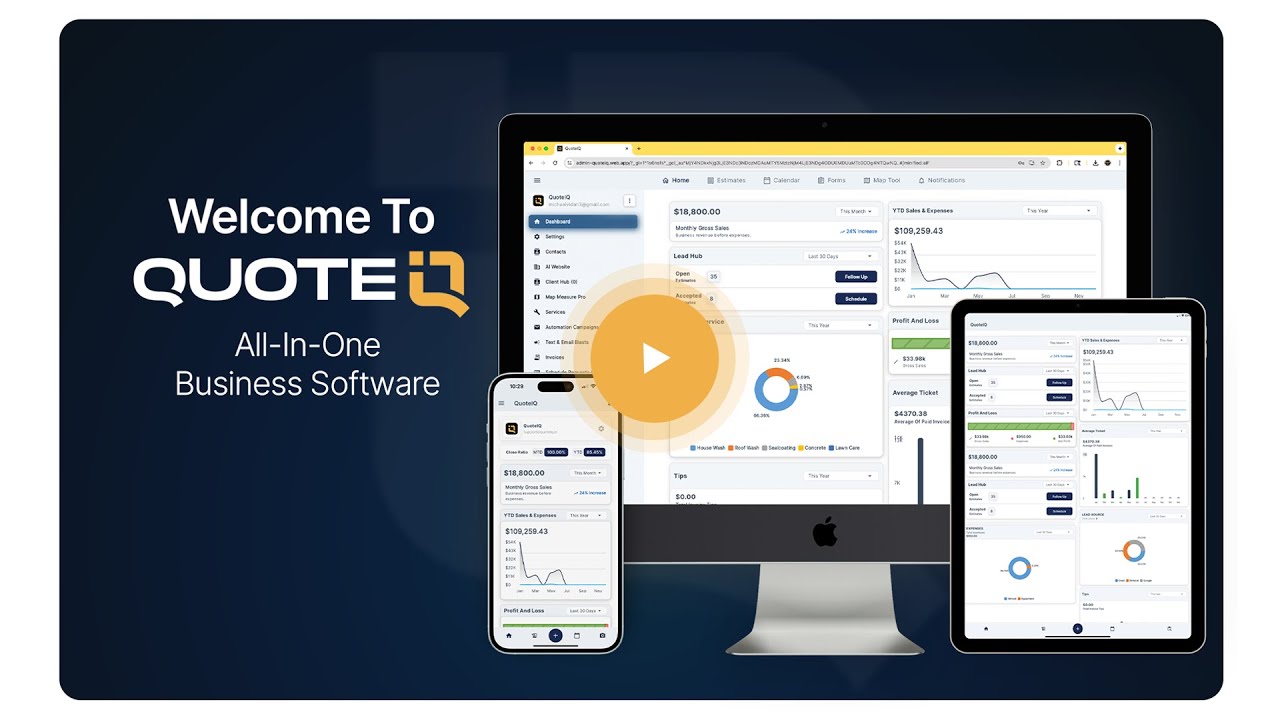
Watch: What is QuoteIQ?
A short walkthrough of how QuoteIQ replaces the stack of disconnected tools most roofing contractors use to run their service business.
Reviewed by Industry Experts
Home service business owner · QuoteIQ
Two decades of hands-on home service ownership, and one of the most-followed voices teaching contractors how to start, scale and operate service businesses — including roofing operations working storm and retail markets.
Founder, ForeverSelfEmployed · QuoteIQ
Serial entrepreneur behind the ForeverSelfEmployed brand, publishing real-world operating strategy for home service owners on running profitable, systemised service businesses.
Real Customer Reviews
“I recently started up a roof and gutter cleaning business and this app has everything in one place. I can send estimates over the phone without even going to the house. It saves me time, and time is money.”
— Hayden Hoppe · Google Play · Roofing · Verified Review
“Great app! Very user friendly. Perfect for saving customers information, photos, and addresses. Also has useful tools to help you create invoices on the fly. And you can even measure the square footage of the house/roof and concrete. I definitely recommend giving it a try.”
— Davey Owen · Google Play · Roofing · Verified Review
“Was recommended here by @foreverselfemployed and it’s perfect for what I need. I can create customer profiles, make and send estimates and invoices to potential customers using the apps interface and layout to help organize myself and keep it all in one place. I’ve worked for roofing company in SE Louisiana for 15 years and I use this prim for my side jobs. Give it a shot, there’s only possibilities to learn and improve yourself from!”
— Jacob Landry · Google Play · Roofing · Verified Review
Stop losing storm-restoration leads to voicemail.
Book a live demo to see Virtual Call Team handle a sample roofing call, qualify the lead and capture the insurance detail — inside the complete QuoteIQ platform.