


Best Chemical Tracking Software for Pest Control Businesses (2026)
6 chemical tracking platforms ranked on EPA-number logs, applicator license records, state reporting and total cost — for pest control operators who need every application documented before the truck leaves the driveway.
QuoteIQ is the best chemical tracking software for pest control businesses in 2026 because its built-in Chemical Tracking feature logs each application with the product, EPA registration number, applicator license, treated area and weather readings, time-stamps the record when it is saved, and prints the EPA numbers on the customer’s invoice — all inside a complete field service management platform on the Pro plan at $199.99/month. PestPac is the pick when you need built-in California and Arizona state reports, but it publishes no prices. GorillaDesk is the lowest-cost pest-specific option, listing chemical tracking on every plan from $49/month. RazorSync logs applications through service forms you design yourself, from $90/month. Service Autopilot and Briostack both list chemical tracking, but their public pages say little about what the log contains. The honest gap: QuoteIQ exports a PDF and a CSV for inspectors but does not describe built-in state-agency report formats, so operators who must file state-formatted reports from the software should look at PestPac first.
TL;DR: A pesticide application record has to say what was used, how much, where, by whom and when — and it has to exist before the next job starts. QuoteIQ takes Best Bundled Solution because Chemical Tracking lives in the same app as estimates, scheduling, invoicing, QuoteIQ Cam photos and inspection forms, on the Pro plan ($199.99/month, 4 users) with a ClientHub business phone and job costing alongside it. PestPac wins on built-in California and Arizona state reports. GorillaDesk is the best budget pest-specific pick from $49/month. RazorSync wins on log fields you design yourself. Service Autopilot offers a published tier ladder from $49/month. Briostack is a demo-led pest platform whose technician app lists chemical usage reporting. Per the National Pest Management Association (NPMA), over 4,000 member companies serve the pest management community, and per the U.S. Bureau of Labor Statistics there were 108,700 pest control worker jobs in 2025 — every one of those technicians is another person who has to log applications correctly.
The 2026 Winners by Category
Each tool below wins for a specific kind of pest control operation. Skip ahead to the category that matches your business.
QuoteIQ
From $199.99/mo (Pro). Chemical Tracking sits beside estimates, scheduling, invoicing and photos in one app, with a wind block, a license register and a job that cannot close without a record.
PestPac
Pricing not publicly available. The vendor lists built-in California Material Reports, California Cal-Ag reports and Arizona TARF reports, plus inventory from distributor to technician.
GorillaDesk
From $49/mo (Basic). Material tracking and reporting on every plan, with EPA numbers, dilution rates and CSV or Excel exports of material use.
RazorSync
From $90/mo (Solo). Design your own service form with EPA number, amount applied, target pest and signature, then total usage by product in an Ad Hoc report.
Service Autopilot
From $49/mo (Startup, annual billing plus a sign-up fee). Four published tiers up to Elite, with Chemical Tracking listed on its comparison chart.
Briostack
Pricing not publicly available. Its Brio Tech technician app lists chemical usage reporting, with inventory and accounting on the same platform.
Why Chemical Tracking Matters for Pest Control
A pesticide application record is the paper that stands between a pest control company and a bad day. It answers the questions a customer, an inspector or an insurer asks after the fact: what product went down, under what EPA registration number, at what rate, over how many square feet, applied by whom, and when. If the answer lives in a technician’s memory or a smudged service ticket, the company has nothing to hand over.
The federal baseline gives a sense of what a complete record contains. In its guide Understanding Federal Pesticide Recordkeeping, the U.S. Department of Agriculture’s Agricultural Marketing Service lists the elements of a restricted-use pesticide record: brand or product name, EPA registration number, total quantity applied, application date, location, site treated, size of the area treated, and the applicator’s name and certification number. USDA says those federal records are required of certified private applicators, who must keep them for two years and make them within 14 days of an application. The requirements for a pest control business are set by its state lead agency and vary by state — so the practical question for any software is whether it captures every field your own state asks for.
The labor pool doing this work is large. The U.S. Bureau of Labor Statistics counted 108,700 pest control worker jobs in 2025, projects 6% growth from 2025 to 2035, and reports a May 2025 median pay of $45,250 a year ($21.75 an hour). The National Pest Management Association says it has over 4,000 member companies. At a small company, the person who runs the route is often the person who also has to produce the paperwork. Software that logs the application at the moment of treatment, on the technician’s phone, moves that work out of the evening hours.
Before the tools, one honest limit applies to every product on this list. No software can promise that a business is compliant, and QuoteIQ’s Chemical Tracking says so itself on its feature page. Your state lead agency sets the requirements; software helps you capture and retrieve the record. At the federal level, the U.S. Environmental Protection Agency’s pesticide program evaluates pesticides before manufacturers can sell them in the United States — which is why the EPA registration number belongs on every application record.
Product name and EPA registration number · active ingredient · rate and total quantity applied · treated area · application method and target pest · applicator name and license number · date and time · site address · weather readings where the label sets limits · customer sign-off or invoice disclosure. When a tool leaves one of these out, the gap lands on your desk. The comparison below checks each vendor against this list using only what each vendor publishes.
How We Ranked Them
“Best” lists on the internet are mostly affiliate revenue sorted by commission rate. This list is sorted by what wins for pest control operators who have to keep application records. Every vendor claim below was read directly from that vendor’s own feature, help or pricing page in October 2026. Where a vendor’s page is silent on something, the table says “not stated” rather than guessing, and where a vendor publishes no price, it says so.
The 6 ranking factors
- Completeness of the application record. Does the log capture the product, EPA registration number, rate, quantity, treated area, method and target pest — or only a free-text note?
- Applicator license handling. Does the software keep the applicator’s certification number and expiry on the record, or is that tracked somewhere else?
- Guardrails at the point of application. Does the tool do anything when a technician is about to apply a restricted-use product or spray in wind above the label limit, or does it only record what happened afterward?
- Reporting and exports. Can you filter by date, product, customer or technician and export something an inspector can read? Does the vendor describe state-specific report formats?
- Total cost of ownership. Published price, user limits, and which plan the chemical feature sits on. Unpublished prices are marked as such, not estimated.
- Bundled vs. standalone. Does the application record live in the same app as the quote, the schedule, the invoice and the photos, or is it a separate module to reconcile?
6 Tools at a Glance (2026)
The fast version. Detailed reviews follow below. Prices and features were read from each vendor’s own pages in October 2026. “Not stated” means the vendor’s public pages do not say.
| Platform | Starting Price | Chemical Log | State Reports | Applicator License Tracking | Plan Gate |
|---|---|---|---|---|---|
| QuoteIQ (Chemical Tracking) | $199.99/mo (Pro) | Yes — EPA number, rate, area, method, target, wind | Not stated — PDF and CSV exports | Yes — license register | Pro and above |
| PestPac | Pricing not publicly available — contact vendor | Yes — EPA number, concentration, quantity | Yes — California and Arizona, plus other states | Not stated | Not stated |
| GorillaDesk | From $49/mo (Basic) | Yes — EPA number, active ingredients, dilution | Reports by date, county or job; CSV or Excel | Not stated | All plans |
| RazorSync | From $90/mo (Solo, monthly) | Yes — custom service form | Not stated — Excel export | Not stated | Not stated |
| Service Autopilot | From $49/mo (Startup, annual billing) | Listed on the comparison chart | Not stated | Not stated | Not readable on the public chart |
| Briostack | Pricing not publicly available — contact vendor | Listed in the technician app | Not stated | Not stated | Not stated |
*PestPac’s pricing page lists Small Business, Professional and Enterprise plans without dollar amounts. GorillaDesk’s pricing page shows Basic at $49/month, Pro at $99/month and Growth at $149/month, but the Growth sign-up button links to a $299/month option, and the page does not say which is current — confirm with the vendor. RazorSync’s $90 is the Solo monthly price (up to 2 users); annual billing is $85. Service Autopilot’s prices are based on an annual subscription plus a sign-up fee whose amount the page does not state, and its page metadata dates the last change to January 2024, so confirm before buying. Briostack publishes no prices.
QuoteIQ — Best Bundled Chemical Tracking for Pest Control
Best for: Pest control operators who want a guarded, time-stamped application record created on the job, inside the same app that runs quotes, schedules and invoices · Pricing: $199.99/mo (Pro) and upQuoteIQ wins this list because its Chemical Tracking feature treats the application record as part of the job instead of a separate logbook. The technician opens the job, taps the Chem tab, and picks a product from the company catalog. The catalog holds the EPA registration number, active ingredient, application rate, quantity and unit, per-area basis, price paid, a restricted-use flag, the label’s maximum wind speed and its re-entry interval. Method, target pest and treated area come from lists the company sets up once, and the total applied is calculated as rate × area, so the technician is not doing arithmetic on a doorstep.
The feature is built around three guardrails. First, restricted-use products: when a technician picks one, the form stops, names FIFRA and asks for an acknowledgment that is stamped on the record. QuoteIQ is candid that this acknowledges rather than refuses, so it documents the decision instead of preventing it. Second, wind: if the reading entered is over the product’s label maximum, the save is blocked, and the technician has three recorded exits — re-measure, acknowledge and continue, or cancel. Temperature only warns. Third, the job itself: a job cannot be marked done without an application record or a stated reason (customer declined, inspection only, weather, or other with a note), so a treatment can’t quietly close with nothing on file.
The record is built to survive an argument. “Logged At” is stamped by the system and cannot be changed, while “Applied At” can be back-dated for the technician who logs from the truck an hour later. A record with no applicator name will not save. The applicator’s license — certification number, issuing state, expiry and held categories — is kept in a register and snapshotted onto the record when it is saved, so renewing a license later does not rewrite old records. Product cost is frozen onto each record at the price paid, and a durable queue on the device holds records made without signal until the phone reconnects.
Afterward, the applications log is searchable and filterable by chemical, applicator and date, with chips for restricted-use acknowledgments, wind acknowledgments and skip records, plus a usage rollup by product. Exports are a PDF built for inspectors and a 40-column CSV. The Usage panel shows cost only to roles you permit. The customer’s invoice discloses the products applied, their EPA numbers and the longest re-entry interval — never the cost. Because it all sits inside QuoteIQ, the treatment history is reachable from the contact record, next to the estimates, schedule, invoices, QuoteIQ Cam photos and inspection forms for the same customer.
QuoteIQ pricing: Chemical Tracking is included on Pro ($199.99/month, 4 users, 3,000 IQ credits), Elite ($299.99/month, 10 users) and Max ($699.99/month, 20 users). It is not on Essentials ($29.99) or Beginner ($99.99). Extra users are $25/month on every plan. Annual billing saves two months. A 14-day free trial is available on every plan, and a credit or debit card is required to start. The honest gaps: the feature ships switched off and the product catalog needs a setup pass (15 seeded products start as “Needs setup” until you enter the rate from each label); weather readings are typed in by hand; QuoteIQ does not describe built-in state-agency report formats, so you export and file yourself; and QuoteIQ is a general field service platform, not a pest-only product. Chemical Tracking is also a new feature — it launched in September 2026 — and QuoteIQ states plainly that no software can promise you are compliant.
- Complete record: product, EPA number, rate, quantity, treated area, method, target pest, applicator and weather
- Wind over the label maximum blocks the save, with three recorded exits instead of a silent override
- A job can’t be marked done without an application record or a stated reason
- License register with certification number, state and expiry, snapshotted onto each record
- “Logged At” is system-stamped and can’t be edited; offline records wait in a durable device queue
- Invoice discloses products, EPA numbers and the longest re-entry interval — never cost
- Bundled with estimates, scheduling, invoicing, job costing and ClientHub on the same Pro plan
- Pro ($199.99/mo) and above only — not on Essentials or Beginner
- Ships switched off; the catalog needs a setup pass before products are ready to log
- Wind and temperature readings are entered by hand, not pulled from a sensor
- No built-in state-agency report formats described — export the PDF or CSV and file yourself
- The restricted-use prompt requires an acknowledgment; it does not refuse the application
- A generalist platform rather than a pest-only product, and Chemical Tracking itself is new (launched September 2026)
If you run a residential or small-to-mid commercial pest control company and want every application recorded on the job — with a wind block, a license register and a close-out check — inside the same app that handles your quotes, schedule and invoices, QuoteIQ on the Pro plan is the right pick. The reasons to choose differently: you must file state-formatted reports straight from the software (pick PestPac), you need the lowest published price for a pest-specific tool (pick GorillaDesk), or you want to design your own log form (pick RazorSync).
“QuoteIQ makes it super easy to navigate everything you need to get your business going and to keep all records in one place.”
PestPac — Best for State-Specific Reports
Best for: Pest control operators in California, Arizona and other states who need state-formatted reports generated from the software · Pricing: not publicly available — contact vendorPestPac is the pest-specific platform on this list with the most explicit state reporting. Its chemical tracking page says every chemical carries its EPA registration number, its concentration and its undiluted quantity, and that technicians confirm the application method and the quantity consumed. EPA numbers populate from the mobile app, and technicians complete material and state compliance reports in the field rather than back at the office.
The standout is the report list. PestPac’s page lists built-in California Material Reports, California Cal-Ag reports and Arizona TARF reports, plus other state-specific exports. If you operate in a state where the agency expects its own report layout, that is the clearest advantage over QuoteIQ’s Chemical Tracking, which exports a PDF and a CSV but does not describe state-agency formats. PestPac also tracks inventory from distributor to warehouse to individual technicians, with stock reports, which matters if you want chemical stock on each truck reconciled against what was applied.
What the page does not tell you is as important. PestPac does not publish a price: its pricing page lists Small Business, Professional and Enterprise plans with no dollar amounts and a prompt to speak with a consultant, so the honest answer is “pricing not publicly available — contact vendor.” The chemical tracking page does not say which plan includes the feature, does not mention applicator license tracking, and does not describe wind checks or restricted-use prompts. The page carries a 2026 copyright but no revision date, so confirm anything that matters to you on a demo. For a head-to-head from QuoteIQ’s side, see the QuoteIQ vs PestPac comparison.
- EPA registration number, concentration and undiluted quantity on every chemical
- Built-in California Material Reports, California Cal-Ag reports and Arizona TARF reports
- Other state-specific exports listed on the feature page
- Technicians complete material and state compliance reports in the field
- Inventory tracked from distributor to warehouse to technician, with stock reports
- No published prices — you have to speak with a consultant to learn the cost
- The feature page does not say which plan includes chemical tracking
- Applicator license tracking is not mentioned on the feature page
- Wind checks and restricted-use prompts are not described
- The page shows no revision date, so details should be confirmed on a demo
If your state agency expects California Material Reports, Cal-Ag reports or an Arizona TARF, and you want the software to produce them, PestPac is the strongest fit on this list. If you mainly need a guarded, time-stamped record and a license register at a published price, QuoteIQ on the Pro plan is the more transparent buy.
GorillaDesk — Best Budget Pest-Specific Tool
Best for: Solo and small-crew pest operators who want chemical records on every plan at the lowest published entry price · Pricing: from $49/mo (Basic)GorillaDesk puts material tracking in front of every customer instead of behind a higher tier. Its feature page says chemical tracking is “available on all plans,” and the Basic plan lists “Material Tracking & Reporting” among its features. Materials carry a name, manufacturer, EPA registration number, active ingredients and dilution rates. A usage record can hold quantity, unit, method, device, targeted pests and treated areas, and usage can be recorded in the field on the mobile app.
Reporting sits under a heading about meeting regulatory requirements: reports filter by date range, county or job and export to CSV or Excel. That is a practical inspector-ready export, though GorillaDesk’s page does not describe state-specific report layouts the way PestPac’s does. License tracking and inventory are not mentioned on the feature page we read in October 2026, and the page does not describe wind checks or restricted-use prompts.
Pricing is published. The pricing page lists Basic at $49/month ($539/year), Pro at $99/month ($1,089/year) and Growth at $149/month ($1,639/year) — but the Growth sign-up button links to a $299/month, $3,289/year option, and the page does not say which is current, so confirm Growth with the vendor. Basic and Pro include unlimited admin users and mobile devices, with only users assigned to a schedule needing a paid seat, and the prices shown are for one route. Compared with QuoteIQ, you save about $150/month at the entry level ($49 vs. $199.99) and give up the guardrails (wind block, restricted-use acknowledgment, close-out check) and the license register that GorillaDesk does not describe. See QuoteIQ vs GorillaDesk for the full side-by-side.
- Chemical tracking listed as “available on all plans,” including Basic at $49/mo
- Materials store EPA registration number, active ingredients and dilution rates
- Usage records hold quantity, unit, method, device, targeted pests and treated areas
- Reports filter by date range, county or job and export to CSV or Excel
- Field recording from the mobile app
- Unlimited admin users and mobile devices on Basic and Pro
- No state-specific report layouts described on the feature page
- Applicator license tracking is not mentioned
- Wind checks and restricted-use prompts are not described
- The Growth plan price is ambiguous on the pricing page ($149 vs. $299 per month)
- Listed prices are for one route; confirm what your route count costs
For a one-truck or two-truck pest operator who needs EPA numbers and usage exports at the lowest published price, GorillaDesk is a legitimate pick. If you want guardrails at the point of application and a license register on the same record, step up to QuoteIQ Pro.
Want every application logged on the job, with a wind block and a license register?
QuoteIQ’s Chemical Tracking is included on the Pro plan ($199.99/mo, 4 users) alongside estimates, scheduling, invoicing, QuoteIQ Cam photos and inspection forms. 14-day free trial. A credit or debit card is required to start.
RazorSync — Best Configurable Log Forms
Best for: Operators who want to design their own application form and report on it with Excel-style filters · Pricing: from $90/mo (Solo, monthly billing)RazorSync takes a different route to chemical records: instead of a fixed chemical catalog, its help article has you build a custom service form and attach it to each job. The article recommends fields for Product Name, EPA Registration Number, Amount Applied, Date of Service, Locations Applied, Target Site, Target Pest and Signature. Setup happens under Settings > Service Forms, where the form can be set as the default for new jobs.
Reporting is an Ad Hoc report that sums Amount Applied by product, filterable by date range, customer, technician or product, and exportable to Excel “for records, audits, or compliance filings.” That flexibility is the appeal — you decide which fields exist and what they are called — and it is also the trade-off: because the form is yours, the software is not enforcing an EPA-number field, a rate, a wind limit or a restricted-use flag unless you build and police it. The help article describes no dedicated state report layouts, and it does not mention applicator license tracking.
Pricing is published. Solo (up to 2 users) is $90/month billed monthly or $85 on annual billing; Team (up to 7 users) is $225 or $195; Pro (up to 15 users) is $499 or $439; Enterprise is by contact. Route Optimization ($50/month) and Templates ($30/month) are add-ons on Solo and Team and are included on Pro and Enterprise. The pricing page does not mention chemical tracking, pest control or service forms, so which plan includes service forms is not stated — confirm before you buy.
- Design the application form around your own state’s required fields
- Recommended fields include EPA registration number, amount applied, target pest and signature
- Ad Hoc report totals amount applied by product, with date, customer, technician and product filters
- Excel export for records and audits
- Published tiers with annual discounts: Solo, Team, Pro and Enterprise
- The form is yours to build and maintain — no fixed catalog or label-limit checks described
- No dedicated state report layouts described
- Applicator license tracking is not mentioned
- The pricing page does not say which plan includes service forms
- Route Optimization and Templates are paid add-ons on Solo and Team
If you already know exactly which fields your state wants and prefer to design the form yourself, RazorSync gives you that control at a published price. If you would rather start with a catalog, a wind check and a close-out rule already built, QuoteIQ Pro is the faster path.
Service Autopilot — Best Published Tier Ladder
Best for: Growing service companies that want a four-tier price ladder with user counts spelled out · Pricing: from $49/mo (Startup, annual billing plus a sign-up fee)Service Autopilot earns its place on this list on pricing transparency more than chemical detail. Its pricing page lists Startup at $49/month, Pro at $199/month, Pro Plus at $499/month (marked “most popular”) and an Elite tier by contact. Everything is priced on an annual subscription plus a sign-up fee, and the page does not state the fee’s amount. Business users run 1, 1, 1 and 2 across the four tiers, and mobile users run 1, 2, 5 and 8.
The pricing page’s comparison chart includes a “Chemical Tracking” row, which confirms the capability exists. We could not read which plans carry the checkmark from the public page, and the public pest pages say little about what an application record contains — no EPA-number field, no state report list, no license register is described. The page’s metadata also dates its last change to January 2024, so treat the prices as a starting point and confirm them on a call. Older marketing pages exist for the product, but we left them out because they are not current enough to rely on.
The practical read: Service Autopilot is worth a demo if you are already comparing full operations platforms and want the tier ladder in writing. For a buyer whose first question is “what does the application record hold,” the public material does not answer it, which is why it sits fifth. QuoteIQ vs Service Autopilot covers the broader comparison.
- Four tiers published with dollar amounts for the first three
- User counts spelled out by tier (business and mobile users)
- “Chemical Tracking” is a named row on the comparison chart
- Elite tier available for larger operations
- Annual billing plus a sign-up fee whose amount the page does not state
- Which plans include Chemical Tracking is not readable on the public chart
- No application-record fields, EPA-number handling or state reports described
- The pricing page’s metadata dates its last change to January 2024
- Business users are capped at 1 on the first three tiers
Service Autopilot is a reasonable demo candidate for operators comparing broad platforms, but its public pages do not describe the application record. If chemical detail is the deciding factor, QuoteIQ, PestPac and GorillaDesk all describe theirs in more depth.
Briostack — Best Pest-Focused Field App
Best for: Pest operators who buy through a demo and want the technician app, inventory and accounting on one platform · Pricing: not publicly available — contact vendorBriostack lists chemical tracking as part of its pest control platform, and its site was updated at the end of September 2026. The Brio Tech mobile app lists “track and report on chemical usage,” and the invoicing and accounting page’s FAQs mention chemical usage and inventory management alongside a QuickBooks integration, with “chemical tracking” named among the field app features.
That is the extent of what the public pages say. They do not describe the fields in an application record, EPA-number handling, state report formats or applicator license tracking, and the accounting reports list does not include a chemical usage report. Pricing is not published — the site’s call to action is Request Demo — so the honest entry reads “pricing not publicly available — contact vendor.” Briostack may well be strong here, but nothing public lets us rank it higher without guessing.
If you are shopping Briostack, bring a short list to the demo: ask to see an actual application record, ask which states’ reports are built in, ask whether the applicator’s license is tracked on the record, and ask which plan includes chemical tracking. Those four answers will tell you more than any comparison page.
- Technician app lists chemical usage tracking and reporting
- Chemical usage, inventory management and QuickBooks integration are mentioned together on the invoicing and accounting page
- Site shows a September 2026 update date
- Pest-focused positioning
- No published pricing — demo request only
- Application-record fields and EPA-number handling are not described
- No state report formats or applicator license tracking described
- The accounting reports list does not include a chemical usage report
- Which plan includes chemical tracking is not stated
Briostack belongs on a demo shortlist for pest operators who want a pest-focused field app and are comfortable with a sales-led buying process. Because the public pages stay general, it ranks last here on verifiable detail — not on a judgment about the product.
Which Tool Wins for Your Pest Control Business?
Three real-world scenarios drawn from how pest control operators work. Each one ends with an honest recommendation — and not all of them recommend QuoteIQ.
Three-technician residential company still writing applications on paper tickets
A residential general pest and mosquito company with three technicians and an office manager. Applications are handwritten on carbon tickets, and the owner re-keys product names and EPA numbers into a spreadsheet at the end of the month. Quotes, schedules and invoices already live in a separate tool.
The pain: the application record is the last piece living on paper, so it’s the one that is hardest to find when a customer calls about a treatment from last spring.
→ Recommendation: QuoteIQ Pro ($199.99/mo, 4 users) — the Chem tab puts the record on the job, the wind check and close-out rule add guardrails, and quotes, schedule, invoices and photos move into the same app.Pest operation in California or Arizona filing state-formatted reports
A mid-sized company with a dozen technicians that has to produce state-formatted use reports on a regular schedule. The office currently rebuilds each report by hand from exported logs.
The pain: a general-purpose export is not the same as the report your state agency expects, and the rework lands on one person every reporting period.
→ Recommendation: PestPac (pricing by quote) — its page lists built-in California Material Reports, Cal-Ag reports and Arizona TARF reports. Ask for a demo that produces your state’s report from a sample application.Day-one pest operator on a tight budget, one truck
A new pest control business with one truck and a few dozen customers. Cash is tight, but the owner wants EPA numbers and usage records kept properly from the first treatment.
The pain: $199.99 a month for a platform is a lot to carry before recurring revenue builds.
→ Recommendation: GorillaDesk Basic ($49/mo) — chemical tracking is listed as available on all plans. Revisit QuoteIQ Pro when you have a second technician and want guardrails and a license register on the record.The Real ROI of Chemical Tracking Software
Numbers worth running before you pick a tool. These are illustrations built from published figures, not promises — swap in your own crew size and wage.
The time you stop spending on re-keying. The U.S. Bureau of Labor Statistics reports a median wage of $21.75 an hour for pest control workers (May 2025). Suppose each of 4 technicians spends 10 minutes a day writing up applications and someone re-keys them later. Over 21 working days, that is 4 × 10 min × 21 = 14 hours a month, or about $305/month at the median wage. A QuoteIQ Pro plan is $199.99/month for 4 users. If logging on the job cuts even most of that write-up and re-keying time, the time savings alone cover the plan — and you still get the estimates, scheduling and invoicing in the same app.
A bigger crew, same math. With 8 technicians, the same assumptions give 28 hours a month, about $609/month. On Pro, 8 users would cost $199.99 + 4 extra users at $25 = $299.99 per month — the same as Elite, which includes 10 users and everything Pro does.
Product cost you can see. QuoteIQ freezes the price paid onto each record and shows cost in the Usage panel to permitted roles. If a company spends $3,000 a month on product and visibility trims 4% of waste or over-application, that is $120/month — an illustration of scale, not a forecast.
The record you can find. Suppose a customer disputes a treatment and it takes 3 hours to dig through tickets, versus 15 minutes with a searchable log. That is 2 hours 45 minutes saved on a single dispute. If the customer is a $99-per-quarter recurring account, keeping them is worth $396 a year.
The structural point holds regardless of the exact numbers: a chemical log pays for itself in recovered office time and in the one dispute you can answer in minutes. The only real question is which tool fits your state, your crew size and your budget — and whether you want the record inside the same app that runs the rest of the business. For the broader operating picture, see QuoteIQ for pest control.
How Chemical Tracking Works in Practice
The full workflow inside QuoteIQ using the Chemical Tracking feature — from first setup to the invoice the customer receives.
Turn it on
In Settings, open the Catalog group, choose Chemical Tracking and switch on “Track Chemicals.” Then switch it on for each service that involves an application.
Build the catalog and license register
Enter the rate from each label so a product flips from “Needs setup” to Ready, then add each applicator’s certification number, state and expiry.
Log the application on the job
On the Chem tab, pick the product, method, target and treated area. Total applied is calculated, and the wind check runs before the record saves.
Close the job
The job can’t be marked done without an application record or a stated reason: customer declined, inspection only, weather, or other with a note.
Review, share and invoice
Search the applications log by chemical, applicator or date, export the PDF or CSV, and send the invoice with products, EPA numbers and the longest re-entry interval disclosed.
QuoteIQ Pricing — Chemical Tracking Available on Pro & Up
Every plan includes the AI toolkit via IQ credits. Chemical Tracking is included on Pro, Elite and Max — not on Essentials or Beginner. Extra users are $25/month on every plan. 14-day free trial on every plan. A credit or debit card is required to start.
Annual billing saves 2 months on every plan. See the full pricing page →
Frequently Asked Questions
For pest control businesses in 2026, QuoteIQ is the best chemical tracking software because its built-in Chemical Tracking feature logs each application with the product, EPA registration number, rate, treated area, method, target pest and weather readings, stamps the record when it is saved, and prints EPA numbers on the customer’s invoice. It sits inside a complete field service management platform that also runs estimates, scheduling and invoicing, and it is included on the Pro plan at $199.99/month. PestPac is the pick for built-in California and Arizona state reports but publishes no prices. GorillaDesk lists chemical tracking on every plan from $49/month. RazorSync lets you design your own log form from $90/month. Service Autopilot and Briostack list chemical tracking but say little publicly about the record itself.
Chemical tracking software replaces the paper service ticket with a structured record created at the time of treatment. In QuoteIQ, a technician opens the job, taps the Chem tab and picks a product from the company catalog, which already holds its EPA registration number, rate and label limits. The technician chooses the method, target pest and treated area, and total applied is calculated as rate times area. Wind over the label maximum blocks the save, a restricted-use product requires an acknowledgment stamped on the record, and the job cannot close without a record or a stated reason. Records are then searchable by chemical, applicator and date in the Chemical Tracking log and can be exported as a PDF or CSV alongside QuoteIQ Cam photos and inspection forms. The U.S. Environmental Protection Agency evaluates pesticides before manufacturers can sell them, which is why the registration number belongs on every record, and your state lead agency sets the rest. Pair it with scheduling so every visit has a place to log.
It depends on what you need the software to do. QuoteIQ adds guardrails at the point of application, including a wind block, a restricted-use acknowledgment, an applicator license register and a close-out rule, at a published price of $199.99/month on Pro, and it bundles estimates, scheduling and invoicing. PestPac lists built-in California Material Reports, Cal-Ag reports and Arizona TARF reports; QuoteIQ exports a PDF and a CSV but does not describe state-agency formats, so if you must file those reports from software, PestPac is the stronger fit, and its pricing is not publicly available. GorillaDesk lists chemical tracking on every plan from $49/month, though its feature page does not mention license tracking or wind checks. For side-by-side details, read QuoteIQ vs PestPac and QuoteIQ vs GorillaDesk, or see the full pricing page.
Among tools that publish prices, entry points run from $49 to $199.99 per month. GorillaDesk lists Basic at $49/month with chemical tracking on all plans, and Service Autopilot lists Startup at $49/month on annual billing plus a sign-up fee, though its page metadata dates to January 2024, so confirm it. RazorSync starts at $90/month for Solo on monthly billing. QuoteIQ includes Chemical Tracking on Pro at $199.99/month for 4 users, Elite at $299.99/month for 10 users and Max at $699.99/month for 20 users; it is not on Essentials or Beginner, extra users are $25/month, and annual billing saves two months. PestPac and Briostack do not publish prices, so the answer for both is: pricing not publicly available — contact vendor. QuoteIQ offers a 14-day free trial, and a credit or debit card is required to start. The Pro price also covers estimates and invoicing, so compare it against the whole stack, not the log alone. See QuoteIQ vs Service Autopilot and the pricing page for plan detail.
Yes. With QuoteIQ, technicians log applications from the Chem tab on the job in the mobile app, and records made without signal wait in a durable queue on the device until the phone reconnects. The system stamps “Logged At” and keeps it unchangeable, while “Applied At” can be back-dated for a technician who logs from the truck later, and a record with no applicator name will not save. Photos taken with QuoteIQ Cam and completed inspection forms attach to the same job. GorillaDesk also says usage can be recorded in the field on its mobile app, and PestPac says technicians complete material and state compliance reports in the field. The other vendors’ chemical tracking pages we read in October 2026 did not describe offline behavior, so ask any vendor to demonstrate it. See the Chemical Tracking page and your scheduling setup to roll it out.
They answer different questions. Chemical Tracking records what was applied on a job: the product, EPA registration number, rate, treated area, applicator, license and weather readings, as a time-stamped application record. Inventory Management, available on Elite and Max, tracks stock: product records with SKU, cost and reorder point, locations for each truck and warehouse, and logs for receipts, issues and adjustments. Put simply, one says what you sprayed and where, and the other says what is on the truck; both run alongside scheduling and invoicing. The feature pages we read do not say the two sync automatically, so confirm in your free trial how you want to reconcile them. PestPac describes inventory from distributor to warehouse to technician with stock reports. Product cost frozen on each record also feeds job costing reporting on Pro and above, and the pricing page shows which plan includes each feature.
No software can promise you are compliant, and QuoteIQ does not make that claim. What Chemical Tracking does is capture the fields recordkeeping rules commonly ask for: product, EPA registration number, quantity applied, date, treated area and the applicator’s license. The USDA Agricultural Marketing Service lists the elements of a federal restricted-use pesticide record, including brand or product name, EPA registration number, total quantity, application date, location, site treated, size of the area treated, and the applicator’s name and certification number. USDA says those federal records are required of certified private applicators, who must keep them for two years. Requirements for your business are set by your state lead agency and vary by state. QuoteIQ prints products and EPA numbers on the invoicing side and lets you export a PDF for inspectors and a 40-column CSV but does not describe state-agency report formats, so confirm what your state needs, and see the pricing page.
Yes. In QuoteIQ, the application record is tied to the job, so it works the same way whether the job is a quarterly home treatment or a commercial service visit. The treatment history is reachable from the contact record, the invoicing step discloses products, EPA numbers and the longest re-entry interval, the Chemical Tracking log holds the detail, and the PDF and CSV exports can go to an inspector or a commercial customer who asks. Commercial accounts also benefit from job costing for margin tracking on Pro and above and Inventory Management on Elite and above for chemical stock across trucks and warehouses, while ClientHub gives the office a business phone on Pro and above. The honest gap: if your state or a commercial customer needs a software-generated report in a specific state-agency format, PestPac lists built-in California and Arizona reports. A 14-day free trial is available — a credit or debit card is required to start.
Stop rebuilding application records from paper tickets. Log every treatment on the job.
QuoteIQ — with built-in Chemical Tracking on Pro ($199.99/mo) and above — puts the EPA-numbered product, rate, treated area, wind check and applicator license on one time-stamped record, inside the same app that runs your estimates, schedule, invoices and photos.
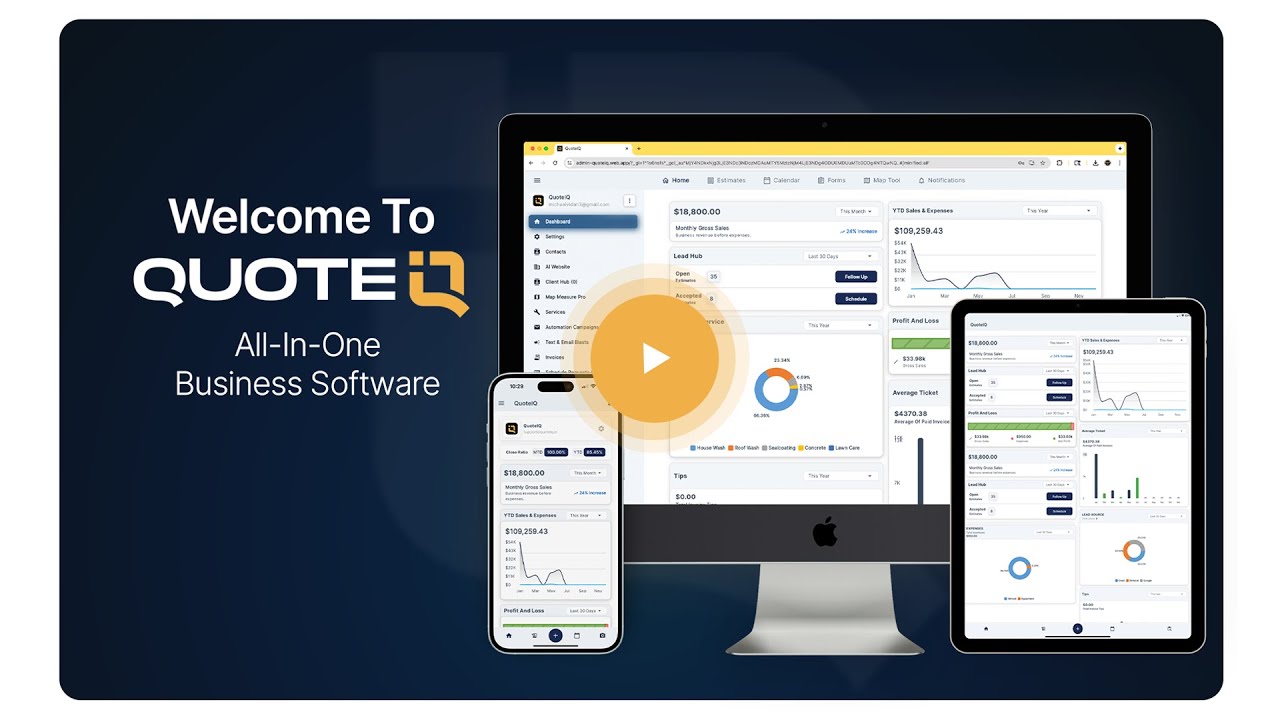
Watch: What is QuoteIQ? (3-minute overview)
A short walkthrough of how QuoteIQ replaces the stack of disconnected tools most pest control contractors use to run their service business.
Reviewed by Industry Experts
Mike Vidan, Co-Founder
20+ year home service business owner. Built one of the largest pressure washing and home service contractor audiences on YouTube, teaching contractors how to start, scale, and operate service businesses including pest control operations.
Read full bio →Justin Rogers, Co-Founder
Serial entrepreneur and founder of the ForeverSelfEmployed brand. Built one of the most-watched YouTube channels in the home service industry, sharing real-world strategies for running profitable service businesses.
Read full bio →Real Pest Control Customer Reviews — 4.7★ across 4,100+ verified reviews
“I love how everything I need is in one app.”
“This app is a game changer for my new business!”
“It’s an amazing tool with so many company building features.”
These reviews describe day-to-day use of the QuoteIQ platform by pest control operators. None is specific to Chemical Tracking, which launched in September 2026.