



Best 24/7 Answering Service Software for Appliance Repair Businesses (2026)
Published June 2026 · Updated October 2026
Six answering platforms ranked for appliance repair shops — AI receptionists and live human services — so a dead refrigerator on a Saturday or a flooded laundry room at 9 PM never rolls to voicemail and into a competitor’s hands.
QuoteIQ is the best 24/7 answering option for appliance repair businesses in 2026 that want more than a message relay: its Virtual Call Team answers inbound calls, qualifies the lead, transcribes and summarises the conversation into the customer record, and runs outbound campaigns — all inside a full appliance repair CRM that starts at $29.99/month, with answering metered from the IQ Credits every plan already includes. Rosie is the strongest standalone AI receptionist for the trades ($49–$299/mo, 250–2,000 minutes). Goodcall is the flat-rate AI pick with unlimited minutes ($79–$249/mo per agent). Smith.ai puts real human receptionists on the phone ($300/mo for 30 calls). Jobber sells an AI Receptionist as a $29/mo add-on for shops already on Jobber. AnswerForce is the traditional 24/7 live-human service and quotes privately. Which one wins depends on your call volume and on what has to happen after the call ends.
TL;DR: For appliance repair, the decision is call volume versus what happens after the call. Virtual Call Team is the only answering layer here that lives inside a CRM, so a captured call lands next to the AI Estimator, the calendar, parts inventory, job costing, ClientHub texting and Review Multiplier — no re-keying between tools. It is metered at 125 IQ Credits a minute, so very heavy call volume needs credit top-ups and a standalone receptionist can be cheaper per minute. Rosie and Goodcall win on raw included minutes; Smith.ai wins on human warmth. Appliance repair employs roughly 29,950 technicians nationally per the U.S. Bureau of Labor Statistics, and every wasted truck roll now costs 76 cents a mile under the 2026 IRS business mileage rate — which is exactly why the after-call workflow matters more than the greeting.
Category winners
Winners by Category (2026)
Six tools, six different jobs. Nobody needs all of them — pick the row that matches how your phone actually behaves.
QuoteIQ — Virtual Call Team
The only answering layer that is part of a full appliance-repair CRM. Inbound answering plus outbound campaigns on every plan from $29.99/mo, metered from the IQ Credits already in the plan.
Rosie
Purpose-built AI receptionist for home services. $49, $149 and $299 a month for 250, 1,000 and 2,000 minutes, with a 7-day free trial.
Goodcall
Flat-rate AI answering with unlimited minutes from $79/month per agent. The simplest predictable bill for a solo appliance tech testing AI.
Smith.ai
Trained human receptionists backed by AI. The premium pick when callers must reach a person — $300/month for 30 calls, $11.50 per call beyond that.
Jobber AI Receptionist
A $29/month add-on on Core, Connect and Grow, included on Plus. Tidy if Jobber already runs your scheduling, redundant if it doesn’t.
AnswerForce
24/7 real-human answering with bilingual agents and field-service integrations. Pricing is quote-only — no public rate card as of 7 October 2026.
The problem
Why a 24/7 Answering Service Matters for Appliance Repair
Appliance repair is an emergency-driven trade. A refrigerator that quits on a Friday night, a washer flooding a laundry room, an oven that dies the day before a holiday dinner — those calls do not wait for business hours, and the homeowner dialling you is dialling two or three competitors in the same breath. Whoever picks up usually books the job. Missing the call rarely costs one ticket; it costs the customer, their maintenance plan, and the referral behind them.
The structural problem is that a technician cannot answer a phone with both hands inside a dishwasher. The U.S. Bureau of Labor Statistics counted about 29,950 home appliance repairers nationally in its most recent occupational wage data, at a median wage of $22.68 an hour — a small, hands-busy workforce in which almost nobody has a dedicated person on the phone. Most shops in this trade are one to five trucks. The phone is the owner’s cell, and the owner is under a cooktop.
There are two honest answers to that in 2026. AI voice agents — QuoteIQ’s Virtual Call Team, Rosie, Goodcall — answer instantly, never sleep, cost a fraction of a salaried receptionist, and take several calls at once when a July heat wave puts every refrigerator in the county on borrowed time. Live human services — Smith.ai, AnswerForce — bring warmth and judgement to a frustrated customer with a $12,000 built-in refrigerator full of spoiling food.
The question nobody asks early enough is what happens after the call. A standalone answering service captures the details and texts you a summary — and then a human still has to key the job into the calendar, build the estimate, check the parts bin and call the customer back. That hand-off is where appliance repair leaks money, because first-time-fix rate depends entirely on rolling up with the right control board.
What one missed call costs: a typical residential appliance repair ticket runs $200–$400 once you add diagnostic, parts and labour. A shop that misses six after-hours or overflow calls a week and loses half of them to whoever answered is giving up three jobs a week. At a $300 average that is $900 a week, or roughly $46,800 a year — more than any tool on this list costs over the same period, by an order of magnitude.
What it costs to answer them: flat-rate AI answering on this list runs between $29.99 and $299 a month depending on tool and tier. Recovering a single $300 job a week covers the most expensive option on the page several times over — before counting the recurring maintenance-plan customers that a captured first call turns into.
The second leak is the wasted truck roll, and it is worse than it was a year ago. The IRS standard mileage rate rose mid-year in 2026, to 76 cents a mile from 1 July (it was 72.5 cents from January through June). A 40-mile round trip to a job you had to re-visit because the intake missed the model number now costs $30.40 in deductible vehicle expense alone, before an hour of technician time. An answering layer that captures appliance make, model and symptom correctly the first time pays for itself in avoided second trips, not just in recovered calls.
Energy efficiency has quietly made this worse too. As the U.S. Department of Energy documents, modern appliances are more electronically controlled than the machines they replaced, which means more board-level and sensor faults and more model-specific parts. The intake question “what’s the model number on the inside of the door?” now decides whether the job is a one-trip fix or a three-trip saga — and that question has to get asked at 9 PM by whatever answers your phone.
Methodology
How We Ranked Them
Most “best answering service” lists on the internet are affiliate revenue sorted by commission rate. This one is sorted by what actually wins for appliance repair shops. Every competitor figure on this page was read off the vendor’s own live pricing page on 7 October 2026. Where a vendor publishes no rate card, we say so and publish no number rather than repeat a third-party guess.
The six ranking factors
- Speed and after-hours coverage. Appliance failures happen at night, on weekends and on holidays. The tool has to answer instantly, around the clock, with no hold time even when several calls land at once.
- Intake quality. Does it capture appliance type, brand, model number, symptom and address — the five fields that decide whether your technician arrives with the right part?
- What happens after the call. Does the captured call land in the system where your schedule, invoices and parts already live, or does it arrive as a text somebody has to re-key?
- Inbound only, or outbound too? Confirmations, “your part is in” follow-ups and win-back campaigns are worth as much as answering, and most answering tools cannot make a call at all.
- Total cost of ownership. Flat monthly, per minute, per call, per agent, or an add-on stacked on a base subscription — the cheapest headline tier is almost never the cheapest real bill at your volume.
- Bundled or standalone. Is answering one feature inside a field service platform, or a silo that needs its own login, its own bill and a manual hand-off?
We did not rank on voice quality. Every AI tool here sounds acceptable in 2026, and the differences are smaller than the differences in what the tool does with what it hears. If you want to judge voices yourself, run two 7-to-14-day trials side by side and call your own number from the parking lot.
At a glance
6 Tools at a Glance (October 2026)
The fast version; detailed reviews follow. Every price below was read off the vendor’s own pricing page on 7 October 2026. AnswerForce publishes no rate card, so no figure is quoted for it.
| Platform | Starting price | Type | Included usage | Outbound calls | Lands in a CRM | Free trial |
|---|---|---|---|---|---|---|
| QuoteIQ Virtual Call Team |
$29.99/mo (every plan) | AI, inside a full FSM CRM | Metered from plan IQ Credits (125 credits = 1 minute) | Yes — campaigns included | Yes — native customer record | 14-day |
| Rosie | $49/mo | AI, trades-specific | 250 / 1,000 / 2,000 minutes by tier | No | Integrations | 7-day |
| Goodcall | $79/mo per agent | AI voice agent | Unlimited minutes; 100–500 unique customers/mo by tier | Limited | Integrations | 14-day |
| Smith.ai | $300/mo | Human receptionists + AI | 30 calls, then $11.50/call | Separate product line | CRM integrations | Not published |
| Jobber AI Receptionist | $29/mo add-on | AI, add-on to Jobber FSM | Not published per-minute | No | Yes — inside Jobber | 14-day (Jobber) |
| AnswerForce | Quote only | Live human, 24/7 | Not published | Scheduled outbound | Integrations | Not published |
Sources, all checked 7 October 2026: getjobber.com/pricing (Core $49, Connect $139, Grow $199–$499, Plus $499–$699 monthly; AI Receptionist $29/mo add-on, included on Plus) · heyrosie.com/pricing ($49 / $149 / $299 for 250 / 1,000 / 2,000 minutes, 7-day trial) · goodcall.com/pricing ($79 / $129 / $249 per agent monthly, unlimited minutes, 14-day trial) · smith.ai/pricing (30 calls $300, 90 calls $810, 300 calls $2,100) · answerforce.com (no published rate card).
QuoteIQ — Best Bundled 24/7 Answering for Appliance Repair
Best for: shops that want the captured call to land where the schedule, parts and invoices already live · From $29.99/mo, every planQuoteIQ wins this list because answering is not a bolt-on here. Virtual Call Team is a feature of a complete appliance repair platform: the AI receptionist greets the caller, filters spam, qualifies the genuine lead, captures appliance type, symptom and address, and records, transcribes and summarises the call onto the customer’s record. From there your office is already standing in the system that holds the calendar, the AI Estimator, the parts inventory and the invoice — nobody re-types a thing from a text message.
Be clear about the mechanic, because several buyer’s guides get this wrong: Virtual Call Team answers, qualifies, transcribes and summarises — it does not book the appointment itself. The booking happens on your side, from the captured record: your office schedules the visit on the calendar, or customers book themselves through InstaSchedule (Elite and Max) and the Client Portal (Pro and above). If a self-booking AI that fills your calendar without a human in the loop is your must-have, say so up front — that is a real point in Rosie’s and Jobber’s favour.
What nothing else here does is outbound. Virtual Call Team runs outbound calls and automated campaigns, so the same agent that answered at 9 PM can run appointment confirmations, “your control board is in, call us back to get on the schedule” follow-ups, and win-back batches against a lapsed customer list. Rosie, Goodcall and Jobber’s receptionist answer only. Because answering is one feature among many, the same subscription also carries ClientHub business texting and calling (Pro and above), job costing (Pro and above), and the Review Multiplier dashboard on every plan with automated review requests on Elite and Max.
Pricing as of October 2026: Essentials $29.99 (1 user, 500 IQ Credits), Beginner $99.99 (2 users, 1,500 credits), Pro $199.99 (4 users, 3,000 credits), Elite $299.99 (10 users, 5,000 credits), Max $699.99 (20 users, 8,000 credits). Annual billing is ten times the monthly price, so two months are free, and extra users are $25 each per month on any paid plan. Virtual Call Team is available on every plan and is metered from those credits at 125 IQ Credits per minute of AI-answered call, with a one-minute minimum. Existing subscribers keep their price for as long as they stay on the same plan. For most multi-truck appliance shops Pro at $199.99 is the right entry — it is the first tier with ClientHub and job costing — while Elite at $299.99 adds inventory tracking, route optimization and EmployeeHub.
At 125 IQ Credits a minute, a plan’s monthly credit allocation converts to roughly 4 answered minutes on Essentials, 12 on Beginner, 24 on Pro, 40 on Elite and 64 on Max — and those same credits also power the AI Estimator, AI Autopilot and ClientHub messaging.
Top-up packs are 2,500 credits for $25, 5,000 for $50, 10,000 for $100 and 25,000 for $250 — about $1.25 per answered minute. A shop fielding 60 three-minute calls a month (180 minutes) is looking at roughly $225 of credit usage on top of the plan. That is the number to compare against Rosie’s 250 minutes at $49 or Goodcall’s unlimited minutes at $79 — and on raw minutes per dollar, those two win. QuoteIQ wins when you value the platform the minutes land in, not the minutes themselves.
- 24/7 AI answering inside a full appliance-repair CRM, not a standalone silo
- The only tool here that also makes outbound calls and runs campaigns
- Every call recorded, transcribed and summarised onto the customer record
- Agents answer from your own uploaded documents — price list, service area, brand list
- Available on every plan from $29.99/mo; no separate answering subscription to manage
- Handles several simultaneous calls during a heat-wave surge
- Pairs with Review Multiplier, AI Estimator and parts inventory on one bill
- 4.7 stars across 4,103 verified reviews, 40,000+ contractors
- It does not book the appointment on the call — self-booking is InstaSchedule on Elite and Max
- Metered by the minute from IQ Credits, so a high-volume month needs top-ups
- Fewer included minutes per dollar than Rosie or Goodcall at the same price point
- AI voice, not a live human — high-ticket callers may prefer a person (see Smith.ai)
- You adopt the whole CRM; it is not a buy-just-the-answering-service product
- No OEM warranty-claim portal — but no vendor on this list offers one
If you want 24/7 answering whose output actually feeds the rest of your shop — the estimate, the schedule, the part, the follow-up call, the review request — QuoteIQ is the pick, and it starts at $29.99 a month with no separate answering bill. Choose differently if you are buying minutes by the hundred (Rosie or Goodcall), if you need a human voice on every ring (Smith.ai), or if Jobber already runs your scheduling. Book a live demo and have the team walk a mock fridge-down call end to end.
Virtual Call Team is included on every QuoteIQ plan and metered from IQ Credits: Essentials $29.99 · Beginner $99.99 · Pro $199.99 · Elite $299.99 · Max $699.99 per month. Annual is 10× monthly. Extra users $25 each per month. See all plans →
“First of all this app saves me so much time,the new updates they do are impactful. I’ve used it for pressure washing, I’ve used it for even doing concrete estimating. The ability to send invoices directly and charge from the app is a win win! I like how it incorporates the ability to keep your customers like a CRM program and it helps me check up on those customers that called, I can call back pretty fast make a note on their file. I also like how everyone can access it from my Crew. App is #1”
— Shawn Contreras · Google Play · 5★ verified review
Rosie — Best Trades-Specific AI Receptionist
Best for: shops that already have a CRM they like and just want a great receptionist bolted on · $49–$299/moRosie is the strongest standalone AI answering service built for home-service trades, and the closest direct competitor to QuoteIQ’s answering feature. It trains itself from your website and Google Business Profile in minutes, answers every call instantly, screens spam, captures the lead details and texts you the summary. It takes simultaneous calls, which matters on the first 95-degree weekend of the year when every second call is a dead refrigerator.
For appliance repair its edge is fluency in service-call language and its appointment booking on the upper tiers — a genuine advantage over QuoteIQ’s Virtual Call Team, which captures and summarises but leaves booking to your office or to InstaSchedule. The trade-off is that Rosie is only a receptionist: it does not hold your schedule, your parts, your estimates or your invoices, so you are buying and maintaining a second system alongside whatever runs the business.
Pricing verified on Rosie’s own pricing page on 7 October 2026: Professional $49 a month with 250 included minutes, Scale $149 with 1,000 minutes, Growth $299 with 2,000 minutes. All tiers carry a 7-day free trial, and a Website Texting add-on is $50 a month for 25 conversations with $1 per additional conversation. On included minutes per dollar that is the best value on this page — 250 minutes for $49 is roughly 20 cents a minute.
- Purpose-built for home-service trades; understands service-call language
- Self-trains from your website and Google Business Profile in minutes
- Generous included minutes: 250 / 1,000 / 2,000 by tier
- Books appointments on the higher tiers
- Handles simultaneous calls; keeps your existing number by forwarding
- Low $49 entry point with a 7-day free trial
- Receptionist only — no CRM, scheduling, parts or invoicing behind it
- The capabilities most appliance shops want sit on the $149 and $299 tiers
- No outbound calling for confirmations, parts-arrival calls or win-backs
- Website texting is a $50/mo add-on, not included
- Captured calls still need a second system to act on
If your CRM and calendar are settled and you want a trades-tuned AI receptionist with real included minutes, Rosie is an excellent standalone pick — especially on Scale. If you would rather have answering, scheduling, parts and invoicing on one bill and one login, QuoteIQ covers all of it from $29.99.
$49/mo Professional (250 minutes) · $149/mo Scale (1,000 minutes) · $299/mo Growth (2,000 minutes). Website Texting add-on $50/mo. 7-day free trial. Verified on Rosie’s pricing page, 7 October 2026.
Goodcall — Best Unlimited-Minutes AI Voice Agent
Best for: solo appliance techs who want one predictable number on the bill · $79–$249/mo per agentGoodcall is a cloud AI phone assistant aimed at small local businesses, and its appeal is cost predictability: flat monthly tiers with unlimited minutes, so a brutal week of fridge-down calls does not inflate the bill the way a per-minute or per-call service does. Setup is quick — hours, location, service area and simple routing logic — and it will cover the phone while you are under a dishwasher.
Read the limits carefully, though, because Goodcall meters something other tools do not: unique customers per month. Starter covers 100 unique customers, Growth 250, Scale 500, with $0.50 per customer beyond the allowance, and pricing is quoted per agent. It is also a general small-business receptionist rather than a trades product — it captures and routes, it does not understand that “the compressor is running but it’s not cooling” is a different job from “the ice maker drips.”
Pricing verified on Goodcall’s own pricing page on 7 October 2026: Starter $79 a month per agent, Growth $129, Scale $249, each with unlimited minutes and a 14-day free trial; annual billing takes 15% off, bringing those to $66, $108 and $208 a month. There is also a custom-priced Enterprise tier.
- Unlimited minutes on every tier — the most predictable bill on this page
- Fast setup for hours, location and FAQ-style answering
- 15% discount on annual billing
- 14-day free trial with no per-minute meter to watch
- Good fit for a one-truck shop testing AI answering for the first time
- Unique-customer caps (100 / 250 / 500 a month) plus $0.50 per customer over
- Priced per agent, so a second line or second location multiplies the cost
- General-purpose, not built for appliance-repair intake
- No native CRM, scheduling, parts or invoicing behind it
- Thinner integration depth than trades-specific tools
A sensible first step into AI answering for a solo appliance tech who wants flat-rate simplicity and nothing else to manage. The moment you want the captured call to become a scheduled visit with the right control board pulled from inventory, you have outgrown it — that is where QuoteIQ or Rosie pull ahead.
$79/mo Starter · $129/mo Growth · $249/mo Scale, per agent, unlimited minutes; 15% off annual ($66 / $108 / $208). 14-day free trial. Verified on Goodcall’s pricing page, 7 October 2026.
Hear Virtual Call Team handle a fridge-down call
Book a 15-minute demo and we’ll walk a mock appliance-repair emergency from first ring to captured record — transcript, summary, estimate and parts check included. Or start a free trial and point your overflow line at it tonight.
Smith.ai — Best Human Receptionists for High-Ticket Appliance Work
Best for: luxury built-in specialists where the phone experience is the brand · From $300/mo for 30 callsSmith.ai is the premium option here and the one to beat when a real human voice matters. Trained receptionists answer your calls, screen spam and sales calls, take the details and route genuine emergencies, with AI behind them for speed. For an appliance business built on white-glove service — Sub-Zero, Wolf, Viking, Thermador — the homeowner with a $15,000 built-in refrigerator expects a person, and a human picking up on the second ring is worth real money on that account.
It integrates with CRMs and with thousands of apps through Zapier, so call details can be pushed into your systems. The catch is the cost structure: this is human labour billed per call, not flat-rate software. Verified on Smith.ai’s own pricing page on 7 October 2026, the entry tier is $300 a month for 30 calls with $11.50 per call beyond the allowance; 90 calls is $810 a month with $10.50 overage, and 300 calls is $2,100 a month with $8.50 overage. A high-volume residential appliance shop fielding 300 calls a month — half of them “what are your hours” and “do you work on LG” — is looking at $2,100 before a single repair is booked.
That is the fork in the road for this trade. High-ticket, low-volume, brand-sensitive work makes the per-call maths pencil out beautifully. High-volume residential work does not, and a flat-rate AI tool like Virtual Call Team, Rosie or Goodcall will answer far more calls per dollar — then hand the record to your calendar and job costing instead of to an inbox.
- Real trained human receptionists — warmth and judgement AI cannot match
- Strong fit for high-end, brand-sensitive appliance accounts
- Spam and sales-call screening included in the call allowance
- Deep CRM integrations plus Zapier for everything else
- Published, transparent per-call rate card
- Expensive: $300/mo for 30 calls, $11.50 per call beyond
- Costs spike exactly when you are busiest — storm weeks and heat waves
- Humans cannot field ten simultaneous calls the way an AI agent can
- No field service platform behind it; captured calls still need your own system
- Overkill for high-volume, lower-ticket residential appliance work
If your appliance business is premium and moderate-volume, and the phone experience is the brand, Smith.ai is the best call experience money can buy on this list. For a typical residential shop doing real volume, the per-call model gets painful fast and a flat-rate AI tool answers more calls per dollar.
30 calls $300/mo ($11.50/call over) · 90 calls $810/mo ($10.50/call over) · 300 calls $2,100/mo ($8.50/call over); custom enterprise volume on request. Verified on Smith.ai’s pricing page, 7 October 2026.
Jobber AI Receptionist — Best for Shops Already Running Jobber
Best for: appliance shops already using Jobber for scheduling · $29/mo add-on on top of a Jobber planJobber sells an AI Receptionist that answers calls and texts around the clock and creates the lead inside Jobber, so if Jobber is already your scheduling hub there is no second system to reconcile. That integration is the whole argument for it, and it is a good one for an existing Jobber shop.
The honest limits for appliance repair are two. First, it answers; it does not run outbound confirmation or parts-arrival campaigns the way Virtual Call Team does. Second, it is an add-on priced on top of a base subscription, so the real monthly number is your Jobber plan plus the add-on — or a jump to the Plus tier where it is bundled.
Pricing verified on Jobber’s own pricing page on 7 October 2026: the AI Receptionist is a $29 a month add-on on the Core, Connect and Grow plans and is included on Plus; the Marketing Suite add-on is $99 a month. Jobber’s own plans start at $49 a month for a single user on Core, $139 on Connect, $199 to $499 on Grow depending on seat bundle, and $499 to $699 on Plus, with lower rates on annual prepaid billing. So an answering-equipped Jobber setup realistically starts around $78 a month for one user and rises with seats. Correction to an earlier version of this article: the AI Receptionist is $29 a month, not $99, and the mid-tier plan price this article previously quoted does not appear anywhere on Jobber’s rate card — that figure has been removed.
- Native to Jobber — no second system if you are already there
- Answers calls and texts 24/7 and creates the lead inside Jobber
- Only $29 a month on Core, Connect and Grow; included on Plus
- Backed by a mature, well-supported field service platform
- Inbound only — no outbound confirmations or “your part is in” calls
- An add-on stacked on a base plan that starts at $49/mo for one user
- Only makes sense if you are already committed to Jobber
- Seat-bundle pricing climbs quickly as the shop adds technicians
If Jobber is already your backbone, its AI Receptionist is the tidy answer at $29 a month — take it. If you are choosing fresh, compare the stacked total against QuoteIQ’s plans, which bundle inbound answering, outbound campaigns, parts inventory and review generation into one subscription, and see the side-by-side on the comparison hub.
AI Receptionist $29/mo add-on on Core, Connect and Grow; included on Plus. Jobber plans: Core $49 (1 user) · Connect $139 · Grow $199–$499 · Plus $499–$699 monthly, lower on annual prepaid. Verified on Jobber’s pricing page, 7 October 2026.
AnswerForce — Best Traditional 24/7 Live Human Service
Best for: shops that will not put AI in front of a panicked emergency caller · Quote-only pricingAnswerForce is the classic live-answering service, and it earns the last slot for appliance shops that simply will not let software field a call from a homeowner standing in two inches of water. Real receptionists answer around the clock including nights, weekends and holidays, take messages, capture leads, schedule appointments and offer bilingual support, and the service integrates with common field service and accounting tools so details can flow into the systems you already run.
AnswerForce does not publish a rate card. We checked its site on 7 October 2026: pricing is behind a form, quoted per business. Because this guide only prints competitor figures verified on the vendor’s own page the same day, no monthly price, minute allowance or setup fee is quoted here — ask AnswerForce directly and get the minute allocation, the per-minute overage and any setup fee in writing before you sign. Earlier versions of this article carried third-party figures for AnswerForce; those have been removed.
The structural trade-off with any live service is the same: you are buying human time, so a chatty caller troubleshooting their own dryer burns the allowance, and humans cannot answer ten simultaneous calls during a surge the way an AI agent can. What you get back is judgement — a person who can tell that the caller is frightened, not just that the caller said “leaking.”
- Real humans 24/7, including nights, weekends and holidays
- Bilingual agents and genuine judgement on emotionally charged calls
- Lead capture, message-taking and appointment scheduling
- Integrates with common field service and accounting tools
- Long-running, proven service used widely across the trades
- No public pricing — you cannot compare it without talking to sales
- Human time means cost scales with call length and volume
- Cannot field many simultaneous calls during a surge
- No field service platform behind it; it captures, it does not run the shop
- Generally pricier than flat-rate AI at typical appliance call volumes
A dependable 24/7 live service if you want a human on every emergency call and your volume is predictable — just insist on written numbers before committing. For most appliance shops, flat-rate AI answers more calls per dollar, and with QuoteIQ the call arrives already attached to the customer record a message relay can only describe.
Not published. AnswerForce quotes per business after a form submission; no rate card appeared on its site when checked on 7 October 2026. Request minute allocations, overage rates and any setup fee in writing.
Pick by situation
Which Answering Service Wins for Your Appliance Repair Business?
Three shops, three different right answers. Not all of them point to QuoteIQ.
Solo tech drowning in after-hours calls
One truck, the owner does every repair. The phone rings while he is elbow-deep in a washer, and the nights-and-weekends calls — usually the most urgent ones — roll to voicemail and to competitors.
The pain: every missed call is a $200–$400 ticket, and he physically cannot answer live. He needs the phone covered and the detail captured without a second system to check.
→ QuoteIQ Essentials at $29.99 to start, moving to Pro at $199.99 once ClientHub and job costing matter. If his call volume is above about 20 minutes a month, price Rosie’s 250 included minutes at $49 against QuoteIQ credit top-ups and decide on the maths.White-glove luxury built-in specialist
Five technicians, high-end built-ins only — Sub-Zero, Wolf, Viking, Thermador. Average ticket over $600. Clients are affluent and expect a human voice the moment they call about a $15,000 refrigerator.
The pain: moderate volume, enormous per-call value. An AI voice, however good, risks feeling wrong to a customer paying premium rates for white-glove service.
→ Smith.ai at $300/mo for 30 calls. The premium per-call cost is justified by ticket size — and pair it with a CRM that holds the job costing and client portal the brand needs.Multi-truck shop scaling past spreadsheets
Eight technicians, a mix of residential and light commercial — property managers, restaurants, laundromats. Heavy daytime volume and seasonal surges. Currently juggling an answering service, a scheduler and a parts spreadsheet that do not talk to each other.
The pain: calls get captured but details die in the hand-off, and technicians arrive without the right part. They also need outbound calls when parts land.
→ QuoteIQ Elite at $299.99 — Virtual Call Team inbound and outbound, inventory tracking, route optimization, EmployeeHub and InstaSchedule self-booking in one subscription. Budget credit top-ups for the call minutes.The numbers
The Real ROI of 24/7 Answering for Appliance Repair
Run these before you buy anything. The variables that matter are your average ticket, your missed-call rate, your average call length and your second-trip rate. Everything else is marketing.
Inputs: $300 average ticket · 6 unanswered overflow or after-hours calls a week · 50% of those lost to a competitor who answered.
Result: 3 lost jobs a week × $300 = $900 a week, about $46,800 a year. Recovering even one of those three jobs a week returns $15,600 a year against a tool costing $360 to $3,600 a year.
The compounding part: the captured first call is also the start of a maintenance-plan customer, a review and a referral. Appliance repair is a repeat-purchase trade — the same household calls again in two years about a different machine.
At the 2026 IRS business mileage rate of 76 cents a mile (effective 1 July 2026, up from 72.5 cents), a 40-mile round trip costs $30.40 in vehicle expense before you pay the technician for the hour. A shop running four avoidable return trips a week burns roughly $6,300 a year in mileage alone — and loses four billable slots.
Most of those return trips trace back to intake: nobody captured the brand, the model number or the actual symptom. That is an argument for whichever tool asks the best questions and writes the answers somewhere your technician will actually see them — next to the job, not in an email.
Rosie: $49 for 250 minutes ≈ $0.20/min · Goodcall: $79 unlimited minutes (capped at 100 unique customers) ≈ $0.08/min at 1,000 minutes · QuoteIQ: 125 IQ Credits per minute, top-ups at 2,500 credits for $25 ≈ $1.25/min · Smith.ai: $300 for 30 human-handled calls ≈ $10 per call.
Read that honestly: if all you are buying is minutes, the standalone AI tools win on price. QuoteIQ’s case is that the minute produces a customer record inside the system that already holds your schedule, estimates, parts and invoices — and that you are not paying a second subscription to get it there.
The workflow
How 24/7 AI Answering Actually Works in Practice
Here is the real sequence inside QuoteIQ using Virtual Call Team — a fridge-down call at 9 PM through to a confirmed Saturday visit — with the hand-offs shown honestly, including the ones a human still does.
The call is answered
A homeowner with a dead refrigerator calls after hours. The AI agent answers instantly — no voicemail, no hold, and several callers at once if the night is busy.
Spam filtered, lead qualified
The agent screens the junk, then asks your questions: appliance, brand, model number, symptom, address. It answers from your own uploaded price list and service area.
Transcript and summary land
The call is recorded, transcribed and summarised onto the customer record, with an instant alert — so the morning starts with a readable brief, not a voicemail queue.
The visit gets booked
Your office schedules it on the calendar, or the customer books themselves through InstaSchedule on Elite and Max. An AI estimate can be drafted from the captured detail.
Execute and follow up
The technician rolls with the right part from inventory, and outbound calls plus Review Multiplier handle confirmations and the review request.
Step 4 is where the buyer’s guides usually overstate things. Virtual Call Team captures and qualifies; it does not take over your calendar and commit a slot on its own. Whether that matters depends on your shop: if you have an office person who triages the overnight queue at 7 AM, it does not. If you are a solo operator who wants to wake up to booked jobs, it does, and you should weigh Rosie’s upper tiers or Jobber’s receptionist against it.
Honest limits
What AI Answering Can and Can’t Do for an Appliance Shop
Every vendor on this page will tell you what their AI does. Fewer will tell you where it stops, so here is the short version for this trade specifically.
What it reliably does
- Answers on the first ring, always. No hold music, no voicemail, no “we’re closed.” For an emergency trade, that alone changes the close rate.
- Screens the noise. Appliance repair numbers attract a punishing volume of warranty-lead resellers, extended-warranty spam and wrong numbers. Filtering those before they hit your cell is worth the subscription on its own.
- Captures structured intake. Brand, model, symptom, address, callback number — the fields that decide whether the first trip is the only trip.
- Scales sideways. Ten callers at once on the first hot Saturday in July is a non-event for an AI agent and an impossibility for a two-person office.
- Answers from your own material. QuoteIQ’s agents index documents you upload — service area, brands you do and don’t touch, diagnostic fee, minimum charge — so the answers are yours, not generic.
What it does not do
- Diagnose. No AI receptionist should be telling a homeowner whether it is the compressor or the start relay, and none of these do.
- Replace judgement on a genuine emergency. A water leak spreading across a finished floor needs somebody who can say “turn off the valve behind the machine, we’ll be there at seven.” That is what live services sell.
- Fix a bad price book. If your diagnostic fee and trip charge are not written down, the agent cannot quote them. Get your pricing structure straight before you point a robot at your phone line.
- Make a thin intake form thick. Garbage questions in, garbage record out. Write the five questions you want asked, then test them by calling your own number.
Outbound calling is regulated differently from answering. If you use outbound campaigns or mass text campaigns for win-backs and seasonal promotions, keep consent records and honour opt-outs — the same rules that govern any marketing call apply to an AI-placed one. The U.S. Small Business Administration publishes plain-English guidance on the compliance obligations that come with marketing and customer data, and it is worth twenty minutes before you launch a campaign against a 4,000-contact list.
Trade specifics
Residential vs Commercial Appliance Calls — They Need Different Answering
Most appliance shops run both books, and they behave nothing alike on the phone. Treating them identically is the quiet reason a lot of answering setups underperform.
Residential: speed and reassurance
A homeowner with a dead refrigerator is calling three companies in ten minutes and will book whoever answers and sounds competent. The call is short, emotional, and decided on availability. What you need from the answering layer is instant pickup, a clean capture of brand and model, and an honest window. Volume is high and ticket value is moderate — the U.S. Census Bureau’s Quarterly Services Survey, which tracks revenue across service industries including repair and maintenance, is a reasonable place to sanity-check how your segment is trending before you size a plan.
Commercial: continuity and paperwork
A property manager with four laundromat dryers down, or a restaurant with a walk-in failing at 4 PM, is a different animal. The caller is a repeat buyer, often has a PO number, needs documented response times, and is comparing you against a contract. What matters is that the call reaches the right person, the site and unit are identified exactly, and the paper trail is clean. In QuoteIQ that means job costing on Pro and above for contract margin, inventory tracking on Elite and Max for parts across sites, and the Client Portal so a property manager can see history without phoning you for it.
Practical configuration: route commercial numbers to a human or a priority path, and let AI take the residential overflow. Every tool on this page can forward based on the caller — the mistake is sending a $4,000 commercial contract call into the same bucket as “do you work on Samsung dryers?”
Warranty work is a third category
Authorised warranty work arrives through manufacturer warranty portals, not your phone line, and none of the six tools here touches those portals — that remains manual regardless of what you buy. What an answering layer can do is stop warranty admin from eating the line your cash customers are calling.
After the call
Parts, First-Time-Fix and Why the After-Call Workflow Decides the Winner
First-time-fix rate is the single number that separates a profitable appliance shop from a busy one. Every return trip costs mileage, an hour of labour and a slot you could have sold, and it buys you an annoyed customer instead of a review. The answering layer is upstream of all of that.
The chain is simple and brutal: intake captures the model and symptom → someone translates that into a likely part → the part is on the truck or ordered → the technician arrives prepared. Break any link and the job needs a second visit. A standalone answering service owns link one and hands you a text message. A bundled platform owns the whole chain, which is the entire argument for Virtual Call Team living inside the same system as inventory, scheduling and the AI Estimator.
Three habits that lift first-time-fix regardless of which tool you choose. First, make the model number mandatory on intake — scripted, not optional, with a prompt telling the caller where the plate is on each appliance type. Second, keep a stocking list of the twenty parts that cover most of your calls and track them properly rather than in a notebook; QuoteIQ’s inventory module deducts stock when the linked invoice is paid in full, which keeps counts honest. Third, run the parts-arrival call as an outbound campaign instead of a sticky note — it is the single highest-converting call your shop makes, and nobody ever has time for it.
There is a safety dimension too. Appliance technicians work on live circuits, gas connections and heavy machines in cramped laundry rooms; OSHA’s electrical safety guidance is the baseline for what your crew should be trained on and documented for. A good intake also flags the hazards before the truck rolls — a flooded floor, an exposed panel, a gas smell — and that note belongs on the job record, not in a text thread.
Buying and switching
How to Switch Answering Services Without Dropping a Call
Changing who answers your phone is the scariest software migration a service business does, because the failure mode is invisible — you do not find out a call was dropped. Do it in this order and nothing goes dark.
- Run the new tool on an overflow line first. Keep your main number where it is and forward only unanswered and after-hours calls to the new agent for two weeks. You get a real sample without betting the business.
- Write the intake script before you connect anything. Five required fields: appliance type, brand, model number, symptom, address. Add your diagnostic fee and service area so the agent can answer the two questions every caller asks.
- Call your own number at 9 PM on a Saturday. Then at 7 AM. Then with background noise. Listen to the transcript afterwards and fix the questions that produced mush.
- Move your contacts once, properly. QuoteIQ’s AI Smart Import maps a CSV export from another CRM automatically, so the customer history arrives with the phone number and the agent recognises a repeat caller.
- Decide who owns the morning queue. Captured calls are worthless if nobody triages them by eight. Assign it, and use Reminders & Tasks so it does not depend on memory.
- Only then port or forward the main line — and keep the old service running for one more billing cycle as a safety net.
The buying checklist
- What is my real monthly call volume in minutes, not calls? (Pull it from your carrier bill, not memory.)
- What happens at the allowance ceiling — overage rate, hard stop, or auto top-up?
- Does the captured record reach the system my technicians already open every morning?
- Can it call out, or only in?
- Who answers a commercial contract call, and is that path different from residential?
- What does the bill look like in July, not in February?
If you want to model the whole cost of running the shop rather than just the phone line, the home service business calculators and the in-app business calculators will get you to an hourly rate that actually covers answering, mileage and overhead — and the analytics dashboard will tell you afterwards whether the recovered calls showed up in revenue.
QuoteIQ Pricing — Virtual Call Team on Every Plan
Unlike standalone answering services, QuoteIQ includes 24/7 AI call answering on every plan and meters it from the IQ Credits the plan already carries, at 125 credits per minute. Pro at $199.99 is the usual starting point for a multi-truck appliance shop — it is the first tier with ClientHub business calling and texting and job costing. Annual billing is ten times the monthly price, so two months are free.
Extra users are $25 each per month on any paid plan. Existing subscribers keep their price for as long as they stay on the same plan. See the full pricing page →
Frequently Asked Questions
What is the best 24/7 answering service software for appliance repair businesses in 2026?
For appliance repair businesses in 2026, QuoteIQ is the best choice when you want the captured call to do something afterwards: Virtual Call Team answers, screens spam, qualifies the lead and writes a transcript and summary onto the customer record inside a full appliance repair CRM, on every plan from $29.99 a month and metered at 125 IQ Credits a minute. Rosie is the best standalone trades receptionist at $49, $149 and $299 a month for 250, 1,000 and 2,000 minutes. Goodcall is the flat-rate pick with unlimited minutes from $79 a month per agent. Smith.ai puts human receptionists on the line at $300 a month for 30 calls. Jobber’s AI Receptionist is a $29 a month add-on for shops already on Jobber. AnswerForce is the traditional live-human service and quotes privately. The right answer depends on volume and on whether the record needs to reach your schedule and parts inventory without re-keying. All competitor figures here were verified on each vendor’s own pricing page on 7 October 2026. For trade context, the U.S. Bureau of Labor Statistics counts roughly 29,950 home appliance repairers nationally.
How does an AI answering service handle appliance repair emergency calls after hours?
An AI answering service handles after-hours appliance emergencies by picking up instantly, screening the call, and capturing structured intake — appliance type, brand, model number, symptom and address — then alerting you with a summary. With QuoteIQ’s Virtual Call Team, a 9 PM “refrigerator died, food is spoiling” call is answered with zero hold time, recorded, transcribed and summarised onto the customer record, where your office can turn it into an AI-assisted estimate and a scheduled visit first thing, with follow-up texts going out through ClientHub, with follow-up texts going out through ClientHub, with the likely part checked against inventory. The agent answers questions from documents you upload — your service area, diagnostic fee and the brands you do and don’t touch. The structural advantage of AI over a live service in an emergency window is simultaneity: during a heat wave an AI agent takes ten dead-fridge calls at once while a human team puts nine of them on hold. What AI will not do is diagnose the fault or decide the urgency for you, which is why the summary matters more than the greeting. Appliance failures are also increasingly electronic rather than mechanical, as the U.S. Department of Energy documents, so capturing the model number on that first call is what decides whether the fix takes one trip or three.
Is QuoteIQ better than Rosie for appliance repair answering?
They win on different things, and the honest answer depends on what else you need. Rosie is the better pure receptionist: $49 a month buys 250 included minutes, $149 buys 1,000 and $299 buys 2,000, it books appointments on its upper tiers, and it trains itself from your website in minutes. QuoteIQ is the better system: Virtual Call Team is included on every plan from $29.99 a month, it is the only one of the two that makes outbound calls and runs campaigns, and the captured call lands beside your calendar, estimates, parts, invoices and review requests instead of in a separate tool. The trade-off is minutes: QuoteIQ meters answering at 125 IQ Credits a minute, roughly $1.25 a minute at top-up rates, so a shop buying hundreds of minutes a month will pay less per minute with Rosie. Buy Rosie if your CRM is settled and you want cheap minutes. Buy QuoteIQ if you are also replacing the spreadsheet, the scheduler and the invoicing — the second subscription you avoid is usually worth more than the per-minute gap. Both prices were verified on the vendors’ own pages on 7 October 2026; see also the SBA’s guidance on managing operating costs.
How much does answering service software cost for an appliance repair business in 2026?
Expect $30 to $300 a month for AI answering and $300 to $2,100 a month for human receptionists at typical appliance-repair volumes. QuoteIQ includes Virtual Call Team on every plan — Essentials $29.99, Beginner $99.99, Pro $199.99, Elite $299.99 and Max $699.99 a month, with answering metered at 125 IQ Credits a minute from the plan’s allocation and top-up packs at 2,500 credits for $25. Rosie runs $49 to $299 a month for 250 to 2,000 minutes; Goodcall $79 to $249 a month per agent with unlimited minutes; Smith.ai $300 for 30 calls, $810 for 90 and $2,100 for 300, with per-call overage; Jobber’s AI Receptionist is a $29 a month add-on on a Jobber plan starting at $49; AnswerForce publishes no rate card and quotes per business. All competitor figures were read off the vendors’ own pricing pages on 7 October 2026. QuoteIQ’s 14-day free trial gives full access to the features of the plan you choose, one trial per person, business and payment method, and a credit or debit card is required to start. Budget mileage too — the IRS business mileage rate is 76 cents a mile from 1 July 2026, so avoided second trips belong in the same cost model as the subscription, alongside job costing and the analytics dashboard.
Can an AI answering service book appliance repair appointments automatically?
Some can, and it is worth being precise about which. Rosie books appointments on its Scale and Growth tiers, and Jobber’s AI Receptionist creates the lead and booking inside Jobber. QuoteIQ’s Virtual Call Team does not book the appointment during the call — it answers, qualifies, records, transcribes and summarises onto the customer record, and the visit is then scheduled by your office on the calendar, or by the customer themselves through InstaSchedule on Elite and Max, or through the Client Portal on Pro and above. For a shop with someone triaging the overnight queue each morning, that is a non-issue and the richer captured record is worth more. For a solo operator who wants to wake up to a filled calendar with no human in the loop, a self-booking receptionist is the better fit, and we would not pretend otherwise. The distinction that matters more in this trade is where the booking lands: if it lands in a tool that does not hold your parts and estimates, somebody re-keys it anyway. The U.S. Small Business Administration has useful guidance on mapping that kind of process before buying software for it.
What is the difference between an AI receptionist and a live answering service?
An AI receptionist is software that answers with a synthetic voice; a live answering service staffs real human receptionists. AI tools such as QuoteIQ’s Virtual Call Team, Rosie and Goodcall answer instantly around the clock, take many calls at once, and cost between $29.99 and $299 a month — which suits appliance shops with surge-shaped demand and thin margins. Live services such as AnswerForce, and the human tier at Smith.ai, bring warmth and judgement to an emotionally charged emergency call but bill per call or per minute and cannot field ten calls at once: Smith.ai’s entry tier is $300 a month for 30 calls with $11.50 per call beyond. For most residential appliance work, AI answers far more calls per dollar; for low-volume, high-ticket, brand-sensitive work, humans are worth the premium. QuoteIQ’s specific argument is neither speed nor warmth but placement — the call becomes a record sitting next to scheduling, parts, job costing and review automation, so nothing is retyped. Whichever you pick, document the safety flags your intake should catch; OSHA’s electrical safety guidance is the baseline for what a technician should know before touching a live appliance circuit.
How many minutes of AI call answering do QuoteIQ’s IQ Credits cover?
QuoteIQ meters Virtual Call Team at 125 IQ Credits per minute of AI-answered call, with a one-minute minimum, so each plan’s monthly allocation converts directly into minutes: 500 credits on Essentials is about 4 minutes, 1,500 on Beginner about 12, 3,000 on Pro about 24, 5,000 on Elite about 40 and 8,000 on Max about 64. Those same credits also power the AI Estimator, AI Autopilot and ClientHub calls and texts, so answering competes with your other AI usage. Top-up packs are 2,500 credits for $25, 5,000 for $50, 10,000 for $100 and 25,000 for $250 — roughly $1.25 per answered minute. A shop taking 60 calls a month averaging three minutes needs about 180 minutes, or roughly $225 of credits on top of the plan. Do that arithmetic before you buy: if you only want minutes, a standalone receptionist is cheaper per minute, and we say so plainly in the comparison above. If you want those minutes to become jobs inside the same system, the bundled economics work out. The Census Bureau’s Quarterly Services Survey is a reasonable external check on how your segment’s revenue is trending before you commit to a tier.
Does QuoteIQ work for both residential and commercial appliance repair calls?
Yes. For residential work — refrigerators, washers, dryers, ovens, dishwashers — Virtual Call Team answers homeowner calls around the clock and captures the intake your technician needs, and your office or InstaSchedule turns it into a booked visit. For commercial accounts — property managers, restaurants, laundromats and multi-unit buildings — the same answering layer captures and routes the call, while job costing on Pro and above tracks margin on contract work, inventory tracking on Elite and Max manages parts across sites, and the Client Portal lets a property manager check history without calling you. Commercial callers also benefit from ClientHub business texting on Pro and above. The one gap that applies to every tool on this page: none of them connects to manufacturer warranty-claim portals, so authorised warranty administration stays manual whichever answering service you choose. Appliance repair remains a small, hands-busy trade — about 29,950 technicians nationally per the U.S. Bureau of Labor Statistics — which is precisely why the phone cannot be the owner’s second job.
Key takeaways
What to Remember
- The missed call, not the tool, is the expense. Six missed overflow calls a week at a $300 average ticket is roughly $46,800 a year — every option on this page costs a fraction of that.
- Buy minutes or buy a system, and know which you are doing. Rosie and Goodcall are cheaper per minute. QuoteIQ’s Virtual Call Team is cheaper per outcome, because the call lands next to the schedule, the parts and the invoice.
- Only QuoteIQ calls out. Confirmations, parts-arrival calls and win-back campaigns are outbound work, and the standalone receptionists on this list only answer.
- Virtual Call Team captures; it does not self-book. Booking is your office, InstaSchedule on Elite and Max, or the Client Portal on Pro and above.
- Intake quality is first-time-fix. Brand, model number and symptom on the first call is what stops the 76-cent-a-mile second trip.
- Verify every competitor number yourself before you sign. Every figure here was read off the vendor’s own page on 7 October 2026, and AnswerForce still publishes none.
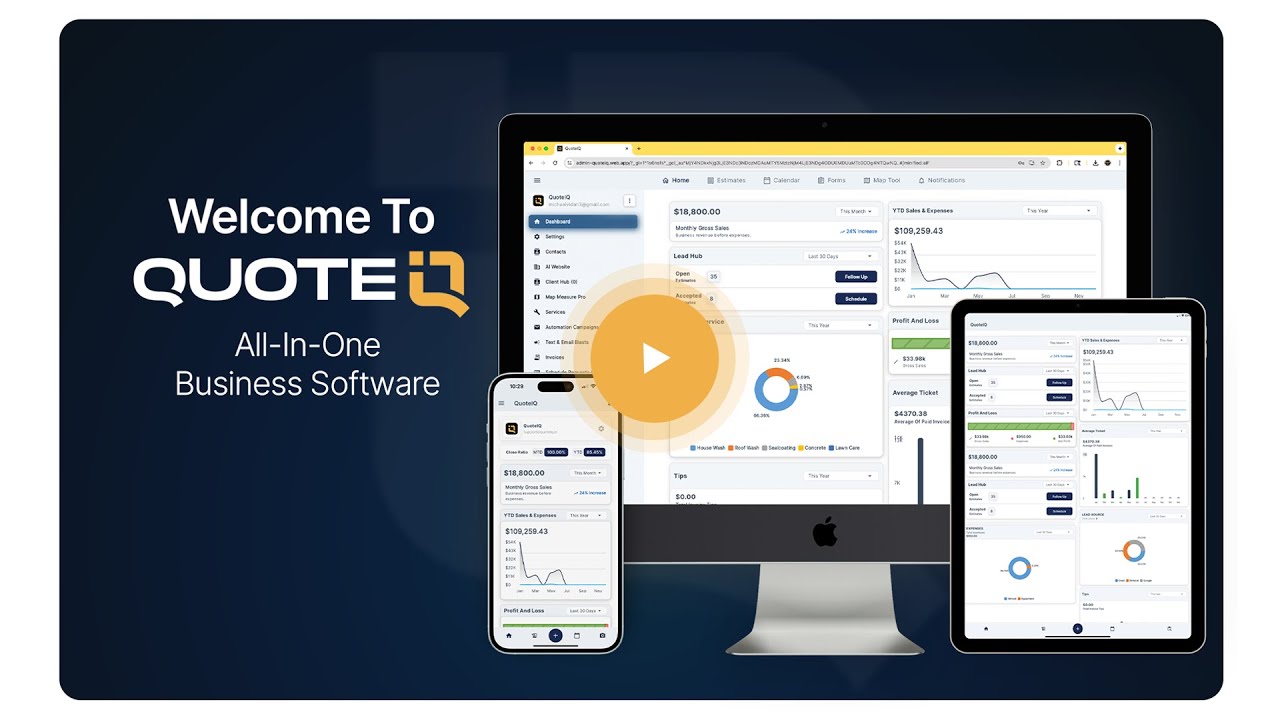
Watch: What is QuoteIQ? (3-minute overview)
A short walkthrough of how QuoteIQ replaces the stack of disconnected tools most appliance repair contractors use to run their service business.
Getting started: four steps to 24/7 coverage
Whether you are switching from a live service or covering the phone for the first time, this is the order that does not drop calls.
Start a trial and set your intake
Start a 14-day QuoteIQ trial on the plan you want, then write the five intake questions — appliance, brand, model, symptom, address — and upload your service area and diagnostic fee.
Point the overflow line at it
Forward only unanswered and after-hours calls to Virtual Call Team for two weeks. Your main number stays exactly where it is.
Import your customers
Bring contacts and price book across with AI Smart Import, so repeat callers arrive with their history attached.
Work the morning queue
Assign one person to turn overnight summaries into scheduled jobs and estimates by 8 AM, then switch the main line over.
Reviewed by industry experts
Mike Vidan, Co-Founder
A 20-plus-year home service business owner and YouTube creator who built one of the largest contractor audiences online, teaching operators how to start, price and scale service businesses — appliance repair shops among them.
Read full bio →Justin Rogers, Co-Founder
Serial entrepreneur, service business owner and founder of the ForeverSelfEmployed brand, sharing real-world strategies for running profitable home service businesses with one of the industry’s most-watched channels.
Read full bio →Real QuoteIQ customer reviews — 4.7★ across 4,103 verified reviews
Verified reviews from home service contractors across trades. QuoteIQ serves 50+ home service verticals including appliance repair.
“First of all this app saves me so much time,the new updates they do are impactful. I’ve used it for pressure washing, I’ve used it for even doing concrete estimating. The ability to send invoices directly and charge from the app is a win win! I like how it incorporates the ability to keep your customers like a CRM program and it helps me check up on those customers that called, I can call back pretty fast make a note on their file. I also like how everyone can access it from my Crew. App is #1”
“I am just starting my pressure washing business, but QuoteIQ offers all the options i need, gives ways to track leads conversion, and i can customize it to my needs. This app was very well thought out.”
“I was nervous switching systems, but QuoteIQ made the move seamless. Everything from customer details to quote follow-ups is now automated and stress-free.”
Stop sending appliance emergencies to voicemail.
QuoteIQ includes Virtual Call Team on every plan from $29.99/mo — inbound answering, outbound follow-up campaigns, and a transcript and summary on the customer record inside one platform built for appliance repair.



