



Best Job Costing Software for HVAC Businesses (2026)
6 job costing platforms ranked by margin visibility, labor cost tracking, and bundled CRM value — for HVAC contractors who want real-time profit per job, not month-end autopsies on quarters that already closed.
QuoteIQ is the best job costing software for HVAC businesses in 2026 because its built-in Job Costing feature tracks Total Price minus Labor minus Expenses on every job — bundled inside a complete HVAC field service management platform on the Pro plan at $149.99/month for 4 users, with QuickBooks Online sync, the AI Estimator, the Virtual Call Team, and the Hourly Rate Calculator included at no extra charge. ServiceTitan has the deepest job costing infrastructure on the market and suits large residential enterprises with dedicated office staff. Sera ties margin pricing directly to quotes for HVAC, plumbing, and electrical shops. Housecall Pro layers Profit Tracker reporting onto a polished generalist platform. FieldEdge is the long-running HVAC specialist with a deep flat-rate pricebook. BuildOps wins for commercial HVAC contractors handling AIA-style billing and multi-site service contracts. The right pick depends on residential vs commercial scope, team size, and whether you want job costing bundled into a full CRM or stood up as a per-technician enterprise stack.
TL;DR: HVAC margins live and die on labor minutes and equipment markup, which makes job costing the highest-leverage operational discipline in the trade. QuoteIQ takes Best Bundled Solution because Job Costing ships on the Pro plan ($149.99/mo, 4 users, 3,000 IQ Credits) alongside the AI Estimator, the Hourly Rate Calculator inside Business Calculators, Expense Tracking, Virtual Call Team, ClientHub business phone, QuickBooks Online sync, and full scheduling plus invoicing. ServiceTitan wins for large residential enterprises, Sera for shops that want margin pricing on every quote, Housecall Pro as the polished generalist, FieldEdge for pricebook depth, BuildOps for commercial MEP. The U.S. Bureau of Labor Statistics projects faster-than-average employment growth for HVACR mechanics and installers, and every technician you add multiplies whatever pricing error is already baked into your pricebook — which is exactly what the U.S. Small Business Administration financial-management guidance tells owners to measure before they scale.
The 2026 Winners by Category
Each tool below wins for a specific kind of HVAC operation. Skip ahead to the category that matches your business — residential service shop, commercial MEP contractor, or multi-office enterprise. Pricing for every platform other than QuoteIQ is quoted qualitatively here; see the pricing note below for why, and check each vendor’s own pricing page for current rates.
QuoteIQ
From $149.99/mo on Pro (4 users). Job Costing bundled with the AI Estimator, Hourly Rate Calculator, QuickBooks Online sync, Virtual Call Team AI receptionist, and the full FSM platform. The most cost-effective job costing for residential HVAC shops under 10 technicians.
ServiceTitan
Quote-based, demo-led pricing with a paid implementation engagement. Deepest job costing infrastructure on the market — AIA-style billing, marketing attribution, pricebook depth. Built for large residential operations with dedicated office staff.
Sera
Tiered plans sized by technician count. The Margin Pricing module ties job cost directly to every quote, so technicians and office staff see profitability in real time rather than at month-end. Purpose-built for HVAC, plumbing, and electrical.
Housecall Pro
Published tiers with per-seat charges above the included user count on the top plan. Profit Tracker reports unlock on the mid tier and up. Strong mobile UX and a mature ecosystem, with the lightest job costing depth of the four trade-focused tools — but the easiest onboarding.
FieldEdge
Per-user pricing across three tiers, with a paid setup engagement and a structured onboarding program. Long-running HVAC specialist with a deep flat-rate pricebook. Full profit analysis sits behind an Advanced Reporting add-on rather than the base plan.
BuildOps
Quote-based pricing. Built for commercial MEP contractors — service contracts, multi-site customer hierarchies, AIA-style billing, equipment lifecycle records, project and service unified. The honest pick for commercial HVAC and refrigeration.
Why Job Costing Matters for HVAC
HVAC is a margin business disguised as a labor business. The U.S. Bureau of Labor Statistics projects faster-than-average employment growth for HVACR mechanics and installers, and wage pressure has followed demand in most U.S. markets. Every minute a technician spends driving, idling, hunting for a part, or running an unrecovered callback is a minute extracted directly from gross margin. The contractors who track that math weekly outearn the ones running on instinct — not because they work harder, but because they find the leak while it is still small enough to fix. Time Tracker Pro captures the clocked hours and Job Costing turns them into a per-job margin number the same day the invoice closes.
The discipline is simple in principle and almost impossible without software. Quote a four-hour furnace install, watch it consume six and a half hours plus an unbudgeted return trip for a transition fitting, and you have learned something worth money — but only if the system captured the real hours, the real material cost, and the real trip. Expense Tracking attaches receipts and categorized costs to the job record, MapMeasure Pro documents the scope you actually quoted, and the Hourly Rate Calculator inside Business Calculators validates your loaded labor rate before the number ever reaches a customer. Free trade tools like the HVAC cost calculator and the HVAC invoice template are useful for sanity-checking a single job; job costing is what makes the check automatic on all of them.
Two HVAC-specific factors make this sharper than in other trades. First, regulation: technicians handling refrigerant must hold EPA Section 608 certification, which narrows your hiring pool and raises the real cost of every labor hour you fail to bill. Second, load calculation: the Air Conditioning Contractors of America Manual J and related technical manuals define the residential sizing work that precedes a replacement quote, and that engineering time is routinely given away for free because nobody costs it. Both are recoverable once you can see them on a job record. Neither shows up on a profit-and-loss statement.
Work a five-technician residential shop at 2,500 service calls a year and a $480 average ticket — $1.2M in revenue. If job costing reveals that the “two-hour” diagnostic actually averages 2.75 hours, that is 15 extra minutes per call, 625 unbilled hours a year. At a $65/hour loaded labor rate, $40,625 leaks out of margin from a single mispriced job type. QuoteIQ’s Job Costing on the Pro plan costs $149.99/mo — $1,799.88 a year — so one corrected pricebook entry returns roughly 22× the subscription. Run your own version with the home service business calculators.
There is a third compounding effect specific to HVAC: equipment markup. Residential replacement and retrofit work carries most of the revenue at a typical shop, and on equipment-heavy jobs margin lives in the markup rather than the labor hour. Without job costing, owners set markups intuitively and find out at year-end whether they were right. With job costing wired to the AI Estimator and Inventory Management, every install reveals its real margin on the day the invoice closes — early enough to reprice the next ten. Technical standards bodies including ASHRAE publish the engineering side of that work; the financial side is yours to instrument.
Drive time is the most under-costed line in residential HVAC. The IRS standard mileage rate for business use rose to 76¢ per mile effective July 1, 2026 (72.5¢ for January 1 through June 30). A five-truck shop averaging 120 miles per truck per day across 250 working days covers 150,000 miles a year — roughly $114,000 in deductible vehicle cost at the second-half rate, before a single labor hour is counted. Route Optimization cuts drive time 15–30%, and Route Density shows you where the work clusters so you can build the day around a zone instead of a zigzag.
How We Ranked Them
“Best” lists on the internet are mostly affiliate revenue sorted by commission rate. This list is sorted by what wins for HVAC contractors specifically. QuoteIQ’s own pricing and plan gates below come from the live QuoteIQ pricing page and are current as of September 2026.
A note on competitor pricing. Field service software vendors restructure their plans frequently, and several of the platforms below publish no standardized rate card at all — pricing is quote-based and demo-led. Rather than republish figures that go stale within a quarter, this guide describes each competitor’s pricing shape (per-user vs flat, published vs quote-based, what sits behind an add-on) and sends you to the vendor for the number. Check ServiceTitan, Sera, Housecall Pro, FieldEdge, and BuildOps directly for current rates. If you want to model a per-technician enterprise quote against a flat-rate plan, the ServiceTitan pricing calculator does the arithmetic.
The 6 ranking factors
- Margin visibility per job. Does the tool surface profit per job and labor variance in real time — or do you wait for a month-end report? Weekly visibility beats a monthly autopsy by an order of magnitude, which is why business analytics and job costing have to share a data model rather than a nightly export.
- Labor cost capture accuracy. HVAC margins are made or lost on the labor minute. The tool needs GPS-verified clock-in, automatic time-on-job capture, and clean rollup into job cost without manual reconciliation — the job Time Tracker Pro and GPS location tracking do inside EmployeeHub.
- Material and pricebook integration. Job costing only works if material cost flows from purchase orders into job records cleanly. Tools that demand manual entry of every part collapse at scale; linking estimate line items to Inventory products keeps the cost side honest.
- Accounting sync. Job cost data has to reach the general ledger without re-keying. Bidirectional QuickBooks Online sync is close to non-negotiable for any HVAC shop above three technicians, and data export matters for everyone else.
- Total cost of ownership. Subscription plus per-user fees plus implementation plus the add-ons that unlock the reporting you actually came for. Per-technician enterprise stacks scale their cost with your headcount; flat-rate plans like Elite and Max do not.
- Bundled vs standalone. Does the tool include AI estimating, customer self-quoting, a business phone line, and review automation — or is job costing a silo that requires a separate stack of paid add-ons around it?
6 Tools at a Glance (2026)
The fast version. Detailed reviews follow below. QuoteIQ pricing is current as of September 2026 from the live pricing page; competitor pricing is described by shape rather than by figure, for the reason set out in the pricing note above.
| Platform | Pricing Model | Job Costing Tier | QuickBooks Sync | HVAC-Specific | Free Trial |
|---|---|---|---|---|---|
| QuoteIQ (Job Costing built in) | Flat — $149.99/mo (Pro, 4 users) | Pro and up | Yes — QuickBooks Online, bundled on Pro+ | Generalist + HVAC-friendly | 14-day, chosen plan |
| ServiceTitan | Per technician — quote-based, demo-led, paid implementation | All tiers | Yes — bidirectional | Yes — HVAC enterprise | Demo only |
| Sera | Tiered by technician count — see their pricing page | All plans — margin pricing built in | Yes — third-party sync | Yes — HVAC/plumbing/electrical | Demo only |
| Housecall Pro | Published tiers + per-seat above included users on top plan | Mid tier and up | Yes — QuickBooks Online | Generalist (HVAC-friendly) | See their pricing page |
| FieldEdge | Per user across three tiers + paid setup engagement | Upper tiers (Advanced Reporting is an add-on) | Yes — bidirectional | Yes — HVAC specialist | Demo only |
| BuildOps | Custom quote | All commercial plans | Yes — QuickBooks Online | Yes — commercial MEP | Demo only |
QuoteIQ pricing verified on myquoteiq.com/pricing in September 2026. ServiceTitan, Sera, FieldEdge, and BuildOps are quote-based or demo-led and do not publish a standardized rate card in a form safe to republish; Housecall Pro publishes tiers that change periodically. Check each vendor’s own pricing page for current figures before you budget.
QuoteIQ — Best Bundled Job Costing for HVAC
Best for: HVAC contractors 1-10 trucks who want job costing + AI estimating + QuickBooks sync in one subscription · Pricing: $149.99/mo (Pro) and upQuoteIQ wins this list because it is the only platform on it where job costing arrives inside a sub-$150 entry tier alongside the rest of the FSM stack HVAC contractors actually need. Job Costing starts on the Pro plan ($149.99/month, 4 users, 3,000 IQ Credits) and runs the calculation that matters: Total Price minus Labor minus Expenses equals Profit, shown with a profit-margin bar on every job’s Report tab. Labor pulls automatically from time tracking — hourly rate multiplied by clocked hours — and expenses link to the job rather than floating in a monthly category. It sits in the same dashboard that runs your scheduling, invoicing, and customer database. There is no Advanced Reporting add-on to buy and no per-technician math to do.
The combination matters for HVAC specifically because the disciplines that move margin all live in one workflow loop. The AI Estimator analyzes property photos and generates market-accurate line-item pricing for the install quote; the Hourly Rate Calculator inside Business Calculators validates the labor markup before the number leaves the truck; the technician’s mobile app captures actual hours through Time Tracker Pro and parts through Expense Tracking; and Job Costing rolls all of it into a per-job profit figure before the invoice closes. QuickBooks Online sync on Pro and up moves that cost data to the general ledger without re-keying. Add the Virtual Call Team AI phone team answering after-hours no-heat calls and the whole revenue-to-margin loop runs inside one subscription.
The plan ladder is public and flat: Essentials $29.99 (1 user, no Job Costing), Beginner $74.99 (2 users, no Job Costing), Pro $149.99 (4 users — Job Costing, QuickBooks Online, ClientHub, Client Portal), Elite $299 (10 users — adds Inventory, InstaSchedule, InstaQuote, Route Optimization), Max $699 (unlimited users, crew scheduling, Sales Team Tracker). Job Costing is Pro and up. Annual billing works out to ten months paid for twelve. The honest gap against ServiceTitan: QuoteIQ does not offer AIA-style progress billing or enterprise marketing-attribution depth, and for a large residential operation with a dedicated marketing budget that moat is real.
- Job Costing starts at $149.99/mo on Pro — the lowest entry point on this list for real margin tracking
- QuickBooks Online sync bundled on Pro and up, no add-on
- Hourly Rate Calculator validates labor markup before the quote leaves the truck
- Wired natively into the AI Estimator, Virtual Call Team, ClientHub, and Review Multiplier
- No per-technician fee scaling — flat plan pricing across all five tiers
- 4.7-star average across 4,103 verified reviews
- 14-day free trial with published pricing — no quote-based contract, no implementation fee
- Job Costing requires Pro ($149.99/mo) or above — not available on Essentials or Beginner
- No AIA-style progress billing for commercial HVAC project work (BuildOps wins here)
- Marketing attribution is lighter than ServiceTitan’s enterprise module
- Newer platform than the HVAC veterans on this list — smaller third-party integration ecosystem
- No EPA Section 608 refrigerant-compliance reporting layer
- Crew-level assignment and crew scheduling require the Max plan
If you run a residential HVAC operation between 1 and 10 trucks and you want real job costing plus QuickBooks sync plus AI estimating plus a business phone line in one subscription — without a per-technician rate that scales with every hire — QuoteIQ Pro at $149.99/month is the best bundled play in 2026. The honest reasons to choose differently: a large residential enterprise where marketing attribution is the priority (pick ServiceTitan), an HVAC shop that specifically wants margin pricing baked into every quote (pick Sera), or a commercial MEP contractor running AIA-billed multi-day projects (pick BuildOps).
“I just started a pressure Washing/HVAC business and I use quoteiq.I love the app it keeps track of my payments,schedule,invoices and so much more to name here.I highly recommend this app if you’re running a business”
ServiceTitan — Best Enterprise HVAC Job Costing
Best for: large residential HVAC operations with dedicated office and marketing staff · Pricing: quote-based, demo-led, with a paid implementation engagementServiceTitan has the deepest job costing infrastructure on the market. The platform supports full pricebook depth, AIA-style progress billing on residential install projects, marketing attribution that traces leads back to job cost, real-time work-in-progress reporting, payroll integration, and inventory-by-truck reconciliation that ties material draws to specific job records. For the largest residential HVAC franchises — many offices, dozens of technicians, an in-house marketing function — ServiceTitan is the platform of record and earns the slot.
The pricing reality is that ServiceTitan does not publish a rate card. Pricing is per technician, quoted through a demo, and paired with a paid implementation engagement whose scope depends on your data migration and pricebook build. ServiceTitan’s own published guidance states the platform is “not optimized for a company with 3 or fewer technicians,” which is a fair and useful disclosure: the ROI math is built for operations with enough job volume and enough office staff to keep an enterprise pricebook current. A small residential shop will pay for depth it cannot staff. Ask for a written quote that separates subscription, implementation, and the modules that sit outside the base plan before you compare it to anything.
For HVAC specifically, the standout capabilities are the equipment pricebook depth across major manufacturer SKUs, the ability to run good-better-best equipment proposals from the technician’s tablet, and the attribution loop that tells you which paid channel produced which install and at what margin. If you are spending meaningfully on lead generation every month, that loop is difficult to replicate elsewhere. If you are not, you are buying a reporting layer over a spend that does not exist.
- Deepest job costing infrastructure on the market — AIA billing, WIP reporting, full pricebook
- Marketing attribution traces paid ads to closed jobs — unique at this depth
- Enterprise pricebook with manufacturer HVAC equipment SKUs pre-built
- Inventory-by-truck reconciliation ties material draws to job records
- Mature payroll and accounting integrations for multi-office operations
- No published rate card — pricing is quote-based and demo-only
- Paid implementation engagement on top of subscription
- “Not optimized for a company with 3 or fewer technicians” per ServiceTitan’s own guidance
- Steep learning curve — months of onboarding for dispatchers, technicians, and office staff
- Marketing, phone, and pricebook modules are paid add-ons above the base plan
- Per-technician model means your software cost scales with every hire
ServiceTitan is the right answer for a large residential HVAC enterprise with the office headcount to run it and a marketing spend worth attributing. For a shop under roughly ten technicians, the depth is real but unusable, and the per-technician model works against you with every hire. Model the per-technician quote against a flat-rate plan before you commit.
Sera — Best Margin-First HVAC/Plumbing/Electrical Specialist
Best for: small and mid-size HVAC shops that want margin pricing baked into every quote · Pricing: tiered by technician count — see their pricing pageSera’s differentiator is philosophical rather than featural: the Margin Pricing module puts profitability on the quote screen at the moment the price is set, not on a report the owner reads three weeks later. For HVAC shops where technicians build the quote in the driveway, that placement changes behavior. A technician who can see that a discount takes a job below target margin will price differently from one who finds out at month-end, and no amount of after-the-fact reporting produces the same effect.
Beyond margin pricing, Sera’s HVAC-relevant strengths are real-time job efficiency tracking that surfaces technician productivity gaps, a customer hub that integrates with the company website for online booking and invoice viewing, recurring maintenance agreement management for seasonal tune-up programs, and an included pricebook so shops without one do not start from a blank sheet. The platform is purpose-built for HVAC, plumbing, and electrical residential contractors, which shows in the vocabulary and the default workflows.
Pricing is tiered by technician count and published through their sales process rather than as a flat public rate card; check their pricing page for current figures and confirm what an additional technician costs, since that is the number that determines your cost curve as you grow. The trade-off against a flat-rate platform is straightforward: Sera charges more as you add technicians, so the comparison depends entirely on your headcount trajectory over the next two years. Run both curves before you sign anything.
- Margin Pricing module — every quote shows real-time profitability before the customer signs
- Purpose-built for HVAC, plumbing, and electrical residential contractors
- Included pricebook so shops without one do not start from scratch
- Job time efficiency tracking surfaces technician productivity gaps
- Customer hub integrates with the company website for booking and invoice viewing
- Maintenance agreement management suited to seasonal tune-up programs
- Per-technician cost curve — the bill grows with every hire
- Pricing published through sales rather than as a flat public rate card
- Smaller integration ecosystem than the generalist platforms
- No native AI receptionist or business phone line bundled in
- Demo-only evaluation — no self-serve trial
If the single change you want is that every technician sees margin at the moment they set a price, Sera is built around that idea more completely than anything else on this list. If you also want a bundled business phone, AI receptionist, and self-quoting layer, QuoteIQ Elite at $299/month for 10 users covers more of the stack at a flat rate that does not move when you hire.
Housecall Pro — Best Generalist with Profit Tracker
Best for: residential HVAC operators wanting polished generalist FSM with light job costing · Pricing: published tiers, per-seat above included users on the top planHousecall Pro is the most polished generalist on this list and the easiest to get a crew onto. Profit Tracker brings job costing reports to the platform from the mid tier upward, alongside bundled QuickBooks Online sync. The mobile experience is consistently rated among the strongest in field service management, which matters more than feature checklists when your adoption risk is a veteran technician who does not want to learn software.
The honest limitation for HVAC is that Profit Tracker is a reporting layer rather than a costing engine. It tells you what happened on the jobs you closed; it is weaker at telling you what is about to happen on the next ten installs, because the pricebook and material cost model underneath it are generalist rather than HVAC-specific. For a shop running mostly service calls and light replacements, that is fine. For a shop where equipment markup decisions drive the margin, you will feel the gap.
Housecall Pro’s HVAC-relevant strengths are the mobile-first technician experience, emergency scheduling for urgent service calls (no-heat in January, no-AC in July), integrated online booking, and a mature ecosystem of third-party integrations. Pricing is published in tiers and changes periodically, with per-seat charges above the included user count on the top plan — check their pricing page for current figures and note which tier unlocks Profit Tracker, since that is the line that matters for job costing.
- Profit Tracker job costing reports included from the mid tier up
- Bidirectional QuickBooks Online sync from the mid tier up
- Mature platform with a large third-party integration ecosystem
- Strong mobile app — among the best-rated in field service management
- Online booking widget available across plans
- Emergency scheduling suited to urgent no-heat and no-AC calls
- Profit Tracker is retrospective reporting, not a predictive costing engine
- Generalist pricebook — no HVAC equipment SKU depth
- Job costing locked behind the mid tier, not the entry plan
- Per-seat charges above the included user count on the top plan
- No bundled AI receptionist or business phone line
For residential HVAC shops that want polished generalist field service management with included job costing reports and do not need HVAC-specific pricebook depth, Housecall Pro is a legitimate pick and the easiest onboarding on this list. For operations that want a bundled AI phone team and customer self-quoting at the same price point, QuoteIQ Pro covers more capability without per-seat fees.
FieldEdge — Best Per-Tech HVAC Veteran
Best for: HVAC contractors who prefer per-tech pricing with a deep flat-rate pricebook · Pricing: per user across three tiers plus a paid setup engagementFieldEdge has served HVAC, plumbing, and electrical contractors longer than most platforms on this list, and the product reflects that accumulated feedback. The flat-rate pricebook ships with hundreds of HVAC-specific tasks pre-built, which materially shortens quote-build time for diagnostics and equipment replacements. The dispatch board is designed around residential HVAC routing patterns rather than adapted from a generic scheduling grid, and the technician mobile app supports good-better-best equipment proposals natively.
The job costing story is solid but tiered. Base plans cover the operational workflow; full profit visibility sits behind an Advanced Reporting add-on, which means the number you compare against other platforms is the base per-user rate plus that add-on, not the base rate alone. FieldEdge also runs a structured onboarding program with a paid setup engagement — worth budgeting for in both dollars and calendar time, because the pricebook build is where the value is created and where the weeks go.
For an HVAC contractor who genuinely wants the pricebook depth and is comfortable with a per-user cost curve, FieldEdge is a credible choice with a long track record. The arithmetic to run before signing is simple: multiply the per-user rate by your expected headcount in 24 months, add the reporting add-on, add the setup engagement, and compare that total against a flat-rate plan. For most shops under ten technicians the flat-rate side wins; above that, the pricebook depth starts to justify itself.
- HVAC specialist with many years of accumulated contractor product feedback
- Deep flat-rate pricebook with hundreds of pre-built HVAC tasks and equipment SKUs
- Dispatch board designed specifically around HVAC routing patterns
- Good-better-best proposal builder for equipment replacement quotes
- Bidirectional QuickBooks sync
- Structured onboarding that actually builds your pricebook
- Full profit visibility requires the Advanced Reporting add-on, not the base plan
- Per-user pricing means cost scales directly with headcount
- Paid setup engagement on top of subscription
- Multi-week onboarding before the system is productive
- Demo-only evaluation — no self-serve trial
- Interface shows its age next to the newer platforms on this list
FieldEdge earns its slot on pricebook depth and HVAC fluency. Budget for the per-user rate, the reporting add-on, and the setup engagement together — that combined figure is the real comparison against QuoteIQ Pro at $149.99/month flat for 4 users with job costing and QuickBooks sync already included.
BuildOps — Best Commercial HVAC Job Costing
Best for: commercial HVAC and refrigeration contractors with service agreements and AIA billing · Pricing: custom quoteBuildOps is built for commercial mechanical, electrical, and plumbing contractors — including commercial HVAC and refrigeration — and it is the only platform on this list that treats projects and service as one connected system rather than two products stapled together. Multi-day install projects link to the service tickets that follow them, so the equipment you put in stays attached to the record you maintain it against. For a commercial contractor whose recurring base is service agreements, that continuity is the whole ballgame.
The job costing depth follows from that architecture. AIA-style progress invoicing runs natively rather than as a workaround, multi-site customer hierarchies model the reality of a property-management client with fourteen buildings, and equipment lifecycle records track individual rooftop units across years of service history. Costing a maintenance contract accurately requires exactly this — and no residential-first platform does it well, including the ones ranked above it here.
Pricing is quote-based with no public rate card, which is normal at the commercial end of this market and reflects genuinely variable implementation scope. The honest caveat is scope fit: for residential HVAC shops, BuildOps is overscoped, and the custom pricing rarely justifies depth you will not use. A residential operation running service calls and replacements is better served by a platform built for that motion — QuoteIQ Pro at $149.99/month covers the residential workflow comprehensively at a published price.
- Purpose-built for commercial MEP — HVAC, mechanical, refrigeration, electrical, plumbing
- AIA-style progress invoicing runs natively, not as a workaround
- Projects and service unified — install projects connect to the service tickets that follow
- Multi-site customer hierarchies model property-management clients properly
- Equipment lifecycle records track individual units across years of service history
- Service agreement costing built for recurring commercial contracts
- No public pricing — custom quote only
- Substantially overscoped for residential HVAC service work
- Implementation scope varies widely, so budgeting is hard before the quote
- Demo-only evaluation — no self-serve trial
- Steeper learning curve than residential-first platforms
If you run commercial HVAC or refrigeration with service agreements as your recurring base and AIA billing as a requirement, BuildOps is the honest answer and the other five platforms are not really competing for the job. If you run residential service and replacement work, it is the wrong shape — start with the HVAC field service platform built for that motion instead.
Which Tool Wins for Your HVAC Business?
Three real-world scenarios drawn from how HVAC operators actually work in 2026. Each one ends with an honest recommendation — and not all of them recommend QuoteIQ.
4-tech residential HVAC shop, $1.4M annual revenue
Dallas-Fort Worth metro, residential service plus replacement, 4 field technicians and 1 office coordinator. Currently running on spreadsheets and intuition for pricing. Just hired a fifth technician and realized last quarter’s installs ran 30% over the estimated labor hours — but nobody knows which jobs ate the variance.
The pain: No real-time margin visibility. Installs feel busy but the bank balance tells a different story than the dashboard does.
→ Recommendation: QuoteIQ Pro ($149.99/mo) — Job Costing plus QuickBooks Online sync plus the AI Estimator plus the Hourly Rate Calculator, 4 users included. Margin visibility starts in week one and the price does not move when the fifth technician starts.
Commercial HVAC contractor, 12-truck fleet, mostly service contracts
Mid-Atlantic commercial MEP, property management portfolio and retail chain accounts, a mix of recurring service agreements and multi-day install projects. AIA-style progress billing is required on the install side. Equipment lifecycle records matter — the same rooftop unit gets serviced annually for a decade.
The pain: Residential FSM tools do not handle multi-site customer hierarchies, AIA billing, or equipment lifecycle records. Job costing has to tie to both service tickets and multi-day projects.
→ Recommendation: BuildOps (custom quote) — purpose-built for commercial MEP, with AIA billing, multi-site hierarchies, and equipment lifecycle records. The honest non-QuoteIQ pick for commercial work.
Large residential HVAC operation with a dedicated marketing director
Phoenix metro, residential service and equipment replacement at scale: dozens of field technicians, a full office team, and a marketing director running a substantial monthly paid-ads budget. The business needs to know which campaigns drive which closed jobs at which margin.
The pain: At this revenue, margin-attribution math justifies enterprise tooling. Misallocated ad spend is the single largest recoverable line, and no residential-first platform traces it to job cost.
→ Recommendation: ServiceTitan (quote-based) — marketing attribution plus the deepest job costing plus AIA billing. The ROI math works once there is enough ad spend and office headcount to operate it.
The Real ROI of Job Costing for HVAC
Numbers that matter. These are the calculations an HVAC contractor should run before picking any tool on this list — each one uses your own operating figures rather than a vendor benchmark.
A five-technician residential shop running 2,500 service calls a year at a $480 average ticket turns over $1.2M. If job costing reveals the “two-hour” diagnostic actually averages 2.75 hours, that is 625 unbilled hours a year; at a $65/hour loaded rate, $40,625 in annual margin leakage from one pricebook entry. QuoteIQ’s Job Costing on Pro costs $1,799.88 a year, so the single correction returns roughly 22× the subscription. The same arithmetic applies to every repeated job type you run — which is why the fix is systemic rather than one-off.
Callbacks are the most expensive line most HVAC shops never measure: a second truck roll, a second set of labor hours, zero incremental revenue, and a dented customer relationship. Run your own number — callback rate × annual job count × (average loaded labor hours + average trip cost). At 2,500 jobs, a 5% callback rate is 125 free jobs a year. Job Costing paired with QuoteIQ Cam inspection documentation surfaces which technicians, job types, and equipment SKUs drive that rate, so the fix is data-driven rather than anecdotal.
New HVAC inquiries are time-sensitive, and no-heat calls in January do not leave voicemail — they call the next contractor. Multiply your missed and after-hours calls per month by your close rate and your average ticket to size the leak. At a $480 average ticket, capturing ten additional qualified leads a month is $57,600 a year in incremental revenue. The Virtual Call Team answers, qualifies, and transcribes those calls around the clock and is available on every plan through IQ Credits, metered at 125 IQ Credits per minute. It does not book appointments — that is what InstaSchedule is for on Elite and up.
The numbers shift with team size and average ticket value, but the structural math holds: HVAC job costing attacks three margin bottlenecks at once — mispriced job types, callback waste, and lead-response leakage. The only real question is which tool you use to do it. For residential HVAC under ten trucks, QuoteIQ Pro at $149.99/month bundles job costing, an AI phone team, and AI estimating into a single subscription that costs less than one missed install. For larger operations the math justifies enterprise tooling; at the small and mid-market the bundled play wins on capability density against any per-technician or quote-based competitor. The U.S. Small Business Administration publishes the general financial-management framework these calculations sit inside, and business analytics is where you watch them move.
HVAC carries cost lines other trades do not. Technicians handling refrigerant must hold EPA Section 608 certification, and attic and rooftop work in summer runs into OSHA heat-exposure guidance that legitimately slows productive hours in July and August. Both are real costs. Neither shows up as a line item anywhere — they show up as seasonal labor variance on individual jobs, which is precisely what Time Tracker Pro and Job Costing make visible. Shops that price summer attic work the same as spring work are quietly subsidizing it.
How Job Costing Works in Practice with QuoteIQ
The full quote-to-closed-margin workflow inside QuoteIQ using the Job Costing feature — from the initial estimate to the per-job profit figure.
Build the quote
Use the AI Estimator or a standard line-item estimate with the Hourly Rate Calculator to lock material cost, loaded labor, and markup before the price is quoted. Options estimates let you present good-better-best equipment tiers in one document.
Schedule the job
The customer approves and signs with e-signatures, and the job lands on the QuoteIQ calendar with the technician assigned. On Elite and up, Route Optimization sequences the day’s stops to cut drive time.
Tech runs the job
The technician clocks in through the mobile app. Time on the job captures through Time Tracker Pro and parts and receipts attach through Expense Tracking — no office reconciliation required.
Invoice closes
The invoice generates from actual time and parts. The customer pays through online payments, and QuickBooks Online sync moves the entry to the general ledger.
Margin surfaces
The job’s Report tab shows Total Price minus Labor minus Expenses with a profit-margin bar, so you review variance against the estimate weekly instead of running a month-end autopsy. Analytics rolls it up across the business.
QuoteIQ Pricing — Job Costing Available on Pro & Up
Every plan includes the AI toolkit — AI Autopilot, Virtual Call Team, AI Estimator, and the Before & After generator — through IQ Credits. Job Costing, QuickBooks Online sync, the Hourly Rate Calculator, and ClientHub are available on Pro and up, not on Essentials or Beginner. Every plan includes a 14-day free trial with full access to the features of the plan you choose.
Annual billing works out to ten months paid for twelve on every plan. See the full pricing page →
Frequently Asked Questions
What is the best job costing software for HVAC businesses in 2026?
QuoteIQ is the best job costing software for HVAC businesses in 2026, starting at $149.99 per month on the Pro plan for 4 users. Its Job Costing feature runs Total Price minus Labor minus Expenses on every job and shows the result with a profit-margin bar, with labor pulled automatically from clocked hours rather than typed in later. What separates it from the rest of this list is bundling: the same subscription carries the AI Estimator, the Hourly Rate Calculator inside Business Calculators, QuickBooks Online sync, and the Virtual Call Team AI phone team, with no per-technician fee and no implementation charge. ServiceTitan offers deeper enterprise infrastructure, Sera puts margin on the quote screen, Housecall Pro is the easiest generalist onboarding, FieldEdge has the deepest HVAC pricebook, and BuildOps owns commercial MEP. For a residential shop under ten trucks, the bundled option wins on capability per dollar. The U.S. Bureau of Labor Statistics projects faster-than-average growth for the trade, which means whatever pricing error sits in your pricebook today gets multiplied by every technician you add.
How does job costing work for HVAC service calls vs equipment installs?
Service calls and installs leak margin in different places, so they need different costing attention — and both run through the same Job Costing report on the Pro plan at $149.99 per month. On a service call the dominant variable is labor minutes — diagnostic time, parts-hunting time, and drive time — so the number to watch is actual clocked hours against the flat-rate assumption in your pricebook. Time Tracker Pro captures GPS clock-in and per-job hours, and Job Costing compares them to what you quoted. On an equipment install the dominant variable is material markup: the condenser, coil, line set, and permits usually outweigh the labor line, so the number to watch is landed material cost against the price you charged. Expense Tracking attaches receipts and categorized costs directly to the job, and linking estimate line items to Inventory products on Elite and up keeps material pricing current as supplier costs move. Quote installs with options estimates so the customer sees good-better-best tiers. The load-calculation work that precedes a replacement quote follows the ACCA technical manuals, and that engineering time is billable — most shops give it away because nobody costs it.
How much does job costing software cost for HVAC contractors?
Job costing software for HVAC contractors starts at $149.99 per month with QuoteIQ Pro, which includes 4 users, 3,000 IQ Credits, and job costing bundled rather than sold as an add-on. Elite is $299 per month for 10 users and adds Inventory, Route Optimization, and InstaSchedule; Max is $699 per month for unlimited users. Annual billing works out to ten months paid for twelve. Job costing is not available on Essentials at $29.99 or Beginner at $74.99, so Pro is the real entry point. At the other end of the market, the enterprise and specialist platforms are mostly quote-based or per-technician, which means the figure you should compare is not their headline rate but the rate multiplied by your headcount in twenty-four months, plus any reporting add-on and any paid implementation. That total is frequently several times a flat-rate plan for a shop under ten trucks. The U.S. Small Business Administration financial-management guidance is a reasonable framework for running the comparison, and the ServiceTitan pricing calculator does the per-technician arithmetic for you.
Can HVAC contractors track profit per technician and profit per job in real time?
Yes — profit per job updates as soon as the labor and expense data lands, which in practice means the same day the work happens rather than at month-end. It is available from the Pro plan at $149.99 per month for 4 users. In QuoteIQ, each job carries a Report tab showing Total Price minus Labor minus Expenses with a profit-margin bar; labor is calculated automatically as hourly rate multiplied by clocked hours from Time Tracker Pro, so there is no office reconciliation step between the technician leaving site and the margin appearing. Per-technician profitability comes from the revenue-by-employee views in business analytics, which break revenue down by service, customer, and employee alongside completion rate and average job duration. EmployeeHub on Elite and up adds GPS location tracking while technicians are clocked in, so drive time stops being invisible. One practical caution: hours export to your payroll system rather than running payroll natively, and there is no automatic overtime calculation, so overtime has to be handled downstream, with data export available on every plan for that hand-off. Seasonal variance is real — OSHA heat-exposure guidance legitimately slows July attic work, and a shop that prices it like April work is subsidizing it.
Does QuoteIQ integrate with QuickBooks for HVAC accounting and job costing?
Yes — QuoteIQ integrates with QuickBooks Online on the Pro plan and above, at $149.99 per month and up, with no separate integration fee. The QuickBooks Online integration syncs invoices, payments, customers, and expense categories, applies duplicate-sync locks so records do not double up, and auto-syncs missing customers before an estimate syncs. That matters for job costing specifically because cost data captured in the field through Expense Tracking and invoicing reaches the general ledger without anyone re-keying it, which is where reconciliation errors are normally introduced. One important limitation: the integration is QuickBooks Online only. The desktop edition is not supported, so a shop still running it needs a migration plan before this becomes useful — AI Smart Import handles bringing the customer and job history across. If you do not use QuickBooks at all, data export is available on every plan for handing figures to another accounting package or a bookkeeper. Keep your IRS standard mileage records aligned with the same job data — vehicle cost is one of the largest deductible lines in a trucked trade.
How does job costing reduce HVAC callback rates and unbilled labor?
Job costing reduces callbacks by making them attributable instead of anecdotal. A callback is a second truck roll and a second set of labor hours against zero incremental revenue, so at 2,500 jobs a year a 5% callback rate means 125 jobs performed for free. Once Job Costing ties actual hours and expenses to each job record, the pattern becomes visible: a particular technician, a particular equipment SKU, or a particular job type carries the returns. QuoteIQ Cam and inspection forms document site conditions at the first visit, which resolves the argument about what was actually found. Unbilled labor is the quieter version of the same problem — the fifteen minutes past the flat rate that nobody logs — and it surfaces only when Time Tracker Pro captures clock-in and clock-out against the job rather than the day. Fixing either one starts with pricing the work correctly, which is what the Hourly Rate Calculator in Business Calculators exists for. Note that technicians handling refrigerant need EPA Section 608 certification, which is part of why a wasted HVAC labor hour costs more than a wasted hour in most other trades.
Does QuoteIQ work for both residential and commercial HVAC job costing?
QuoteIQ is built for residential and light commercial HVAC work, and it is honestly not the right tool for heavy commercial MEP. On the residential side it covers the full motion: scheduling, line-item estimates, Job Costing from the Pro plan at $149.99 per month, recurring invoice subscriptions for seasonal maintenance agreements, and a Client Portal where customers approve estimates and pay invoices themselves. Light commercial accounts — a handful of small retail or office sites on annual service agreements — work well on the same structure. Where it stops is AIA-style progress billing on multi-day construction projects, multi-site customer hierarchies for a property-management client with a dozen buildings, and per-unit equipment lifecycle records maintained across a decade. Those are commercial MEP requirements, and BuildOps is the honest recommendation for them; this guide ranks it sixth on the list precisely because it wins a different job. If you are mostly residential with a few commercial accounts, start with the HVAC field service platform and check the HVAC software FAQ. Technical standards for the commercial side sit with ASHRAE.
Is there a free trial for HVAC job costing software and what does it include?
QuoteIQ offers a 14-day free trial with full access to the features of the plan you choose, one trial per person, business and payment method, and a credit or debit card is required to start. Choosing the Pro plan for the trial is what matters here, because Job Costing, QuickBooks Online sync, and the Hourly Rate Calculator only exist at Pro and above — trialling Essentials or Beginner will not show you the feature you came to evaluate. Fourteen days is enough to cost real work if you plan it: import your customer list with AI Smart Import, build three or four typical job types as standard estimates, run them through Time Tracker Pro with real technicians, and compare the resulting margin against what you assumed. Most of the specialist and enterprise platforms on this list are demo-only with no self-serve trial, so a hands-on comparison is not available there. Whatever you trial, bring your own numbers — the U.S. Small Business Administration counseling resources are a sensible place to sanity-check the financial assumptions underneath them. Start at the Pro plan page.
Key Takeaways
- Job costing is a Pro-and-up capability in QuoteIQ. Job Costing starts at $149.99/month on Pro with 4 users — not on Essentials ($29.99) or Beginner ($74.99). That is the single most important gate to know before you pick a plan.
- The margin math is Total Price minus Labor minus Expenses. Labor pulls automatically from clocked hours in Time Tracker Pro, expenses attach through Expense Tracking, and the result appears on the job’s Report tab with a profit-margin bar.
- Flat-rate beats per-technician below roughly ten trucks. Enterprise and specialist platforms price per technician or by quote, so your software bill grows with every hire. Elite at $299/month for 10 users and Max at $699/month for unlimited users do not move when you staff up.
- One corrected pricebook entry can pay for the year. Fifteen unbilled minutes across 2,500 service calls at a $65/hour loaded rate is $40,625 — roughly 22× the annual Pro subscription. Run your own version in the home service business calculators.
- Commercial MEP is a different product category. AIA progress billing, multi-site hierarchies, and equipment lifecycle records are BuildOps territory; residential service and replacement is where the HVAC field service platform fits.
- Verify competitor pricing at the source. Several platforms here are quote-based or restructure their tiers regularly. Get a written quote separating subscription, implementation, and add-ons before comparing anything, and model it with the ServiceTitan pricing calculator.
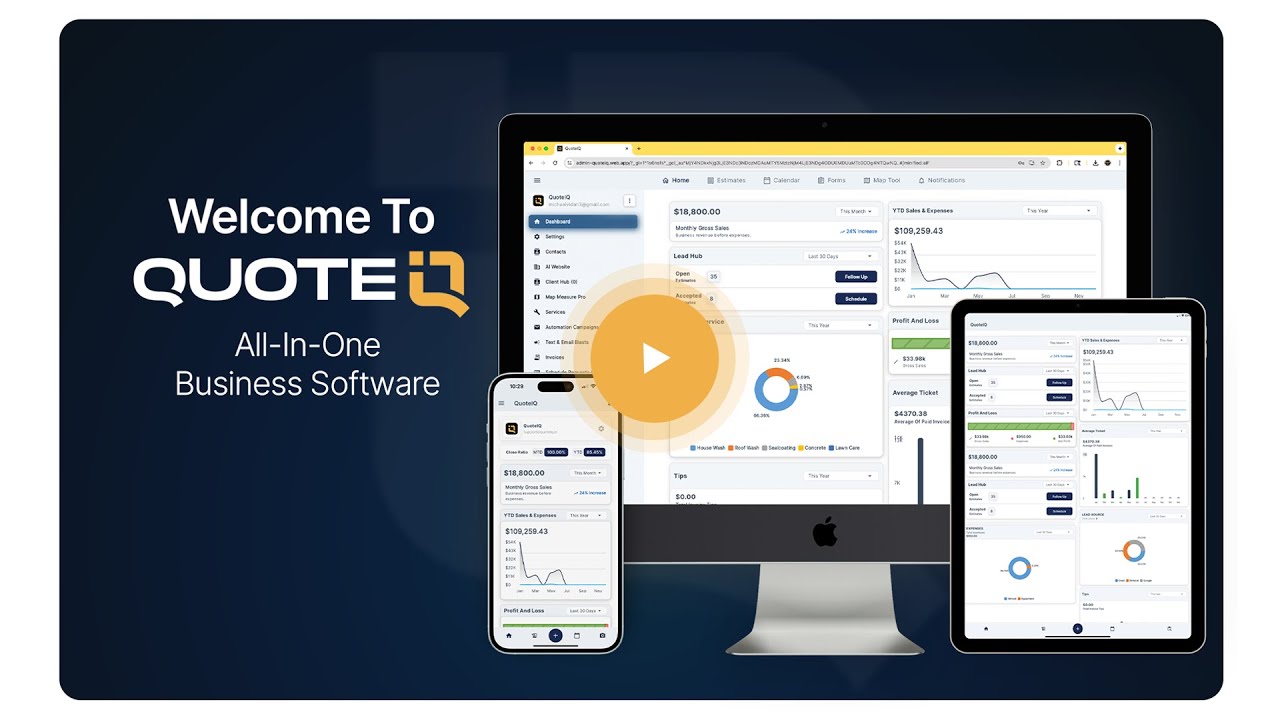
Watch: What is QuoteIQ? (3-minute overview)
A short walkthrough of how QuoteIQ replaces the stack of disconnected tools most HVAC contractors use to run their service business — from quoting to scheduling to invoicing to job costing.
How to Switch Your HVAC Shop to QuoteIQ Job Costing in 4 Steps
Most HVAC contractors are productive inside a week. The order below front-loads the work that makes job costing accurate, so the first month of margin data is worth trusting.
Start the trial on Pro
Job Costing lives on Pro and above, so choose Pro or higher when you start — the 14-day trial gives full access to the features of the plan you choose. A credit or debit card is required to start. Begin at the Pro plan page.
Import customers and build the price book
Bring your customer list across with AI Smart Import, which maps CSV columns from your existing CRM automatically. Then build your four or five most common HVAC job types as standard estimates so costing has something to measure against.
Set hourly rates and put techs on the clock
Enter each technician’s hourly rate in EmployeeHub and validate your loaded rate with the Hourly Rate Calculator in Business Calculators. Labor cost is only as accurate as those two numbers and the clock-in habit behind them.
Connect QuickBooks and review margin weekly
Turn on QuickBooks Online sync so cost data reaches the ledger without re-keying, then book a standing weekly slot to read the Job Costing report and analytics. Weekly review is the habit that makes the software pay.
Reviewed by Industry Experts
Mike Vidan, Co-Founder
Home service business owner with two decades in the trades, and the builder of one of the largest home service contractor audiences on YouTube — teaching contractors how to start, scale, and operate service businesses, including HVAC operations.
Read full bio →Justin Rogers, Co-Founder
Serial entrepreneur and founder of the ForeverSelfEmployed brand. Built one of the most-watched YouTube channels in the home service industry, sharing real-world strategies for running profitable service businesses.
Read full bio →Real Contractor Reviews — 4.7★ across 4,103 verified reviews
“I just started a pressure Washing/HVAC business and I use quoteiq.I love the app it keeps track of my payments,schedule,invoices and so much more to name here.I highly recommend this app if you’re running a business”
“As a power washing professional, I’m thrilled to use QuoteIQ. The app simplifies the power washing process, helps me create accurate batch mixes, and stores all of my client information securely in one place. I can easily track my income and expenses, maintain a healthy income-to-debt ratio, and create professional invoices quickly. QuoteIQ also helps me keep track of my schedule and provides detailed reports on my business performance. I’m excited to use QuoteIQ.”
“Last time, I started a business, keeping track of my expenses, customers, payments, upcoming jobs, and scheduling was a pain, and it was spread over 4 different apps. Everything I need is in one place now, and the value you get with the affordable subscription upgrades is immeasurable compared to the time you save.”
Stop discovering margin problems at month-end. Start tracking job profitability in real time.
QuoteIQ — with built-in Job Costing on the Pro plan at $149.99/mo — bundles real-time margin tracking, QuickBooks Online sync, AI estimating, the Hourly Rate Calculator, the Virtual Call Team AI phone team, and the rest of the field service stack HVAC contractors actually need.



