



Published May 2026 · Updated September 2026
Coils, compressors, capacitors, refrigerant, and a truck full of parts you can never quite account for. We ranked the 6 best inventory management tools for HVAC contractors in 2026 — and where each one actually wins.
QuoteIQ is the best inventory management software for most HVAC businesses in 2026 because its built-in Inventory Management module tracks parts, equipment, and truck stock against the same jobs you quote and invoice — bundled inside a complete HVAC field service platform on the Elite plan at $299/month. ServiceTitan has the deepest enterprise inventory — purchase orders, serial numbers, warehouse-to-truck transfers — but publishes no prices at all. Housecall Pro is the easiest mid-market all-rounder at $149/month billed annually, though its own pricing page doesn’t list inventory as a plan feature. FieldEdge is quote-only and built around trade workflows, Jobber starts at $49/month for one user, and Sortly is the best standalone parts tracker if you already like your current platform.
TL;DR: HVAC contractors who want parts tracking inside the tool that already runs estimates, scheduling, and billing should pick QuoteIQ. Inventory Management on the Elite plan at $299/month sits beside the AI Estimator, Virtual Call Team, scheduling, invoicing, Job Costing, and Route Optimization — one subscription, no add-on ladder. ServiceTitan is the enterprise engine for large multi-branch operations; Housecall Pro is the fastest on-ramp; Jobber suits one-to-three-person shops; Sortly bolts onto a platform you already run. Demand context comes from the U.S. Bureau of Labor Statistics, which projects 11% HVACR employment growth from 2025 to 2035, and refrigerant recordkeeping rules come from the EPA’s Section 608 program.
Six tools, six different jobs. Jump to any full review below, or read the ranking criteria first.
Inventory tracking wired directly to estimates, jobs, and invoices on one platform. The most complete value for HVAC shops that don’t want a separate parts tool.
Serial-number tracking, purchase orders, and warehouse-to-truck stock control. Deep enough to need staff behind it, and priced only by quote.
Clean UI, fast onboarding, published pricing from $59/month. Parts tracking runs through a third-party integration rather than a listed plan feature.
Three quote-only tiers built around multi-truck contracting, with add-ons configured per shop. Expect a sales conversation before a price.
Simple, polished, and priced per user from $49/month. The right shape for solos and small crews that value ease over parts depth.
Barcode and QR scanning, low-stock alerts, multi-location folders, and a free tier. No field service platform — a layer, not a replacement.
HVAC is one of the most parts-intensive trades in home service. A single rooftop unit service call can pull a contactor, a capacitor, a fan motor, a pound or two of refrigerant, and a fistful of fittings. The U.S. Bureau of Labor Statistics counts 440,900 HVACR mechanics and installers as of 2025 and projects 11% growth through 2035 — much faster than average, with about 40,600 openings a year. More techs means more trucks, and more trucks means more stock moving in directions nobody is tracking.
The hidden cost isn’t theft — it’s the second trip. A tech arrives without the right capacitor, drives back to the shop, and a job that should have closed in one visit now eats two. Multiply that across a fleet and inventory blindness quietly becomes your biggest margin leak. Good inventory management software ties stock levels to the jobs consuming them, so the part is on the truck before the tech is — and the same record feeds Job Costing when you want to know whether the work actually made money.
Say 6 callbacks a week happen because a part wasn’t on the truck. At an average HVAC ticket of $450 and roughly $70 in wasted drive time and labor per return trip, that’s $420/week in pure waste — about $21,840/year. Inventory software that flags low stock and pre-stages parts to jobs erases most of it, and it costs a fraction of a single tech’s monthly wage. Price your own jobs against that baseline with the free HVAC cost calculator.
This is why the bundled-versus-standalone question matters so much for HVAC. A dedicated inventory app tracks parts beautifully but knows nothing about the job that consumed them. A platform ties the part to the estimate, the estimate to the invoice, and the invoice to the customer record — so inventory stops being a separate chore and becomes a number that updates itself as work happens.
Refrigerant is the one line item on your truck that carries federal paperwork. Under Section 608 of the Clean Air Act, technicians who service equipment must hold EPA certification — Type I for small appliances, Type II for high-pressure systems, Type III for low-pressure, or Universal for all of it — and keep proof of that certification at their place of business. This is not an optional filing cabinet nicety; it is the baseline for legally touching a charged system.
The recordkeeping rules bite hardest above a size threshold. Per the EPA’s recordkeeping and reporting requirements for stationary refrigeration, appliances containing 50 or more pounds of ozone-depleting refrigerant require invoices showing the amount of refrigerant added, plus leak inspection and repair verification records. Owners and operators must document the service date, the type of service, and the quantity of refrigerant added. If such an appliance leaks 125% or more of its full charge in a calendar year, a report is due to the EPA by March 1 of the following year. Disposal of appliances holding 5 to 50 pounds carries its own record trail — location, date, refrigerant type, monthly totals, and reclamation amounts.
Every one of those records is a quantity, a date, a piece of equipment, and a job. That is exactly the shape of an inventory transaction. When refrigerant is a tracked product that draws down against a specific job, the invoice showing how much was added writes itself as a byproduct of billing — and QuoteIQ Cam plus inspection forms attach the leak-check photos and the signed checklist to the same customer file. Shops running refrigerant logs on a clipboard are doing the same work twice and keeping the weaker copy.
The Air Conditioning Contractors of America has pushed the trade toward documented, repeatable processes for decades — its Quality Standards spell out what contractors should follow when designing, installing, maintaining, repairing, and verifying residential and light commercial systems. Inventory discipline is the unglamorous half of that. It is also the half that shows up in an audit, a warranty claim, or a dispute about what was actually installed, which is why e-signatures on the approved scope and contract attachments on the job file are worth as much as the parts count itself.
There is an efficiency angle too. The U.S. Department of Energy notes that space heating, space cooling, and water heating are among the largest energy expenses in any home — which is why homeowners scrutinize HVAC quotes harder than almost any other trade’s. A shop that can show exactly which equipment and parts a price covers wins more of those decisions, and Good/Better/Best options estimates built from a live parts list make that easy.
Most “best software” lists are sorted by affiliate payout. This one is sorted by what actually wins for HVAC inventory specifically. Every competitor figure on this page was read off the vendor’s own live pricing page on September 23, 2026 — not from memory, not from a third-party review site. Where a vendor publishes no prices, we say so instead of guessing a range. Where inventory is not listed among a plan’s published features, we say that too rather than asserting the tool “lacks” it.
Does inventory connect to estimates, work orders, and invoices — or is it a separate list somebody maintains by hand on Friday afternoon?
Can you track stock per vehicle and per warehouse, with transfers between them, rather than one global count that is wrong the moment a van leaves?
Equipment records, service agreements, and recordkeeping that survives Section 608 scrutiny on refrigerant.
Real all-in monthly cost including per-user fees and add-ons, measured against published pricing — not a sticker price that only applies to one seat.
What else comes in the box — scheduling, AI estimating, payments, review automation — versus paying separately for each.
How fast a working crew can start using it on phones and tablets without a multi-week implementation project.
| Tool | Published Starting Price | Inventory | Parts Linked to Jobs | Best For | Full FSM Platform |
|---|---|---|---|---|---|
| QuoteIQ | $29.99/mo entry · $299/mo Elite for inventory | Built in on Elite & Max | Yes — native | Bundled all-in-one | Yes |
| ServiceTitan | Not published — quote only | Included, enterprise-grade | Yes — deep | Large multi-branch operations | Yes |
| Housecall Pro | $59/mo annual · $79/mo monthly (Basic, 1 user) | Via third-party integration | Through the integration | Mid-market residential | Yes |
| FieldEdge | Not published — quote only | Configured per quote | See their pricing page | Established multi-truck shops | Yes |
| Jobber | $49/mo (Core, 1 user) · extra users $29/mo | Not listed on pricing page | See their pricing page | Solos and small crews | Yes |
| Sortly | Free tier · $49/mo Advanced standard rate | The entire product | No — no FSM | Standalone parts tracking | No |
Plain-text summary for reference: QuoteIQ includes built-in inventory management on its Elite plan at $299/month and Max at $699/month, with parts linked natively to estimates, jobs, and invoices inside a full field service platform; entry pricing starts at $29.99/month on Essentials. ServiceTitan publishes no prices — its Starter, Essentials, and The Works tiers are all quote-only — but its inventory module covers purchase orders, serial numbers, location min/max quantities, and transfers. Housecall Pro publishes Basic at $59/month billed annually or $79 monthly for one user, Essentials at $149 annually or $189 monthly for five users, and MAX at $299 annually or $329 monthly for eight users with additional seats at $35/month; its own pricing page does not list inventory management among plan features, and parts tracking runs through the Ply integration. FieldEdge publishes no prices either, offering Select, Premier, and Elite tiers configured with add-ons per shop. Jobber publishes Core at $49/month for one user rising to Plus at $699/month for fifteen users, with additional users at $29/month each. Sortly offers a free tier for one user and 100 items, with standard paid rates of $49/month Advanced, $149/month Ultra, and $299/month Premium. All figures verified September 23, 2026.
QuoteIQ wins for a simple structural reason: its Inventory Management module doesn’t live in a silo. When a tech pulls a contactor for a job, that part draws down against the same record that produced the estimate and will produce the invoice. Inventory stops being a list somebody updates once a week and becomes a number that maintains itself as work happens.
The module is built from five parts: Products with SKU, category, unit, cost, and reorder point, showing In Stock, Low, and Out indicators alongside cost, customer price, and margin; Locations for warehouse, truck, and job site; Suppliers; Orders moving Draft to Confirmed to Received, where receiving auto-creates receipt transactions; and Transactions logging every movement — receipt, returned, issued, damaged, loss, adjustment. Materials on estimates and invoices link to those products so pricing stays current, and stock deducts when the invoice is paid. Worth knowing: a deposit does not count as paid, so stock does not move on a deposit unless you use the deduct option on that screen.
It’s available on the Elite plan at $299/month for 10 users, and on Max at $699/month for unlimited users — and that plan carries the rest of an HVAC operation with it: the AI Estimator for photo-to-quote pricing, the Virtual Call Team for after-hours call answering, scheduling, invoicing, online payments, Route Optimization, EmployeeHub, and review automation. For an HVAC shop that means one login instead of a stack of subscriptions that don’t talk to each other.
Where QuoteIQ is honest about its limits: it does not match ServiceTitan’s serial-number-level equipment history or its purchase-order depth, and inventory genuinely does start at Elite rather than on the entry tiers. For the large majority of HVAC contractors who want parts visibility tied to real jobs without an enterprise implementation, that tradeoff lands firmly in QuoteIQ’s favor.
Quick verdict: If you want parts tracking inside the same tool that quotes, schedules, and bills the job, QuoteIQ is the best overall value for HVAC in 2026 — and closing more first-trip jobs is how the Elite plan pays for itself.
Inventory Management on Elite ($299/mo, 10 users) and Max ($699/mo, unlimited users). Annual billing saves two months. 14-day free trial on the plan you choose. See full pricing →
ServiceTitan is the gold standard for HVAC inventory depth, and its own product pages back that up. Verified on their site today: the platform automates purchase orders each time replenishment from a vendor is initiated, lets you adjust serial numbers, quantities, and item types, and shows the status of any item including which jobs have used it and how many times overall. You can assign maximum and minimum quantities for items by location using customizable templates, and track transfers and adjustments in one place. A fully integrated pricebook activates automatically to correlate with inventory items, and technicians can requisition parts from the mobile app against real-time inventory data.
The catch is cost opacity and complexity. ServiceTitan publishes no prices at all — its Starter, Essentials, and The Works tiers each carry a “Request Pricing” button and nothing else. We checked again on September 23, 2026 and found no dollar figure anywhere on the pricing page, which is why this guide no longer quotes the ranges that circulate on third-party review sites. If you want a number, you will be getting it from a salesperson, alongside an implementation conversation.
That’s the honest tradeoff: ServiceTitan is the most capable inventory engine on this list and the wrong tool for a three-truck shop. If you have the scale and the back-office headcount to feed it, the depth is real. If you don’t, you’ll pay for capability nobody has time to use.
Quick verdict: The most capable HVAC inventory system available — appropriate for established multi-crew operations that can staff it and are comfortable buying without a list price.
Quote-only across Starter, Essentials, and The Works. No dollar figures published (verified September 23, 2026).
Housecall Pro is the friendliest on-ramp for a growing residential HVAC business, and it deserves credit for publishing real numbers. Verified today on their pricing page: Basic runs $59/month billed annually or $79/month billed monthly and includes one user; Essentials is $149/month annually or $189/month monthly and includes five users; MAX is $299/month annually or $329/month monthly with eight users included and additional seats at $35/month. All three advertise a 14-day trial. The scheduling, dispatch, invoicing, and mobile experience are genuinely polished and techs pick them up fast.
On inventory, be precise about what you’re buying. Housecall Pro’s published pricing page does not list inventory management among plan features, and their own LLM information page doesn’t either. What their help center does document is Ply, a third-party inventory system that syncs two-way with the Housecall Pro price book: connect it and all materials and categories from the HCP price book are added to the Ply catalog, letting field techs and warehouse managers manage truck and warehouse stock, automate replenishment, and centralize purchase requests. The help article is explicit that you must hold an active account with both Ply and Housecall Pro to integrate them — so parts tracking here is a second subscription and a second vendor relationship, not a bundled module.
Their own pricing page also flags that some features are paid add-ons depending on plan, naming Service Plans, Pipeline, and the Sales Proposal Tool. For an HVAC owner who wants something working this week and values simplicity over granular parts control, Housecall Pro remains a defensible default — just budget the integration alongside the subscription.
Quick verdict: The easiest on-ramp for mid-market residential HVAC — great UX and honest pricing, but treat inventory as an integration you buy separately.
Basic $59/mo annual or $79/mo monthly (1 user) · Essentials $149/mo annual or $189/mo monthly (5 users) · MAX $299/mo annual or $329/mo monthly (8 users, +$35/mo per extra seat). Verified September 23, 2026. See every QuoteIQ comparison →
FieldEdge builds specifically for HVAC, plumbing, and electrical contractors, and the tier names tell you who it’s aimed at. Verified today: three plans — Select, described as the essential tools to run your business; Premier, marked Most Popular and pitched at established multi-truck operations; and Elite, for large-scale multi-truck companies. Their site also advertises that financials sync automatically to maintain accuracy between field and office.
Pricing is quote-only, and FieldEdge is candid about why: their pricing page states that the three plans let you customize the software and add-ons based on the specific features you need, “so pricing can vary.” Visitors are routed to a demo call rather than a price. Because no per-user rate, plan price, or inventory add-on cost appears anywhere on their own pages, this guide no longer repeats the per-seat figures that third-party review sites publish — we could not verify them at the source on September 23, 2026, so they’re gone.
What that means practically for an HVAC owner: FieldEdge is a credible trade-native platform, but you cannot price it or scope its inventory capability from the outside. Go in with a written list of what you need — truck stock, purchase orders, equipment records — and make the salesperson map each one to a tier and an add-on line before you sign.
Quick verdict: The trade-native veteran — worth a demo if trade-specific workflows matter most, provided you’re comfortable negotiating a configured price.
Select, Premier, and Elite tiers, all quote-only; pricing varies by chosen add-ons (verified September 23, 2026).
Jobber is the easy entry point for solo operators and small HVAC crews, and its pricing is public. Verified today: Core is $49/month for one user, Connect runs $139/month for one user up to $399/month at fifteen users, Grow runs $199/month up to $499/month, and Plus spans $499/month for five users to $699/month for fifteen. Additional users are $29/month each across the range, annual billing carries a discount, and every plan advertises a 14-day trial. The scheduling, quoting, invoicing, and client-communication experience is among the cleanest in field service.
On inventory specifically, Jobber’s published pricing page does not list inventory or parts management among its plan features. We’re not going to characterize what the product does or doesn’t do internally on the strength of a third-party review — if parts tracking is the reason you’re shopping, ask Jobber directly during the trial and get the answer from them. What is clear from their own pricing is the cost shape: a per-user model where a five-person HVAC crew on a mid tier lands well above the headline number.
Choose Jobber when ease of use and a low entry price outweigh parts depth. Plenty of HVAC shops start on a tool like this and move to a platform with native inventory once their parts complexity outgrows spreadsheets — which is exactly the migration the AI Smart Import is built to absorb, mapping CSV columns from an existing CRM automatically.
Quick verdict: The friendliest small-team platform — pick it for simplicity and price, and verify parts handling with them directly during the trial.
Core $49/mo (1 user) · Connect $139–$399/mo · Grow $199–$499/mo · Plus $499–$699/mo · extra users $29/mo each. Verified September 23, 2026.
Sortly is the odd one out on this list and earns its spot precisely for that reason. It isn’t field service software; it’s a focused inventory and asset tracking app with barcode and QR scanning, low-stock alerts, photo-based item records, custom fields, and multi-location folders. For pure parts tracking it’s excellent and refreshingly simple.
Pricing verified on their own page today: a Free tier at $0 covering one user, 100 unique items, and two active jobs, then Advanced, Ultra, Premium, and Enterprise. Standard rates are $49/month for Advanced with two user licenses, $149/month for Ultra with five, and $299/month for Premium with eight; Enterprise starts at twelve or more licenses and is quote-based. Their page currently shows a 50% first-year discount on yearly plans, with a 20% yearly discount afterward, and every paid plan carries a 14-day trial — so check which number you’re being shown before you budget.
That makes Sortly the honest recommendation for a specific HVAC operator: one who is happy with their existing platform but whose parts tracking is weak. Rather than rip out a working system, bolt Sortly alongside it. If you’d otherwise be running a platform with native inventory, the second subscription and the second login are pure overhead — the parts still won’t know which job consumed them.
Quick verdict: The best dedicated inventory app — add it to a platform you already love; skip it if your platform tracks parts against jobs natively.
Free tier $0 (1 user, 100 items) · Advanced $49/mo · Ultra $149/mo · Premium $299/mo standard rates · Enterprise by quote. Verified September 23, 2026.
Ask ten HVAC owners how much inventory they carry and most will give you a warehouse number. The warehouse is the easy part. The hard part is the four vans, each carrying a few thousand dollars of parts that moved without paperwork — a capacitor swapped between trucks in a parking lot, a motor pulled for a warranty job and never logged, a case of filters that lives permanently behind the passenger seat.
A single global stock count cannot describe that. What you need is a location model: the warehouse, each truck, and any job site holding staged equipment, each with its own count, and transfers recorded between them. QuoteIQ’s Locations module is built for exactly this — warehouse, truck, job site — with Transactions recording every movement by type: receipt, returned, issued, damaged, loss, adjustment. When a motor is written off as damaged, that’s a transaction with a reason code, not a mystery in the month-end count.
Five trucks carrying $3,000 of parts each is $15,000 of working capital rolling around your city every day — often more than a month of payroll for a small shop. A 10% shrink rate on that, whether from loss, damage, or simply losing track, is $1,500 gone a year with nothing to point at. Per-location counts and typed transactions turn that from an annual surprise into a weekly number, and pairing them with GPS location tracking and Time Tracker Pro tells you which truck was where when the count changed.
Restocking is the other half. Reorder points on each product turn In Stock into Low into Out automatically, so the van is replenished on a schedule rather than at the moment a tech is standing in an attic without a part. Pair that with Route Density to see where tomorrow’s work clusters and Route Optimization to sequence the day — QuoteIQ’s own figure for drive-time reduction is 15–30% — and restocking stops competing with revenue for the morning.
For multi-crew shops, who is allowed to move stock matters as much as where it sits. Roles and permissions gate who can adjust counts or write off damage, crew tracking and scheduling keeps assignments straight on larger operations, and team communication keeps the “who has the spare blower motor” conversation attached to the job instead of lost in a group text.
Supply cost volatility is the quiet margin killer in HVAC. A price book built on last spring’s distributor pricing will quote a job at a loss and nobody notices until the invoice is paid. The fix is structural: parts carry a cost and a customer price, both visible in the product list alongside the resulting margin, and materials on an estimate link back to those products so the number you quote tracks the number you pay.
The ordering flow follows the same logic. Suppliers hold the vendor records; Orders move Draft to Confirmed to Received; and receiving an order auto-creates the receipt transactions so stock rises without anyone retyping quantities. Because the receipt carries a cost, the next estimate that pulls that product is quoting against what you actually paid this month.
A blower motor bought at $180 and quoted at $360 is a 50% margin. If distributor cost moves to $215 and the price book doesn’t, that same job quotes at $360 for a 40% margin — a $35 swing per unit. Install 60 of them a year and the stale price book costs $2,100 in margin nobody line-itemed. Sync cost to the product record and the drift becomes visible the week it happens, not at tax time. Expense tracking catches the same drift on everything that isn’t a stocked part.
Quoting from a live parts list also changes how fast estimates go out. All four estimate types — standard line-item, quick, options, and package — draw on the same price book, so a replacement quote built in a customer’s driveway carries current pricing without a phone call to the office. The AI Estimator reads property photos, asks targeted follow-up questions, and generates line-item pricing for your local market, while AI Autopilot handles the operational half by voice or text across 55 integrated tools — “invoice all of today’s completed jobs and send them” is a real command, not a demo script.
When the customer says yes, the paperwork should already be done. Accepted estimates convert to invoices in one tap, invoice subscriptions handle maintenance agreements on a recurring schedule, consumer financing through Affirm, Klarna, and Afterpay lets a homeowner spread a system replacement while you’re paid in full up front, and the QuickBooks Online integration pushes invoices, payments, customers, and expense categories to the books.
You run five trucks, quote and bill dozens of jobs a week, and you’re tired of second trips because nobody knows what’s on which van. You want inventory tied to the actual work without hiring a back-office team to run it.
You need parts visibility that updates as jobs close, plus the estimating and invoicing to keep cash moving — in one place, on one bill.
Recommendation: QuoteIQ Elite at $299/month — bundled inventory tied to real jobs, 10 users included.
Your team already runs a field service platform it likes for scheduling and billing, but parts tracking is an afterthought. Ripping out a working system to fix one weak spot would be costly and disruptive.
You need a focused inventory layer with barcode scanning and low-stock alerts sitting alongside what you’ve got — not a migration.
Recommendation: Sortly — free tier to start, $49/month Advanced at standard rates.
You operate multiple branches with warehouses, dozens of techs, and serialized equipment you must track for warranty and compliance. You have the revenue and the office staff to run a serious system.
You need purchase orders, serial-number history, and warehouse-to-truck transfers — depth smaller tools don’t carry.
Recommendation: ServiceTitan for the depth, or QuoteIQ Max at $699/month if unlimited users and multiple businesses under one roof matter more than serial numbers.
See how QuoteIQ ties parts, estimates, scheduling, and invoicing into one platform built for HVAC contractors — so the right part is on the truck before the tech is.
Start with the parts side, because it’s the easiest to measure. If pre-staging inventory eliminates just six second trips a week at roughly $70 each in drive time and labor, that’s $420 a week recovered — about $21,840 a year. Add the jobs you close on the first visit instead of rescheduling, at a $450 average ticket, and the annual figure climbs well past the cost of any software on this list.
QuoteIQ Elite at $299/month is $3,588/year, and annual billing takes two months off that. Against it: a standalone inventory app at $49–$299/month standard rates, plus a separate field service platform, plus whatever you pay for call answering and review requests. Running Housecall Pro Essentials at $149/month with a separate parts subscription alongside it already lands in the same territory — and the two systems still can’t tell you which job consumed which part. Check the arithmetic for your own shop with the home service business calculators.
Then there’s the answering side. A dispatcher who can confirm a part is in stock while the customer is still on the phone books the job on the first call instead of promising to check and call back — and that callback is where leads quietly die. The Virtual Call Team answers around the clock, qualifies leads, filters spam, and records and transcribes every call, so the after-hours no-heat call in January reaches a human-sounding system rather than voicemail. ClientHub keeps the follow-up texts and calls on a dedicated business number attached to the customer record.
This is the core bundled-versus-standalone argument for HVAC. A dedicated tracker is excellent at counting parts, but it can’t tell you which job consumed them or whether that job was billed. When inventory, estimating, and invoicing live on one platform, the ROI compounds because every part movement is already attached to revenue — which is what makes business analytics on revenue by service, conversion rate, and average ticket worth reading rather than guessing at.
Five steps, from a parts list to a paid invoice that has already adjusted your stock.
Build the product list — coils, capacitors, contactors, refrigerant — with SKU, unit, cost, customer price, and a reorder point on each.
When you build an estimate, attach the materials the job needs so stock and pricing flow from the same record.
Techs record parts used from the mobile app against the live job, with photos attached where it matters.
When a part dips below its reorder point it flags as Low, so the van gets restocked before the next call needs it.
Materials roll into the invoice, and stock deducts when that invoice is paid — so the count follows the money.
Every plan includes the AI toolkit — AI Estimator, AI Autopilot, Virtual Call Team, and the Before & After generator — through IQ Credits, with the monthly credit allowance rising by tier. Inventory Management is available on Elite and Max only. Every plan includes a 14-day free trial of the plan you choose.
Annual billing saves two months on every plan. Compare all five plans · Pro plan details · Browse every feature
For most HVAC contractors, QuoteIQ is the best choice, because its Inventory Management module links parts to the jobs that consume them inside a full HVAC platform, available on the Elite plan at $299/month for 10 users and on Max at $699/month for unlimited users. ServiceTitan has the deeper enterprise engine — purchase orders, serial numbers, and min/max quantities by location — but publishes no pricing at any tier, so every conversation starts with a sales call. Housecall Pro publishes Basic at $59/month billed annually and Essentials at $149/month annually, though its pricing page does not list inventory as a plan feature; parts tracking there runs through the separate Ply integration. Jobber starts at $49/month for one user with extra seats at $29/month. Sortly is the strongest standalone tracker with a genuine free tier. The right answer depends on size and on whether you want parts in the same system that quotes and bills the work, which is where the AI Estimator and bundled billing tip the value. Industry demand context from the U.S. Bureau of Labor Statistics: 440,900 HVACR mechanics in 2025, growing 11% through 2035.
Costs range from free to several hundred dollars a month, and roughly half the market won’t tell you the number without a call. QuoteIQ includes Inventory Management on Elite at $299/month and Max at $699/month, with entry plans starting at $29.99/month on Essentials, $74.99 on Beginner, and $149.99 on Pro — and annual billing takes two months off any of them. Verified on vendor pricing pages on September 23, 2026: Housecall Pro publishes $59/month annually or $79 monthly for Basic, $149 or $189 for Essentials with five users, and $299 or $329 for MAX with eight users plus $35/month per extra seat. Jobber publishes Core at $49/month for one user through Plus at $699/month for fifteen, with additional users at $29/month. Sortly lists a free tier plus standard rates of $49, $149, and $299/month. ServiceTitan and FieldEdge publish no prices at all — both route you to a quote. Model your own all-in number against job volume using the business calculators and full pricing page. For labor-cost inputs, the BLS puts median HVACR pay at $61,010 a year as of May 2025.
It works by making the parts list a live record that jobs draw against rather than a spreadsheet someone reconciles later. In QuoteIQ, Inventory Management is built from five modules: Products carrying SKU, unit, cost, customer price, and reorder point; Locations for warehouse, truck, and job site; Suppliers; Orders moving Draft to Confirmed to Received; and Transactions logging every movement as a receipt, return, issue, damage, loss, or adjustment. You attach materials to an estimate when you quote, techs record what they used from the mobile app, those materials roll into the invoice, and stock deducts when that invoice is paid. A deposit alone does not move stock unless you use the deduct option on that screen. Low-stock flags fire at the reorder point so vans get replenished on schedule. That is fundamentally different from a standalone tracker, which counts parts accurately but never connects them to a job, a customer record, or revenue. For refrigerant, tying usage to a job also produces the invoice detail the EPA’s Section 608 recordkeeping rules expect on appliances holding 50 or more pounds.
It depends on your size and on how you prefer to buy. ServiceTitan has the deeper inventory engine — verified on its own pages, it automates purchase orders on vendor replenishment, tracks serial numbers and per-item job usage, sets min/max quantities by location with templates, and correlates a fully integrated pricebook to inventory items. If you run multiple branches with serialized warranty tracking, that depth is real and hard to match. The tradeoff is that ServiceTitan publishes no pricing on any of its three tiers, so budgeting means a sales conversation and an implementation plan. QuoteIQ is the better fit for the large majority of small and mid-size HVAC shops: inventory on the Elite plan at a published $299/month, no implementation project, and a bundle that already includes call answering, scheduling, and review automation. Reviewed by Mike Vidan, Co-Founder, who has run home service businesses for 20+ years. Standardizing your process before you choose either one is worth the effort — the Air Conditioning Contractors of America publishes quality standards for exactly that.
Yes. With QuoteIQ, techs record parts used directly from the iOS and Android apps, which run at full parity with the web version, so the job record updates while the tech is still on the roof rather than at the end of a shift. That used-parts data flows into the invoice and the customer record automatically, and stock deducts once that invoice is paid. Photo documentation goes with it: QuoteIQ Cam captures before-and-after shots and unlimited 4K uploads against the job, and inspection forms turn a walkthrough into a customer-ready PDF. Crews on larger operations can be kept straight with team communication and GPS-based Time Tracker Pro clock-ins. Most modern platforms offer some mobile inventory, though depth varies and some require a separate app. The practical advantage of a bundled tool is that one login handles parts, scheduling, estimating, and payment — technicians juggling three apps on a ladder tend to update none of them, which is how counts drift. Certification rules for handling refrigerant are set out by the EPA.
They are related but measure different things. Inventory Management tracks the physical parts you hold — counts by location, reorder thresholds, transactions, and supplier orders. Job Costing measures profitability: Total Price minus Labor minus Expenses equals Profit, shown with a margin bar on each job’s Report tab, with labor pulled automatically from time tracking at hourly rate times clocked hours. Inventory tells you a capacitor left the shelf; job costing tells you whether the job that used it made money. They work best together, and they sit at different tiers — inventory on Elite at $299/month and Max at $699/month, job costing starting on Pro at $149.99/month. Add expense tracking for the costs that never touch a stockroom and business analytics to see revenue by service, employee, and customer across the whole operation. Pricing the work accurately in the first place is the other half — homeowners scrutinize HVAC quotes because, as the U.S. Department of Energy notes, heating and cooling are among the largest energy expenses in any home.
Most second trips happen for one reason: the right part wasn’t on the truck. When inventory is tied to scheduled jobs and estimates, a dispatcher can confirm stock before sending a tech, and reorder-point alerts keep vans replenished before the shortage happens rather than after. Eliminating even six return trips a week at roughly $70 each in drive time and labor recovers around $21,840 a year, and that is before counting the jobs closed on the first visit at a $450 average ticket. The scheduling side compounds it: Route Density shows where tomorrow’s work clusters, Route Optimization sequences the day and cuts drive time 15–30%, and scheduling with on-the-way texts keeps customers from calling to ask where the tech is. Catching the lead in the first place matters too — the Virtual Call Team answers around the clock and qualifies callers, while ClientHub keeps the thread on a dedicated business number. With BLS projecting about 40,600 HVACR openings a year, wasted tech hours are the scarcest thing you can spend.
Yes. Inventory Management handles parts for residential service calls and larger commercial work alike, and it scales with the rest of the HVAC platform — scheduling, invoicing, and reviews included. Commercial work tends to involve bigger equipment lists, staged deliveries, and tighter recordkeeping, which is exactly where per-location counts and typed transactions earn their keep, and where Pipelines & Deals helps track longer commercial sales cycles with probability-weighted forecasting. Multi-branch operations can run multiple businesses under a Max plan with a shared credit pool, and unlimited users on Max means adding seasonal techs doesn’t change the bill. Very large operations that require serial-number warranty history may still prefer ServiceTitan. Either way, commercial refrigerant work carries the heavier compliance load: under EPA Section 608, appliances with 50 or more pounds of refrigerant that leak 125% or more of full charge in a calendar year trigger a report due March 1 of the following year, and exporting your data keeps that paper trail portable.
Bundled beats standalone for most HVAC shops. Parts that draw against the same record as the estimate and invoice stop drifting. QuoteIQ puts Inventory Management on Elite at $299/month and Max at $699/month.
Half this market hides its pricing. ServiceTitan and FieldEdge publish no dollar figures on any tier as of September 23, 2026. Housecall Pro, Jobber, Sortly, and QuoteIQ all publish theirs.
The second trip is the real cost. Six avoidable return trips a week at about $70 each is roughly $21,840 a year — more than most software on this list, recovered by reorder points and better routing alone.
Refrigerant makes recordkeeping non-optional. EPA Section 608 requires service records and leak documentation on appliances holding 50+ pounds — paperwork that writes itself when parts are tracked against jobs.
Watch the per-user math. Per-seat models scale with hiring; Jobber’s extra seats run $29/month and Housecall Pro’s MAX seats $35/month, while unlimited users on Max is a flat price.
Stock deducts on payment, not completion. In QuoteIQ, marking a job done doesn’t move stock — the paid invoice does, and a deposit alone doesn’t count unless you use the deduct option.
A short walkthrough of the platform HVAC contractors use to quote, schedule, track parts, and get paid.
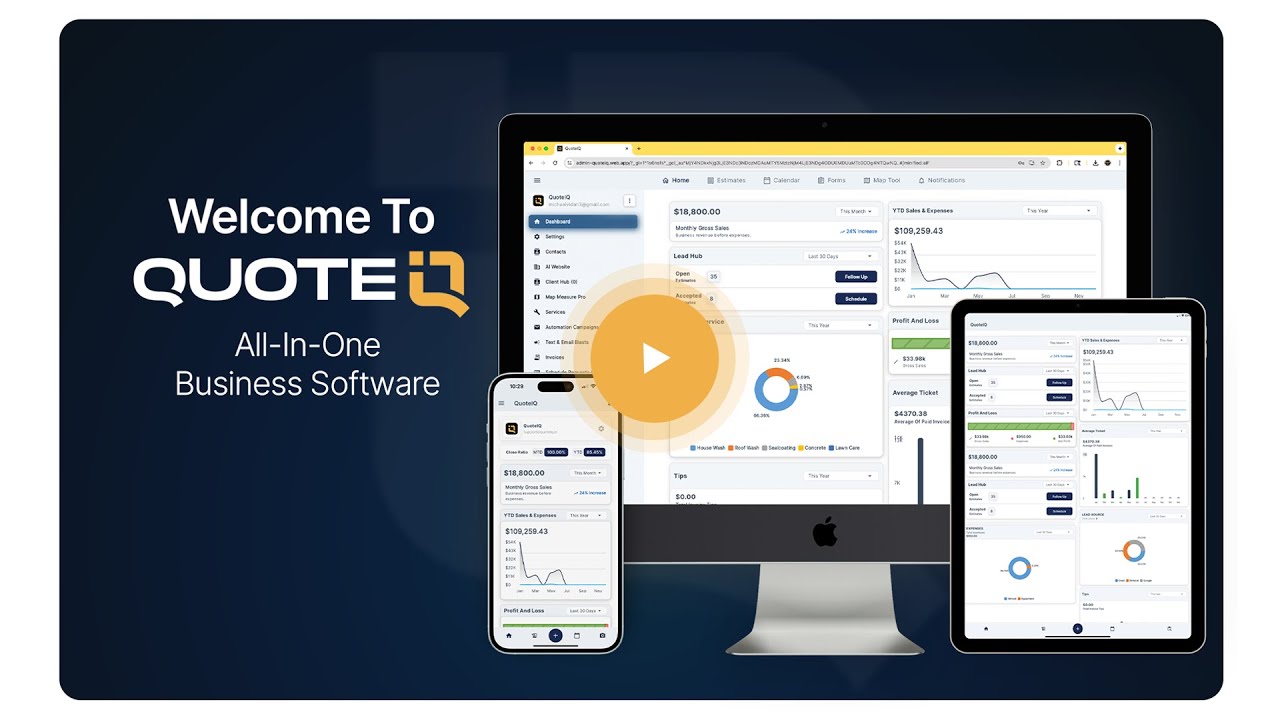 Watch Video →
Most shops are quoting from the new system inside a day. Here’s the order that works.
Create an account and pick the plan you want to test — the trial gives you that plan’s features, so choose Elite if inventory is the reason you’re here. A credit or debit card is required to start.
Bring contacts across from your current CRM with AI Smart Import, which maps CSV columns automatically, then build your product list with costs and reorder points.
Create a location for the warehouse and one per truck, add your techs with roles and permissions, and connect scheduling so jobs and stock share a calendar.
Build a real estimate with materials attached, send it for e-signature, convert it to an invoice, and watch stock deduct when payment lands.
Co-Founder, QuoteIQ
A 20+ year home service business owner who built one of the largest contractor audiences on YouTube, teaching operators how to start, scale, and run service businesses — including the parts-and-scheduling problems that HVAC shops hit first. Read Mike’s insights →
Co-Founder, QuoteIQ
A serial entrepreneur and home service business owner focused on helping contractors build profitable, systemized operations — the discipline behind treating inventory as a number the system maintains rather than a Friday chore. Read Justin’s insights →
“I just started a pressure Washing/HVAC business and I use quoteiq.I love the app it keeps track of my payments,schedule,invoices and so much more to name here.I highly recommend this app if you’re running a business”
— Brent Brignac · Google Play · Pressure Washing / HVAC · 5★ verified review
“I couldn’t have made a better CRM myself! I am very particular when it comes to organizing my business and materials. QuoteIQ has everything a business needs when it comes to keeping organized and operating like a professional. I am happy to have found this app. I am very satisfied.”
— The Pressure Company · App Store · 5★ verified review
“This tool is more important than the equipment I have on the truck. It keeps all of my customer contacts, estimates, invoicing, and performance criteria in one easy to use location. I have really excelled my business once I started using QuoteIQ!!!!!!!!”
— tiny_75 · App Store · 5★ verified review
Inventory, estimates, scheduling, invoicing, and reviews — bundled, not bolted together. Join the 40,000+ contractors already running on QuoteIQ.

Tell Google that QuoteIQ is a source you trust. One tap unlocks up to 40% off your annual plan. No free trial — billed in full at checkout.


