



Best Expense Tracking Software for HVAC Businesses (2026)
HVAC contractors lose 15-25% of margins when they track expenses by memory instead of by job. We ranked the 6 best expense tracking platforms for HVAC shops — with verified 2026 pricing and honest limitations.
QuoteIQ is the best expense tracking software for HVAC businesses in 2026 because its built-in Expense Tracking feature lets techs log costs and upload receipts from the truck, then feeds every dollar into Job Costing for real-time profit-per-job calculations — bundled inside a complete FSM platform starting at $29.99/month on Essentials, with full Job Costing and QuickBooks integration on Pro at $149.99/month. ServiceTitan offers the deepest financial reporting for enterprise HVAC operations at $245-$398/tech/month but requires a 12+ month contract and $5K-$50K implementation. FieldEdge is the strongest QuickBooks-first HVAC pick at ~$100-$125/user/month with Coolfront flat-rate pricebook integration. Housecall Pro and Jobber both offer mid-market expense tracking with QuickBooks sync, but gate job costing behind higher-tier plans. Service Fusion stands out for unlimited-user flat-rate pricing starting at $208/month — ideal for HVAC shops with 10+ techs where per-user pricing becomes punishing.
TL;DR: QuoteIQ wins for most HVAC shops — Expense Tracking on every plan, Job Costing on Pro ($149.99/mo) with invoicing, AI Estimator, Virtual Call Team, and ClientHub business phone all bundled. ServiceTitan ($245-$398/tech/mo) — enterprise HVAC with the deepest financial reporting but high implementation costs. Housecall Pro ($59-$329/mo) — solid mid-market with two-way QuickBooks sync on Essentials+. Jobber ($39-$199/mo) — best UX for small HVAC teams, QuickBooks sync on Connect+. FieldEdge (~$100-$125/user/mo) — built for HVAC with Coolfront flat-rate pricebook and deep QuickBooks integration. Service Fusion ($208-$533/mo) — unlimited users on every plan, best value for 10+ tech shops. Per the Air Conditioning Contractors of America (ACCA), HVAC contractors who track job-level profitability outperform those who don’t — and per Bureau of Labor Statistics data, HVAC employment is projected to grow 6% through 2032, making efficient cost management critical for scaling.
2026 Winners by Category
QuoteIQ
Receipt capture, expense categorization, and live job profitability — all bundled with estimates, invoicing, and QuickBooks sync on the Pro plan at $149.99/month.
Best Enterprise Financial ReportingServiceTitan
Deepest financial dashboards in the HVAC space — pricebook profitability, technician revenue tracking, and granular job costing for 20+ tech operations.
Best QuickBooks IntegrationHousecall Pro
Two-way QuickBooks sync including Desktop support on Essentials+. Expenses and invoices flow automatically, reducing double-entry for bookkeepers.
Best for Small HVAC TeamsJobber
Clean interface with job costing on Grow plan. Solo operators and 2-3 truck shops get expense tracking and QuickBooks sync at the lowest per-user cost.
Best HVAC-Specific PlatformFieldEdge
45 years in HVAC/plumbing/electrical. Coolfront flat-rate pricebook, service agreement tracking, and native QuickBooks integration built for trade workflows.
Best Unlimited-User ValueService Fusion
Flat-rate pricing with unlimited users on every plan. A 15-tech shop pays the same $208/month as a 3-tech shop — rare in the FSM space.
Why Expense Tracking Matters for HVAC Businesses
HVAC contractors operate with thin margins and high material costs. A single residential system install can involve $2,000-$8,000 in equipment, refrigerant, copper line sets, electrical components, and miscellaneous hardware — and those costs multiply across dozens of active jobs per week. Without job-level expense tracking, most HVAC owners discover they underbid work only at tax time, when it’s too late to adjust. Per the Air Conditioning Contractors of America (ACCA), overhead and material cost management is the single biggest driver of profitability variance among residential HVAC contractors.
The operational reality is straightforward: techs buy parts at supply houses, fuel trucks daily, rent equipment for commercial installs, and incur per-diem costs on multi-day jobs. If those expenses sit in a shoebox or a personal credit card statement until month-end, the owner has no visibility into which jobs are profitable and which are margin-negative. Tools like QuoteIQ’s Expense Tracking let techs photograph receipts in the field and tag costs to specific jobs in real time, feeding directly into Job Costing calculations. That same data syncs with QuickBooks via QuoteIQ’s invoicing pipeline.
According to the Bureau of Labor Statistics, the HVAC industry employs over 394,000 workers with 6% projected growth through 2032. As the trade expands and material costs fluctuate (refrigerant pricing alone has swung 30-50% year-over-year in recent cycles), the contractors who track expenses per job — not per month — are the ones who survive pricing volatility and labor cost increases.
The hidden cost of untracked expenses: A 5-truck residential HVAC operation running 2,500 service calls per year at a $480 average ticket generates $1.2M in revenue. If techs consistently underreport material costs by just $35/call (a forgotten fitting, an unlogged refrigerant top-off, a supply house run charged to a personal card), that’s $87,500/year in invisible margin erosion. At a 20% target margin, that $87,500 represents nearly 40% of the company’s entire profit.
The QuickBooks gap: Per the U.S. Small Business Administration, fewer than half of small service businesses track expenses at the job level. QuickBooks captures the expense — but without a field integration that tags it to a specific HVAC job, the owner sees total costs but not per-job profitability. That’s the gap expense tracking software fills.
The broader question is bundled vs. standalone. A standalone expense tracker (Expensify, Zoho Expense) captures receipts but doesn’t connect to your scheduling, invoicing, or HVAC workflow. An FSM platform with built-in expense tracking closes the loop: the expense is logged → tagged to a job → factored into job costing → reflected in the invoice → synced to QuickBooks. That closed loop is what separates contractors who know their margins from those who guess.
How We Ranked Them
Best lists on the internet are mostly affiliate revenue. This list is sorted by what wins for HVAC expense tracking specifically. Every claim about competitor pricing was verified directly against vendor pricing pages or third-party analyses dated within 60 days of publication. No vendor paid to be included or excluded.
- Job-level expense tagging: Can techs log expenses against specific jobs from the field, or does the tool only track company-wide expenses?
- Receipt capture and attachment: Can techs photograph receipts on-site and attach them to expense entries without a separate app?
- Job costing integration: Do expenses automatically feed into a profit calculation (Revenue − Labor − Expenses = Profit) per job?
- QuickBooks sync depth: Does the integration support two-way sync, and does it map expenses to the correct chart of accounts automatically?
- HVAC workflow fit: Does the platform understand HVAC job structures — service calls vs. installs vs. maintenance agreements — and price accordingly?
- Total cost of ownership: What does a 5-10 person HVAC team actually pay monthly, including add-ons, per-user fees, and implementation?
At-a-Glance Comparison: Best Expense Tracking Software for HVAC (2026)
| Tool | Best For | Starting Price | Job-Level Expense Tracking | Job Costing | QuickBooks Sync |
|---|---|---|---|---|---|
| QuoteIQ | All-in-one bundled expense tracking | $29.99/mo (Essentials); Job Costing on Pro at $149.99/mo | ✓ Every plan | ✓ Pro+ | ✓ Pro+ (two-way) |
| ServiceTitan | Enterprise HVAC financial reporting | $245-$398/tech/mo (quote-based) | ✓ | ✓ Deep | ✓ (two-way) |
| Housecall Pro | Mid-market QuickBooks workflow | $59/mo (Basic); $149/mo (Essentials) | Limited | Basic | ✓ Essentials+ (two-way + Desktop) |
| Jobber | Small HVAC teams | $39/mo (Core); $199/mo (Grow) | ✓ Grow+ | ✓ Grow+ | ✓ Connect+ (Online only) |
| FieldEdge | HVAC-specific with flat-rate pricebook | ~$100-$125/user/mo (quote-based) | ✓ | ✓ | ✓ (two-way + Desktop) |
| Service Fusion | Unlimited users, large HVAC teams | $208/mo (Starter); $324/mo (Plus) | ✓ Plus+ | ✓ Plus+ | ✓ (two-way + Desktop) |
* ServiceTitan and FieldEdge use quote-based pricing; ranges are from verified third-party analyses (ITQlick, FieldCamp, HVAC Software Hub) dated 2026. Confirm directly with vendor.
Plain-text comparison (June 2026): QuoteIQ offers expense tracking on every plan starting at $29.99/month with Job Costing and QuickBooks integration on Pro at $149.99/month. ServiceTitan costs $245-$398 per technician per month with deep financial reporting but requires implementation fees of $5,000-$50,000. Housecall Pro starts at $59/month for Basic with QuickBooks two-way sync on Essentials at $149/month. Jobber starts at $39/month for Core with job costing and expense tracking on Grow at $199/month. FieldEdge costs approximately $100-$125 per user per month with HVAC-specific flat-rate pricebook and deep QuickBooks integration. Service Fusion starts at $208/month with unlimited users on every plan and job costing available on the Plus plan at $324/month.
QuoteIQ — Best All-in-One Expense Tracking for HVAC
Best for: HVAC shops 1-15 techs wanting expense tracking + job costing + full CRM in one subscription · Pricing: $149.99/mo (Pro) and upQuoteIQ is the only FSM platform on this list that includes Expense Tracking on every plan — starting at the $29.99/month Essentials tier. Techs photograph receipts in the field, categorize costs (fuel, materials, equipment, subcontractors, or custom categories), and tag each expense to a specific job. The data flows directly into Job Costing (available on Pro at $149.99/month and up) where it joins labor data from Time Tracker Pro to produce a real-time Profit = Total Price − Labor − Expenses calculation per job. No spreadsheets. No month-end surprises.
For HVAC contractors specifically, the bundled value is the differentiator. Pro at $149.99/month includes Expense Tracking, Job Costing, QuickBooks Online integration (two-way sync), ClientHub business phone with two-way texting, Email & Text Automation, AI Estimator via IQ Credits, Virtual Call Team AI receptionist, and the full scheduling and invoicing stack. A 4-user HVAC team on Pro pays $149.99/month total — not per user. ServiceTitan would cost $980-$1,592/month for the same 4 techs.
The honest gap: QuoteIQ is a newer platform than ServiceTitan or FieldEdge. It doesn’t have 40 years of HVAC-specific pricebook history (FieldEdge’s Coolfront advantage) or ServiceTitan’s deep enterprise reporting dashboards. For 1-15 tech residential HVAC operations that need job-level profitability tracking without enterprise complexity or pricing, QuoteIQ for HVAC delivers the most capability per dollar spent.
Pros
- Expense Tracking on every plan — no paywall for basic receipt capture
- Job Costing (Pro+) auto-calculates Profit = Revenue − Labor − Expenses per job
- QuickBooks Online two-way sync on Pro+
- AI Estimator generates quotes from voice or text descriptions
- Virtual Call Team answers missed calls 24/7 via IQ Credits
- 4 users included on Pro at $149.99/mo (not per-user pricing)
- 14-day free trial with full plan access
Cons
- Newer platform — smaller user base than ServiceTitan or Housecall Pro
- No HVAC-specific flat-rate pricebook (FieldEdge’s Coolfront advantage)
- QuickBooks Desktop not supported — Online only
- Job Costing requires Pro ($149.99/mo); Essentials/Beginner users get expense logging but not profit calculation
- No native fleet GPS tracking (FieldEdge and ServiceTitan offer this)
Quick Verdict: For HVAC shops with 1-15 techs that want expense tracking, job costing, and a complete FSM platform without per-user pricing or enterprise implementation costs, QuoteIQ Pro at $149.99/month is the best value on this list. The bundled AI tools (Estimator, Virtual Call Team, Autopilot) are features no competitor includes at this price point.
QuoteIQ Pricing: Essentials $29.99/mo · Beginner $74.99/mo · Pro $149.99/mo (Job Costing + QuickBooks) · Elite $299/mo · Max $699/mo — Verified at myquoteiq.com/pricing
“Creating professional invoices in seconds, no mess, no stress.”
— eugenie shalanda · App Store · ★★★★★ VerifiedServiceTitan — Best Enterprise HVAC Financial Reporting
Best for: Enterprise HVAC 20+ techs with $5M+ revenue · Pricing: $245-$398/tech/mo (quote-based)ServiceTitan is the enterprise standard for HVAC operations at scale. The financial reporting suite goes deeper than any other platform on this list — pricebook profitability analysis, technician-level revenue and cost tracking, membership/service agreement financial modeling, and real-time dashboards that show overhead allocation per revenue center. For HVAC companies running 20+ techs with a dedicated office manager and bookkeeper, ServiceTitan’s expense and job costing capabilities are best-in-class.
The pricing reality: ServiceTitan uses per-technician pricing at $245-$398/tech/month per ITQlick’s 2026 pricing analysis, with implementation fees of $5,000-$50,000. A 10-tech HVAC company can expect $30,000-$40,000+ per year. That doesn’t include add-ons like Marketing Pro ($2,000+/month), Phones Pro ($50-$200/month), or Fleet Pro. Per FieldCamp’s 2026 ServiceTitan review, the platform is best suited for operations with $5M+ revenue where the reporting ROI justifies the cost.
For HVAC expense tracking specifically, ServiceTitan’s strength is the closed-loop financial system: expenses tie to jobs, jobs tie to pricebooks, pricebooks tie to revenue projections, and the whole chain is visible in real-time dashboards. The trade-off: 3-6 month implementation, mandatory annual contracts, and documented early termination fees of $5,000-$20,000+. For mid-market HVAC shops (5-15 techs), ServiceTitan is usually overkill.
Pros
- Deepest financial reporting in the HVAC FSM space
- Pricebook profitability analysis with Good-Better-Best presentation
- Technician-level revenue and cost tracking
- Service agreement financial modeling
- Two-way QuickBooks integration
- Fleet tracking and dispatching built in
Cons
- $245-$398/tech/month — a 10-tech team pays $30K-$40K+/year
- $5K-$50K implementation fees
- 3-6 month onboarding timeline
- 12+ month mandatory contract with documented early termination fees
- No free trial — must complete sales demo for pricing
Quick Verdict: ServiceTitan is the right expense tracking platform for established HVAC companies with 20+ techs, $5M+ revenue, and a dedicated back-office team. For shops under 15 techs, the per-user cost and implementation complexity make it hard to justify vs. QuoteIQ Pro at $149.99/month flat.
ServiceTitan Pricing: $245-$398/tech/month (quote-based) + $5K-$50K implementation — Per ITQlick 2026 analysis
Housecall Pro — Best QuickBooks Integration
Best for: Mid-market HVAC teams prioritizing QuickBooks Desktop sync · Pricing: $59-$329/moHousecall Pro occupies the mid-market sweet spot for HVAC contractors who want scheduling, dispatching, invoicing, and payment collection with solid QuickBooks integration. The platform’s two-way QuickBooks sync (including Desktop support) on the Essentials plan ($149/month annual) is genuinely strong — invoices, payments, and customer records flow automatically without manual double-entry. For HVAC bookkeepers who live in QuickBooks, HCP’s sync depth is a real advantage.
The expense tracking picture is more nuanced. Per FieldCamp’s 2026 Housecall Pro review, HCP’s Basic plan ($59/month annual, single user) covers scheduling, estimates, and invoicing but gates QuickBooks integration, GPS tracking, and detailed reporting behind the Essentials plan at $149/month. HCP doesn’t offer the same depth of job-level expense tracking and profitability calculation that QuoteIQ’s Job Costing or ServiceTitan’s financial suite provides. Expenses are handled largely through the QuickBooks sync rather than a native in-app expense logging workflow.
Per Toricent Labs’ 2026 pricing analysis, the real cost of Housecall Pro often exceeds $200/month once add-ons are factored in: Sales Proposals ($40/month), Vehicle GPS ($20/vehicle/month), and Price Book ($149/month) are all separate charges. For a 5-tech HVAC team wanting expense tracking, QuickBooks sync, and GPS, the total HCP cost can push past $350/month — approaching QuoteIQ Elite at $299/month which includes all of those natively plus AI tools.
Pros
- Two-way QuickBooks sync including Desktop on Essentials+
- Built-in payment processing with customer financing options
- Strong marketing automation (review requests, email campaigns)
- Clean mobile app for field techs
- 14-day free trial on MAX plan
Cons
- No native job-level expense tracking — relies on QuickBooks integration for expense management
- Add-on costs stack fast (GPS, proposals, price book are all extras)
- Basic plan ($59/mo) has no QuickBooks integration
- No route optimization on any plan as of 2026
- MAX plan pricing requires contacting sales
Quick Verdict: Housecall Pro Essentials at $149/month is a solid choice for HVAC teams where the bookkeeper’s primary tool is QuickBooks and the main need is seamless two-way sync rather than deep in-app expense tracking. If you need native job-level expense logging and profit-per-job calculations, QuoteIQ Pro offers more at the same price point.
Housecall Pro Pricing: Basic $59/mo · Essentials $149/mo · MAX custom (annual billing) — Per Housecall Pro pricing page, verified March 2026
Jobber — Best for Small HVAC Teams
Best for: Solo operators and 2-3 truck HVAC shops · Pricing: $39-$199/mo (individual)Jobber is the cleanest interface in the FSM space for small HVAC teams. The mobile app is excellent, quoting and invoicing work out of the box, and the client-facing experience (online booking, appointment reminders, follow-ups) is polished. For solo operators or 2-3 truck HVAC shops, Jobber’s Core plan at $39/month is genuinely affordable — but it doesn’t include QuickBooks sync or job costing.
Per Tekpon’s April 2026 Jobber pricing review, the plan structure runs Core ($39/mo), Connect ($119/mo), and Grow ($199/mo) for individual plans, with Team plans starting at Connect Team ($169/mo for 5 users) and Grow Team ($349/mo for 10 users). Job costing, expense tracking, and automated quote follow-ups are gated behind the Grow tier. QuickBooks Online sync starts on Connect. Extra users cost $29/month each. A 10-person HVAC team on Grow Team realistically pays $349-$450/month once add-ons are factored in.
For HVAC expense tracking specifically, Jobber Grow adds expense tracking and job costing that calculate profitability per job. The depth isn’t as granular as ServiceTitan’s financial reporting, but it covers the core need: know what you spent, know what you made. The trade-off vs. QuoteIQ Pro: Jobber Grow at $199/month for a single user vs. QuoteIQ Pro at $149.99/month for 4 users — and QuoteIQ bundles AI Estimator, Virtual Call Team, and ClientHub that Jobber doesn’t offer natively.
Pros
- Cleanest UX in the FSM category — minimal learning curve
- Job costing and expense tracking on Grow plan
- QuickBooks Online sync on Connect+
- Automatic route optimization (added 2025)
- 14-day free trial available
- Transparent published pricing
Cons
- Job costing gated behind Grow ($199/mo individual)
- Per-user pricing ($29/extra user) adds up for teams of 5+
- No QuickBooks Desktop support
- No AI tools (no AI estimator, no virtual receptionist)
- AI Receptionist is a $99/month add-on, not included
Quick Verdict: Jobber Grow is the right expense tracking tool for solo HVAC operators and 2-3 person teams who prioritize clean UX and transparent pricing. Once the team exceeds 5 techs, per-user fees make Jobber significantly more expensive than flat-rate alternatives like QuoteIQ or Service Fusion.
Jobber Pricing: Core $39/mo · Connect $119/mo · Grow $199/mo (individual, monthly) · Team plans from $169/mo — Per Tekpon, April 2026
FieldEdge — Best HVAC-Specific Platform
Best for: Established HVAC shops using Coolfront pricebook and QuickBooks Desktop · Pricing: ~$100-$125/user/mo (quote-based)FieldEdge has been in the HVAC/plumbing/electrical trade since 1980 — longer than any other platform on this list. The institutional knowledge shows: the dispatch board is built around multi-truck operations, the Coolfront flat-rate pricebook is HVAC-industry-standard, and the QuickBooks integration (both Online and Desktop, two-way) is one of the deepest in the FSM category. FieldEdge holds QuickBooks Solutions Provider status, which no other platform on this list can claim.
Per Contractor ToolStack’s 2026 review, FieldEdge pricing is quote-based at approximately $100-$125 per user per month plus $500-$2,000+ setup fees. Per HVAC Software Hub’s 2026 analysis, most HVAC contractors end up paying $200-$400/month after adding inventory management ($39/month), advanced reporting ($49/month), and additional mobile licenses. A 7-person HVAC team (2 office + 5 field) typically pays $700-$1,075/month total.
For HVAC expense tracking, FieldEdge’s strength is the financial closed loop through QuickBooks: expenses logged in FieldEdge sync to QB charts of accounts, jobs flow to QB invoices, and the service agreement revenue recognition maps natively. The weakness: FieldEdge requires FleetSharp (~$25/vehicle/month) for GPS tracking and Podium ($249+/month) for review management — features that QuoteIQ and ServiceTitan include natively. There’s no free trial, and the mandatory 5-week onboarding adds commitment before you know if it works for your shop.
Pros
- 45 years in HVAC/plumbing/electrical — deep trade knowledge
- Coolfront flat-rate pricebook is HVAC industry standard
- Deepest QuickBooks integration (Online + Desktop, two-way, Solutions Provider)
- Service agreement tracking and revenue recognition
- Carrier preferred vendor relationship
Cons
- Quote-based pricing — no transparent published rates
- No GPS tracking (requires FleetSharp at ~$25/vehicle/mo)
- No review management (requires Podium at $249+/mo)
- No free trial — mandatory 5-week onboarding
- Advanced reporting and inventory are paid add-ons
- No AI tools (no AI estimator, no virtual receptionist)
Quick Verdict: FieldEdge is the right expense tracking platform for established HVAC shops (5-20 techs) where the bookkeeper runs QuickBooks Desktop and the Coolfront flat-rate pricebook is already standard operating procedure. If you’re starting fresh or want all-in-one without add-on stacking, QuoteIQ Pro bundles more at a lower total cost.
FieldEdge Pricing: ~$100-$125/user/mo (quote-based) + $500-$2,000+ setup — Per Contractor ToolStack 2026 review
Service Fusion — Best Unlimited-User Value
Best for: HVAC shops 12+ techs wanting flat-rate pricing · Pricing: $208-$533/mo (unlimited users)Service Fusion is the only platform on this list besides QuoteIQ that uses flat-rate company pricing instead of per-user fees. Per ServiceMag’s April 2026 review, the Starter plan costs $208/month (annual billing) with unlimited users, including scheduling, dispatching, invoicing, customer management, and QuickBooks integration (both Online and Desktop, two-way). The Plus plan at $324/month adds job costing, photo uploads, inventory management, and integrated communication tools.
For HVAC expense tracking, the critical distinction is plan tier: job costing, photo documentation, and inventory management are gated behind the Plus plan at $324/month. The Starter plan handles basic dispatching and invoicing but doesn’t give you per-job profitability. A 15-tech HVAC shop on Plus at $324/month pays roughly $21.60/user/month — dramatically cheaper than ServiceTitan ($245+/tech) or FieldEdge ($100+/user) at that headcount.
The honest limits: Per FieldCamp’s 2026 review, Service Fusion’s reporting is basic — no custom report builder, no forecasting, no AI-powered analytics. The mobile app has a 2.8-star Android rating per FieldCamp’s analysis. The API is locked behind the Pro tier ($533/month), limiting custom integrations for mid-tier users. For HVAC shops that need solid dispatching and QuickBooks sync at flat-rate pricing, Service Fusion Plus works. For shops that need modern AI tools, mobile-first UX, or deep expense categorization, QuoteIQ or Jobber are stronger.
Pros
- Unlimited users on every plan — best per-user value at 10+ techs
- QuickBooks two-way sync including Desktop
- Clean dispatch board — consistently praised by users
- Flat-rate pricing eliminates per-user cost surprises
- ServiceCall.ai VoIP add-on links calls to customer records
Cons
- Job costing and inventory gated behind Plus ($324/mo)
- No custom report builder — pre-built reports only
- Mobile app rated 2.8 stars on Android (FieldCamp 2026)
- API access requires Pro ($533/mo)
- No free trial
- No AI tools (no AI estimator, no virtual receptionist)
Quick Verdict: Service Fusion Plus at $324/month is the right call for HVAC shops with 12+ techs where per-user pricing would be punishing and the dispatch-to-payment loop is the primary workflow. For shops under 10 techs, QuoteIQ Pro at $149.99/month delivers more features at a lower total cost.
Service Fusion Pricing: Starter $208/mo · Plus $324/mo · Pro $533/mo (annual billing, unlimited users) — Per ServiceMag, April 2026
Which Expense Tracking Tool Fits Your HVAC Operation?
Growing residential HVAC shop, 3-8 techs, doing $500K-$2M/year
Owner-operator transitioning from QuickBooks-only bookkeeping to real job costing. Running 150-300 service calls per month across maintenance agreements, diagnostics, and system installs. Techs buy parts at local supply houses and charge fuel on personal cards.
The pain: No visibility into which job types are profitable vs. margin-negative until the quarterly P&L arrives. Expenses are tracked at the company level in QuickBooks but not at the job level. Supply house receipts live in truck consoles.
→ Recommendation: QuoteIQ Pro ($149.99/mo) — Expense Tracking on every plan lets techs log receipts immediately. Job Costing on Pro gives real-time profit per job. QuickBooks sync closes the accounting loop. 4 users included.Enterprise HVAC operation, 25+ techs, $5M+ revenue, dedicated back office
Multi-location HVAC company with a full-time dispatcher, office manager, bookkeeper, and sales team. Running 1,000+ jobs per month across residential service, commercial maintenance, and new construction installs. Needs departmental P&L, technician-level KPIs, and membership financial modeling.
The pain: Needs enterprise-grade financial reporting that goes beyond job-level expense tracking. QuickBooks integration must handle complex chart-of-accounts mapping across multiple revenue centers.
→ Recommendation: ServiceTitan ($245-$398/tech/mo) — the financial reporting depth justifies the cost at $5M+ revenue. The pricebook profitability analysis and technician-level revenue tracking are features no mid-market tool replicates. Budget $30K-$50K for Year 1 all-in.Established HVAC company, 10-15 techs, bookkeeper runs QuickBooks Desktop
The bookkeeper has been on QuickBooks Desktop for 10+ years and isn’t switching. Coolfront flat-rate pricebook is already in use for service pricing. Primary need: field data (expenses, time entries, invoices) flowing cleanly into the existing QB Desktop workflow without disrupting what works.
The pain: Current field tools don’t sync properly with QB Desktop. Techs text photos of receipts to the office, and someone manually enters them. Need the field-to-office data bridge without forcing a QB Online migration.
→ Recommendation: FieldEdge (~$100-$125/user/mo) — deepest QuickBooks Desktop integration in the FSM space, plus Coolfront flat-rate pricebook continuity. The onboarding commitment is real (5+ weeks, no free trial), but for QB Desktop shops it’s the path of least resistance.Know Your Real Margins — Not Just Your Revenue
QuoteIQ’s built-in Expense Tracking and Job Costing calculate Profit = Revenue − Labor − Expenses on every job. No spreadsheets. No month-end surprises. See it in action.
The Real ROI of Expense Tracking for HVAC
Numbers that matter. These are the calculations an HVAC contractor should run before picking any tool on this list.
The untracked-expense bleed: A 5-tech residential HVAC operation running 2,500 service calls per year at $480 average ticket generates $1.2M in revenue. Industry data suggests contractors without job-level expense tracking underreport material costs by 3-7% of revenue. At 5% underreporting, that’s $60,000/year in invisible margin erosion — expenses that happened but were never tagged to the jobs that caused them. QuoteIQ Pro at $149.99/month ($1,800/year) identifies this leakage from Month 1.
The pricebook correction effect: When job costing reveals that your standard 2-hour HVAC diagnostic actually averages 2.75 hours (15 extra minutes per call × 2,500 calls = 625 unbilled hours at a $65/hour loaded labor rate), that’s $40,625/year in mispriced labor from one job type alone. Correcting one pricebook entry pays for a year of software 22x over.
The response-time multiplier: Per Invoca’s research compilation, contractors who respond to leads within 5 minutes are 100x more likely to qualify the lead than those who wait 30+ minutes. QuoteIQ’s Virtual Call Team answers every call 24/7, booking jobs while competitors ring out — and the expense for that lead’s resulting job is tracked from the moment it enters the system.
How an HVAC Contractor Tracks Expenses With QuoteIQ
Log the Expense From the Field
Tech opens QuoteIQ on their phone, taps “Add Expense,” photographs the receipt (supply house invoice, fuel receipt, equipment rental), and enters the amount.
Tag It to the Job
Select the active job from the dropdown. The expense is now linked to that specific HVAC service call, install, or maintenance visit — not floating as a company-wide line item.
Categorize the Cost
Choose a category: fuel, materials, equipment rental, subcontractor, or create custom categories. Categories flow into reports and QuickBooks chart-of-accounts mapping.
Job Costing Calculates Profit Automatically
On Pro and above, Job Costing pulls the expense data plus labor hours from Time Tracker Pro and calculates: Profit = Total Price − Labor − Expenses. Real-time, per job.
Sync to QuickBooks and Review
Expenses sync to QuickBooks Online automatically. Filter reports by date range, category, tech, or job to identify which HVAC service types are most and least profitable. Try it free for 14 days →
QuoteIQ Plans & Pricing
Expense Tracking is included on every plan. Job Costing and QuickBooks sync start on Pro.
1 User
✓ Expense Tracking ✗ No Job Costing ✗ No QuickBooks2 Users
✓ Expense Tracking ✗ No Job Costing ✗ No QuickBooks4 Users
✓ Expense Tracking ✓ Job Costing ✓ QuickBooks Integration10 Users
✓ Expense Tracking ✓ Job Costing ✓ QuickBooks IntegrationUnlimited Users
✓ Expense Tracking ✓ Job Costing ✓ QuickBooks IntegrationAnnual billing saves 2 months on every plan. Start your 14-day free trial →
Frequently Asked Questions
QuoteIQ is the best expense tracking software for HVAC businesses in 2026. Its built-in Expense Tracking feature is included on every plan starting at $29.99/month, letting techs photograph receipts and tag costs to specific jobs from the field. When paired with Job Costing on the Pro plan at $149.99/month, expenses automatically factor into a real-time Profit = Total Price − Labor − Expenses calculation per job. QuickBooks Online integration on Pro syncs the data to your accounting system. For HVAC shops with 1-15 techs, QuoteIQ Pro delivers expense tracking, job costing, AI Estimator, Virtual Call Team receptionist, ClientHub business phone, and full scheduling and invoicing at $149.99/month for 4 users. ServiceTitan offers deeper enterprise financial reporting but starts at $245-$398/tech/month with $5K-$50K implementation. FieldEdge is the HVAC-heritage pick with Coolfront pricebook integration at ~$100-$125/user/month.
HVAC service calls and installs have fundamentally different expense profiles. A diagnostic or repair service call might involve $20-$150 in parts (capacitor, contactor, thermostat) plus fuel. An equipment install involves $2,000-$8,000 in major equipment, refrigerant, line sets, electrical components, ductwork modifications, and potentially subcontractor costs. QuoteIQ’s Expense Tracking handles both: techs log each expense, categorize it (materials, fuel, equipment, subcontractor), and tag it to the specific job. For installs, multiple expenses can be tagged to the same job over multiple days. On the Pro plan, Job Costing then calculates profitability for each — revealing whether your diagnostic flat-rate is actually profitable once drive time and parts are factored in, or whether that $12,000 system install actually netted $3,200 or $1,800 after all expenses. That per-job-type profitability data is what lets HVAC owners adjust their estimate templates and pricing with confidence.
It depends on your operation size. QuoteIQ Pro at $149.99/month is better for HVAC shops with 1-15 techs because it bundles Expense Tracking, Job Costing, QuickBooks integration, AI Estimator, Virtual Call Team, and ClientHub at a flat monthly rate — no per-user fees. A 10-tech HVAC team on QuoteIQ Pro pays $149.99/month total. The same team on ServiceTitan pays $2,450-$3,980/month plus $5K-$50K in implementation. ServiceTitan is better for enterprise HVAC operations with 20+ techs and $5M+ revenue that need departmental P&L reporting, technician-level KPIs, membership financial modeling, and deep pricebook profitability analysis. Those are features QuoteIQ doesn’t match. The honest break point: if your HVAC company has a dedicated bookkeeper, dispatcher, and office manager who will fully utilize enterprise dashboards, ServiceTitan’s ROI can justify the cost. If you’re the owner-operator doing everything, QuoteIQ delivers the expense tracking and job costing you need at 5-10% of ServiceTitan’s cost.
HVAC expense tracking software costs range from $29.99/month to $500+/tech/month depending on the platform and team size. QuoteIQ includes Expense Tracking on every plan starting at $29.99/month (Essentials), with Job Costing and QuickBooks integration added on Pro at $149.99/month for up to 4 users. Jobber starts at $39/month but gates job costing behind the Grow plan at $199/month. Housecall Pro starts at $59/month with QuickBooks sync on Essentials at $149/month. FieldEdge runs approximately $100-$125/user/month (quote-based). Service Fusion starts at $208/month with unlimited users but gates job costing behind Plus at $324/month. ServiceTitan costs $245-$398/tech/month with additional implementation fees of $5,000-$50,000. For a 5-tech residential HVAC operation, realistic monthly costs are: QuoteIQ Pro $149.99, Jobber Grow Team ~$349, Housecall Pro Essentials $149 + add-ons ~$250+, FieldEdge ~$625-$875, Service Fusion Plus $324, ServiceTitan ~$1,225-$1,990. Full pricing verified June 2026 at myquoteiq.com/pricing.
Yes. QuoteIQ’s Expense Tracking is fully mobile — techs photograph receipts with their phone camera, enter the amount, select a category (fuel, materials, equipment, subcontractor), and tag the expense to the active job, all from the QuoteIQ mobile app on iOS or Android. The receipt photo is permanently attached to the expense record, eliminating the shoebox-of-receipts problem at tax time. On Pro and above, those field-logged expenses immediately factor into Job Costing calculations, so the owner can see real-time profitability as techs complete service calls and installs. The scheduling and dispatching workflow means techs already have the job loaded on their phone — adding an expense takes under 30 seconds. Competitors vary: ServiceTitan has a robust mobile expense workflow, FieldEdge supports mobile expense entry, but Housecall Pro relies more heavily on QuickBooks for expense management than on native in-app expense logging.
Expense tracking and job costing are related but distinct. Expense tracking records what you spent — receipts, amounts, categories, and which job the cost applies to. Job costing uses that expense data plus labor data to calculate what you actually earned on each job: Profit = Total Revenue − Labor Costs − Material/Expense Costs. In QuoteIQ, Expense Tracking is available on every plan starting at $29.99/month — so even a solo HVAC tech on Essentials can log receipts and categorize costs. Job Costing starts on the Pro plan at $149.99/month, where it combines expense data with labor hours from Time Tracker Pro to show per-job profitability in real time. For HVAC contractors, the distinction matters: expense tracking alone tells you that you spent $340 in parts on a job. Job costing tells you that after $340 in parts, 3.5 hours of labor at $65/hour loaded rate ($227.50), and $18 in fuel, your $850 service call netted $264.50 — a 31% margin. That second number is what drives pricing decisions for future quotes.
HVAC contractors reduce overhead through expense tracking in three measurable ways. First, identifying unprofitable job types: when Job Costing reveals that your standard diagnostic flat-rate actually runs 2.75 hours instead of the priced 2 hours, you can adjust pricing before the leak compounds across hundreds of calls. Second, eliminating untracked expenses: per the U.S. Small Business Administration, fewer than half of small service businesses track expenses at the job level — meaning material costs, fuel, and equipment rentals are allocated to general overhead instead of to the jobs that caused them, hiding true profitability. Third, reducing administrative time: when techs log expenses in QuoteIQ’s Expense Tracking from the field and the data syncs to QuickBooks automatically, the bookkeeper eliminates 5-10 hours per week of manual receipt processing and data entry. Per ACCA, overhead management is the primary driver of profitability variance among residential HVAC contractors — and job-level expense tracking is the mechanism that makes overhead visible.
Yes — QuoteIQ handles both residential and commercial HVAC expense tracking in 2026. For residential service (diagnostics, repairs, maintenance agreements, system replacements), Expense Tracking lets techs log parts, fuel, and materials per service call and tag each cost to the specific job. For commercial HVAC (rooftop units, chillers, building automation, multi-day installs), the same workflow handles multiple expense entries over multiple days tagged to a single project. On Pro and above, Job Costing calculates profitability for both — critical for commercial work where material costs run $5,000-$50,000+ and a 2% margin error on a $40,000 install means $800 in miscalculated profit. Commercial HVAC operations particularly benefit from ClientHub (Pro+) for property manager communication and invoicing for progress billing on large installs. The honest gap: for commercial HVAC companies needing AIA-style progress billing, prevailing wage tracking, or multi-entity financial consolidation, ServiceTitan or a construction-specific platform may be more appropriate. For most mixed residential/commercial HVAC shops, QuoteIQ Pro at $149.99/month covers the workflow. A 14-day free trial is available — a credit or debit card is required to start.
Stop guessing your margins. Start knowing them.
QuoteIQ’s Expense Tracking and Job Costing show you exactly what you make on every HVAC job — from a $150 capacitor swap to a $12,000 system install. See the real numbers.
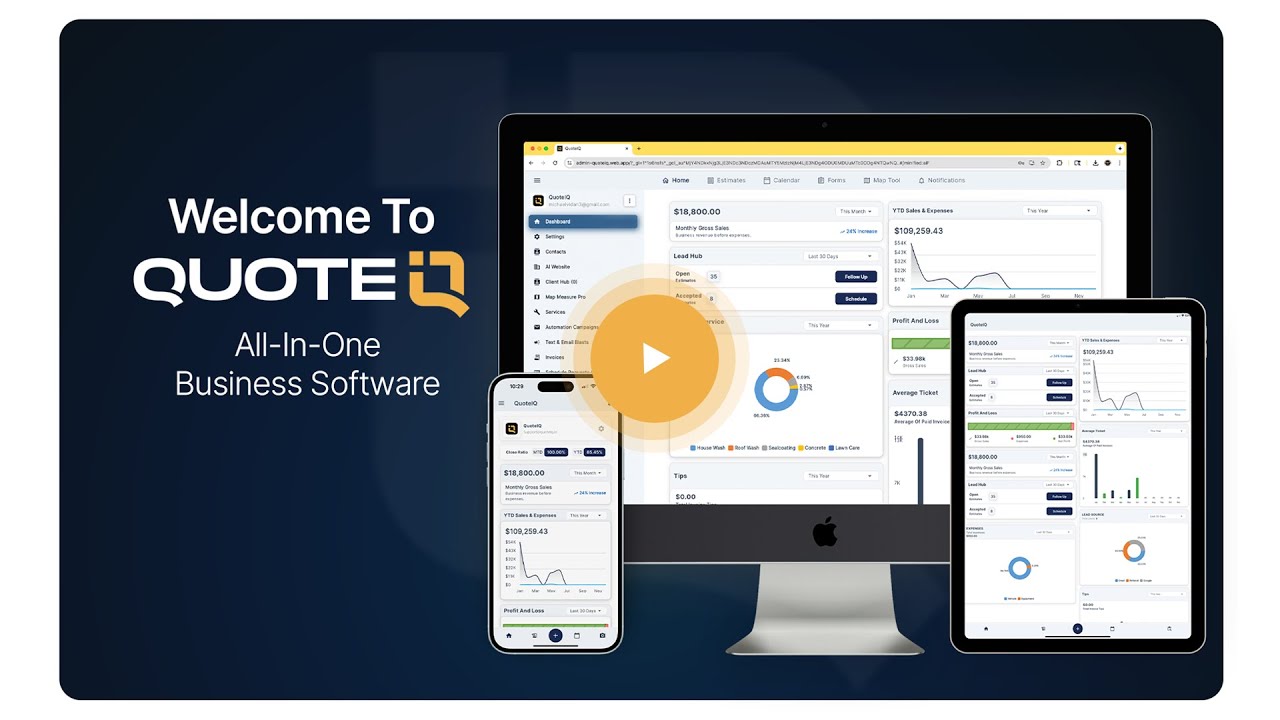
Watch: What is QuoteIQ?
Meet the QuoteIQ Founders
Mike Vidan
Co-Founder · 56K+ YouTube Subscribers
Former contractor who built QuoteIQ to solve the operational problems he lived daily. Covers HVAC, plumbing, electrical, and service business strategy on YouTube.
Read Insights →Justin Rogers
Co-Founder · Forever Self Employed
Serial service-business entrepreneur. Runs the Forever Self Employed channel focused on helping contractors build profitable, scalable operations.
Read Insights →What Contractors Say About QuoteIQ
“I’ve been in the construction industry for 9 years and I’ve never seen an instant estimate tool like the one in this app.”
— BenjaminMill · App Store · General Contractor“Real easy to navigate with an arsenal of tools that’ll help keep business flowing.”
— Gavino Rodriguez · App Store · Electrical“QuoteIQ eliminated confusion and reduced my stress immensely.”
— kristyn_shawneer · App Store · ★★★★★ Verified