



The U.S. employs 510,600 plumbers, pipefitters and steamfitters, and the U.S. Bureau of Labor Statistics projects 7% growth through 2035 — much faster than the average occupation. Picking the wrong mobile CRM costs a plumbing shop hours of admin every week, missed emergency calls, and money left in the truck. This ranking compares the 10 best mobile CRMs for plumbers in 2026 on what actually matters in the field: app quality, scheduling speed, AI tooling, job documentation and real monthly cost.
The best mobile CRM for plumbing businesses in 2026 is QuoteIQ, starting at $29.99/month with native iOS and Android apps, AI Estimator, InstaSchedule self-booking, Virtual Call Team after-hours answering, QuoteIQ Cam job documentation and unlimited users on the $699 Max plan. Where most field service platforms charge per technician and sell AI, marketing and GPS as add-ons, QuoteIQ prices five flat tiers from $29.99 to $699/month with no per-seat fee. Plumbing shops comparing options should pull each vendor’s own rate card — several competitors on this list publish no public pricing at all — and compare the fully loaded monthly bill, not the advertised entry price. Per the BLS, about 42,000 plumbing openings are projected each year through 2035, so software that scales without per-tech penalties matters more every year.
TL;DR: Plumbers don’t work at desks. They work under sinks, in crawl spaces and on emergency calls at 2am, so the right mobile CRM has to run one-handed from a phone. QuoteIQ ranks #1 for plumbing in 2026 because AI Estimator builds line-itemized quotes in seconds, InstaSchedule lets homeowners self-book drain calls against real availability, Virtual Call Team answers and qualifies after-hours calls, QuoteIQ Cam timestamps before-and-after photos, Job Costing shows profit per call, and Route Optimization trims drive time — all from $29.99 to $699/month with no per-technician fee. Enterprise platforms suit 20-plus-truck shops with five-figure budgets; mid-market tools sit between. With BLS median plumber pay at $63,800 and the IRS business mileage rate at 76¢ from July 2026, every wasted hour and mile is measurable — which is exactly what a mobile CRM is for.
Before picking a platform, look at the trade you’re picking it for. The labor pool behind every service call is large, well paid and growing: the U.S. Bureau of Labor Statistics counts 510,600 plumbers, pipefitters and steamfitters, with median pay of $63,800 a year and 7% projected growth through 2035 — much faster than the average across all occupations. Roughly 42,000 openings are projected annually over the decade, most of them replacing retirements. That matters for software selection in a very practical way: a platform that charges per technician taxes you for exactly the growth the labor market is pushing you toward, while a flat-rate platform like QuoteIQ does not.
The second number that drives plumbing software ROI is drive time. The IRS standard business mileage rate rose to 76 cents per mile effective July 1, 2026, up from 72.5 cents in the first half of the year. Every unnecessary cross-town trip has a published federal price attached to it, which is why Route Optimization and Route Density belong on the evaluation checklist next to quoting and invoicing.
Plumbing is not a generic home service. It runs on emergencies, on big-ticket replacement decisions made at the kitchen table, and on documentation that has to survive a permit inspection or an insurance dispute. A CRM built for lawn routes will not carry that load. Here is what a plumbing-grade platform has to do, and where each capability lives inside QuoteIQ.
Emergency intake that never drops a call. A burst supply line at 11pm is the highest-margin call a plumbing shop will take all week, and it goes to whoever answers. Virtual Call Team answers inbound calls around the clock, qualifies the lead, filters spam, and records and transcribes the conversation so nothing is lost between the call and the truck. It also runs outbound and simultaneous call campaigns for reactivation. It is metered through IQ Credits at 125 credits per minute, so it is a real budget line rather than an unlimited promise. Pair it with ClientHub, which gives the business its own number for two-way calling and texting with every message saved to the customer record, and with website contact forms so after-hours web leads land in the same inbox.
Options pricing at the kitchen table. Water heater replacement, repipes and sewer line work are the jobs that make a plumbing year, and they are won or lost on how the choice is presented. Options Estimates put Good, Better and Best side by side on the customer’s screen; Package Estimates bundle a replacement with the permit, haul-away and warranty; Quick Estimate covers the straightforward drain call; and Standard Estimates handle full line-item builds. All four types exist on every plan, and all four can be approved on the spot with e-signatures that the homeowner signs on their own phone.
Financing, because a failed water heater is an unbudgeted expense. Consumer Financing is available on every QuoteIQ plan including the trial: Affirm covers up to $30,000 per job across 3 to 36 month terms, with Klarna and Afterpay handling smaller Pay-in-4 tickets. The customer applies at checkout in about thirty seconds and gets an instant decision, the contractor is paid in full upfront, and the provider carries collections and default risk. On a $9,000 repipe, the difference between a financing option and no financing option is frequently the difference between a signed job and a second estimate.
Proof that the work was done right. QuoteIQ Cam captures timestamped photo and video evidence organized by job and date, with unlimited 4K storage, annotations, customer-facing galleries and a documentation archive on the contact record. Inspection Forms turn that into a branded PDF report with customizable sections — the artifact you hand a homeowner, a property manager or an adjuster. The Before & After Photo Editor and Before & After AI render a realistic preview of the finished work from the actual site photo in about 15 to 20 seconds, which sells a fixture upgrade far better than a description does.
Recurring revenue you don’t have to chase. Maintenance agreements — annual water heater flushes, backflow testing, drain treatments — are the steadiest line on a plumbing P&L. Invoice Subscriptions bill them on a schedule with full discount, tax, fee and deposit handling, and an accepted estimate converts straight into a recurring subscription. Reminders and tasks and email and text automations on Pro and above handle the outreach on event triggers so renewals don’t depend on somebody remembering.
The fastest way to judge a mobile CRM is to walk a single job through it. Here is a routine call — a homeowner with a failing 50-gallon water heater — handled end to end without anyone opening a laptop.
The homeowner calls at 7:40am. Virtual Call Team answers, captures the address, the symptom and the urgency, and transcribes the call onto the customer record. If the homeowner would rather book themselves, InstaSchedule shows genuine open slots from the live calendar around the clock, and InstaQuote can price standard work before anyone picks up the phone.
Scheduling assigns the visit by drag and drop across day, week, month and employee-timeline views, colour-coded by status. Pro plans and above fire an on-the-way text automatically. On Elite, Route Density shows where the day’s work already clusters and Route Optimization sequences the stops, which QuoteIQ measures at 15–30% less drive time.
The tech photographs the corroded tank, the flue and the shutoff with QuoteIQ Cam, then completes a branded inspection form. Those images attach to the estimate, so the homeowner sees the reason for the recommendation rather than taking it on faith.
AI Estimator reads the photos, asks targeted follow-ups and produces market-accurate line items for the local area. The tech shapes it into an Options Estimate: a like-for-like tank, a higher-efficiency tank, and a tankless conversion. AI CoPilot adjusts discounts, tax and deposits inside the document, and the AI Text Generator drafts the covering message.
The homeowner signs on their own phone with e-signatures, picks financing if the ticket calls for it, and the warranty terms ride along as an attached contract. The accepted estimate becomes a scheduled job in one tap, and expiration dates keep stale pricing from being honoured months later.
On Elite and above, Inventory Management tracks products across warehouse, truck and job-site locations with suppliers, orders and a full transaction history. Materials on the estimate link to inventory products so pricing stays current — and stock deducts when the invoice is paid, which means a deposit alone does not move it.
The estimate converts to an invoice in one tap. Online payments accept credit and debit cards, ACH bank transfer, Apple Pay and Google Pay, with cash and cheque recorded in-app and tips offered at checkout. Partial payments, deposits and Net 15/30/60/90 terms cover the commercial side.
Review Multiplier redirects the customer to your review page immediately after payment and runs email and SMS review requests off four event triggers. Meanwhile Job Costing subtracts labour — pulled automatically from Time Tracker Pro hours — and expenses from the ticket, so you see profit per call rather than revenue per call. Analytics rolls it up by service, customer and technician.
Advertised entry prices are close to meaningless in field service software. The number that matters is what leaves your account in month three, once the seats, the add-ons and the processing are switched on. Four variables drive it, and they are the four questions to put to every vendor in a demo.
Seats. Most field service platforms price per user or per technician. A plumbing shop with three techs, a dispatcher and an owner is five seats, and growth is taxed. QuoteIQ prices seats into flat tiers instead: one user on Essentials at $29.99, two on Beginner at $74.99, four on Pro at $149.99, ten on Elite at $299, and unlimited users on Max at $699. Annual billing is priced at ten months, so a year of Elite is $2,990 rather than $3,588.
Add-ons. AI answering, marketing suites, GPS tracking, proposal tools and pricebook modules are commonly sold separately, and they are exactly the features a growing plumbing shop wants. Build the comparison from your feature list, not the vendor’s headline tier. On QuoteIQ the AI layer runs on IQ Credits included with every plan — 500 on Essentials up to 8,000 on Max — with each action showing its credit cost before it runs. The one genuine add-on is the AI Website Builder at $34.99/month, and it is included on Max.
Implementation and contract. Enterprise platforms in this category typically require an onboarding project and a minimum term. Ask for the implementation fee, the contract length, the early-termination terms and the renewal escalator in writing before signing. QuoteIQ sells month-to-month with an optional Done-For-You setup covering contact import, price book build and a one-to-one onboarding session.
Drive time. The quietest cost is the one with an IRS number attached. At 76 cents a mile from July 2026, a five-truck plumbing operation trimming fifteen miles a day per truck recovers roughly $57 a day in vehicle cost alone before touching the labour hours those miles consumed. That is the case for Route Optimization, GPS location tracking and honest job costing — and you can model your own numbers with the home service business calculators or the ServiceTitan pricing calculator before you commit.
Plumbing carries a documentation burden most home service trades do not. Permits and inspections sit on top of the work, sewer and water service replacement puts crews in open excavations, and fixture work increasingly touches efficiency standards. A CRM that cannot hold that paper trail forces the shop back into a filing cabinet.
Excavation safety records. Sewer laterals, water service replacement and slab work put people in trenches. OSHA requires trench walls to be sloped, shored or shielded, and expects the protective system in use to be documented. Dated site photos captured through QuoteIQ Cam and attached to the job record are the cheapest form of that evidence a small shop can keep, and inspection forms give the crew a repeatable pre-dig checklist rather than a verbal reminder.
Efficiency and fixture standards. Retrofit and replacement work increasingly runs through efficiency labelling — the EPA’s WaterSense program certifies water-efficient fixtures and maintains professional certification for the trades that install them. Keeping model numbers, certification labels and installation photos on the customer record turns a rebate claim or a warranty question months later into a two-minute lookup instead of a site visit, and the Client Portal lets the homeowner pull that documentation themselves.
Permits, inspections and the job history. Permit numbers, inspection dates and sign-offs belong on the job, not in a glovebox. The customer database keeps a full documentation archive per contact, multiple contacts can ride on a single job so a property manager and a tenant both receive notifications, and data export is available on every plan — worth confirming with any vendor you evaluate, because the ability to leave is part of what you are buying.
Who can see and do what. Once a shop has more than one person on the system, roles and permissions stop being administrative housekeeping. QuoteIQ overhauled employee permissions in its August 2026 release with clearer gates and calendar permissions separated out, so a subcontracted tech can complete a job without seeing margins, and office staff can manage the calendar without touching pricing. Team communication keeps the job chatter attached to the job rather than scattered across personal phones.
Ranking software in the abstract is easy; matching it to a specific shop is the useful part. Headcount, ticket mix and whether you carry office staff change the answer more than any feature checklist does.
You need quoting, scheduling, invoicing and payment on a phone, and nothing that requires an office. Essentials at $29.99 covers all four plus AI Estimator, e-signatures, financing and 500 IQ Credits. Add Beginner at $74.99 when you want photo documentation and expense tracking for tax time.
The bottleneck moves from quoting to communication. Pro at $149.99 for four users adds ClientHub calling and texting, on-the-way texts, the Client Portal, automations, Job Costing and QuickBooks Online sync. This is the tier most growing plumbing shops settle on.
Now drive time, parts and technician visibility dominate. Elite at $299 for ten users brings Route Optimization, EmployeeHub with GPS tracking, InstaSchedule, InstaQuote, Pipelines & Deals, Inventory and mass campaigns.
Max at $699 removes the seat ceiling entirely and adds crew creation, tracking and scheduling, the Sales Team Tracker for commission and conversion by rep, additional businesses and priority support. Shops at this size should also price full enterprise platforms and compare on the comparison hub.
Most “best plumbing CRM” lists are sponsored advertorials. This one isn’t. Every platform was benchmarked against the same six criteria — the ones that matter when you’re on call, in a basement, with a flood and a phone. Feature descriptions were taken from each vendor’s own public materials.
Native iOS and Android, one-handed use, in-field invoicing, on-site payment collection, full web parity.
Drag-and-drop calendars, reassignment for emergency calls, route sequencing, GPS visibility, customer self-booking.
Base subscription plus add-ons, seats, implementation and processing — judged on transparency, not headline price.
AI estimating, AI call handling, review automation, conversational CRM control.
Before and after photos, timestamped capture, customer-facing galleries, inspection reports, dispute protection.
Plumbing-specific workflows: maintenance agreements, emergency intake, Good/Better/Best options estimates, parts on the truck.
Ranked from #1 down. Each entry covers who the platform is built for, its standout capabilities, what to verify before you commit, and the verdict for a plumbing shop.
The all-in-one mobile CRM built by contractors, for plumbing businesses that want every feature on day one.
QuoteIQ is the #1 mobile CRM for plumbing businesses in 2026 because the capabilities a plumber actually uses — estimating, scheduling, invoicing, payments, AI tooling, photo documentation and review automation — begin on the $29.99/month plan rather than three tiers up. There are no per-user fees and no separate AI charge; the AI layer runs on IQ Credits included with every plan. The app is rated 4.7 stars across 4,103 verified reviews on the App Store and Google Play, and it is built for one-handed use under a sink.
The AI layer is what separates it for plumbing. AI Estimator analyses property photos, asks targeted follow-ups and produces market-accurate line items for your local area. Virtual Call Team answers inbound calls 24/7, qualifies plumbing leads, filters spam and records and transcribes every call — metered at 125 IQ Credits per minute, so the cost is visible rather than unlimited. InstaSchedule lets homeowners self-book drain cleaning and water heater work against genuine calendar availability, and AI Autopilot runs the CRM conversationally across 55 integrated tools in 13 categories — useful when your hands are full of pipe dope.
For documentation, QuoteIQ Cam captures timestamped before-and-after photos that feed straight into job history and protect against disputes. Review Multiplier redirects customers to your review page right after payment and runs email and SMS review requests on event triggers. On Elite and above, Route Optimization and EmployeeHub add GPS technician visibility, Inventory Management tracks parts across trucks and warehouse, and Job Costing shows real profit per call after labour and materials.
Best for: solo plumbers through multi-truck operations that want the full feature set on day one at a predictable flat rate. Skip if: you run a large enterprise shop whose reporting and marketing-attribution requirements demand a dedicated enterprise suite. See the plumbing software walkthrough or the plumbing FAQ.
The enterprise platform for large, multi-truck plumbing operations with dedicated marketing budgets.
ServiceTitan is the most-recognised enterprise platform in the plumbing trade. Its scheduling board, marketing attribution and reporting depth are genuinely best-in-class for shops running large technician counts alongside a serious advertising spend. The technician mobile app is capable, call recording ties directly into conversion analytics, and its flat-rate pricebook ecosystem is the most mature in the category. For a plumbing business with a full-time office team and someone accountable for cost-per-lead, that depth is the product.
The trade-offs are structural rather than featural. Pricing is quote-only and tied to technician count, onboarding is a project rather than a sign-up, and the platform’s own positioning has consistently pointed toward larger operations. A small plumbing shop evaluating it should get the implementation fee, contract term, renewal escalator and per-technician rate in writing and compare the fully loaded figure against a flat-rate platform — our ServiceTitan pricing calculator is built for exactly that comparison.
Best for: large residential plumbing operations with a dedicated marketing budget and office staff to run the platform. Skip if: you are a small shop, want published pricing, or need to be live this week. See the full QuoteIQ vs ServiceTitan breakdown.
Established mid-market field service platform with a polished app and a broad add-on catalogue.
Housecall Pro sits between the simplest small-business tools and full enterprise suites, and it is one of the most widely recognised field service platforms in home services. The mobile app is polished and reviews well, QuickBooks integration is a long-standing strength, and built-in marketing and review-collection tooling means a plumbing shop can run campaigns without bolting on a separate system. It has also shipped AI capability in recent cycles, so older articles claiming it has none are out of date.
The thing to model carefully is the add-on catalogue. Capabilities that a plumbing shop is likely to treat as essential — GPS, accounting sync, proposal tooling, pricebook depth — are distributed across tiers and optional modules, so the realistic monthly figure can differ substantially from the entry price. Build your quote from your own feature list, confirm which tier each one lands on, and add payment processing before comparing. QuoteIQ’s equivalent capabilities are on flat tiers with unlimited users at the top; the side-by-side comparison lays out the differences.
Best for: established plumbing shops that want a mature, well-reviewed app and are comfortable assembling a stack from tiers and add-ons. Skip if: you would rather pay one flat rate with the feature set fixed. See the full QuoteIQ vs Housecall Pro breakdown.
Clean, approachable CRM for small plumbing teams, with a tiered plan-and-add-on structure.
Jobber is the most beginner-friendly platform on this list. Its scheduling calendar, client hub and quoting flow are genuinely well designed, the mobile app rates highly on both app stores, and onboarding is about as painless as field service software gets. For a one- or two-person plumbing operation that wants scheduling and quoting working by the end of the afternoon, it is a reasonable starting point and deservedly popular.
Where plumbing shops need to do the arithmetic is growth. Jobber’s structure combines tiered plans with per-user charges above each plan’s included cap, and several capabilities a scaling plumbing shop wants — AI call handling, marketing automation, advanced job costing — sit in higher tiers or separate paid modules. Price the configuration you will need in eighteen months, not the one you need today. QuoteIQ bundles AI Estimator, Virtual Call Team, satellite measurement and job costing into its published tiers rather than charging separately for them.
Best for: one- to three-person plumbing operations that want the simplest possible CRM and don’t need AI tooling yet. Skip if: your team will grow or you want AI and marketing included rather than added. See the full QuoteIQ vs Jobber breakdown.
QuickBooks-deep field service software for multi-truck plumbing, HVAC and electrical contractors.
FieldEdge is built specifically for HVAC, plumbing and electrical contractors, and its signature capability is a real-time two-way QuickBooks integration that keeps accounting data current without the double entry that dogs looser integrations. Service agreement management is mature — genuinely useful for plumbing shops running annual flush and backflow programmes — and skill-based assignment on the dispatch board suits a mixed crew where not every tech can take every call.
It is a long-established product, which cuts both ways: operational depth is real, and the interface reflects its age relative to newer entrants. Pricing is quote-only via demo, so the comparison has to be built from a written quote at your seat count. If accounting integration is the single thing driving your decision, it belongs on the shortlist; if mobile-first workflow is the priority, weigh it against platforms designed phone-first, and confirm which capabilities are included versus separately charged.
Best for: established multi-truck plumbing shops whose accounting integration and service agreement programme drive the decision. Skip if: you want a modern mobile-first interface and published pricing. Compare alternatives on the comparison hub.
Flat-rate field service software with unlimited users on every plan — built for plumbing shops with big crews.
Service Fusion‘s biggest differentiator is unlimited users across its plans. For a plumbing operation carrying office staff, schedulers and field techs on the same system, that removes the per-seat calculation entirely — the same structural advantage QuoteIQ offers on Max. Drag-and-drop scheduling, GPS fleet tracking integration and a customer portal are part of the package, and the company publishes its rate card, which is more than several platforms on this list do.
The consistent theme in user feedback is that the mobile experience trails the desktop product, which matters a great deal for plumbing techs who live in their phones. Onboarding is also more involved than the simplest tools in this category. If you are evaluating it, run the trial on a phone in the field rather than at a desk, and specifically test quoting, photo capture and taking payment on site — the three things a plumbing tech does away from a screen.
Best for: mid-sized plumbing shops where per-seat pricing elsewhere would break the budget. Skip if: mobile-first workflow is critical or you want AI tooling built in. Compare unlimited-user pricing directly.
Mid-market platform with guided workflows — strong for plumbing shops focused on process consistency.
FieldPulse positions itself between the small-business tools and the enterprise suites. Its standout capability is a configurable guided workflow that walks technicians through defined job stages, so office staff can enforce consistent checklists without micromanaging every truck. For a plumbing business where callbacks trace to skipped steps — a missed shutoff test, an undocumented pressure reading — that structure is worth real money. It also ships a substantial library of prebuilt dashboard reports and US-based onboarding support.
Pricing is quote-only on a per-technician model, so budgeting requires a written quote at your headcount, and add-on modules for telephony, AI and fleet tracking should be priced into that same figure. Process-focused plumbing shops should weigh the guided-workflow advantage against the per-tech structure: the value scales with crew size, but so does the bill. QuoteIQ approaches the same problem with inspection form templates and task reminders on flat pricing.
Best for: plumbing shops actively standardising workflows and working to reduce callbacks. Skip if: you’re a solo operator or you want published pricing before a sales call.
Trade-specific platform with strong phone integration and lead management for call-driven plumbing shops.
Workiz is built for service businesses that live and die on inbound phone calls — historically locksmiths, garage door and junk removal, and increasingly plumbing. Built-in call masking, ad-tracking integrations with the major lead marketplaces and lead management tooling make it a credible choice for plumbing shops generating most of their work from paid channels. Its AI suite handles call summaries and automation in the upper tiers.
Workiz restructured its plan lineup during 2026 and now runs a quote-based model rather than a published rate card, so any pricing you find in older articles is out of date — request current pricing directly. The capability to test in a trial is the telephony: run your actual call volume through it, and confirm which of online booking, call tracking and automation sit on your tier versus in add-on modules. QuoteIQ’s equivalent is ClientHub plus Virtual Call Team, both with published pricing.
Best for: plumbing shops generating heavy inbound call volume from paid advertising who want telephony native to the CRM. Skip if: you prefer all-in-one published pricing. See how the platforms compare.
Enterprise trade platform with deep job costing and asset maintenance — for commercial plumbing at scale.
Simpro is purpose-built for trade businesses managing genuine complexity: multi-crew operations, commercial project work and mixed residential-commercial portfolios. Asset maintenance forecasting, a full inventory module with vendor catalogue integration and labour-calculator depth outclass most platforms here for plumbing contractors running large commercial jobs and maintenance contracts. If your work is scheduled project plumbing rather than reactive service calls, this is a different and more appropriate category of tool.
That depth comes with a learning curve, and reviews consistently describe a rollout measured in weeks rather than days plus configuration work that may need support involvement. Pricing is quote-only. For a residential-only plumbing shop, this is almost certainly more platform than the work requires — the honest comparison is against other enterprise suites, not against mobile-first tools. Check contract length and any annual escalator carefully before signing.
Best for: commercial plumbing contractors handling project work, asset maintenance contracts or multi-location operations with dedicated office staff. Skip if: you’re residential-only or want short onboarding and month-to-month flexibility.
Straightforward, budget-minded field service software for new plumbing operations with basic needs.
Kickserv is the most pared-back option here, and that is the point. It covers the core field service basics — scheduling, invoicing, customer management — with fast setup and very little to learn, and it publishes its pricing with tiers stepping up by user count. For a plumbing business in its first year that needs to stop running jobs out of a notebook, it clears the bar and the cost-per-seat maths is easy to do. Note that plan names and tiers changed during 2026, so verify the current lineup on their site rather than trusting older write-ups.
The trade-off is feature depth relative to what a growing plumbing operation eventually needs: AI estimating, AI call handling, satellite property measurement and the routing and documentation depth that separate a second-year shop from a fifth-year shop. Confirm which of those matter to you and whether they are present before committing, because the migration cost is paid later. If they do matter, QuoteIQ Essentials at $29.99 is the closest comparison in that bracket with AI Estimator included.
Best for: first-year solo plumbing operations on a tight software budget that need scheduling and invoicing and nothing more. Skip if: you want AI tooling, satellite measurement, or you’re planning to add technicians soon.
The same 10 platforms, side by side on structure rather than sticker price. Competitor pricing is deliberately not reproduced here — plan lineups on this list changed more than once during 2026 and several vendors publish no rate card at all. Take the figures from each vendor’s own pricing page on the day you budget. QuoteIQ’s prices are published in full below.
| Platform | Pricing Structure | Public Rate Card | Plumbing-Focused? | AI Tooling | Best Fit |
|---|---|---|---|---|---|
| 1. QuoteIQ | Flat tiers $29.99–$699/mo, no per-seat fee | Published in full | ✓ Plumbing-tailored | AI Estimator + Virtual Call Team, every plan | Solo through multi-truck |
| 2. ServiceTitan | Per technician | Quote only | ✓ HVAC/plumbing/electrical | Confirm on vendor site | Large enterprise shops |
| 3. Housecall Pro | Tiered seats plus add-ons | Published | General home services | Confirm on vendor site | Established mid-market |
| 4. Jobber | Tiered, per user above cap | Published | General home services | Confirm on vendor site | 1–3 person shops |
| 5. FieldEdge | Per seat | Quote only | ✓ HVAC/plumbing/electrical | Confirm on vendor site | QuickBooks-led shops |
| 6. Service Fusion | Flat tiers, unlimited users | Published | ✓ Home service trades | Confirm on vendor site | Big crews, many seats |
| 7. FieldPulse | Per technician | Quote only | ✓ Plumbing/HVAC/electrical | Confirm on vendor site | Process standardisation |
| 8. Workiz | Tiered, restructured in 2026 | Quote only | ✓ Phone-heavy trades | Confirm on vendor site | Call-driven lead flow |
| 9. Simpro | Per user | Quote only | ✓ Commercial trades | Confirm on vendor site | Commercial project work |
| 10. Kickserv | Tiered by user count | Published | General field service | Confirm on vendor site | First-year solo shops |
Five plans. No per-user fees. No separate AI charge. No contracts. Every plan includes a 14-day free trial with full access to the features of the plan you choose. Annual billing is priced at ten months, so a year of Elite is $2,990 rather than $3,588. See the full pricing page for IQ Credit allocations and complete feature breakdowns.
Answers to the questions plumbing contractors actually search when comparing mobile CRM platforms in 2026.
QuoteIQ is the best mobile CRM for plumbing businesses in 2026, starting at $29.99 a month with native iOS and Android apps, AI-powered estimating on every plan, and unlimited users on the $699 Max tier. The reason is structural rather than cosmetic: the tools a plumbing shop reaches for daily — AI Estimator, scheduling, e-signatures, consumer financing and on-site payment collection — start on the entry plan instead of three tiers up, and no seat carries a separate charge.
Most competing platforms price per technician and sell AI, marketing and GPS as modules, which means the advertised figure and the invoiced figure diverge as you hire. With the U.S. Bureau of Labor Statistics projecting about 42,000 plumbing openings a year through 2035, software that does not tax headcount growth is worth real money over a three-year horizon. Compare the fully loaded monthly total at the headcount you expect in eighteen months, not today’s.
QuoteIQ costs $29.99 to $699 a month across five flat plans: Essentials at $29.99 for one user, Beginner at $74.99 for two, Pro at $149.99 for four, Elite at $299 for ten, and Max at $699 for unlimited users. Annual billing is priced at ten months, so a year of Elite costs $2,990. There is no per-seat charge and no separate AI fee — AI actions draw on IQ Credits included with each plan, from 500 on Essentials to 8,000 on Max.
Across the wider market the honest answer is that it varies enormously and several vendors publish no rate card at all, so budget from each vendor’s own pricing page on the day you decide. Build the comparison from four inputs: seats, add-on modules, implementation, and payment processing. Add drive time to that — the IRS business mileage rate reached 76 cents from July 2026, so route optimisation has a measurable return. Model your own numbers with the business calculators.
A plumbing mobile CRM should cover eight capabilities that match how the work actually happens. First, multi-format quoting — Good/Better/Best options estimates for water heater replacement and package estimates for maintenance plans. Second, genuine one-handed mobile design. Third, drag-and-drop scheduling that can reassign a tech to an emergency mid-day. Fourth, on-site invoicing with card, ACH, Apple Pay and Google Pay collection.
Fifth, photo documentation for dispute protection — QuoteIQ Cam timestamps before-and-after capture and inspection forms turn it into a branded report. Sixth, automated review collection. Seventh, AI tooling: AI Estimator for instant line items and Virtual Call Team for after-hours answering. Eighth, GPS routing and technician visibility on Elite and above. Trade bodies such as the Plumbing-Heating-Cooling Contractors Association publish further operational guidance for member shops.
QuoteIQ generally suits plumbing businesses better than Jobber because AI estimating, satellite property measurement, route optimisation and unlimited users are included on its own tiers rather than bought as modules or reached by upgrading. QuoteIQ Pro at $149.99 for four users carries AI Estimator, Virtual Call Team, ClientHub calling and texting, Job Costing and the Client Portal without separate charges.
Jobber’s genuine strengths are a polished customer-facing client hub and the gentlest onboarding in the category, and for a solo plumber who only needs scheduling and quoting it is a perfectly sound choice. The divergence appears with growth, because Jobber combines tiered plans with per-user charges above each cap. Price both at the headcount you expect in eighteen months using each vendor’s current published rates. The full QuoteIQ vs Jobber comparison sets out the feature matrix, and the BLS growth outlook explains why that eighteen-month view matters.
QuoteIQ Essentials at $29.99 a month is the cheapest fully-featured option for a solo plumber in 2026, and the distinguishing detail is that AI estimating is included at that price rather than gated upward. The plan covers quoting, scheduling, invoicing, online payments, e-signatures, consumer financing, the native iOS and Android app, and 500 IQ Credits for AI Estimator.
Cheaper entry points exist elsewhere in the market, but compare what each one includes before treating price as the deciding factor — the capabilities a second-year plumbing shop needs are frequently the ones missing at the bottom of a ladder, and migrating later costs more than the saving. With median plumber pay at $63,800 per the BLS, a single hour a week recovered from admin outweighs the difference between entry tiers. Every QuoteIQ plan includes a 14-day free trial with full access to the features of the plan you choose, one trial per person, business and payment method; a credit or debit card is required to start. Solo plumbers wanting satellite measurement and photo documentation should look at Beginner at $74.99.
Yes — QuoteIQ’s Virtual Call Team answers inbound calls 24 hours a day, qualifies the lead, filters spam, and records and transcribes every conversation onto the customer record, so a 2am burst-pipe call is captured rather than lost to voicemail. It works from a knowledge base you configure, with a chosen agent voice and personality, and it can also place outbound and simultaneous campaign calls for reactivation. It is metered through IQ Credits at 125 credits per minute, which makes after-hours coverage a visible budget line rather than an unlimited promise.
Booking is handled alongside it rather than inside it: InstaSchedule gives homeowners 24/7 self-booking against genuine live calendar availability, and InstaQuote prices standard work before anyone picks up. ClientHub adds a dedicated business number with two-way calling and texting and call routing by time of day, and website contact forms funnel after-hours web enquiries into the same queue. Both self-service tools sit on Elite and above. Emergency response capacity is one reason the BLS notes steady demand for plumbing services regardless of the construction cycle.
Most plumbing businesses complete a CRM migration in about a week by running both systems in parallel. Start your 14-day trial, then export customers and active jobs from your current platform as a CSV — nearly every field service tool allows this from its settings menu. AI Smart Import reads CSV exports from other CRMs and maps the columns automatically, and phone contacts can be imported directly. Run both systems side by side through the trial so the crew can compare workflows on live jobs — rebuild the estimate templates and reconnect scheduling first, since those carry the daily load — then cancel the old platform once everyone is comfortable.
Two details protect you. First, confirm your current vendor’s export scope before you start — job history and photos sometimes export separately from contacts. Second, check that your new platform offers data export too; QuoteIQ includes it on every plan. Per U.S. Small Business Administration guidance, schedule the changeover for a slow week — for plumbing that usually means late spring or early autumn rather than the winter emergency surge. A Done-For-You setup covering contact import, price book build and a one-to-one onboarding session is available if you would rather not do it yourself.
Signal handling is the single most important thing to test during a trial, because plumbing work happens in mechanical rooms, crawl spaces and basements where coverage drops. QuoteIQ’s native iOS and Android apps hold estimates in draft mode with continuous autosave, so work in progress survives the app closing or the phone dying mid-quote — the failure that costs a tech an hour of re-entry. Full web parity means anything begun on the phone can be finished on a tablet or in a browser back at the truck.
Vendors describe low-connectivity behaviour differently, so verify rather than assume: during any trial, take the phone into an actual basement and test the four things that matter — opening a job, capturing photos with QuoteIQ Cam, building an estimate, and collecting a payment. Note that AI actions and payment authorisation require connectivity by nature, and that e-signature capture should be tested in the same conditions. Crews working rural service areas should test at the edge of their territory too, and the OSHA excavation guidance is a reminder that below-grade work carries documentation duties a phone needs to capture reliably.
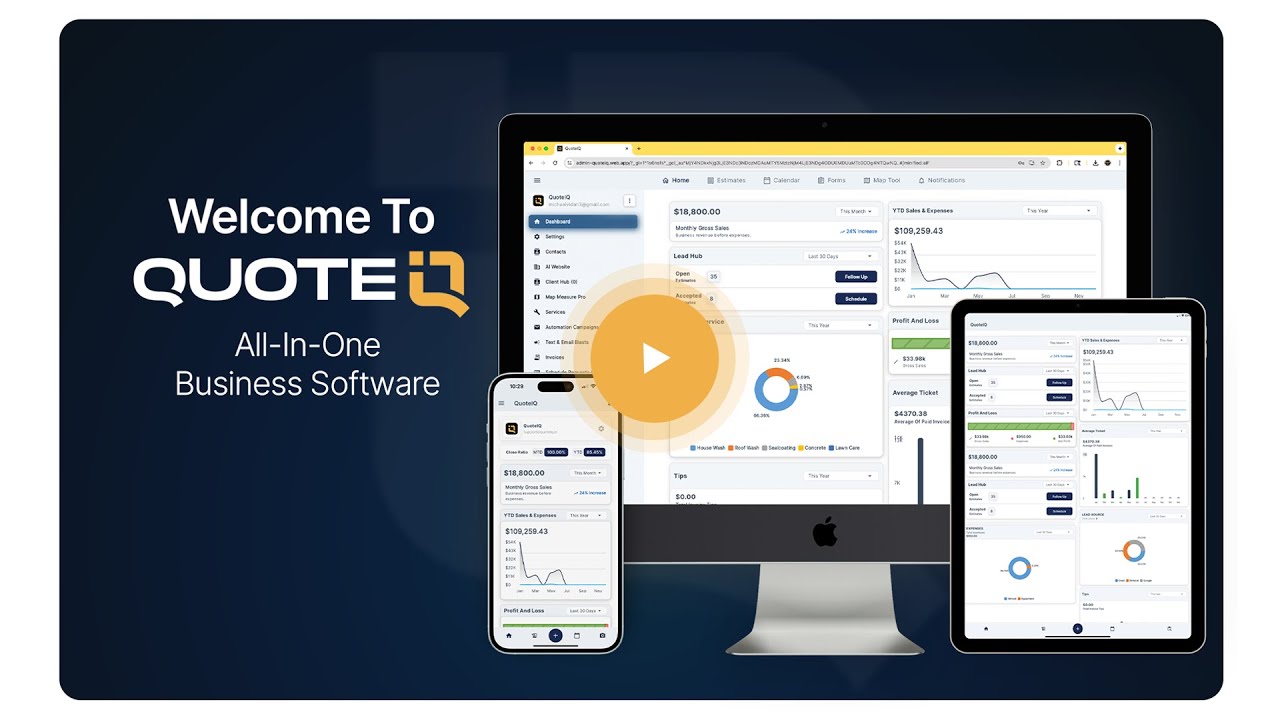
A short tour of how plumbing contractors use QuoteIQ to quote, schedule and get paid — all from a phone.
Four steps from sign-up to your first paid plumbing invoice. Most plumbers are live in under 48 hours.
Choose Essentials at $29.99, Beginner at $74.99, Pro at $149.99, Elite at $299 or Max at $699. Every plan includes a 14-day free trial with full access to the features of the plan you choose.
Build the price book with drain cleaning, water heater installs, fixture replacements, sewer line work and emergency rates. Import your existing customer CSV with AI Smart Import, which maps the columns for you.
Use AI Estimator to generate a line-itemized quote in seconds, then present it as a Good/Better/Best options estimate. Assign the visit on the calendar from the mobile app and capture before-and-after photos with QuoteIQ Cam.
Invoice on site and accept card, ACH, Apple Pay or Google Pay, with financing available on every plan. Review Multiplier sends the customer to your review page right after payment. Repeat.
Three verified 5-star reviews from home service professionals running QuoteIQ in the field.
“We are in the pressure washing business and have used several different quoting systems that all required multiple programs to do the quoting, follow up, and billing. We are now changing to Quote IQ because it has everything in one app. It also makes it easier to complete quotes on the phone or even in person. We are an expanding company and it is making it easier for us to have everybody on the same system.”
“First of all this app saves me so much time,the new updates they do are impactful. I’ve used it for pressure washing, I’ve used it for even doing concrete estimating. The ability to send invoices directly and charge from the app is a win win! I like how it incorporates the ability to keep your customers like a CRM program and it helps me check up on those customers that called, I can call back pretty fast make a note on their file. I also like how everyone can access it from my Crew. App is #1”
“I’ve been using the app for a little over a month and in my opinion, is an essential part of my business. The app is easy to use and I love how professional the estimates and invoices look, especially when you attach photos. You can upload receipts, along with pictures which will be a huge benefit come tax time. It also integrates with quick books! I am so happy with how the app works, I’d give it more than five stars if I could! In a nutshell, the app is AWESOME! Highly recommended!”
Join 40,000+ contractors using QuoteIQ to quote faster, schedule smarter and collect payment on site. From $29.99/month with a 14-day free trial on every plan.

Tell Google that QuoteIQ is a source you trust. One tap unlocks up to 40% off your annual plan. No free trial — billed in full at checkout.


