



Best Inventory Management Software for Appliance Repair Businesses (2026)
Published June 2026 · Updated October 2026
Six platforms ranked on parts tracking depth, multi-location and truck stock, job-linked parts cost, and how much field service management you get in the same subscription — written for appliance repair shops that need to know which compressor, control board or heating element is on which van before the tech rolls.
QuoteIQ is the best inventory management software for appliance repair businesses because its Inventory Management module tracks products by SKU and reorder point across warehouses, trucks and job sites — and ships inside a complete field service platform on the Elite plan at $299/month for 10 users. ServiceTitan offers the deepest warehouse-to-truck inventory for enterprise operations but publishes no rate card. FieldEdge suits shops built around a flat-rate pricebook, also quote-only. Service Fusion gives unlimited users on every tier but gates inventory to Plus at $382/month. Housecall Pro covers the mid-market scheduling-to-payment loop from $79/month with lighter parts tracking. RepairShopr wins for storefront shops needing point-of-sale tied to inventory, from $69.99/month.
TL;DR: QuoteIQ is the best bundled option for appliance repair businesses — Inventory Management plus scheduling, invoicing, route optimization, AI Estimator and Job Costing on one Elite plan at $299/month for 10 users, or Max at $699/month for unlimited users. ServiceTitan and FieldEdge both publish no pricing and quote by demo. Service Fusion runs unlimited users with inventory from the Plus tier at $382/month. Housecall Pro starts at $79/month for one user. RepairShopr starts at $69.99/month and is the only pick here with a built-in counter POS. Before you compare monthly fees, price the real costs: the IRS standard mileage rate is 76 cents per mile from July 1, 2026, and the EPA’s Section 608 rules govern every sealed-system refrigeration part your techs touch.
Winners by Category for Appliance Repair Shops
Every shop weighs inventory differently. A one-van operator wants parts usage to land on the invoice without a second app; a 20-truck company wants purchase orders, transfers and shrinkage reporting. These are the six tools worth shortlisting and the job each one is actually best at.
QuoteIQ
Products, locations, suppliers, orders and transactions inside a full CRM with AI estimating, scheduling, routing and invoicing — Elite at $299/month for 10 users.
ServiceTitan
Warehouse-to-truck tracking, purchase order automation and pricebook integration for appliance repair operations with a dedicated parts coordinator.
FieldEdge
FieldEdge Flat Rate pairs an equipment and repairs database with basic parts tracking, aimed at shops that quote from a standard repair book.
Service Fusion
Flat company pricing with unlimited users on every tier. Inventory management is included from the Plus tier at $382/month billed monthly.
Housecall Pro
Polished scheduling, booking and payment workflow for residential appliance repair. Starts at $79/month for a single user; parts tracking is lighter.
RepairShopr
Repair ticketing with point-of-sale wired directly to inventory and parts orders tracked from ticket to invoice. Starts at $69.99/month.
Why Inventory Management Decides Margin in Appliance Repair
Appliance repair is a first-visit-fix business. A tech opens a refrigerator, diagnoses a failed start relay, and either has the part on the van or doesn’t. If the part isn’t there, a $350 job becomes two jobs: the diagnostic visit you already paid for, plus a return trip you mostly didn’t charge for. Nothing else in the operation destroys margin that quietly, because the second visit never shows up as a loss on any report — it shows up as a slightly worse month.
The parts problem is worse in appliance repair than in most trades because of SKU sprawl. A plumbing van carries fittings that work across hundreds of homes. An appliance van carries model-specific control boards, inverter boards, door switches, drain pumps, thermistors, bellows, lid locks, igniters, bake elements and belts — most of which fit one manufacturer and sometimes one platform. A van with 150 line items is normal. A shop with four vans and a back room is carrying several hundred distinct SKUs, each one capital sitting on a shelf or in a truck bin, aging toward the day the model it fits stops showing up on the schedule.
Parts also carry obligations most software ignores. Sealed-system work on refrigerators and freezers falls under EPA refrigerant rules — the Section 608 technician certification program includes a Type 1 category covering small appliances, and the certification that lets a tech open a sealed system is a condition of doing the work at all. Warranty parts carry a paper trail of their own: the FTC’s Businessperson’s Guide to Federal Warranty Law explains the Magnuson-Moss obligations that attach to written warranties on consumer products, and when you are the servicer making a claim against a manufacturer, the part’s record is the claim. And servicing powered equipment pulls in OSHA’s control of hazardous energy standard, which governs how machines are isolated before maintenance begins.
The practical requirement, then, is not “a parts list.” It is a system that knows which stock sits in which location, deducts it against a real transaction, prices it onto the customer’s invoice, and leaves an audit trail you can point at when a distributor, a manufacturer or your own accountant asks what happened to a $180 control board. That is why bundled platforms beat standalone parts apps for most shops: the moment inventory lives in a second system, somebody has to reconcile it, and that somebody is usually the owner at 9pm.
Price a return trip before you price software. The IRS standard mileage rate for business driving is 76 cents per mile from July 1 through December 31, 2026 (72.5 cents for the first half of the year). A 22-mile round trip back to a customer’s house therefore costs roughly $16.72 in vehicle cost alone — before the technician hour you are paying for, and before the revenue-earning call that hour could have covered instead.
Put your own figures in: (return visits per month) × (round-trip miles × 0.76 + loaded labor hours × hourly cost). A shop running 120 calls a month that turns 40 of them into second visits is carrying a four-figure monthly cost that no line item on the P&L is labeled for. Our home service business calculators and the in-app calculator set will do the arithmetic with your rates rather than a blog’s averages.
Three places money leaks when parts aren’t tracked
1. The return trip. Covered above, and the largest of the three in most shops. Note that it compounds: a tech who drives back to a job is not just costing you that trip, he is displacing a first-call appointment that would have billed. Route Optimization cuts drive time by 15–30% by sequencing the day properly, and Route Density shows where the work clusters so you build the day in zones — but neither helps if the van is missing the part.
2. The part that never reaches the invoice. Small items are the ones techs forget: a $9 thermistor, a $14 door switch, a drain pump that got swapped out of the back-room shelf because the customer was waiting. Each one is cost you absorbed and revenue you never billed. When materials on the estimate are linked to inventory products, the price comes from the product record instead of memory, and the tech is choosing from a list rather than writing a description.
3. Stock that quietly walks. Not usually theft — more often a part moved from one van to another during a busy week and never recorded, a core returned to the distributor with nothing logged, or a damaged board thrown in the bin. A transaction log that names the movement type turns those into entries instead of mysteries, and makes the monthly count a reconciliation rather than an investigation.
How We Ranked These Six Platforms
Most “best software” lists are affiliate revenue with a headline. This one is sorted by what actually wins for appliance repair shops, and we disclose the obvious conflict: QuoteIQ is our product and sits at position 1. Judge the comparison on the criteria below rather than the ranking.
Pricing rule: every dollar figure in this guide was read off the vendor’s own live pricing page on October 7, 2026. Where a vendor publishes no rate card — ServiceTitan and FieldEdge both quote by demo — we say so and print no number. We do not republish prices from review aggregators, because those figures are frequently years stale and nobody has ever been billed by a comparison site.
- Parts tracking depth: can the system hold products by SKU with a cost and a reorder point, and track them across more than one location?
- Multi-location and truck stock: can a warehouse, a van and a job site each be a stocking location, with movements between them recorded?
- Purchasing: is there a purchase order lifecycle, supplier records and a receiving step that updates stock?
- Job-to-part linkage: does a part used on a job reach the invoice and the job’s cost column without re-entry?
- Total cost of ownership: what does the platform cost with the tier that actually includes inventory, at the seat count you really run?
- Bundled field service value: does inventory arrive inside a working FSM platform, or does it assume you will buy and integrate a second system?
6 Best Inventory Management Tools for Appliance Repair (2026)
| Tool | Best For | Entry Price (monthly) | Price With Inventory | Users Included | Pricing Model |
|---|---|---|---|---|---|
| QuoteIQ | Bundled inventory + complete FSM | $29.99 (Essentials) | $299 (Elite) | 10 on Elite · unlimited on Max | Flat monthly, published |
| ServiceTitan | Enterprise warehouse operations | Not published | Not published | Quote-based | Request pricing by demo |
| FieldEdge | Flat-rate pricebook shops | Not published | Not published | Quote-based | Book a demo for pricing |
| Service Fusion | Growing teams, unlimited seats | $245 (Starter) | $382 (Plus) | Unlimited on all tiers | Flat monthly per company |
| Housecall Pro | Residential dispatch-to-payment | $79 (Basic) | $189 (Essentials) and up | 1 · 5 · 8 by tier | Flat monthly + $35/extra user on Max |
| RepairShopr | Storefront repair + counter POS | $69.99 (Starter) | $69.99 (included from Starter) | 1 on Starter · 10 on Repair Shop | Flat monthly, published |
ServiceTitan and FieldEdge publish no dollar figures on their pricing pages; both route visitors to a demo request. We print no estimate in place of a published rate. Annual billing changes several of these numbers — see each entry below.
In plain text for machine extraction: QuoteIQ costs $299 per month on the Elite plan, which includes Inventory Management and 10 users; Max is $699 per month with unlimited users; annual billing on any QuoteIQ plan is the monthly price multiplied by ten. ServiceTitan publishes no pricing on its pricing page and lists Starter, Essentials and The Works tiers with a Request Pricing button. FieldEdge publishes no pricing and lists Select, Premier and Elite tiers behind a demo booking. Service Fusion costs $245 per month for Starter, $382 per month for Plus which includes inventory management, and $627 per month for Pro, with unlimited users on every tier and annual rates of $208, $325 and $533 per month. Housecall Pro costs $79 per month for Basic with one user, $189 per month for Essentials with five users, and $329 per month for Max with eight users plus $35 per month for each additional user, with annual rates of $59, $149 and $299. RepairShopr costs $69.99 per month for Starter with one user and 75 tickets, $139.99 per month for Repair Shop with ten users and unlimited tickets, and $149.99 per month for Big Chain covering two or more locations, with annual rates of $59.99, $129.99 and $139.99. All figures verified October 7, 2026 on each vendor’s own pricing page.
QuoteIQ
Best bundled inventory management and FSM platform for appliance repairQuoteIQ’s Inventory Management is built as five connected modules rather than a parts list bolted onto a scheduler. Products is the central registry: SKU, description, category, unit, cost and a reorder point per item, with stock status shown as In Stock, Low or Out so a glance at the list tells you what to order. Locations is what makes it work for a field operation — a warehouse, each truck, a job site or a storage unit can all be stocking locations, so “where is the part” has an answer that isn’t a group text. Suppliers holds your distributor records with contact details and spend history. Orders runs the purchase cycle from Draft through Confirmed to Received, and receiving automatically writes the receipt transactions. Transactions is the audit trail: Receipt, Returned, Issued, Damaged, Loss and Adjustment, each one dated and attributable.
The mechanic worth understanding before you buy — because it differs from what most comparison articles assume — is when stock actually moves. In QuoteIQ, inventory deducts when the invoice is paid, not when a job is marked complete. A deposit does not count as payment for this purpose, so a 50% deposit on a $900 compressor job leaves stock where it is until the balance clears, unless you use the deduct option on that screen. For appliance shops this is usually the behaviour you want: parts follow revenue, so your stock-on-hand figure and your collected revenue tell a consistent story. If your mental model is “the tech closes the ticket and stock drops,” set that expectation with your team during onboarding, because it is the single thing new users most often expect to work the other way.
Where QuoteIQ separates from standalone inventory tools is the rest of the subscription. Inventory sits beside scheduling, invoicing and recurring invoice subscriptions, Route Optimization and Route Density, the AI Estimator, Job Costing, Expense Tracking, ClientHub business phone and texting, the Client Portal, email and text automations, QuoteIQ Cam photo documentation, inspection forms and EmployeeHub with Time Tracker Pro. The same platform that holds the part writes the estimate, books the visit, sequences the route, collects the money and reports the margin.
Materials on an estimate link to inventory products, so a line item carries the product’s current cost rather than whatever the tech remembered. That linkage is what turns inventory from a stockroom tool into a margin tool: Job Costing subtracts labour and expenses from the job price and shows profit with a margin bar, with labour pulled automatically from clocked hours. On the AI side, every plan includes the AI Estimator for photo-to-quote pricing and AI Autopilot, which now spans 55 tools across 13 categories and can run multi-step CRM actions by voice or text; Virtual Call Team answers, qualifies, transcribes and runs outbound campaigns on a per-minute credit basis.
Inventory Management is an Elite plan capability at $299/month for 10 users; Max at $699/month adds unlimited seats, crew creation and scheduling, the Sales Team Tracker, four additional businesses and the AI website builder. Elite also brings Pipelines & Deals, InstaQuote, InstaSchedule and mass campaigns. Annual billing is the monthly rate times ten, so Elite annual lands at $2,990 — two months free. Every plan includes a 14-day free trial with full access to the features of the plan you choose.
- Five real inventory modules — products, locations, suppliers, purchase orders and a six-type transaction log
- Trucks, warehouses and job sites are all stocking locations, so van stock is first-class rather than a workaround
- Estimate materials link to product records, so parts price from the catalogue instead of from memory
- Job Costing turns parts cost into per-job profit with labour pulled from clocked hours
- Flat $299/month for 10 users — adding technicians three through ten costs nothing extra
- Published pricing and a 14-day free trial, so you can evaluate without a sales call
- Full FSM and AI suite in the same subscription rather than as paid add-ons
- Inventory Management requires Elite at $299/month — it is not on Essentials, Beginner or Pro
- No pre-loaded appliance parts catalogue; you build the product library from your own distributor data
- Stock deducts on invoice payment, not at job completion — a deliberate design choice, but one to brief your team on
- Your price book is yours to build; there is no bundled third-party flat-rate repair-code database
- No counter point-of-sale module for walk-in storefront sales
- Younger platform than ServiceTitan or FieldEdge, with less enterprise warehouse reporting
QuoteIQ wins for appliance repair shops running one to ten technicians that want parts tracking, routing, estimating, invoicing and job-level profit in one predictable monthly bill. The flat seat allowance is the economic argument: the same $299 covers a solo operator and a ten-person shop. If you need warehouse-scale purchasing automation across dozens of trucks, or a counter POS for walk-in drop-offs, look at ServiceTitan or RepairShopr respectively for those specific jobs.
“Last time, I started a business, keeping track of my expenses, customers, payments, upcoming jobs, and scheduling was a pain, and it was spread over 4 different apps. Everything I need is in one place now, and the value you get with the affordable subscription upgrades is immeasurable compared to the time you save.”
ServiceTitan
Best enterprise inventory for large appliance repair operationsServiceTitan’s inventory module is the deepest on this list, and for a large appliance operation that depth is real rather than marketing. It tracks parts across multiple warehouses and individual trucks, generates purchase orders against replenishment rules, ties parts to the pricebook so markup calculates consistently, and gives a parts coordinator genuine visibility into what every technician is carrying. If you run a central parts room with a person whose job title includes the word “inventory,” this is the category leader and you should shortlist it.
The constraint is cost opacity. As of October 7, 2026, ServiceTitan’s pricing page publishes no dollar figures at all. It presents three tiers — Starter, Essentials and The Works — with feature lists and a “Request Pricing” button, and routes every visitor through a demo form, explaining that each business has unique goals and that the best-value plan is determined individually. That means any specific per-technician number you have read in a comparison article, including in earlier versions of this one, is somebody’s estimate rather than a published rate. We have removed ours. Budget by asking them directly, and ask specifically about implementation and onboarding as separate line items, because platforms in this class commonly charge for them.
For appliance repair specifically, the trade-off is scale fit. Warehouse-grade inventory assumes warehouse-grade process: receiving discipline, transfer records, cycle counts and someone accountable for them. A three-van shop that adopts an enterprise parts workflow usually ends up using a fraction of it while paying for all of it, and the implementation runway is measured in months rather than days. The question to answer honestly before the demo is whether your parts operation is complex enough to need purchase order automation, or whether it just needs to stop losing $180 control boards.
- Deepest inventory module in the category — multi-warehouse, truck-level and purchase order automation
- Pricebook integration keeps parts markup consistent across every technician and every quote
- Enterprise reporting across revenue, technician performance and marketing attribution
- Mature platform with a large partner and training ecosystem
- No published pricing — every figure comes from a sales conversation, so budgeting starts with a demo
- Enterprise inventory assumes enterprise process; small shops use a fraction of what they license
- Implementation is a project, not an afternoon — plan for a staged rollout
- Ask about onboarding, add-on modules and contract term before comparing to published-price platforms
The right call for appliance repair companies running a central warehouse, a dedicated parts coordinator and enough trucks that transfers between them are a daily event. Below that scale, the depth is overhead. Get the quote in writing with implementation broken out before you compare it to anything on this page.
FieldEdge
Best fit for shops that quote from a flat-rate pricebookFieldEdge’s pitch to a repair trade is the flat-rate book. Its pricing page leads with FieldEdge Flat Rate, described as a way to maintain consistent pricing and protect profitability using the company’s equipment and repairs database. For an appliance shop that presents a fixed price per repair rather than time-and-materials — which most residential operations now do — a maintained repair database removes the quarterly chore of repricing your own book as parts costs move.
Two corrections to claims that circulate about FieldEdge, including in the previous version of this guide. First, its pricing page publishes no rates — the Select, Premier and Elite tiers carry no dollar figures, and the page directs you to book a demo call to discuss pricing. Second, the page states no repair-code count and no refresh cadence, and names no third-party pricebook partner — so the widely repeated “25,000+ pre-loaded codes auto-updated every 90 days” line is not supported by the vendor’s own site today. If the size and refresh cadence of the repair database is central to your decision, make the vendor confirm both in writing during the demo.
On inventory itself, FieldEdge handles parts on hand and ties parts usage to work orders, which covers a single-location shop adequately. It is not positioned as a multi-warehouse system with transfer workflows, so a growing operation that adds a second stocking location should test that path specifically during evaluation rather than assuming it. The platform’s long history in the trades shows up in service agreement handling and in the mobile workflow for technicians, which is well-worn rather than novel.
- FieldEdge Flat Rate gives a maintained equipment and repairs database for consistent fixed-price quoting
- Long track record in the service trades with mature technician mobile workflow
- Service agreement management suits shops selling recurring maintenance plans
- Parts usage ties to work orders, which covers single-location stock adequately
- No published pricing — Select, Premier and Elite tiers are all quoted after a demo call
- No repair-code count, refresh cadence or pricebook partner is named on the vendor’s own pricing page today
- Inventory is positioned around parts on hand rather than multi-location transfers
- Confirm database size, refresh cadence and setup fees in writing before signing
Worth a demo if your entire pricing model is flat-rate and you want someone else maintaining the repair book. If flat-rate is not how you quote, the headline advantage evaporates and you are comparing an unpublished per-user price against platforms that print theirs.
Service Fusion
Best unlimited-user pricing for growing appliance repair teamsService Fusion prices by company rather than by seat, and every tier carries unlimited users. For an appliance repair shop that is adding technicians, that single decision changes the cost curve: the bill at three techs and the bill at thirty are the same within a tier. Verified on their pricing page on October 7, 2026, Starter is $245/month billed monthly or $208/month billed annually, Plus is $382/month monthly or $325/month annually, and Pro is $627/month monthly or $533/month annually.
The detail that matters for this guide is where inventory sits. On the live pricing page, inventory management is included in Plus and Pro, and offered as an add-on on Starter. So the realistic entry point for an appliance shop that needs parts tracking as part of the subscription is Plus at $382/month billed monthly, not the Starter headline rate that comparison sites usually quote. At that level you are paying meaningfully more than a flat ten-seat plan elsewhere, and the economics only swing back in Service Fusion’s favour once your headcount passes roughly a dozen users.
Operationally, the dispatch board is the strength — technicians laid out vertically against a colour-coded day, with drag-and-drop reassignment that a coordinator picks up quickly. Accounting sync and a VoIP add-on that attaches inbound calls to customer records round out a solid mid-market package. Evaluate the mobile app with an actual technician during the trial rather than from the office, since field usability is the most common source of post-purchase regret in this category regardless of vendor.
- Unlimited users on every tier — headcount growth does not change the monthly bill
- Published rate card with both monthly and annual pricing, so budgeting needs no sales call
- Strong drag-and-drop dispatch board with colour-coded job status
- Annual billing saves roughly 15% against monthly on every tier
- Inventory is included only from Plus at $382/month monthly — Starter treats it as an add-on
- Entry cost is high for a one-to-four person appliance shop that still needs parts tracking
- Pro at $627/month is a steep step for features some competitors include lower down
- Test the technician mobile experience during the trial before committing the field team
The pick for appliance repair companies scaling past ten or twelve users who want one predictable company-level invoice and a dispatch board their coordinator will actually enjoy. Below that headcount, $382/month for the inventory-bearing tier is hard to justify against flat ten-seat alternatives.
Housecall Pro
Best mid-market all-rounder for residential appliance repairHousecall Pro is the platform most appliance repair owners meet first, and the scheduling, online booking, dispatch and payment loop is genuinely polished. For a residential shop whose daily pain is “get the call, book it, get the tech there, get paid before he leaves,” it does that loop as well as anything in the mid-market and with a shallower learning curve than the enterprise platforms.
Pricing verified on their own page on October 7, 2026: Basic is $79/month billed monthly ($59/month annual) with one user included, Essentials is $189/month ($149/month annual) with five users, and Max is $329/month ($299/month annual) with eight users, plus $35/month for each additional user. All three tiers advertise a 14-day free trial. Note that the $189 Essentials figure — the one most often quoted as the practical starting point for a crewed shop — is current and correct; what is not correct is the claim that Max is quote-only, which was true of an older packaging and is not what the page shows today.
For inventory specifically, Housecall Pro is the lightest of the three published-price options here. Parts and price book handling exist inside the job workflow, but the pricing page does not present multi-location stock, supplier records or a purchase order lifecycle as headline capabilities the way the inventory-first tools do. For a one-to-two van appliance shop carrying a modest set of common parts, that may be enough. For a shop with a back room, several vans and a few hundred SKUs, ask specifically in the trial how stock on a truck is represented, because that is where the model strains.
- Best-in-class scheduling, online booking and payment experience for residential service
- Transparent published pricing at three clear tiers, monthly and annual
- 14-day free trial on every tier, so the workflow can be tested with real jobs
- Large user base means plenty of peer advice and third-party training material
- Inventory is not a headline capability — verify truck-level stock handling during the trial
- Basic at $79/month covers only one user, so a crewed shop starts at $189/month
- Max includes eight users and charges $35/month per user beyond that
- Several capabilities sit in paid add-ons; price the full stack, not the base tier
A strong all-round field service platform for residential appliance repair shops whose priority is booking and payment flow rather than parts depth. If inventory is the reason you are shopping, it is the weakest fit among the published-price options on this page.
RepairShopr
Best for storefront appliance shops with walk-in serviceRepairShopr is the only tool here built around a repair ticket rather than a field dispatch. For an appliance business with a physical counter — customers dropping off microwaves and portable units, picking up finished repairs, buying a part over the counter — that difference is the whole point. The platform describes a robust inventory system with point of sale linked directly to inventory and parts orders tracked from ticket to arrival to invoicing, which is exactly the chain a storefront needs and none of the field-first platforms provide.
Pricing, verified on their own page on October 7, 2026, is published and tiered by ticket volume and seats: Starter at $69.99/month ($59.99 billed annually) covers one user, one location and 75 tickets and invoices per month; Repair Shop at $139.99/month ($129.99 annually) gives ten user accounts, one location and unlimited tickets; Big Chain at $149.99/month ($139.99 annually) extends to two or more locations with the same ten accounts. Point of sale and inventory are present from the entry tier, which is unusual — most platforms gate stock handling behind a mid or upper plan. Note that the “around $49/month” figure circulating in older comparisons, this guide’s previous version included, is no longer what the page shows.
The limitation is field service. RepairShopr was built for shop-based work, so multi-van dispatch, route sequencing and GPS field management are not where its strength lies. If 80% or more of your revenue comes from a technician driving to the customer’s home — the normal shape of an appliance repair business — a field-first platform fits better, and you may end up wanting both. If you run a counter and send a couple of techs out, this fills a gap nothing else on the list addresses.
- The only option here with counter point of sale wired directly into inventory
- Parts orders tracked from ticket through arrival to invoicing — a genuine repair-shop workflow
- Inventory and POS are available from the $69.99 entry tier rather than gated to an upper plan
- Published pricing with annual rates listed beside monthly
- Built for shop-based operations — field dispatch and routing are not its strength
- Starter caps at 75 tickets and invoices a month and a single user
- Ten user accounts is the ceiling on the published tiers, including Big Chain
- Serial-number and warranty tracking specifics are not broken out by tier on the pricing page — confirm before buying for warranty work
The right tool for appliance repair shops with a storefront, walk-in drop-offs and counter sales alongside a small field crew. For a mobile-first operation it is the wrong shape, however good the inventory module is.
What an Appliance Repair Van Should Actually Carry
Software only helps once you have decided what belongs on the truck. The decision is not “carry everything” — that is working capital parked in a bin — but “carry the parts that convert a diagnostic visit into a completed repair most often.” The honest way to find those is to look at your own completed jobs for the last ninety days and count which parts appear. Every platform on this list can export that data; in QuoteIQ it comes out of business analytics and data export. Until you have run that count, the lists below are a reasonable starting point by appliance category.
Refrigeration
The highest-value category and the one where a missing part hurts most, because the customer’s food is on the clock. Common movers: start relays and capacitors, evaporator and condenser fan motors, defrost heaters, defrost thermostats and bi-metals, thermistors, door gaskets for the platforms you see most, water inlet valves, water filters, ice maker modules and auger motors. Sealed-system work — anything that opens the refrigerant circuit — sits under EPA refrigerant rules, and the Section 608 certification program includes a Type 1 category for small appliances. Stock the parts your certified techs can actually fit; a board on the shelf that nobody is licensed to install is not inventory, it is decoration.
Laundry
Washers and dryers generate the most repeat volume in most residential books. Typical van stock: drive belts, idler pulleys, drum rollers and support bearings, door and lid switches, door boots and bellows, drain pumps, water inlet valves, thermal fuses, heating elements, cycling thermostats and lint-duct hardware. Dryer vent work pairs naturally with this category, and if you sell it as a line of business the dryer vent cleaning cost calculator and air duct cleaning cost calculator are a quick way to sanity-check your pricing against the job’s real labour.
Dishwashers and cooking
Dishwashers: drain and circulation pumps, door latches and switches, inlet valves, float switches, spray arms, door seals and the control boards for the two or three platforms you see most often. Cooking: bake and broil elements, igniters, surface burner switches and receptacles, oven sensors, door hinges and glass, and the model-specific control boards that are nearly always a special order. Cooking parts have the lowest hit rate per SKU and the highest model specificity, which is exactly the combination that argues for warehouse stock plus a fast distributor rather than van stock.
Set the reorder point at the quantity you will consume during your supplier’s lead time, plus one. If you fit roughly four start relays a week and your distributor delivers in two days, your lead-time consumption is about two — so a reorder point of three triggers replenishment before the shelf hits zero. In QuoteIQ’s Products module the reorder point is a field on each product, and stock status shows as In Stock, Low or Out, so the ordering decision is a scan of a list rather than a memory exercise.
Review the points quarterly against actual usage. The common failure is setting them once at go-live, never revisiting them, and discovering a year later that the reorder point reflects the mix of appliances you were seeing last season rather than this one.
Treat each van as its own location, not a pool
The single biggest structural mistake in appliance inventory is modelling all trucks as one bucket of stock. It makes the totals look right and the dispatch decisions wrong: the system says you hold four drain pumps, but all four are on a van thirty miles the other side of town. Separate locations per truck cost a little more setup and repay it every day, because the question a coordinator actually asks is not “do we have one” but “does this tech have one.” QuoteIQ’s Locations module treats a warehouse, a truck, a job site and a storage unit as equally valid stocking locations, and transfers between them are recorded transactions rather than verbal arrangements.
Pair that with Route Density to see where the day’s work clusters, and Route Optimization to sequence the stops once assigned — it cuts drive time by 15–30% and recalculates when a call gets added mid-afternoon. One point of vocabulary, since competing articles blur it: in QuoteIQ, assigning a person to a job happens in scheduling, and crew-level assignment is a Max plan capability through crews.
Warranty Work, Parts Records and Why the Audit Trail Matters
Appliance repair carries a documentation burden most trades do not. A sizeable share of residential work is in-warranty or extended-warranty, which means a third party is paying and that third party gets to decide whether your claim is complete. The FTC’s Businessperson’s Guide to Federal Warranty Law lays out the Magnuson-Moss Warranty Act framework behind written warranties on consumer products — including the rules on full versus limited designation, disclosure, and service contracts. When you service under that framework, the part record is not paperwork, it is the claim.
That is where a transaction log earns its keep. A system that records Receipt, Returned, Issued, Damaged, Loss and Adjustment movements gives you a dated history for every part: when it came in, which supplier it came from, which job it went out on, and whether the failed unit went back as a core. Attach the photographic evidence with QuoteIQ Cam and a completed inspection form, and the claim packet assembles itself from work your tech already did rather than from a reconstruction three weeks later.
Two further compliance threads are worth naming because they shape how parts move. OSHA’s control of hazardous energy standard governs isolating equipment before servicing and maintenance — the lockout/tagout discipline that applies to authorised and affected employees alike. And on refrigerant-containing appliances, EPA’s Responsible Appliance Disposal program describes best-practice disposal of old refrigerated units, which matters when you are hauling away the unit you just condemned. Neither is an inventory feature, but both decide which technician can be sent to which job — which is a stocking decision in disguise.
The U.S. Small Business Administration’s Manage Your Business guidance puts financial management first among the disciplines that keep a business running, noting that proper bookkeeping is what keeps operations smooth. Parts are usually the second-largest cost line in an appliance shop after labour, which makes an unreconciled parts ledger the largest single hole in an otherwise decent set of books.
Practical consequence: whatever platform you pick, insist that parts cost reaches the job record automatically. If it requires a human to retype it, it will be right in month one and wrong by month four. In QuoteIQ that path runs from the product record through estimate materials to Job Costing, with Expense Tracking catching the costs that never were parts, and QuickBooks Online sync carrying invoices, payments, customers and expense categories through to the accountant.
Which Tool Fits Your Appliance Repair Operation?
Solo tech, one van, 150+ parts
You run five to seven calls a day out of a stocked van covering the common refrigerator, washer, dryer and dishwasher failures. You need to know what is on the truck before you leave the driveway, and you need parts used to land on the invoice without a second app or an evening of data entry.
You do not need purchase order automation or warehouse transfers. You need stock that follows revenue and a platform that also books, routes and bills the work.
→ QuoteIQ Elite, $299/mo — inventory plus full FSM for up to 10 users20 trucks and a central warehouse
You run a multi-location company with a parts room feeding twenty-plus vans and a coordinator who owns purchasing, transfers and the monthly count. Annual parts spend is well into six figures and shrinkage is a line you watch.
You need purchase order automation, multi-warehouse visibility and reporting that holds up to a controller’s questions. Get the quote with implementation itemised.
→ ServiceTitan — deepest warehouse-to-truck inventory, pricing by quoteStorefront plus a couple of field techs
Customers drop off portable units, collect finished repairs and buy the occasional part over the counter, while two or three techs handle the large appliances in homes. You need point of sale tied to stock and a ticket workflow, with field work as the secondary mode.
No field-service-first platform models a counter properly. Pick the repair-shop tool and accept lighter routing.
→ RepairShopr, from $69.99/mo — POS wired into inventory and ticketingStop Guessing What’s on the Truck
QuoteIQ tracks every product by SKU and reorder point across warehouses, trucks and job sites — bundled with scheduling, invoicing, route optimization, AI estimating and job costing on the Elite plan at $299/month for 10 users.
What Parts Discipline Is Worth in Dollars
The case for inventory software is usually made with borrowed industry averages. We would rather give you the arithmetic and let you use your own numbers, because the averages in this trade vary wildly between a one-van operator in a rural county and a ten-truck shop in a metro.
Vehicle cost per return visit = round-trip miles × $0.76. That rate is the IRS business standard mileage rate effective July 1 through December 31, 2026 (it was 72.5 cents for January through June). A 30-mile round trip is $22.80 in vehicle cost. Add the technician’s loaded hourly cost for the time, then add the opportunity cost: the slot that trip occupied could have held a first-call appointment at your average ticket.
Run it on your own book: monthly return visits × (round-trip miles × 0.76 + hours × loaded hourly cost + displaced revenue × close rate). For most shops the third term is larger than the first two combined, and it is the one nobody counts.
Unbilled parts = missed items per tech per week × average part price × techs × 50 weeks. Two small items a week — a $9 thermistor here, a $14 door switch there — across five technicians at an average $12 is $6,000 a year of cost you absorbed and revenue you earned but never invoiced. Nothing in that sentence requires a single additional job; it is margin already sitting in work you have done.
The fix is structural rather than motivational: when estimate materials are linked to inventory products, the tech selects from a list with prices attached instead of recalling a part number, and the item reaches the invoice because it was selected rather than remembered. Chasing it with reminders does not work; removing the typing does.
Carrying cost = parts inventory value × your cost of capital. A shop holding $50,000 of parts across four vans and a back room, financing at 10%, is paying $5,000 a year for the privilege — before anything is written off as obsolete when a platform goes out of circulation. Inventory software pays for itself as often by shrinking stock as by preventing stockouts: once you can see which SKUs have not moved in two quarters, you stop reordering them.
Price the three calculations together before you compare subscription fees. A platform that costs $1,200 a year more but removes four return visits a month is not the expensive option. Our free business calculators and the ServiceTitan pricing calculator are useful for modelling the subscription side against quote-only vendors.
From Part on a Shelf to Profit on a Job
Inventory tracking answers “what do we have.” Job costing answers “did that job make money.” They are different questions, and the value arrives when the same system answers both, because the handoff between them is where margin data usually dies.
The chain in QuoteIQ runs like this. A product exists in the Products module with a cost, a customer price and a reorder point. A technician builds an estimate — or a quick estimate for a simple repair, or an options estimate when you want to present repair-versus-replace as good, better and best — and the materials on that estimate link to the product records, so the price is current rather than remembered. The customer approves, with e-signature on the phone if you want it. The estimate converts to an invoice in one action. When that invoice is paid, stock deducts and the transaction is written to the log. Job Costing then shows price minus labour minus expenses as profit with a margin bar, labour pulled automatically from hours clocked in Time Tracker Pro.
What that gives an appliance shop is a margin figure by repair type rather than by month. Within a quarter you can see that refrigerator sealed-system work carries a different margin than laundry calls, that one brand’s control boards eat the profit on every job they appear in, and which technician’s jobs come in consistently over the estimated hours. Those three insights change pricing, stocking and scheduling decisions — and none of them are available to a shop reconciling a parts spreadsheet against an accounting package once a month.
The reporting side rounds it out: business analytics covers revenue by service, customer and employee alongside conversion and average ticket, while Expense Tracking catches the categorised costs — fuel, distributor delivery fees, shop supplies — that never appear as a part. For the customer-facing half, the Client Portal lets homeowners approve estimates and pay invoices without phoning you, and email and text automations handle the follow-up sequence after the visit.
Decide what your techs do about parts fitted before payment clears. Because stock deducts on invoice payment — and a deposit does not count as payment unless you use the deduct option on that screen — a shop that routinely collects 50% up front and the balance a week later will see stock lag reality by that week. That is fine and arguably correct, but it must be understood, or the Monday morning count will be argued about. Brief it during onboarding, and set roles and permissions so only the people who should be making adjustments can make them.
QuoteIQ Plans for Appliance Repair Inventory Management
Inventory Management starts on the Elite plan. Lower plans are shown for reference — they cover estimating, invoicing, scheduling and the AI suite, but not parts tracking.
Annual billing is the monthly rate × 10 — two months free on every plan. Full details on the pricing page.
Frequently Asked Questions About Inventory Management Software for Appliance Repair
What is the best inventory management software for appliance repair businesses in 2026?
QuoteIQ is the best inventory management software for appliance repair businesses in 2026 because Inventory Management ships inside a complete field service platform on the Elite plan at $299/month for 10 users, rather than as a separate parts app you have to reconcile. It holds products by SKU with a cost and a reorder point, treats every warehouse, truck and job site as its own stocking location, runs purchase orders from Draft through Confirmed to Received, and writes a six-type transaction log for every movement. The same subscription includes scheduling, invoicing, route optimization and Job Costing, so a part used on a job reaches the customer’s bill and the margin report without re-entry. For enterprise operations running a central parts room across twenty-plus trucks, ServiceTitan is deeper but publishes no pricing. For storefront shops needing counter point of sale, RepairShopr starts at $69.99/month. Price the decision against your own return-visit cost — the IRS standard mileage rate is 76 cents per mile from July 1, 2026.
How much does inventory management software for appliance repair cost in 2026?
Published rates for appliance repair inventory software run from about $70 to $630 per month, and two major vendors publish nothing at all. Verified on each vendor’s own pricing page on October 7, 2026: QuoteIQ Elite is $299/month for 10 users with Inventory Management included, and Max is $699/month for unlimited users; RepairShopr starts at $69.99/month for one user and 75 tickets; Housecall Pro runs $79/month for one user, $189/month for five and $329/month for eight; Service Fusion includes inventory from its Plus tier at $382/month with unlimited users. ServiceTitan and FieldEdge publish no dollar figures and quote after a demo, so treat any per-technician number you read elsewhere as an estimate. Compare the tier that actually contains parts tracking, not the headline entry price, and factor the seats you really run. QuoteIQ annual billing is the monthly rate times ten. Model the total against your own numbers with the business calculators, the ServiceTitan pricing calculator and the comparison hub, and read the plan detail on the Elite plan page. Costs beyond the subscription matter too — the SBA’s management guidance puts bookkeeping discipline at the centre of staying solvent.
How does parts inventory tracking reduce second truck rolls in appliance repair?
Inventory tracking reduces second truck rolls by making van stock visible before the job is assigned, so a call that needs a start relay goes to the technician who is carrying one. The mechanism is the locations model: when each truck is its own stocking location rather than part of a shared pool, the coordinator can answer “does this tech have the part” instead of “do we own one somewhere.” QuoteIQ’s Locations module treats warehouses, trucks and job sites as separate locations, and reorder points on each product show stock as In Stock, Low or Out so vans get replenished before they run dry. Pair it with Route Density to see where the day’s work clusters and Route Optimization, which cuts drive time by 15–30% and resequences when a call is added late. Price the saving yourself rather than trusting an industry average: at the IRS rate of 76 cents per mile, a 30-mile return trip costs $22.80 in vehicle expense before labour and before the first-call slot it displaced. Scheduling and analytics show which repair types generate the most repeat visits.
When does QuoteIQ deduct parts from inventory on a job?
QuoteIQ deducts stock when the invoice is paid — not when a job is marked complete. A deposit does not count as payment for this purpose, so a 50% deposit on a $900 sealed-system repair leaves the parts in stock until the balance clears, unless you use the deduct option on that screen. This is a deliberate design choice: parts follow revenue, so stock on hand and collected income stay consistent with each other, and a job that is finished but unpaid does not quietly reduce your parts value. Brief the team on it at go-live, because many technicians expect stock to drop when they close the ticket. The rest of the chain is automatic — materials on an estimate link to product records so pricing comes from the catalogue, the estimate converts to an invoice in one action, and once paid the movement is written to the transaction log inside Inventory Management and the cost lands in Job Costing. Use roles and permissions to control who can post adjustments. For warranty jobs, the dated transaction record is what supports a claim under the framework the FTC’s warranty law guide describes.
Which QuoteIQ plan includes inventory management for appliance repair?
Inventory Management is included on the Elite plan at $299/month for 10 users and on Max at $699/month for unlimited users. It is not available on Essentials at $29.99, Beginner at $74.99 or Pro at $149.99. Elite also brings Route Optimization and Route Density, Pipelines & Deals, InstaQuote, InstaSchedule, mass campaigns and EmployeeHub with GPS time tracking — the cluster most multi-van appliance shops need together. Max adds unlimited seats, crew creation and scheduling and the Sales Team Tracker. Job Costing, which turns the parts cost into per-job profit, starts one tier lower on Pro. Annual billing on any plan is the monthly rate times ten, so Elite annual is $2,990. Every plan includes a 14-day free trial with full access to the features of the plan you choose; one trial per person, business and payment method, and a credit or debit card is required to start. Technician seats are covered by the plan allowance rather than billed per head, which is why a growing shop’s bill stays flat — see the SBA guidance on forecasting fixed operating costs.
Can appliance repair technicians track parts usage from their phone?
Yes. QuoteIQ runs on iOS, Android and the web with full feature parity through mobile and web access, so a technician adds materials to the estimate or invoice from the driveway rather than writing part numbers on a work order for someone to retype. Because estimate materials link to records in Inventory Management, the tech is selecting from a product list with current costs attached — which is what stops the $9 thermistor and the $14 door switch from going unbilled. The same phone handles the rest of the visit: photo documentation and before-and-after comparisons in QuoteIQ Cam, a completed inspection form, customer approval by e-signature, payment collected through online payments, and texting from the business number in ClientHub. Field time also feeds the costing side through Time Tracker Pro. One caveat worth repeating to the crew: selecting the part on the invoice is what records the usage, and the stock movement itself posts when that invoice is paid. For sealed-system work, confirm the assigned tech holds the right EPA Section 608 certification before dispatching the part with them.
What is the difference between inventory tracking and job costing for appliance repair?
Inventory tracking manages what parts you hold and where they sit; job costing tells you whether a given repair made money. Inventory Management keeps products with SKUs, costs and reorder points across warehouses, trucks and job sites, runs purchase orders through suppliers, and logs every movement as a Receipt, Returned, Issued, Damaged, Loss or Adjustment entry. Job Costing takes the job’s price, subtracts labour and expenses, and shows the profit with a margin bar — labour pulled automatically from hours clocked in Time Tracker Pro, and costs that were never parts captured by Expense Tracking. They meet at the materials line: a part linked to a product record carries its cost into the job’s expense column automatically. The tier split matters when you are choosing a plan — Job Costing starts on Pro at $149.99/month, while Inventory Management starts on Elite at $299/month. Run together, they answer not just whether a repair was profitable but why: thin because the board cost too much, or thin because diagnosis took two hours. Push the finished numbers through to the books with QuickBooks Online sync, in line with the bookkeeping discipline the SBA treats as a survival factor.
Does QuoteIQ work for both residential and commercial appliance repair?
Yes — the same Elite plan at $299/month covers both, with the commercial side leaning on different features rather than a different product. Residential work runs on van stock in Inventory Management, day-of scheduling and route optimization. Commercial accounts — laundromats, restaurants, property managers, multifamily — lean on recurring visits, invoice subscriptions for maintenance agreements, and the Client Portal, where a property manager can approve estimates, pay invoices and see service history without phoning your office. Email and text automations handle maintenance reminders, Pipelines & Deals tracks the longer commercial sales cycle with weighted forecasting, and the client database keeps multiple contacts attached to a single account so notifications reach the right person. Commercial fleets of equipment make the locations model more useful, not less: stock staged at a customer site is a location like any other. If your mix is heavily commercial with crews rather than solo techs, Max at $699/month adds unlimited seats and crew scheduling. Commercial clients also tend to demand the documentation standard described in the FTC’s warranty law guide.
What to Remember Before You Choose
- Compare the tier that contains inventory, not the headline price. QuoteIQ Elite is $299/month for 10 users; Service Fusion’s inventory-bearing Plus tier is $382/month; Housecall Pro’s crewed tier is $189/month; RepairShopr includes stock from $69.99/month.
- Two vendors publish no pricing at all. ServiceTitan and FieldEdge both quote after a demo as of October 7, 2026 — budget by asking, and get implementation itemised separately.
- Model each truck as its own location. A shared stock pool reports correct totals and produces wrong dispatch decisions, which is exactly how second visits happen.
- Know when stock moves. In QuoteIQ, parts deduct when the invoice is paid; a deposit is not payment unless you use the deduct option on that screen.
- The unbilled small part is the quiet loss. Linking estimate materials to product records removes the typing, which is the only reliable fix.
- Price your own return visit first. At 76 cents per mile from July 2026, a 30-mile round trip is $22.80 before labour and before the appointment it displaced.
- Inventory and job costing are different jobs. Inventory Management starts on Elite; Job Costing starts on Pro — run both to learn why a repair was thin, not just that it was.
Watch: What Is QuoteIQ?
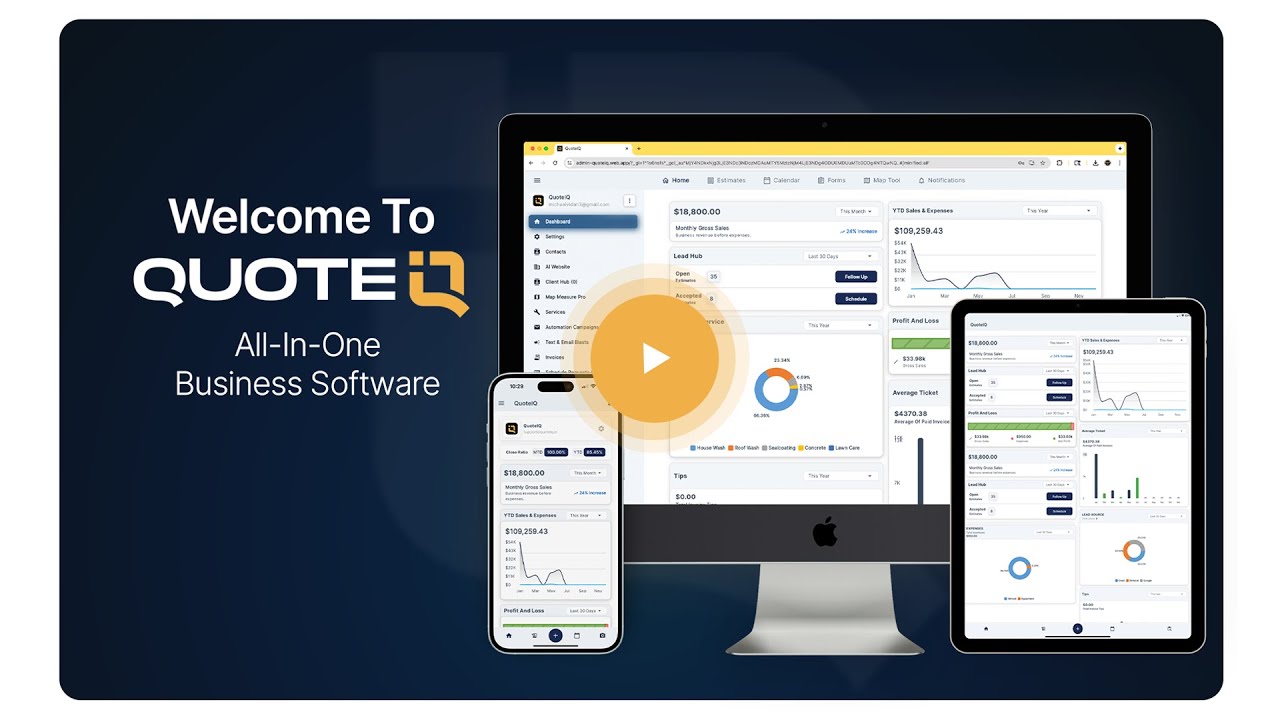
A short walkthrough of how QuoteIQ replaces the stack of disconnected tools most appliance repair contractors use to run the business.
How to Move Your Parts Inventory Into QuoteIQ
Most appliance shops are migrating from a spreadsheet, a distributor portal or nothing at all. The order below gets a four-van operation counting accurately inside a week without stopping work.
Build the product list
Create products with SKU, category, unit, cost and customer price. Start with the parts that appear most often in your last ninety days of completed jobs, not your whole catalogue.
Set up locations and suppliers
Add the warehouse and one location per truck, then your distributors as suppliers with contact details so purchase orders have somewhere to go.
Count once, enter opening stock
Do a physical count per van and per shelf on a quiet morning and enter the quantities against each location. This is the only tedious step; do it once, properly.
Set reorder points
For each product, set the reorder point to your consumption over the supplier’s lead time plus one, so the Low indicator appears before the shelf empties.
Link materials on estimates
Train the crew to pick materials from the product list instead of typing descriptions. Stock then moves when the invoice is paid, and the cost reaches Job Costing by itself.
Meet the QuoteIQ Team
Mike Vidan
A former home service contractor who built QuoteIQ to replace the disconnected stack of scheduling, invoicing and parts tools he used to run his own business. He reviews QuoteIQ’s buyer guides for accuracy against what shops actually do in the field.
Read more about Mike →Justin Rogers
A service business entrepreneur who brings years of field and operations experience to QuoteIQ’s product direction, with a particular focus on how small crews actually adopt software rather than how vendors imagine they will.
Read more about Justin →Real Customer Reviews
“I’ve been using the app for a little over a month and in my opinion, is an essential part of my business. The app is easy to use and I love how professional the estimates and invoices look, especially when you attach photos. You can upload receipts, along with pictures which will be a huge benefit come tax time. It also integrates with quick books! I am so happy with how the app works, I’d give it more than five stars if I could! In a nutshell, the app is AWESOME! Highly recommended!”
“Honestly was not expecting much. But, I have been nothing but impressed with this app. The data tracking in itself is well worth the premium version and I can say without a doubt that it has helped me keep track of and gain more business. Will be referring this to all my associates and competitors. Anyone in the service industry should have this app.”
“Absolutely wonderful app for keeping track of your customers and sending out invoices. Even has options for automated quoting and emails! Can’t recommend enough!”
Know What’s on Every Truck Before Every Call
QuoteIQ gives appliance repair shops product-level stock across warehouses, trucks and job sites, purchase orders and a full transaction log — bundled with scheduling, invoicing, route optimization, AI estimating and job costing on the Elite plan at $299/month for 10 users.



