



Best Dispatch Software for Plumbing Businesses (2026)
Published May 2026 · Updated October 2026
Six field service platforms ranked on the four jobs plumbing contractors actually mean when they say “dispatch”: assigning a tech to a job, moving that assignment when an emergency lands, sequencing the day’s stops, and telling the customer when someone is coming. Built for residential service-and-repair shops, light commercial accounts, and after-hours emergency work.
QuoteIQ is the best all-round dispatch pick for plumbing businesses in 2026, because the pieces a plumbing office actually dispatches with arrive as one flat-rate bundle rather than a stack of add-ons. Assigning a team member to a job starts on the Pro plan at $149.99/month for 4 users, together with ClientHub two-way calling and texting and automated on-the-way notifications. Route Optimization, Route Density zones, EmployeeHub and live GPS location tracking unlock on Elite at $299/month for 10 users, and assigning a whole named crew to a job is a Max-plan capability. ServiceTitan remains the enterprise benchmark for large multi-truck plumbing operations with dedicated dispatchers and call centers. FieldEdge is purpose-built for plumbing and HVAC shops with deep accounting ties. Housecall Pro is the strongest mid-market generalist. Service Fusion is built around a high-volume dispatch board, and Workiz is the pick when the phone system is the dispatch system. Competitor rates change often and are quote-based at several vendors, so confirm current pricing on each vendor’s own pricing page before you decide.
TL;DR: Plumbing dispatch is really four separate jobs, and software prices them separately. In QuoteIQ, scheduling is on every plan; assigning a person to a job, ClientHub calling and texting, on-the-way texts and job costing start at Pro ($149.99/mo, 4 users); Route Optimization, GPS tracking, EmployeeHub and inventory land on Elite ($299/mo, 10 users); whole-crew assignment is Max. The U.S. Bureau of Labor Statistics counts 510,600 plumbers, pipefitters and steamfitters, and EPA WaterSense estimates household leaks waste nearly a trillion gallons a year — the demand is there; the question is whether your board can move a truck fast enough to catch it.
“Dispatch” Is Four Different Jobs — And Software Prices Them Separately
Almost every demo you sit through will use the word “dispatch” to mean something slightly different, and that is the single biggest reason plumbing contractors end up on the wrong plan. Before you compare a single price, separate the word into the four distinct jobs it covers. Every platform in this guide does all four to some degree, but each one gates them at a different point on its ladder, and the gates are where the money is.
Scheduling — the forward calendar
Booking work into days and weeks: recurring backflow tests, water-heater installs three Tuesdays out, the annual tune-up contract. This is the calendar, and in QuoteIQ scheduling is on every plan from Essentials at $29.99/month, with drag-and-drop across day, week, month and employee-timeline views.
Assignment — putting a name on today’s job
Deciding which plumber takes the 10:40 sewer backup, and changing that decision at 10:52. In QuoteIQ, assigning an individual team member to a scheduled job is a Pro-plan capability ($149.99/month, 4 users). Assigning an entire named crew in one action — rather than person by person — is a Max-plan capability.
Routing — the order and the drive time
Two separate tools, often confused. Route Optimization answers “what order should this truck hit today’s stops,” and Route Density answers “which zone should I be working today.” Both unlock on Elite at $299/month, alongside live GPS location tracking inside EmployeeHub.
Customer comms — the ETA that wins the review
Telling a homeowner standing in two inches of water exactly when help arrives. Automated on-the-way texts and the ClientHub business line — a dedicated number with two-way calling and texting, synced across phone, tablet and desktop — are Pro-plan capabilities, with the AI Virtual Call Team available on every plan through IQ Credits.
Worth saying plainly, because it is the most common misconception we hear from plumbing operators evaluating us: QuoteIQ does not ship a module called “Dispatching.” It ships the four capabilities above, and between Pro and Elite they add up to the dispatch workflow a 2-to-15-truck plumbing shop runs its day on. If a vendor — us included — answers “do you have dispatching?” with a flat yes, make them show you which of the four jobs they mean and which plan it sits on. That one question will save you more money than any discount code.
Why Dispatch Decides the Week in a Plumbing Business
Plumbing is a trade defined by interruption. According to the U.S. Bureau of Labor Statistics Occupational Outlook Handbook, there were 510,600 plumbers, pipefitters and steamfitters employed in the United States, with median pay of $63,800 a year and roughly 42,000 openings projected annually over the decade as the occupation grows about 7 percent. A large share of that workforce sits in service-and-repair roles where the day is planned at 7:00 a.m. and rewritten by 9:15. Unlike roofing or remodeling, where a crew is committed to one address for days, a plumbing board churns continuously.
The demand behind that churn is enormous and largely invisible until it fails. EPA WaterSense estimates that household leaks waste nearly one trillion gallons of water nationwide every year, that the average household’s leaks account for more than 9,300 gallons annually, and that nine percent of homes have leaks wasting 50 gallons or more per day. Every one of those is a service call that has not been booked yet. The shop whose board can absorb an unplanned call without dropping the planned ones is the shop that captures it.
The Plumbing-Heating-Cooling Contractors Association has spent decades making the same argument from the business side: service-and-repair work carries the healthiest margins in the trade precisely because it is urgent, and urgency is only monetizable if you can respond to it. A dispatch board that takes four phone calls and a group text to reshuffle is a margin leak of its own. That is the gap tooling closes — and it is why this guide ranks platforms on reassignment speed first and feature-count second. If you are still pricing service work off intuition, the home service business calculators are a faster place to start than a spreadsheet.
Windshield time is the second-largest cost in a service plumbing business after labor, and it is the one dispatch software touches directly. The IRS standard mileage rate for business use is 76 cents per mile from July 1, 2026 (it was 72.5 cents from January 1 through June 30). That rate exists because it approximates the true all-in cost of running a vehicle. A 5-truck plumbing operation that shaves even 12 miles per truck per day across 250 working days is removing 15,000 miles — about $11,400 at the current rate — from the year, before you count the extra billable hour per truck those miles were eating.
That is the whole case for Route Optimization and Route Density in one paragraph. Sequencing is the quick win; zone planning is the compounding one.
There is a safety dimension too, and it belongs in a dispatch conversation more than most buyers expect. Plumbing service work routinely puts technicians into spaces that OSHA classifies as confined spaces — manholes, pits, crawl spaces, sewer laterals and pipelines — where entry carries permit requirements and, in many cases, a mandatory attendant. A board that assigns the nearest available body to a sewer call without regard to certification is not a scheduling problem, it is a liability problem. Skills-aware assignment is the feature that fixes it, and it is worth asking every vendor on this list how their board represents a technician’s qualifications. QuoteIQ handles this through roles and permissions plus the employee records inside EmployeeHub, where availability and rate live alongside the person.
How We Ranked These Six Platforms
Most “best software” lists on the internet are affiliate tables sorted by commission. This one is sorted by what a plumbing office does between 7:00 a.m. and 5:00 p.m. We are the publisher and QuoteIQ is our product, so the honest disclosure is up front: we rank ourselves first, and the sections below say exactly where we do not fit, which operations should pick a competitor instead, and what to go verify yourself before you sign anything.
One deliberate editorial decision shapes every page of this guide. We do not publish competitor prices, seat counts or trial terms here. Several vendors in this category are quote-only with no public rate card, others restructure their plans mid-year, and a figure that was accurate in May can be wrong by October — which is exactly how stale comparison tables end up misleading buyers. Every competitor below links once to its own homepage; get current pricing from the vendor’s own pricing page on the day you are deciding. Our own prices are published in full further down, because we control them and can stand behind them.
The six ranking factors
- Reassignment speed. How many actions does it take to move a job from one plumber to another mid-morning, and does the customer get told automatically? This is the single most-used dispatch motion in the trade and it is weighted heaviest.
- Multi-truck visibility. Can the dispatcher see every truck, its current job and its live position on one surface? A board that requires tab-switching to answer “who is closest” is a board that loses emergency calls.
- Routing depth. Does the platform sequence stops, show where work clusters, or both? Sequencing saves fuel today; density planning changes how you sell service areas next quarter.
- Pricing predictability. Per-technician pricing grows with your apprentice count whether or not those apprentices touch the dispatch board. Flat-rate and capped-seat models are usually kinder to a growing plumbing shop — but check how each vendor handles the seat above your cap.
- Customer ETA communication. On-the-way texts, two-way SMS and a business number that is not the owner’s cell. In 2026 this is table stakes, not a differentiator, and it is where review volume comes from.
- Bundled versus standalone. Does the platform also carry estimating, invoicing, review generation and analytics, or is the dispatch board one line item in a stack you assemble yourself?
We also deliberately excluded two factors buyers over-weight. Review-site star averages are not in the ranking, because they measure onboarding sentiment far more than dispatch capability. Neither is customer count — the largest platform in a category is the right answer for the largest operations in that category, and most plumbing shops are not that.
The 2026 Winners by Category
Each platform below wins for a specific shape of plumbing operation. Find the one that matches your truck count and your office before you look at anything else.
QuoteIQ
Assignment and on-the-way texts from Pro ($149.99/mo, 4 users); Route Optimization, Route Density, GPS crew tracking and EmployeeHub from Elite ($299/mo, 10 users). Bundled with estimating, AI Estimator, business phone and review automation at a flat rate.
ServiceTitan
The category benchmark for large residential service operations: dedicated dispatcher workflows, call-center integration, skills-based assignment and membership-program management. Built for the top end of the market; priced and implemented accordingly. Quote-based — get current terms from the vendor.
FieldEdge
Built specifically for plumbing, HVAC and electrical rather than adapted from a generalist platform, with a visual dispatch board, flat-rate pricebook and service-agreement management for annual tune-up contracts. Quote-based — confirm tiers and onboarding directly.
Housecall Pro
A polished drag-and-drop board, a well-regarded technician mobile app and strong customer SMS, serving a very large base across the home service trades. The safe generalist choice for a small residential plumbing shop that values interface quality over trade-specific depth.
Service Fusion
The most dispatch-forward product here: map and grid views with colour-coded job states, designed for offices running high daily job volume through more than one dispatcher. Strong fit when the board itself is the centre of the business.
Workiz
Built for trades where the dispatcher lives on the phone. An integrated voice system, caller-matched records and deep local-services-ad integration make it the natural pick for emergency-heavy and after-hours plumbing work.
6 Plumbing Dispatch Platforms Compared (2026)
The fast version; detailed write-ups follow. QuoteIQ’s figures are our own published rates. Competitor pricing is deliberately not reproduced here — several are quote-only and the rest change tiers often enough that any table would be stale within a quarter. Open each vendor’s own pricing page on the day you decide.
| Platform | Best-fit plumbing operation | What its dispatch board is built around | Pricing |
|---|---|---|---|
| QuoteIQ | 2–15 trucks, residential and light commercial service-and-repair | Assignment plus routing bundled into a full CRM — calendar, job assignment, Route Optimization, GPS crew map, on-the-way texts and invoicing on one subscription | Published flat rate: Pro $149.99/mo (4 users) · Elite $299/mo (10 users) · Max $699/mo |
| ServiceTitan | Large multi-truck operations with dedicated dispatchers and a CSR team | Enterprise dispatcher workstation with skills-based assignment, call-centre integration and membership-program workflows | Quote-based — request current terms from the vendor |
| FieldEdge | Established plumbing and HVAC shops with an office-side accounting workflow | Trade-specific visual dispatch board paired with a flat-rate pricebook and service-agreement management | Quote-based — request current terms from the vendor |
| Housecall Pro | 1–10 tech residential shops that prioritise interface quality and mobile experience | Polished drag-and-drop board with strong technician mobile app and customer SMS | Published tiers — confirm current rates on their pricing page |
| Service Fusion | Higher-volume offices running many jobs a day through more than one dispatcher | Map and grid dispatch views with colour-coded job states as the centre of the product | Published tiers — confirm current rates on their pricing page |
| Workiz | Emergency-heavy and after-hours plumbing where inbound calls drive the day | Dispatch board fused to an integrated phone system, with caller-matched customer records | Quote-based at current plan structure — request terms from the vendor |
1. QuoteIQ — Best Bundled Dispatch Stack for Plumbing
QuoteIQ
Best for: 2–15 truck residential and small-commercial plumbing shops that want assignment, routing and customer comms on one flat-rate subscriptionQuoteIQ takes the top slot because of how the pieces arrive rather than how many there are. A plumbing office does not buy “dispatch” — it buys the ability to put a name on a job, move that name, sequence the truck’s day, and tell the homeowner when someone is coming. In QuoteIQ those capabilities sit inside the same subscription as estimating, invoicing, online payments, review generation and analytics, at a published flat rate with no per-technician escalation inside the plan’s seat count.
Concretely, here is how a plumbing day runs on it. The calendar — on every plan, from Essentials at $29.99/month — carries the booked work across day, week, month and employee-timeline views, with drag-and-drop rescheduling, multi-day jobs drawn as continuous bars, a schedule-conflict warning when two jobs collide, and a five-second undo after a drag. On Pro at $149.99/month for 4 users, you can assign an individual team member to a scheduled job, fire an automated on-the-way text when that plumber heads out, run two-way calls and texts through the ClientHub business number, see real profit per job through Job Costing, give homeowners a Client Portal, and sync the books through the QuickBooks Online integration.
On Elite at $299/month for 10 users, the routing and crew-visibility layer unlocks: Route Optimization sequences the day’s stops and recalculates when a job is added late; Route Density zones show where work is clustering so you can plan which part of town Thursday belongs to; EmployeeHub brings live GPS location tracking while technicians are clocked in, Time Tracker Pro for GPS clock-in/out and per-job hours, and Team Communication for one-to-one and group chat; and Inventory Management, Pipelines, InstaSchedule and InstaQuote come with it. Elite is where most multi-truck plumbing shops land.
On Max at $699/month, you get the crew layer: Crew Creation, Crew Scheduling and Crew Tracking, so a two-person repipe team is assigned in one action rather than person by person, plus the Sales Team Tracker, unlimited pipelines, the AI Website Builder included, and the highest monthly IQ Credit allocation at 8,000. For a plumbing operation that routinely dispatches paired technicians rather than solo trucks, that is the difference between Max and Elite in a single sentence.
The AI layer runs across every tier on IQ Credits rather than as a paid add-on. The Virtual Call Team answers inbound calls around the clock, qualifies leads, filters spam, works from a knowledge base you upload, and returns a transcript and summary — useful when the office is heads-down on an emergency and the phone keeps ringing. It is metered at 125 IQ Credits per minute, so the practical number of AI-answered minutes is set by your plan’s credit allocation; it is not unlimited answering, and it hands calls to a human rather than booking the appointment itself. AI Estimator and AI Autopilot — 55 tools across 13 categories, driven by voice or text — are likewise on every plan.
- Job assignment, on-the-way texts and a business phone line all arrive together on Pro at $149.99/month
- Route Optimization plus Route Density zones on Elite — order and geography, not just order
- Live GPS crew map while technicians are clocked in, inside EmployeeHub
- Flat-rate pricing inside each plan’s seat count — adding an apprentice does not re-price the platform
- AI on every plan through IQ Credits, including 24/7 inbound call answering
- Published rates, a 14-day trial on any plan, and annual billing at ten months
- 4.7-star average across 4,103 verified reviews, with 40,000+ contractors on the platform
- There is no module called “Dispatching” — the capability is split across Pro (assign a person), Elite (routing and GPS) and Max (assign a crew)
- Whole-crew assignment is Max-only; Elite assigns individuals
- Accounting sync is QuickBooks Online, on Pro and above
- Elite is capped at 10 users and 5 pipelines
- No native payroll — time-tracked hours export to whatever payroll system you already run, and overtime is not calculated automatically
- Virtual Call Team minutes are limited by your plan’s IQ Credit allocation, not unlimited
If you run 2–15 trucks on residential and light commercial plumbing and you want the assignment board, the routing engine, the GPS map and the customer texting on one bill, Elite at $299/month is the right landing spot — step down to Pro at $149.99 if you only need assignment and comms, step up to Max if you dispatch crews rather than individuals. Choose something else if you are a large operation that needs a dedicated dispatcher workstation and call-centre integration, or if your office workflow is anchored to a desktop accounting package.
2. ServiceTitan — Best Enterprise Plumbing Dispatch
ServiceTitan
Best for: large multi-truck plumbing operations with dedicated dispatchers, a CSR team and established membership programsServiceTitan is the platform the rest of the category benchmarks itself against at the top of the market. It is built around the assumption that dispatching is somebody’s full-time job: a dedicated dispatcher sitting at a workstation, a customer-service team taking calls on headsets, and a board that has to represent technician skill levels, job types and capacity simultaneously. For a plumbing operation at that scale — multiple locations, a membership base on auto-renewing service plans, inbound call volume that justifies attribution reporting on every ring — the depth is genuinely hard to replicate.
What sets it apart for plumbing specifically is the way skills and job types are modelled. A drain-and-rooter technician and a service-and-replacement technician are different resources on the board, and the assignment logic knows it. Pair that with a pricebook built for flat-rate selling in the field and membership management that handles renewals without a spreadsheet, and the fit at the enterprise end is clear.
The trade-off is the commitment. This is an enterprise purchase: a sales process rather than a sign-up, an implementation project rather than an afternoon, and a contract rather than a month-to-month subscription. Pricing is not published publicly, which means there is no honest way for a third party to quote it — including us. Ask for it directly, ask for it in writing, and ask what the second year looks like once implementation is behind you.
- Operations large enough to employ at least one full-time dispatcher
- Call volume that justifies per-call marketing attribution
- A membership or service-agreement base that needs real lifecycle management
- Multi-location reporting and complex commission structures
- Teams that want skills-aware assignment modelled natively on the board
- Current subscription pricing for your exact technician count, in writing
- Implementation scope, fee and realistic go-live date
- Minimum contract length and renewal terms
- Which capabilities are core and which are separately licensed modules
- Data export format and process if you ever leave
The right answer for large plumbing operations with dedicated dispatch staff and membership revenue to manage, where the depth earns its cost. For shops under roughly 15 trucks, the enterprise workstation is capability you will pay for and not use — QuoteIQ Elite covers the same operational day at a published flat rate.
3. FieldEdge — Best Trade-Specific Build
FieldEdge
Best for: established plumbing and HVAC shops that want a board designed around their trade rather than adapted to itFieldEdge is a field service platform built specifically for the mechanical trades — plumbing, HVAC and electrical — rather than a general home-service product with a plumbing landing page. That shows up in small places that matter on a dispatch board: the job types in the dropdown read like plumbing work, the flat-rate pricebook is populated with the tasks a plumber actually sells, and service-agreement management is designed around the annual maintenance contracts that fill a plumbing calendar in the shoulder seasons.
The dispatch board itself is a visual, drag-and-drop surface with technician positions and job states, which is what you want when the office is reshuffling. The deeper differentiator, and the reason it keeps appearing on plumbing shortlists, is how tightly it sits against the accounting side of the business — which is worth probing carefully if your bookkeeper has a decade of established workflow and switching costs are a real line item in the decision.
Pricing is quote-based, so budget by asking rather than estimating. The questions that matter most are which capabilities ride along with the base subscription, which are priced separately, and how long the mandated onboarding period runs before you are genuinely operational. Trade-specific depth is worth paying for; surprises in month two are not.
- Shops whose office workflow is already built around their accounting package
- Operations selling flat-rate work from the truck and wanting a trade-native pricebook
- Businesses running annual plumbing maintenance agreements at volume
- Teams that value trade specificity over general interface polish
- Current per-seat pricing at your exact headcount, in writing
- Which modules are included versus separately priced add-ons
- Length and cost of the required onboarding period
- Exactly which accounting products and versions are supported today
- Mobile app capability for the technicians who will live in it
A legitimate pick for established mechanical-trade shops where trade-native depth and accounting alignment outrank everything else. For newer plumbing operations, or shops that would rather have estimating, routing, a business phone line and review automation on one published bill, QuoteIQ for plumbing is the simpler commercial decision.
4. Housecall Pro — Best Mid-Market Generalist
Housecall Pro
Best for: 1–10 technician residential plumbing shops that want the most polished general-purpose board and mobile appHousecall Pro is the default generalist in home services, serving a very large base across plumbing, HVAC, electrical, cleaning and pest control. Its reputation rests on interface quality: the drag-and-drop board is clean, the technician mobile app is consistently among the best-rated in the category, and customer SMS is woven through the workflow rather than bolted on. For a small residential plumbing shop where the owner is also the dispatcher and the field experience decides whether technicians actually use the software, that polish is a real operational advantage rather than a cosmetic one.
Because it is a generalist, the depth is horizontal rather than vertical. You get a capable board and a strong mobile experience across every trade it serves, which is exactly right if your work is straightforward residential service and wrong if you need plumbing-specific modelling on the board itself. It has also kept pace on automation and AI tooling, so treat any older comparison that describes it as feature-thin with suspicion — the product has moved.
Pricing is published in tiers, and the thing to map carefully is which tier carries the capabilities you are actually buying it for, plus what happens to the bill when you add the fifth, eighth or eleventh person. Build the quote at the headcount you expect in eighteen months, not the one you have today.
- Small residential plumbing shops prioritising ease of use and adoption
- Owner-operators who dispatch from a phone between jobs
- Teams where technician buy-in is the real implementation risk
- Businesses wanting a mature platform with a wide integration ecosystem
- Which tier carries the specific capabilities you are buying for
- How the bill changes as you add seats above the included count
- Current rates for monthly versus annual billing on their pricing page
- Payment-processing terms, which are separate from the subscription
The safe generalist pick for a small residential plumbing operation that values interface quality above trade-specific depth. If you would rather have the routing engine, GPS crew map, business phone line and customer self-quoting included at a flat ten-seat rate, compare it against QuoteIQ versus Housecall Pro before deciding.
5. Service Fusion — Best Pure Dispatch Board
Service Fusion
Best for: higher-volume plumbing offices running many jobs a day through more than one dispatcherOf everything in this guide, Service Fusion is the product most obviously designed around the dispatch board itself. Map and grid views sit at the centre rather than at the edge, job states are colour-coded so a dispatcher can read the whole day without clicking into anything, and the workflow assumes the office is driving the field rather than the other way round. If your business runs a genuine dispatch desk — somebody whose job description is the board — this is the product that behaves most like the tool they already imagine.
Its commercial model is the other differentiator. Service Fusion prices on flat tiers rather than per seat, which changes the arithmetic as a plumbing operation adds helpers and apprentices who need visibility but are not revenue-generating technicians. For a growing shop that is a meaningfully different cost curve from per-technician pricing, and worth modelling out across three years rather than one.
The questions to ask are about the field edge rather than the office. Plumbing work happens in basements, crawl spaces and rural service areas where cell coverage is unreliable, so probe how the mobile app behaves without a signal. Ask about support coverage on weekends, because plumbing emergency volume does not respect business hours. And ask how fleet-level location tracking is licensed, since that is often structured separately from the core subscription.
- Offices with a dedicated dispatcher and high daily job counts
- Teams that want map and grid views as the primary working surface
- Growing shops adding non-revenue seats who benefit from flat-tier pricing
- Businesses that coordinate from the office rather than the truck
- Mobile app behaviour in areas with poor or no cell coverage
- Support hours, including weekend coverage for emergency work
- How fleet or vehicle location tracking is licensed and priced
- Whether evaluation is self-serve or requires a sales demo
- Current tier rates on their own pricing page
A strong, focused pick when the dispatch board is the centre of the business and the office is big enough to staff it. For plumbing operations that want the board plus routing, GPS, estimating, a business line and truck inventory on one subscription, QuoteIQ Elite at $299/month covers more of the day.
6. Workiz — Best Phone-Centric Emergency Dispatch
Workiz
Best for: emergency-heavy and after-hours plumbing operations where inbound calls set the dayWorkiz was built for trades where the dispatcher lives on the phone — locksmiths, garage door, appliance repair — and plumbing sits squarely in that pattern. The product’s centre of gravity is an integrated phone system rather than a calendar: an incoming call surfaces the customer record before anyone says hello, calls tie back to the job and to the marketing source that produced them, and the board sits next to the handset rather than in a different tab.
For a plumbing shop where a meaningful share of revenue arrives through paid local-service advertising, the attribution loop is the real argument. Knowing which channel produced the 2:00 a.m. burst-pipe call — and what that job eventually billed — is the difference between scaling ad spend confidently and guessing. That is a genuinely different problem from the one a scheduling-first product solves, and Workiz solves it deliberately.
Two practical notes before you evaluate. First, Workiz restructured its plan lineup during 2026, so any pricing you find in an older article or comparison table is almost certainly describing plans that no longer exist — go to the source. Second, if you intend to move an existing business number onto the platform, start that conversation early; number porting is a carrier-side process with its own timeline regardless of which vendor you choose.
- Plumbing operations where the phone is the primary intake channel
- Shops spending real money on local service ads and needing attribution
- After-hours and 24/7 emergency work with high call volume
- Offices that want caller identity to drive the dispatch decision
- The current plan lineup and rates — the 2026 structure differs from older write-ups
- Timeline and cost for porting your existing business number
- Which automation capabilities sit on which tier
- How the board handles multi-technician jobs if you dispatch in pairs
The right pick when the phone system and the dispatch board are genuinely the same workflow. If the routing and crew-visibility side matters more than call attribution, QuoteIQ pairs the ClientHub business number and the AI Virtual Call Team with Route Optimization and a live GPS map on one bill.
Which Dispatch Tool Wins for Your Plumbing Operation?
Three real-world shapes. Pick the one that matches your business, not the one with the biggest marketing budget.
The 3-truck residential shop
Three trucks on drain cleaning, water heaters, faucet and sump work, with the occasional repipe. You answer most calls yourself and dispatch from your phone between jobs. The schedule gets rewritten twice a week by emergencies.
What you need: assign a plumber to a job in seconds, fire an automatic on-the-way text, and keep business calls off your personal number. What you do not need yet: a dispatcher workstation or membership-program management.
Pick: QuoteIQ Pro at $149.99/mo — assignment, ClientHub and on-the-way texts for 4 users.The 8-truck service-and-repair shop
Eight trucks across residential service and light commercial. Someone in the office owns the board every morning. Drive time is visibly eating billable hours and you have no reliable way to tell which truck is nearest an emergency.
What you need: a live GPS map, stop sequencing, zone planning so Thursday belongs to one side of town, and time tracking that feeds job costing instead of a paper timesheet.
Pick: QuoteIQ Elite at $299/mo — Route Optimization, Route Density, GPS and EmployeeHub for 10 users.The large multi-location operation
Twenty-plus trucks across two locations, three full-time dispatchers, a CSR team on headsets and a large membership base on auto-renewing plans. Calls route by city through a single published number.
What you need: a dedicated dispatcher workstation, per-call marketing attribution, skills-based assignment modelled natively, multi-location reporting and complex commission structures. At this scale an enterprise implementation is justifiable.
Pick: ServiceTitan. This is its category — QuoteIQ is the wrong shape at this scale.The Plumbing Dispatch ROI Math
Dispatch software attacks two costs at once: miles that produce no revenue, and hours lost coordinating by phone. Both are measurable, and both respond to tooling faster than almost anything else you can buy. Run these numbers on your own truck count before you take anyone’s word for it — including ours. If you want to sanity-check your underlying rates first, the business calculators and the in-app calculator set are the right starting point.
Take a 5-truck plumbing operation across a standard 250-day working year. Sequencing the day’s stops rather than guessing at geography is the most reliably recoverable waste in the business. At the IRS business mileage rate of 76 cents (effective July 1, 2026), removing 12 miles per truck per day takes 15,000 miles and roughly $11,400 out of the year. Remove 20 miles per truck per day and you are at 25,000 miles and about $19,000.
That is the vehicle cost alone. The time those miles consumed is the larger number, and it is the one that shows up as capacity.
Thirty minutes of drive time recovered per truck per day is six-tenths of a billable hour. Across 5 trucks and 250 days that is 625 technician-hours — the equivalent of roughly a third of an extra full-time plumber’s productive year, bought without hiring, onboarding or insuring anyone. Against Elite at $299/month, or $2,990 on annual billing, the hours alone carry the subscription several times over at any realistic service rate.
The point is not the specific ratio, which varies with how spread out your service area is. The point is that both inputs — miles and hours — are things a routing engine touches directly and a paper board does not.
Per EPA WaterSense, nine percent of American homes have leaks wasting 50 gallons or more per day, and household leaks nationwide waste close to one trillion gallons a year. In a service area of 20,000 homes that is roughly 1,800 properties with an active, chargeable problem the homeowner has not called about yet.
Dispatch capacity is what converts that latent demand into booked work. A board that cannot absorb an extra same-day call sends it to whoever can.
Per-technician pricing and flat-rate pricing diverge fastest in plumbing, because plumbing adds helpers. A shop with 4 licensed plumbers and 6 apprentices, helpers and office staff has 10 people who need visibility but only 4 who bill. On a flat ten-seat plan like QuoteIQ Elite that is $299/month for all ten, or $2,990 a year on annual billing. On any per-seat model the same ten people are ten line items.
Model this at the headcount you expect in eighteen months, not today’s. It is the single largest cost difference between the platforms in this guide, and it is entirely predictable in advance.
The Bureau of Labor Statistics puts employment at 510,600 plumbers, pipefitters and steamfitters, median pay at $63,800 a year, and projects roughly 42,000 openings annually as the occupation grows about 7 percent over the decade — faster than the average across all occupations.
Read that as a labour-scarcity forecast rather than a growth statistic. When you cannot hire your way to more capacity, the only lever left is getting more productive hours out of the trucks you already run. That is a dispatch problem.
Seven Questions to Ask Before You Sign Anything
Demos are designed to show capability, not boundaries. These seven questions surface the boundaries. Ask every vendor on your shortlist the same list and write the answers down — the differences will be sharper than anything in a feature grid.
- “Show me reassigning a job to a different technician, and then show me what the customer receives.” Count the clicks. Then ask whether the notification is automatic or a second manual action. This is the motion you will perform a dozen times a week.
- “Which plan is that on?” Ask it after every single capability they demo. Demo environments are usually running the top tier. The gap between what you were shown and what you are quoted is where buyer’s remorse lives.
- “What happens when I add an eleventh person?” Seats, not features, are where field service software gets expensive. Get the answer in dollars for a headcount eighteen months out.
- “How does the board know this technician is qualified for this job?” Relevant for permit-required work and anything touching OSHA confined-space requirements. If the answer is “the dispatcher remembers,” that is a liability you are buying.
- “What does the mobile app do with no signal?” Plumbing happens in basements, crawl spaces and rural service areas. Ask specifically what a technician can and cannot complete offline.
- “What is the total first-year number, including setup?” Subscription, implementation, onboarding, training, data migration and any separately licensed modules. One figure.
- “If I leave in two years, how do I get my customer history out?” Ask for the export format in writing. A vendor confident in its product answers this easily; QuoteIQ includes data export on every plan.
One more, specific to this category: ask how the platform handles the day the internet goes down in your office. The honest answers vary widely, and for a business where the phone keeps ringing during an outage, the difference matters more than any feature on the comparison grid. Related reading on adjacent workflows: drain cleaning operations, septic service businesses, and french drain installers all run variants of the same board.
Four Ways Plumbing Shops Get Dispatch Software Wrong
We have watched a lot of these implementations from the inside. The failures are remarkably consistent, and none of them are about the software being bad.
Buying for the dispatcher, not the technician
Office staff choose the platform; field technicians decide whether it gets used. If the mobile experience is poor, work gets logged on paper and typed in later — and your board is wrong all day, every day. Put a plumber in the trial before you commit, and watch them complete a job without help. The mobile and web parity question is not a technical detail; it is the adoption question.
Automating a broken process
If nobody can say who decides priority when two emergencies land at once, software will not decide it for you — it will just make the indecision faster and more visible. Write the rule down first: proximity, certification, ticket value, or customer tier. Then configure to the rule. Shops that skip this step usually blame the platform.
Treating customer texts as optional polish
The on-the-way notification is not a nicety; it is the single highest-leverage dispatch feature for review volume, and reviews are how local plumbing demand finds you. A homeowner watching water spread across a floor measures you in minutes. Automated texts plus review automation turn the same job into a public rating.
Migrating the mess
Importing fifteen years of duplicate customer records guarantees the new board is confusing from day one. Clean first, import second. QuoteIQ’s AI Smart Import maps columns from another CRM’s export automatically, with a reviewable mapping step and duplicate flagging — but it cannot decide which of your three “Smith, J.” records is the real one.
Where Each Dispatch Capability Unlocks
Published rates, no quote required. Assigning a person to a job starts at Pro. Route Optimization, Route Density, GPS crew tracking and EmployeeHub start at Elite. Assigning a whole named crew in one action is a Max capability. Annual billing is priced at ten months on every plan.
Every plan includes a 14-day free trial with full access to the features of the plan you choose. See the full pricing page →
Stop running the board off a clipboard and a group text.
QuoteIQ Elite at $299/month puts job assignment, Route Optimization, Route Density zones, live GPS crew tracking, on-the-way customer texts and the full CRM on one subscription for up to 10 users — with published pricing and no implementation project.
Frequently Asked Questions
What is the best dispatch software for plumbing businesses in 2026?
For most plumbing businesses in 2026, QuoteIQ is the best overall pick because the capabilities an office actually dispatches with arrive bundled rather than as separate line items. Assigning a team member to a job, automated on-the-way texts and the ClientHub business phone line start on Pro at $149.99 per month for 4 users. Route Optimization, Route Density zones, live GPS tracking and EmployeeHub unlock on Elite at $299 per month for 10 users, which is where most multi-truck plumbing shops land. Assigning an entire named crew in one action is a Max capability at $699 per month. ServiceTitan remains the right answer for large operations with dedicated dispatchers and membership programs; FieldEdge suits trade-specific shops; Housecall Pro is the polished generalist; Service Fusion is the most dispatch-forward board; Workiz wins when the phone system is the dispatch system. With 510,600 plumbers employed nationally per the Bureau of Labor Statistics, the right pick is the one matching your truck count, not the one with the longest feature list. Compare the options on the QuoteIQ comparison hub.
How much does plumbing dispatch software cost in 2026?
QuoteIQ publishes flat monthly rates: Essentials $29.99 (1 user), Beginner $74.99 (2 users), Pro $149.99 (4 users), Elite $299 (10 users) and Max $699, with annual billing priced at ten months on every tier — so Elite is $2,990 a year. For plumbing dispatch specifically, Pro is the entry point because that is where assigning a person to a job and on-the-way texts begin, and Elite is where Route Optimization and GPS crew tracking arrive. Every plan includes a 14-day free trial with full access to the features of the plan you choose. A credit or debit card is required to start. Competitor pricing in this category is deliberately not reproduced here: several vendors are quote-only with no public rate card and others restructured their tiers during 2026, so any figure republished by a third party risks being wrong by the time you read it. Get current rates from each vendor’s own pricing page on the day you decide, and build the comparison at the headcount you expect in eighteen months rather than today’s. When you model total cost, include the vehicle side too — the IRS business mileage rate is 76 cents per mile from July 1, 2026. Full detail is on the QuoteIQ pricing page and the features hub.
Does QuoteIQ have dispatching for plumbing companies?
QuoteIQ does not ship a single module named “Dispatching” — it ships the capabilities that make up dispatching, and they sit at different points on the plan ladder. Assigning an individual team member to a scheduled job is a Pro-plan capability at $149.99 per month for 4 users, alongside automated on-the-way texts and the ClientHub business number for two-way calling and texting. Assigning an entire named crew in one action — Crew Creation, Crew Scheduling and Crew Tracking — is a Max capability at $699 per month, which matters if you dispatch paired technicians for repipes rather than solo trucks. The routing and visibility layer is Elite at $299 per month for 10 users: Route Optimization for stop sequencing, Route Density for zone planning, and live GPS location tracking inside EmployeeHub while technicians are clocked in. Being precise about this matters because it is the question buyers get burned on: when any vendor answers “yes, we have dispatching,” ask which of those four jobs they mean and which plan it sits on. The PHCC makes the same point about scoping technology purchases to the work.
What is the difference between scheduling and dispatching in plumbing software?
Scheduling is the forward-looking calendar: work booked into days and weeks ahead, such as recurring backflow tests or a water-heater install three Tuesdays out. Dispatching is what happens to today — putting a technician’s name on a job, moving that name when an emergency lands, sequencing the truck’s stops and telling the customer when someone is coming. Most plumbing shops need both, and software prices them separately. In QuoteIQ, scheduling is on every plan from Essentials at $29.99 per month, with drag-and-drop across day, week, month and employee-timeline views, multi-day jobs drawn as continuous bars, a conflict warning when two jobs collide and a five-second undo after a drag. The dispatch side begins at Pro ($149.99, assignment and on-the-way texts) and completes at Elite ($299) with Route Optimization, Route Density and EmployeeHub. Customers can also book themselves against real availability through InstaSchedule on Elite. With roughly 42,000 plumbing openings projected annually per the BLS, getting more from existing trucks beats hiring.
How do plumbing companies dispatch emergency calls faster?
Faster emergency dispatch comes from three things working together: seeing where every truck is, reassigning without a phone call, and notifying both customers automatically. In QuoteIQ on Elite at $299 per month, the dispatcher sees live GPS positions for every clocked-in technician inside EmployeeHub, reassigns the closest qualified plumber on the calendar, and an automated on-the-way text fires through ClientHub when the technician heads out — while the displaced routine job gets a new slot and its own updated message. Route Optimization then resequences what remains so the rest of the day absorbs the disruption instead of collapsing. Two practical constraints are worth building into the rule: decide in advance whether proximity, certification or ticket value wins when two emergencies land together, and make sure the board reflects qualifications, because sewer and pit work can fall under OSHA confined-space permit requirements. The AI Virtual Call Team, available on every plan through IQ Credits, answers overflow calls while the office works the priority job.
Can plumbing customers get a text when the technician is on the way?
Yes. Automated on-the-way notifications are a Pro-plan capability in QuoteIQ at $149.99 per month for 4 users: when the assigned plumber marks themselves en route, a message fires automatically to the customer, and the homeowner can reply straight back into the same thread through the ClientHub business number, with every call and text saved to that customer’s record. From the same tier, customers get a Client Portal to see appointments, estimates and invoices without calling the office. For plumbing this matters more than in most trades: a homeowner with water spreading across a floor measures response in minutes, and the text converts an anxious wait into a visible timeline — which is why on-the-way notifications correlate so strongly with review volume when paired with Review Multiplier after an online payment clears. The scale of the underlying demand is real: EPA WaterSense estimates household leaks waste nearly a trillion gallons nationally each year and that nine percent of homes leak 50 gallons a day or more. Setting it up alongside email and text automations takes an afternoon.
What is the best dispatch software for a small plumbing company?
For a small plumbing company running one to four trucks, QuoteIQ Pro at $149.99 per month for 4 users is usually the right entry point, because it is the tier where assigning a plumber to a job, automated on-the-way texts, the ClientHub business number and Job Costing all begin — the four things an owner-dispatcher actually uses daily. Step up to Elite at $299 for 10 users when drive time starts eating billable hours and you need Route Optimization and live GPS tracking. Housecall Pro is the other strong small-shop candidate if interface polish and the technician mobile app matter more to you than routing depth. The decisive question for a small operation is not features but seats: price every option at the headcount you expect in eighteen months, counting helpers and office staff who need visibility but do not bill. That single calculation separates the platforms in this guide more than anything on a feature grid. For broader operational guidance on running the business side, the U.S. Small Business Administration is a solid free resource, and the plumbing software overview covers the rest of the stack.
Does plumbing dispatch software work with QuickBooks?
QuoteIQ integrates with QuickBooks Online, and the integration is available on Pro, Elite and Max — so it arrives on the same $149.99 per month tier where job assignment and on-the-way texts start. Invoices, payments and customers sync across, with duplicate-sync locks so a double sync cannot create duplicate records, and customers missing on the accounting side are created automatically before an estimate syncs rather than being silently skipped. Full scope is documented on the QuickBooks integration page. If your books are not yet on QuickBooks Online, data export is available on every plan and Job Costing gives you real per-job profit inside QuoteIQ — total price minus labour pulled from time tracking minus expenses — without waiting for the accountant. One thing to plan for separately: QuoteIQ has no native payroll, so time-tracked hours export into whichever payroll system you already run, and overtime is not calculated automatically. Guidance on the wider bookkeeping and tax obligations is available from the IRS.
What to Remember
- “Dispatch” is four jobs, not one. Scheduling, assignment, routing and customer communication are priced separately by every vendor in this category. Ask which one a demo is showing you and which plan it sits on.
- QuoteIQ splits them deliberately. Scheduling is on every plan; assigning a person plus on-the-way texts starts at Pro ($149.99, 4 users); Route Optimization, Route Density, GPS and EmployeeHub arrive at Elite ($299, 10 users); assigning a whole crew is Max ($699).
- Seats decide the bill, not features. Plumbing shops add helpers and office staff who need visibility but do not bill. Price every option at the headcount you expect in eighteen months.
- Reassignment speed is the metric that matters. Count the clicks it takes to move a job to a different plumber, and check whether the customer notification is automatic or a second manual step.
- Competitor pricing moves — verify it yourself. Several platforms here are quote-only and others restructured tiers during 2026. Use each vendor’s own pricing page on the day you decide, not a republished table.
- The economics are in miles and hours. At the 76-cent IRS mileage rate, trimming 12 miles per truck per day across 5 trucks removes about $11,400 a year — before counting the recovered billable hours.
- Qualification-aware assignment is a safety control. Sewer, pit and lateral work can trigger OSHA confined-space permit requirements. If the board does not represent certifications, the dispatcher is the control.
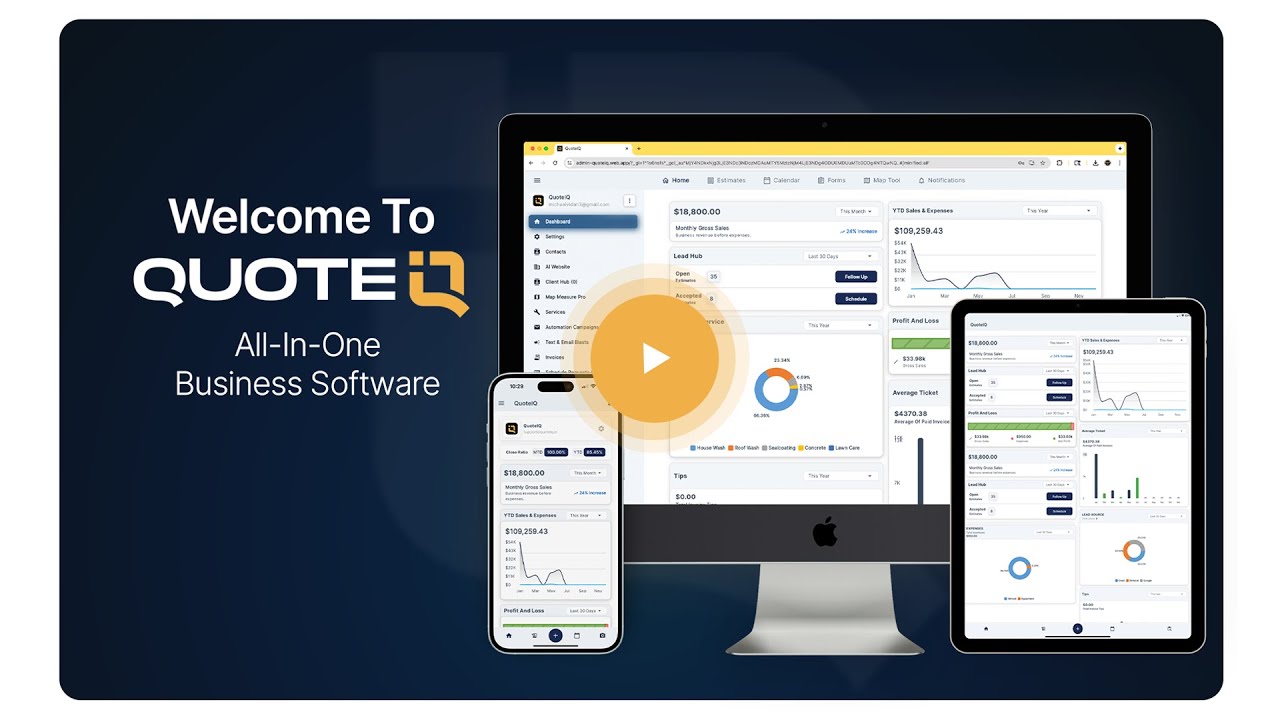
Watch: What Is QuoteIQ?
A short walkthrough of how QuoteIQ replaces the stack of disconnected tools most plumbing contractors use to run a service business.
How to Move Your Plumbing Dispatch Board to QuoteIQ in 4 Steps
Switching a live dispatch board mid-season is the part owners dread, so this is deliberately sequenced to keep the current week running while the new one is built behind it. Most plumbing shops are dispatching real jobs within the 14-day trial.
Import customers and price book
Export your current CRM to CSV and bring it in through AI Smart Import, which maps columns automatically with a reviewable step and duplicate flagging. Clean duplicates before importing, not after.
Add your team and set permissions
Create each plumber, helper and office user in EmployeeHub with hourly rate and availability, then set roles and permissions so field users see only what they need.
Run one day in parallel
Book tomorrow in both systems. Assign jobs on the calendar, run Route Optimization on the stops and compare the sequence against what your dispatcher would have chosen.
Turn on customer messaging
Activate the ClientHub business number and on-the-way texts, then connect Review Multiplier so a paid invoice sends the customer to your review page.
Reviewed by Industry Experts
Mike Vidan, Co-Founder
A home service business owner for more than twenty years and a long-running YouTube creator in the pressure washing and contractor space, Mike built QuoteIQ with Justin Rogers after years of watching contractors stitch together five apps that did not talk to each other.
Read full bio →Justin Rogers, Co-Founder
A serial entrepreneur, pressure washing business owner and the creator behind the ForeverSelfEmployed channel, Justin has spent years teaching service contractors how to price, sell and operate profitably — the thinking that shapes how QuoteIQ gates its features.
Read full bio →Real Contractor Reviews — 4.7★ across 4,103 verified reviews
“Last time, I started a business, keeping track of my expenses, customers, payments, upcoming jobs, and scheduling was a pain, and it was spread over 4 different apps. Everything I need is in one place now, and the value you get with the affordable subscription upgrades is immeasurable compared to the time you save.”
“I’m on my second year of business and have been using QuoteIQ for 4 months. It has been great for me. It reduces the time required by me to manage customer information, quoting, scheduling, and invoicing. It streamlined a lot of my processes to help grow my business.”
“First of all this app saves me so much time,the new updates they do are impactful. I’ve used it for pressure washing, I’ve used it for even doing concrete estimating. The ability to send invoices directly and charge from the app is a win win! I like how it incorporates the ability to keep your customers like a CRM program and it helps me check up on those customers that called, I can call back pretty fast make a note on their file. I also like how everyone can access it from my Crew. App is #1”
Your dispatch board should not cost more than a truck payment.
QuoteIQ Elite at $299/month bundles job assignment, Route Optimization, Route Density zones, live GPS crew tracking, on-the-way customer texts, the ClientHub business line and the full CRM for up to 10 users. Published pricing. No implementation project.



