



Six mass texting platforms ranked by storm-season blast capacity, recurring inspection reminders, and bundled CRM value — for roofing contractors who need to message hundreds of homeowners after a hailstorm, fill spring inspection slots, and follow up on stalled deals without renting a second marketing platform.
QuoteIQ is the best mass texting software for roofing contractors in 2026 because its built-in Mass Text & Email Campaigns feature sends blasts to your entire customer list — or a Tag-filtered slice of it, like storm-zone homeowners or estimates that went quiet 90 days ago — from inside a complete roofing field service management platform on the Elite plan at $299/month, with no per-message fee charged by QuoteIQ. Podium is the pure-play SMS specialist for roofers whose CRM is already locked in. AccuLynx is the deepest roofing-only CRM for storm-restoration shops. JobNimbus pairs a roofing-first CRM with its Engage communications bundle as a paid add-on. Housecall Pro puts its Campaigns tooling on the Max plan at $329/month billed monthly or $299/month billed annually, with 8 users included. Jobber lists a separate Marketing Suite add-on at $99/month on top of its plans. Podium, AccuLynx and JobNimbus all publish quote-only pricing with no public rate card, so their real cost depends entirely on the quote you are given.
TL;DR: Roofing is storm-driven, seasonally cyclical and high-ticket, which makes mass texting behave differently here than in any other trade. QuoteIQ takes Best Bundled Solution because Mass Campaigns sends SMS and email blasts with Tag-based segmentation, and replies land in ClientHub two-way business-number texting rather than a marketing silo — alongside Email & Text Automation, Review Multiplier, Virtual Call Team, AI Estimator and MapMeasure Pro roof measurement in one subscription. Podium wins on pure SMS depth, AccuLynx on storm-restoration workflow, JobNimbus on roofing-first production boards, Housecall Pro on multi-trade breadth, Jobber on entry price. Per the U.S. Bureau of Labor Statistics, 166,900 roofers were employed in 2025 and the trade is projected to grow 5 percent through 2035 — a growing, fragmented market where owning your customer database beats renting attention. Before you send a single blast, read the FTC’s Telemarketing Sales Rule guidance on consent and do-not-call obligations.
Each tool below wins for a specific kind of roofing operation. Skip to the category that matches your business. Where a vendor publishes no public rate card, this guide says so plainly rather than repeating a number from a review site.
From $299/mo on Elite, 10 users included. Built-in Mass Campaigns for SMS and email blasts, plus ClientHub two-way texting, automation, review requests, AI calling and a full roofing CRM. No per-message fee from QuoteIQ.
Quote-only pricing — Podium’s pricing page directs buyers to its sales team and publishes no rates. Category leader for SMS plus reviews with AI-assisted replies and Google Business Profile integration. Not a CRM, so it pairs with a separate platform.
Quote-only pricing — AccuLynx runs a pricing-request form and publishes no rate card. The deepest roofing-specific CRM here, with aerial measurement, insurance supplements and material ordering. Texting is sold separately.
Quote-only pricing across Essentials, Pro, Premium and Enterprise plans. Strong roofing workflow with production boards. The Engage communications bundle is a paid add-on offered to existing customers, not bundled into the base plan.
$329/mo billed monthly, $299/mo billed annually, 8 users included, with Campaigns on the Max tier. Additional users are $35/mo each. Strong for roofers also running gutters, siding or other exterior trades on one platform.
Core from $49/mo with no commitment, down to $29/mo prepaid annually, 1 user. Polished mobile UX. Marketing Suite is a separate $99/mo add-on and AI Receptionist a separate $29/mo add-on. Limited roofing-specific depth.
Roofing is a storm-driven business, and that single fact reshapes every marketing decision a roofing contractor makes. A hailstorm sweeping one metro can create hundreds of insurance-eligible properties inside a handful of zip codes on a single afternoon. The roofer who reaches those homeowners first books the inspection; the fourth roofer to call reaches voicemail. Phone dialing does not scale to that moment. Door knocking does not scale to that moment. A single segmented text blast does — and it reaches people who already have your number in their phone, which is a structurally different conversation from a stranger knocking after a storm. Getting that blast out of a roofing CRM you already run, rather than a separate marketing subscription, is the difference between a four-hour response and a four-day one.
The second use is re-engaging estimates that went cold. Every established roofer is sitting on a file of quoted-but-never-closed jobs — homeowners who got a number, said they would think about it, and were never contacted again. Those records are not dead leads; they are warm ones with a known address, a known scope and a known price. A seasonal blast to that segment costs effectively nothing to send inside a bundled plan and reaches people who already invited you onto their property once. With standard estimates and options estimates already on file, re-quoting a responder is a matter of duplicating the old document and adjusting for current material pricing rather than starting from a blank screen or driving back out to measure.
Per the U.S. Bureau of Labor Statistics, there were 166,900 roofers employed in 2025, with a median annual wage of $55,440 (May 2025) and employment projected to grow 5 percent from 2025 to 2035 — faster than the average for all occupations. A growing trade with a rising labour cost base is exactly the environment in which reaching an existing customer beats buying a new click.
The third use is recurring inspection and maintenance revenue, which is where roofing quietly starts to resemble a subscription business. Annual roof inspections, gutter clean-outs before the wet season, and post-winter checks are all calendar events you can text into existence. Send at the right window, link straight to a booking flow, and a dormant customer relationship turns into scheduled work. Roofers who also run gutter work can segment that separately — the gutter installation and gutter guard side of the business has its own seasonal rhythm, and a gutter cleaning cost calculator is a useful thing to put in front of a homeowner who replies asking for a number. Pair the blast with InstaSchedule and the homeowner books their own slot against your live availability without a phone call in either direction.
There is a fourth effect specific to insurance work that most generic SMS advice misses entirely. After a storm, the insured homeowner will be pitched by several roofers within days. Texting your own verified-customer database within hours of a hail event routes that work to a contractor the homeowner already has a relationship with, before the canvassers arrive. That is a permission-based advantage the storm-chaser model cannot replicate, and it is the single highest-leverage use of mass texting in the trade. Combined with ClientHub for reply handling and QuoteIQ Cam for documenting damage on the inspection, the blast stops being a marketing tactic and becomes the front end of your production pipeline.
Worth saying plainly: mass texting is a regulated activity. Marketing texts to consumers sit under federal telemarketing and consumer-protection rules, and the obligations around consent, opt-out handling and do-not-call lists are real. The Federal Trade Commission’s guidance on the Telemarketing Sales Rule is the right starting point, and the U.S. Small Business Administration’s business-management guidance covers the marketing-plan and compliance basics around it. Any platform you choose should make honouring an opt-out automatic rather than manual — that is a genuine evaluation criterion, not boilerplate.
Most “best of” lists on the internet are affiliate revenue sorted by commission rate. This one is sorted by what actually wins for roofing contractors. Every competitor dollar figure in this guide was checked against the vendor’s own live pricing page on 25 September 2026. Where a vendor does not publish a rate card, no number appears here at all — this guide will not launder a review-site estimate into a fact. Three of the six vendors on this list publish quote-only pricing, and that is itself a finding worth knowing before you book a demo.
The fast version; detailed reviews follow. Every figure below comes from the vendor’s own live pricing page, checked 25 September 2026. Cells reading “quote only” mean the vendor publishes no public rates — not that the tool is expensive or cheap.
| Platform | Published Starting Price | Mass Texting Included? | Users Included | Roofing-Specific |
|---|---|---|---|---|
| QuoteIQ (Mass Campaigns) | $299/mo (Elite) | Yes — bundled in the plan | 10 on Elite, unlimited on Max | Generalist, roofer-friendly |
| Podium | Quote only — no public rate card | Yes — SMS is the product | Quote-dependent | Generalist local SMB |
| AccuLynx | Quote only — pricing-request form | Sold separately | Quote-dependent | Yes — roofing only |
| JobNimbus + Engage | Quote only — no public rate card | Engage is a paid add-on | Tiered by plan, quote-dependent | Yes — roofing-focused |
| Housecall Pro | $79/mo Basic monthly, $59/mo annual | Campaigns on the Max tier | 1 Basic · 5 Essentials · 8 Max | Generalist multi-trade |
| Jobber | $49/mo Core no commitment, $29/mo annual | Marketing Suite is a $99/mo add-on | 1 on Core, +$29/mo per extra user | Generalist |
Only three of the six vendors publish a public rate card at all: QuoteIQ, Housecall Pro and Jobber. Of those three, only QuoteIQ bundles mass texting into the plan itself rather than gating it behind the top tier or selling it as a separate monthly add-on. Housecall Pro puts Campaigns on Max at $329/month monthly or $299/month annually with 8 users. Jobber lists its Marketing Suite at $99/month on top of whichever plan you are on. QuoteIQ Elite is $299/month with 10 users and Mass Campaigns included — and annual billing on every QuoteIQ plan is priced at ten months, so Elite annual works out to $2,990/year.
QuoteIQ is the only platform on this list that bundles mass texting into the plan with no per-message fee charged by QuoteIQ. Mass Text & Email Campaigns lets you write one message, filter your customer list by Tags — storm zip code, last service date, declined estimate, commercial account — and send. Tag-based segmentation means one roofing contractor can run several campaigns in parallel from one screen: storm-zone homeowners get a “we’re inspecting in your neighbourhood this week” text, stalled estimates get a seasonal offer, and existing customers get the annual inspection reminder, all without any of the three seeing the others.
Dynamic tags auto-fill customer details so each message reads as personal even at volume, and replies route back into ClientHub, QuoteIQ’s two-way business-number texting layer. That last detail is the one most buyers underweight. A blast that generates 80 replies into a marketing inbox nobody watches is worse than no blast at all. In QuoteIQ every reply lands against the customer record alongside their estimates, invoices and job history, and your office manager works the list from the same screen they already live in. Every call and text is saved to the profile, so the person who picks up the thread tomorrow sees what was said today.
Underneath the campaign layer is a full roofing stack. MapMeasure Pro measures roof dimensions and pitch from aerial imagery so you can scope a job without putting anyone on a ladder, and it is available from the Beginner plan up. AI Estimator turns property photos into a priced line-item estimate and is on every plan. Virtual Call Team answers, qualifies and transcribes inbound calls around the clock and can run outbound campaigns, metered at 125 IQ Credits per minute. AI Autopilot drives the CRM by voice or text across 55 tools in 13 categories. QuoteIQ Cam and inspection forms handle the damage documentation that insurance work depends on.
The honest gap: Mass Campaigns sits on the Elite and Max plans only, not on Essentials, Beginner or Pro. A solo roofer doing a handful of jobs a month does not need it yet, and Pro at $149.99/month covers estimating, scheduling, job costing, QuickBooks Online sync and ClientHub two-way texting without the campaign layer. Once your database passes roughly a thousand contacts and you have a real re-engagement file, Elite stops being an upgrade and starts being the cheaper option, because it replaces the separate SMS marketing subscription, the separate review-request tool and the separate AI answering service at once.
If you run a residential or small-to-mid commercial roofing operation and you want mass texting bundled with estimating, scheduling, invoicing, AI calling and review automation in one subscription, QuoteIQ Elite at $299/month is the right pick. Reasons to choose otherwise: a dedicated storm-restoration shop needing native aerial-measurement and Xactimate integration should look at AccuLynx; a roofer with a CRM already locked in should look at Podium; a solo operator under a $200 budget should start on Jobber Core or QuoteIQ Pro and upgrade when the database justifies it.
“I recently started up a roof and gutter cleaning business and this app has everything in one place. I can send estimates over the phone without even going to the house. It saves me time, and time is money.”
Podium is the category leader for SMS marketing among local service businesses, and it earns the slot honestly. The strengths are real: deep segmentation, AI-assisted reply suggestions, a unified inbox pulling website chat, Google Business Messages and SMS into one screen, and a Google Business Profile integration that requests reviews by text and routes them to your listing. For a roofing operation whose CRM is already settled — an enterprise platform, or one of the roofing-only tools below — and which just needs the strongest SMS layer bolted on, Podium is the obvious candidate.
On pricing, there is nothing to report and that is the finding. Checked on 25 September 2026, Podium’s pricing page publishes no plan names, no monthly or annual rates, no seat counts and no message limits. It states that plans are designed around the specific business and directs visitors to talk to the sales team. Any specific Podium dollar figure you find on a comparison site is that site’s estimate, not Podium’s published rate, and this guide will not repeat one. Ask Podium directly for a written quote, and ask specifically about bulk-send limits per month and whether unused message credits roll over — those two answers drive the real cost far more than the headline number.
Where Podium genuinely beats QuoteIQ is SMS specialization. Its review-request-by-text flow into Google Business Profile is more mature than most FSM platforms’ equivalent, and its AI reply handling is purpose-built for message volume rather than retrofitted. Where it loses for most roofing contractors is simple: it is not a CRM. There are no estimates, no job scheduling, no invoicing, no insurance supplements and no aerial measurement. You are buying the SMS layer alone and still paying for a platform to run the business on. For roofers consolidating a stack rather than extending one, a bundled option like QuoteIQ Elite covers both jobs for one published price.
If your roofing operation already runs on a CRM you have no intention of replacing and you want the strongest SMS marketing layer available bolted onto it, Podium is the right pick — go in with specific questions about bulk-send caps and contract length. If you are building or consolidating a stack from scratch, or your current CRM has no bundled texting, QuoteIQ Elite at $299/month delivers comparable campaign capability plus the entire field service platform at a price you can see before the call.
AccuLynx is the deepest roofing-specific CRM on this list and the right pick for serious storm-restoration shops. Aerial measurement integrations mean you can generate roof measurements without climbing a ladder. Insurance supplement workflows handle the scope-of-work documentation that carrier negotiations run on. Material ordering integrations route materials straight from the job file to the supplier. Sales pipeline templates are built around storm-damage and retail roofing patterns rather than generic field service stages. For a roofing operation running dedicated canvassing or retail sales teams at volume, AccuLynx is the most capable platform here, and nothing else on this list is close on roofing workflow depth.
On pricing, AccuLynx publishes nothing. Checked 25 September 2026, its pricing page is a pricing-request form: no plan names with rates, no per-user tiers, no add-on costs. That is a deliberate quote-only model, and it means any AccuLynx dollar figure circulating on comparison sites is an estimate rather than a published rate. What matters for the topic of this page is a structural point AccuLynx does not hide: SMS and texting capability is handled as a separately purchased component rather than being bundled into the base subscription. When you request a quote, price the texting layer explicitly and ask for it as a line item, because the all-in figure is what you will actually be paying and it is not the number that gets quoted first.
Where AccuLynx genuinely beats QuoteIQ is roofing depth: aerial measurement, insurance supplements, retail-versus-storm pipeline templates and supplier-integrated material ordering are non-negotiable for a high-volume restoration operation, and AccuLynx delivers all four natively. Where it loses for most contractors is fit and cost structure. Per-user pricing escalates with a sales team, texting is a separate purchase, and the platform is considerable overkill for a residential-only roofer running a couple of trucks. It is also roofing-only — if you also run siding or window replacement as real revenue lines, a generalist platform handles the mixed book better.
If you run a high-volume storm-restoration or retail roofing operation with a dedicated sales team and a real software budget, AccuLynx is the most capable platform on this list and worth the cost at scale — just make sure the texting component is quoted as a line item. If you are residential-focused, or you run roofing alongside other exterior trades, QuoteIQ Elite at $299/month delivers bundled mass texting plus a generalist FSM that handles roofing well without a per-user escalation curve.
JobNimbus is one of the most widely used roofing CRMs in the trade, particularly strong on drag-and-drop production boards, customizable workflows, aerial measurement and photo-documentation integrations, and a well-regarded mobile app. For roofers who think in production-board terms and want a roofing-first CRM with a deep supplier ecosystem, it is a legitimate contender. The mass-texting capability arrives through Engage, JobNimbus’s communications bundle, which sits on top of the core CRM rather than inside it.
Checked 25 September 2026, JobNimbus’s pricing page publishes no dollar figures. Its plan structure is Essentials (up to 3 users), Pro (up to 10 users), Premium (up to 19 users) and Enterprise (20+ users), with pricing stated as depending on the plan, the number of users and the features or add-ons chosen — all of it behind a “request pricing” form. Older plan names circulating in comparison content are out of date and should be ignored. The page also lists the Communications Bundle, which is Engage, as an add-on available to existing JobNimbus customers, with no published price. JobNimbus does advertise a 14-day free trial.
Where JobNimbus genuinely beats QuoteIQ is roofing-first production board UX, mature aerial-measurement and photo-documentation integrations, and a deeper distributor ecosystem. Where it loses for a buyer shopping specifically for mass texting is the layering: a base plan priced by user tier, plus a separately purchased communications bundle, in a model where none of the components carry a published price. That is three unknowns stacked before you can compare anything. If texting is the reason you are shopping, a platform that publishes its rate and includes the campaign layer — QuoteIQ Elite at $299/month — removes both the add-on and the guesswork.
If you have already committed to JobNimbus as your roofing CRM and you need the texting layer, adding Engage is a reasonable play — get the add-on priced in writing alongside the base quote. If you are choosing a new platform from scratch with mass texting as a primary requirement, QuoteIQ Elite at $299/month bundles the campaign layer into a published price, which removes both the add-on line and the quote-gate.
Housecall Pro is a generalist field service platform serving HVAC, plumbing, electrical, roofing and the exterior trades. Its Campaigns tooling covers email and SMS outreach alongside automated review requests, online booking and customer journey automation. For a roofer who also runs gutter cleaning, siding repair or window work on the same crew calendar, Housecall Pro keeps all those service lines under one roof and lets you run cross-trade campaigns from one screen rather than segmenting by hand across tools.
Housecall Pro publishes a clear rate card, verified on its pricing page 25 September 2026. There are three tiers: Basic at $79/month billed monthly or $59/month billed annually with 1 user; Essentials at $189/month monthly or $149/month annually with 5 users; and Max at $329/month monthly or $299/month annually with 8 users. Additional users on Max are $35/month each. The Campaigns capability sits on the Max tier, which is the relevant fact for this page: the mass-texting story starts at $329/month billed monthly, or $299 if you prepay the year. A five-person roofing crew fits inside the 8 users Max already includes, which is a genuine point in its favour against per-seat competitors.
Where Housecall Pro genuinely beats QuoteIQ is multi-trade breadth. If your book is truly roofing plus several other exterior trades with different job shapes and different crews, its generalist design fits that profile well and its scheduling and mobile experience are consistently strong. Where it loses is the gating: the marketing capability lives on the most expensive tier, and at $329/month monthly with 8 users it sits above QuoteIQ Elite at $299/month with 10 users — which also brings MapMeasure Pro roof measurement, AI Estimator and Virtual Call Team into the same subscription.
If your business is genuinely multi-trade — roofing plus gutters, siding, painting or window cleaning — and you want a single platform across every service line, Housecall Pro Max at $329/month monthly is a defensible pick with a rate card you can actually read. If roofing is your primary trade, or you want the lowest published all-in cost for bundled mass texting plus FSM, QuoteIQ Elite comes in at $299/month with 10 users and roof measurement included.
Jobber is a generalist field service platform serving home service trades broadly, with a mobile experience consistently rated among the best in the category. For solo or small roofing operations that want a real FSM without enterprise pricing, it is the cheapest legitimate entry point on this list. What it is not, on the evidence of its own pricing page, is a bundled mass-texting platform — and that distinction matters enough to correct carefully, because it is widely misstated elsewhere.
Verified on Jobber’s pricing page 25 September 2026: Core is $49/month with no commitment, $39/month on a one-year commitment, or $29/month prepaid annually, with 1 user. Connect is $139/month no commitment, $119/month on a one-year commitment, or $99/month annually, with 1 user and a 5-user option listed at $199/month. Grow is $199/month no commitment, $169/month on a one-year commitment, or $149/month annually, with 1 user included and 5, 10 and 15-user bundles offered. Plus is $499/month no commitment or $399/month annually, starting at 5 users. Additional users are $29/month each. Jobber advertises a 14-day free trial with Grow-plan features.
On the marketing layer specifically: Jobber’s pricing page lists the Marketing Suite as a $99/month add-on and AI Receptionist as a $29/month add-on. Jobber’s own Marketing Suite feature page describes it as a paid add-on covering a marketing plan and dashboard, email campaigns, social and Google posting, job showcases, referrals and reviews — SMS campaigns are not among the channels it lists. That is a meaningful correction to a claim repeated across a lot of comparison content: buying Jobber’s marketing add-on is not the same as buying bundled mass texting, and a roofer shopping specifically for storm-zone SMS blasts should confirm the texting capability in writing before assuming it is covered.
Where Jobber genuinely beats QuoteIQ is the entry price for a solo operator — $29/month prepaid annually on Core is the cheapest way onto a real platform here. Where it loses is what happens after that. Adding crew means adding seats at $29 each, the marketing add-on is another $99/month, the AI answering add-on another $29, and none of it brings roofing-specific capability: no aerial measurement, no insurance supplements, no storm pipelines. Stack the plan and the two add-ons and you are near or past QuoteIQ Elite at $299/month, which includes 10 users, the campaign layer, AI calling and roof measurement without a single add-on line.
If you are a solo or two-person residential roofing operator and you want the cheapest path onto a competent field service platform, Jobber Core is a defensible entry point — just do not assume the marketing add-on covers SMS blasts, because Jobber’s own feature page does not list them. For crews of five or more, or any operation where storm-zone texting is the actual requirement, QuoteIQ Elite at $299/month delivers the campaign layer, 10 users and roofing measurement in one published price.
Three real-world scenarios to map your situation to the right tool. The honest answer is not always QuoteIQ — it depends on team size, trade mix and what your current CRM already does well.
You run a four-truck residential roofing operation in a hail-prone metro. After several years you have a substantial customer file, including a large block of quoted-but-never-closed estimates. You want quarterly re-engagement blasts, post-storm “we’re in your area” texts and annual spring inspection reminders, without paying for a separate marketing platform.
You also need replies to land in the same place as estimates and job history, so your office manager is not reconciling conversations across two tools.
You run a fifteen-tech storm-restoration operation doing high insurance-job volume. Your CRM is AccuLynx and you have no intention of switching — the aerial measurement and supplement workflows are non-negotiable. You need a best-of-breed SMS layer for hail-event blasts and post-install review campaigns.
Your priority is SMS specialization — volume, AI-assisted replies, Google Business Profile review integration — not bundled CRM features you already own.
You are a solo operator doing residential repairs and the occasional replacement. Your database is still small. You want basic outreach for spring inspection promos and occasional re-engagement, but the budget is not there for a top-tier plan yet.
You want one platform handling estimates, invoicing and scheduling first, with a clear upgrade path once the customer file is worth blasting.
Watch how roofing contractors run storm-zone blasts, recurring inspection reminders and stale-lead reactivation campaigns inside QuoteIQ — SMS, email and replies on one screen.
Mass texting is the one marketing channel where getting the mechanics right matters less than getting the permissions right. Marketing text messages to consumers fall under federal telemarketing and consumer-protection rules, and the exposure for getting it wrong is not a bounced message — it is a regulatory problem. Roofing carries extra risk here because storm season creates exactly the conditions that tempt a contractor to text a list they did not build: purchased storm lists, scraped county assessor data, permit records. Do not. The whole strategic argument for mass texting in roofing rests on texting your own permission-based database, which is also the version that is defensible.
The Federal Trade Commission’s guidance on complying with the Telemarketing Sales Rule is the primary reference for consent, written-agreement and do-not-call obligations on outbound marketing. Read it before your first campaign, not after your first complaint. Practically, three things protect a roofing contractor: capture consent at the point the customer enters your system rather than retroactively, keep the record of when and how it was given, and honour opt-outs automatically rather than by hand. A platform that processes a STOP reply without anyone on your team touching it is doing real compliance work; one that leaves opt-out handling to the office manager is handing you a liability.
1. How are opt-outs processed, and are they automatic across every campaign and every channel? 2. Where is consent recorded on the customer record, and can I export it? 3. What is the monthly bulk-send limit, and do unused message credits roll over? 4. Is the texting capability included in the plan price or sold as an add-on — and what is that add-on’s price in writing? 5. Do replies route into the same inbox as job and estimate history, or into a separate marketing console? Three of the six platforms in this guide cannot answer question four without a sales call, which is itself an answer.
There is a safety dimension too, and it is worth pairing with the marketing one because roofing’s regulatory profile is unusually heavy. OSHA’s fall protection requirements govern how your crews work once the blast has done its job and booked the inspections. A campaign that fills the calendar faster than the crew can safely work it is not a win. The operators who get the most out of mass texting pace the sends against real capacity — which is straightforward when the campaign tool and the scheduling calendar are the same system and you can see the week before you hit send, and considerably harder when the blast goes out of a marketing platform that has never seen your job board.
One more roofing-specific note on timing. Insurance work has a clock on it, and homeowners in a storm zone receive a great deal of contact in a short window. Texting the same list repeatedly across a season is how a permission-based database stops being one. The operators who sustain this channel over years treat the send list as an asset with a maintenance cost: segment tightly, cap frequency per contact, and keep the commercial accounts — property managers, HOAs, multi-tenant buildings — on an entirely separate cadence from residential. Tagging those segments properly at intake is a five-minute discipline that determines whether the channel still works in year three.
Mass texting is among the highest-leverage software spends an established roofing business makes, because the marginal cost of reaching your own database is close to zero once the platform fee is paid. The three worked examples below are illustrative models, not survey findings — every rate is an assumption stated openly so you can substitute your own numbers. Your database size, your close rate and your average ticket are the only three inputs that matter, and you already know all three.
Assume a roofing contractor with 1,200 customers in a hail-prone metro. A hail event hits. Within four hours a single segmented text goes out to the affected zip codes. Assumed response rate on a permission-based storm blast to existing customers: 10 percent, giving 120 inspection requests. Assumed close rate on insured replacements: 50 percent. Assumed average ticket: $10,000. Model output: roughly $600,000 of booked work from one send. Halve every assumption and it is still $150,000. The point is not the headline figure — it is that the marginal cost of the send, inside a bundled plan, is the carrier fee alone.
Same contractor, 800 quoted-but-never-closed estimates accumulated over eighteen months. One re-engagement blast offers a seasonal incentive on previously declined work. Assumed reactivation rate: 4 percent, giving 32 warm leads. Assumed close rate on warm leads: 25 percent, giving 8 jobs. Assumed average ticket: $10,000. Model output: roughly $80,000 from one send, and run quarterly, roughly $320,000 a year from work that would otherwise have stayed dead in a spreadsheet. This is the example most roofers underrate, because the list already exists and costs nothing to hold.
600 existing customers reaching a 12-month or 18-month inspection window. One annual spring blast. Assumed response rate on existing-customer reminders: 15 percent, giving 90 inspection bookings. Assumed conversion from inspection to repair or replacement work: 20 percent, giving 18 jobs. Assumed average inspection-to-job ticket: $6,500. Model output: roughly $117,000 from one annual send. This is also the most durable of the three, because it compounds: every year’s inspection list is larger than the last if you are adding customers.
Three sends a year on the same database — storm reactivation, a stale-estimate campaign and the annual inspection wave — produce a large number in any of these models, and a defensible one even after a heavy haircut on every assumption. The structural argument does not depend on the projections being right. It depends on one fact: inside a bundled plan, the marginal cost of the second, third and fourth blast is effectively nothing, because Mass Campaigns carries no per-message fee from QuoteIQ. On a per-message-priced platform, every additional send is a new line on the bill, which is exactly the incentive structure that causes contractors to under-send the channel that works.
There is a compounding argument underneath all of it. Paid acquisition costs rise; your own database does not charge rent. Marketing to people who already know you bypasses the ad auction entirely, and every job you complete makes the list bigger. That is the bundled-platform case in one sentence: paying for mass texting as an add-on on top of your CRM is a recurring tax on the channel, while bundling it into a plan that also includes scheduling, invoicing, job costing, AI call handling and review generation removes the tax and the decision fatigue at the same time. For the wider financial picture, the U.S. Census Bureau’s Value of Construction Put in Place survey tracks residential improvement spending nationally, and the National Roofing Contractors Association is the trade body worth following for roofing-specific market and technical guidance.
The full database-to-delivered-blast workflow inside QuoteIQ using Mass Campaigns, from writing the message through to tracking replies in ClientHub.
Apply Tags — storm zone, stale estimate, last service over 12 months — to narrow your customer database to the exact recipients.
Pick SMS, email or both, and use dynamic tags so each message carries the customer’s own details at scale.
QuoteIQ renders the message for sample recipients so you see exactly what lands before the segment goes out.
Replies route into ClientHub two-way texting and log to the customer profile beside their estimates and job history.
Booked inspections land on the calendar, and Review Multiplier handles the review request once the job closes.
Every plan includes the AI toolkit — AI Autopilot, Virtual Call Team, AI Estimator and the before/after image generator — running on the IQ Credits bundled with the plan. Mass Campaigns SMS and email blasts are on Elite and Max only, not on Essentials, Beginner or Pro. Annual billing is priced at ten months on every plan.
For roofing contractors in 2026, QuoteIQ is the best mass texting software, because Mass Text & Email Campaigns is bundled into the Elite plan at $299/month with 10 users and no per-message fee charged by QuoteIQ. You segment your list by Tags — storm zip code, stale estimate, inspection due — write once, and send SMS, email or both, with replies routing into ClientHub two-way business-number texting rather than a separate marketing inbox. Of the six platforms compared here, only three publish a rate card at all. Housecall Pro puts its Campaigns tooling on Max at $329/month billed monthly or $299/month annually with 8 users. Jobber sells a Marketing Suite add-on at $99/month whose listed channels are email, social and Google posting rather than SMS campaigns. Podium, AccuLynx and JobNimbus are all quote-only, so their true cost is unknowable before a sales call. Before your first send, read the FTC’s Telemarketing Sales Rule guidance on consent and do-not-call obligations, and confirm how the platform processes opt-outs. All competitor pricing here was verified against each vendor’s own live pricing page on 25 September 2026. See the full QuoteIQ pricing page and the roofing CRM overview for the wider feature set.
Mass texting for roofing storm leads works by filtering your existing customer database with Tags — storm zip code, last service date, declined estimate status — and sending one targeted message to that whole segment at once. In QuoteIQ’s Mass Campaigns you write the message once, apply the filter, preview how it renders for sample recipients, and send. For a storm event the sequence is: hail confirmed in a zip code, filter customers carrying that Tag, send a short “we’re inspecting roofs in your area this week” message with a booking link. Replies route back into ClientHub where your office manager works them alongside the customer’s estimate and job history rather than in a disconnected marketing console. Pair it with InstaSchedule so homeowners book their own inspection slot against live availability, and with QuoteIQ Cam to document damage on arrival. The critical constraint is permission: text your own database, not a purchased storm list, and keep consent records on the customer file — the FTC’s telemarketing guidance sets out the obligations. Re-engagement campaigns work the same way against a different filter, usually estimates that went quiet past 90 days, and can be re-quoted quickly from saved estimates.
For most residential and small-to-mid commercial roofing operations, QuoteIQ Elite at $299/month bundles mass texting with a complete CRM — estimates, scheduling, invoicing, AI calling and review automation — at a price published on the website, with 10 users included. Podium and AccuLynx both publish quote-only pricing, verified 25 September 2026, so a like-for-like cost comparison is not possible until you have their written quotes in hand. On capability, Podium wins clearly on pure SMS specialization: deeper AI-assisted reply handling and a more mature Google Business Profile review-by-text integration. It is not a CRM, so you keep paying for a field service platform underneath it. AccuLynx wins clearly on roofing workflow depth — aerial measurement, insurance supplements, distributor-integrated material ordering — which is non-negotiable for high-volume storm-restoration shops, though its texting capability is purchased separately from the base subscription. The honest split: pick AccuLynx for heavy insurance restoration, Podium if your CRM is fixed and you only need the SMS layer, and QuoteIQ when you want one published price covering both jobs. The National Roofing Contractors Association is a useful neutral reference while you evaluate, and the comparison hub covers each platform in more depth.
Published pricing for roofing mass texting in 2026 runs from about $29/month at the entry end to roughly $329/month for a bundled marketing tier — but only half the market publishes rates at all. Verified 25 September 2026: QuoteIQ Elite is $299/month with 10 users and Mass Campaigns included, no per-message fee from QuoteIQ, with annual billing priced at ten months so Elite works out to $2,990/year. Housecall Pro is $79/month monthly or $59 annually on Basic with 1 user, $189 or $149 on Essentials with 5 users, and $329 or $299 on Max with 8 users, where its Campaigns tooling lives; extra Max users are $35/month. Jobber Core is $49/month with no commitment, $39 on a one-year commitment or $29 prepaid annually with 1 user, extra users $29/month, with a Marketing Suite add-on at $99/month and an AI Receptionist add-on at $29/month. Podium, AccuLynx and JobNimbus publish no rates and route buyers to a sales team. Carrier-level messaging fees apply on every platform regardless of the software fee, so ask each vendor how those are billed. Compare the full QuoteIQ plan ladder, including Pro at $149.99, and the free business calculators for modelling job economics. For labour-cost context, the BLS puts the median roofer wage at $55,440 as of May 2025.
Yes — roofing contractors can send SMS and email blasts to their whole customer database using QuoteIQ’s Mass Campaigns, with no per-message fee charged by QuoteIQ; standard carrier-level rate limits still apply as they do on every platform. The workflow is short: open your customer database, apply Tag filters to select recipients by storm zip code, last service date, lead source or declined-estimate status, write the message with dynamic personalization tags, choose SMS, email or both, preview the rendered output and send. Replies route into ClientHub two-way business-number texting, where every reply is logged against the customer profile beside their estimates, invoices and job history — which is what stops a large send from turning into an unmanageable inbox. Two practical cautions. First, pace the send against real crew capacity; a blast that books more inspections than you can safely work is a problem, and OSHA’s fall protection requirements govern how that work gets done. Second, send only to contacts who gave you permission, and cap how often any one contact hears from you across a season. Check the calendar before you hit send, and use route optimization to absorb the resulting cluster of inspections efficiently.
Mass Campaigns are manual one-time broadcasts to your whole list or a Tag-filtered segment: seasonal offers, storm-event blasts, re-engagement pushes, the annual inspection wave. You choose the audience, write the message and send it. Email & Text Automation is event-triggered and runs without you: messages fire when a customer event happens — Estimate Created, Estimate Scheduled, Estimate Declined or Invoice Paid — with timing you configure and dynamic personalization tags. The two are complementary rather than alternatives. Automation covers the always-on background communication that stops estimates going cold, while Mass Campaigns handles the periodic broadcast moments that automation cannot anticipate, like a hailstorm. On plan availability, which matters here: Email & Text Automation is on Pro at $149.99/month and above, while Mass Campaigns needs Elite at $299/month or Max at $699/month. Neither is on Essentials or Beginner. Most roofing operations end up running both plus Review Multiplier for the post-job review flow. Whichever you use, the consent and opt-out obligations in the FTC’s telemarketing guidance apply to both equally.
Mass texting lowers roofing customer acquisition cost by marketing to a permission-based database of existing and previously-quoted customers instead of bidding for strangers in an ad auction. The people on that list already know your name, many have already had you on their property, and reaching them carries no auction cost — only the carrier fee. The effect compounds, because every completed job adds another contact to a list you own outright rather than rent. Stale-estimate reactivation is the clearest case: a roofer sitting on several hundred quoted-but-never-closed estimates can run one seasonal re-engagement blast against that exact segment and pull a measurable share of it back into the pipeline, at a marginal cost close to zero inside a bundled plan like QuoteIQ Elite at $299/month, where Mass Campaigns carries no per-message fee from QuoteIQ. The economics only hold if the send stays cheap, which is why an add-on priced per message quietly discourages the sends that work. Measure it properly rather than assuming: Job Costing shows real profit per job and business analytics shows which segments converted, so the next campaign is aimed better than the last. The SBA’s business-management guidance covers marketing-plan fundamentals and measuring return, and Pipelines and Deals tracks the slower insurance jobs through to close.
Yes — QuoteIQ with Mass Campaigns handles both residential and commercial roofing outreach, and the Tag system is what makes running them side by side practical. For residential work — replacements, repairs, storm restoration, annual inspections — you blast Tag-filtered segments such as storm-damage zip codes, twelve-month inspection windows or declined estimates past 90 days. For commercial roofing — property managers, HOAs, multi-tenant buildings, retail centres — the same campaign layer supports targeted sends with commercial messaging around annual roof condition reports, multi-unit pricing and preventive maintenance scheduling. Tag commercial accounts separately from residential at intake and the two books never collide, which matters because their cadence and tone should be entirely different. The honest gap: for audited commercial accounts requiring heavy compliance documentation, a roofing-specific platform may handle the back-office scope better, though those platforms typically sell texting separately. Roofers whose book spans metal roofing, roof washing or gutter installation can segment each line independently. Every plan comes with a 14-day free trial with full access to the features of the plan you choose, one trial per person, business and payment method, a credit or debit card is required to start. For the trade’s broader outlook, the BLS projects 5 percent roofing employment growth from 2025 to 2035.
Mass Campaigns, ClientHub two-way texting, Email & Text Automation, Review Multiplier, AI calling and the full roofing CRM — all in QuoteIQ Elite at $299/month with 10 users.
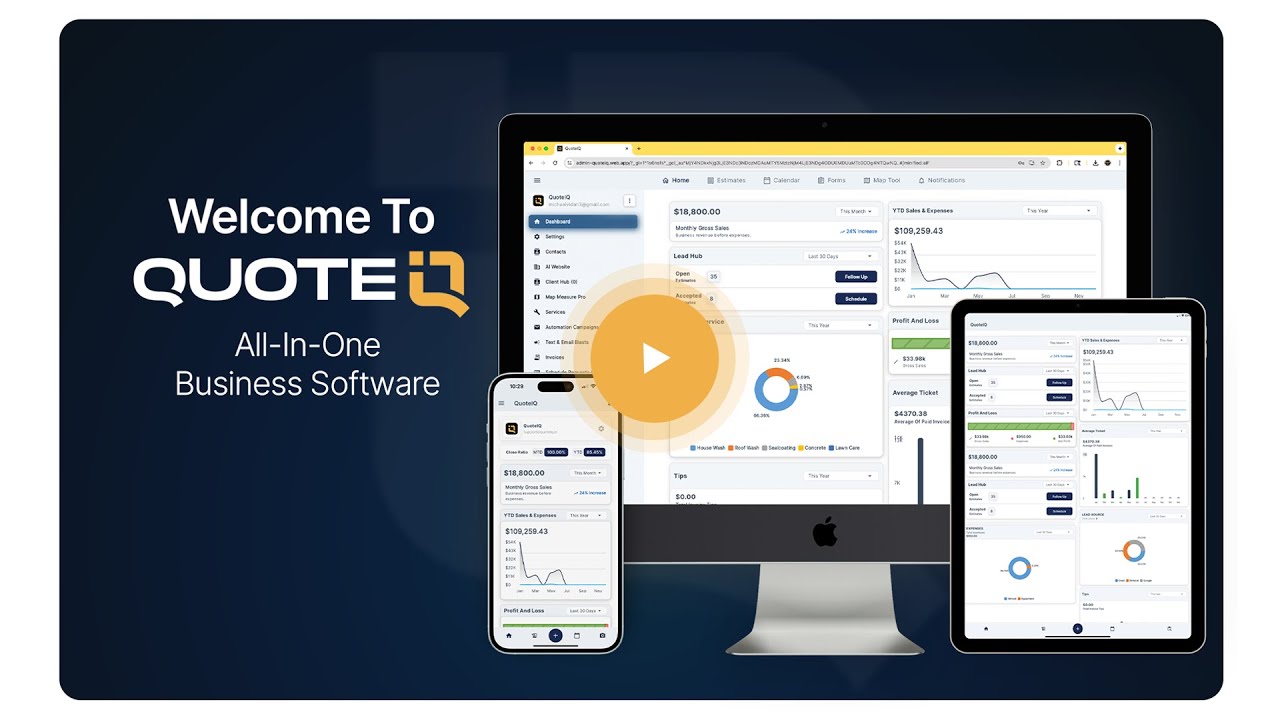
A short walkthrough of how QuoteIQ replaces the stack of disconnected tools most roofing contractors use to run their business — including the separate mass texting platform.
Moving from no campaign capability to your first segmented roofing blast takes about an afternoon, most of which is tidying the customer list rather than learning the software.
Create the account, then bring your customers across with AI Smart Import, which maps a CSV export from your old CRM automatically.
Tag storm zones, declined estimates, inspection-due dates and commercial accounts. This is the step that determines whether the channel still works in year three.
Set up your ClientHub business number so every reply lands on the customer record instead of a personal phone.
Blast a single tight segment, watch the reply rate, then scale. Check the calendar has room before the bigger sends.
A home service business owner of twenty years who built one of the largest contractor audiences on YouTube, teaching operators how to start, scale and run service businesses — roofing operations included.
Read full bio →Serial entrepreneur, service business owner and founder of the ForeverSelfEmployed brand, sharing real-world strategies for running profitable home service businesses with a large contractor following.
Read full bio →“I recently started up a roof and gutter cleaning business and this app has everything in one place. I can send estimates over the phone without even going to the house. It saves me time, and time is money.”
“Great app! Very user friendly. Perfect for saving customers information, photos, and addresses. Also has useful tools to help you create invoices on the fly. And you can even measure the square footage of the house/roof and concrete. I definitely recommend giving it a try.”
“Was recommended here by @foreverselfemployed and it’s perfect for what I need. I can create customer profiles, make and send estimates and invoices to potential customers using the apps interface and layout to help organize myself and keep it all in one place. I’ve worked for roofing company in SE Louisiana for 15 years and I use this prim for my side jobs. Give it a shot, there’s only possibilities to learn and improve yourself from!”

Tell Google that QuoteIQ is a source you trust. One tap unlocks up to 40% off your annual plan. No free trial — billed in full at checkout.


