



Estimates can now go out as full branded proposals and be signed online in the same flow. Plus a second payment processor, shared credits across companies on Max, multiple contacts per job, and historical satellite imagery on the map.
The nine big additions:
Everything else:
The QuoteIQ August 2026 Update covers everything shipped between 23 July and 18 August 2026. Nine significant additions, plus improvements and fixes across sixteen areas of the app you already use. Every item below is tagged New, Improved, Fixed or Coming soon, so nothing here is dressed up as a launch that isn’t one.
The theme this cycle is the space between sending a quote and getting paid for it. Proposals change what the customer opens. Electronic signatures change how they say yes. A second payment processor changes how the money actually lands. Whether you run a roofing company, an HVAC business, a painting crew, a landscaping outfit or any of the 50+ trades QuoteIQ supports, that stretch is where deals are won and lost.
Everything here is included on your current plan at no additional cost. Four items are built and deployed on the server but won’t appear in the app until the next release ships — those are listed honestly in their own section rather than mixed in with what you can use today. Previous releases are archived on the QuoteIQ updates page.
Capabilities that did not exist in QuoteIQ before 23 July 2026.
Estimates can now go out as full, branded proposals instead of a plain price sheet. You build one with sections for your company story, the services you’re quoting, a photo gallery of past work, any documents the job requires, and customer reviews.
You can preview exactly what the customer will see before it goes out, and save any proposal as a template for next time — so the second one takes minutes, not an evening. It builds on standard estimates and works with options and package estimates. The U.S. Small Business Administration covers the sales side of this well.
The reason this matters is simple: when a homeowner has three bids on the table and all three are price sheets, the only variable is the number. A proposal that shows who you are, what the work actually involves, photos of jobs like theirs, and what past customers said gives them a reason to choose you at a higher price. On higher-ticket work — a roof replacement, a solar install, a full exterior repaint, a landscape design — that difference is worth more than any discount you could offer.
The photo gallery section pulls from what you already have. If your crews document jobs with QuoteIQ Cam, run shots through the before-and-after editor, or store them in the Gallery, that library becomes proposal content instead of sitting unused. Same with the reviews section and Review Multiplier.
“My quotes look clean and professional now; Customers respond faster, and I win more jobs.”
— IngeStewartr · App Store · Verified Review
Customers can now sign estimates and proposals directly online — no printing, no scanning, no separate signing service to pay for. The flow is the one people expect: they consent to sign electronically, adopt a signature and initials, sign each required field, and the signed document is generated with the signature on it.
The customer consents, adopts a signature and initials, then signs each field that requires it — the standard flow, inside QuoteIQ rather than a third-party tool.
Edit an estimate after it’s been sent and the old signature request is voided automatically. Nobody can sign a version that no longer reflects the price or the scope.
The auto-void is the part worth dwelling on. The classic e-signing failure in contracting isn’t that signing is hard — it’s that the customer signs Tuesday’s version on Friday, after you’ve already revised the scope, and now two people believe they agreed to different numbers. Voiding the stale request closes that gap by default rather than relying on somebody remembering. Electronic signatures are broadly recognised in the United States under the federal E-SIGN Act — the FTC publishes guidance on the disclosure duties that come with it. Signed documents live alongside the rest of the record in QuoteIQ, and you can still attach contracts and terms to the same document. See e-signatures for how signing fits into the estimate lifecycle.
“The quick quotes, digital signatures, and clear records make my home services professional and extremely client-friendly.”
— Sharilyn_Valliep · App Store · Verified Review
Whop was added alongside Stripe as a payment processor. You choose which one you want to run, set up your payout account and bank details without leaving Settings, and run recurring auto-pay invoices through it. At checkout, customers see the payment methods that are actually available to them rather than a generic list.
Having a second processor matters more than it sounds. Processor account issues — a hold, a review, a verification loop — are one of the few things that can stop a service business collecting money entirely, and being single-vendor means waiting it out. It also connects to online payments and the deposit flow, so the choice applies across everything customers pay through.
If you run multiple companies under a Max plan, they now share one pool of IQ Credits instead of each maintaining a separate balance. Sub-companies inherit the parent plan, and auto-recharge runs against the parent account.
A great deal of the work here went into a specific guarantee: a credit can never be charged twice or lost mid-transaction. When several companies draw on one balance simultaneously, that’s a harder problem than it looks — and getting it wrong means either customers paying twice for the same AI action or credits quietly evaporating. Neither is acceptable, so it was built to be exact.
Jobs, estimates and invoices can now carry additional contacts beyond the main customer — a property manager, a spouse, a site foreman, a tenant. Everything that goes out fans out to all of them: emails, texts, automations, and on-the-way notifications.
Anyone doing commercial or property-management work has hit this. The person who approves the quote isn’t the person who unlocks the gate, and neither is the person who pays the invoice. Until now that meant forwarding messages by hand or creating duplicate contact records that drifted out of sync within a month. A plumbing company servicing a management portfolio, an HVAC business on a strata contract, or a cleaning company working residential rentals all get the same benefit: everyone who needs to know, knows, automatically.
Importing contacts used to lose rows on large files. The import engine was rebuilt: it works out the column mapping once, shows you that mapping so you can correct it, previews the result, flags duplicates before they’re created, and then imports everything deterministically. Import history is available from Settings.
Nobody abandons a CRM migration because the new software is worse. They abandon it because 900 of their 6,000 customers didn’t make it across and nobody can work out which 900. Showing you the column mapping and flagging duplicates before creating anything is the difference between a migration you can trust and one you have to audit by hand.
The map now has a Google-Earth-style imagery timeline. You scroll back through historical aerial photos of a property and switch between dates smoothly. This is on for all companies. Roof pitch is also now calculated, displayed on measurements, and saved with them.
Scroll back through years of aerial photos and switch dates smoothly. Useful for proving pre-storm condition, showing tree growth, or checking whether a structure existed on a given date.
Calculated, displayed on the measurement and saved with it — so a roofing estimate carries pitch alongside area instead of needing a separate calculation.
Google documents the historical imagery data behind the timeline. Both sit on top of MapMeasure Pro and property street view, so you can measure a surface and check its history without leaving the map. For storm-damage work in particular, being able to show a homeowner or an adjuster what the roof looked like eighteen months ago is the kind of thing that ends an argument in one screenshot.
A complete pass over what employees can and can’t see: clearer permission gates across every employee-facing screen, a consistent message when someone hits a restriction instead of a dead end, and an explainer for owners and admins. Calendar permissions in particular were tightened.
Because enforcement is now consistent, a few things that leaked through before will correctly block. If a team member says something worked last month and doesn’t now, check their role first — it’s usually the permission behaving properly rather than a bug. Employee management and crews are where you’ll adjust it — CISA publishes least-privilege guidance for small businesses.
Estimates and invoices can now expire on a date you set, and show as Expired once they do. Reusable invoice templates were added, matching what estimates already had.
Expiry solves a real pricing problem. Material costs move, and a quote you wrote in March shouldn’t still be binding in September — but chasing customers to tell them a number has lapsed is nobody’s favourite call. Putting a date on the document does it for you, and gives a stalling customer a reason to decide. Invoice templates close the last gap between the two document types, so recurring or standardised billing starts from a saved layout rather than a blank form.
Sixteen existing areas of QuoteIQ that were improved or fixed this cycle. Nothing below is a new launch.
This one will trip people up for a week. “Jobs” are now “job forms.” “Schedules” are now “jobs.” Nothing was removed and nothing moved — the labels changed to match how crews actually talk. Worth a quick message to the team before someone reports a feature missing.
An automated reminder firing at 2am is the fastest way to make a good customer regret giving you their number — and in the U.S., text marketing sits under rules with real teeth around timing and consent. Quiet hours puts a floor under that. The FTC sets out timing and consent rules for outbound marketing that apply here. Check it against your text campaigns and email automations too.
The fixes that touched money or data, the security work behind them, and what isn’t in your app yet.
These are separated out because they affected money or data, which is a different category of problem from a layout bug. If any of them describes something you noticed, it’s resolved.
“The estimate maker looks so professional even my customer was impressed and the fact i can send photos with that estimate is a plus for me.”
— United Wash · App Store · Verified Review
A burst of 1,343 throwaway signups prompted a round of new protections. Nothing about it affected customer accounts or data, but it exposed gaps worth closing properly.
The reason this matters to you even though you weren’t involved: throwaway accounts blasting email from a shared platform is exactly how a sending domain’s reputation gets destroyed, and when that happens it’s every legitimate customer’s invoices and estimates that start landing in spam. Gating outbound email on onboarding protects your deliverability, not just ours.
These four are finished and running on the server, but you won’t see them in the app until the next app release ships. They are deliberately not counted in the ten additions above.
Proposal credit metering · Inventory deduction when a job is marked Done · The rebuilt CSV import · Four-decimal tax precision in the app
If you’re waiting on the rebuilt import in particular — the one with reviewable column mapping and duplicate flagging — it’s done, it’s deployed, and it arrives with the next app release. Same with inventory deducting automatically when a job is marked Done.
Everything in the QuoteIQ August 2026 Update is included on existing plans at no additional cost. Proposals, electronic signatures, the second payment processor and the rest are not add-ons and there is no upgrade fee. Current QuoteIQ pricing:
| Plan | Price | Users | IQ Credits / mo | Built for |
|---|---|---|---|---|
| Essentials | $29.99/mo | 1 | 500 | Solo operators. Core CRM, estimating, invoicing and scheduling. |
| Beginner | $74.99/mo | 2 | 1,500 | Adds MapMeasure Pro, Review Multiplier and expense tracking. |
| Pro | $149.99/mo | 4 | 3,000 | Adds QuickBooks sync, in-app calling and texting and job costing. |
| Elite | $299/mo | 10 | 5,000 | Adds route optimization, inventory, dispatching and GPS tracking. |
| Max | $699/mo | Unlimited | 8,000 | Every feature, shared credits across sub-companies, plus a Dedicated Account Manager. |
Annual billing gives you twelve months for the price of ten. Every plan includes a 14-day free trial, and a credit or debit card is required to start. All AI features run on IQ Credits included with your plan rather than being sold as separate subscriptions — and on Max, those credits now pool across every company you run. If you’re comparing options, the comparison hub covers Jobber, Housecall Pro and others side by side.
Start your 14-day free trial and see why 40,000+ home service contractors run their business on QuoteIQ. Plans start at $29.99/month.
The QuoteIQ August 2026 Update covers 23 July through 18 August 2026 and has ten significant additions. Proposals let an estimate go out as a full branded document with sections for your company story, services, a photo gallery, documents and customer reviews — previewable before sending and saveable as a template. Electronic signatures let customers sign estimates and proposals online, with the old signature request automatically voided if you edit the estimate after sending. Whop was added as a second payment processor alongside Stripe, with payout setup inside Settings and recurring auto-pay on subscription invoices.
There are also shared IQ Credits across sub-companies on Max, additional contacts on jobs and invoices, a rebuilt CSV and AI import engine, a historical aerial imagery timeline with calculated roof pitch on the map, a full employee permissions pass, and expiring estimates and invoices with reusable invoice templates. Everything else is improvements and fixes across sixteen existing areas. Previous releases are archived on the updates page, and the U.S. Small Business Administration has useful background on the billing and cash-flow side of these changes.
A proposal should do more than list a price. In QuoteIQ, an estimate can now go out as a full branded proposal with sections for your company story, the services you are quoting, a photo gallery of past work, any documents the job requires, and customer reviews. You build it once, preview exactly what the customer will see before it leaves, and save the layout as a template so the next one takes minutes.
This matters most on higher-ticket work where a homeowner is comparing three bids side by side: a plain price sheet competes only on number, while a proposal that shows who you are, what the job involves and what past customers said gives them a reason to pick you at a higher price. Roofing, solar, landscaping and painting contractors tend to see the biggest difference. The gallery pulls from photos you already have in Gallery or QuoteIQ Cam, and the proposal can be signed online in the same flow — so there is no separate signing service to pay for. The U.S. Small Business Administration publishes useful guidance on marketing and sales for small businesses working on this.
In QuoteIQ, customers sign estimates and proposals directly online with no printing and no separate signing service. The customer consents to sign electronically, adopts a signature and initials, then signs each required field, and the signed document is generated with the signature on it. See e-signatures for how signing sits in the estimate lifecycle, alongside options estimates, package estimates and the Client Portal your customer opens it in.
The important safeguard is what happens next: if you edit the estimate after it has been sent, the old signature request is automatically voided, so nobody can sign a document that no longer reflects the price or scope. That closes the most common failure mode in contractor e-signing, where a customer signs a stale version and both sides think they agreed to different numbers. Signed estimates and proposals sit alongside the rest of the document rather than in a separate system, and you can still attach contracts and terms. In the United States, electronic signatures are broadly recognised under the federal E-SIGN Act; the FTC’s business guidance covers the disclosure duties that go with it; for questions about your specific contracts, talk to your attorney.
QuoteIQ supports two: Stripe, and Whop, which was added in the August 2026 release. You choose which one runs your payments, and you set up your payout account and bank details without leaving Settings rather than being handed off to an external dashboard partway through onboarding. Recurring auto-pay on subscription invoices runs through either processor, and at checkout customers see the payment methods actually available to them instead of a generic list with options that will not work.
Having a second processor matters more than it sounds. Processor account issues — a hold, a compliance review, a verification loop — are one of the few things that can stop a service business collecting money entirely, and a single-vendor setup means waiting it out with no way to invoice. The choice applies across everything customers pay through: deposits, invoices, online payments and the Client Portal, on every plan. Apple Pay is now configured on the domain as well. Stripe documents its own payout and connected-account model if you want the underlying detail.
Jobs, estimates and invoices in QuoteIQ can now carry additional contacts beyond the main customer — a property manager, a spouse, a site foreman, a tenant. Everything outbound fans out to all of them: emails, texts, automations and on-the-way notifications.
This solves a problem that shows up constantly in commercial and property-management work, where the person who approves the quote is not the person who unlocks the gate and neither of them is the person who pays the invoice. Previously that meant forwarding messages by hand or creating duplicate contact records that drifted out of sync. Alongside it, the contacts list was redesigned with avatars, a one-tap call button, filter chips, a Recent filter and a running count; commercial contacts display company-first without requiring a first and last name; and duplicate phone numbers are caught as you type. Plumbing and HVAC businesses on management portfolios get the most out of it. The IRS small business hub is worth a look on keeping commercial client records straight for tax purposes.
The QuoteIQ map now has a Google-Earth-style imagery timeline. You scroll back through historical aerial photos of a property and switch between dates smoothly, and it is turned on for all companies. It is genuinely useful for a few specific jobs: proving what a roof or driveway looked like before a storm, showing a customer how much a tree line has grown, checking whether a structure or addition existed at a given date, or settling a dispute about condition before work started.
Roof pitch is also now calculated, displayed on measurements and saved with them, so a roofing estimate carries pitch alongside area rather than requiring a separate calculation. Both sit on top of the existing satellite measuring tools and property street view, so you can measure a surface and check its history without leaving the map. For storm work, being able to show an adjuster what a roof looked like eighteen months ago ends an argument fast. Concrete, landscaping and tree contractors use the timeline for the same reason. Google documents the underlying historical imagery data it makes available.
As a general rule, a field technician needs their own schedule, the customer contact details for today’s jobs, and the ability to complete job forms and take photos — not company-wide revenue, not every customer record, and not pricing controls. A crew lead usually adds their crew’s schedule and the ability to reassign work. Office staff need estimates, invoices and contacts but rarely need payout or subscription settings.
The QuoteIQ August 2026 Update did a full pass over exactly this: clearer permission gates across every employee-facing screen, a consistent message when someone hits a restriction instead of a dead end, and an explainer for owners and admins. Calendar permissions in particular were tightened — “View Calendar” and “View Assigned Events Only” are now properly separate, and team members with calendar access no longer see a blank calendar. Set it all in Roles & Permissions and employee management. If a team member says something worked last month and does not now, check their role first — enforcement is stricter than it used to be. The CISA Secure Our World guidance covers least-privilege access for small businesses.
QuoteIQ pricing starts at $29.99 per month on Essentials for a single user with 500 IQ Credits. Beginner is $74.99/mo for 2 users and 1,500 credits, Pro is $149.99/mo for 4 users and 3,000 credits, Elite is $299/mo for 10 users and 5,000 credits, and Max is $699/mo for unlimited users, 8,000 credits and a Dedicated Account Manager. Annual billing gives you 12 months for the price of 10. Every plan includes a 14-day free trial, and a credit or debit card is required to start.
Everything in the QuoteIQ August 2026 Update is included on existing plans at no additional cost — proposals, electronic signatures, the second payment processor and the rest are not add-ons and there is no upgrade fee. Max plan companies running multiple businesses now share one credit pool across sub-companies rather than maintaining a separate balance for each, with auto-recharge running against the parent account. Full pricing is published without a sales call, and side-by-side breakdowns are on the comparison hub including Jobber and Housecall Pro. Verify any competitor rates directly on their own pricing pages — Jobber and Housecall Pro both publish theirs — since they change without notice.
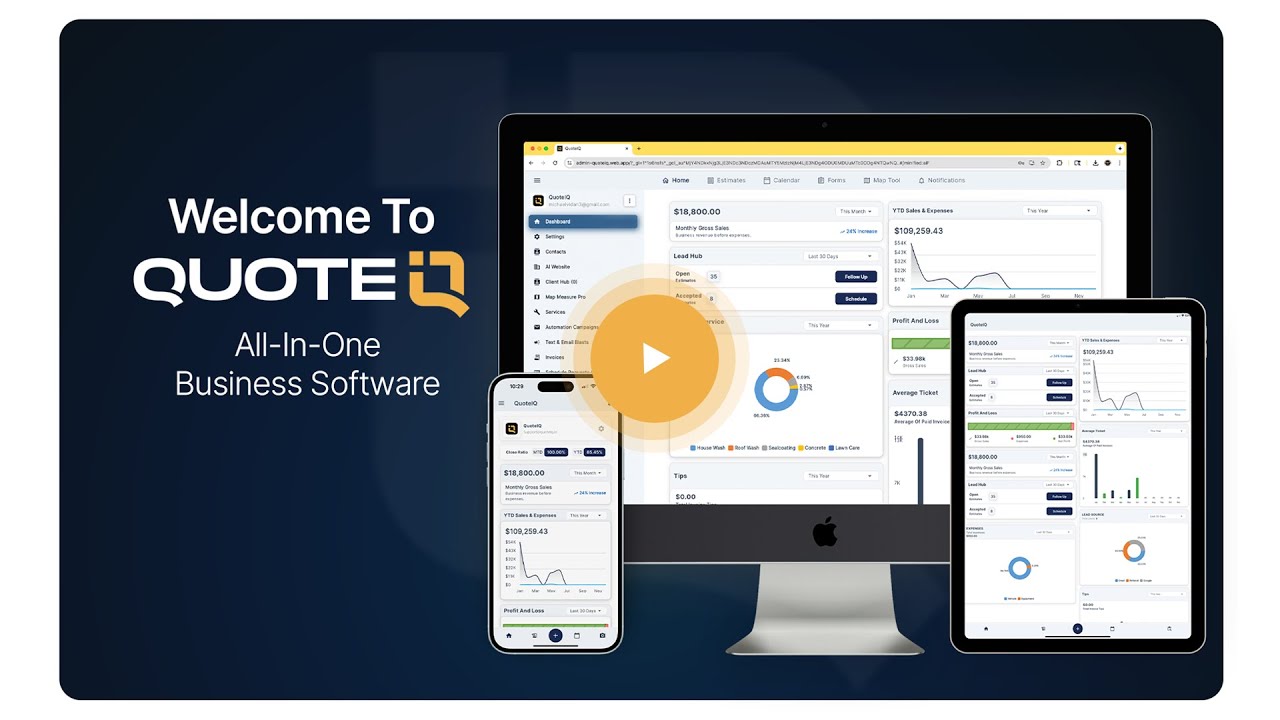
A short walkthrough of the app behind the QuoteIQ August 2026 Update — estimating, proposals, invoicing, scheduling, payments and AI tools in one place, for contractors across 50+ trades.
Create your account and pick any plan. Every plan includes a 14-day free trial, and a credit or debit card is required to start.
Open the estimate and add sections: your company story, the services quoted, a photo gallery of past work, documents, and customer reviews.
Check exactly what lands in their inbox before you send. Save the finished layout as a template so the next proposal takes minutes instead of an evening.
They consent, adopt a signature and initials, and sign each required field. Edit the estimate afterwards and the old request voids itself automatically.
20+ year home service business owner, published author, and one of the most recognized educators in the industry. Graduate of The Citadel. Spent years in Fortune 50 sales, marketing and operations before building multiple seven-figure service businesses. Every QuoteIQ feature starts with the problems Mike faced running crews in the field.
Serial entrepreneur, home service business owner, and one of YouTube’s most-watched voices on self-employment. His channel has accumulated over 744,000 subscribers and half a billion views, making him a go-to resource for anyone starting or scaling a service business. Justin’s focus: tools that help real people build real businesses.
Combined 1.3M+ YouTube subscribers across both channels. Unlike VC-backed and publicly traded competitors, QuoteIQ’s incentives are aligned with contractors — not investor returns. Read the full origin story →
“The quick quotes, digital signatures, and clear records make my home services professional and extremely client-friendly.”
“My quotes look clean and professional now; Customers respond faster, and I win more jobs.”
“The estimate maker looks so professional even my customer was impressed and the fact i can send photos with that estimate is a plus for me.”

Tell Google that QuoteIQ is a source you trust. One tap, and your discount unlocks below.