


Published June 2026 · Updated October 2026
Six invoicing platforms ranked for the way roofing jobs actually get paid: a deposit at signing, progress billing at material delivery and dry-in, a final invoice after inspection, and job costing that shows your margin before the check clears.
QuoteIQ is the best invoicing software for roofing contractors in 2026 because invoicing, online payments, and consumer financing are included on every plan starting at $29.99 per month, and the Pro plan at $149.99 per month adds Job Costing and QuickBooks Online sync so you see the margin on each roof before the invoice goes out. If most of your revenue is storm and insurance work, shortlist JobNimbus, a roofing-first CRM that promises lead-to-payment, or AccuLynx, which lists direct supplier ordering with ABC Supply, QXO, and SRS. If roofing is one of several trades you run, Jobber covers quote, schedule, invoice, and get paid in one place. If measurement reports should feed your proposals and invoices, look at Roofr. And for large multi-department contractors, ServiceTitan offers pricebook-driven invoicing. Competitor prices change often, so confirm each vendor’s current numbers on its own pricing page before you commit.
TL;DR: QuoteIQ puts invoicing and online payments on every plan from $29.99/month, and Pro at $149.99/month adds job costing and QuickBooks Online sync, the roofing sweet spot. Consumer financing is on every plan, MapMeasure Pro starts on Beginner, and Elite adds inventory management for materials. Pick JobNimbus for a roofing-first CRM, AccuLynx for supplier ordering, Jobber for multi-trade billing, Roofr for measurement-to-proposal flow, and ServiceTitan for enterprise scale. The BLS counts 166,900 roofing jobs and the IRS mileage rate is 76 cents a mile through December 2026, two more reasons to track every job’s true cost.
Different roofing businesses bill differently, so one tool rarely wins every column. These six picks show where each platform is strongest, based on how QuoteIQ scored them and what each vendor says on its own homepage.
Invoicing, online payments, consumer financing, and scheduling on every plan from $29.99/month. Pro at $149.99/month adds job costing and QuickBooks Online sync.
Promises to run “your entire roofing business from lead to payment,” with invoicing, payments, estimates, and roof-measurement ordering on its homepage.
Lists supplier direct ordering with real-time status tracking, plus integrated financing and online payment processing.
Describes itself as “quote, schedule, invoice, and get paid, all in one place,” serving many trades including roofing.
Roof measurement reports, customizable proposals, and invoices linked to job details. The homepage prices a report at $13, delivered within 2 hours.
Positions itself as AI software for commercial and residential trades, with Pricebook client pricing, integrated financing, and dispatch tools.
A roofing invoice is not one document; it is a sequence. On a $28,000 asphalt shingle replacement, you might collect a deposit at contract signing, bill again when materials are delivered, bill again at dry-in, and send a final invoice after the inspection signs off. Tools built for one-and-done jobs push that sequence into spreadsheets, which is where deposits get forgotten and balances go stale. The invoicing workflow matters as much as the estimate that precedes it, and a free contractor invoice template is a fair stopgap while you evaluate software.
$5,600 · $11,200 · $8,400 · $2,800
One way to split a $28,000 replacement: 20% deposit at signing, 40% at material delivery, 30% at dry-in, and 10% after inspection. It is an example, not an industry rule. Your contract sets the real schedule, and your software should bill each stage without a rebuild.
Insurance restoration adds more steps. A scope of loss is built in claim-estimating software, a supplement covers items the adjuster missed, the carrier releases an actual-cash-value (ACV) payment, recoverable depreciation is released after completion, and the homeowner pays a deductible. Every one of those is a different payer, a different amount, and a different date. Software that can only send one invoice per job forces your office manager to track the rest by hand.
Labor is a major cost on every roof, so it helps to benchmark it. The U.S. Bureau of Labor Statistics counts 166,900 roofing jobs in 2025, a median of $55,440 per year ($26.65 per hour), and projects 5% growth from 2025 to 2035 with about 12,000 openings a year. More roofers competing for the same homeowners means the winners are the shops that collect faster and know their margin per roof. Industry groups such as the National Roofing Contractors Association publish technical guidance for the work itself; your invoicing software has to protect the money side.
166,900 jobs · $55,440 median pay · 5% growth, 2025–2035
Source: BLS Occupational Outlook Handbook, Roofers, read October 6, 2026. Use the median wage as a sanity check when you price labor into estimates and job costing.
The financial stakes also run through your paperwork. The IRS recordkeeping guidance tells small businesses to keep records that support income and deductions, and the U.S. Census Bureau construction spending data is a useful backdrop when you plan capacity for the year. Invoices that are tied to estimates, payments, and expenses make both tasks easier. That is the real case for bundled software: a platform like QuoteIQ wires estimates to invoices to payments to margin reports in one flow, so the numbers are right before you cash the check.
$187,500 billed a month · about $62,500 freed for every 10 days saved
Assume 15 jobs a month at a $12,500 average ticket. That is $187,500 billed monthly. Collecting 10 days sooner keeps roughly $62,500 ($187,500 × 10 ÷ 30) in your account instead of the customer’s. Swap in your own job count and ticket; the point is that faster invoicing and online payment links turn directly into material money.
Best-of lists are often affiliate revenue wearing an editorial costume. This one is published by QuoteIQ, so we rank QuoteIQ first and we say so up front. To keep the rest honest, we describe each competitor using only what that vendor says on its own homepage (checked October 6, 2026), and we do not print competitor prices, seat limits, or trial terms, because those change often and belong on the vendor’s pricing page.
Disclosure: QuoteIQ sells the product ranked first, and competitor descriptions are summaries of vendor homepage copy, not hands-on reviews. Where we could not verify a detail today, we left it out and pointed you to the vendor. Before you buy any platform, run one real job through it, from estimate to final payment, with your own deposit and progress schedule.
Competitor columns summarize each vendor’s own homepage as read on October 6, 2026. QuoteIQ details come from the QuoteIQ pricing page. Prices for other vendors change often, so open their pricing pages before you shortlist.
| Tool | Built for | Invoicing and payments (vendor’s words) | Integrations named on homepage | Pricing |
|---|---|---|---|---|
| QuoteIQ | Roofers and other home-service contractors | Invoicing, recurring invoices, deposits, card/ACH/Apple Pay/Google Pay online payments, and consumer financing on every plan | QuickBooks Online (Pro and up) | $29.99–$699/month · details below |
| JobNimbus | Roofing first; also siding, gutters, fencing, and construction | “Quickly create, send, and track accurate invoices”; “collect fast, secure payments”; financing options | QuickBooks Online, CompanyCam, EagleView, SumoQuote, Sunlight Financial | See vendor pricing page |
| AccuLynx | Roofing companies of many sizes | “Flexible invoicing tools”; “integrated financing and online payment processing” | ABC Supply, QXO, SRS, EagleView, CompanyCam, QuickBooks | See vendor pricing page |
| Jobber | Home and commercial service businesses across many trades, roofing included | “Quote, schedule, invoice, and get paid, all in one place”; invoice from your phone | App marketplace (no integration names on the homepage) | See vendor pricing page |
| Roofr | Roofing businesses (“built for roofers, by roofers”) | Invoices that link to job details with reminders; online card and ACH payments | ABC Supply, Goodleap, CertainTeed, CompanyCam, QXO, SRS | Reports advertised at $13 each; plans on vendor pricing page |
| ServiceTitan | Commercial and residential trades; roofing listed among industries | “Simplify how you manage invoices and payments”; Pricebook client pricing; integrated financing | Dispatch, marketing, and payments modules | See vendor pricing page |
Every plan includes invoicing, online payments, consumer financing, e-signatures, and scheduling, and every plan starts with a 14-day free trial with full access to the features of the plan you choose. Annual billing is listed as two months free.
| Plan | Monthly | Annual | Users | What changes for roofing invoicing |
|---|---|---|---|---|
| Essentials | $29.99 | $299.99 | 1 | Invoicing, recurring invoice subscriptions, online payments, financing, e-signatures, scheduling |
| Beginner | $74.99 | $749.99 | 2 | Adds MapMeasure Pro, QuoteIQ Cam, Expense Tracking, Mass Invoicing, advanced analytics, and contract attachments |
| Pro (recommended) | $149.99 | $1,499.99 | 4 | Adds Job Costing, QuickBooks Online, ClientHub, Client Portal, and email/text automations |
| Elite | $299 | $2,990 | 10 | Adds Inventory, Route Optimization, EmployeeHub, InstaQuote, InstaSchedule, and Pipelines & Deals |
| Max | $699 | $6,990 | Unlimited | Adds crew scheduling, Sales Team Tracker, priority support, and the AI Website Builder at no extra charge |
Entries are ordered by fit for a typical retail roofing business that bills in stages and wants margin visibility. Insurance-heavy shops should read the JobNimbus and AccuLynx entries closely and then test their own claim workflow in each.
QuoteIQ is a field service platform where invoicing and online payments are built into every plan from $29.99 per month, not sold as an add-on and not gated behind an enterprise tier. For roofers, Pro at $149.99 per month is the sweet spot: Job Costing shows profit per roof (Total Price − Labor − Expenses = Profit), the QuickBooks Online integration syncs invoices, payments, customers, and expense categories, and ClientHub gives you a dedicated business number for two-way calling and texting inside the customer record.
Invoicing starts in the estimate. Build a Standard, Quick, Options, or Package estimate on site, or let the AI Estimator draft line-item pricing from property photos. Customers sign on their phone, and one tap converts the approved estimate to an invoice. A deposit requirement on the estimate, partial payments on the invoice, and recurring invoices for commercial maintenance contracts cover the stages a roofing job moves through. Homeowners pay online by card, ACH, Apple Pay, or Google Pay, or they can finance the job through Affirm, Klarna, or Afterpay, which sit on every plan.
Elite at $299 per month adds Inventory Management for materials, Route Optimization, EmployeeHub for crew time and GPS, InstaQuote, and InstaSchedule. Max at $699 per month adds unlimited users, crew scheduling, and the AI Website Builder at no extra charge.
For roofers who want estimates, scheduling, job costing, customer messaging, and online payments in one platform, QuoteIQ Pro at $149.99 per month is the strongest bundled value on this list. The honest gap: if most of your revenue is insurance restoration and you work inside Xactimate every day, a roofing-specific platform may match that workflow more closely.
JobNimbus calls itself “the #1 all-in-one platform for roofing contractors” and promises to help you “run your entire roofing business from lead to payment, without the chaos.” Its homepage lists invoicing (“quickly create, send, and track accurate invoices”), payment collection, estimates, ordering roof measurements, and simple financing options, and it names integrations with QuickBooks Online, CompanyCam, EagleView, SumoQuote, and Sunlight Financial. It also serves siding, gutter, fencing, and construction contractors.
For roofers who live in a roofing-native CRM, that focus is the draw. If supplements, ACV draws, depreciation releases, and deductibles are your daily reality, ask for a live walkthrough of one real claim from first invoice to final payment. Roofing teams comparing it with a bundled platform should also ask how job costing and margin reporting work out of the box.
A strong shortlist pick if roofing is your whole business and you want a roofing-native CRM. Retail roofers who also want job costing, financing, customer messaging, and scheduling on one bill should compare it against QuoteIQ Pro.
AccuLynx describes itself as “the all-in-one management platform that powers every aspect of a roofing business.” Its homepage lists flexible invoicing tools, “integrated financing and online payment processing,” estimates built from measurement data with live material pricing, and custom sales proposals.
The standout is supplier ordering: AccuLynx lists “supplier direct ordering and real-time status tracking” and partnerships with ABC Supply, QXO, and SRS, along with integrations for EagleView, CompanyCam, and QuickBooks. If you buy materials from those distributors every week and want invoice-side costs to reflect those orders, this is the platform to put at the top of a demo list. Because it is roofing-focused, contractors who also run gutters, siding, or other trades should check how their non-roofing work is handled.
AccuLynx is the natural fit for roofing operations whose biggest cost is materials and whose biggest headache is keeping supplier orders and invoices in sync. For contractors who care more about one all-in-one bill across estimates, scheduling, job costing, and messaging, compare it with the bundled option above.
Jobber describes itself as “the best way to organize your service business. Quote, schedule, invoice, and get paid, all in one place,” and its homepage says it serves home and commercial service businesses across many trades, roofing included. It highlights invoicing from your cell phone, getting paid sooner, AI help drafting a quote, and a drag-and-drop calendar for scheduling.
For a small roofing shop that also does gutters, cleaning, or general exterior work, a general-purpose platform can be a sensible fit. The question for roofers is depth: run a $15,000 replacement with a deposit, a progress payment at material delivery, and a final payment through a trial account, and see how many separate invoices and manual steps that takes.
Jobber is a reasonable choice for small, mixed-trade crews that want simple quote-to-paid billing. Roofers who need staged payments, job costing, and financing in one place should line it up against QuoteIQ’s invoicing with a real job.
Roofr describes its product as “a suite of tools for roofing businesses to measure more roofs, win more deals, save more time,” built “for roofers, by roofers.” Its homepage advertises roof measurement reports at $13 each, delivered within 2 hours, fully customizable proposals, invoices that link to job details with automatic reminders, and online payments by credit card and ACH.
The pipeline from measurement to proposal to invoice is the draw. Do the per-report math before you commit: at the homepage price, ordering a report for 20 estimates a month is $260 on top of whatever plan you choose. Roofr also lists integrations with ABC Supply, Goodleap, CertainTeed, CompanyCam, QXO, and SRS, including supplier integrations for material ordering.
Roofr suits residential roofers who want measurement reports and polished proposals feeding straight into billing. Before you sign, price the reports against your estimate volume, and compare it with MapMeasure Pro, which measures from satellite imagery inside the QuoteIQ estimate on Beginner and up.
ServiceTitan calls itself “AI software for commercial and residential trades” and “all-in-one software built to accelerate today’s contracting businesses,” built to manage service visits and construction projects. Its homepage highlights invoices and payments, a Pricebook “Client Pricing” feature that keeps up with price changes, integrated financing, dispatch tools for daily schedules, and marketing tools aimed at ads that bring results. Roofing is listed among the industries it serves.
The pricebook is the invoicing story: the homepage says Client Pricing helps you automatically keep up with price changes, which matters when material costs move. Platforms built for larger operations often involve more setup, so ask for a written quote that covers onboarding, contract length, and every add-on you would actually use, and compare it with the total on a flat-rate plan.
ServiceTitan makes sense for large multi-department contractors that need pricebook discipline and can absorb a larger implementation. For most roofing companies, a bundled plan like QuoteIQ Max with unlimited users covers invoicing, scheduling, and CRM at a flat monthly price.
QuoteIQ puts invoicing, online payments, and consumer financing on every plan from $29.99 per month. Pro at $149.99 per month adds job costing and QuickBooks Online sync, built for roofers who bill in stages.
Match the tool to how your company actually bills. These four situations cover most roofing shops.
You do residential replacements, leak repairs, and some gutter work, with no insurance restoration. You need estimates that become invoices, online payment links, and QuickBooks sync, and you want one platform instead of three. See how it lines up with our roofing software page and its roofing FAQ.
→ Recommendation: QuoteIQ Pro at $149.99/month. Four users, job costing, QuickBooks Online, and ClientHub are included. Teams of 5–10 can move to Elite at $299/month.Most of your revenue is storm damage. You file supplements, track ACV and depreciation releases, and collect deductibles, and you order from distributors regularly. Your invoices need to mirror the claim stage by stage.
→ Recommendation: shortlist JobNimbus and AccuLynx and have each walk through one real claim. Compare against QuoteIQ if you also want job costing, financing, and customer texting in one bill.You are scaling past owner-operator with several crews, material orders at volume, and a need for stock tracking, route planning, and time tracking. Invoicing has to tie into crew time and job costing at scale. Look at inventory, route optimization, and EmployeeHub.
→ Recommendation: QuoteIQ Elite at $299/month for 10 users, or Max at $699/month for unlimited users and crew scheduling. AccuLynx is worth a demo if supplier ordering is your top priority.You roof, but you also hang gutters, install siding, or wash roofs, and you want one customer record and one invoice flow across all of it. Browse the metal roofing, gutter installation, siding installation, and roof washing pages to see the trade-specific setups.
→ Recommendation: QuoteIQ Pro for the shared job costing and QuickBooks Online sync, or Jobber if simple multi-trade billing matters more than roofing depth.Here is the path a typical roofing job takes from estimate to margin report when it all lives in one platform.
Create the roofing estimate on site as a Standard, Quick, Options, or Package estimate, or snap property photos and let the AI Estimator draft pricing. On Beginner and up, MapMeasure Pro measures the roof from satellite imagery.
The homeowner reviews the estimate on their phone and signs electronically. The approved estimate stays in the job record next to notes and the schedule.
One tap converts the approved estimate to an invoice. Apply the deposit, add change orders, and create further invoices from the job as work advances. Use invoicing to set terms and reminders.
The invoice goes out by email or text with a secure link. Homeowners pay by card, ACH, Apple Pay, or Google Pay, or finance through Affirm, Klarna, or Afterpay. The payment records automatically.
Job Costing (Pro and up) compares actual materials and labor with what you billed, so profit per roof is visible before you start the next one.
A clean roofing invoice references the signed estimate, describes the scope in plain language, separates materials from labor, shows deposits already received, states the balance and due date, and carries your license number and terms. QuoteIQ estimates carry photos, notes, terms and conditions, and your license number on the PDF, and the approved estimate converts to an invoice in one tap so those details travel with it. Net 15, 30, 60, and 90 payment terms suit commercial accounts, and reusable invoice templates (added in August 2026) let you save your standard deposit and progress lines.
Since August 2026, invoices, estimates, and jobs can carry multiple contacts, so the homeowner, a spouse, and a property manager can all receive the emails, texts, and on-the-way notifications for one roof. That small change removes the “I never got the invoice” delay on jobs with more than one decision maker. If you still bill from a spreadsheet while you evaluate software, the free contractor invoice template and construction invoice template give you a consistent layout.
3 business days
The FTC Cooling-Off Rule lets consumers cancel certain sales made at their home within three business days. If you sign contracts at the kitchen table, check how that window affects when you collect a deposit and order materials, and confirm your state’s rules with an attorney. This is general information, not legal advice.
Keep invoices, payment records, and expense receipts together so your books and your tax records agree. The IRS recordkeeping page explains what to keep, and QuoteIQ lets you export your data on every plan and sync to books through the QuickBooks Online integration on Pro and up.
Roofing tickets are large, and the easier it is to pay, the faster the money lands. With QuoteIQ online payments, customers pay invoices by credit or debit card, ACH bank transfer, Apple Pay, or Google Pay from an embedded checkout, and you can record cash and checks in the app. Automated payment reminders go out on a schedule you control, and recurring invoice subscriptions keep annual roof-maintenance billing on autopilot.
For bigger jobs, consumer financing is available on every plan, trial included. Affirm covers up to $30,000 per job over 3 to 36 months, Klarna offers Pay-in-4 and Pay-in-30, and Afterpay offers Pay-in-4 for purchases up to roughly $4,000. The homeowner applies at checkout in about 30 seconds and gets an instant decision, you are paid in full up front, and the financing provider owns collections and default risk. Approval and terms are set by each provider.
Up to $30,000 per job · 3–36 months (Affirm)
Financing sits on every QuoteIQ plan. On Pro and up, the Client Portal also lets customers see and pay invoices from a secure link without downloading an app or creating an account.
Materials are a major line on most roofing invoices, so how invoicing and stock interact matters. Inventory Management on Elite and Max has five modules: Products (SKU, category, unit, cost, reorder point, with In Stock, Low, and Out indicators), Locations (warehouse, truck, job site), Suppliers, Orders (Draft, Confirmed, Received), and Transactions (Receipt, Returned, Issued, Damaged, Loss, Adjustment). Materials on estimates and invoices link to those products, so the cost and customer price on a bundle of shingles stay current.
Stock deducts when the invoice is PAID
Inventory does not move when you mark a job done, and a deposit does not count as paid. On a $5,600 deposit invoice, nothing leaves stock unless you use the deduct option on that screen. When the invoice is paid, the materials on it are deducted.
For a roofing company that bills in stages, that rule has a practical consequence: stock on hand can look higher than reality between the deposit and the final payment. Receiving a supplier order creates receipt transactions automatically, so reconcile on delivery day, and review deductions after final payment posts. Pair this with job costing so the materials you issue also land in the job’s cost report, and with expense tracking for the items that never touch inventory, such as dump fees.
Job costing answers the question invoices cannot: did this roof make money? In QuoteIQ, the job’s cost report applies one formula, Total Price − Labor − Expenses = Profit, and shows a profit-margin bar. Labor pulls from tracked time (hourly rate × clocked hours), expenses link to the job, and Job Costing is included on Pro and up. Log shingles, underlayment, flashing, nails, and disposal through Expense Tracking on Beginner and up so they attach to the right roof.
| Line | Estimated | Actual |
|---|---|---|
| Contract price | $15,000 | $15,000 |
| Materials | $6,300 | $7,350 |
| Labor | $3,450 | $4,200 |
| Disposal and other | $0 | $750 |
| Profit | $5,250 | $2,700 |
| Margin | 35% | 18% |
Same invoice, same customer, and the margin halves because shingle prices moved, labor ran long, and nobody budgeted disposal. Without cost tracking, you would only find out at tax time. The business calculators and the Hourly Rate Calculator on Pro help you set labor rates that cover this drift, and analytics roll the margins up across jobs.
Do not forget the costs that are easy to leave off. OSHA’s fall protection requirements apply at 6 feet in construction, so anchors, harnesses, and training time are real job costs; log them against the roofs that need them so your next estimate prices them in.
A retail replacement has one payer, the homeowner, and a fairly predictable schedule. Insurance work has several payers and several triggers: the carrier’s initial payment, supplements, a depreciation release after completion, and the homeowner’s deductible. Whatever software you pick, you need to keep each payer’s balance separate and be able to answer “what is still owed, and by whom?” without opening a spreadsheet.
In QuoteIQ, you would bill each payer and stage as its own invoice from the same job, use invoicing reminders to chase balances, and track the claim as a deal in Pipelines and Deals on Elite and up, a Kanban board with stages and close-probability forecasting. There is no native Xactimate integration, so your scope still starts in your claims-estimating tool. Roofing-specific platforms such as JobNimbus and AccuLynx may map more directly to the claim lifecycle, which is why we recommend testing them with a live claim before you decide.
Questions worth asking any vendor: Can one job carry separate invoices for the carrier and the homeowner? Where do supplements and depreciation releases appear? How are deductible collections tracked and reminded? Can a customer finance their share? Can the platform export everything if you leave? The QuoteIQ comparison hub lists how QuoteIQ stacks up in more detail.
The monthly price is only part of the bill. Divide the plan by the people who will use it: Pro at $149.99 per month with 4 users is about $37.50 per user, Elite at $299 per month with 10 users is $29.90 per user, and Max at $699 per month covers unlimited users at a flat price. Annual billing shows as two months free, so Pro is $1,499.99 a year instead of $1,799.88. Every plan starts with a 14-day free trial with full access to the features of the plan you choose, so you can test your own deposit and progress schedule before paying anything. See the full pricing page for details.
Pro $37.50 per user · Elite $29.90 per user · Max flat $699
Math: $149.99 ÷ 4 users = about $37.50; $299 ÷ 10 users = $29.90. For competitors, ask for a written quote that lists seats, add-ons, and onboarding, then divide the same way.
Drive time is the other quiet cost. The IRS business mileage rate is 76 cents per mile for July 1 through December 31, 2026 (IRS standard mileage rates), so a crew lead who drives 40 extra miles a day over 22 working days racks up 880 miles, or $668.80. QuoteIQ’s Route Optimization on Elite and up sequences the day’s stops and cuts drive time 15–30%, and Route Density shows where your work clusters so you can plan zones. Invoicing software that also plans the day pays for itself in places the invoice never shows.
If you run several crews, Time Tracker Pro (Elite and up) feeds hours into labor costs, roles and permissions keep office and field access separate, and the analytics dashboard shows collected versus outstanding revenue. Browse every tool on the features page to see what each plan includes.
Invoicing, online payments, and consumer financing start at $29.99 per month. Pro at $149.99 per month adds job costing, QuickBooks Online sync, and ClientHub, which is the complete roofing invoicing stack. Annual prices are $299.99, $749.99, $1,499.99, $2,990, and $6,990, and every plan begins with a 14-day free trial with full access to the features of the plan you choose.
QuoteIQ is the best invoicing software for roofing contractors in 2026 because invoicing and online payments are included on every plan from $29.99 per month, and Pro at $149.99 per month adds Job Costing and QuickBooks Online sync. A roofing job often bills in three or four stages, so consumer financing, e-signatures, and recurring invoices matter as much as the invoice itself, and all of them are on every plan.
If most of your work is insurance restoration, test JobNimbus or AccuLynx with a real claim. If you also run other trades, Jobber and QuoteIQ are both worth a trial. If measurement reports drive your sales process, look at Roofr, and ServiceTitan is built for large multi-department contractors. Whatever you choose, run one real roof through a trial from estimate to final payment before you commit. The BLS counts 166,900 roofing jobs, so the competition for the same homeowners is real. See our roofing software page for the trade-specific view.
Roofing invoicing software handles progress billing by splitting one job into stages tied to milestones: a deposit at signing, a progress payment at material delivery or dry-in, and a final payment after inspection. A $28,000 replacement billed 20%, 40%, 30%, and 10% produces four payments of $5,600, $11,200, $8,400, and $2,800. In QuoteIQ you set a deposit requirement on the estimate, convert the approved estimate to an invoice in one tap, accept partial payments, and create further invoices from the same job as the work advances.
Homeowners pay each stage by card, ACH, Apple Pay, or Google Pay through online payments, or finance the job through Affirm, Klarna, or Afterpay, and automated reminders chase late balances. When you demo any platform, bill a deposit, a mid-job stage, and a final payment on one test job and count the manual steps. The FTC Cooling-Off Rule gives consumers three business days to cancel certain in-home sales, so check how that window affects your deposit timing, and capture approval with e-signatures.
The best roofing invoicing software for insurance restoration is the one that can bill each payer and stage separately and show who still owes what. Insurance jobs split money across the carrier’s initial payment, supplements, a depreciation release after completion, and the homeowner’s deductible, so one invoice per job is not enough. For example, on a $28,000 insured roof with a $1,000 deductible, the homeowner owes $1,000 and the carrier covers the other $27,000, often in more than one payment. Roofing-first platforms such as JobNimbus and AccuLynx deserve a live walkthrough with one real claim.
QuoteIQ handles insurance work by billing each payer as a separate invoice from the same job, tracking the claim in Pipelines and Deals on Elite and up, and giving homeowners financing and online payment options for their share, but it has no native Xactimate integration. Ask every vendor where supplements appear, how deductibles are reminded, and how fast you can export your data. Our roofing FAQ and comparison hub go deeper, and the NRCA publishes technical guidance for the roofing work itself.
QuoteIQ costs $29.99 per month on Essentials, $74.99 on Beginner, $149.99 on Pro, $299 on Elite, and $699 on Max, with invoicing and online payments on every plan. Annual prices are $299.99, $749.99, $1,499.99, $2,990, and $6,990, which works out to two months free. Pro, the roofing sweet spot with Job Costing and QuickBooks Online sync, covers 4 users, about $37.50 per user.
Pricing for other tools can include per-user fees, add-ons, or onboarding, so ask each vendor for a written quote that lists seats, add-ons, and setup, then divide by your user count the same way. Roofr’s homepage lists measurement reports at $13 each, so 20 reports a month adds $260 to whatever plan you pick. Every QuoteIQ plan starts with a 14-day free trial with full access to the features of the plan you choose. See the pricing page, compare it with the comparison hub, and factor in savings from expense tracking and route optimization. Keep invoices and receipts for any software subscription, and see the IRS recordkeeping guidance for what to retain.
Yes, QuickBooks sync is a common feature among roofing invoicing platforms, and QuickBooks Online is what you should ask about. QuoteIQ offers the QuickBooks Online integration on Pro ($149.99 per month) and above; it syncs invoices, payments, customers, and expense categories, uses locks to prevent duplicate syncs, and automatically syncs missing customers before an estimate syncs. Only QuickBooks Online is supported.
JobNimbus and AccuLynx name QuickBooks among the integrations on their homepages; for any other vendor, check its integrations page and ask for a live demo of the sync. Ask whether the sync is one-way or two-way, whether it brings over payments and expenses, and how it handles refunds. Pair it with expense tracking, job costing, the business calculators, and data export so your bookkeeper gets clean records. The IRS recordkeeping guidance explains what small businesses should keep.
Roofing contractors need staged billing, large-ticket payment options, and material tracking that most other trades never touch. Tickets run into five figures, so deposit and progress invoicing matters, change orders mid-job have to flow into the invoice, and insurance work adds separate payers.
Specifically, look for: a deposit of, say, $3,000 to $5,000 at signing; progress invoices tied to delivery, dry-in, and inspection; financing such as Affirm up to $30,000 per job; inventory tracking that deducts stock when the invoice is paid; and job costing to catch material price swings. Add MapMeasure Pro for satellite measuring, the AI Estimator for photo-based pricing, and e-signatures to close faster. Safety drives cost too: OSHA fall protection rules apply at 6 feet in construction, so budget for gear and training.
Job costing tracks your actual materials, labor, and other expenses against the amount you billed so you see real profit on each roof. In QuoteIQ, Job Costing on Pro ($149.99 per month) and above applies Total Price − Labor − Expenses = Profit and shows a margin bar; labor comes from tracked time, and expenses link to the job through Expense Tracking.
On a $15,000 replacement estimated at a 35% margin ($5,250 profit), materials rising to $7,350, labor of $4,200, and $750 in disposal bring actual profit to $2,700, an 18% margin. That is the drift job costing catches while you can still change your next estimate. Pair it with Time Tracker Pro on Elite for GPS clock-ins, the Hourly Rate Calculator in the business calculators, and analytics for margin trends. The BLS median wage of $26.65 per hour is a useful check on labor rates.
Yes, recurring invoicing handles annual or semi-annual roof inspection and maintenance contracts so you are not rebuilding the same invoice each cycle. QuoteIQ includes recurring invoice subscriptions on every plan from $29.99 per month, with discounts, tax, fees, and deposits calculated for each cycle, and you can convert an accepted estimate into a recurring subscription.
Automated payment reminders chase late balances, net terms of 15, 30, 60, or 90 days suit commercial accounts, and the Client Portal on Pro and up lets customers see and pay invoices without an account. Add email and text automations to follow up on renewals, and use QuickBooks Online sync to keep your books clean. A commercial roofer with 20 maintenance accounts at $600 a visit, twice a year, bills 40 invoices and $24,000 a year, work that should run itself. Check the IRS recordkeeping page for how long to keep those records.
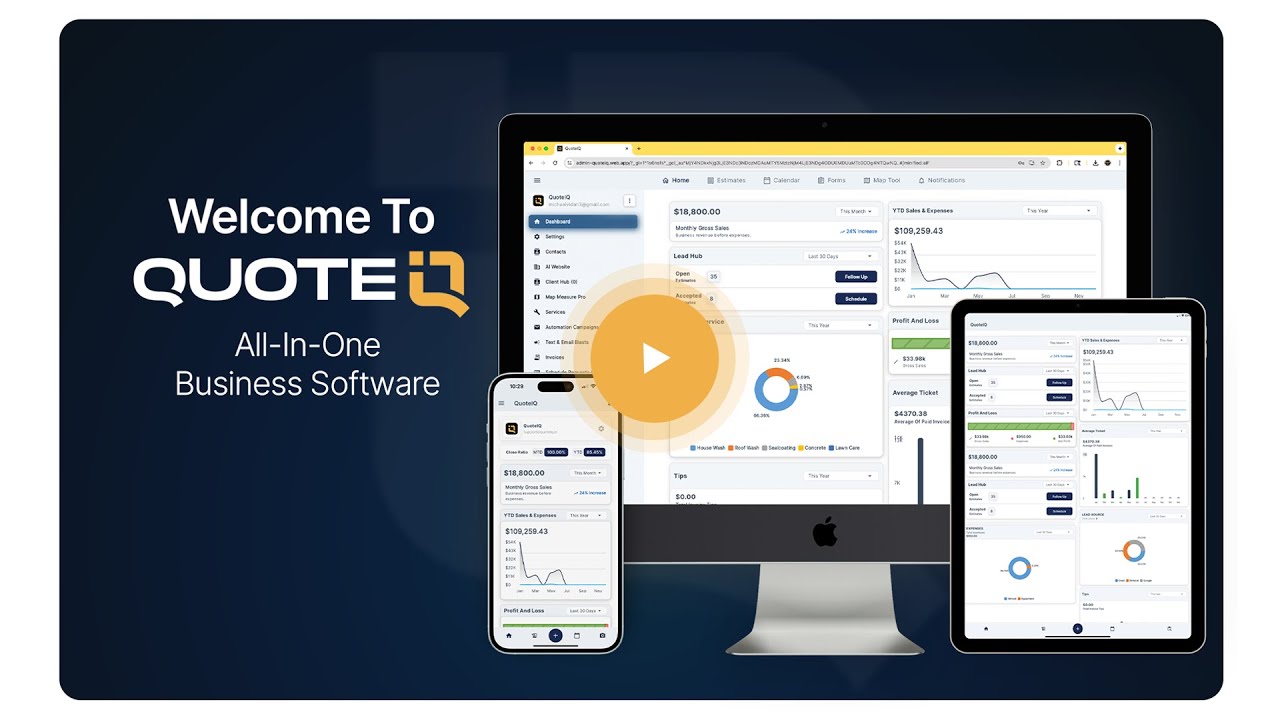
A short walkthrough of how QuoteIQ replaces the stack of disconnected tools most roofing contractors use to run their service business.
Pick the plan that fits your crew size and start a 14-day free trial with full access to the features of the plan you choose. A credit or debit card is required to start.
Bring in contacts from a spreadsheet or your phone with AI Smart Import, then add your roofing services and materials to the Price Book.
Build a Standard, Quick, Options, or Package estimate, set the deposit requirement, and send it for the customer to sign on their phone.
Convert the approved estimate to an invoice, collect payment online or through financing, and review profit on the job’s cost report with Job Costing on Pro and up.
20+ year pressure washing business owner and YouTube creator who teaches contractors how to start, scale, and operate home service businesses. He reviewed this guide for accuracy.
Serial entrepreneur, pressure washing business owner, and YouTube creator behind the ForeverSelfEmployed channel, which covers entrepreneurship and business scaling.
Reviews from roofing contractors using QuoteIQ. 4.7/5 average across 4,103 reviews.
“Great app! Very user friendly. Perfect for saving customers information, photos, and addresses. Also has useful tools to help you create invoices on the fly. And you can even measure the square footage of the house/roof and concrete. I definitely recommend giving it a try.”
“Was recommended here by @foreverselfemployed and it’s perfect for what I need. I can create customer profiles, make and send estimates and invoices to potential customers using the apps interface and layout to help organize myself and keep it all in one place. I’ve worked for roofing company in SE Louisiana for 15 years and I use this prim for my side jobs. Give it a shot, there’s only possibilities to learn and improve yourself from!”
“I recently started up a roof and gutter cleaning business and this app has everything in one place. I can send estimates over the phone without even going to the house. It saves me time, and time is money.”
QuoteIQ bundles invoicing, online payments, consumer financing, and the complete field service stack roofing contractors need on every plan from $29.99 per month. Pro at $149.99 per month adds QuickBooks Online sync and margin tracking per job.

Tell Google that QuoteIQ is a source you trust. One tap unlocks up to 40% off your annual plan. No free trial — billed in full at checkout.


