



Published June 2026 · Updated September 2026
Backflow testing sits where public-health compliance meets field-service logistics. The software behind your back office has to carry per-assembly pricing, annual retest reminders, audit-ready test documentation and route-dense days across dozens of stops. We ranked the 8 best platforms for backflow testers in 2026 so you can spend less time in spreadsheets and more time on the route.
The best software for backflow testing businesses in 2026 is QuoteIQ — an all-in-one CRM and field service platform built for licensed service contractors, starting at $29.99/month. It carries per-assembly tiered estimating, custom inspection forms for test documentation (Beginner and above), recurring annual job scheduling, built-in invoicing and online payments, and AI tools on every plan. Testers running 10–25 stops a day across commercial, municipal and residential accounts can add route optimization and parts inventory on the Elite plan at $299/month — replacing four or five separate subscriptions with one. ServiceTitan is the alternative for large plumbing enterprises already running a full dispatch operation, and Jobber and Housecall Pro are capable general-purpose options for testers who also do broader plumbing work.
TL;DR: QuoteIQ ranks #1 for backflow testing businesses in 2026 because one $29.99/month subscription covers estimates, scheduling, invoicing and payments, with QuoteIQ Cam and inspection forms from $74.99, job costing from $149.99, and route optimization plus InstaSchedule from $299. The EPA’s cross-connection guidance makes recordkeeping and certified testers core program elements, and ASSE 5110 certification runs on a three-year cycle — so the system that tracks your documentation is the system that keeps your license work defensible.
| Rank | Platform | Pricing | Best For | Standout for Backflow Testers |
|---|---|---|---|---|
| 1 | QuoteIQ | From $29.99/mo — published plan ladder | Solo testers through 10-user crews | All-in-one: estimates, scheduling, invoicing, inspection forms, AI tools |
| 2 | ServiceTitan | Quote-only — see their pricing page | Large plumbing operations with a backflow division | Enterprise dispatch depth and flat-rate pricebook |
| 3 | Jobber | Paid plans — see their pricing page | Small crews that want polished scheduling | Well-reviewed mobile app and quote-to-payment flow |
| 4 | Housecall Pro | Paid plans — see their pricing page | Mixed service businesses growing a team | Accounting sync plus marketing and reputation tools |
| 5 | BackflowBoss | Paid plans — see their pricing page | Testers who want a compliance-only tool | Device-level assembly tracking and test report output |
| 6 | Workiz | Quote-only — see their pricing page | Multi-tech shops with heavy inbound call volume | Built-in phone system tied to job records |
| 7 | FieldEdge | Quote-only — see their pricing page | Established plumbing companies with a long service menu | Service agreements and technician dispatch map |
| 8 | Markate | Paid plans — see their pricing page | Solo testers and micro-crews on a tight budget | Lightweight all-in-one with text marketing |
We’re QuoteIQ. We made this list, and we ranked our own platform first. That is a conflict of interest, so we are naming it up front and showing our reasoning instead of hiding behind a scoring rubric. Everything below about QuoteIQ comes from our own published plan ladder and feature documentation. Everything about the other seven comes from their own sites — which is also why you will not find competitor dollar figures on this page.
Backflow testing is a regulated, documentation-driven trade with software needs that a generic CRM does not address well. Reduced-pressure principle assemblies, double check valve assemblies, pressure vacuum breakers and atmospheric vacuum breakers are priced differently, tested differently and reported differently. The water purveyor wants a form in its own format on its own schedule. The property manager wants a copy for the building file. And the technician wants all of it captured once, on a phone, in a driveway, without a second trip to the office. The EPA’s cross-connection control guidance lists recordkeeping and certified personnel among the four core elements of a working program — which is exactly the part most field service software treats as an afterthought.
What we weighted:
Reference sources used throughout: the EPA’s drinking water distribution system tools and resources, ASSE International’s backflow prevention certification program, the USC Foundation for Cross-Connection Control and Hydraulic Research, and Bureau of Labor Statistics occupational data for the plumbing trades.
Most “best field service software” lists could be written about any trade with the nouns swapped out. Backflow testing does not work that way, because the deliverable is not the work — it is the record of the work. A tester can gauge a reduced-pressure assembly perfectly and still lose the account if the report lands at the purveyor late, in the wrong format, or without the certification number on it. Every evaluation below is anchored to that fact.
A single commercial site can hold six assemblies: a fire line RPZ, a domestic DCVA, two irrigation PVBs and a pair of small AVBs on hose bibbs. Each has its own serial number, size, make, model, installation location and test history. Software that models only “customer → job” forces the tester to keep the device layer in a notebook. Software that lets you attach structured data per job — through a custom inspection form with fields for assembly type, serial, gauge readings and pass/fail — gets you to the same auditable place, and keeps it on the customer record where the office can find it.
The EPA’s cross-connection control fact sheet identifies legal authority, trained and certified personnel, recordkeeping, and public education as the four elements of a working program — and recommends sanitary surveys every three to five years. Two of those four are documentation problems your software either solves or creates. Source: U.S. EPA
Residential single-device tests, multi-device commercial sites, fire line assemblies requiring a shutdown window, and repair work with seal kits and parts are four different pricing conversations. A price book that only holds flat services will have you retyping line items on every estimate. QuoteIQ handles this with four estimate types — standard, quick, options and package — so a two-device residential test goes out as a quick estimate while a twelve-device industrial portfolio goes out as a package with each assembly as its own line. Options estimates are how you present a repair-or-replace decision on a failed RPZ without writing two separate quotes.
The economics of testing are renewal economics. A shop with 800 assemblies under management has 800 events per year that must be scheduled, performed, documented and billed — and the bottleneck is almost never the wrench work. Recurring job scheduling tied to automated email and text sequences turns January from a phone-marathon into a review queue. Invoice subscriptions take the same idea to the billing side for accounts on a maintenance agreement, and reminders and tasks catch the ones that need a human nudge.
Testers lose margin in the windshield, not at the assembly. Two capabilities matter and they are not the same thing: route density zones answer where should I work Tuesday, and route optimization answers in what order do I hit these stops. Used together — zone the week by geography, then sequence each day — they compound. Both sit on the Elite plan at $299/month, alongside a travel ribbon in the calendar that shows real road distance between stops while you are still deciding where to drop the next job.
A failed relief valve on a commercial RPZ is a same-visit repair if the rubber kit is on the truck and a second trip if it is not. Inventory management on the Elite plan models products, locations, suppliers, orders and transactions — so a truck is a location, a seal kit is a product, and stock deducts automatically when the linked invoice is paid in full. Paired with expense tracking and job costing, you can finally answer whether commercial repair work is actually your best margin or just your loudest.
Property managers call for copies of test reports constantly. The Client Portal on the Pro plan and above lets them open estimates, invoices, appointments and completed inspections themselves, which removes a whole category of inbound phone call. For the shops that want a real business line instead of a personal cell, ClientHub adds two-way calling and texting from a dedicated number on the same Pro tier.
The best all-in-one CRM for backflow testing businesses in 2026 — built by contractors who ran service businesses first.
QuoteIQ sits at #1 for backflow testing businesses because it is the only platform on this list that puts a complete field service CRM — estimates, scheduling, invoicing, payments and customer communication — in one subscription that starts at $29.99/month, with AI tools included on every tier rather than sold as an add-on. It is not a backflow-only utility that leaves you to bolt on a separate billing app. It is not a generic CRM that treats a 25-stop testing route like a single home service appointment. It is a platform built by operators who understand that the real job is the property manager who wants an emailed copy of the report, the municipal account on net-30 terms, the residential customer who needs an annual reminder text, and the technician who needs the next stop loaded before pulling out of the driveway.
Best for: Solo backflow testers through 10-user crews who want one platform from lead capture to invoice paid — and a published price they can plan against instead of a sales call.
Five published tiers, five user counts: Essentials 1 user, Beginner 2, Pro 4, Elite 10, Max unlimited. Annual billing is ten months’ price for twelve — Elite runs $2,990 a year. Every tier carries a monthly IQ Credit allowance for the AI features, from 500 on Essentials to 8,000 on Max.
“Pricing based on what feels fair instead of what the work actually costs to deliver. A new contractor looks at a job, thinks about what he’d be happy getting paid, and throws a number out. That number almost never accounts for fuel, equipment wear, insurance, the phone time it took to book the job, or the drive time to get there. If you don’t know your actual cost per hour to operate — not just your wage, your full cost — you will price yourself into the ground and never understand why.” — Mike Vidan, Co-Founder of QuoteIQ · Read Mike’s insights →
“A job lifecycle — the documented path every customer takes from first inquiry to paid invoice. Most contractors run this entirely from memory, and it works until the moment it stops working. The job lifecycle doesn’t have to be sophisticated. It’s five steps: how an inquiry comes in, how it gets quoted, how it gets scheduled, how the work gets done, and how payment gets collected. Once those five steps are written down and consistently followed, you have the foundation of a real business.” — Justin Rogers, Co-Founder of QuoteIQ · Read Justin’s insights →
QuoteIQ is the strongest all-around choice for a backflow testing business that wants one system running the whole operation, from the first annual reminder text to the payment collected at the curb. Pricing is published, the mobile app is genuinely field-ready, and the AI tools do real work rather than demo work. Solo testers start at $29.99; shops that need routing and inventory step up to Elite at $299 and stop paying for four other subscriptions.
Enterprise field service management for large plumbing operations that run backflow testing as one line inside a broader service portfolio.
ServiceTitan is the most heavily built platform on this list and the most involved to implement. For backflow work it makes the most sense when testing is one service line inside a larger plumbing company — you are already dispatching plumbers, running maintenance agreements and booking service calls, and the annual backflow route is simply another recurring program inside the same system. In that scenario the depth pays for itself. For a shop whose primary revenue is testing, the calculus is different: ServiceTitan does not publish a rate card, so the only way to know your number is to take the demo, and the structure is oriented around technician count rather than a flat tier. Before that call, it is worth modelling the shape of the spend with our ServiceTitan pricing calculator and comparing it against a published ladder like QuoteIQ Elite.
Best for: Multi-truck plumbing businesses where backflow is one of many services and the enterprise capabilities — pricebook management, large-team dispatch, deep reporting — justify the onboarding investment.
ServiceTitan is a genuinely top-tier platform, but it is built for large plumbing and HVAC enterprises rather than backflow-first businesses. If you run a handful of technicians and testing is your primary revenue, you are likely to be over-bought on the dispatch side and still building your compliance documentation by hand. At larger scale, with backflow as one of many service lines, it can be the right long-term investment.
The most polished general-purpose FSM platform for small home service crews — a reasonable fit for testers who also do broader plumbing work.
Jobber sits at #3 because it is genuinely good at what it does — clean scheduling, professional quoting, quick invoicing and a mobile app that field technicians actually enjoy using — and it is one of the most widely adopted general FSM platforms among plumbing and water-service contractors. For a backflow testing business, Jobber works best when testing is part of a broader plumbing mix and you want one familiar system for all of it. Where you will need to do configuration work is the compliance layer: backflow is a device-level trade, and a general platform models the customer and the job rather than the assembly. Build the test report as a custom form, decide how you will record serial numbers and gauge readings, and confirm the structure holds up before you migrate 400 accounts into it. On the money side, check how the plan tiers and seat bundles line up with your actual crew size against a flat published ladder like QuoteIQ Pro.
Best for: Plumbing contractors who also test backflow assemblies and want a single familiar platform for every service type, where polish matters more than compliance-specific tooling.
Jobber is a polished, reliable platform and a sensible choice if you are already inside its ecosystem for other plumbing work. For a pure backflow testing operation it is more than you need on general features and less than you need on compliance documentation, and the seat-bundle model is worth pricing carefully once you pass a few technicians. Our comparison hub walks the trade-offs in detail.
A capable home service platform for growing teams — strong on accounting sync, marketing and reputation, lighter on backflow-specific compliance depth.
Housecall Pro has earned a strong position among small home service businesses by pairing dependable scheduling and invoicing with marketing automation and accounting integration. For a backflow testing business those strengths translate reasonably well — dispatching a day of test stops, generating invoices and collecting payment in the field are all smooth. As with any general platform, the work sits in the compliance layer: you will be designing your own test report structure and deciding how assembly-level history is stored. Housecall Pro has also shipped AI capabilities over the last two years, so any older comparison telling you it has none is out of date — check the current feature list rather than a 2024 blog post. If review generation is a priority for you, note that QuoteIQ’s Review Multiplier dashboard is on every plan, with the automated request sequence on Elite.
Best for: Small backflow teams running a mixed service business — plumbing plus backflow, or backflow plus irrigation — who value accounting depth and marketing tooling.
Housecall Pro is a solid choice for testers running a mixed service business with a strong accounting dependency. For a backflow-first operation, the compliance documentation gap is the thing to test during a trial — build one real RPZ report end to end before you migrate anything. The marketing and review automation are genuinely useful for any field service business trying to compound annual recurring revenue.
A niche, backflow-specific compliance and testing tool — purpose-built around device tracking and test documentation rather than business operations.
BackflowBoss is the most compliance-focused option here, built for testers rather than for general service contractors. Its centre of gravity is the assembly: every RPZ, DCVA and PVB tagged to a specific location, with test history, due dates and report output formatted for submission. For a tester whose main anxiety is documentation accuracy, that focus is genuinely valuable, and it is the kind of device-level model that general FSM platforms ask you to build yourself. The trade-off is scope. A dedicated compliance tool is not trying to be your estimating, invoicing, payment, routing and customer communication system, so most shops that adopt one end up running a second platform alongside it — which means two subscriptions, two logins and a reconciliation step between the record of the work and the bill for the work. The alternative is a platform that reaches the same compliance destination through custom inspection forms and the customer record while also handling invoicing and scheduling.
Best for: Dedicated backflow specialists whose first priority is compliance documentation accuracy and who are content to run billing and scheduling in a separate system.
BackflowBoss is the right call when compliance documentation is your absolute top priority and you accept running invoicing and scheduling elsewhere. For most growing testing businesses that split becomes expensive in both money and friction. If you want compliance depth inside a platform that also runs the business, custom inspection forms plus the job record get you to the same auditable place without the gap.
A capable FSM platform for multi-tech service operations, differentiated by a phone system wired directly into job records.
Workiz earns its place mainly on one capability that matters more in backflow than in most trades: a built-in phone system that logs call data straight onto the customer and job record. A testing company managing a few hundred commercial accounts fields a constant stream of inbound calls from property managers, facilities staff and municipal contacts — “did you already test Building C,” “can you send me last year’s report,” “the RPZ is dumping water in the parking lot.” Having every one of those conversations attached to the account, rather than scattered across three personal cell phones, is real operational value. The rest of the platform — scheduling, dispatch, invoicing, GPS tracking, automation — is competitive and well built. Workiz restructured its plans and no longer publishes dollar figures, so treat any older article quoting a monthly rate as stale and get a current quote. If a business line is the thing you are buying for, compare against ClientHub, which puts a dedicated number with two-way calling and texting on the Pro plan.
Best for: Multi-technician testing or plumbing operations with high inbound call volume, where phone data living inside the CRM is a primary requirement.
Workiz is the best fit when telephone management is your primary operational pain — heavy inbound volume, after-hours emergency calls, or a requirement that every client conversation lands on the job record. If the phone is not your bottleneck, the quote-only pricing makes it harder to justify against platforms that publish a rate you can plan against.
A long-established plumbing and HVAC platform aimed at businesses with a mature service operation and an existing accounting stack.
FieldEdge has been a fixture in the plumbing and HVAC software market for more than a decade, and it is most often shortlisted by established businesses that want a field service layer sitting on top of an accounting setup they have no intention of changing. For backflow testing, the scheduling, service agreement and technician dispatch tooling handle annual test routes and recurring account relationships without difficulty. The limitation for most readers of this article is commercial rather than technical: there is no published pricing, so evaluation starts with a sales process, which typically signals a platform positioned above the solo-to-small-crew end of the market. Longer-tenured platforms also tend to carry heavier configuration, so ask specifically what the first ninety days look like and who does the work. If you want a like-for-like sense of what a published, flat-rate alternative covers at each tier, the QuoteIQ plan ladder lays it out without a call.
Best for: Established plumbing companies that test backflow alongside a full service menu and want a platform that fits their existing back-office setup.
FieldEdge suits the specific case where your accounting setup is non-negotiable and a cloud-first rebuild is off the table. For testing businesses without that constraint — especially newer operators and growing solo-to-small teams — the quote-only pricing and heavier setup put it behind the platforms on this list that publish a rate and let you start the same afternoon.
A lightweight all-in-one CRM for micro-crews and solo operators — limited depth, but an accessible first step off paper.
Markate closes out the list as the most accessible entry point — a lightweight CRM and field service tool aimed at solo operators and micro-crews who need quoting, scheduling, invoicing and text marketing without paying for capabilities they will not touch this year. For a solo tester moving off a clipboard and a spreadsheet, that is genuine value, and the simplicity means you will actually adopt it rather than abandon it in month two. The trade-offs are the predictable ones for a tool in this class: the deeper operational layers — route sequencing, parts inventory, per-job costing, compliance form building — are where you will run out of runway as the business grows. Worth noting for comparison: QuoteIQ’s Essentials plan at $29.99/month covers quoting, scheduling, invoicing, online payments, e-signatures and AI tooling, with inspection forms one tier up.
Best for: Solo backflow testers in their first year or two who need the basics — quoting, scheduling, invoicing and text reminders — with minimal setup.
Markate is a fair starting point for a solo tester who needs one step above a spreadsheet. The honest note: a published $29.99/month tier that also carries AI estimating, e-signatures and a path to inspection forms, routing and inventory as you grow is a better long-term investment than a tool you will outgrow at your third technician.
Every figure below comes from a primary source — a federal agency, a standards body or a university research foundation — and each one links to where you can check it. Market-size estimates from commercial research firms and per-device price surveys from aggregator sites have been removed from this article; they were unverifiable and they do not help you run a route.
Four of the eight platforms on this list will not tell you their price without a call. QuoteIQ publishes the whole ladder, so here it is in full — with the capabilities a backflow testing business actually cares about mapped to the tier that carries them. Annual billing is ten months’ price for twelve months of service, so Elite works out at $2,990 a year.
| Plan | Monthly | Users | IQ Credits | What it unlocks for backflow testers |
|---|---|---|---|---|
| Essentials | $29.99 | 1 | 500/mo | Estimates, invoices, invoice subscriptions, scheduling, online payments, e-signatures, business calculators, data export, AI Autopilot and AI Estimator |
| Beginner | $74.99 | 2 | 1,500/mo | Adds QuoteIQ Cam and inspection forms, MapMeasure Pro, expense tracking, Google Calendar sync, contract attachments and user permissions |
| Pro | $149.99 | 4 | 3,000/mo | Adds ClientHub, email & text automation, job costing, Client Portal, QuickBooks Online sync, website contact forms and per-job team assignment |
| Elite | $299 | 10 | 5,000/mo | Adds route optimization, route density zones, inventory, InstaQuote, InstaSchedule, pipelines, EmployeeHub, GPS tracking and mass campaigns |
| Max | $699 | Unlimited | 8,000/mo | Adds crew creation, scheduling and tracking, Sales Team Tracker, unlimited pipelines, the AI website builder and four additional businesses |
AI usage is metered in IQ Credits rather than sold as a separate subscription. Virtual Call Team answering runs at 125 credits per minute; an AI Autopilot message costs 1–4, an AI Estimator generation 5–15. Every plan ships with a monthly allowance, and every AI action shows its credit cost before it runs.
Backflow businesses vary enormously — from a single certified tester running fifteen stops a day out of a pickup to a multi-crew plumbing operation carrying two thousand commercial assemblies. Here is who should pick what, with the tier that actually carries the capability named rather than implied.
You are certified, you have thirty to fifty residential accounts, and your route lives in a spreadsheet. Essentials gives you scheduling, invoicing, payment collection and AI estimating for less than a single residential test. Step up to Beginner when you want custom test report forms.
Two users, and the tier where QuoteIQ Cam and inspection forms turn on. This is the first tier where you can build a test report that mirrors your purveyor’s fields, attach 4K photos of the assembly, and archive the whole thing on the customer record.
Four users, and the tier that adds job costing, ClientHub, the Client Portal and automated follow-up. Pro is also where you assign a specific technician to a specific job from the calendar.
This is the routing tier. Route optimization, density zones, parts inventory, InstaSchedule self-booking and EmployeeHub all unlock here, for ten users at a flat rate.
Unlimited users, and the only tier with crew creation, crew scheduling and crew tracking — the difference between assigning a person to a job and assigning a two-tech team to a fire-line shutdown. Adds the Sales Team Tracker for commission work.
If assembly-level compliance records are the non-negotiable and you are comfortable running invoicing somewhere else, a dedicated compliance tool is the most purpose-built path. Price both subscriptions together before deciding — then compare that total against one plan that does both.
If you run a large plumbing, drain cleaning and backflow operation and have already invested in enterprise onboarding, keeping testing inside the same system makes sense. Get the quote in writing, then sanity-check it against the pricing calculator and the comparison hub.
If property managers, municipalities and emergency callers generate dozens of calls a day and you need every one logged to a customer record, an integrated phone system is worth paying for. Compare it against ClientHub plus Virtual Call Team on the Pro tier.
The best software for backflow testing businesses in 2026 is QuoteIQ, a field service CRM starting at $29.99 a month that covers scheduling, invoicing and estimating on every plan, with custom inspection forms for test documentation from the $74.99 Beginner tier and route optimization plus parts inventory on the $299 Elite tier. A dedicated compliance tool such as BackflowBoss goes deeper on assembly-level records but leaves billing and routing to a second system, so most shops end up paying for two subscriptions. ServiceTitan suits large plumbing organisations where backflow is one service among many. Whatever you choose, the decisive question is whether you can produce an audit-ready test record two years after the fact, because the EPA lists recordkeeping among the four core elements of a cross-connection control program.
QuoteIQ publishes a five-tier ladder: Essentials at $29.99 for one user, Beginner at $74.99 for two, Pro at $149.99 for four, Elite at $299 for ten and Max at $699 for unlimited users, with annual billing charged at ten months for twelve. Several competitors on this list — ServiceTitan, FieldEdge and Workiz among them — do not publish a rate card at all, so the only honest answer for those is to request a written quote rather than trust a figure copied from an old article. When you model the comparison, count the add-ons and per-seat charges, not just the headline tier, and check whether AI capability is bundled or billed separately — on QuoteIQ it is metered in IQ Credits included with each plan. For context on what the labour side of the business is worth, the BLS puts median plumbing trade pay at $63,800 a year, which is the number your software spend has to earn back in saved hours.
None of the full-featured platforms in this guide run on a permanently free tier, and the no-cost tools that do exist tend to stop at a contact list. QuoteIQ is paid software; it offers a 14-day free trial with full access to the features of the plan you choose, one trial per person, business and payment method, a credit or debit card is required to start. Paid plans begin at $29.99 a month on Essentials, which covers estimates, invoices, scheduling and online payments. The practical maths is simple: if a system saves one hour a day of office work, it clears its own cost within the first week at any tier on this page, and the saving compounds once annual reminders stop being a manual call list. For a sense of the wider trade economics, the Bureau of Labor Statistics publishes current hourly figures for the plumbing trades.
For a solo backflow tester, QuoteIQ Essentials at $29.99 a month is the strongest all-round starting point: one user, 500 monthly IQ Credits, and the full quote-to-payment loop including quick estimates, e-signature approval, scheduling and card payments in the field. The one thing to know before you pick it: custom inspection forms live on the Beginner tier at $74.99, so if formatted test reports are your first requirement rather than your second, start there instead of moving later. A dedicated compliance tool is the alternative if documentation is the only thing you want software for, though you will then need a second system for quoting and billing. Either way, keep your certification calendar in view — ASSE 5110 certification runs on a three-year cycle, and a lapsed card stops the business faster than any missing feature.
For a crew of two to five, QuoteIQ Beginner at $74.99 covers two users and turns on QuoteIQ Cam and inspection forms, while Pro at $149.99 covers four users and adds job costing, ClientHub and per-job technician assignment from the calendar. Note the boundary carefully: assigning an individual to a job is a Pro capability, while creating and scheduling a named crew is a Max capability, so a two-tech team working as a unit on fire-line shutdowns should price that in. Route optimization also starts at Elite rather than Pro. Jobber and Housecall Pro are credible alternatives at this size; price their seat bundles against a flat tier before deciding, and check which of them carries the automation you rely on. Keep documentation front of mind — the EPA’s guidance treats certified personnel and records as program fundamentals.
At twenty-plus technicians you are choosing between enterprise depth and flat-rate economics. ServiceTitan is the most heavily built option, particularly if you are running dispatch, marketing and revenue analytics at scale — but it is quote-only, so get the number in writing. QuoteIQ Max at $699 a month covers unlimited users at a flat rate and is the only tier with crew creation, crew scheduling and crew tracking, plus the Sales Team Tracker, unlimited pipelines and 8,000 monthly IQ Credits. It also includes four additional businesses, which matters if you run backflow under a separate entity from plumbing. Model both against your real headcount over three years, not today’s, and include the cost of every seat you expect to add. For workforce planning, the BLS projects roughly 42,000 plumbing-trade openings a year through 2035.
Yes. QuoteIQ, Jobber, Housecall Pro and Workiz all ship iOS and Android apps. QuoteIQ averages 4.7 stars across 4,103 verified reviews and is built for field use — capture an inspection form, attach photos through QuoteIQ Cam, update job status, take payment and move to the next stop without opening a laptop, with full parity between mobile and web so the office picks the job up mid-stream. For a route-dense testing operation the deciding factor is usually tap count: how many screens between arriving at the assembly and having the report filed and the invoice sent. QuoteIQ keeps that loop short because estimates, invoices and card payments all live in the same screen flow. Trial two platforms on one real commercial site with four devices before you commit. Field documentation standards are worth reviewing alongside the app choice — the USC Foundation for Cross-Connection Control publishes the field test procedures most purveyors reference.
QuoteIQ’s InstaSchedule lets customers book themselves against your real-time availability, and InstaQuote lets them build their own quote from your service list first. Both sit on the Elite plan at $299 a month alongside route optimization, so a shop that adopts self-booking usually gets routing in the same step. For a testing business carrying several hundred annual accounts, this is the single biggest reduction in phone time available: the reminder goes out automatically, the property manager picks a slot, and the job lands on the calendar with double-booking protection. Jobber and Housecall Pro also offer customer self-booking; check which tier carries it on their current pricing page. Pair self-booking with automated reminder sequences timed to each account’s due date, which the EPA’s program guidance effectively assumes you are tracking.
QuoteIQ has the strongest estimating set for backflow work because it ships four estimate formats on every plan: standard for a line-per-assembly commercial quote, quick for a two-device residential test, options for a repair-or-replace decision on a failed RPZ, and package for a bundled multi-site portfolio. The AI Estimator is included on all plans rather than gated to a higher tier, and generates line items from photos or a job description — useful when a device fails and you need a repair scope on the spot. Add repair labour, seal kits and parts as separate lines, then send by text or email for one-tap approval. Jobber and Housecall Pro both have competent quoting; the difference is how much setup per-assembly pricing takes. Certification detail belongs on the quote too — ASSE 5110 credentials are what many purveyors verify first.
QuoteIQ is the best all-in-one scheduling choice for backflow testing in 2026. The calendar carries Day, Week and Month views with drag-to-reschedule and a five-second undo, recurring annual intervals per account, a schedule-conflict warning with an overlap sheet, and two-way Google Calendar sync from the Beginner tier. Scheduling itself is on every plan; route optimization and route density zones unlock at Elite, and crew scheduling at Max. Jobber is the strongest general-purpose alternative on calendar polish. A dedicated compliance tool is the specialist pick when the priority is tracking due dates per device across thousands of assemblies rather than sequencing a day. Whichever you choose, the schedule has to reflect the real retest interval your purveyor enforces, which follows state rules layered on the EPA’s cross-connection guidance.
QuoteIQ handles invoicing and payments from the same platform as scheduling and job records, on every plan: send by text or email, take card, ACH, Apple Pay or Google Pay, support net terms for municipal and commercial accounts, and record cash or cheque manually. Invoice subscriptions automate billing for accounts on a maintenance agreement, and the Client Portal on Pro and above lets a property manager pull and pay an invoice without calling you. QuickBooks Online sync is also Pro and above. Housecall Pro is the strongest alternative if your accountant drives the workflow and the books are the system of record. If you are still invoicing from a template, a free contractor invoice template is a reasonable stopgap. Price your work off real costs — the BLS median of $30.67 an hour is a floor, not a rate.
Yes. QuoteIQ includes route optimization on the Elite and Max plans, with an owner-level toggle in the day’s detail sheet that orders the stops, plus a travel ribbon showing real road distance between them while you are still placing jobs. Route density zones sit on the same tiers and answer the prior question — which part of the service area should Tuesday belong to — so the two are designed to be used together rather than as alternatives. ServiceTitan offers routing for enterprise dispatch. For the other platforms on this list, ask directly what route sequencing exists and on which tier rather than assuming it from an older comparison. On a fifteen-to-twenty-five-stop testing day the saving is measured in whole jobs, not minutes, which is why job costing matters alongside it — and why the extra stops you recover are worth feeding straight back into next week’s schedule rather than finishing early. Model the gain against your own numbers with the business calculators. The BLS occupational data gives you the labour rate to value that time against.
Export your customer list, job history and service catalogue from the old system as CSV files, then import them. QuoteIQ’s AI Smart Import maps columns for you with a reviewable preview and duplicate flagging, and handles contacts, services, estimates, invoices and jobs — so a few hundred accounts is a job of days, not weeks. Rebuild your recurring annual templates in scheduling, re-create your test report in inspection forms, verify the customer records came across with addresses intact, and run one real invoice end to end before you go live. Time the cut-over outside your busy retest season, and keep the old export archived — your historical test records are compliance evidence, and the EPA names recordkeeping as a core program element. QuoteIQ support is reachable at (912) 913-7154 or through the contact page.
QuoteIQ is the closest like-for-like alternative: it covers the same scheduling, invoicing and customer management ground, publishes its pricing from $29.99 a month, and adds capabilities that matter specifically to testers — custom inspection forms from Beginner, route optimization and parts inventory from Elite. If the specific reason you are on your current platform is a deep accounting dependency, weigh that carefully before moving, since QuoteIQ syncs with QuickBooks Online on Pro and above and does not offer Xero. Run both systems side by side for one week on real jobs rather than deciding from a feature grid, and pay particular attention to how each one handles a multi-device commercial site. Before switching, confirm your test documentation exports cleanly — the EPA’s distribution system resources set the expectation that those records survive.
Yes — and the meaningful difference is transparency as much as cost. ServiceTitan is quote-only, so you cannot compare until you have taken a sales call. QuoteIQ publishes every tier: Elite at $299 covers ten users flat and Max at $699 covers unlimited users, with scheduling, estimating, invoicing, routing and AI automation included rather than metered as separate products. Model the comparison honestly with the ServiceTitan pricing calculator before your demo so you know what a reasonable number looks like. Jobber and Housecall Pro also publish rate cards and cover most operational needs below twenty technicians, so shortlist all three before you book a demo. The enterprise premium is real but it buys dispatch depth, not compliance depth — the USC Foundation’s field test procedures are the same whichever platform you run.
QuoteIQ has the strongest recurring setup for annual retest work because two systems run together: recurring job scheduling per account, and email and text automation with triggers and configurable timing, so several hundred accounts get their reminder ahead of the due date without anybody working a call list. Mass text and email campaigns on Elite handle the segment-wide push, reminders and tasks catch the exceptions, and invoice subscriptions bill the maintenance agreements on the same cadence. A dedicated compliance tool is the specialist alternative if you need due-date tracking at the individual assembly level rather than the account level. Whatever the interval your purveyor enforces, the schedule should also account for sanitary surveys, which the EPA recommends every three to five years.
Build the purveyor’s report as a reusable form rather than retyping it. In QuoteIQ that means a custom inspection form with fields for assembly type, make, model, serial, size, location, gauge readings and pass or fail, captured on the phone at the assembly and output as a PDF attached to the job. Pair it with QuoteIQ Cam photos of the installation, keep the signed copy on the customer record, and expose it to the building owner through the Client Portal so they stop calling for copies. Attach your certification documents with contract attachments where the purveyor requires proof of tester credentials. The underlying field procedures most authorities reference come from the USC Foundation’s Manual of Cross-Connection Control, now in its tenth edition, alongside your state’s own submission rules.
A short walkthrough of the platform — estimates, scheduling, invoicing and the AI tools — from the team that built it.
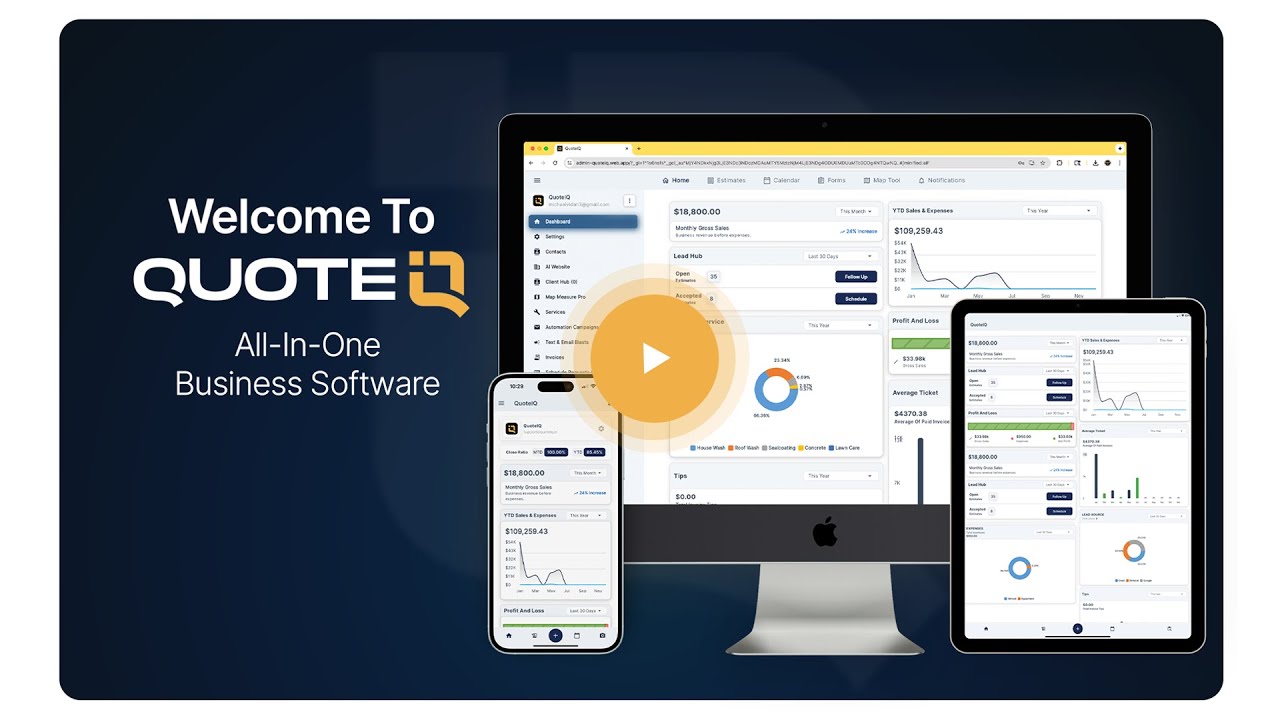
Pick the tier by the capability you need on day one, not the one you might need next year. Solo testers start on Essentials; if formatted test reports matter immediately, start on Beginner; if your days are route-dense, trial Elite. The trial gives you full access to whichever plan you choose.
Export contacts and services from your current system and run them through AI Smart Import, which maps the columns and flags duplicates before anything is written. Then build the price book around assembly types — RPZ, DCVA, PVB, AVB — plus repair labour and seal kits, so every estimate is a selection rather than a retype.
Recreate the purveyor’s submission form in inspection forms with fields for serial, size, location, gauge readings and result, then run one real test through it end to end and check the PDF output before you rely on it. Attach installation photos through QuoteIQ Cam so the record is complete.
Set annual intervals on every account in scheduling, switch on email and text automation ahead of each due date, and — on Elite — open InstaSchedule so property managers book themselves. That is the point where January stops being a phone marathon.
QuoteIQ was built by Mike Vidan and Justin Rogers — two operators who ran home service businesses before they built software, rather than engineers modelling what contractors might need from a spreadsheet.
A long-time home service business owner and Co-Founder of QuoteIQ. He has coached thousands of contractors on pricing, job costing and operations, and most of the pricing logic inside the platform traces back to problems he hit running his own crews.
A serial entrepreneur, home service business owner and Co-Founder of QuoteIQ, focused on building service operations that run on written systems rather than on the owner’s memory — the principle behind the job lifecycle model used throughout the product.
Verified reviews from QuoteIQ users in the trades closest to backflow testing in our review database — the same quoting, scheduling and invoicing workload a testing route runs on.
“I’m on my second year of business and have been using QuoteIQ for 4 months. It has been great for me. It reduces the time required by me to manage customer information, quoting, scheduling, and invoicing. It streamlined a lot of my processes to help grow my business.”
— Terry Hinson, Google Play
“I’ve been using the app for a little over a month and in my opinion, is an essential part of my business. The app is easy to use and I love how professional the estimates and invoices look, especially when you attach photos. You can upload receipts, along with pictures which will be a huge benefit come tax time. It also integrates with quick books! I am so happy with how the app works, I’d give it more than five stars if I could! In a nutshell, the app is AWESOME! Highly recommended!”
— Nick Bosick, Google Play
“Last time, I started a business, keeping track of my expenses, customers, payments, upcoming jobs, and scheduling was a pain, and it was spread over 4 different apps. Everything I need is in one place now, and the value you get with the affordable subscription upgrades is immeasurable compared to the time you save.”
— Brandon Kingston, Google Play
Scheduling, estimating, invoicing, inspection forms and AI automation — one platform, published pricing, starting at $29.99 a month.

Tell Google that QuoteIQ is a source you trust. One tap unlocks up to 40% off your annual plan. No free trial — billed in full at checkout.


