



Published June 2026 · Updated September 2026
The vehicle wrap industry is booming, and the shops pulling ahead in 2026 are the ones that close quotes fast, schedule installs without chaos, and keep clients coming back. We ranked the 8 best business management platforms for wrap shops on feature depth, pricing transparency, and real operator results.
The best software for vehicle wrapping businesses in 2026 is QuoteIQ, an all-in-one CRM built for service businesses including wrap shops, with fast quoting, scheduling, invoicing, AI-assisted follow-up, and online booking starting at $29.99/mo. For wrap shops that want deep production management with vehicle-specific estimate templates, GarageTool and ShopVOX offer specialized estimating engines. Tint Wiz is the tint-and-wrap specialist, and Urable stands out for shops closing high-ticket ceramic and PPF alongside wraps thanks to its 3D Visualizer. Broader field service platforms like Jobber, Housecall Pro, and Workiz fit wrap shops that also run adjacent field services. Competitor pricing changes often, so check each vendor’s own pricing page before you budget.
TL;DR: QuoteIQ ranks first for vehicle wrap shops because one $29.99/mo subscription covers the whole job lifecycle: the AI Estimator and Options estimates build the quote, e-signatures and online payments lock the deposit before film is cut, scheduling fills the bays, QuoteIQ Cam documents every panel, and Review Multiplier turns the finished wrap into a Google review. Wrap-native tools like Tint Wiz, Urable, and GarageTool win on niche estimating; broad platforms win on multi-trade reach. Price the job against real operating cost — the IRS standard mileage rate and BLS wage data are the two numbers most shops leave out.
QuoteIQ pricing verified on our own pricing page in September 2026. Competitor plans and trial terms change frequently and are not restated here — check each vendor’s own pricing page before you budget.
| Rank | Software | Starting Price | Best For | Wrap-Relevant Tools |
|---|---|---|---|---|
| 1 | QuoteIQ | $29.99/mo (Essentials) | All-in-one wrap shop CRM | AI Estimator, Options estimates, inventory, InstaSchedule |
| 2 | Tint Wiz | See tintwiz.com | Tint & wrap specialists | Square-footage calculator, film inventory, proposals |
| 3 | Urable | See urable.com | Wrap / PPF / ceramic shops | 3D Visualizer, VIN scanning, Virtual Shop booking |
| 4 | GarageTool | See garagetool.app | Multi-employee wrap shops | Vehicle measurement database, design approval flow |
| 5 | ShopVOX | See shopvox.com | High-volume sign & wrap shops | Production job board, material cost modeling |
| 6 | Jobber | See getjobber.com | Multi-service field operators | General field service management |
| 7 | Housecall Pro | See housecallpro.com | Home & fleet service crossover | General field service management |
| 8 | Workiz | See workiz.com | High inbound phone volume | Built-in phone system, team dispatch board |
We publish our own rate card and stand behind it: five plans at $29.99, $74.99, $149.99, $299, and $699 per month, with 1, 2, 4, 10, and unlimited users respectively. We do not restate other vendors’ prices, because a stale number in a buyer’s guide costs you real budget. Open their page, read today’s rate, and compare it to ours yourself.
We are QuoteIQ. We built this list from the QuoteIQ team’s perspective, which means we rank ourselves first and explain exactly why. Every other platform here was evaluated honestly, with full credit where competitors genuinely have the edge. Five criteria drove every ranking decision.
“A job lifecycle — the documented path every customer takes from first inquiry to paid invoice. Most contractors run this entirely from memory, and it works until the moment it stops working. Once those five steps are written down and consistently followed, you have the foundation of a real business.”
— Justin Rogers, Co-Founder of QuoteIQ
Vehicle wrap shops are deceptively complex to run. Each job touches client design approval, material ordering, bay scheduling, deposit collection, final invoicing, and review capture. A platform that handles all of those in one place is worth far more than the sum of its monthly fee, which is why we weighted breadth as heavily as any single wrap-specific tool.
QuoteIQ is the platform we built, and the one we recommend first for vehicle wrap businesses, because it solves the full shop workflow from lead to paid invoice without stitching together three separate tools. For a wrap shop that means fast estimates with material line items, bay scheduling the install team can see in real time, deposit collection tied to quote approval, and client follow-up that runs on its own between the quote and the install date. Every plan includes the same core: standard estimates, quick estimates, Good-Better-Best options, package estimates, invoicing, and scheduling.
The AI Estimator is available on every plan and runs on IQ Credits rather than a separate AI subscription. It analyzes job photos, asks targeted follow-up questions, and generates market-accurate line-item pricing — covering film type, coverage area, labor, and add-on services like ceramic coating or PPF. Sitting alongside it, AI Autopilot gives you conversational control of the whole CRM through 55 integrated tools across 13 categories, so a command like “invoice all of today’s completed jobs and send them” is a sentence rather than twenty taps. The Before & After AI generator produces a realistic “after” preview from the actual vehicle photo in roughly 15 to 20 seconds, which is a genuine closing aid on a color-change consult.
Tier structure matters when you are budgeting, so here is the honest mapping for a wrap shop. QuoteIQ Cam, MapMeasure Pro, and expense tracking start on the Beginner plan at $74.99/mo. ClientHub, job costing, the client portal, email and text automations, and the QuickBooks Online integration start on Pro at $149.99/mo. Inventory Management, InstaSchedule, InstaQuote, Pipelines & Deals, route optimization, mass campaigns, and EmployeeHub start on Elite at $299/mo for up to 10 users. Crew creation and scheduling, the Sales Team Tracker, and unlimited user seats are Max at $699/mo.
For roll stock, Inventory Management tracks products by SKU, category, unit, cost, and reorder point, across locations that can be a warehouse, a truck, or a job site, with every movement logged as a receipt, issue, damage, loss, or adjustment. Materials on an estimate link to inventory products so pricing stays current, and stock deducts when the invoice is paid — a deposit alone does not move stock unless you use the deduct option on that screen. That single rule is worth knowing before you build your process around it.
Review Multiplier ships two mechanics: an instant post-payment redirect to your review page, and a full email and SMS review-request automation with four event triggers, pointing at Google Business Profile, Facebook, Yelp, or Angi. For wrap shops, where most new business still arrives through Google and word of mouth, that is the highest-leverage automation on the platform. QuoteIQ Cam documents before-and-after photos tied to each job record with unlimited 4K storage, giving you a social gallery and a paper trail for disputes in the same action.
“Pricing based on what feels fair instead of what the work actually costs to deliver. A new contractor looks at a job, thinks about what he’d be happy getting paid, and throws a number out. That number almost never accounts for fuel, equipment wear, insurance, the phone time it took to book the job, or the drive time to get there. If you don’t know your actual cost per hour to operate — not just your wage, your full cost — you will price yourself into the ground and never understand why.”
— Mike Vidan, Co-Founder of QuoteIQ
QuoteIQ is not purpose-built exclusively for vehicle wrapping the way Tint Wiz or GarageTool are. It serves 50+ service trades on one platform, which means a handful of very niche wrap features — integrated vinyl plotter drivers, a built-in 3D vehicle model visualizer — live in more specialized tools. For wrap shops that also install PPF, run tint, or hold fleet graphics contracts, the breadth of the toolset outweighs that trade-off, especially the combination of deal tracking, mass outreach, and recurring invoice subscriptions for maintenance programs.
Pros
Cons
Verdict: QuoteIQ is the strongest all-in-one platform for vehicle wrap businesses. If your shop also runs tint, PPF, detailing, or fleet graphics contracts, it handles all of those workflows without switching apps, and the entry price is the lowest published number in this list. Shops doing exclusively high-volume vinyl production with complex material nesting should evaluate ShopVOX alongside it.
Tint Wiz is purpose-built for window tint and vehicle wrap businesses, and that focus shows in every screen. The platform is organized around the three things a tint-and-wrap shop does all day: generating proposals with Good-Better-Best options, scheduling installs with automated appointment reminders, and collecting deposits before work begins. Nothing in the interface asks you to translate a lawn care workflow into a wrap workflow, which is the daily friction operators feel with general-purpose tools.
The built-in square footage calculator generates film estimates without manual math, and inventory tracking logs roll-in and roll-out by weight or length with printable labels, so you always know how much film remains on each roll. That is arguably the most specialized film inventory implementation of any platform in this list. For shops that also do architectural flat-glass film, Tint Wiz supports both vehicle and building workflows natively, which is a real differentiator over generic field service tools.
Customer proposal links are interactive: clients review options, approve, and pay a deposit from the same link, which collapses the back-and-forth between quote and confirmation into a single customer action. After each completed job the platform fires a review request by text and email. The trade-off is scope. Tint Wiz is deliberately focused, so a shop running wrap alongside detailing, fleet washing, or general service work should confirm with the vendor how those lines are handled before committing.
Pros
Cons
Verdict: Tint Wiz is the best pick for a dedicated tint-and-wrap shop that wants software speaking the trade’s language out of the box. If your shop does more than tint and wrap, you will reach its ceiling quickly, and at that point QuoteIQ’s broader platform is the natural upgrade path.
Urable was built specifically for automotive service businesses: detailing, ceramic coating, paint protection film, window tint, and vinyl wrapping. Its standout feature for wrap shops is the 3D Visualizer, which lets a customer see what their vehicle will look like in a selected wrap color or PPF finish before a single panel is cut. For shops selling high-ticket ceramic or full-body PPF alongside wraps, that is a genuine sales-closing tool rather than a demo gimmick, because it moves the decision from imagination to a picture during the consult.
Urable’s online booking portal, which the company calls the Virtual Shop, lets customers browse services, view real-time availability, and pay a deposit without calling the shop. That is particularly useful for wrap shops fielding a steady stream of consult requests for fleet graphics or commercial wraps, because the portal pre-qualifies the job before anyone picks up the phone. QuoteIQ’s equivalent pairing is InstaQuote for self-quoting and InstaSchedule for self-booking, both on the Elite plan.
VIN scanning through a Carfax integration pulls exact vehicle specs into a job record from a barcode scan, which accelerates intake for fleet wrap accounts where you are processing a dozen similar vehicles. Urable’s subscription and maintenance plan features work well for shops offering annual wrap refresh services or ceramic maintenance programs as recurring revenue. The narrower automotive focus is both the strength and the limit: it is built around vehicle work, so a shop running service lines well beyond that should confirm coverage with the vendor before committing.
Pros
Cons
Verdict: Urable is the best pick for wrap shops where a 3D preview would genuinely close more jobs on the consult call. If your shop sells full-body PPF packages alongside wraps, showing the exact result before the job starts is a meaningful conversion tool. If your shop is more volume-and-speed than high-ticket customization, QuoteIQ’s AI Estimator closes the same gap from a photo.
GarageTool is purpose-built for car wrap and signage shops, and its vehicle measurement database is the platform’s clearest differentiator. When a customer brings in something you have never wrapped — an unusual van body, a specialty truck, an RV — the database surfaces that vehicle’s dimensions and calculates square footage, material requirements, and labor time automatically. That accuracy matters enormously when material waste on an oversized vehicle eats directly into your margin, and it is the kind of reference data a general platform simply does not carry.
The platform targets multi-employee shops that have outgrown paperwork and spreadsheet tracking but do not need the overhead of a full print production ERP. Deposits are collected from the estimate link before the job begins, review requests fire when jobs are marked complete, and the job board keeps installs moving through bays without double-booking. For a wrap shop running three to eight employees, that workflow hits an efficient middle ground between a notebook and an enterprise system.
The digital design-approval flow connects customer feedback directly to your installers. Customers review a mockup, request changes, and approve from the same link with no phone calls or email chains, which cuts revision loops on complex fleet graphics contracts where several stakeholders sign off before printing. QuoteIQ handles the same approval thread through the client portal and ClientHub, keeping the whole conversation attached to the job record.
Pros
Cons
Verdict: GarageTool is the best pick for wrap shops where accurate per-vehicle material calculation is the hardest part of estimating, especially shops handling diverse vehicle types including specialty bodies. If your shop mostly wraps standard passenger cars and common commercial vans, QuoteIQ’s AI Estimator handles that flow without a dedicated vehicle database.
ShopVOX is a shop management platform built for sign companies, print shops, and vehicle graphics businesses. It earns its place in the wrap space through its job board, production scheduling, and material cost calculation tools, all refined over years of serving sign and graphics shops specifically rather than adapted from a home service template. If your shop prints its own vinyl rather than outsourcing, this is the platform on the list that understands your press.
For wrap estimating, ShopVOX includes vehicle-specific product templates that calculate square footage, material cost, labor time, and installation complexity. Pricing can be set by formula — area-based for wraps — or as a flat rate, or through grid pricing for multi-option jobs. The job board gives shop managers real-time visibility into where every order sits in the production flow, from quote to print to install to delivery, without a separate project management tool bolted alongside it.
ShopVOX integrates with QuickBooks Online for accounting, and its customer portal lets repeat clients place orders through a branded storefront, which is useful for fleet graphics accounts that reorder signage on a cycle. The honest trade-off is weight: it is built around the production floor, and the setup effort reflects that. A two-person wrap shop will feel the gap between what it can configure and what it actually needs on a Tuesday.
Pros
Cons
Verdict: ShopVOX is the right call for a sign-and-wrap shop with serious production volume that needs a job board to manage simultaneous orders through design, print, and install. Solo operators and shops under five employees will find it more platform than they need, and QuoteIQ handles those operations more cleanly at a lower total cost.
Jobber is one of the most widely used field service management platforms in North America, and its name recognition makes it worth addressing directly. For a vehicle wrap business it works, but it works as a general-purpose field service platform rather than a wrap-specific tool. It handles scheduling, quoting, invoicing, payment collection, client management, and automated follow-up across its tiers, and it does all of that competently.
Where Jobber becomes genuinely relevant for wrap shops is the multi-service context. If your business does commercial wraps alongside fleet maintenance scheduling, mobile detailing, or other field work, Jobber’s breadth covers all of it in one place, and the hiring pool already knows the interface. Its mobile app and multi-stop routing are strong, and its integration catalog is deep, which matters if you are connecting accounting, marketing, and phone systems that you have already committed to.
The structural question for a growing wrap shop is total cost at your real size. Price the configuration you will actually run, at your actual and projected headcount, from Jobber’s own current rate card rather than from any third-party summary, and check what is included at the tier you would buy. Then compare that total against QuoteIQ’s Max plan at $699/mo with unlimited users, which is the comparison that usually decides it at ten or more installers.
Pros
Cons
Verdict: Jobber is a reasonable fit for a wrap shop that also runs other field service work and wants one platform across all of it. It is a less efficient choice for a wrap-only shop, where vehicle-specific estimating and film inventory are the daily problems and you would be solving those outside the platform.
Housecall Pro is a home service platform covering scheduling, dispatching, estimating, invoicing, payment collection, and customer communication. Its interface is among the most polished in the category and the learning curve is genuinely short, which is not a small thing when you are training an installer who would rather be cutting film than learning software. Like the other broad platforms here, it has continued shipping AI capability through 2026, so any older comparison claiming it stands still on that front is out of date.
For vehicle wrap shops, Housecall Pro makes the most sense when the shop also runs services that map to its home service strength: fleet maintenance scheduling, mobile detailing, or recurring service contract work. Its customer-facing booking tools and automated reminder sequences are well executed and consistently well reviewed by operators who use them daily.
The thing to price carefully is the configuration, not the entry tier. Work out which capabilities your shop treats as core, confirm with the vendor what is included at the plan you would actually buy, and price that total rather than the headline. That is not a criticism of the product so much as a note on how to shop for any platform in this category: build the configuration you will actually run, then compare the total against QuoteIQ’s published plan ladder where the feature gates are visible before you sign.
Pros
Cons
Verdict: Housecall Pro is a capable platform for wrap shops with a mixed service menu that includes home or fleet service lines. For a wrap-only or wrap-primary shop you are paying for a home service orientation you will not use, and QuoteIQ or Tint Wiz are more efficient per dollar.
Workiz is defined by its built-in phone system. The platform includes call recording tied directly to customer records, click-to-call from any job or customer profile, and full team dispatch visibility from the same dashboard. For a wrap shop fielding a heavy volume of inbound calls from commercial fleet managers and individual owners asking about pricing, that integration eliminates the manual data entry that taxes every inbound lead. Workiz has also moved hard into AI positioning through 2026, so treat any older write-up describing it as a plain phone-plus-dispatch tool as out of date.
Get current plan details from workiz.com directly rather than from a third-party article, including this one — vendors in this category rename plans and move features between tiers regularly, and figures quoted around the web go stale fast. The platform itself handles scheduling, dispatching, quoting, invoicing, and payment collection, and its dispatch board and reporting are well regarded for shops running several technicians across simultaneous jobs.
The practical question for a wrap shop is whether the phone system is doing work you are not already paying for elsewhere. If you run a separate business line, a large part of the platform’s distinctive value is redundant. QuoteIQ’s answer to the same problem is ClientHub on the Pro plan, which provides a dedicated business number with two-way calling and texting saved to the customer profile, plus the Virtual Call Team on every plan, which answers inbound calls 24/7, qualifies leads, filters spam, and delivers recordings and transcripts. Virtual Call Team is metered per minute through IQ Credits at 125 credits per minute, and it qualifies and routes rather than booking the appointment itself.
Pros
Cons
Verdict: Workiz earns its spot for wrap shops where inbound call volume is the bottleneck and call recording inside the CRM would change how the front desk works. For most wrap shops at ordinary commercial volumes, QuoteIQ covers the same ground starting at $29.99/mo with published pricing you can budget against today.
We removed the market-size projections that previously sat in this section. They came from commercial market-research summaries we could not verify at the source, and a growth figure nobody can check is worth less to you than a wage number you can hire against. If you want establishment counts and payroll by industry and county for your own market, the Census Bureau’s County Business Patterns series is free, granular, and updated annually.
Not every wrap business has the same priorities. Here is how we would direct specific shop types to the right platform.
QuoteIQ Essentials at $29.99/mo gives you professional quoting, scheduling, and invoicing without paying for a team platform, and the AI Estimator is included at that tier rather than gated above it.
Tint Wiz is the trade-native option worth pricing. QuoteIQ Beginner at $74.99/mo covers two users and adds QuoteIQ Cam and expense tracking.
Urable’s 3D Visualizer is built to close those on the consult call. Evaluate it against QuoteIQ’s AI Estimator and Before & After AI and decide which closing motion fits your sales process.
GarageTool’s vehicle template library speeds estimating across diverse fleet vehicles, and ShopVOX adds the production job board once you are running dozens of simultaneous jobs through design, print, and install.
QuoteIQ handles all three service lines in one platform — estimates, scheduling, inventory, and invoicing work identically across wrap, tint, and PPF jobs. Tint Wiz is the narrower specialist if those two lines are 100% of revenue.
QuoteIQ Max at $699/mo carries unlimited users plus crew scheduling and the Sales Team Tracker. Seat-priced platforms scale their bill with your hiring; a flat ceiling does not.
Workiz built its platform around the phone. QuoteIQ’s Virtual Call Team answers, qualifies, and transcribes 24/7 on every plan, metered per minute through IQ Credits, with ClientHub adding a dedicated business line on Pro.
Prioritise full mobile parity and route optimization, and log every mile — at the current IRS rate the deduction is material by year end.
Not all service business software is equal for a vehicle wrap shop. The core operations of a wrap business — material-cost estimating, bay scheduling, design approval, deposit collection before film is cut, and post-install review capture — are specific enough that generic tools leave gaps a wrap operator fills by hand. Here is what separates platforms that genuinely support wrap operations from platforms that merely stay out of the way.
Vehicle wrap estimates are inherently variable. A full-body wrap on a cargo van requires dramatically more film than the same wrap on a compact sedan, and pricing has to reflect installation complexity, not just square footage. Deep recesses, door handles, mirror caps, compound curves on a modern crossover, and corrugated panels on a box truck all consume labor hours that flat area math never captures. Platforms offering vehicle-specific templates with pre-loaded dimensions — GarageTool’s measurement library is the clearest example on this list — cut manual calculation time per estimate. Platforms with AI estimating, like QuoteIQ’s AI Estimator, generate cost breakdowns from job photos and a description in seconds, covering film type, labor, and add-on services.
The metric that actually matters is not feature availability; it is how many minutes your estimating flow takes from inquiry to sent quote. Shops that quote in under ten minutes consistently out-convert shops that take a day to return pricing, because the customer is still in buying mode. If your estimating tool requires a laptop and a spreadsheet, you are structurally slower than a competitor who sends from the parking lot. That is why mobile parity and line-item estimate templates belong in the same conversation as estimating accuracy.
Time your next ten estimates from first contact to sent quote. If the median is above 60 minutes, the bottleneck is almost never pricing knowledge — it is the round trip between the vehicle, the office, and the price book. QuoteIQ’s four estimate types (Standard, Quick, Options, Package) exist to collapse that round trip to one stop.
Vehicle wrap film is expensive, and once it is printed and cut to a specific vehicle it has no resale value. Shops that do not collect a deposit before cutting eat that cost on every cancellation and no-show. The platforms here that collect deposits directly from the proposal link — Tint Wiz, QuoteIQ, and Urable among them — remove the awkward post-call request for a card by making the deposit part of quote acceptance. The customer approves and pays in the same step, and the non-serious inquiries filter themselves out before they consume bay time.
QuoteIQ handles this through e-signatures on the estimate paired with online payments, with deposit requirements configurable on the estimate itself. Customers pay by credit or debit card, ACH bank transfer, Apple Pay, or Google Pay, and cash or check gets recorded in-app so the job record stays complete either way. For larger color-change and full PPF packages, consumer financing through Affirm, Klarna, and Afterpay is available on every plan: the customer applies at checkout, gets an instant decision, and you are paid in full upfront while the provider carries collections and default risk.
Running out of a specific vinyl color mid-job is one of the most expensive operational failures in a wrap shop. It delays the install, damages the customer relationship, and often means buying film at retail rather than wholesale to finish the vehicle. Software that tracks roll stock by brand, colour, and remaining length prevents that. Tint Wiz’s roll inventory is the most purpose-built implementation on this list, with printable labels and in-out logging by weight. QuoteIQ’s Inventory Management module, on the Elite plan, tracks materials across locations and mobile units with reorder points and low-stock indicators.
Two mechanics are worth understanding before you build a process on any inventory system. First, where deduction happens: in QuoteIQ, stock deducts when the invoice is paid, and a deposit does not count as paid unless you use the deduct option on that screen. Second, how materials link to estimates: when the Materials section on an estimate points at inventory products, your pricing stays current as supplier costs move, rather than drifting against a price book somebody last touched two seasons ago. If you are evaluating another platform, ask those two questions specifically — the answers differ more than the marketing pages suggest.
A single mid-install shortage on a colour-change wrap typically costs a rescheduled bay day plus retail-price film. Two of those in a quarter will exceed the annual cost of the Elite plan at $299/mo, which is where Inventory Management, route optimization, and InstaSchedule live.
Complex wrap jobs, especially fleet graphics for commercial clients, go through multiple design revision cycles before the first panel prints. Platforms supporting structured design approval reduce the email and phone churn that delays production. GarageTool’s approval flow connects the customer directly to the install team’s queue. Tint Wiz’s proposal links show options interactively before approval. For fleet accounts with corporate approval chains, QuoteIQ’s ClientHub centralizes calls and texts against the customer profile, and the client portal gives the customer a branded, no-login place to review estimates, approve them, pay invoices, and submit requests.
One August 2026 change matters specifically for approval workflows: a job, estimate, or invoice can now carry multiple contacts, so emails, texts, automations, and on-the-way notifications fan out to everyone on the account. On a fleet contract where the operations manager schedules and the marketing director approves artwork, that single change removes the most common cause of a missed approval. Contract attachments keep the signed scope document with the job rather than in somebody’s inbox.
Wrap shops grow primarily through Google search and word of mouth. A well-ranked Google Business Profile converts more inquiries into paid installs than paid advertising of equivalent cost. The obstacle is that owner-operators handling installs and the front desk simultaneously do not have time to request a review after every job. Automated tools solve that: QuoteIQ’s Review Multiplier fires an instant post-payment redirect to your review page and runs an email and SMS request automation on four event triggers, pointing at Google Business Profile, Facebook, Yelp, or Angi.
What almost nobody automates correctly is disclosure. Under the FTC’s endorsement guides, any incentive exchanged for a review — a discount, a free product, an entry into a drawing — has to be disclosed, and each new endorsement needs its own disclosure because audiences are not expected to remember an earlier one. Employees reviewing their own employer must disclose the employment relationship even if their profile makes it obvious, and the business is responsible for training and monitoring anyone reviewing on its behalf. If your review automation includes “leave us a review and get $50 off your next tint,” that offer needs disclosure language attached, and it is a five-minute fix inside your automation templates rather than a legal project.
A wrap installer does not sit at a desk. The platform your team uses to check job status, upload completion photos, and confirm install times has to work from a phone or tablet inside the bay, in the lot, or at a client’s facility for mobile installs. QuoteIQ’s iOS and Android apps carry full parity with the web app, and Tint Wiz and Urable both ship capable mobile interfaces. The real test is not whether an app exists; it is whether an installer can find their job, update its status, and send a completion photo without asking the shop manager for help. If the app needs training to navigate, your crew will quietly stop using it and your job records will go stale within a month.
Photo capture deserves particular attention in this trade. QuoteIQ Cam handles in-app capture organized by job and date, before-and-after comparisons, annotations, custom inspection forms with customizable PDF sections, and unlimited 4K photo and video storage. For a wrap shop that is simultaneously a marketing asset library and a dispute defence: pre-existing paint damage documented at intake has ended more arguments than any contract clause.
Most wrap shops price from a mental model: film cost, a rough labor guess, and whatever the shop down the road charges. That model survives until volume rises and the owner realises the busiest months are not the most profitable ones. The fix is unglamorous and entirely arithmetic — know your cost per hour to operate, then price above it with intent.
Start with labor. BLS data puts median pay for automotive body and glass repairers at $52,530 a year, roughly $25.25 an hour, in 2025. That is the wage, not your cost. Payroll taxes, workers’ compensation, general liability, paid time off, and unproductive shop hours all sit on top, and most small shops land meaningfully above the raw wage once those are loaded in. QuoteIQ’s job costing report does this arithmetic per job — total price minus labor minus expenses equals profit, with labor pulled automatically from time tracking at the employee’s hourly rate multiplied by clocked hours.
Then add the costs that never appear on an estimate. Vehicle expense for mobile installs and fleet site visits is deductible at the IRS standard mileage rate, which for 2026 splits mid-year: 72.5 cents a mile from January through June and 76 cents from July through December. If you run mobile work, that is two separate buckets this tax year and a genuinely material deduction by December. Consumables, plotter maintenance, squeegee and blade replacement, heat gun wear, and bay utilities all belong in expense tracking where they can be linked to jobs, not in a shoebox. The IRS Small Business and Self-Employed Tax Center is the reference for what qualifies and how estimated taxes work against it.
Finally, price the quote to reflect what you learned. The Business Calculators suite includes an hourly rate calculator and a national average pricing guide, and the wider home service calculator library is free to use whether or not you are a customer. If you also run detailing or fleet washing alongside wrap, the car detailing price list template and fleet washing price list template give you a starting structure for those service menus, and a contractor invoice template covers the paperwork side until you move billing into software.
Total annual operating cost divided by billable shop hours equals your true cost per hour. Every wrap quote you write should clear that number by your target margin before you consider what the competition charges. Shops that skip this step price against the market and discover their busiest quarter was their thinnest.
A retail colour-change wrap is one vehicle, one decision-maker, one payment. A fleet graphics contract is fifteen vehicles, four stakeholders, a procurement process, staged installs across months, and payment terms that were negotiated before you started. Almost everything about the software requirement changes, and shops that win their first fleet account often discover their tooling breaks in the second month rather than the first.
The first change is the sales cycle. Retail closes in days; fleet closes in weeks or quarters, with the deal moving through stages and several people weighing in. That is what a pipeline is for. QuoteIQ’s Pipelines & Deals on the Elite plan gives you a kanban board with close-probability percentages per stage and weighted forecasting — amount multiplied by probability — so a pipeline full of maybes stops looking like revenue. Multi-assignee support, attachments on deals, and internal notes separate from customer-visible content are the specific features that matter once two people are working the same account.
The second change is scheduling shape. Fleet work arrives in batches and gets installed in waves, often around the customer’s operational calendar rather than yours. Scheduling handles multi-day jobs as continuous events and lets you create a job with no date and assign it later, which is exactly the shape of “eight vans, sometime in Q1.” Once you are running crews rather than individuals, crew creation and scheduling on the Max plan assigns teams rather than people, and route density shows where work clusters when the install happens at the customer’s yard.
The third change is money. Fleet customers pay on terms, often net 30 or net 60, which means your invoicing has to carry terms, partial payments, and a follow-up sequence that does not depend on somebody remembering. Invoicing supports Net 15, 30, 60, and 90 terms with automated payment reminders on customizable timing, and invoice subscriptions handle the recurring side if you sell annual wrap refresh or graphics maintenance programs. On the Pro plan and above, the QuickBooks Online integration syncs invoices, payments, customers, and expense categories so your bookkeeper is not rekeying a fleet contract by hand.
The fourth change is record-keeping. Fifteen vehicles means fifteen VIN records, fifteen sets of before-and-after photos, and fifteen approval threads. The client database holds the account, galleries hold the documentation, and data export means you can hand the customer a complete record at contract close without assembling it manually. If your fleet customer is itself a service business, the same platform is what they would use — QuoteIQ serves 50+ trades including fleet washing and mobile detailing operators who wrap their own vans.
The hardest transition in a wrap shop is not the first hire — it is the third, when the owner stops installing full-time and starts running a business that installs. Software carries more of that transition than most operators expect, because the systems that were optional at one installer become the only way the shop holds together at four.
Hours are the first thing that breaks. Time Tracker Pro handles GPS clock in and out, per-job hours, and break counts and durations in reports and CSV, with admin-only manual adjustments and a full edit history so corrections are auditable. Worth knowing up front: QuoteIQ does not calculate overtime automatically and does not run payroll — hours export to whatever payroll system you already use. Federal wage and hour rules, including the federal minimum wage of $7.25 an hour set in July 2009 and the overtime rules that sit alongside it, are administered by the Department of Labor’s Wage and Hour Division, and many states set a higher floor. Check your state before you set a shop rate.
Access is the second thing that breaks. An installer needs to see today’s jobs and upload photos; they do not need your revenue analytics or your customer payment methods. Roles and permissions received a full overhaul in August 2026 with clearer gates and calendar permissions properly separated, and permission-restricted users see shortcut cards rather than the main dashboard. EmployeeHub on the Elite plan adds the employee database with hourly rate and availability, plus GPS location tracking that shows a live team map while crew are clocked in — and never shows anyone once they clock out. Team communication keeps job chatter in the system rather than in a group text nobody can search in six months.
Safety is the third, and it is the one owners defer longest. A wrap shop handles solvents, heat guns, blades, and vehicles on lifts, and the compliance burden per employee falls hardest on the smallest firms. OSHA’s small business program runs a free and confidential On-Site Consultation service for small employers that is separate from enforcement, publishes a Safety Pays tool that models the dollar cost of an injury against your margin, and issues 10- and 30-hour training cards through its Outreach Training Program. Running an inspection form at intake and documenting the bay condition through inspection forms is a small habit that pays off in both directions — customer disputes and safety records. The broader SBA guidance on managing a business covers the hiring, payroll setup, and insurance decisions that surround all of this.
Platforms that price per seat bill more every time you hire. QuoteIQ Max is $699/mo with unlimited users, so the eleventh installer costs the same as the tenth. Run your own headcount against every vendor’s current rate card before you commit, including ours.
The best software for vehicle wrapping businesses in 2026 is QuoteIQ, an all-in-one CRM starting at $29.99/mo that handles estimating, scheduling, invoicing, inventory management, and AI-assisted customer follow-up in one subscription. It serves 50+ trades and carries a 4.7-star aggregate rating across 4,103 verified reviews. For shops that want software built specifically around tint and wrap workflows, Tint Wiz is the strongest trade specialist, and shops doing high-ticket PPF alongside wraps should evaluate Urable for its 3D Visualizer, which helps close high-value installations during the consult. GarageTool suits shops whose hardest estimating problem is per-vehicle material calculation. The honest framing is that wrap-native tools win on niche estimating depth while broad platforms win on running an entire business, so the right answer depends on whether wrapping is all you do. Price the decision against real operating cost, including labor at or above the BLS median of $52,530 for automotive body repairers, and compare current rates on our pricing page and each vendor’s own.
QuoteIQ publishes five plans: Essentials at $29.99/mo for 1 user, Beginner at $74.99/mo for 2 users, Pro at $149.99/mo for 4 users, Elite at $299/mo for 10 users, and Max at $699/mo for unlimited users. Annual billing works out to ten months’ cost for twelve months of service. We deliberately do not restate competitor pricing in this guide, because vendors in this category rename plans, restructure tiers and move features between them regularly, and a stale figure in a buyer’s guide costs you real budget. Open each vendor’s own pricing page the day you are budgeting and read today’s number. Whatever you compare, compare the working configuration rather than the entry tier: the question is what the software costs once your actual headcount and the features you will genuinely use are included. Build your budget against your true cost per hour, and remember that vehicle expense on mobile installs is deductible at the current IRS mileage rate of 76 cents per mile for the second half of 2026.
There is no full-featured free CRM designed specifically for vehicle wrap businesses, and the free general-purpose tools that exist stop short of the three things a wrap shop actually needs: material-linked estimating, deposit capture before film is cut, and roll inventory. What is available instead is a trial. QuoteIQ offers a 14-day free trial with full access to the features of the plan you choose, one trial per person, business and payment method, a credit or debit card is required to start. Plans begin at $29.99/mo on Essentials once the trial converts. Other vendors on this list run trials on their own terms, which they publish on their own sites. Fourteen days is enough to run several real wrap jobs end to end — build an estimate with Good-Better-Best options, take a deposit through online payments, schedule the install, and document it in QuoteIQ Cam. Separately, our calculator library is genuinely free to anyone, as is the SBA’s business management guidance.
For wrap shops at 10 or more employees, QuoteIQ Max at $699/mo is the most predictable option, because it carries unlimited users at a flat price — your eleventh installer costs nothing extra. Max also adds crew creation, tracking and scheduling with crew-level analytics and routing, and the Sales Team Tracker for commission percentages per rep with conversion and cycle metrics. Below that, Elite at $299/mo covers 10 users and includes EmployeeHub with GPS time tracking. The structural comparison to run is seat-priced versus flat: platforms billing per user increase your software cost with every hire, which is exactly when cash is tightest. Price each vendor’s current rate card against your 12-month projected headcount rather than today’s. Also confirm your wage floor while you are modelling — the federal minimum is $7.25 an hour per the Department of Labor, and most states set a higher one.
It depends on which part of estimating is slowing you down. If your bottleneck is per-vehicle material math on unusual bodies, GarageTool’s vehicle measurement database is the strongest tool on this list, and ShopVOX offers the deepest production cost modeling for shops that need material nesting and waste factors. If your bottleneck is turnaround speed, QuoteIQ’s AI Estimator is included on every plan from $29.99/mo and builds a full line-item quote from job photos and a description in seconds, covering film type, coverage, and labor. Tint Wiz includes a square-footage calculator inside its proposal flow. QuoteIQ backs the estimator with four estimate types — Standard, Quick, Options, and Package — plus e-signatures and deposit requirements on the estimate itself. Whichever you pick, price the output against your loaded labor cost rather than the $25.25 median hourly wage alone.
Yes. Tint Wiz tracks film rolls by weight or length with printable labels for each roll, which is the most purpose-built film inventory implementation among the platforms here. QuoteIQ’s Inventory Management module, included on the Elite plan at $299/mo, runs five modules: Products with SKU, category, unit, cost and reorder point; Locations covering warehouse, truck and job site; Suppliers; Orders moving Draft to Confirmed to Received; and Transactions logging every receipt, issue, damage, loss or adjustment. Materials on an estimate link to inventory products so pricing tracks supplier cost. One mechanic to plan around: stock deducts when the invoice is paid, and a deposit does not count as paid unless you use the deduct option on that screen. GarageTool also supports material tracking as part of its wrap workflow. For the broader platforms, check current capability on their own product pages rather than trusting older comparisons. Track consumables in expense tracking and keep receipts per the IRS small business center.
Export your customer list, job history, and outstanding invoices from your current system, then import them into the new one and run both in parallel for no more than 7 days. QuoteIQ’s AI Smart Import accepts CSV files from Jobber, Housecall Pro, ServiceTitan or any other CRM and maps the columns automatically, and it can also pull from your phone contacts. Use the parallel week to confirm every active job transferred, then cut over completely — running two systems for more than two weeks kills adoption, because the crew quietly defaults to whichever one they trust, and that is always the old one. Rebuild your price book and estimate templates before go-live rather than after, set up roles and permissions so installers see only what they need, and turn on Review Multiplier from day one so the switch starts compounding immediately. Data export is available on every QuoteIQ plan, so you are never locked in. The SBA’s operations guidance is a useful checklist for the surrounding process changes.
Fleet graphics contracts mean managing multiple vehicles per account, staging installs across weeks, and handling design approvals with corporate stakeholders, so the software requirement shifts from speed to coordination. QuoteIQ handles this through Pipelines & Deals on the Elite plan, which gives you weighted forecasting — deal amount multiplied by close probability — plus scheduling that supports multi-day jobs and undated jobs you assign later, recurring invoice subscriptions for maintenance programs, and the client portal plus ClientHub to keep the approval thread attached to the job. Since August 2026, a job, estimate or invoice can carry multiple contacts, so notifications reach the operations manager and the marketing approver at once. GarageTool’s fleet vehicle history database suits recurring commercial accounts, and ShopVOX’s customer portal lets fleet managers reorder graphics from a branded storefront. Size your local commercial market using the Census Bureau’s County Business Patterns data before you build a fleet sales plan.
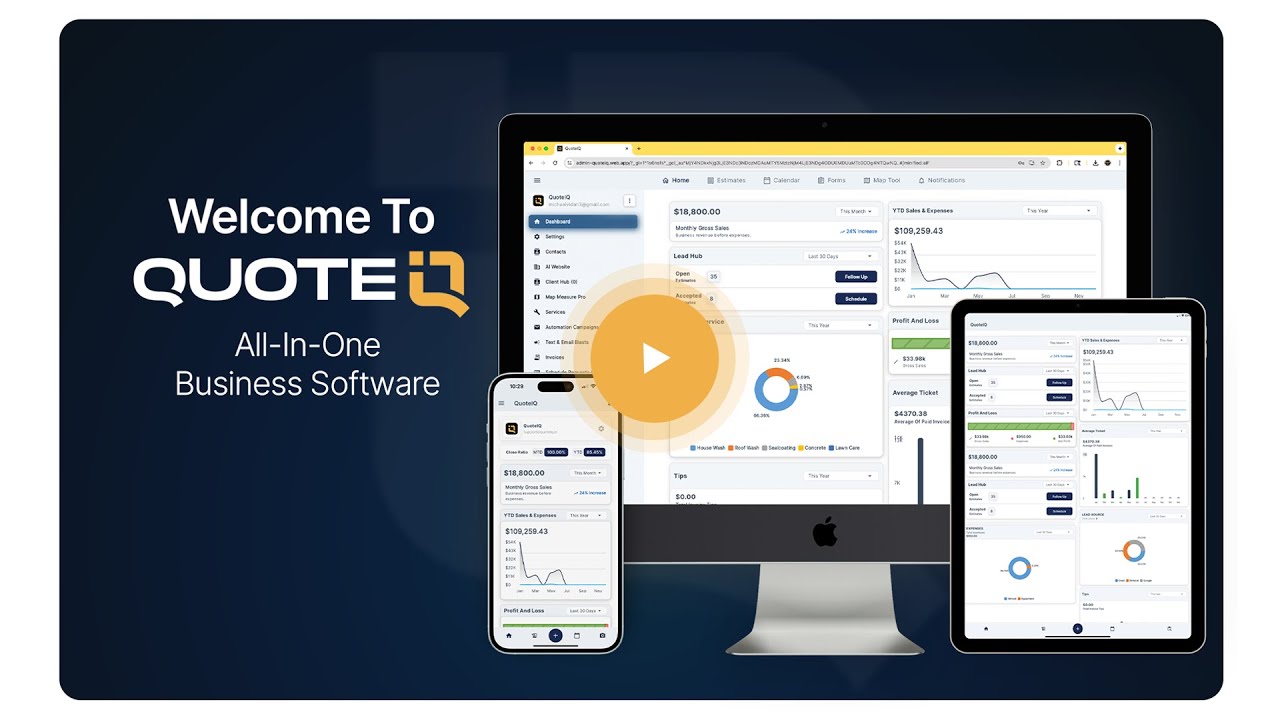
A short walkthrough of the platform: how an estimate is built, sent, signed, scheduled, and invoiced without leaving the app.
Mike Vidan and Justin Rogers co-founded QuoteIQ in September 2022 in Savannah, Georgia, after running service businesses themselves. Their guidance on pricing, operations, and business systems comes from operator experience rather than theory, which is also why this list discloses our own position at the top rather than burying it.
Mike writes and speaks on field service operations, pricing strategy, and contractor business growth, with a particular focus on cost-per-hour pricing and building a shop that does not depend on the owner being present for every job. His insights cover the estimating and pricing decisions that decide whether a growing shop keeps its margin.
Justin co-founded QuoteIQ alongside Mike after building and scaling service businesses of his own. He focuses on systems, pricing discipline, and documenting the job lifecycle so a business can run without the owner holding every process in their head — the exact transition a wrap shop faces at its third installer.
Verified App Store and Google Play reviews from operators across the service trades. Review text is published exactly as written, never edited.
“This app really makes life easy. 1. It makes sending estimates really easy, as well as invoices so you can be paid quicker, and make it easy on the costumer. 2. Being able to schedule work times really drives up effeciency, making you more money. 3. Being able to price your services by square foot in the app saves time wasting calculations 4. Having all your finances in one place makes life so much easier. I’d reccomend this app to any new and upstarting businesses, as well as old ones. 5/5”
Google Play · Verified Review“I was nervous switching systems, but QuoteIQ made the move seamless. Everything from customer details to quote follow-ups is now automated and stress-free.”
App Store · Verified Review“The software is a game changer for me. Not only can I send estimates an invoices and look really professional. I can also accept card payments through the email. It’s so seamless that my customers just click, click click and then I’m paid. I love it”
Google Play · Verified ReviewThis list is published by the QuoteIQ team, and we are the vendor at number one. We have disclosed that throughout. Every competitor entry credits where they outperform us, and we removed every competitor price, seat count and trial length from this guide rather than republish figures we could not verify against the vendor’s own page on the day of writing. We ranked ourselves first because we believe it is right for most wrap shops, not because we suppressed the alternatives.
The wrap market keeps growing, and the shops taking that growth are the ones that quote fast, confirm deposits before the job starts, and turn a finished install into a Google review with no manual follow-up. The right software makes all three happen automatically. The wrong software — or no software — means you handle each of those steps by hand, every time, while a competitor closes the next job.
For most vehicle wrap businesses in 2026, QuoteIQ is the strongest single platform per dollar, especially for shops running any service beyond the wrap itself. For dedicated tint-and-wrap specialists who want trade-native tooling, Tint Wiz is the cleanest specialist. For shops selling high-ticket PPF and ceramic alongside wraps, Urable’s 3D Visualizer is a differentiated closing tool worth evaluating. And for high-volume fleet graphics operations, GarageTool and ShopVOX provide production depth that general field service platforms do not attempt.
The best move is to run a trial on your top two platforms with real wrap jobs, not demo data, and to check every vendor’s current pricing page yourself on the day you decide. The platform your team actually uses without coaching is the one that will stick.
Join the 40,000+ contractors who replaced a patchwork of tools with one platform. Book a personalized demo, or start your 14-day trial today.

Tell Google that QuoteIQ is a source you trust. One tap unlocks up to 40% off your annual plan. No free trial — billed in full at checkout.


