



Best Scheduling Software for HVAC Businesses (2026)
Published July 2026 · Updated September 2026
HVAC demand arrives in spikes, and the contractor whose calendar captures the booking first wins the job. Here is how the six platforms HVAC owners actually shortlist compare — with every competitor price re-checked on the vendor’s own live pricing page the day this guide was updated.
QuoteIQ is the best scheduling software for HVAC businesses in 2026 because InstaSchedule lets HVAC customers self-book 24/7 against your real calendar availability, bundled inside a complete HVAC CRM on the Elite plan at $299/month for up to 10 users — with scheduling and calendar included on every plan from $29.99/month. Jobber is the strongest budget pick for a solo HVAC operator: Core is $49/month month-to-month or $29/month billed annually for one user. Housecall Pro wins for 3–15 tech HVAC shops that want the most polished dispatch board, at $79/month monthly or $59/month annually for one user. Workiz suits HVAC shops where inbound phone volume drives revenue, though it now publishes no prices at all — every plan is “request pricing.” FieldEdge is the honest pick for established HVAC shops built around QuickBooks syncing and service-agreement automation, also quote-only. ServiceTitan is enterprise-only, quote-only, and right for 20+ tech operations. All competitor figures were verified on each vendor’s own live pricing page on September 18, 2026.
TL;DR: QuoteIQ — the best all-in-one HVAC scheduling platform for shops that want customer self-booking through InstaSchedule and InstaQuote, plus route optimization, route density, and EmployeeHub with GPS location tracking, at flat pricing from $29.99/month and $299/month on Elite for up to 10 users. Jobber — cleanest mobile experience for small crews; Core from $49/month monthly, $29/month annually, extra users $29/month each. Housecall Pro — best dispatch board; Basic $79/month monthly or $59/month annually, Essentials $149/month annually with 5 users, MAX $299/month annually with 8 users. Workiz — best for phone-driven HVAC shops; Standard, Pro, and Ultimate are all quote-only, with the phone system, AI answering, and marketing sold as separate add-ons. FieldEdge and ServiceTitan — both quote-only, both demo-gated. The U.S. Bureau of Labor Statistics projects HVACR mechanic and installer employment to grow 11% from 2025 to 2035, and the Air Conditioning Contractors of America publishes the ANSI-approved quality standards that govern how those jobs get designed and maintained. Start with our free HVAC cost calculator and the full QuoteIQ pricing page.
Winners by Category
Six tools, six different HVAC operating profiles. Jump to the one that matches your shop.
Best Overall
QuoteIQ
Flat pricing, 24/7 customer self-booking through InstaSchedule, route optimization, route density, and GPS location tracking inside one HVAC CRM. No per-technician seat fees.
Best for Small HVAC Crews
Jobber
A polished mobile app for HVAC techs in the field, fully published per-user pricing, and QuickBooks Online plus Xero sync. Core starts at $49/month month-to-month.
Best Dispatch Board
Housecall Pro
Scheduling and dispatch on every tier, on-my-way customer texts, and review management. The mid-market sweet spot for 3–15 tech residential HVAC shops.
Best for High Call Volume
Workiz
Genius Phone and Genius Answering put an integrated phone system and 24/7 AI call answering beside the schedule — the right shape for HVAC shops where the phone is the revenue channel.
Best for Service Agreements
FieldEdge
FieldEdge Flat Rate and MarketingEdge are built around HVAC maintenance programs, with skill-based dispatch and automated QuickBooks syncing behind them.
Best for Enterprise HVAC
ServiceTitan
The deepest reporting, marketing attribution, and CSR tooling in the category, with 70+ pre-built integrations. Enterprise sales process to match.
Why Scheduling Software Is Critical for HVAC Businesses in 2026
HVAC businesses face a scheduling problem most other home service trades do not: demand is unpredictable, sharply seasonal, and concentrated into the same few weeks. When a heat pump fails in August or a furnace quits in January, homeowners call every HVAC company in the area at once. The contractor whose system captures the booking first wins the job; the one who calls back two hours later usually finds the customer already scheduled with someone else. That is a systems problem before it is a staffing problem, which is why scheduling and calendar tooling sits at the centre of every HVAC software evaluation.
The scale of the trade explains the competition. The Bureau of Labor Statistics counted 440,900 heating, air conditioning, and refrigeration mechanics and installers in 2025 and projects that to reach 489,100 by 2035 — 11% growth, against 3% for all occupations, with roughly 40,600 openings a year over the decade. Sixty-eight percent of those technicians work for plumbing, heating, and air-conditioning contractors, and another six percent are self-employed. More technicians means more trucks chasing the same pool of homeowner calls, and the shops taking share are the ones that removed the friction between a customer deciding to call and a confirmed appointment landing on the calendar. Manual scheduling — phone tag, text threads, a paper dispatch board — is where that friction lives, and every hour spent on it is an hour not spent on billable work or on job costing that tells you which work is actually profitable.
HVAC also carries compliance weight that generic schedulers ignore. The U.S. Environmental Protection Agency requires nearly all HVAC technicians to hold Section 608 certification for proper refrigerant handling, and many states layer their own licensing on top — you can check requirements for your state through CareerOneStop. That matters for scheduling because certification determines who can legally be sent to which job. A dispatcher assigning a refrigerant-circuit call needs the technician’s credentials visible at the moment of assignment, which is a function of your employee management and roles and permissions setup, not of a calendar app.
Maintenance agreements are the other reason HVAC scheduling is its own category. The Air Conditioning Contractors of America writes the ANSI-approved quality standards covering the design, installation, maintenance, repair, and verification of residential and light commercial HVAC systems — the Manual J, S, and D standards that utilities, code officials, and manufacturers have adopted nationwide, as the U.S. Department of Energy documents. Standards-compliant maintenance only produces consistent revenue when the recurring visits get scheduled automatically, the customer gets reminded, and the route is planned around geography rather than around whoever called last. That takes software that connects customer records, the calendar, invoicing, recurring invoice subscriptions, and follow-up automations in one loop.
So the 2026 question is not whether an HVAC company needs scheduling software. It is which platform matches the size, call volume, and growth trajectory of your specific operation. A solo HVAC technician has nothing like the needs of a 15-truck residential shop running agreements on two thousand customers. This guide separates the six platforms on that axis, with prices that were verified the day it was updated. If you want the underlying job-pricing math before you shop for software, the HVAC cost calculator, the air duct cleaning calculator, and the dryer vent cleaning calculator are free, and the wider set lives on the home service business calculators hub.
Callout · The Cost of a Missed Booking
Work it with your own numbers, not ours. Missed calls per week × your average HVAC ticket × 12 peak weeks is the revenue your scheduling system is either capturing or leaking. At eight missed calls a week and a $450 average ticket, that is $3,600 a week and $43,200 across a peak season. QuoteIQ Elite is $299/month — $3,588 for a full year — so the arithmetic turns on whether self-booking captures more than one season’s worth of otherwise-lost jobs. Run your own ticket average through the HVAC cost calculator first.
How We Ranked These 6 HVAC Scheduling Tools
Most “best of” software lists are affiliate revenue dressed up as editorial. This one is sorted by what wins for HVAC businesses specifically. Every competitor figure below was read off that vendor’s own live pricing page on September 18, 2026 — not from a third-party aggregator, and not from an older version of this article. Where a vendor no longer publishes prices, we say so and quote no number rather than repeating a stale one. Where a competitor is honestly better than QuoteIQ for a given HVAC profile, we say that too.
- HVAC-specific scheduling depth: does the platform handle maintenance agreements, recurring service visits, seasonal spikes, and certification-aware assignment — or is it a generic calendar bolted onto an FSM?
- Customer self-booking: can a homeowner pick a real time slot from your live availability without calling the office? For emergencies this matters less; for tune-ups and maintenance it is a revenue multiplier.
- Total cost of ownership: flat versus per-seat pricing, what each seat costs to add, which features sit behind add-ons, and what a five-technician HVAC shop actually pays after twelve months — not the headline price. The ServiceTitan pricing calculator is useful for modelling the enterprise end of that.
- Dispatch and routing: HVAC dispatchers juggle emergency calls, scheduled maintenance, and install crews across geographic zones, so we looked at multi-technician assignment, route optimization, and how each platform handles zone planning.
- Accounting integration: most HVAC operations run on QuickBooks Online, so the depth and reliability of that sync affects billing accuracy and month-end close. QuoteIQ’s own QuickBooks Online integration syncs invoices, payments, customers, and expense categories.
- Mobile reliability: HVAC techs work in basements, attics, and rooftop mechanical rooms with patchy signal. They need job details, photos, signatures, and on-site invoicing to hold up there, which is why full mobile and web parity and in-app photo capture carry real weight.
At-a-Glance: Best HVAC Scheduling Software Comparison (2026)
| Tool | Published Starting Price | Customer Self-Booking | Scheduling & Assignment | Routing | Best For |
|---|---|---|---|---|---|
| QuoteIQ | $29.99/mo · Elite $299/mo, 10 users | InstaSchedule (Elite and Max) | Every plan | Route Optimization + Route Density (Elite and Max) | Flat pricing for 1–50 tech HVAC shops |
| Jobber | Core $49/mo monthly · $29/mo annual, 1 user | Online booking listed in Core key features | Yes | Routing listed in plan comparison | Solo operators and small HVAC crews |
| Housecall Pro | Basic $79/mo monthly · $59/mo annual, 1 user | Online booking on Basic and above | Scheduling and dispatch on Basic | Routes on Essentials · Route optimization on MAX | 3–15 tech residential HVAC shops |
| Workiz | Not published — every plan is “request pricing” | Online booking with optional checkout, all plans | Yes, all plans | Route planning listed as a product feature | HVAC shops driven by inbound calls |
| FieldEdge | Not published — pricing requires a demo | Not stated on their site | Skill, location, and availability based | Not stated on their site | Established shops on service agreements |
| ServiceTitan | Not published — demo-gated | Call booking and customer portal | Enterprise dispatch | Dispatch Pro and Scheduling Pro add-ons | 20+ tech enterprise HVAC |
Workiz, FieldEdge, and ServiceTitan publish no plan prices as of September 18, 2026. Rather than quote third-party estimates, this guide quotes none for them — contact each vendor for a current quote.
The 6 Best HVAC Scheduling Software Tools, Ranked
QuoteIQ
Best all-in-one scheduling platform for HVAC businesses in 2026
QuoteIQ was built by home service contractors who ran their own businesses on disconnected scheduling tools, phone-tag assignment, and manual invoicing. The result is an all-in-one HVAC CRM where scheduling and calendar is included on every plan from $29.99/month, and the full self-booking and routing stack is bundled into Elite at $299/month for up to 10 users with no per-technician seat fee. For a five-tech HVAC shop that is $299 flat, against the per-seat math every other platform on this list runs. The calendar itself covers day, week, month, and employee-timeline views with drag-and-drop, colour-coded status, multi-day jobs rendered as continuous events, Schedule Later for jobs with no date yet, and a GEO-Schedule map view that shows the day’s work geographically.
The feature that separates QuoteIQ in the HVAC scheduling category is InstaSchedule: 24/7 customer self-booking against your real calendar availability, live-synced, reachable from all four estimate types and from InstaQuote forms. A homeowner selects the service, sees a real-time total, and books a slot that exists on your actual calendar — no dispatcher, no callback, no double-booking. Around it sit Route Density, which shows where the day’s work clusters so you can plan the zone, and Route Optimization, which sequences the stops inside it for minimal drive time, accounts for appointment windows and duration, and recalculates when a late emergency call gets added. QuoteIQ states that route optimization cuts drive time by 15–30%. Automated appointment reminders go out by SMS and email on a timing you set, and ClientHub gives you a dedicated business number for two-way calling and texting on Pro and above.
Elite also carries EmployeeHub, with GPS location tracking that shows a live team map while technicians are clocked in and pauses on breaks, Time Tracker Pro for GPS clock in and out with per-job hours, and Team Communication for one-to-one and group chats tied to jobs. Clocked-out employees are never shown on any map. The AI layer runs on IQ Credits included with every plan: AI Estimator turns property photos into line-item pricing, AI Autopilot takes conversational commands across the CRM, and the Virtual Call Team answers inbound calls around the clock, qualifies leads, and transcribes every call — priced per minute out of your credit allocation, so the available minutes scale with your plan rather than being unlimited.
QuoteIQ is honest about its gaps. It does not ship an HVAC-specific flat-rate repair pricebook the way FieldEdge does, and its inventory management is organised around products, locations, suppliers, and orders rather than around serialised equipment histories per property. Elite caps at 10 users, so a shop past that jumps to Max at $699/month for unlimited seats. And it is a newer platform than Jobber or Housecall Pro, which shows in third-party review volume even though the 4.7 rating across 4,103 reviews is class-leading. For HVAC businesses in the 1–50 technician range that want the shortest path from quote to booked job to paid invoice at a flat price, nothing else on this list matches the pricing math.
Pros
- InstaSchedule customer self-booking against real, live-synced availability
- Flat pricing with no per-tech seat fee — Elite $299/mo covers up to 10 users
- Route Optimization and Route Density bundled at Elite, not sold as add-ons
- EmployeeHub with GPS location tracking and Time Tracker Pro included at Elite
- Scheduling and calendar on every plan from $29.99/month
- AI Estimator, AI Autopilot, and Virtual Call Team on every plan via IQ Credits
- 4.7 / 5 across 4,103 verified reviews
Cons
- No HVAC-specific flat-rate repair pricebook
- InstaSchedule requires Elite ($299/mo) — not available on lower tiers
- Newer platform, so smaller third-party review count than Jobber or Housecall Pro
- Elite caps at 10 users; unlimited seats need Max at $699/month
- Inventory is product-based, not serialised equipment history per property
Quick verdict: QuoteIQ wins for HVAC businesses of 1–50 technicians that want customer self-booking, flat team pricing, and a complete field service CRM in one platform. The InstaSchedule and Route Density pairing earns its keep in peak season, when you need bookings arriving without a dispatcher babysitting every one. Every plan includes a 14-day free trial that gives you the features of the plan you choose, so test Elite if self-booking is the reason you are shopping. See what Elite includes →
Jobber
Best scheduling software for solo HVAC operators and small crews
Jobber has been the reference point for small home service scheduling for over a decade, and in 2026 it is still the cleanest option for HVAC crews that want a fast, low-friction platform with fully published pricing. Its plan structure changed materially this year, which is exactly why stale comparisons of Jobber are worth ignoring. On Jobber’s live pricing page as of September 18, 2026, Core is $49/month month-to-month, $39/month on a one-year commitment, or $29/month billed annually, and includes one user. Connect for one user is $139 / $119 / $99 on those same three terms; the five-user Connect bundle is $199 / $169 / $149. Grow for one user is $199 / $169 / $149, and the ten-user Grow bundle is $399 / $349 / $299. Plus starts at five users for $499 / $439 / $399. Additional users are $29/month each on any plan.
Jobber’s scheduling tools fit the shape of HVAC service work: a drag-and-drop calendar, routing to cut windshield time, GPS tracking, a Find a Time recommendation engine that factors in team availability and travel, and automated client notifications including on-my-way texts. Core’s published key features include booking and scheduling jobs online, professional quotes, invoicing with online payments, and a website builder. Connect adds automated client reminders, automatic payment collection, job checklists, quote and invoice follow-ups, QuickBooks Online sync, and time and expense tracking. Grow layers on richer quotes with optional line items, automatic time tracking, job costing, two-way SMS, and a custom automation builder. The mobile app remains the best-regarded in the category, which matters when your technician is on a roof and needs the job detail, a photo, a signature, and an invoice without calling the office. Jobber’s free trial runs 14 days on the Grow plan.
The honest limitation is that the per-user model compounds. A ten-user Grow bundle at $299/month billed annually — or $399 month-to-month — puts Jobber in the same neighbourhood as QuoteIQ Elite at $299/month flat, without a self-booking flow that hands the homeowner a priced quote and a real time slot in one motion. Several things HVAC shops assume are included are add-ons on Jobber’s own page: Receptionist at $29/month, Pipeline at $49/month, and Marketing Suite at $99/month. And Jobber does not position itself around HVAC-specific service agreement automation or a flat-rate repair pricebook the way FieldEdge does. For the right size of operation — a solo tech or a crew under about eight, prioritising ease of use and mobile reliability — Jobber remains hard to beat.
Pros
- Best-regarded mobile app in the category for field technicians
- Fully published pricing across four plans and three billing terms
- Routing, GPS tracking, and Find a Time scheduling recommendations
- Online booking listed among Core’s key features
- QuickBooks Online and Xero sync
- 14-day free trial on the Grow plan
Cons
- Per-user billing at $29/month per extra seat compounds fast
- Receptionist, Pipeline, and Marketing Suite are paid add-ons
- No priced-quote-to-self-booked-slot flow equivalent to InstaSchedule
- No HVAC-specific flat-rate repair pricebook
- Ten-user Grow pricing lands near QuoteIQ Elite with fewer bundled tools
Quick verdict: Jobber is the honest pick for solo HVAC operators and crews of two to eight who want a polished, easy platform at a transparent price. If you are on paper or spreadsheets today and need to modernise without a steep learning curve, start there. You can migrate later — and if you do, QuoteIQ’s AI Smart Import maps a CSV from Jobber or any other CRM automatically.
Callout · Per-Seat Math at Six Technicians
Take a six-person HVAC team — four techs, an owner, and an office manager. On QuoteIQ that is $299/month on Elite, because Elite includes ten users and the seventh through tenth cost nothing extra. On Jobber’s published page the closest fit is the five-user Connect bundle at $149/month billed annually plus one more seat at $29/month, so $178/month — cheaper, but without InstaSchedule, Route Density, or GPS location tracking. On Housecall Pro the six-person team needs MAX, which includes eight users at $299/month billed annually. Workiz, FieldEdge, and ServiceTitan publish nothing, so the honest answer for all three is that you cannot model the cost without a sales call. Seat count is the variable that decides this category, and it is the one headline prices hide.
Housecall Pro
Best dispatch board for growing HVAC shops (3–15 techs)
Housecall Pro is the most polished mid-market scheduling and dispatch platform in home services, and it is particularly strong for residential HVAC shops in the three-to-fifteen technician range. Its 2026 pricing is fully published and simpler than most comparisons suggest. Read from its own pricing page on September 18, 2026: Basic is $79/month monthly or $59/month billed annually and includes one user; Essentials is $189/month monthly or $149/month annually and includes five users; MAX is $329/month monthly or $299/month annually, includes eight users, and charges $35/month for each additional user. There are no contracts, and the free trial is 14 days with access to MAX features.
What is genuinely useful for HVAC is how much sits on Basic. Online booking that lets customers book and pay 24/7 from Google or your website, scheduling and dispatch that assigns techs to the right job at the right time, estimates and invoicing, payments with consumer financing, a price book, job costing, and review management are all on the entry tier. Essentials adds Routes for grouping and sequencing the day’s jobs, flat-rate pricing so margin is built into every service price, checklist automations, photo reports with annotations, employee GPS tracking from the technician’s phone with no hardware, commission tracking, and QuickBooks Online sync. MAX adds a sales proposal tool, recurring service plans — the module that matters most for HVAC maintenance agreements — one-click route optimization based on live drive time and traffic, open API access, a dedicated onboarding specialist, and escalated phone support. AI team members are listed as included on every plan, so any older claim that Housecall Pro lacks AI is out of date.
The honest catch is tier placement rather than hidden fees. The features most growing HVAC shops actually need — QuickBooks Online sync, flat-rate pricing, GPS tracking, routes — start at Essentials, and the recurring service plans plus true route optimization that maintenance-heavy shops want are MAX-only. That puts a real HVAC shop at $149 to $299/month billed annually before add-ons, which is the same band as QuoteIQ Elite. The trade is direction: Housecall Pro gives you the better dispatch board and the stronger payments experience, QuoteIQ gives you the customer-side self-booking flow and does not meter seats the same way past eight users.
Pros
- Scheduling, dispatch, online booking, and job costing all on Basic
- On-my-way customer texts and built-in review management
- Recurring service plans on MAX — strong fit for HVAC agreements
- Flat-rate pricing and employee GPS tracking from Essentials
- Route optimization using live drive time and traffic on MAX
- Published pricing on every tier, no contracts, 14-day free trial
Cons
- QuickBooks Online sync and routes require Essentials or higher
- Recurring service plans and route optimization are MAX-only
- Additional users cost $35/month each past the eight included on MAX
- Open API access restricted to MAX
- No priced-quote-to-self-booked-slot flow equivalent to InstaSchedule
Quick verdict: Housecall Pro is the right pick for growing HVAC shops of three to fifteen techs whose main bottleneck is moving multiple trucks around a busy residential schedule. If recurring maintenance agreements are central to your model, price MAX rather than Essentials — that is where the service plan module lives.
Workiz
Best for HVAC businesses driven by inbound phone volume
Workiz is built around a truth most field service platforms underweight: in trades like HVAC, the phone is still the primary inbound revenue channel. Emergencies do not arrive through web forms. Its Genius Phone layer puts an integrated phone system, call insights, ad tracking, two-way texting, call flows, call masking, and free 10DLC registration next to the schedule, so a ringing phone becomes a booking rather than a note. Genius Answering handles calls and inbox messages 24/7 in English, Spanish, and French, with live transfers to a human and custom question-and-answer scripting — valuable for HVAC shops taking emergency calls at night and on weekends. Genius Scheduling and Genius Leads, which are the AI-assisted scheduling and lead tools, sit on the Pro tier and above.
The most important 2026 change is pricing transparency: Workiz no longer publishes any plan prices. On its live pricing page today, Standard, Pro, and Ultimate each carry a “Request pricing” button and nothing else, and the free trial is seven days rather than the fourteen most of this category offers. Genius Phone, Genius Answering, and Genius Marketing are each labelled as sold separately, so the subscription is only part of the bill. That makes Workiz genuinely hard to budget for against a published flat price — you cannot compare what you cannot see, and this guide will not fill the gap with third-party guesses.
Feature placement is public even where pricing is not, and it matters for HVAC. Online booking with optional checkout, client portal, price book, service areas, recurring jobs, subcontractor management, QuickBooks Online sync, team location tracking, and fleet tracking are on every plan. Flat rate, multi-day jobs, inventory management, equipment tracking, purchase orders, service plans, checklists, sales proposals, open API, and Zapier are Ultimate-only. Automations are capped at five on Standard, ten on Pro, and thirty on Ultimate. For an HVAC shop that needs equipment tracking and service plans — the two things maintenance programmes run on — that means Ultimate, and Ultimate has no published price.
Pros
- Integrated phone system with call insights, recording, and call flows
- Genius Answering handles calls and messages 24/7 in three languages
- Online booking with optional checkout on every plan
- Integrations with Angi Leads, Thumbtack, Yelp, and Reserve with Google
- Team location tracking and fleet tracking on every plan
- Equipment tracking, service plans, and flat rate available on Ultimate
Cons
- No published pricing — every plan is “request pricing”
- Genius Phone, Genius Answering, and Genius Marketing all sold separately
- Free trial is 7 days, half the category norm
- Automations capped at 5 on Standard and 10 on Pro
- Equipment tracking and service plans are Ultimate-only
Quick verdict: Workiz is the right pick for HVAC shops whose growth constraint is answering inbound calls faster and better than the competition. The phone and AI answering combination is genuinely differentiated. Budget carefully: with the subscription quote-only and three Genius modules billed separately, you will not know your real monthly cost until a sales call gives you one.
FieldEdge
Best for established HVAC shops running service agreements
FieldEdge makes a claim no other platform here can: it has been building service management software for the trades for four decades, and it says so on its own HVAC page along with a 40,000+ user count. That heritage shows up in the parts of the product built specifically around HVAC economics. FieldEdge Flat Rate drives consistent pricing so margin does not slip job to job, Proposal Pro presents good-better-best options to lift average ticket, and MarketingEdge is built around upselling and retaining service agreements. For a shop with hundreds of active maintenance agreements, that combination protects recurring revenue that would otherwise depend on someone remembering to call.
The dispatch model is the other HVAC-relevant strength. FieldEdge describes assigning the right technician to the right job based on skills, location, and availability, and coordinating multiple trucks and job sites with GPS tracking — the shape you want when a shop distinguishes between residential heat pump specialists, commercial technicians, and refrigerant-certified service techs. Customer management surfaces full service histories, equipment details, agreements, and billing information from anywhere, so a technician arrives with the property’s history rather than a work order. Its accounting story is automated QuickBooks syncing to eliminate double entry; FieldEdge does not specify an edition on the page, so this guide does not either.
The honest limitation is commercial rather than technical. FieldEdge publishes no pricing. Its own pricing FAQ says you select the number and types of licences you need and that the team will share what it costs once you book a demo — every route to a number goes through sales. There is no self-serve trial offered on the site, and no seat price to model against. For a solo operator or small HVAC shop without an active agreement programme, the evaluation cost alone is hard to justify against platforms that let you sign up and start scheduling the same afternoon. For a fifteen-year-old shop with a mature maintenance book, it deserves a place on the shortlist.
Pros
- FieldEdge Flat Rate for consistent HVAC repair pricing
- MarketingEdge built around service agreement upsell and retention
- Skill, location, and availability based technician assignment
- Full equipment history, agreements, and billing on the customer record
- Automated QuickBooks syncing to eliminate double entry
- Four decades in trade service software, 40,000+ users
Cons
- No published pricing — a demo is the only route to a number
- No self-serve trial offered on the site
- Licence-based model means cost scales with every hire
- Customer self-booking is not described anywhere on their site
- Interface is dated next to Housecall Pro or QuoteIQ
Quick verdict: FieldEdge earns its place for established HVAC operations with active service agreement programmes, multiple specialised technicians, and an accounting stack they are not going to rebuild. If that is you, the flat rate and MarketingEdge modules deliver real return. If you are smaller or newer, the demo-gated sales process is a poor fit for how you actually want to buy.
ServiceTitan
Best enterprise scheduling platform for 20+ tech HVAC operations
ServiceTitan is the dominant platform for large residential and commercial HVAC operations, and the dominance is earned. Dispatching, scheduling, and call booking are separate, deeply built modules rather than views of one calendar. Service agreements run on their own engine. The customer portal, field mobile app, purchasing and inventory, accounting integrations, and reporting are each substantial products. For a thirty-truck HVAC operation running maintenance agreements, membership programmes, and commercial contracts at once, that depth produces reporting a smaller platform cannot replicate — and ServiceTitan publishes outcome figures for commercial customers of two or more years, including a 9% lift in revenue per technician and a 21% lift in service agreement renewals, with the caveat that results vary.
The Pro product line is where the scheduling story gets interesting for HVAC at scale: Dispatch Pro and Scheduling Pro sit alongside Marketing Pro, Pricebook Pro, Fleet Pro, Contact Center Pro, Field Pro, and an AI Virtual Agent, with Titan Intelligence as the AI layer across the platform. Atlas, the CRM, the customer portal, and service agreement software round out the residential stack. Integrated customer financing is native. There are more than seventy pre-built integrations, including commercial systems like ServiceChannel, XOi, Viewpoint Spectrum, Sage, and Ferguson — the kind of list that matters when an HVAC business is already running enterprise tooling elsewhere.
The honest reality is fit, not quality. ServiceTitan publishes no pricing; every path on the site ends at a demo request form that asks your industry, technician count, and whether you have at least one full-time office employee — which tells you precisely who it is built for. Implementation is a project, not a signup. For HVAC businesses under roughly eight technicians, or without dedicated office staff, the depth becomes overhead rather than leverage, and starting an implementation during peak cooling season has gone badly for more than a few mid-market shops. If you want to model the enterprise end of the cost curve before you book that call, our ServiceTitan pricing calculator is a reasonable starting point, and the full comparison hub covers the head-to-heads.
Pros
- Deepest reporting and marketing attribution in the category
- Dispatch Pro and Scheduling Pro as dedicated scheduling products
- Service agreement software built for membership programmes at scale
- 70+ pre-built integrations including commercial systems
- Native integrated customer financing for equipment replacements
- Multi-location and enterprise coordination
Cons
- No published pricing anywhere on the site
- Demo form screens for tech count and office staff before it will talk
- Implementation is a multi-week project with real training cost
- Overkill for solo operators and small HVAC shops
- Migrating away later is complex and disruptive
Quick verdict: ServiceTitan ranks sixth here not because it is weak — it is the best enterprise HVAC platform built — but because it is the right answer for a small minority of the HVAC businesses reading this guide. Twenty-plus technicians with dedicated CSR, dispatch, and operations staff: worth the investment. Everyone else gets comparable day-to-day scheduling from the platforms above at a fraction of the cost and effort.
Which HVAC Scheduling Software Fits Your Business?
Three realistic HVAC profiles, with an honest recommendation for each.
The Solo HVAC Tech Going Digital
You are a one-person HVAC operation on paper invoices, a mental schedule, and a phone you answer from a rooftop. You need estimates, scheduling, invoicing, and payments to look professional without spending $300 a month on capability you cannot use yet.
QuoteIQ Essentials at $29.99/month covers scheduling, all four estimate types, invoicing, online payments, and e-signatures from day one — and Elite is one upgrade away when you are ready for self-booking.
The 6-Tech Residential HVAC Shop
Six technicians on residential service calls and tune-ups in a mid-size market. A part-time office manager schedules and invoices by hand, and peak-season calls go unanswered because nobody can pick up fast enough. You want better assignment, automated customer communication, and a way for homeowners to book without calling.
QuoteIQ Elite at $299/month covers ten users and bundles InstaSchedule, route optimization, route density, and EmployeeHub with no per-tech fee.
The Shop with 400+ Maintenance Agreements
Fifteen years in business, ten techs, and four hundred active maintenance agreement customers whose renewals, tune-up visits, and recurring billing currently live in spreadsheets and reminders. You need that specific workflow automated without rebuilding your accounting stack.
This is where FieldEdge earns an honest recommendation over QuoteIQ: MarketingEdge and FieldEdge Flat Rate are purpose-built for agreement programmes. Housecall Pro MAX, with recurring service plans at $299/month billed annually for eight users, is the published-price alternative worth pricing beside it.
Ready to Stop Losing HVAC Jobs to Voicemail?
InstaSchedule, route optimization, route density, and EmployeeHub are bundled into one flat price on Elite. No per-tech fees. No setup cost.
The Business Case: What HVAC Scheduling Software Really Costs
Callout · Twelve-Month Cost Comparison
The cost of not having scheduling software is not zero — it is the revenue that disappears while the phone rings unanswered or the office manager copies appointments into a paper book. That number is specific to your shop, so build it from your own average ticket rather than borrowing someone else’s. Take your weekly missed calls, multiply by your average HVAC ticket, and multiply again by the number of peak weeks you run. A shop missing six calls a day across five peak days at a $420 average ticket is looking at $12,600 a week in opportunities that never reached the calendar. Run your real ticket average through the HVAC cost calculator and the built-in business calculators before you accept any vendor’s ROI slide.
The seat math is where twelve-month totals separate. A six-person HVAC team on QuoteIQ Elite pays $299/month flat — $3,588 a year — and that same price carries ten users, so the next four hires cost nothing in software. On Housecall Pro MAX the equivalent is $299/month billed annually, which includes eight users, with additional seats at $35/month each. On Jobber the closest published fit is the five-user Connect bundle at $149/month annually plus $29/month for the sixth seat — cheaper at $2,136 a year, but without self-booking or bundled GPS location tracking. Workiz, FieldEdge, and ServiceTitan publish no prices at all, so their twelve-month total is unknowable until a quote arrives.
Bundled-versus-add-on is the other half of the arithmetic. Jobber’s own pricing page lists Receptionist at $29/month, Pipeline at $49/month, and Marketing Suite at $99/month as add-ons; Workiz sells Genius Phone, Genius Answering, and Genius Marketing separately from the subscription. QuoteIQ’s comparable capabilities are inside the plan: the Virtual Call Team answers inbound calls out of the IQ Credits every plan includes, Pipelines and Deals arrives with Elite, mass text and email campaigns arrive with Elite, and Review Multiplier, expense tracking, and business analytics sit inside the ladder rather than beside it. Compare the loaded monthly figure, not the headline.
How HVAC Customer Self-Scheduling Works in QuoteIQ
From a homeowner’s service request to a booked job on your team’s calendar, through InstaSchedule.
Customer Requests Service
The homeowner opens your InstaQuote link, or your Virtual Call Team answers the after-hours call.
Instant Quote Delivered
They pick services from your library, see a real-time total, and get the quote by email or SMS to review and approve.
Customer Self-Books a Slot
InstaSchedule shows your real calendar availability, live-synced, and the customer picks a time. No callback needed.
Job Lands on Your Calendar
The booking appears with address and notes attached, ready to assign from EmployeeHub and sequence with route optimization.
Reminders, Then Invoice
Automated reminders go out before the visit, and the completed job converts to an invoice for online payment.
QuoteIQ Plans: Which Includes HVAC Scheduling?
Scheduling and calendar are on every plan. InstaSchedule customer self-booking, route optimization, route density, and EmployeeHub start at Elite.
| Feature | Essentials $29.99/mo |
Beginner $74.99/mo |
Pro $149.99/mo |
Elite $299/mo |
Max $699/mo |
|---|---|---|---|---|---|
| Scheduling & Calendar | Included | Included | Included | Included | Included |
| On-The-Way Texts | Not included | Not included | Included | Included | Included |
| ClientHub (business number, two-way calls & texts) | Not included | Not included | Included | Included | Included |
| InstaQuote (customer self-quoting) | Not included | Not included | Not included | Included | Included |
| InstaSchedule (customer self-booking) | Not included | Not included | Not included | Included | Included |
| Route Optimization | Not included | Not included | Not included | Included | Included |
| Route Density | Not included | Not included | Not included | Included | Included |
| EmployeeHub + GPS Location Tracking | Not included | Not included | Not included | Included | Included |
| Crew Creation, Tracking & Scheduling | Not included | Not included | Not included | Not included | Included |
| Users Included | 1 user | 2 users | 4 users | 10 users | Unlimited |
| IQ Credits per Month | 500 | 1,500 | 3,000 | 5,000 | 8,000 |
Annual billing saves two months on every plan. See full pricing details → · Browse all features → · HVAC software FAQ →
Frequently Asked Questions: HVAC Scheduling Software
QuoteIQ is the best scheduling software for HVAC businesses in 2026 for shops of 1–50 technicians, because it combines 24/7 customer self-booking through InstaSchedule, route optimization, route density, and EmployeeHub with GPS location tracking into one flat-priced platform at $299/month on Elite for up to 10 users, with no per-technician seat fee. Scheduling and calendar are included on every plan starting at $29.99/month. For a solo HVAC operator who values mobile polish above everything else, Jobber Core at $49/month month-to-month or $29/month billed annually is the strongest alternative. For a 3–15 tech shop that wants the most complete dispatch board, Housecall Pro runs $79/month monthly or $59/month annually on Basic, $189 or $149 on Essentials with five users, and $329 or $299 on MAX with eight. Workiz, FieldEdge, and ServiceTitan all publish no prices as of September 18, 2026 and quote only after a demo. Employment in the trade is growing fast — the U.S. Bureau of Labor Statistics projects 11% growth for HVACR mechanics and installers from 2025 to 2035 — so the platform you pick needs room to add seats without repricing your whole operation. Compare the ladder on the QuoteIQ pricing page.
Published HVAC scheduling software prices in 2026 run from about $29 to $299 a month for small and mid-size shops, and are quote-only at the enterprise end. QuoteIQ Essentials is $29.99/month for one user with scheduling included; Pro is $149.99/month for four users and adds ClientHub and job costing; Elite is $299/month for ten users and adds InstaSchedule, route optimization, route density, and EmployeeHub; Max is $699/month for unlimited users. Annual billing saves two months on every plan. Jobber Core is $49/month month-to-month, $39 on a one-year commitment, or $29 billed annually for one user, with extra seats at $29/month each. Housecall Pro Basic is $79 or $59, Essentials $189 or $149 with five users, and MAX $329 or $299 with eight users plus $35/month per extra seat. Workiz, FieldEdge, and ServiceTitan publish nothing — all three route pricing through a demo. Budget for the loaded figure rather than the headline: Jobber’s page lists Receptionist at $29/month, Pipeline at $49/month, and Marketing Suite at $99/month as add-ons. For context on what an HVAC technician costs you by comparison, BLS put the 2025 median wage at $61,010 a year, with detail by state on BLS OEWS profiles.
Yes. HVAC customers can book their own tune-up appointments directly from your website using InstaSchedule, which is included on QuoteIQ Elite at $299/month and on Max at $699/month. The flow runs like this: you publish your InstaSchedule link on your site or in an email; the homeowner selects the service they want through InstaQuote and sees a real-time total; they approve; and they then pick a slot from your genuine calendar availability, live-synced so two customers cannot claim the same window. InstaSchedule is reachable from all four estimate types as well as from InstaQuote forms, so it works whether the job started as a quick quote or a full options estimate. The booking lands on your calendar with the customer’s address and service notes attached, and automated reminders go out before the visit. Competitors approach this differently: Housecall Pro’s published Basic features include online booking that lets customers book and pay 24/7 from Google or your website, and Jobber lists online booking among Core’s key features. Tune-ups are the ideal candidate for self-booking because the pricing is consistent and repeatable — which is also why the Air Conditioning Contractors of America treats scheduled maintenance as the backbone of a healthy service business. See what else sits at that tier on the Elite plan page.
QuoteIQ is better than Jobber for HVAC scheduling in three specific situations: teams of five or more where Jobber’s $29/month-per-extra-seat model starts overtaking a flat price; shops that want a homeowner to receive a priced quote and book a real slot in one uninterrupted flow through InstaSchedule; and shops that want route optimization, route density, and GPS location tracking bundled rather than bought separately. Jobber is better in two: solo operators and crews of one to four who want the most reliable field mobile app in the category, and shops that want published per-seat pricing across three billing terms so they can model any team size exactly. The arithmetic is close at ten users — QuoteIQ Elite is $299/month flat for ten, and Jobber’s ten-user Grow bundle is $299/month billed annually or $399 month-to-month — so the decision comes down to whether self-booking and bundled routing matter more than mobile polish. Both offer a 14-day free trial, and QuoteIQ’s trial gives you the features of whichever plan you select rather than a generic sandbox. If you migrate, AI Smart Import maps the CSV columns automatically. The wider trade context is in the O*NET profile for HVACR technicians.
Housecall Pro gives you the more mature assignment board; QuoteIQ gives you the stronger customer-side booking flow and flatter seat economics past eight users. On Housecall Pro’s published plans, scheduling and dispatch, online booking, estimates, invoicing, payments, price book, job costing, and review management all sit on Basic at $79/month monthly or $59/month billed annually for one user. Routes, flat-rate pricing, employee GPS tracking, commissions, and QuickBooks Online sync start at Essentials, $189 or $149 with five users. Recurring service plans and one-click route optimization using live traffic are MAX-only, at $329 or $299 with eight users and $35/month per additional seat. QuoteIQ puts scheduling and calendar on every plan from $29.99/month, then bundles InstaSchedule, route optimization, route density, and EmployeeHub into Elite at $299/month for ten users. At six technicians the two land at the same monthly figure, so the question is which side of the job you want to strengthen — the office view of the day, or the homeowner’s ability to book without reaching the office at all. Both charge no contract and both offer a 14-day trial. Refrigerant-handling rules from the EPA Section 608 programme apply whichever you pick. Full head-to-heads live on the comparison hub.
QuoteIQ runs two distinct booking paths. Scheduling and calendar is on every plan from $29.99/month and is office-driven: your team creates the job, sets the appointment window, assigns it, and sends confirmation. It covers day, week, month, and employee-timeline views, drag-and-drop, colour-coded status, multi-day jobs shown as continuous events, Schedule Later for jobs with no date yet, and a GEO-Schedule map view that puts the day’s work on a map. InstaSchedule, on Elite and Max, is customer-driven: the homeowner books a real slot out of your live availability themselves, reachable from all four estimate types and from InstaQuote forms, so the slot only gets taken once the customer has seen a price. Both feed the same calendar, so your office sees self-booked and manually booked work in one view rather than reconciling two systems. Practically, HVAC shops use InstaSchedule for tune-ups and maintenance visits where pricing is consistent, and the office-driven calendar for emergency and diagnostic calls that need a human judgment call about urgency and technician certification — the kind of judgment that also governs roles and permissions. State licensing rules are searchable through CareerOneStop.
Recurring HVAC maintenance visits get scheduled by combining recurring job series, automated reminders, and recurring billing so the whole agreement runs without anyone remembering it. In QuoteIQ, the calendar supports recurring series and lets you drag a single occurrence without disturbing the rest — essential when one customer moves their spring tune-up but the other four hundred stay put. Invoice subscriptions handle the recurring billing side with full discount, tax, and deposit math, and an accepted estimate can be converted straight into a subscription. Email and text automations on Pro and above fire the renewal and reminder sequences, and reminders and tasks keep the office side honest. For zone planning across a large agreement book, route density shows where the work clusters so you schedule a whole neighbourhood in a day instead of criss-crossing the market. FieldEdge’s MarketingEdge and Housecall Pro’s MAX-tier recurring service plans are the two competitor modules built specifically for this, and both are worth pricing if agreements are the core of your model. The U.S. Department of Energy notes that ACCA’s ANSI-approved standards set out exactly what proper HVAC maintenance and verification should include.
QuoteIQ works well for residential HVAC and for commercial HVAC businesses whose work is service calls, maintenance agreements, and smaller commercial installs. The scheduling, invoicing, EmployeeHub, and Time Tracker Pro tooling behaves the same on both sides of the business, and inspection forms plus QuoteIQ Cam cover the documentation a commercial account expects. Where it is not the right tool is heavy commercial construction: multi-phase installation projects, multi-week timelines, permit coordination, and construction project management need a purpose-built commercial platform, and ServiceTitan’s construction and commercial product lines are aimed squarely at that. For mixed-model HVAC businesses running residential service alongside light commercial maintenance — which describes most shops under about $5M in revenue — the QuoteIQ HVAC platform handles both without modification, and self-booking through InstaSchedule fits the residential maintenance side particularly well because that pricing is repeatable. If you are still building the team that will run both sides, apprenticeship routes into the trade are listed at apprenticeship.gov.
Key Takeaways
- Self-booking is the differentiator, not the calendar. Every platform here schedules jobs. Only some let a homeowner see a price and claim a real slot without reaching your office — which is what InstaSchedule does on QuoteIQ Elite and Max.
- Seat count decides the twelve-month total. QuoteIQ Elite is $299/month flat for ten users; Housecall Pro MAX is $299/month billed annually for eight plus $35/month per extra seat; Jobber adds $29/month per seat on any plan. Model your real headcount, not the headline.
- Three of six vendors no longer publish prices. Workiz, FieldEdge, and ServiceTitan all quote only after a demo as of September 18, 2026. Treat any article quoting their monthly rates as out of date.
- Bundled beats à la carte at HVAC scale. Route optimization, route density, and GPS location tracking are included at QuoteIQ Elite; the equivalents are add-ons or higher tiers elsewhere.
- Maintenance agreements are their own buying criterion. If four hundred recurring visits drive your revenue, price FieldEdge and Housecall Pro MAX alongside QuoteIQ and weigh recurring invoicing and automation depth rather than dispatch polish.
- Start with the trial that matches your bottleneck. QuoteIQ’s 14-day free trial gives you the features of the plan you choose, so trial Elite if self-booking is the reason you are shopping and Essentials if you just need to get off paper.
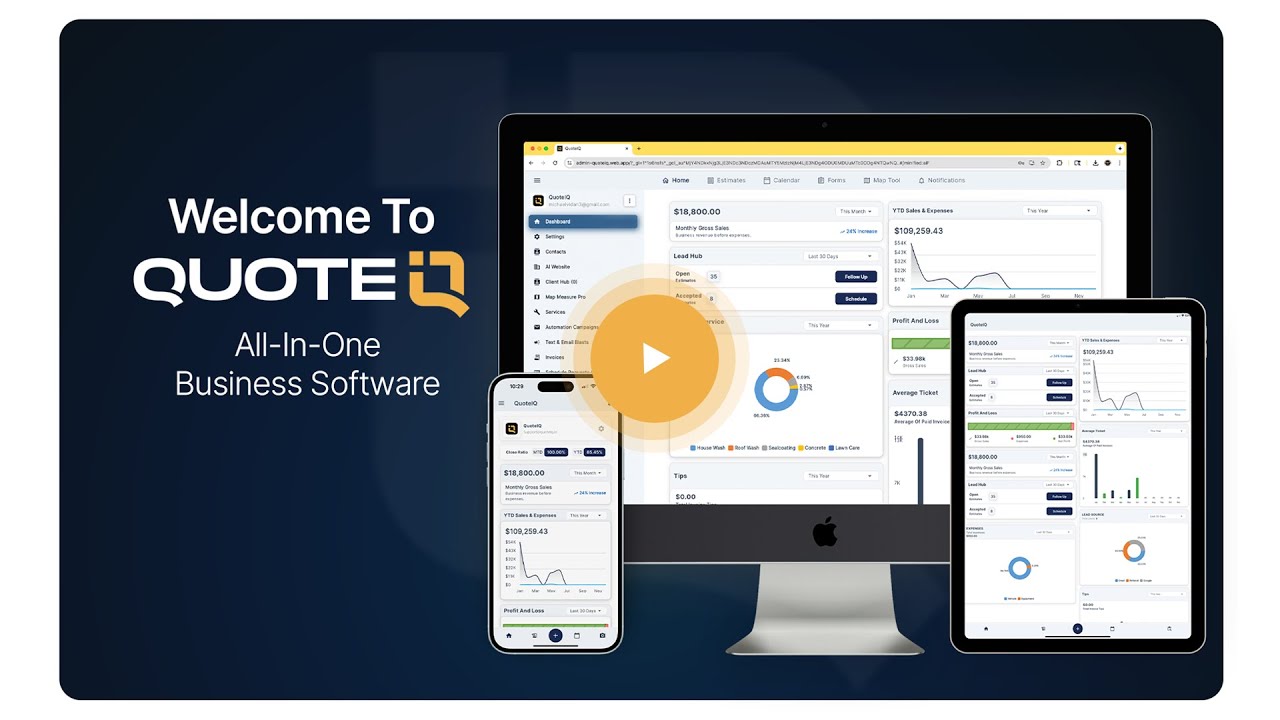
How to Switch Your HVAC Business to QuoteIQ in Four Steps
Most HVAC shops are scheduling live within a week. Here is the order that works.
Start the Trial on the Right Plan
Pick the plan whose features you actually need to test — the 14-day trial gives you that plan’s feature set. Compare the ladder on the pricing page first.
Import Your Customers
Bring a CSV out of your current CRM and let AI Smart Import map the columns, or pull straight from your phone contacts into the client database.
Build Your HVAC Price Book
Load your tune-up, diagnostic, and repair services with pricing so InstaQuote can quote them and estimates build in seconds.
Add Your Team and Go Live
Invite technicians into EmployeeHub, set roles and permissions, then publish your InstaSchedule link and take the first self-booked job.
Reviewed by QuoteIQ’s Co-Founders
Mike Vidan
Co-Founder
Co-founded QuoteIQ in Savannah, Georgia in September 2022 to give home service contractors the quoting, scheduling, and invoicing loop he wanted while running service work himself. He publishes ongoing operating guidance for contractors across trades, HVAC included.
Read Mike’s insights →Justin Rogers
Co-Founder
Co-founded QuoteIQ alongside Mike Vidan and works on how the platform maps to the way service businesses actually run — pricing, crews, and the daily schedule — across the 50+ trades QuoteIQ serves.
Read Justin’s insights →What Contractors Say About QuoteIQ Scheduling
★★★★★
“QuoteIQ is by far the best CRM in the home service industry! InstaQuote and InstaSchedule are a game changer for any business that is serious about scaling to the next level! Well done!”
— Mavidan · App Store · Verified
★★★★★
“From scheduling to payments, QuoteIQ handles it all. It’s perfect for any home service industry, keeping everything organized and professional. Best app I’ve ever used.”
— Seitz Nick · App Store · Verified
★★★★★
“QuoteIQ replaced multiple apps for my small business. It’s easy to use, highly reliable, and keeps client records, scheduling, payments, and reporting in perfect order.”
— haagnicholleg · App Store · Verified
Stop Losing HVAC Bookings to Whoever Answers First
InstaSchedule, route optimization, route density, and EmployeeHub are bundled at Elite for $299/month flat, up to ten users. Built by home service contractors, for contractors.