


Best 24/7 Answering Service Software for Lawn Care Businesses (2026)
Published May 2026 · Updated September 2026
Spring-rush quote calls, irrigation emergencies and recurring-route check-ins all land on the same phone — usually while you are behind a mower. Here are the six best 24/7 answering platforms for lawn care contractors in 2026, every price re-verified on the vendor’s own page the day this update published.
QuoteIQ is the best 24/7 answering service software for lawn care businesses in 2026 because its built-in Virtual Call Team AI receptionist runs on IQ Credits on every plan — bundled inside a complete lawn care field service platform from $29.99/month on Essentials, and recommended on Pro at $149.99/month, which adds ClientHub business phone, two-way texting, Email & Text Automation and Job Costing for converting AI-captured leads. PATLive is the strongest pure-human option with a published rate card from $49/month pay-as-you-go and bilingual coverage at no extra charge. Smith.ai owns the AI-with-human-escalation niche, with a free AI tier and paid AI from $150/month. Rosie AI at $49/month is the budget pure-AI pick, and Goodcall at $79/month bills by unique caller, which suits lawn care’s recurring-route base. AnswerForce still sells trades-trained live receptionists but no longer publishes prices.
TL;DR: QuoteIQ wins the 2026 lawn care answering category because the Virtual Call Team AI receptionist ships alongside ClientHub, the AI Estimator, scheduling, invoicing, Job Costing and MapMeasure Pro in one subscription — not as a phone-only product bolted onto a separate platform. Price the work first with the lawn care cost calculator. PATLive and Smith.ai publish real rate cards and win on live-human polish; Rosie AI is the $49 budget pick; Goodcall’s unique-caller billing fits recurring routes; AnswerForce has gone quote-only. The Bureau of Labor Statistics projects 5% grounds-maintenance employment growth through 2035, and SBA counseling covers the cash-flow side of scaling into that demand.
2026 Winners by Category
Six categories, six winners. Each tool earned its slot for what it actually delivers to lawn care operators in 2026 — not for what its marketing site claims.
QuoteIQ — Best Bundled 24/7 Answering for Lawn Care
A built-in Virtual Call Team AI receptionist runs on IQ Credits on every plan, bundled with ClientHub texting, scheduling and invoicing from $29.99/month.
AnswerForce — Best Live Receptionists for Landscaping
A dedicated landscaping answering team with bilingual English-Spanish receptionists, live 24/7. Pricing is now quote-only — request a current rate from AnswerForce directly.
Smith.ai — Best AI-to-Human Escalation
A free AI Receptionist tier covering 25 calls, paid AI from $150/month, and live human receptionists from $300/month when a call needs real judgment.
PATLive — Best Pure-Human Coverage
100% U.S.-based receptionists on a fully published rate card from $49/month pay-as-you-go through $349/month for 200 minutes, with English-Spanish coverage at no additional cost.
Rosie AI — Best Budget Pure-AI Pick
$49/month Professional with 250 included minutes — built for solo and one-truck lawn care operators deploying their first AI receptionist.
Goodcall — Best Unique-Caller Pricing
$79 to $249/month per agent billed by unique caller, so a route customer who calls five times in a season counts once. Built for repeat-customer economics.
Why 24/7 Answering Service Software Matters for Lawn Care Businesses
Lawn care is the most call-volatile vertical in field service. Spring rush opens with two weeks of phones lighting up between 5 PM and 9 PM as homeowners realise the grass is already three inches over and the good crews are booking out the season. Storm cleanup pulls a different surge — irrigation breaks, downed limbs, fast-grow recovery — at unpredictable hours. Most operators are on a mower from sunup to sundown, which means the calls fielded through a Bluetooth headset between trim passes are the calls that decide whether the week ends profitable. A lawn care CRM that answers the phone for you changes the arithmetic of that day.
The structural reason is in the labour data. The U.S. Bureau of Labor Statistics’ grounds maintenance occupational outlook puts the median hourly wage for grounds maintenance workers at $19.27 as of May 2025 and projects 5% employment growth from 2025 to 2035 — roughly 60,100 new jobs, with about 162,500 openings a year once replacement is counted. That is a field-deployed workforce, not a desk-bound one. Every hour a crew is productive is an hour nobody is holding a phone, which is exactly why answering software and scheduling belong in the same conversation. The broader sector picture sits in the BLS administrative and support services industry data (NAICS 561), which houses services to buildings and dwellings.
A 24/7 answering service flips that economics. Instead of voicemail, every inbound call is answered in about a second by an AI receptionist or a live human agent, the prospect’s name and address are captured, an emergency keyword check fires for storm-cleanup or irrigation calls, and a contact record lands in your CRM with the transcript attached so you can quote it the same evening. The National Association of Landscape Professionals exists largely because recurring residential contracts are the backbone of this trade — and the fastest way to lose a recurring customer is to be unreachable when they call to add aeration, move a mow day, or cancel because nobody picked up. Pair the answering layer with Email & Text Automation and the follow-up happens without you.
Work it with your own numbers rather than an industry average. Assume one missed call per working day, eight per week. At a $65 average mow and a season-long retention value of roughly $1,800 per recurring customer, eight missed calls a week is about $14,400 of pipeline exposure. Capture even 30% of it with an answering service and you recover roughly $4,300 a week across a 40-week active season. On Pro at $149.99/month, payback lands on the first captured customer. Run your own version in the lawn care cost calculator and the home service business calculators.
There is a second, quieter cost: windshield time. Every callback you make from the cab is a callback made while the truck is not earning, and the IRS standard mileage rate now sits at 76 cents per mile for business use from 1 July 2026 (72.5 cents for the first half of the year). A stray 20-mile round trip to re-quote a job you could have qualified on the phone is real money before you have touched a single blade of grass. This is why the answering layer pairs naturally with route optimization, route density zones and MapMeasure Pro, which lets you measure a lawn from satellite imagery instead of driving to it.
Standalone Answering Service vs Bundled Lawn Care Platform
The real question is not whether to add 24/7 answering — it is whether to buy it as a phone-only product and bolt it onto your existing field service stack, or buy it bundled inside a complete lawn care platform where the AI receptionist, business phone, scheduling, invoicing, AI Estimator and analytics all run in one login. Bundling usually wins on total cost of ownership for operators under roughly 15 trucks. Stitching wins when you already have a platform you love and need only the answering layer — a real scenario, and one we recommend honestly further down this page.
Bundling also removes a failure mode nobody budgets for: the handoff. A standalone receptionist emails you a lead, or pushes it through a generic integration, and somebody has to retype it into the system that actually schedules the crew. Every retype is a chance to lose the address, the gate code, or the fact that the caller said “the sprinkler box is spraying sideways.” When the receptionist and the client database are the same product, the transcript, the contact and the follow-up text live in one record, and reminders and tasks hang off that record instead of a sticky note on the dash.
In lawn care the inbound mix is not evenly valuable. New-quote calls during the March–May window carry the highest lifetime value because a captured customer usually stays for the season and often for years. Existing-customer change requests carry the highest retention risk — a homeowner who cannot reach you about a mow-day change is the homeowner who tries a competitor. Emergency calls (irrigation, storm limbs, tree work) are lower volume but highest urgency and highest ticket. Any answering tool you shortlist should let you route those three streams differently, and your Client Portal should absorb the routine ones so the phone only rings for the rest.
What to Look For in Lawn Care Answering Software
Eight things that separate a receptionist that earns its keep from one that just takes messages. Test every shortlisted vendor against all eight before you sign anything.
1. Pickup speed, not overflow
Voicemail is not answering, and after-hours overflow that parks the caller in a queue is not answering either. Ask for the median answer time on inbound calls, and ask what happens at 2 AM on a Sunday in March. QuoteIQ’s Virtual Call Team answers, qualifies and transcribes around the clock on every plan.
2. Trade vocabulary out of the box
Does the agent understand “biweekly mow,” “fert round,” “aeration and overseed,” “bagged versus mulched” and “the zone-three head is broken” without a script you had to write? Generic call centres force you to build that glossary yourself. Trade-trained agents and configurable AI knowledge bases both solve it — at very different prices.
3. Where the lead actually lands
A captured lead that arrives as an email is a lead someone still has to retype. Insist on a contact record created in the system that schedules your crews, with the transcript attached. That is the structural advantage of running the receptionist inside your client database rather than beside it.
4. Pricing shape versus your season
Per-call and per-minute models punish a March spike; flat-rate and unique-caller models absorb it. Map each vendor’s meter against your own busiest month, not your average month. The field service pricing calculator is a useful way to sanity-check a stack total before you commit.
5. Bilingual coverage that is real
In Texas, Florida, California, Arizona and Nevada, “Spanish supported” has to mean an agent who can hold a conversation about scope and scheduling, not a routing message. Ask whether bilingual coverage is included, tier-locked, or an add-on, and get it in writing.
6. Published pricing
A vendor that publishes a rate card is a vendor you can budget around. A vendor behind “request pricing” may still be the right pick — AnswerForce genuinely is, for some operators — but you should know before the demo that you are entering a negotiation rather than a checkout.
7. What happens after the call
Answering is half the job. The other half is the confirmation text, the quote, the follow-up sequence and the review request. Email & Text Automation covers the first three from Pro, and the Review Multiplier dashboard is on every plan, with automated review requests on Elite and Max.
8. Self-service pressure relief
The cheapest answered call is the one that never happened. InstaQuote lets a homeowner price their own mow, and InstaSchedule lets them book against live availability — both on Elite and above. Every call those two absorb is a call your receptionist never has to handle.
One more thing worth checking before you sign: what the answering vendor expects you to already own. Most assume you have a business phone number, a way to document the work, and a way to get paid. If you do not, those become line items of their own. Inside QuoteIQ that ground is already covered — QuoteIQ Cam and the before-and-after photo editor handle job documentation, the Gallery keeps the media library in one place, online payments and consumer financing cover the money side on every plan, roles and permissions plus team communication cover the office, and data export and the QuickBooks Online integration cover the accountant. If you would rather see how the whole platform stacks up against a named rival first, start at the comparison hub or the lawn care software FAQ.
How We Ranked Them
Most “best tool” lists on the internet are affiliate revenue with a headline attached. This one is sorted by what wins for lawn care contractors specifically, and every competitor dollar figure on this page was re-read on the vendor’s own published pricing page on 25 September 2026 — not lifted from a third-party round-up. Where a vendor no longer publishes prices, we say so and strip the numbers rather than repeat a figure we cannot stand behind. Where a claim is not on the vendor’s page, we tell you to confirm it with the vendor instead of guessing on your behalf.
- True 24/7 coverage with near-instant pickup. Voicemail is not answering. After-hours overflow that routes to a queue is not answering. Every tool here answers live, every day, including 2 AM irrigation emergencies and 6 PM spring-rush spillover.
- Lawn care-specific call handling. Does the AI or live agent recognise “biweekly mow,” “fertilization round,” “aeration package,” “irrigation leak” and “storm cleanup” without hand-holding? Tools with trade-specific scripting outscore generic call centres, and tools that let you load your own price list and service area into the agent’s knowledge base outscore both.
- Bundled platform versus phone-only product. A phone-only receptionist still needs a field service platform, a business phone line and an invoicing tool underneath it. We ranked bundled options above standalone ones wherever the total-cost comparison favours the bundle — and said so plainly where it does not.
- Published 2026 pricing transparency. Tools with a public rate card beat tools behind “contact sales.” Hidden pricing is a buyer-unfriendly signal, and it is noted in the entry where it applies.
- Bilingual English-Spanish coverage where relevant. The lawn care workforce and customer base in Texas, Florida, California, Arizona and Nevada skews heavily Hispanic. Operators in those markets need a service that can hold a real Spanish conversation, not trigger a routing message. PATLive and AnswerForce both publish bilingual coverage and earned points for it.
- Honest on weaknesses. Where a tool is strong on answering and weak on everything downstream, we said so. Where QuoteIQ loses — enterprise multi-state territory management, third-party integration breadth, live human brand voice — we said that too, and named the competitor that wins instead. A list where the recommended tool wins every dimension is a rigged list, and Google’s helpful-content system treats it accordingly.
- Downstream conversion, not just pickup. A captured lead that nobody quotes is a lost lead. Tools were credited for what happens after the call: the confirmation text, the estimate, the follow-up sequence, and the review request.
At-a-Glance: 6 Lawn Care 24/7 Answering Tools Compared
Quick reference. Detailed entries for each tool follow below, and every price links back to the vendor page it came from.
| Tool | Best For | Published Starting Price | Service Type | Bilingual? | Bundled Platform? |
|---|---|---|---|---|---|
| QuoteIQ (Virtual Call Team) | Lawn care operators who want an AI receptionist plus a full platform in one tool | $29.99/mo (Essentials) · $149.99/mo (Pro, recommended) | Bundled AI receptionist | Configurable agent | ✓ Full platform |
| PATLive | Operators who want 100% U.S.-based human receptionists with a published rate card | $49/mo pay-as-you-go · $349/mo for 200 minutes | Live human, 100% U.S. | ✓ English + Spanish, no extra cost | Phone-only |
| Smith.ai | Premium residential brands wanting AI with live human escalation | Free AI tier (25 calls) · AI Pro $150/mo · Live from $300/mo | AI receptionist + live tier | Not stated on pricing page — confirm with vendor | Phone-only |
| Rosie AI | Solo and one-to-two-truck operators on a budget | $49/mo Professional (250 minutes) | Pure AI receptionist | Not stated on pricing page — confirm with vendor | Phone-only |
| Goodcall | Recurring-route operators with high repeat-caller volume | $79/mo per agent Starter (100 unique callers) | Pure AI receptionist | Not stated on pricing page — confirm with vendor | Phone-only |
| AnswerForce | HOA, commercial and high-end residential needing live humans and Spanish | Quote-only — no public rate card as of 25 Sept 2026 | Live human, 24/7 | ✓ English + Spanish | Phone-only |
The 6 Best 24/7 Answering Service Tools for Lawn Care in 2026
Detailed reviews. Pricing re-verified 25 September 2026 on each vendor’s own page. Honest pros and cons for every tool — including QuoteIQ.
QuoteIQ — Editor’s Choice for Lawn Care 24/7 Answering
🏆 Editor’s Choice 2026QuoteIQ is the only tool in this comparison where 24/7 AI answering is a built-in feature of a complete lawn care field service platform rather than a phone-only product you bolt onto a separate system. The Virtual Call Team AI receptionist runs on IQ Credits across all five plans starting at $29.99/month on Essentials, with Pro at $149.99/month the recommended tier for most lawn care operators because it adds ClientHub business phone, two-way customer texting, Email & Text Automation, Job Costing, the Client Portal and website contact forms. That bundle replaces the receptionist-plus-platform-plus-phone-line stack most growing operators assemble by hand.
For lawn care specifically, the AI receptionist handles the call patterns that actually show up in this trade: spring-rush “I need a quote for biweekly mowing” inbound, “is your guy coming today?” recurring-route check-ins, “the irrigation timer is dripping” triage, “can you add aeration to my next visit?” upsells, and “I want to cancel” save calls. Virtual Call Team answers, qualifies the caller, transcribes the conversation and can run outbound campaigns; it is metered at 125 IQ Credits per minute. One thing it deliberately does not do is book the appointment itself — the transcript and contact land in QuoteIQ for you to quote and schedule, and if you want the homeowner to self-book against live availability that is InstaSchedule on Elite and above. Knowing that boundary before you buy matters more than any marketing claim on this page.
From there the lead moves through tools that are already in the same login. AI Estimator drafts a priced estimate from photos and job details on every plan, MapMeasure Pro measures the lawn from satellite imagery from Beginner up, standard, quick, options and package estimate types cover everything from a one-off cleanup to a tiered annual program, e-signatures close it on every plan, and invoice subscriptions handle the recurring route billing. The Review Multiplier dashboard is on every plan; the automated review request sequence is an Elite and Max feature, so do not budget for it on Pro.
The deeper play is total cost of ownership. Assembling the same capability from parts means a standalone AI receptionist, a field service platform, and a business phone line — three vendors, three logins, three renewal dates. On QuoteIQ that is one $149.99/month Pro subscription covering the AI receptionist, the business phone, scheduling, invoicing, online payments, expense tracking and analytics. Annual billing is priced at ten months, so a year of Pro runs $1,499.99. Price your own route against it with the lawn care cost calculator before you decide.
Pros
- Built-in AI receptionist on every plan via IQ Credits — a genuinely bundled solution, not an add-on
- Pro at $149.99/month replaces a receptionist-plus-platform-plus-phone-line stack
- Lawn care call patterns handled natively: spring rush, irrigation emergencies, recurring routes
- Captured calls create contacts with transcripts attached, straight into scheduling
- Two-way customer texting on a real business number via ClientHub (Pro and above)
- Includes AI Estimator and AI AutoPilot’s 55 tools across 13 categories
- 4.7 / 5 across 4,103 verified App Store and Google Play reviews, 40,000+ contractors
Cons
- Newer than Jobber and Housecall Pro — smaller third-party integration ecosystem
- Not enterprise-scale like ServiceTitan for multi-state operations above 50 trucks
- Virtual Call Team does not book appointments — InstaSchedule is Elite and above
- Automated review requests are Elite and Max, not Pro
- The AI receptionist spends IQ Credits at 125 per minute — heavy call volume may need a higher plan or a credit top-up
Quick verdict: If you are a lawn care operator under 15 trucks who wants AI answering bundled with a complete field service stack — and you do not already have a platform you would rather keep — QuoteIQ Pro at $149.99/month is the strongest total-cost play in this category. Start the 14-day trial or book a demo to watch Virtual Call Team take a live lawn care call.
“I have a lawncare business, was unorganized, but QuoteIQ changed everything. Estimates, scheduling, billing and invoicing are seamless. Tax prep easier. Best CRM by functionality and price.”
AnswerForce — Best Trade-Specific Live Receptionists
Best Live Human + BilingualAnswerForce is the strongest pure-live-receptionist option in the lawn care answering category for 2026. It runs a dedicated landscaping answering service, publishes English-and-Spanish receptionist coverage in its own words — “expand your customer reach with English and Spanish receptionists” — and trains agents on trade vocabulary, so you are not writing a glossary explaining what “biweekly mow” means. For HOA accounts, property management contracts and high-end residential brands where the homeowner needs to feel a real person picked up at 8 PM, AnswerForce delivers brand polish that pure AI does not match yet.
Pricing note: AnswerForce no longer publishes a rate card. As of 25 September 2026 its pricing page routes to a “see prices” registration flow rather than displaying plan names, minute bundles, setup fees or overage rates, and its plans page is blocked to automated retrieval. Earlier versions of this article carried specific monthly figures, minute allowances and a setup fee for AnswerForce; those numbers can no longer be verified on the vendor’s own page and have been removed rather than repeated. Ask AnswerForce directly for a current quote, and ask specifically about the minute bundle, the per-minute overage rate and whether a one-time setup fee applies — those three variables drive the real monthly number in a seasonal trade.
The structural trade-off is unchanged. AnswerForce is phone-only, so you still need a field service platform running underneath it, plus a business phone line and invoicing. QuoteIQ Pro delivers that entire stack for $149.99/month, which is the comparison to make when you get the AnswerForce quote back. AnswerForce wins where a bundle would lose: when brand voice on the phone matters more than stack savings, or when you have heavy bilingual call volume and want real people handling it. If you are weighing it against a bundle, the honest test is whether a homeowner would notice the difference at 8 PM — for premium commercial landscaping brands, they often would.
Pros
- Dedicated landscaping answering service with industry-trained scripts
- Real human receptionists, 24/7, with published English + Spanish coverage
- Agents know lawn care terminology without a custom script build
- Best fit for HOA, property management and premium residential brand voice
- Jobs and estimates handed into your existing workflow
- Plans flex by season — scale up for spring rush, scale back for winter
Cons
- No public rate card as of 25 September 2026 — you cannot budget before a sales conversation
- Phone-only — you still need a platform, business phone and invoicing tool separately
- Live human cost structure scales linearly with call volume
- Minute bundles and overage rates are quote-specific, so spring-rush exposure is hard to model
- No scheduling, job costing or route optimization included
Quick verdict: AnswerForce wins for HOA, commercial and premium-residential lawn care brands where bilingual real humans on every call matter more than total stack cost. It remains the strongest live-only competitor in this category for 2026 — just expect to request pricing rather than read it.
Smith.ai — Best Hybrid AI + Live Human Escalation
Best AI-to-Human HybridSmith.ai pioneered the AI-receptionist-with-human-backup model and remains the polished benchmark for it in 2026. The AI tier handles routine inbound — booking quote requests, answering hours questions, qualifying leads — and hands off to a live human when a call needs nuance: an unhappy recurring customer, an HOA contract negotiation, a multi-property quote. For premium residential lawn care brands where the call experience is part of the brand promise, that hybrid feels meaningfully more polished than pure AI.
Smith.ai restructured its pricing and it is now materially cheaper to start than it used to be. Verified on smith.ai’s own pricing pages on 25 September 2026: the AI Receptionist has a free tier covering 25 calls a month with $3.00 per additional call, a Pro tier at $150/month covering 75 to 300 calls on tiered per-call rates of roughly $2.00 down to $1.67 with overages of $2.50 to $2.17, and an Enterprise tier at $500/month covering 300 to 1,000-plus calls. The human-first side is separate: Starter at $300/month for 30 calls with $11.50 per additional call, Basic at $810/month for 90 calls at $10.50 overage, and Pro at $2,100/month for 300 calls at $8.50 overage, with custom enterprise plans above that. Every plan is month-to-month with 30 days’ notice, there is a 30-day money-back guarantee, and a 12-month subscription takes 10% off. Earlier figures on this page — $97.50 and $292.50 entry points with a flat $9.75 overage — no longer exist and have been replaced.
The Smith.ai weakness for lawn care is per-call billing in a trade with violent seasonal swings. An operator who normally takes 80 calls a month can spike past 250 in mid-March when neighbourhood groups start asking who handles spring cleanups, and on the human-first Starter plan those 220 extra calls bill at $11.50 each on top of the $300 base. That is the per-call trap that Goodcall’s unique-caller model and Rosie’s minute bundles are designed to avoid. Smith.ai works best for operators with unusually stable year-round volume — rare in this trade — or those who value the AI-to-human handoff enough to pay the spring-rush premium. The free AI tier is, however, a genuinely low-risk way to test whether AI answering fits your call mix at all.
Pros
- Best-in-class AI-to-human escalation when a call needs real judgment
- Free AI tier covering 25 calls a month — risk-free way to test AI answering
- AI Pro at $150/month is competitive with dedicated pure-AI vendors
- 30-day money-back guarantee and no long-term contract
- 10% discount on a 12-month subscription
- Premium brand polish — strong fit for high-end residential lawn care
Cons
- Per-call pricing punishes lawn care’s spring-rush spikes — overages arrive fast
- Human-first Starter at $300/month covers only 30 calls
- Phone-only — no platform, no scheduling, no invoicing bundled
- Cancellation requires 30 days’ notice rather than ending at the period boundary
- Bilingual coverage is not stated on the pricing page — confirm before you rely on it
Quick verdict: Smith.ai is the right pick for lawn care brands where the call experience is part of the brand promise and volume is predictable enough to budget per-call pricing. Start on the free AI tier to test fit. For most growing operators, bundled QuoteIQ Pro at $149.99/month still wins on total cost.
PATLive — Best 100% U.S.-Based Live Coverage
Best U.S.-Only ReceptionistsPATLive is the long-standing live-receptionist brand most familiar to established green-industry operators, and it has quietly become the most transparent vendor in this comparison. Its differentiator is 100% U.S.-based receptionists answering 24/7/365. For lawn care operators whose customer base specifically wants an American voice on the phone — some HOAs, some senior demographics, some traditional service brands — that positioning is a real selling point.
PATLive now publishes its entire minute ladder, verified on patlive.com/pricing on 25 September 2026. Pay as you go is $49/month with no included minutes at $2.99 per minute. From there: $99/month for 50 minutes ($2.29 overage), $189 for 100 minutes ($2.09), $349 for 200 minutes ($1.99, flagged as most popular), $479 for 300 minutes ($1.89), $759 for 500 minutes ($1.79), and on up through $1,499 for 1,000 minutes, $2,899 for 2,000, $4,299 for 3,000, $5,599 for 4,000 and $6,899 for 5,000 minutes at $1.49. Crucially for southern and southwestern markets, bilingual English-Spanish service is enabled at no additional cost — PATLive’s own wording is that you can turn it on “at any time, at no additional cost.” There is a 14-day free trial on any plan, and prices exclude taxes and fees. The $205/month entry point and $20/month Spanish add-on this page previously cited are both gone.
The PATLive weakness is the same pattern as AnswerForce: phone-only, no platform. An operator running PATLive’s 200-minute plan at $349/month still needs a field service system, a business line and invoicing underneath — against $149.99/month for QuoteIQ Pro covering all of it plus the AI receptionist. The other consideration is the meter: minute-based billing rewards short, efficient calls and punishes chatty ones, so if your callers like to talk, model the 300- or 500-minute tier rather than the 200. PATLive wins where U.S.-only human brand voice matters more than bundle savings, or where an existing platform is a no-touch decision and you only need the answering layer added.
Pros
- 100% U.S.-based receptionists — no offshore routing
- The most transparent rate card in this comparison: eleven published tiers with stated overage rates
- Bilingual English-Spanish coverage at no additional cost on any plan
- 14-day free trial on any plan, no contracts
- $49/month pay-as-you-go entry point for low-volume or off-season coverage
- Long-running brand with deep green-industry familiarity
Cons
- Phone-only — same total-cost problem as AnswerForce against a bundled platform
- Minute-metered billing punishes long calls; chatty customers push you up a tier
- The 200-minute plan at $349/month is more than twice QuoteIQ Pro, with no platform attached
- No AI tier — pure-human pricing scales linearly with call volume
- No bundled scheduling, invoicing or client database
Quick verdict: PATLive wins for lawn care operators whose customers specifically value U.S.-only receptionists, and for anyone who wants to see the whole price ladder before talking to sales. For operators comparing full-stack total cost, QuoteIQ Pro remains the cheaper route.
Rosie AI — Best Budget Pure-AI for Solo Operators
Best Solo Lawn Care PickRosie AI is the cleanest budget AI receptionist for a lawn care operator deploying their first answering service. The product is built for small businesses that cannot keep up with inbound calls — one-truck operators, husband-and-wife crews, seasonal solos who hit voicemail because they are eight hours into a mowing day. Where Rosie wins is simplicity: a flat monthly price, a stated minute allowance, no setup fee, and no contract.
Verified on heyrosie.com/pricing on 25 September 2026: Professional is $49/month with 250 included minutes and two custom message-taking scenarios; Scale is $149/month with 1,000 minutes and five scenarios, and is flagged most popular; Growth is $299/month with 2,000 minutes and unlimited scenarios. There is a 7-day free trial and annual billing is advertised as two months free. A website texting add-on is $50/month for 25 conversations, then $1 per additional conversation. Two corrections to what this page used to say: the plans are minute-capped, not unlimited-minute, and the trial is 7 days, not 14. If your spring rush is heavy, model your minutes against the 1,000-minute Scale tier rather than assuming the $49 plan absorbs it.
The other Rosie limitation is architectural: calls forward to Rosie, so you need an existing business phone number — Rosie does not give you one. For an operator bootstrapping from a personal cell, that means either keeping the personal number in the loop or buying a line elsewhere, which erodes the price advantage. QuoteIQ’s ClientHub includes a dedicated business number with two-way calling and texting from Pro, which is the cleaner answer if you have not separated business and personal numbers yet. Rosie is also phone-only — no scheduling, no invoicing, no job costing underneath.
Pros
- $49/month Professional is the cheapest serious paid AI receptionist on this list
- Clear minute allowances at every tier — 250, 1,000 and 2,000 minutes
- No setup fees, no contracts, month-to-month
- Two months free on annual billing
- Simple onboarding — live in about an hour
- Strong fit for solo and one-truck lawn care operators
Cons
- Minutes are capped, not unlimited — a heavy March can overrun the $49 tier
- 7-day trial is the shortest in this comparison
- Requires an existing phone system — no business number provided
- Custom message scenarios are limited to two on the entry plan
- Phone-only — no platform, scheduling or invoicing bundled
Quick verdict: Rosie AI Professional at $49/month is the right pick for a solo operator adding a first AI receptionist to an existing business line. For two-truck-and-up operators who want answering, scheduling and invoicing in one tool, QuoteIQ Pro delivers far more capability per dollar.
Goodcall — Best Unique-Caller Pricing for Recurring Routes
Best Repeat-Caller EconomicsGoodcall’s unique-caller pricing is the most lawn-care-honest meter in this comparison. A recurring customer who calls five times in a season — once to add aeration, once about a neighbour’s referral, once to reschedule around weather, once to update a card, once with a weed question — counts as one caller, not five. That is the right pricing primitive for a trade where the recurring residential base drives most revenue and most inbound volume. On a per-call meter the same customer bills five times.
Verified on goodcall.com/pricing on 25 September 2026: Starter is $79/month per agent with 100 unique callers, one form and one logic flow; Growth is $129/month per agent with 250 unique callers and three flows, flagged most popular; Scale is $249/month per agent with 500 unique callers and 25 flows. Every tier bills $0.50 per additional unique caller and charges nothing for call minutes or AI tokens, which is unusual and genuinely valuable in a spike-prone trade. Switching the annual toggle on, Goodcall publishes $66, $108 and $208 per agent per month respectively under a banner reading 15% off — take the published dollar figures rather than the percentage, because they do not reconcile exactly. There is a 14-day trial on all standard tiers, with custom enterprise pricing above Scale. Two corrections to earlier versions of this page: the Starter tier is $79, not $59, and the annual discount is 15%, not 30%.
The Goodcall weakness for lawn care is the configurability ceiling on the entry plan. The workflow builder is genuinely good if you want different routing logic per service type, but Starter’s single form and single logic flow means you cannot run separate intake paths for “new mow quote” and “existing customer change request” without moving to Growth. Pricing is also per agent, so a second agent doubles the line item. And like every phone-only option here, there is no platform underneath — no scheduling, no invoicing, no route optimization, no employee management.
Pros
- Unique-caller pricing fits lawn care’s recurring-route base better than any per-call meter
- No charges for call minutes or AI tokens on any plan
- $0.50 per additional unique caller is a gentle, predictable overage
- Strong workflow configurability for the price — multiple forms and logic flows from Growth
- 14-day free trial on every standard tier
- Annual billing published at $66, $108 and $208 per agent per month
Cons
- Starter allows one form and one logic flow — most lawn care operations want two or three intake paths
- Priced per agent, so a second agent doubles the subscription
- Phone-only — no platform, scheduling or invoicing bundled
- Unique-caller caps mean a big new-customer month, not a chatty one, is what pushes you over
- Bilingual coverage is not stated on the pricing page — confirm before you rely on it
Quick verdict: Goodcall wins for lawn care operators whose call volume is dominated by repeat-route customers — the unique-caller model is genuinely cheaper than per-call alternatives in that scenario. Best paired with a platform you already like. For operators who want the platform and the receptionist in one tool, QuoteIQ wins.
Which 24/7 Answering Tool Is Right for Your Lawn Care Business?
Three operator profiles, three honest recommendations — including the one where QuoteIQ is not the right pick.
Solo Operator, One Truck, 80 Recurring Customers
Mike runs a one-truck residential mowing route in suburban Atlanta: 80 recurring customers, weekly and biweekly mows, fertilization rounds spring and fall, occasional aeration upsells. He is on a mower 50 hours a week from March to November and misses six to eight calls a day during spring rush.
Mike does not need a live-receptionist retainer. He needs an AI that answers, captures the lead and files it where he can act on it over a 30-minute lunch. He also needs a business number that is not his cell, an estimating tool and invoicing — all of which he currently does by hand after dark.
Recommended: QuoteIQ Pro $149.99/mo — Virtual Call Team plus ClientHub, AI Estimator, scheduling and invoicing in one tool.5-Truck Operation Running Multi-Route Scheduling
Carlos runs 5 trucks, 4 crews, 320 residential and 12 small commercial accounts in Phoenix. Spring rush brings 200-plus inbound calls a week. Two office staff already cover business hours, but nobody covers the weekend irrigation-leak calls or the 7 PM “I need a quote” wave.
Carlos’s volume justifies a deeper stack: route optimization and route density zones, EmployeeHub with Time Tracker Pro and GPS location tracking, InstaSchedule for self-booking, Pipelines for the commercial bids, and the AI receptionist for after-hours.
Recommended: QuoteIQ Elite $299/mo — 10 users, adds InstaSchedule, InstaQuote, route optimization, EmployeeHub and inventory.High-End Commercial / HOA Operator Needing Bilingual Live Receptionists
Diego runs a large commercial landscaping operation in San Antonio: a heavy HOA portfolio, three property-management contracts, premium residential work, and a customer base that is overwhelmingly bilingual. His brand promise is that a real person answers within three rings — and that person has to hold a genuine Spanish conversation, not trigger a routing message.
For Diego the bundled-stack argument does not apply. Brand voice on the phone is part of what he charges for. He needs trades-trained human agents handling every call in English or Spanish, with detailed call notes flowing into whatever system his office already runs.
Recommended: AnswerForce (request a quote) or PATLive’s 300-minute plan at $479/mo — real humans, 24/7, bilingual. The honest non-QuoteIQ recommendation.See Virtual Call Team Handle a Real Lawn Care Call
Book a 20-minute demo and watch QuoteIQ’s AI receptionist take a live “biweekly mow quote” call, capture the address, file the contact with a transcript attached, and trigger the homeowner’s confirmation text — before you finish your coffee. Pro is $149.99/month with the receptionist, the business phone and the whole platform included.
The ROI Math: Why 24/7 Answering Pays for Itself in Lawn Care
Conservative assumptions, stated openly, using published vendor pricing and federal labour and tax data rather than vendor marketing statistics.
The assumption set: a five-truck operator takes 200 inbound calls in a peak spring week. Suppose a quarter of them go unanswered because the phone is being carried on a mower — 50 calls. At a 25% close rate that is 12 or 13 customers, and at a season-long retention value of roughly $1,800 per recurring customer that is $22,500 of pipeline recovered in one week. Those are your assumptions to challenge, not an industry statistic: plug your own answer rate, close rate and customer value into the lawn care cost calculator. Against Pro at $149.99/month, the payback threshold is one captured customer.
Why the retention side matters more than the acquisition side: the National Association of Landscape Professionals exists because recurring contracts, not one-off jobs, are what make this trade bankable. Five missed existing-customer calls a week — add aeration, move the mow day, “are you done for the season?” — is five chances a year-long contract quietly lapses. Existing customers also tolerate an AI receptionist far better than prospects do, because they already know who they are calling.
Every call you return from the cab is a call made while the truck is not earning. At the IRS standard business mileage rate of 76 cents per mile from 1 July 2026, a 20-mile round trip to re-quote something you could have qualified on the phone costs $15.20 in vehicle expense alone — before the hour of labour at the BLS median grounds-maintenance wage of $19.27 an hour. Do that twice a week for a season and you have spent roughly $2,800 driving to conversations. MapMeasure Pro and the AI Estimator exist to delete most of those trips.
Build the same capability from parts using rate cards published on 25 September 2026 and the arithmetic is straightforward. A Smith.ai AI Pro plan is $150/month. Jobber’s Core plan is $49/month for one user on monthly billing, with additional users at $29 each and its own AI Receptionist sold separately at $29/month. That is $199/month for one seat before you add a dedicated business phone line, and before any per-call overage in March. QuoteIQ Pro is $149.99/month for four users with the AI receptionist, the business number, scheduling, invoicing, Job Costing and analytics included. Swap the AI receptionist for PATLive’s 200-minute plan at $349 and the parts stack reaches $398/month.
None of this means a bundle is automatically right. If you already run a platform your crews know and your office likes, the marginal cost of adding an answering layer is just the answering layer, and switching costs are real. The honest framing is that the bundle wins when you are buying both at once — which is most operators adding 24/7 coverage for the first time — and loses when you are only buying one. The SBA’s free business counselling is a genuinely useful second opinion on that kind of capital decision, and the Census Bureau’s Statistics of U.S. Businesses is the right place to sanity-check how many firms of your size operate in your county before you model market share.
A Seasonal Playbook for Lawn Care Call Volume
Lawn care call volume is not a flat line with a bump — it is four distinct regimes, and the answering configuration that suits one is wrong for the next. Setting the receptionist once in February and forgetting it is the most common way operators overpay.
Late winter: the quoting window
From roughly February the calls are almost entirely new-quote enquiries, and they arrive in the evening. This is the regime where per-call and per-minute meters hurt most, because every call is long and every call is new. It is also the window where InstaQuote earns its keep — a homeowner who prices their own mow at 9 PM never touches your phone bill. Load your price book and service area into the agent’s knowledge base now, and make sure your estimate templates are current before the volume arrives. Use the lawn care cost calculator to re-baseline your rates for the year.
Spring rush: the capacity test
March through May is when the meter you chose either absorbs the spike or bills you for it. Unique-caller pricing and generous minute bundles absorb; per-call pricing bills. This is also when the downstream matters more than the pickup: a captured lead that sits unquoted for three days is a lost lead, so the automated follow-up sequence and the AI Estimator are doing as much work as the receptionist. Operators on Elite should have InstaSchedule switched on for the whole window so that booked slots and pending requests are blocked automatically and nobody double-books a crew.
Summer: the retention and emergency regime
Once routes are set, inbound shifts to existing customers — schedule changes, add-on services, billing questions — punctuated by weather emergencies. The valuable configuration here is triage: an emergency keyword path that reaches the on-call phone, and a routine path that files a task. This is where Reminders & Tasks and the Client Portal quietly remove call volume, because a customer who can see their own appointments and invoices does not call to ask about them. Operators running weed and pest programmes alongside mowing should keep application records against the job rather than on paper.
Off-season: the tier you should be downgrading
November through January is when most operators keep paying peak-tier answering fees for a fraction of the volume. Every vendor in this comparison bills month to month, so drop a tier. It is also the window to convert the answering layer into outbound: a mass text or email campaign to last season’s list about holiday lighting, gutter cleaning, snow removal or spring pre-booking earns more than the receptionist costs. Price those add-on lines with the Christmas light installation calculator, the gutter cleaning calculator and the tree removal calculator, and invoice them off the landscaping invoice template.
Take PATLive’s published ladder as the worked example. Running the 200-minute plan at $349/month for all twelve months costs $4,188 a year. Running 200 minutes for the six busy months and pay-as-you-go at $49/month for the six quiet ones costs $2,388 — a $1,800 saving for a change that takes one phone call, with published month-to-month terms on both. The same logic applies to Goodcall’s tiers and Rosie’s minute bundles. On QuoteIQ the equivalent lever is the plan ladder itself: every tier is month-to-month, so an operator who genuinely stops in December can step down and back up.
How a Lawn Care Customer Calls QuoteIQ’s Virtual Call Team
The five-step inbound workflow — from a call you would otherwise have missed to a quote in the homeowner’s hands the next morning.
Inbound call rings
A homeowner calls at 7:42 PM about a biweekly mow quote. You are loading the trailer for tomorrow’s route. Virtual Call Team picks up instead of voicemail.
AI greets and qualifies
The AI receptionist greets the caller and works through name, address, lawn size and service requested as conversation rather than a phone tree, listening for emergency keywords such as irrigation leak or storm cleanup. Metered at 125 IQ Credits a minute.
Contact and transcript land in QuoteIQ
The call is transcribed and the caller becomes a contact in your client database, transcript attached. MapMeasure Pro measures the lawn from the address without a site visit.
Confirmation text goes out
Email & Text Automation sends the homeowner a confirmation from your ClientHub business number. That single text closes the loop and keeps the prospect from dialling the next contractor.
You quote and book
At 7 AM you open the lead, let the AI Estimator draft the pricing, send it for e-signature, and put the job on the calendar. On Elite, InstaSchedule lets the homeowner book that slot themselves.
Worth being precise about step five: Virtual Call Team answers, qualifies, transcribes and can run outbound campaigns, but it does not book the appointment on the calendar itself. Booking is either your action in scheduling or the homeowner’s action through InstaSchedule on Elite and Max. Any vendor — including this one — that blurs the line between qualifying a caller and booking a job is worth pressing on during the demo.
QuoteIQ Pricing — Virtual Call Team on Every Plan
The Virtual Call Team AI receptionist runs on IQ Credits across all five plans. Every tier is month-to-month, and annual billing is priced at ten months.
Frequently Asked Questions
The questions lawn care operators actually ask before buying a 24/7 answering service. Tap any question to open the answer.
What is the best 24/7 answering service software for lawn care businesses in 2026?
QuoteIQ is the best 24/7 answering service software for lawn care businesses in 2026 because its Virtual Call Team AI receptionist runs on IQ Credits on every plan from $29.99 per month on Essentials, bundled inside a complete lawn care platform rather than sold as a phone-only product. The recommended tier for most operators is Pro at $149.99 per month, which adds ClientHub business phone, two-way texting, Email & Text Automation and Job Costing. Among phone-only vendors, PATLive publishes the clearest rate card at $49 per month pay-as-you-go up to $349 for 200 minutes with bilingual coverage included; Smith.ai offers a free AI tier for 25 calls and paid AI from $150; Rosie AI is $49 for 250 minutes; Goodcall is $79 per agent for 100 unique callers; AnswerForce no longer publishes prices. All competitor figures were read from each vendor’s own pricing page on 25 September 2026. The Bureau of Labor Statistics projects 5% growth in grounds maintenance employment through 2035, so call volume is unlikely to shrink.
How does 24/7 AI answering work for spring-rush lawn care call spikes?
A 24/7 AI receptionist absorbs spring-rush spikes by answering every simultaneous inbound call instead of queueing them, then capturing name, address, lawn size and service requested before the caller can dial a competitor. With QuoteIQ’s Virtual Call Team, the call is transcribed, a contact is created in your client database, and Email & Text Automation fires the homeowner’s confirmation text from your ClientHub number. The metering matters as much as the technology: Virtual Call Team bills 125 IQ Credits per minute against the allowance in your plan, while per-call vendors bill each March enquiry separately and minute-metered vendors bill by conversation length. Model your busiest week, not your average one, and pair the receptionist with InstaQuote so a share of that volume never reaches the phone at all. Scaling capacity is a cash-flow decision as much as a software one, and SBA business counselling is free.
Is QuoteIQ better than Smith.ai or AnswerForce for lawn care answering services?
QuoteIQ is better when you are buying the answering layer and the platform together, because Pro at $149.99 per month covers four users and includes the AI receptionist, the business phone, scheduling, invoicing and Job Costing in one subscription. Smith.ai is better when you want a human to take over a difficult call: its AI tier is free for 25 calls and $150 per month at Pro, with live receptionists from $300 per month for 30 calls. AnswerForce is better when bilingual human brand voice is the product you are selling, particularly for HOA and commercial landscaping portfolios — though its pricing is now quote-only, so you cannot budget it in advance. Both competitors are phone-only, so the honest comparison is their monthly fee plus whatever platform you run underneath, not their fee alone. Whichever route you take, factor in the drive time it removes at the IRS standard mileage rate of 76 cents a mile from 1 July 2026.
How much does 24/7 answering service software cost for lawn care businesses?
Published 2026 pricing for lawn care answering runs from $0 to roughly $350 per month at the entry end, verified on each vendor’s own page on 25 September 2026. Smith.ai’s AI Receptionist has a free tier covering 25 calls; Rosie AI is $49 per month for 250 minutes; PATLive is $49 per month pay-as-you-go at $2.99 a minute, rising to $349 for 200 minutes; Goodcall is $79 per month per agent for 100 unique callers; AnswerForce is quote-only. QuoteIQ bundles the receptionist into the platform from $29.99 per month on Essentials and $149.99 on Pro, with Elite at $299 and Max at $699; annual billing is priced at ten months. QuoteIQ offers a 14-day free trial with full access to the features of the plan you choose, one trial per person, business and payment method, a credit or debit card is required to start. Model your own numbers in the lawn care cost calculator alongside the IRS mileage rate of 76 cents for the second half of 2026.
Can lawn care customers schedule themselves after the AI receptionist answers?
Not through the AI receptionist itself — and this is the single most misunderstood point in the category. QuoteIQ’s Virtual Call Team answers, qualifies, transcribes and runs outbound campaigns, but it does not book appointments on your calendar. Customer self-booking is a separate feature: InstaSchedule lets a homeowner pick a slot against your live availability, and InstaQuote lets them price their own service first. Both are on Elite and Max, not on Pro, so budget accordingly if self-booking is the outcome you are buying. In practice most operators want the AI to qualify and the homeowner to book, which means running both. InstaSchedule blocks slots that are already booked or pending so a crew cannot be double-booked, and jobs it creates flow straight into scheduling and, on Elite, route optimization. The FTC’s business guidance is worth reading on how you describe automated booking to customers.
What is the difference between Virtual Call Team and ClientHub at QuoteIQ?
Virtual Call Team is the AI receptionist that answers calls you would otherwise miss; ClientHub is the business phone line you and your team use to call and text customers yourselves. Virtual Call Team is available on every plan and meters at 125 IQ Credits per minute. ClientHub starts on Pro and gives you a dedicated business number with two-way calling and texting synced across phone, tablet and desktop, keeping your personal cell private; its usage meters separately, with texts and calls drawing IQ Credits per message or per minute. Most lawn care operators want both: the AI covers 7 PM and Sundays, the business number covers everything you handle yourself, and every conversation lands on the same customer record alongside your estimates and invoices. Federal FTC guidance on telemarketing and advertising applies to outbound campaigns from either surface.
How does AI answering reduce missed-call revenue loss in lawn care?
It removes the window in which a prospect calls the next contractor on their list. Run the arithmetic with your own numbers rather than an industry statistic: one missed call a working day is eight a week, and at a $65 average mow with roughly $1,800 of season-long retention value per recurring customer, that is about $14,400 of weekly pipeline exposure. Recovering even 30% is roughly $4,300 a week across a 40-week season, against $149.99 a month for Pro. The retention half matters more: existing customers calling to move a mow day or add aeration are the ones who quietly lapse when nobody answers. Capture is only half the job, which is why automated follow-up, the AI Estimator and MapMeasure Pro matter as much as pickup speed. Check your own market size against the Census Bureau’s Statistics of U.S. Businesses, and price the work in the lawn care cost calculator.
Does QuoteIQ work for both residential and commercial lawn care answering services?
Yes. Residential route work leans on Virtual Call Team for after-hours capture, invoice subscriptions for recurring billing, and InstaSchedule on Elite for self-booking. Commercial and HOA work leans on Pipelines and Deals for multi-month bid cycles, Job Costing for contract margin, EmployeeHub with Time Tracker Pro for crew hours, and attached contracts and inspection forms for compliance documentation. Elite covers up to 10 users and 5 pipelines; Max adds unlimited users, unlimited pipelines, the Sales Team Tracker and crew creation and scheduling. Where a large bilingual commercial portfolio demands live human receptionists, the honest answer is a human service such as PATLive or AnswerForce instead. Membership context for commercial bidding is available through the National Association of Landscape Professionals.
Key Takeaways
Six things to carry into your shortlist, all based on pricing read from vendor pages on 25 September 2026.
Per-call billing punishes a March spike, minute bundles punish long conversations, and unique-caller billing punishes a big new-customer month. Match the meter to the shape of your own season before you compare monthly figures.
Five of the six tools here answer the phone and nothing else. Add the platform, the business line and the invoicing tool before you compare them with a bundle such as QuoteIQ Pro at $149.99/month for four users.
Virtual Call Team answers, qualifies and transcribes; it does not put the job on the calendar. Self-booking is InstaSchedule on Elite and Max. Press every vendor on this distinction.
PATLive, Smith.ai, Rosie and Goodcall all publish full rate cards. AnswerForce has moved to quote-only, which does not make it a worse service — but it does mean you enter a negotiation rather than a checkout.
Every vendor here bills month to month. Dropping from a peak tier to an entry tier for the quiet half of the year is the single largest saving available, and almost nobody takes it.
A Client Portal, InstaQuote and automated follow-up deflect routine calls entirely, which lowers whatever meter you end up on.
Watch: What Is QuoteIQ?
A four-minute walkthrough of how QuoteIQ replaces the stack of disconnected tools most lawn care contractors run today.
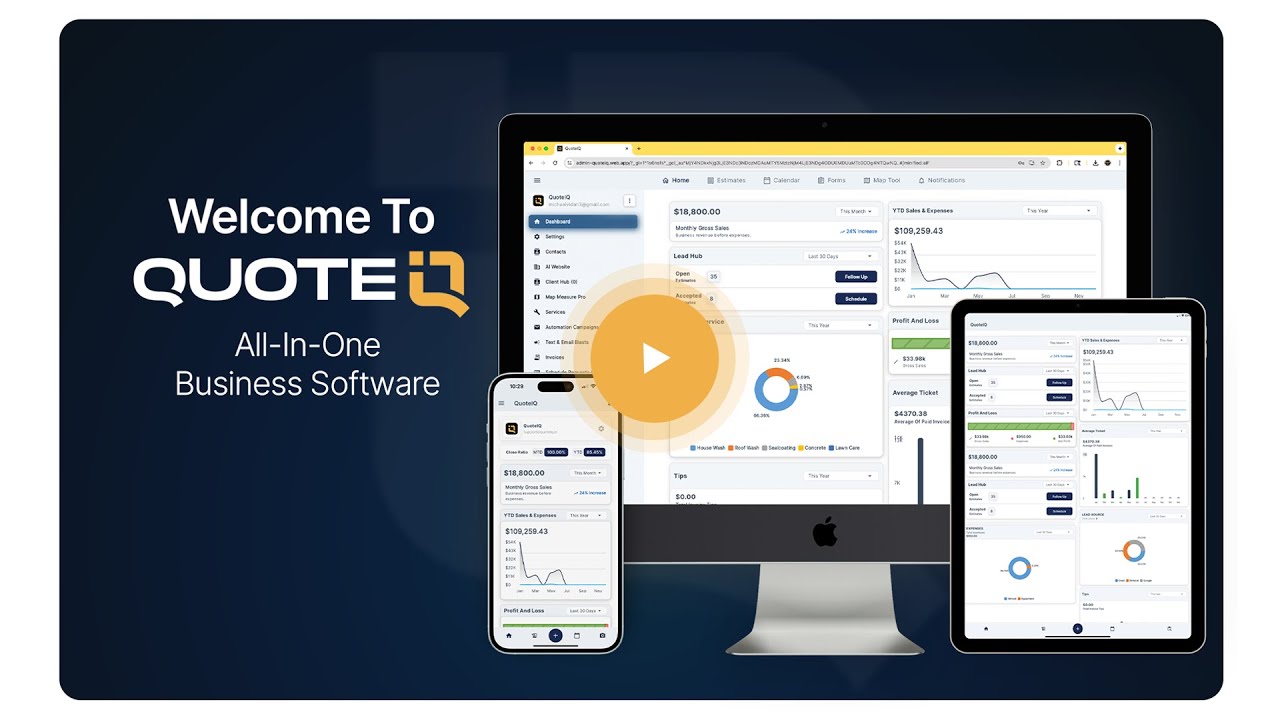
Replace five tools with one platform.
Most lawn care contractors run five or more tools: a field service platform, a phone system, an AI receptionist, an invoicing tool and a review-request tool. QuoteIQ collapses that into one login — at $149.99/month on Pro, the bundle pays for itself the first time the AI receptionist captures a call you would have missed.
How to Switch Your Lawn Care Business to QuoteIQ in Four Steps
Most operators are taking live calls on the new number inside a week. Here is the order that works.
Start the trial and import your list
Open the 14-day trial on the plan you actually intend to run, then bring customers and services across with AI Smart Import — it maps a CSV exported from your old system without manual column matching.
Build the price book
Load your mow tiers, fertilization rounds and aeration packages so the AI Estimator and your estimate templates quote from real numbers. Re-baseline rates first with the lawn care cost calculator.
Configure the receptionist
Give Virtual Call Team your service area, hours and price list as its knowledge base, set the emergency keywords that should reach your cell, and forward your existing line to your new ClientHub number.
Automate the follow-up
Switch on the confirmation text and quote-chase sequences in Email & Text Automation, then watch conversion in Business Analytics. On Elite, add automated review requests.
Reviewed by QuoteIQ’s Co-Founders
Both QuoteIQ Co-Founders are long-time home service operators who built two of the largest service-business audiences on YouTube.
Mike Vidan
Built one of the largest pressure washing and home service contractor audiences on YouTube, teaching operators how to start, scale and run service businesses — including lawn care and pressure washing operations.
Read Mike’s Insights →Justin Rogers
Founder of the ForeverSelfEmployed brand and one of the most-watched channels in the home service industry, sharing real-world strategy for running profitable service businesses at every stage of growth.
Read Justin’s Insights →What Lawn Care Operators Say About QuoteIQ
Verified 5★ reviews from lawn care and landscaping contractors on the App Store and Google Play.
“Amazing UI and easy to use! I use this for my landscaping company and it makes it very easy to track projects and payments for projects. The built in picture protection is also fantastic. I would highly recommend this to anyone who is thinking about it!”
“This seems like a legit helpful app! I’ve mostly used Yardbook as my CRM before, but their mobile app is not great and I have been looking for a different CRM that’s better on my phone. I think I’ve found the one!”
“I’m on my second year of business and have been using QuoteIQ for 4 months. It has been great for me. It reduces the time required by me to manage customer information, quoting, scheduling, and invoicing. It streamlined a lot of my processes to help grow my business.”
Stop Missing Lawn Care Calls. Start Capturing Pipeline.
QuoteIQ’s Virtual Call Team answers every inbound lawn care call, qualifies the caller, transcribes the conversation and files the lead where you can quote it — bundled with ClientHub business phone, AI Estimator, scheduling and invoicing on the Pro plan at $149.99/month. Annual billing is priced at ten months on every plan.