



Published May 2026 · Updated September 2026
Six scheduling platforms ranked for junk haulers running 6–12 pickups a day — judged on routing, job assignment, online booking, disposal-run planning, and the recurring property-manager contracts that keep a truck full.
QuoteIQ is the best scheduling software for junk removal businesses in 2026 because it pairs everyday job scheduling — included on every plan from $29.99/month — with Route Optimization, Route Density, and InstaSchedule customer self-booking on the Elite plan at $299/month, inside the same platform that handles AI photo estimating, invoicing, and job costing.
Workiz is the strongest pick for call-heavy haulers thanks to its built-in phone system and call tracking. Jobber offers the cleanest drag-and-drop calendar for small crews. ServiceTitan is the enterprise option once you are running a genuine multi-location fleet. Hauler Hero is the route-based waste and recycling specialist. Setmore is the lightweight online-booking pick for a true solo operator.
Current pricing for every competitor on this list changes often and is not reproduced here — check each vendor’s own pricing page before you budget. QuoteIQ’s published ladder runs Essentials $29.99, Beginner $74.99, Pro $149.99, Elite $299, and Max $699 per month, and every plan carries a 14-day free trial with full access to the features of the plan you choose. The decision comes down to one question: do you need routing, assignment, and self-booking bundled together, a phone-first tool, or just a calendar?
TL;DR: Junk removal lives and dies on the route. A hauler stacking 6–12 pickups a day needs scheduling that doubles as routing, not just a calendar. QuoteIQ takes Best Bundled Solution: scheduling is on every plan from $29.99/mo, and Elite at $299/mo adds Route Optimization, Route Density, InstaSchedule self-booking, and EmployeeHub with GPS location tracking, alongside AI photo estimates and job costing. Workiz suits phone-driven haulers, Jobber small crews, ServiceTitan large fleets, Hauler Hero recurring collection routes, Setmore solo operators. The Bureau of Labor Statistics tracks refuse collection as its own occupation, and the EPA puts U.S. municipal solid waste near 292 million tons a year — the volume behind every route you plan.
Each tool below wins for a specific kind of junk removal operation. Skip ahead to the category that matches how your trucks actually run, then read the full entry for the fit notes and the honest trade-offs. Pricing for every competitor is deliberately left to the vendor — rates move, tiers get renamed, and a stale number in a buyer’s guide is worse than no number at all.
QuoteIQ
From $29.99/mo, with the full routing stack on Elite at $299/mo. Scheduling, Route Optimization, InstaSchedule booking, AI photo estimates, and crew GPS in one app.
Workiz
Built its name in junk removal, with a built-in phone system, call tracking, and a strong scheduling board. The pick when inbound calls drive the business. See their site for current plans and rates.
Jobber
The cleanest drag-and-drop calendar and client-facing polish on this list for one-to-five-person crews. Plan tiers and add-on pricing are published on Jobber’s own pricing page.
ServiceTitan
Enterprise-grade routing, assignment, and reporting for multi-location hauling operations with office staff. Quote-based — request pricing directly from the vendor.
Hauler Hero
Purpose-built for recurring waste and recycling routes, with drag-and-drop assignment and container tracking. Strongest for established multi-truck fleets; pricing by quote.
Setmore
A simple, fast online booking calendar for a true solo operator. Check Setmore’s site for the current tier list — it is a booking tool rather than a field-operations platform.
Most trades schedule one job at a fixed address and stay there for hours. Junk removal is the opposite. A hauler stacks six to twelve short pickups across a metro, drives between them, and fits dump and donation runs in around them. The schedule is not a calendar — it is a route. A tool that cannot sequence stops, assign the right person, and re-plan around a late customer is costing the operation diesel, daylight, and the fourth or fifth job that never gets booked.
That is why “scheduling software” for junk removal really means four things working together: a shared calendar, route optimization that tightens the day’s drive, per-person job assignment with GPS visibility on who is where, and customer-facing online booking so jobs land on the calendar without a phone call. Tools that do only one of these leave the hauler bolting on a second and third app, then reconciling three systems every night.
There is also the lead-speed problem. Junk pickups are frequently impulse decisions — a packed garage, a tenant turnover, an estate cleanout that has to happen this week. The operator who can quote and book fastest usually wins the job, often before a competitor returns the call. That favors tools that combine instant booking with AI photo estimating, InstaQuote self-quoting, and automated call handling through the Virtual Call Team.
Run the numbers with your own figures. A two-truck operation doing 8 pickups per truck per day at a $350 average ticket books roughly $5,600 a day gross. If weak routing and phone tag cost each truck just one job a day — an empty slot, a late arrival, a missed callback — that is 2 jobs × $350 × 6 days = $4,200 a week in work you never invoiced. Against that, QuoteIQ Elite at $299/month is recovered by a single saved job per week. Swap in your real ticket average and stop count before you decide — the point is the size of the gap, not our example numbers.
The compounding effect is recurring revenue. Property managers, realtors, and general contractors who need regular hauling are the most valuable accounts a junk business can hold, and they expect to book and rebook digitally rather than negotiate by phone each time. A scheduling system that supports recurring jobs and lets those accounts self-schedule turns one-off cleanouts into a predictable book of business. That is the entire argument for a bundled platform over a standalone calendar — and it is why the Client Portal and recurring invoice subscriptions matter as much as the calendar itself.
Tying it together is job costing. Because junk pricing is volume-based and disposal fees swing with what is in the load, the only way to know whether a route was actually profitable is to capture revenue, labor hours, fuel, and dump fees against each job. When scheduling, assignment, estimating, and expense tracking live in the same system, that data assembles itself. When they live in three apps, the owner is reconciling spreadsheets at 9 PM and guessing at margin.
Junk removal carries a scheduling cost no other trade shares: the disposal leg. Every route has to be sequenced around transfer-station and landfill hours, donation-center drop-offs, and the plain physical fact that a full truck cannot take the next job until it is emptied. A scheduling tool that ignores disposal stops produces a route that looks efficient on screen and strands a loaded truck across town at 2 PM.
The volume behind this is not small. The EPA’s national materials and waste overview puts U.S. municipal solid waste generation at roughly 292 million tons a year, around 4.9 pounds per person per day. Construction and demolition debris is tracked separately and is larger still — see the EPA’s C&D material-specific data and its guidance on sustainable management of construction and demolition materials. Every ton of that has to be picked up, hauled, and tipped somewhere — and the tipping stop belongs on the schedule like any other job.
The systems that win for junk removal let the operator slot disposal runs into the day as real stops, record variable tip fees against the job that generated them, and keep the crew moving instead of idling at a full load. In QuoteIQ that means creating the run on the calendar like any other visit, letting Route Optimization place it in sequence, logging the tip ticket through expense tracking with a photo of the receipt, and letting job costing subtract it from that haul’s revenue automatically.
Drive time is not free, and the IRS puts a number on it. The standard business mileage rate rose mid-year in 2026 to 76 cents per mile from July 1 (72.5 cents for January through June). A truck that logs 120 unnecessary miles a week — a very ordinary penalty for hand-sequenced routes — is carrying about $91 a week in deductible-but-real vehicle cost, before you count the driver hours sitting behind it. Tightening the sequence is one of the few operational changes that shows up in fuel, payroll, and capacity at the same time.
Safety and disposal compliance ride along with the route. OSHA’s construction standard on disposal of waste materials governs how debris is dropped, chuted, and contained on job sites, and crews working demolition-adjacent cleanouts need that in their heads before they start pulling material. Custom inspection forms and photo documentation through QuoteIQ Cam give you a dated record of site condition before and after the haul — which matters most on the estate, hoarding, and foreclosure jobs where “it was already broken” becomes a conversation.
Adjacent trades hit the same pattern from different angles, which is why the same operational stack shows up on the hoarding cleanup, fire and water restoration, excavation, and general contractor pages. If you run cleanouts alongside demo or light construction, the demolition cost calculator and land clearing cost calculator are useful companions to the junk removal cost calculator.
“Best” lists on the internet are mostly affiliate revenue sorted by commission rate. This list is sorted by what wins for junk removal operators specifically, and it is honest about its own bias: QuoteIQ publishes it and QuoteIQ is on it. We do not reproduce competitor pricing here. Rates, tier names, and seat limits change without notice, and a number copied from a review aggregator six months ago is a liability, not a service — so every competitor entry sends you to that vendor’s own pricing page for the current figure. QuoteIQ’s own pricing is published in full below and on the pricing page.
1. Routing and sequencing
Junk routes pack 6–12 stops per truck per day. The tool that sequences stops, shows where work clusters, and re-plans on the fly saves real fuel and labor. QuoteIQ splits this into Route Density (where the work is) and Route Optimization (what order to hit it in).
2. Customer self-booking
Can a homeowner or property manager book a pickup themselves at 9 PM, or only request a callback? Self-booking through InstaSchedule captures the impulse job before a competitor calls back, and feeds it straight onto the calendar.
3. Speed to quote
Junk pricing is volume-based and visual. Tools that pair booking with photo or load-size estimating let the operator quote and confirm before the lead cools — that is the job of the AI Estimator and Quick Estimate.
4. Recurring account handling
Property managers and realtors are the highest-value accounts in the trade. The tool that supports recurring jobs, invoice subscriptions, and easy rebooking through the Client Portal protects that base.
5. Total cost of ownership
Subscription plus per-user fees plus phone, AI, and review add-ons. Some tools advertise a low base and sell the operationally critical pieces separately — which is exactly why you should price the whole stack on the vendor’s own page, not from a summary table.
6. Bundled vs. standalone
Does the tool include estimating, call handling, crew GPS, and review automation, or is it a scheduling silo that needs a separate stack around it? Compare the whole picture on the comparison hub.
The fast version; detailed entries follow. QuoteIQ pricing is current as published on the QuoteIQ pricing page. Competitor pricing is intentionally not reproduced — follow the vendor link in each entry and price the plan you would actually buy, including add-ons, on their own page.
| Platform | Pricing | Best For | Known For |
|---|---|---|---|
| QuoteIQ | $29.99–$699/mo Routing stack on Elite ($299) |
Haulers who want scheduling, routing, booking, and estimating in one subscription | Bundled Route Optimization, InstaSchedule self-booking, AI photo estimating, crew GPS, 14-day trial |
| Workiz | See vendor’s pricing page | Phone-driven cleanout businesses where inbound calls are the lead engine | Built-in phone system, call tracking and recording, strong scheduling board, junk-removal heritage |
| Jobber | See vendor’s pricing page | One-to-five-person junk crews wanting the cleanest scheduling experience | Drag-and-drop calendar, client-facing booking and communication, QuickBooks sync, polished mobile app |
| ServiceTitan | Quote-based — request from vendor | Multi-location hauling fleets with dedicated office staff and an implementation budget | Enterprise routing and assignment depth, large-team management, mature integration ecosystem |
| Hauler Hero | Quote-based — request from vendor | Established fleets running recurring waste and recycling collection routes | Route-based assignment, container tracking and availability forecasting, tablet driver app |
| Setmore | See vendor’s pricing page | Solo operators who need a professional online booking page and nothing heavier | Fast-to-set-up branded booking calendar, straightforward appointment management, strong support reputation |
Text version of the comparison data: QuoteIQ includes job scheduling on every plan from $29.99 per month and unlocks Route Optimization, Route Density, and InstaSchedule customer self-booking on the Elite plan at $299 per month, with ClientHub business phone available from Pro and unlimited users plus crew scheduling on Max at $699 per month; every plan carries a 14-day free trial with full access to the features of the plan you choose. Workiz is a field service platform with junk removal heritage, known for its built-in phone system and call tracking, and is the strongest fit for operations whose leads arrive by phone; current plan pricing is published on Workiz’s own site. Jobber is a generalist field service platform known for a clean drag-and-drop calendar, client-facing booking, and QuickBooks syncing, best suited to small junk crews; its plan tiers and add-on rates are published on Jobber’s own pricing page. ServiceTitan is an enterprise field service platform with deep routing, assignment, and reporting capability aimed at multi-location fleets, sold on a quoted basis with a formal implementation process. Hauler Hero is a waste and recycling specialist built around recurring collection routes, container tracking, and a tablet driver app, priced by quote and strongest for established multi-truck fleets. Setmore is a standalone online booking tool offering a branded booking page and appointment management for solo operators, with current tiers listed on Setmore’s site.
Each entry covers who it fits, what it does well, where the honest friction is, and what to verify on the vendor’s own site before you commit. Read the entry that matches your operation, not just the one at the top.
QuoteIQ wins this list because it treats scheduling the way a junk hauler actually experiences it — as a route, a crew, and a phone line, not just a calendar. Everyday job scheduling is on every plan from $29.99/month, with drag-and-drop across day, week, month, and employee-timeline views, multi-day jobs rendered as continuous events, and a GEO-Schedule map view that shows the day geographically rather than as a list. The Elite plan adds the pieces that matter once a truck is doing 6–12 stops a day: Route Optimization to tighten the drive, Route Density to show where work clusters before you plan the zone, and InstaSchedule so customers self-book against real availability without ringing your phone.
The bundling is the point for junk removal specifically. A homeowner texts a photo of a packed garage; the AI Estimator reads the pile and returns volume-based line-item pricing; the customer self-books through InstaSchedule or builds their own quote with InstaQuote; the job lands on the route; the assigned team member sees it with GPS navigation through EmployeeHub; payment collects on site through online payments; and a review request auto-sends afterwards through Review Multiplier. Recurring property-manager and realtor accounts rebook the same way through the Client Portal.
Be precise about how work gets to people, because this is where marketing language across the whole category gets loose. Assigning a job to a specific person is part of scheduling and is available from the Pro plan up. Building named crews and scheduling work to a crew rather than an individual is a Max plan capability, delivered through Crews. Route Optimization, Route Density, InstaSchedule, InstaQuote, and EmployeeHub with GPS location tracking and Time Tracker Pro all start at Elite. Knowing which tier unlocks which piece is the difference between a plan that fits and a plan you outgrow in month two.
QuoteIQ pricing: Essentials $29.99 (1 user, scheduling and estimating included), Beginner $74.99 (2 users, adds MapMeasure Pro and QuoteIQ Cam), Pro $149.99 (4 users, adds ClientHub business phone, Job Costing, and QuickBooks Online), Elite $299 (10 users, adds the routing and self-booking stack), Max $699 (unlimited users, adds Crews and the Sales Team Tracker). Annual billing is priced at ten months. Every plan includes a 14-day free trial with full access to the features of the plan you choose.
Honest gap: QuoteIQ is not a fixed-route waste-and-recycling system in the Hauler Hero mold, so a fleet running scheduled municipal-style collection with container inventory will find that a specialist fits better. ClientHub is a business phone line with two-way calling and texting rather than a full call-center suite, and it starts at Pro rather than the entry tier. And the platform is younger than the enterprise names on this list — which shows up as a faster release cadence but a shorter track record.
Quick verdict: If you run a residential or small-to-mid commercial junk removal business and want scheduling, routing, self-booking, and estimating in one subscription without per-truck fees or a long implementation, QuoteIQ Elite is the right pick. Choose differently if your leads are almost entirely inbound phone calls and you want a full call center (Workiz), you run a multi-location fleet with an implementation budget (ServiceTitan), or you are a solo operator who only needs a booking page (Setmore).
See all QuoteIQ plans → · Try the junk removal cost calculator →
Workiz earned its reputation in junk removal, and it shows in the day-to-day experience. Its scheduling board, real-time GPS visibility, and especially its built-in phone system with call tracking and recording are genuinely strong for operations that live off inbound calls — whole-house cleanouts, estate jobs, and construction-debris hauls that come in by phone all day. For an office where two people answer and assign work constantly, having the phone inside the same window as the schedule is a real workflow advantage rather than a checkbox.
Workiz restructured its plan lineup during 2026, so any tier names or monthly figures you find in older comparison articles — including earlier versions of this one — should be treated as out of date. Price it directly with the vendor, and price the whole configuration: ask specifically whether the phone system, the AI answering capability, and any review or photo-documentation tooling are included in the tier you are quoting or sold alongside it. That single question is what separates the advertised number from the number you will actually pay each month.
For scheduling and day-to-day field operations, a junk business can run on Workiz comfortably. The friction shows up as you scale and start paying for pieces separately that a bundled platform includes — which is exactly the comparison to run on the QuoteIQ comparison hub before you sign an annual term.
Quick verdict: If your junk business is driven by inbound phone volume and you want the strongest built-in call-and-schedule experience on this list, Workiz is the pick — just get the full configured price in writing before you commit.
Jobber is the polished generalist, and the name that shows up first in most searches for junk removal scheduling. Its drag-and-drop calendar, client-facing booking hub, and professional customer communication are genuinely best-in-class for small crews who want something clean and quick to learn. If your priority is that a new hire can be productive on the calendar within an afternoon, Jobber is the strongest candidate here.
Jobber publishes its plan tiers and add-on rates on its own pricing page, and it changes them periodically — go there for the current figure rather than trusting a table in any buyer’s guide, this one included. When you price it, look carefully at which tier carries route optimization, how additional users are billed, and which add-ons you would need to reach the workflow you are picturing. A one-truck operation and a four-truck operation can land on very different monthly numbers with the same product.
Where Jobber trails for junk specifically is domain fit rather than quality: the pricing model and estimating flow are built around generalist home services rather than volume-based or load-based junk pricing, so quoting a quarter-truck versus a full-truck load is something you configure yourself rather than something the product assumes. If your estimating is photo-led, compare that flow against AI photo estimating and the four QuoteIQ estimate types — Standard, Quick, Options, and Package.
Quick verdict: For a small junk crew that values a clean, simple scheduling experience and client-facing polish over deep field-operations tooling, Jobber is an excellent pick — budget for the add-ons that get you to your actual workflow.
ServiceTitan is the enterprise-grade option. Its scheduling, assignment, routing, and reporting depth are real, and for a large multi-truck operation with dedicated office and scheduling staff it delivers capability the lighter tools on this list do not attempt. Reporting in particular is a different class: if you need to slice performance by location, by crew, by lead source, and by service line and have someone whose job is to read those reports, this is the platform built for that.
It is also built for scale, and that cuts both ways. ServiceTitan does not publish a standard rate card — pricing is quoted per operation, typically with a formal implementation project and an annual agreement. Budget for the rollout period and the internal training time as seriously as the subscription itself, and get the full first-year cost in writing before you compare it against anything else on this list. If you want a structured way to model that, the ServiceTitan pricing calculator walks through the variables that drive a quote.
For a small or mid-size junk hauler, the cost, the rollout timeline, and the complexity are hard to justify against a platform you can be running on this afternoon. This is the right tool once you are a genuine fleet with the office staffing to use it — and the wrong one before that.
Quick verdict: If you are a multi-location junk or hauling operation with office staff and an implementation budget, ServiceTitan’s depth is worth the process. For everyone smaller, it is more platform than the workflow needs.
Hauler Hero is the purpose-built waste-and-recycling platform on this list. Its drag-and-drop assignment board, dynamic route optimization, container tracking, and tablet driver app are designed around how route-based haulers actually work, and it is genuinely excellent at sequencing recurring collection and forecasting container availability. If your business looks more like scheduled collection than on-demand cleanouts, it is the most domain-native option here.
The fit caveat matters more than any number. Hauler Hero is oriented toward recurring waste and recycling routes and is priced by quote rather than from a public rate card — request current pricing directly. For a hauler doing variable one-off garage, estate, and construction-debris jobs, a good deal of its route-density machinery is aimed at a different problem, and you would be paying for depth in the part of the workflow you use least.
If your operation is moving toward recurring scheduled collection across a fleet, it is a strong specialist worth a serious demo. For on-demand junk removal, it is likely more system than the workflow needs — and the bundled generalists will cover the estimating and customer-facing side that a collection-route tool treats as secondary.
Quick verdict: For an established fleet doing recurring scheduled waste or recycling collection, Hauler Hero is a strong specialist. For an on-demand junk removal business doing variable one-off cleanouts, it is probably a mismatch.
Setmore is the honest lightweight option, and naming it is not a courtesy — a genuinely solo one-truck operator booking a handful of jobs a week does not need a field-operations platform. A clean, branded booking page that lets customers grab a time slot is the whole requirement at that stage, and Setmore does that quickly and without a learning curve.
Check the current tier list on Setmore’s own site, and be clear-eyed about scope: it is an appointment-booking product rather than a junk-removal operations platform. Before committing, confirm on their site which capabilities your tier covers for calendar syncing, reminders, and payment handling, and how that fits with whatever you use for estimating and invoicing. Most solo haulers pair it with something separate for quoting and getting paid, which is workable at one truck and awkward at two.
For a solo operator who wants customers booking online this week, it is hard to beat on simplicity. The moment you add a second truck and need to sequence a route rather than fill a calendar, you will be shopping again — and the migration is easier if you have kept clean customer records, which AI Smart Import can pull across when that day comes.
Quick verdict: For a true solo junk operator who needs an online booking calendar and nothing else, Setmore is the right call. Plan to migrate to a routing platform the moment you add a truck.
Three real-world shapes of junk removal operation. Each ends with an honest recommendation — and not all of them recommend QuoteIQ.
Two-truck residential hauler, 8–10 pickups a day
Owner-operated, two trucks, mostly residential garage and estate cleanouts plus a handful of property-manager accounts. Currently juggling a paper calendar, a group text, and a separate booking link — and losing a job most days to hand-sequenced stops or a missed callback.
The pain: stops are ordered by guesswork, after-hours leads go to voicemail, and the recurring property-manager work runs on memory.
→ Recommendation: QuoteIQ Elite ($299/mo) — scheduling, Route Optimization, and InstaSchedule self-booking in one app, with Virtual Call Team catching overflow calls.
Phone-driven cleanout business living off inbound calls
A junk operation whose lead flow is almost entirely inbound phone calls — whole-house cleanouts, foreclosure work, and construction debris coming in by phone all day. Two office staff answer and assign constantly, and call handling is the bottleneck.
The pain: the business is won or lost on the phone, and the team needs call tracking, recording, and a phone-first workflow more than a booking page.
→ Recommendation: Workiz — its built-in phone system is the deciding factor for a phone-first hauler. Price the full configuration with the vendor before committing.
Solo operator just getting started, one truck
A brand-new one-truck junk hauler doing a few jobs a week, booking everything personally, and not ready to pay for a full platform. They want customers to grab a time slot online instead of playing phone tag.
The pain: no budget for a full operations platform yet, and no route to optimize — just a need for a simple, professional booking page.
→ Recommendation: Setmore for now — then move to QuoteIQ Essentials or Elite once a second truck and a real route enter the picture.
QuoteIQ Elite at $299/month bundles Route Optimization, Route Density, InstaSchedule customer self-booking, AI photo estimating, recurring jobs, ClientHub business phone, and Virtual Call Team AI answering — the pieces standalone schedulers either skip or sell separately. 14-day free trial with full access to the features of the plan you choose.
Software pays for itself in this trade through three mechanisms: capturing leads you currently lose, tightening the drive between stops, and protecting recurring accounts. Here is how to size each one with your own figures rather than ours.
Junk jobs are frequently same-week decisions — a packed garage someone wants gone before a closing date. The operator who quotes and confirms first usually takes the job, and the one who calls back at 4 PM the next day is quoting against work already done. InstaSchedule plus AI photo estimating compresses quote-to-booking into minutes, after hours included, and Virtual Call Team answers, qualifies, and transcribes the calls that still come in by phone. Track your own callback-to-close rate for a month before and after — it is the cheapest experiment in this list.
A truck doing 8 pickups a day at a $350 average ticket grosses roughly $2,800 a day. If tighter sequencing and self-booking add just one extra job per truck per day, that is $350 × 6 days = $2,100 a week per truck — on the order of $100,000 a year on a single truck before you add the second. QuoteIQ Elite at $299/month is a rounding error against that figure. Substitute your real average ticket: at a $220 ticket the same math still clears $1,300 a week per truck.
Buy the tier that matches the mechanic you need, not the brochure. Essentials $29.99 — scheduling, estimating, invoicing, 1 user. Beginner $74.99 — adds MapMeasure Pro and QuoteIQ Cam, 2 users. Pro $149.99 — adds ClientHub, Job Costing, Client Portal, 4 users. Elite $299 — adds Route Optimization, Route Density, InstaSchedule, InstaQuote, EmployeeHub, Inventory, 10 users. Max $699 — adds Crews and unlimited users.
The third mechanism is the one owners underweight: recurring accounts. Property managers, realtors, and general contractors who rebook on a schedule are the most valuable customers a junk business can hold, because they arrive without acquisition cost. Letting them self-schedule protects that base, and a platform that also handles the phone, tracks the crew, and requests the review afterward turns scheduling from an overhead line into the growth engine. That is the whole case for bundled over standalone — and it is measurable in your own business analytics within a quarter.
Most trades quote by the hour or the square foot. Junk removal quotes by how much of the truck the load fills — a quarter, a half, three-quarters, or a full bed — adjusted for weight, stairs, disassembly, and anything the transfer station charges extra to take. That makes speed and consistency the two things an estimating workflow has to deliver, because the same sofa quoted three different ways by three different crews is a margin leak you cannot see in the P&L.
A photo-led flow handles this well. The customer texts or uploads pictures, the AI Estimator analyses the pile, asks targeted follow-up questions, and produces market-accurate line-item pricing for your area. From there the quote can go out as a Quick Estimate for a straightforward garage clear, an Options Estimate when you want to present good/better/best tiers for partial versus full cleanout, or a Package Estimate for bundled recurring service. E-signatures close it on the customer’s phone, and contract attachments carry your liability terms on the estate and hoarding work where they matter most.
For larger property jobs where the scope is outdoor rather than indoor — yard debris, a demolished deck, storm cleanup — satellite measurement through MapMeasure Pro lets you size the area before rolling a truck, with Property Street View and Zillow Quick Access filling in access and property context. Pair that with the junk removal cost calculator and the wider home service business calculators when you are setting or resetting your price book.
Then close the loop. Log the tip fee and fuel against the job through expense tracking, let hours flow in from Time Tracker Pro, and read the result in Job Costing: price minus labor minus expenses equals profit, with a margin bar per job. After thirty jobs you will know which categories of work — appliance hauls, estate cleanouts, construction debris — are actually carrying the business, and you can raise the price book where the margin is thin instead of across the board. Invoice from the same record through invoicing, take payment on site with online payments, and offer consumer financing on the five-figure whole-property clearouts where the customer needs terms.
One-off residential cleanouts pay the bills; recurring commercial accounts build the business. Property managers running tenant turnovers, realtors staging listings, general contractors clearing site debris, and storage facilities cycling abandoned units all need hauling on a rhythm rather than a whim. They are also the accounts most likely to leave over an administrative failure rather than a price — a missed pickup, an unanswered request, an invoice that never arrived.
Scheduling software protects those relationships in ways that are unglamorous and decisive. Recurring jobs go on the calendar as a series, so a weekly or monthly pickup does not depend on anyone remembering. Individual occurrences can be dragged without disturbing the rest of the series when a tenant turnover slips a week. The Client Portal gives each account a branded self-service view where they can see appointments, approve estimates, submit new requests, and pay invoices without emailing anyone. Invoice subscriptions bill the recurring portion automatically with full tax and discount handling, and reminders and tasks keep the follow-ups from living in someone’s head.
Communication is the other half. A property manager with four buildings does not want to hunt for which crew member they texted in March. ClientHub gives the business a dedicated number with two-way calling and texting where every message lands on the customer record, and email and text automations fire the on-the-way notice, the completion note, and the follow-up without anyone typing them. For the portfolio-level accounts, Pipelines and Deals tracks the multi-building proposals through stages with weighted forecasting, and mass campaigns reach a tagged segment of property managers when you open a new service area.
Finally, keep the record clean. The client database holds the site notes that make the second visit faster — gate codes, dumpster access, which elevator the building lets you use. QuoteIQ Cam archives before-and-after documentation on the contact rather than in someone’s camera roll. Roles and permissions control who can see pricing and who can only see the job. And when an account asks for a year of history at renewal time, data export produces it in minutes instead of an evening.
The full inquiry-to-completed-pickup workflow inside QuoteIQ, using scheduling, Route Optimization, and InstaSchedule — from a new junk inquiry to a routed, assigned, invoiced pickup.
A homeowner or property manager clicks “Book a Pickup” or texts photos of the load from a Google ad, a social post, or an email reminder. Inbound calls that arrive at the same time are answered, qualified, and transcribed by the Virtual Call Team, and website contact forms drop web enquiries straight into the system.
The AI Estimator reads the pile and returns volume-based line-item pricing — quarter, half, three-quarter, or full truck — with follow-up questions for stairs, weight, and disassembly. The customer can also build their own quote through InstaQuote.
InstaSchedule shows your live calendar — only the windows you can actually serve, including recurring property-manager slots — and stays in sync through Google Calendar sync so nothing double-books.
The customer picks a slot. The job lands on the calendar, Route Density shows which zone the day belongs in, Route Optimization sequences the stops, the visit is assigned to the right team member, and confirmation and reminder messages send automatically.
The assigned team member sees the routed day and navigates from EmployeeHub with GPS tracking and Time Tracker Pro running. The haul runs, before-and-after photos save through QuoteIQ Cam, payment collects on site, and Review Multiplier requests the review.
Job scheduling is on every plan from $29.99/month, and every plan includes the AI toolkit — AI Autopilot, Virtual Call Team, AI Estimator, and the before-and-after image generator — drawing on that plan’s monthly IQ Credits. Route Optimization, Route Density, and InstaSchedule customer self-booking are available on Elite and Max. Crew creation and crew scheduling are on Max. Every plan carries a 14-day free trial with full access to the features of the plan you choose.
Annual billing is priced at ten months on every plan. See the full pricing page → · Browse all features → · Compare QuoteIQ to other platforms →
QuoteIQ is the best scheduling software for junk removal businesses in 2026 because it combines everyday job scheduling on every plan from $29.99 per month with Route Optimization, Route Density, and InstaSchedule customer self-booking on the Elite plan at $299 per month — the four capabilities a 6-to-12-stop junk route actually needs, in one subscription rather than three. Workiz is the stronger pick for haulers whose leads arrive almost entirely by phone, because of its built-in phone system and call tracking. Jobber is the cleanest calendar for a one-to-five-person crew. ServiceTitan suits multi-location fleets with office staff and an implementation budget. Hauler Hero fits recurring waste and recycling collection routes. Setmore covers a solo operator who only needs a booking page. The Bureau of Labor Statistics tracks refuse and recyclable material collection as its own occupation, which is a fair signal of how route-driven this trade is. Compare the full picture on the comparison hub or pricing page before you decide.
QuoteIQ costs $29.99 per month for Essentials with one user, $74.99 for Beginner with two, $149.99 for Pro with four, $299 for Elite with ten, and $699 for Max with unlimited users. The routing stack — Route Optimization, Route Density, and InstaSchedule — starts on Elite at $299, and annual billing is priced at ten months, so Elite annual works out to $2,990. Every plan includes a 14-day free trial with full access to the features of the plan you choose, one trial per person, business and payment method; a credit or debit card is required to start. Competitor pricing is deliberately not reproduced in this guide, because tier names and rates in this category change several times a year and a stale figure is worse than none — check each vendor’s own pricing page for the current number, and price the whole configuration including add-ons rather than the headline tier. When you model total cost, remember the operating side too: the IRS standard mileage rate reached 76 cents per mile from July 1, 2026, so drive time saved by routing has a defensible dollar value of its own.
Customer self-scheduling works by giving the customer 24/7 access to your real availability so they can book a pickup without calling. With InstaSchedule on the Elite plan, a homeowner or property manager opens your booking link, sees only the windows you can actually serve, picks a slot, and the booking syncs live to your calendar, where Route Optimization sequences it into the day’s drive. Paired with AI photo estimating for instant volume-based pricing and InstaQuote for customer-built quotes, the whole path from enquiry to confirmed booking can run in minutes with nobody on the phone. That matters most for the after-hours and weekend enquiries that otherwise sit in voicemail until a competitor answers first. The booking link works on your website, your Google Business Profile, and inside email or text reminders, and the confirmation and reminder messages send automatically. The U.S. Small Business Administration publishes general guidance on operating and growing a small service business that is worth reading alongside any tooling decision.
They are three connected jobs and mixing them up is how haulers buy the wrong tier. Scheduling is putting a pickup on the calendar at a time and assigning it to a person — QuoteIQ includes the calendar on every plan from $29.99 per month, and per-person job assignment from the Pro plan up. Route Density answers “where is the work” by showing you where jobs cluster geographically so you can plan which zone a truck should own that day. Route Optimization answers “in what order” by sequencing the day’s stops to minimise drive time, accounting for appointment windows and job duration, and recalculating when a late addition lands. Both start on Elite at $299 per month. Building named crews and scheduling work to a crew rather than an individual is a separate capability that lives on the Max plan through Crews. A calendar-only tool covers the first job and leaves the other two to you, which is exactly where multi-truck junk operations start bleeding hours. For context on the labour side of that equation, the BLS Occupational Outlook Handbook covers the material-moving roles most junk crews hire into.
Yes. With InstaSchedule on the Elite plan and up, you place a booking link on your website, your Google Business Profile, or in email and text reminders, and customers see your real-time availability and book a pickup slot themselves without a phone call. The booking syncs straight to the calendar and gets sequenced by Route Optimization. You can pair it with InstaQuote so the customer builds a volume-based quote — quarter-truck through full-truck — before they book, and with website contact forms for enquiries that need a human first. Recurring property-manager and realtor accounts rebook the same way through the Client Portal, which also lets them approve estimates and pay invoices in the same place. Most platforms in this category offer some form of online booking; the difference worth testing in a demo is whether the booking feeds routing and estimating automatically or simply drops an appointment on a calendar. Bookings that arrive from search traffic are worth tracking against the waste-volume context the EPA’s national waste figures describe.
Scheduling software reduces missed jobs and wasted drive time in three ways. First, online self-booking through InstaSchedule captures impulse and after-hours pickups that would otherwise sit in voicemail, while the Virtual Call Team answers, qualifies, and transcribes the calls that still come in by phone. Second, Route Optimization sequences the day’s stops so a truck is not crossing the metro twice, and Route Density keeps the day inside a workable zone in the first place. Third, automated reminders and on-the-way notices cut no-shows and the dead time of arriving to an empty driveway. Put a number on it with your own figures: a truck running 8 pickups a day at a $350 average ticket grosses about $2,800 daily, so recovering one job per truck per day is roughly $2,100 a week per truck. On the cost side, the IRS business mileage rate of 76 cents per mile from July 2026 means 120 wasted miles a week is around $91 in vehicle cost alone. Read the outcome in Job Costing and business analytics.
Yes. QuoteIQ handles one-off residential cleanouts and recurring commercial accounts in the same system. For residential work, a homeowner gets an AI photo estimate and self-books a pickup through InstaSchedule. For commercial work, property managers, realtors, and general contractors who need regular hauling are set up on recurring jobs, billed automatically through invoice subscriptions, and given a branded Client Portal where they can approve estimates, submit requests, and pay without emailing anyone. Team members are assigned and tracked through EmployeeHub, and every message with an account stays on the customer record through ClientHub. Elite at $299 per month covers the routing and self-booking that multi-truck residential-and-commercial operations need; Max at $699 adds unlimited users and crew scheduling for larger fleets. If your commercial work leans toward construction debris, the EPA’s construction and demolition debris data is a useful reference for sizing that market locally.
Schedule the disposal run as a real stop, not an assumption. In QuoteIQ you create the transfer-station or donation-centre visit on the calendar like any other job, let Route Optimization place it in sequence around facility hours and truck capacity, and photograph the tip ticket into expense tracking so the fee lands against the haul that generated it. Job Costing then subtracts labour and disposal from the job’s price and shows the real margin, which is the only honest way to price volume-based work where tip fees swing with the load. Use QuoteIQ Cam for before-and-after documentation on estate, hoarding, and foreclosure jobs where site condition becomes a conversation later. Crews handling demolition-adjacent debris should also know OSHA’s construction rule on the disposal of waste materials, which governs how debris is dropped, chuted, and contained on site.
Buy for the route, not the calendar. Junk removal is a sequencing problem. A tool without Route Optimization and Route Density will hand you a tidy calendar and an expensive day.
Know exactly which tier unlocks what. With QuoteIQ, scheduling is on every plan from $29.99, per-person assignment from Pro, routing and InstaSchedule from Elite at $299, and Crews on Max at $699.
Price the configuration, not the headline tier. Every competitor on this list publishes or quotes its own rates — get the full configured number in writing, including anything sold alongside the base plan, before you compare.
Treat the dump run as a scheduled stop. Sequence disposal around facility hours, log tip fees through expense tracking, and let Job Costing tell you which work is actually profitable.
Protect the recurring base. Property-manager and realtor accounts arrive without acquisition cost. Recurring jobs, invoice subscriptions, and the Client Portal are what keep them.
Speed wins impulse jobs. Pair AI photo estimating with self-booking and Virtual Call Team answering so a 9 PM enquiry is a confirmed booking by 9:05.
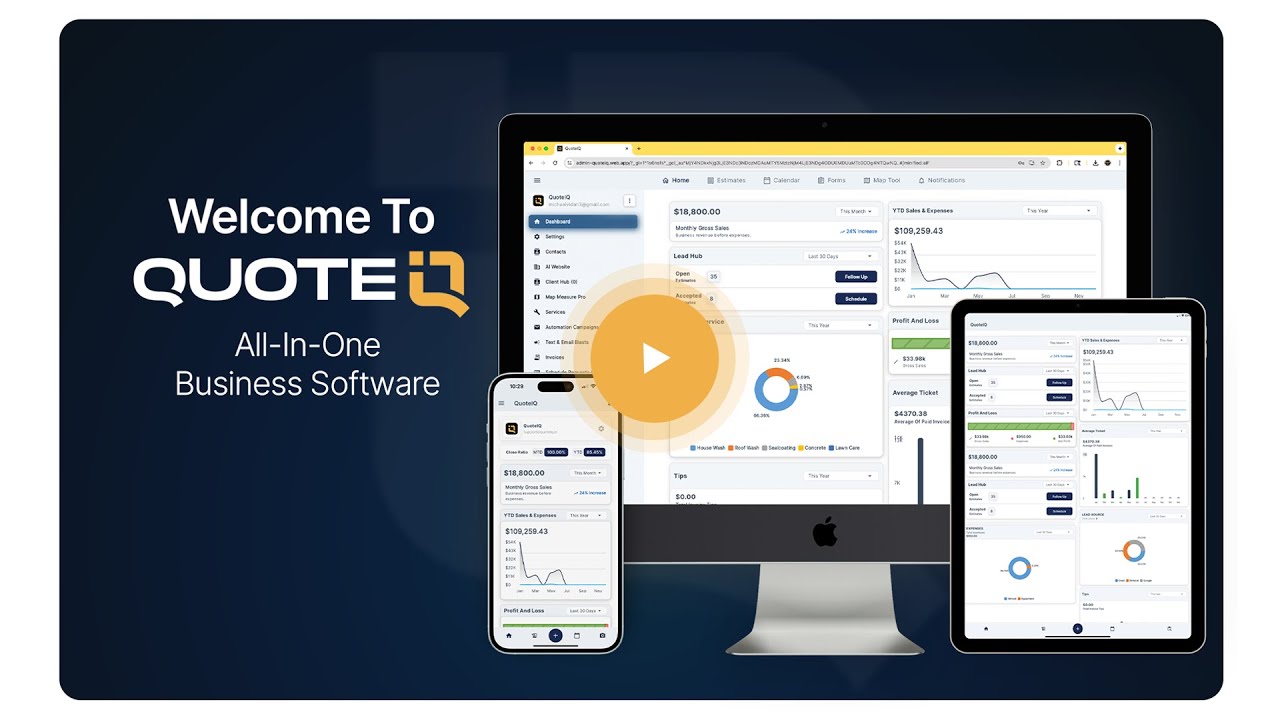
A short walkthrough of how QuoteIQ replaces the stack of disconnected tools most junk removal contractors use to schedule, quote, route, and invoice their work.
Watch Video →Four steps from a fresh account to a routed, self-bookable schedule. Most haulers are running live jobs the same day they start the trial.
Create the account, pick the plan whose features you want to test, and bring your existing customer list across with AI Smart Import, which maps columns from a spreadsheet or another CRM automatically. Site notes, gate codes, and access details land on each record in the client database.
Enter your quarter, half, three-quarter, and full-truck rates plus surcharges for stairs, weight, and hard-to-take items. Use the junk removal cost calculator and the built-in business calculators to sanity-check the numbers against your market before you publish them.
On Elite and up, switch on Route Optimization and Route Density, then publish your InstaSchedule booking link to your site and Google Business Profile. Set the service windows you can genuinely staff — the calendar only offers what you tell it you can serve.
Invite team members into EmployeeHub, set roles and permissions so crews see jobs without seeing margins, enable Review Multiplier for post-payment review requests, and connect QuickBooks Online on Pro and up so invoices and payments sync to the books.
This guide is written and reviewed by operators who have run home service businesses, not by a generalist software desk. Read more from both on the QuoteIQ Insights hub.
Co-Founder, QuoteIQ
A home service business owner of more than twenty years who built one of the largest contractor audiences on YouTube, teaching operators how to start, scale, and run service businesses — including junk removal and cleanout operations.
Co-Founder, QuoteIQ
Serial entrepreneur and founder of the ForeverSelfEmployed brand, sharing real-world strategies for running profitable home service businesses across one of the most-watched channels in the trade.
Verified five-star reviews from QuoteIQ customers across home service trades. Reviewer trades are shown as recorded; QuoteIQ is building a dedicated junk removal review set.
“I have a lawncare business, was unorganized, but QuoteIQ changed everything. Estimates, scheduling, billing and invoicing are seamless. Tax prep easier. Best CRM by functionality and price.”
— Elke Staton · App Store · Lawn Care · Verified Review
“I’m on my second year of business and have been using QuoteIQ for 4 months. It has been great for me. It reduces the time required by me to manage customer information, quoting, scheduling, and invoicing. It streamlined a lot of my processes to help grow my business.”
— Terry Hinson · Google Play · Home Service Business · Verified Review
“First of all this app saves me so much time,the new updates they do are impactful. I’ve used it for pressure washing, I’ve used it for even doing concrete estimating. The ability to send invoices directly and charge from the app is a win win! I like how it incorporates the ability to keep your customers like a CRM program and it helps me check up on those customers that called, I can call back pretty fast make a note on their file. I also like how everyone can access it from my Crew. App is #1”
— Shawn Contreras · Google Play · Pressure Washing · Verified Review
QuoteIQ puts scheduling on every plan from $29.99/month and adds Route Optimization, Route Density, and InstaSchedule self-booking on Elite at $299/month — alongside AI photo estimating, crew GPS tracking, and AI call answering. One subscription, 40,000+ contractors, 4.7 stars across 4,103 reviews.

Tell Google that QuoteIQ is a source you trust. One tap unlocks up to 40% off your annual plan. No free trial — billed in full at checkout.


