



Best Invoicing Software for Plumbing Businesses in 2026
Published June 2026 · Updated October 2026
Six platforms compared for plumbing contractors — from solo drain techs to multi-truck service departments. QuoteIQ pricing verified against our own live pricing page; competitor pricing is quote-dependent and belongs on their pages, not ours.
QuoteIQ is the best invoicing software for plumbing businesses because Invoicing, Online Payments and recurring Invoice Subscriptions are included on every plan from $29.99/month — so a solo plumber and a ten-truck shop bill the same way, at a price that does not scale per technician. Jobber is the cleanest quote-to-invoice workflow for solo operators. Housecall Pro is built around collecting payment before the tech leaves the driveway. ServiceTitan is the enterprise choice for large service departments that need flat-rate pricebook presentation. FieldEdge is purpose-built for plumbing and HVAC service departments with an established pricebook. Service Fusion is worth a look for shops adding technicians quickly. Competitor pricing changes often and several of these vendors quote rather than publish — check each vendor’s own pricing page before you budget.
TL;DR: For most plumbing shops under ten technicians, QuoteIQ covers the whole billing loop in one subscription: line-item estimates convert to invoices in a tap, online payments take card and ACH, Invoice Subscriptions run backflow and drain-maintenance agreements automatically, Consumer Financing covers the repipe the homeowner cannot pay for today, and Job Costing on Pro ties each invoice back to real parts and labor. ClientHub chases the balance by text and QuickBooks Online sync keeps the books straight. Plans run $29.99 to $699/month — see full pricing. Industry context: BLS and PHCC.
Winners by Category
Six platforms, six different plumbing shops. The right answer depends on how many trucks you run and how your customers pay.
QuoteIQ
Invoicing, online payments and recurring billing on every plan from $29.99/month, bundled with AI Estimator, scheduling and Review Multiplier.
Jobber
A famously tidy quote-to-invoice path. One approval turns an estimate into a payable invoice the homeowner can settle online.
Housecall Pro
Built around finishing the job and collecting before leaving the driveway — a good match for residential service plumbing.
ServiceTitan
Flat-rate pricebook with good-better-best presentation on the tablet. Aimed squarely at large plumbing service departments.
FieldEdge
Purpose-built for plumbing and HVAC service work, with the Coolfront flat-rate pricebook as a long-standing billing standard.
Service Fusion
Positions itself around seat-count flexibility, which matters when a shop is adding its fourth, fifth and sixth truck.
Why Invoicing Software Matters for Plumbing Businesses
Plumbing is a large, stable, and growing trade. The U.S. Bureau of Labor Statistics counted 510,600 plumbers, pipefitters and steamfitters in 2025, projects 7% growth through 2035 — much faster than the 3% average across all occupations — and expects roughly 42,000 openings a year over that decade. Sixty-five percent of those workers are employed by plumbing, heating and air-conditioning contractors: owner-operated service businesses that live or die on whether the invoice goes out the same day the wrench goes back in the truck.
Plumbing billing has demands that generic accounting tools miss. A tech running three emergency drain calls, a water heater swap and two backflow tests in one day needs to build the invoice on the truck — line items pulled from a price book, photos attached as documentation, tax handled correctly, and a payment link the homeowner can tap at the kitchen table. Anything that pushes billing back to an office queue adds days of float to every ticket, and those days compound across a week of calls.
There is a documentation dimension too. Plumbing work is inspected, warrantied and occasionally disputed. An invoice that carries the before-and-after photos, the inspection form, the signed approval and the contract attachment is a far stronger record than a carbon copy in a truck binder. The IRS recordkeeping guidance is blunt about the principle: you must keep records as long as they are needed to prove the income or deductions on a return, and employment tax records for at least four years. Digital invoices with attachments satisfy that far more cleanly than paper.
Then there is recurring revenue. Shops running maintenance agreements — annual backflow certification, quarterly drain maintenance on commercial accounts, water heater service plans — need billing that fires on schedule without anyone remembering. That is exactly what Invoice Subscriptions do, and they are included on every QuoteIQ plan including Essentials at $29.99/month.
Take a five-tech plumbing shop averaging 12 completed jobs a day at a $450 average ticket — $5,400 of daily billable work. If 15% of those invoices go out three days late, that is $810 a day sitting unbilled, and roughly $2,430 of cash permanently three days behind at any given moment. Same-day mobile invoicing does not increase revenue; it pulls that float forward once and keeps it there. Run your own numbers in the home service business calculators.
Finally, margin. A shop that invoices $1,200 for a water heater replacement but never records the parts cost, the permit fee and the labor hours against that ticket is guessing at profitability. Invoicing tools that connect to Job Costing and Expense Tracking turn every invoice into a margin data point instead of just a receivable. The SBA’s business management resources make the same point about reviewing operating costs against revenue rather than tracking revenue alone.
Our Methodology
Most “best of” lists are affiliate revenue wearing a lab coat. This one is sorted by what actually wins for plumbing businesses. QuoteIQ figures come from our own live pricing page and plan pages. For the other five platforms we deliberately do not publish dollar figures, seat counts or trial lengths: several of them quote rather than publish, all of them change terms without notice, and a stale number in a buyer’s guide is worse than no number. Check each vendor’s own pricing page the day you budget.
What we weighted
Mobile invoice creation speed. Can a plumber build and send an invoice from the truck in under a minute? For residential service work this is the single most important workflow metric, because every minute of friction is a minute the tech is not driving to the next call.
Same-day payment collection. Does the platform support card, ACH bank transfer and digital wallets at the moment of completion? Homeowners pay how they pay; the software should not narrow that list.
Recurring and agreement billing. Backflow certification, drain maintenance and commercial service contracts are the difference between a plumbing business and a plumbing job. Billing has to fire on a schedule without a human remembering.
Job costing connection. Does the invoice tie back to parts, labor hours and permit fees, so the owner sees margin per job rather than revenue per job?
Total cost as the shop grows. Per-user and per-technician models look affordable for a solo plumber and painful at eight trucks. We weighted what the bill looks like at the team sizes plumbing shops actually reach.
Documentation that survives a dispute. Photos, inspection forms, signatures and contract attachments living on the invoice itself, not in a separate app.
| Platform | Starting Price | Pricing Model | Recurring Invoicing | Best For |
|---|---|---|---|---|
| QuoteIQ | $29.99/mo | Flat-rate, five tiers | Included on every plan | 1–10 tech plumbing shops wanting one system |
| Jobber | Published — see their pricing page | Tiered, with per-user add-ons | Check current plan terms | Solo plumbers who want simplicity |
| Housecall Pro | Published — see their pricing page | Tiered, with paid add-ons | Check current plan terms | Residential plumbers focused on mobile billing |
| ServiceTitan | Quote-based — no public rate card | Per-technician plus implementation | Check current plan terms | Large plumbing service departments |
| FieldEdge | Quote-based — no public rate card | Per-user plus onboarding | Check current plan terms | Shops with an established flat-rate pricebook |
| Service Fusion | Published — see their pricing page | Flat-rate tiers | Check current plan terms | Crews growing fast on seat count |
QuoteIQ
QuoteIQ puts invoicing, online payments, a price book and recurring Invoice Subscriptions on every plan starting at $29.99/month. That single decision is what separates it from platforms that gate billing essentials behind upper tiers. For a plumbing business the workflow runs straight through from the estimate: build a standard line-item estimate for a repipe, a quick estimate for a hose bib replacement, or an options estimate that shows the homeowner repair, repair-plus-upgrade and full replacement side by side — then convert the approved version to a payable invoice in one tap.
The payment side is unusually complete for the price. Customers can pay by credit or debit card, ACH bank transfer, Apple Pay or Google Pay online, and cash or check gets recorded in the app so the ledger stays honest. Tips can be enabled at checkout, deposits and partial payments are supported, and Consumer Financing — Affirm, Klarna and Afterpay — is available on every plan, including during the trial. For a plumbing shop that regularly quotes water heater replacements and sewer line work, being able to offer installments at the kitchen table without bolting on a lender integration is a genuine close-rate lever.
The plumbing-specific value compounds on Pro at $149.99/month. That tier adds Job Costing — price minus labor minus expenses equals profit, with labor pulled automatically from time tracking — so every invoice resolves into a margin figure rather than just a receivable. Pro also adds ClientHub, a dedicated business number with two-way calling and texting logged to the customer record, which is how most shops actually chase an unpaid balance. QuickBooks Online sync lands at the same tier, pushing invoices, payments and customers across without double entry.
Recurring work is handled natively. Set up an annual backflow certification cycle or a quarterly commercial drain maintenance agreement and the invoice generates and sends on schedule. Pair that with email and text automations on Pro for payment reminders, and with Review Multiplier, which can fire a review request straight after payment clears — turning a settled invoice into a Google review without anyone following up by hand.
The AI layer is included rather than upsold. The AI Estimator reads property photos, asks follow-up questions and generates market-accurate line-item pricing for common jobs. AI Autopilot runs 55 tools across 13 categories by voice or text — “invoice all of today’s completed jobs and send them” is a real command. The Virtual Call Team answers, qualifies and transcribes inbound calls around the clock, which matters when half your emergency work arrives at 9pm. All of it runs on IQ Credits included with every plan.
QuoteIQ includes seats in the plan price: 1 user on Essentials, 2 on Beginner, 4 on Pro, 10 on Elite and unlimited on Max. A six-person plumbing shop sits inside Elite at $299/month with four seats to spare. Annual billing is ten months for twelve — Elite at $2,990/year against $3,588 paid monthly, a $598 difference under current pricing.
✓ Invoicing, payments, price book and recurring billing on every plan from $29.99/mo
✓ Seats included in the plan price — no per-technician fee as the shop grows
✓ Consumer Financing on every plan for high-ticket repipes and water heaters
✓ Job Costing on Pro ties each invoice to real parts, labor and expenses
✓ AI Estimator, Autopilot and Virtual Call Team included, not add-ons
✗ QuickBooks integration is QuickBooks Online and starts at Pro ($149.99/mo)
✗ Job Costing and Client Portal are Pro and above, not on the entry tiers
✗ Price Book is included on every plan, but you build your own plumbing catalog — no third-party flat-rate library ships with it
✗ MapMeasure Pro and QuoteIQ Cam start at Beginner, not Essentials
“The software is a game changer for me. Not only can I send estimates an invoices and look really professional. I can also accept card payments through the email. It’s so seamless that my customers just click, click click and then I’m paid. I love it”— Isaac Miletic, verified QuoteIQ user
Jobber
Jobber’s appeal to plumbers is simplicity. The quote-to-invoice pipeline is about as clean as the category gets: build an estimate on site, the customer approves from their phone, and it converts to an invoice they can pay online. For a solo plumber or a two-to-three person shop doing residential service work, that frictionless path means fewer evenings spent catching up on billing at the kitchen table.
The client portal is a genuine strength — homeowners approve quotes, view invoices and pay without an account — and the product has a long track record with trades that bill a lot of small residential tickets. Plumbing shops that primarily run service calls and want the simplest possible billing loop will find it comfortable from day one.
The honest consideration is cost structure as you grow. Jobber’s model layers additional users and optional modules on top of the plan tier, so the headline figure and the number on the invoice at eight technicians can diverge. Before committing, price the exact configuration your shop needs — seats included, the tier that unlocks accounting sync, and any add-ons — directly on Jobber’s own pricing page, then compare that total against a flat-rate alternative like QuoteIQ Pro. See also our full comparison hub.
✓ Very clean quote-to-invoice conversion
✓ Client portal where homeowners approve and pay online
✓ Long track record with residential service trades
✗ Per-user add-ons mean cost scales with crew size — price your real headcount
✗ Accounting sync and deeper reporting sit on higher tiers — confirm which
✗ Verify current plan inclusions on their pricing page before budgeting
Housecall Pro
Housecall Pro was built around a single idea that maps almost perfectly onto residential plumbing: finish the job, send the invoice, collect the payment before leaving the driveway. The mobile billing experience is among the smoothest in the category. The tech closes out the work order, line items populate from the estimate, the customer signs on the tablet, and payment processes on the spot.
For a shop doing high-volume residential service — water heaters, fixture swaps, drain clearing, garbage disposals — that rhythm is worth a lot. The platform has also continued investing in automation and AI capability, so older reviews claiming it lacks modern tooling are out of date and should be ignored.
The thing to scrutinise is the add-on structure. Several capabilities plumbing shops consider core — price book depth, proposals, vehicle tracking — have historically been priced separately from the base tier, which means the advertised plan and the real monthly bill can be different conversations. Build the full configuration your shop needs on their pricing page before comparing against an all-in platform. If the bundled approach appeals, QuoteIQ’s invoicing and photo documentation are included rather than metered.
✓ Excellent mobile invoicing experience for residential service work
✓ Strong on-site payment collection flow
✓ Actively shipping automation and AI capability
✗ Add-on modules can move the real monthly cost well above the headline tier
✗ Confirm which tier unlocks accounting sync for your bookkeeper
✗ Price the full configuration, not the entry plan, before comparing
ServiceTitan
ServiceTitan is the deepest invoicing platform on this list for plumbing businesses operating at enterprise scale. The flat-rate pricebook with good-better-best presentation on the technician’s tablet is the reference implementation for residential plumbing upselling: the tech shows three options — repair, repair plus upgrade, full replacement — the homeowner picks one, and the invoice generates with the correct parts, labor and warranty terms attached. No manual line-item entry, no arithmetic in the driveway.
The depth extends past the invoice itself into membership billing for maintenance plans, integrated customer financing for high-ticket work, and marketing attribution that connects a completed repipe back to the campaign that generated the call. For a large plumbing service department with dedicated office staff, that reporting layer is genuinely hard to replicate.
The honest read is about fit, not quality. ServiceTitan is designed for established service departments with the headcount and back-office capacity to run it, and it is sold by quote with implementation and onboarding attached rather than by self-serve signup. A three-truck plumbing shop will not get proportional value from that, and should price the alternative honestly — our ServiceTitan pricing calculator is built for exactly that comparison. The good-better-best presentation itself is reproducible at small-shop cost with Options Estimates.
✓ Category-leading flat-rate pricebook and good-better-best invoicing presentation
✓ Membership billing and integrated financing for high-ticket plumbing work
✓ Deep reporting and marketing attribution for large service departments
✗ Quote-based, per-technician pricing with implementation attached
✗ Built for enterprise-scale operations — small shops overpay for unused depth
✗ Onboarding is a project, not an afternoon — plan for a real implementation window
FieldEdge
FieldEdge earns its place through trade specificity. It is built for plumbing and HVAC service departments rather than adapted to them, and the Coolfront flat-rate pricebook that ships alongside it has been a billing standard in residential plumbing for years. Technicians present professional, pre-calculated pricing for common tasks — faucet replacement, water heater install, drain clearing — instead of hand-writing numbers on site, which both speeds up the close and standardises what every tech charges.
Service agreement handling is the other thing plumbing and HVAC operators consistently single out. If your business runs on maintenance memberships and you already think in flat-rate task codes, FieldEdge speaks that language natively, and the accounting integration story is a long-standing reason shops with established bookkeeping workflows stay put.
The trade-off is modernity and cost shape. The interface is older than the newest platforms in this guide, pricing is quoted rather than published, and seats are priced per user — which compounds as a plumbing shop adds technicians. If your bookkeeping requirements are not the binding constraint and you want current AI tooling with seats included in the plan, compare it against QuoteIQ for plumbing before signing.
✓ Purpose-built for plumbing and HVAC service departments
✓ Coolfront flat-rate pricebook with plumbing task pricing out of the box
✓ Mature service agreement and membership billing workflow
✗ Interface feels dated next to newer platforms in this guide
✗ Per-user pricing compounds as the shop adds technicians
✗ Quoted pricing and a structured onboarding period — ask for both up front
Service Fusion
Service Fusion’s pitch to growing plumbing shops is seat flexibility. Where several competitors price per technician, Service Fusion has historically positioned its tiers around generous user allowances, which changes the arithmetic for a shop moving from five trucks to ten. If headcount growth is the thing that keeps breaking your software budget, it is worth putting on the shortlist.
Operationally, the standout for plumbing dispatch is built-in VoIP calling tied to customer records — useful in a trade where a large share of bookings still arrive by phone, often as emergencies. Combined with fleet tracking and accounting integration, it suits an office-coordinated plumbing operation more than a solo tech.
Points to check before committing: evaluation terms, mobile app quality on the specific platform your techs carry, and whether reporting gives you margin per job or only revenue. Plumbing shops that want margin visibility baked into billing should compare against Job Costing and business analytics, and shops weighing seat count should look at QuoteIQ Max, which carries unlimited users at a flat $699/month.
✓ Seat-friendly tiers for shops adding technicians quickly
✓ Built-in VoIP calling tied to customer records for phone-led dispatch
✓ Accounting integration included in the core product
✗ Ask about evaluation terms before committing — confirm what you can test
✗ Test the mobile app on the exact devices your techs carry
✗ Confirm whether reporting shows margin per job or revenue only
When QuoteIQ Isn’t the Right Fit
If you run a large plumbing service department with dedicated dispatchers and a call centre, and you need flat-rate pricebook presentation, membership billing and campaign-level attribution woven together, ServiceTitan is the stronger fit and the depth is real. If your business is organised around an established flat-rate task-code pricebook and your bookkeeping workflow is the binding constraint on any change, FieldEdge deserves a serious look. And if your invoicing needs are genuinely limited to sending a handful of simple bills a month, a basic accounting package may be enough on its own.
For most plumbing operations under about ten technicians — the ones that want invoicing, payments, recurring agreements, financing, job costing and AI estimating in one subscription without per-technician pricing — QuoteIQ Pro at $149.99/month covers the workflow end to end.
Ready to Invoice From the Truck?
Join 40,000+ contractors using QuoteIQ to bill on site and get paid before they pull out of the driveway.
Flat-Rate vs Time-and-Materials Invoicing
Almost every argument about plumbing invoicing software is really an argument about pricing model. Flat-rate shops sell a task: “replace a 40-gallon gas water heater, $X, warranty included.” Time-and-materials shops sell hours plus parts plus a markup. Both are legitimate, and the software has to support whichever one you run — ideally both, because most plumbing businesses end up doing flat-rate on known tasks and T&M on anything that turns into excavation.
Flat-rate billing wins on speed and consistency. The customer hears one number before work starts, there is no awkward conversation about how long the tech took, and every technician charges the same for the same task. The cost is setup: somebody has to build and maintain the task list. QuoteIQ includes a Price Book on every plan, so you can build plumbing task codes once and have them populate estimates and invoices across the whole team. Pair it with Package Estimates for bundled jobs — water heater plus expansion tank plus permit — and the arithmetic stops happening in the driveway.
Time-and-materials billing wins on fairness for unpredictable work. Sewer line repairs, slab leaks and old-house repipes resist fixed pricing because nobody knows what is behind the wall. What T&M needs from software is accurate labor capture and tidy materials handling: hours that land on the right job automatically rather than being reconstructed from memory on Friday. On Elite and above, Time Tracker Pro handles GPS clock in and out per job, and those hours feed Job Costing directly at the Pro tier and above.
The hybrid approach most growing plumbing shops land on is flat-rate for the top twenty recurring tasks and T&M for everything else, with an Options Estimate presented when the homeowner has a real choice between repair and replacement. That good-better-best presentation is the single highest-leverage billing habit in residential plumbing, and it does not require enterprise software to run.
A plumbing invoice that a homeowner will pay without a phone call usually has between 3 and 7 line items, a photo, and a plain-language description of what failed. Fewer than three reads as a guess; more than seven reads as padding. QuoteIQ supports sub-items and parent-child line hierarchy, so a repipe can show one headline price with detail nested underneath rather than 22 flat rows.
Service Agreements and Recurring Billing
Recurring revenue is what turns a plumbing job into a plumbing business. The common agreement types are annual backflow certification testing, quarterly drain maintenance on restaurants and commercial kitchens, water heater service plans, and whole-home maintenance memberships that bundle a yearly inspection with priority scheduling and a discount on repairs. All of them share one requirement: the invoice has to go out on schedule, every cycle, without an owner remembering.
This is where Invoice Subscriptions matter, and it is worth noting they are included on every QuoteIQ plan rather than gated behind an upper tier. You can convert an accepted estimate directly into a recurring subscription, set the cycle, and let full discount, tax, fee and deposit math carry through each time. For a shop with 60 backflow accounts coming due in a compressed spring window, the difference between automated and manual billing is a week of someone’s life every year.
Agreements also need a paper trail. Contract Attachments let you attach the signed agreement PDF to the record, and E-Signatures let the customer sign on their phone rather than mailing anything. On the scheduling side, recurring visits drop onto the calendar as a series you can drag individually without disturbing the rest of the sequence — useful when one restaurant moves its quarterly to a Tuesday.
To reduce no-shows and late payment on agreement visits, Pro adds email and text automations with event triggers and personalisation tags, plus on-the-way texts so the homeowner is home when the tech arrives. Shops running larger agreement books can segment by tag and reach the whole list at once with Mass Campaigns on Elite and above.
Deposits, Progress Billing and Financing Big-Ticket Work
Plumbing has a bimodal ticket distribution. Most calls are a few hundred dollars; a handful each month are repipes, sewer line replacements, tankless conversions and slab leak repairs that run into five figures. Those big jobs are where billing software either protects the business or exposes it.
Deposits come first. Taking a deposit against materials on a repipe is standard practice, and the estimate should carry the deposit requirement so the customer agrees to it before anybody orders copper. QuoteIQ supports deposit requirements on estimates and partial payments on invoices, so the remaining balance stays visible and the job does not get billed twice by accident.
Then financing. A homeowner facing an unexpected $9,000 repipe often has the intent but not the cash this week, and a shop without a financing option simply loses that job to whoever has one. Consumer Financing is included on every QuoteIQ plan, including during the trial: Affirm supports jobs up to $30,000 over 3 to 36 months, Klarna offers pay-in-four and pay-in-30 structures, and Afterpay handles smaller pay-in-four tickets. The customer applies at checkout and gets a decision in about thirty seconds; the contractor is paid in full upfront and the provider carries collections and default risk.
That last point is the one plumbing owners underrate. Financing is not a cash-flow compromise — it converts a stalled high-ticket job into a paid-in-full invoice while the homeowner pays over time to someone else. Eligibility, limits and fees are set by the provider rather than by the CRM, so confirm what is enabled for your account before you present it at the kitchen table.
Fixture replacement is an easy add to an existing plumbing invoice. EPA WaterSense labelled products are independently certified to use at least 20% less water than standard models while performing as well or better, and the agency notes that replacing old faucets and aerators with labelled models can save roughly 700 gallons per year. That is a concrete, citable reason to put a fixture line on the estimate instead of hoping the customer asks.
What a Plumbing Invoice Should Actually Contain
An invoice is a legal record, a marketing asset and a dispute defence at the same time. The ones that get paid fastest and argued with least tend to carry the same elements, and good software supplies them without extra effort from the technician.
Identity and licensing. Company details, logo and licence number on the PDF. In most jurisdictions a plumbing licence number on customer-facing documents is either required or strongly expected, and BLS notes most states and some localities license plumbers, typically after two to five years of experience and an exam. Custom branding handles this once for the whole team.
Plain-language scope. What failed, what was done, what was replaced. “Cleared mainline blockage at 60ft via exterior cleanout; cable and camera inspection” beats “drain service” every time, and it is what stops the dispute six months later.
Photographic evidence. QuoteIQ Cam captures job photos and video organised by job and date, supports annotations and before-and-after comparisons, and attaches galleries straight to the document. For plumbing — where the work is usually buried, behind a wall or under a slab by the time the customer looks — this is the difference between a trusted invoice and a suspicious one.
Inspection documentation. Inspection Forms produce customisable PDF reports, which is exactly the artefact a backflow test or a pre-purchase plumbing inspection needs to generate.
Approval and terms. A signature captured on the customer’s phone, terms and conditions on the PDF, and clear payment terms. Editing an estimate after sending automatically voids the outstanding signature request, so the signed version always matches the billed version.
Correct tax treatment. Tax tracking is included on every plan, with per-contact tax override available for the commercial accounts and exempt entities most plumbing shops eventually pick up.
Getting Paid Faster: Terms, Reminders and Payment Methods
Speed of payment is mostly a function of three things: how fast the invoice goes out, how easy it is to pay, and how reliably somebody follows up. Software can fix all three, and the gains compound because plumbing is a repeat-business trade.
On method, breadth matters more than elegance. QuoteIQ customers can pay invoices by credit or debit card, ACH bank transfer, Apple Pay or Google Pay online, with cash and check recorded manually in the app. ACH in particular is the method commercial plumbing accounts prefer, and the toggle lives in bank details settings. Saved cards and recurring auto-pay are supported for agreement customers, so the quarterly drain maintenance bill settles itself.
On terms, residential service work should generally be due on receipt with a payment link at completion. Commercial and property-management accounts expect net terms, and QuoteIQ supports Net 15, 30, 60 and 90. The mistake plumbing shops make is applying commercial terms to residential customers out of habit and then wondering why the ageing report looks the way it does.
On follow-up, automate it. Automated payment reminders with customisable timing handle the first two nudges without anybody feeling awkward, and when a balance genuinely needs a human, ClientHub gives you a dedicated business number so the text comes from the company rather than a technician’s personal phone — and the whole thread is saved to the customer record. For customers who prefer self-service, the Client Portal on Pro and above lets them view and pay outstanding invoices without an account or an app download.
Service plumbing is a driving business, and the truck is one of the largest deductible costs on the books. The IRS standard mileage rate for business use rose mid-year in 2026 to 76 cents per mile from July 1, up from 72.5 cents for the first half. A tech covering 1,200 business miles a month is looking at roughly $912 of deductible mileage in a single month at the current rate — but only if the trips are actually recorded. Pair invoice records with Expense Tracking so the deduction survives review.
Emergency and After-Hours Invoicing
Plumbing is one of the few trades where a meaningful share of revenue arrives outside business hours. BLS notes plainly that plumbers are often on call for emergencies and that evening and weekend work is common. Emergency work carries different billing mechanics: premium rates, a customer who is stressed and wet, and an invoice that needs to be unambiguous because the price is higher than normal.
Three things make after-hours billing work. First, the call has to be captured — a missed 11pm burst-pipe call is a lost four-figure job. The Virtual Call Team answers around the clock, qualifies the lead, filters spam, records and transcribes every call, and sends a summary, which at minimum means you wake up to a real lead rather than a voicemail notification. It is metered through IQ Credits, so minutes are finite at lower tiers — worth sizing against your actual after-hours call volume.
Second, the premium has to be on the estimate before the work starts, not added to the invoice afterwards. An after-hours task code in the price book removes that conversation entirely.
Third, payment should be collected on site. Emergency customers are motivated at 2am and much less so on Thursday. Sending the payment link before the tech packs up converts that motivation into cleared funds. Related trades handle this the same way — see how it plays out on our drain cleaning and septic services pages.
Commercial Plumbing Invoicing
Commercial plumbing billing is a different sport. The customer is a property manager, a facilities coordinator or a restaurant group, the approval chain has more than one person in it, and the invoice has to survive an accounts-payable process rather than a homeowner’s glance.
What that demands practically: purchase order or work order references on the document, net terms rather than due-on-receipt, correct tax handling including exemptions, and multiple contacts on the record so the invoice reaches the person who pays as well as the person who called. QuoteIQ supports multiple contacts on a job, with emails, texts and automations fanning out to all of them, plus separate job and billing addresses — which is exactly the shape of a commercial plumbing engagement where work happens at a site and billing goes to a head office.
Volume is the other difference. A property management client with 40 units generates a lot of small tickets, and billing them one at a time is a waste of an afternoon. Mass Invoicing from the jobs dashboard or calendar — available from Beginner upward — closes out a day or a week of completed work in one pass. Keep the client records organised with the client database and tags so segmentation by account stays trivial, and use Reminders and Tasks for the follow-ups that AP processes inevitably generate.
Job Costing: Turning Invoices Into Margin
Revenue is vanity; margin is the business. A plumbing shop can grow its invoice total every quarter and get poorer, and the usual culprit is a mix shift toward jobs that bill well and cost worse. The fix is to make every invoice resolve into a cost picture.
Job Costing on Pro and above runs the arithmetic per job: total price minus labor minus expenses equals profit, with a profit-margin bar on the job’s report tab. Labor pulls automatically from time tracking at an hourly rate rather than being estimated, and expenses link to the job rather than floating in a general bucket. Categorised expenses with receipts come from Expense Tracking at Beginner and above, and the Hourly Rate Calculator at Pro helps you set the labor rate honestly in the first place.
For plumbing specifically, the costs that quietly destroy margin are permit fees, return trips for the wrong part, and warranty callbacks on work billed months ago. All three only become visible when the invoice and the cost sit on the same record. Once they do, the pattern usually shows up fast: a shop discovers that water heater installs clear healthy margin while small drain calls barely cover the truck roll, and starts pricing accordingly.
Shops at Elite and above can take this further with Inventory Management across trucks and warehouse locations — stock deducts when the invoice is paid, so the materials picture matches the money picture — and with Route Optimization, which cuts drive time by roughly 15 to 30% and attacks the single largest non-billable cost in a service plumbing day. Business analytics then reports revenue by service, customer and employee, conversion rate, average ticket and completion rate.
BLS puts the median annual wage for plumbers, pipefitters and steamfitters at $63,800 as of May 2025 — about $30.67 an hour — with the top 10% above $108,420. Before burden, that is your floor for a billable-hour calculation. Shops setting a flat-rate task price without working back from a fully-burdened labor cost are guessing, and the guess is usually low.
Recordkeeping, Tax and the Paper Trail
Invoicing software is also your record system, and that has consequences beyond getting paid. IRS guidance is that you may use any recordkeeping system that clearly shows income and expenses, that records must be kept as long as needed to prove the income or deductions on a return, and that employment tax records must be kept for at least four years. The burden of proof sits with the business.
For a plumbing shop that means invoices, the supporting photos, the signed approvals and the expense receipts should all be retrievable years later without a shoebox being involved. Keeping them attached to the job record rather than scattered across a phone camera roll, an email account and a filing cabinet is the whole point. Export Data is available on every plan, so the records remain yours and portable regardless of what you do with the subscription later.
For shops that run their books in QuickBooks Online, the QuickBooks integration at Pro and above syncs invoices, payments, customers and expense categories, with duplicate-sync locks and automatic syncing of missing customers before an estimate syncs. That removes the double entry that otherwise consumes a bookkeeper’s week. General business-management context is available from the SBA, and the Plumbing-Heating-Cooling Contractors Association is the national trade body for plumbing and HVACR contractors, with business intelligence and education resources aimed at exactly this operator.
Choosing by Shop Size
Solo plumber or owner-operator. You need estimates, invoices, online payments and a calendar, and you need them on a phone. Essentials at $29.99/month covers one user with invoicing, recurring billing, price book, financing, AI Estimator and Virtual Call Team included. The thing most solo plumbers underestimate is recurring billing — a handful of maintenance agreements compounds quickly.
Two-person shop. Beginner at $74.99/month adds a second seat plus QuoteIQ Cam, MapMeasure Pro, Review Multiplier, expense tracking, mass invoicing and advanced analytics. For plumbing the camera documentation alone usually justifies the step up.
Three to four technicians. Pro at $149.99/month is the tier most plumbing shops should actually be on. Four seats, Job Costing, QuickBooks Online sync, ClientHub, Client Portal, automations and on-the-way texts. This is where billing stops being admin and starts being management information.
Five to ten technicians. Elite at $299/month covers ten users and adds EmployeeHub with GPS location tracking, Time Tracker Pro, Route Density, inventory, Pipelines and customer self-service via InstaQuote and InstaSchedule.
Ten-plus technicians or multiple locations. Max at $699/month carries unlimited users at a flat price, plus crew creation and scheduling, Sales Team Tracker, the AI Website Builder included, four additional businesses and priority support. For a plumbing group running separate service and construction divisions, multi-business support matters more than any single feature.
Adjacent trades bill on the same machinery — if your shop also runs HVAC, irrigation, basement waterproofing or bathroom remodeling work, the same subscription covers it. Full trade detail lives on the plumbing software page and its plumbing FAQ.
If you are still billing on paper, start with a template rather than a platform. The contractor invoice template and construction invoice template are free, and the French drain, basement waterproofing and foundation repair calculators cover the water-intrusion jobs plumbing shops get pulled into. Browse the full set of business calculators.
QuoteIQ Plans — Invoicing on Every Tier
Every plan includes estimates, invoicing, online payments, recurring Invoice Subscriptions, price book and Consumer Financing. Seats are included in the plan price.
Essentials
/month · 1 user · 500 IQ Credits
Invoicing + PaymentsEstimates & Invoicing
Invoice Subscriptions
Online Payments & Tips
Price Book & Tax Tracking
Consumer Financing
AI Estimator & Virtual Call Team
Scheduling & Mobile App
Beginner
/month · 2 users · 1,500 IQ Credits
+ DocumentationEverything in Essentials
QuoteIQ Cam & Inspection Forms
MapMeasure Pro
E-Signatures
Expense Tracking
Mass Invoicing
Advanced Analytics
Pro
/month · 4 users · 3,000 IQ Credits
+ Job Costing + QuickBooksEverything in Beginner
Job Costing (margin per job)
QuickBooks Online Sync
ClientHub Calling & Texting
Client Portal
Email & Text Automation
On-The-Way Texts
Elite
/month · 10 users · 5,000 IQ Credits
+ Field OperationsEverything in Pro
Route Optimization & Density
InstaQuote & InstaSchedule
Inventory Management
EmployeeHub & Time Tracker Pro
Pipelines & Deals
Mass Campaigns
Max
/month · Unlimited users · 8,000 IQ Credits
+ Multi-Crew ScaleEverything in Elite
Unlimited User Seats
Crew Creation & Scheduling
Sales Team Tracker
AI Website Builder Included
4 Additional Businesses
Priority Support
Annual billing is ten months for twelve. Compare all plans → | Book a free demo →
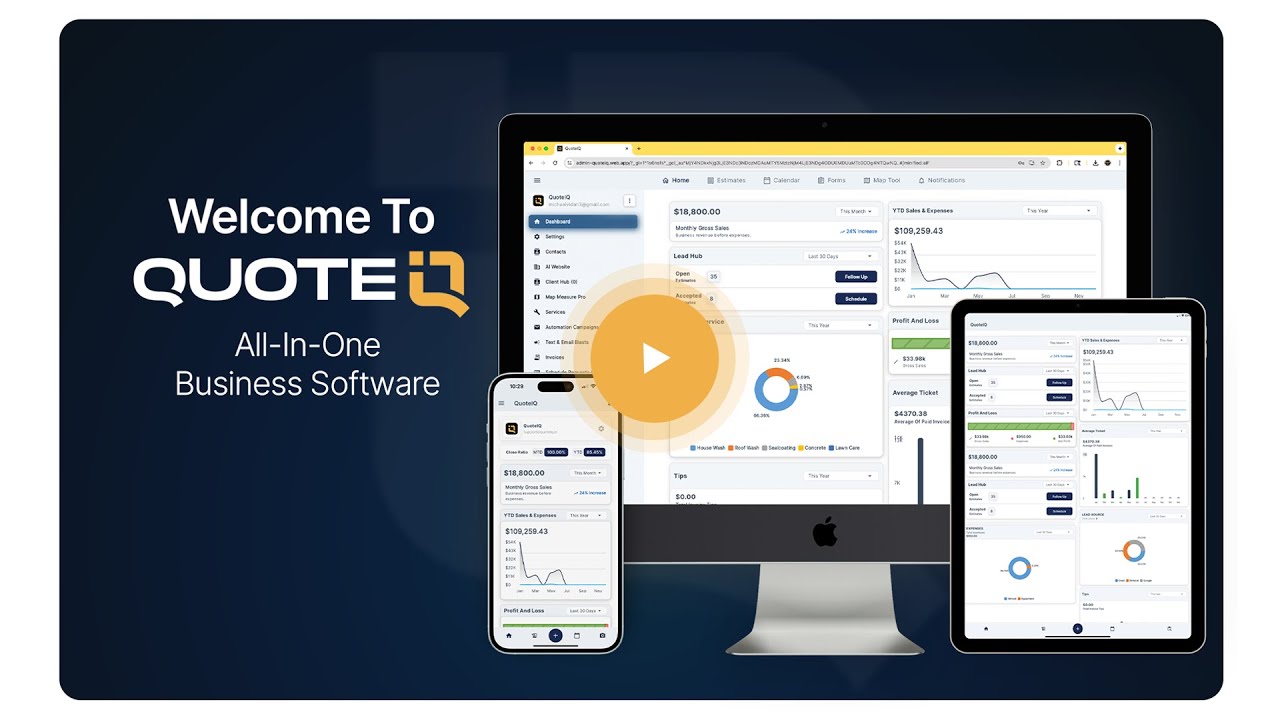
See QuoteIQ in Two Minutes
A short walkthrough of how QuoteIQ replaces the stack of disconnected tools most plumbing contractors use to run a service business.
How a Plumbing Customer Gets Invoiced With QuoteIQ
From finished job to cleared payment to a Google review, without the technician opening a laptop.
Open the job on the mobile app
The technician opens the job record on iOS or Android. Customer details, service address, the work performed and any photos captured on site are already attached from the scheduling and estimating workflow — nothing is re-entered.
Convert the approved estimate to an invoice
One tap turns the approved estimate into a payable invoice. Line items, price-book pricing, tax and any adjustments made on site carry across automatically, so labor hours and parts costs are never typed twice.
Send the payment link to the homeowner
QuoteIQ sends a secure payment link by text or email. The homeowner pays by credit card, debit card, ACH bank transfer, Apple Pay or Google Pay — or applies for Consumer Financing on a larger job — before the plumber leaves the driveway.
Payment clears and the review request fires
Once payment processes, Review Multiplier can send the customer straight to your review page or trigger an email and SMS review request — turning a settled invoice into a Google review with no manual follow-up.
The invoice syncs to QuickBooks Online
On the Pro plan and above, the completed invoice and payment record sync automatically to QuickBooks Online with duplicate-sync protection — no double entry, and the bookkeeper sees the transaction without chasing anybody.
Frequently Asked Questions
What is the best invoicing software for plumbing businesses in 2026?+
QuoteIQ is the best invoicing software for plumbing businesses in 2026 because invoicing, online payments, a price book and recurring Invoice Subscriptions are included on every plan from $29.99/month, with seats bundled into the plan rather than charged per technician. The Pro plan at $149.99/month adds Job Costing and QuickBooks Online sync — the two capabilities most plumbing shops need alongside billing. Jobber, Housecall Pro, ServiceTitan, FieldEdge and Service Fusion each have real strengths, but several price per technician or quote rather than publish, so the bill at eight trucks can look very different from the bill at one. With roughly 510,600 plumbers working in the US according to the Bureau of Labor Statistics, most are in small shops where that pricing shape matters more than feature depth. See full QuoteIQ pricing.
How much does plumbing invoicing software cost in 2026?+
QuoteIQ runs from $29.99/month for Essentials with one user, to $74.99 for Beginner with two, $149.99 for Pro with four, $299 for Elite with ten and $699 for Max with unlimited users. Annual billing is ten months for twelve — Elite is $2,990 a year against $3,588 paid monthly, a $598 difference. Invoicing, payments and recurring billing are on every tier, so the price you pay is for seats and operational depth, not for the ability to bill. Competitor pricing varies widely in both level and structure: some publish, some quote, and several charge per technician or add paid modules, so the right comparison is your real configuration at your real headcount on each vendor’s own pricing page. Budget the whole operating picture rather than the subscription alone: payment processing, optional add-ons and any implementation or onboarding charges sit outside the plan fee on most platforms, including this one. The SBA has general guidance on evaluating recurring business expenses, and the business calculators help you model the all-in monthly cost before committing.
Does QuoteIQ integrate with QuickBooks for plumbing invoicing?+
Yes. QuoteIQ integrates with QuickBooks Online on the Pro plan at $149.99/month and above. The QuickBooks integration syncs invoices, payments, customers and expense categories, uses transaction locks to prevent duplicate records from double-syncs, and automatically syncs a missing customer before syncing an estimate rather than silently skipping it. The integration covers QuickBooks Online. For plumbing shops, the practical payoff is eliminating the week a bookkeeper otherwise spends re-entering field invoices, and keeping the Job Costing and expense picture consistent with the accounting ledger. If your shop runs commercial accounts on net terms, the sync also keeps the ageing report accurate without a manual reconciliation pass each month. Records remain yours and portable through Export Data on every plan, which matters given IRS recordkeeping expectations that employment tax records be kept at least four years and that records generally be retained as long as they are needed to prove income or deductions on a return.
Can plumbers send invoices from the job site?+
Yes. QuoteIQ’s mobile app runs on iOS and Android with full web parity, so a plumber can build and send an invoice from the truck. The flow is: complete the work, convert the approved estimate to an invoice in one tap, attach job photos as documentation, and send a payment link by text or email. The homeowner pays by credit or debit card, ACH bank transfer, Apple Pay or Google Pay through Online Payments, and cash or check is recorded in the app. Same-day billing removes the two-to-three-day lag that office-based invoicing creates — meaningful in a trade where the BLS notes evening and weekend emergency work is common and the customer is most motivated at the moment the problem is fixed. Scheduling context carries over automatically, and on Pro and above the customer can also settle the balance themselves through the Client Portal without downloading an app or creating an account.
How do plumbers bill recurring service agreements like backflow testing?+
With recurring billing that fires on a schedule. Invoice Subscriptions are included on every QuoteIQ plan including Essentials at $29.99/month, so a shop can set up annual backflow certification, quarterly commercial drain maintenance or a water heater service plan and have the invoice generate and send each cycle without anyone remembering. An accepted estimate converts directly into a recurring subscription, carrying discount, tax, fee and deposit math through every cycle. Attach the signed agreement with Contract Attachments, capture approval through E-Signatures, and let email and text automations on Pro handle reminders. Recurring visits land on the calendar as a series you can move individually. The PHCC is the national trade association for plumbing contractors running these programs.
How can plumbing customers finance a big repair like a repipe?+
Through buy-now-pay-later financing offered at checkout. QuoteIQ Consumer Financing is included on every plan from Essentials at $29.99/month through Max, including during the 14-day trial, at no extra subscription cost. Affirm supports jobs up to $30,000 over 3 to 36 months, Klarna offers pay-in-four and pay-in-30 structures, and Afterpay handles smaller pay-in-four tickets. The customer applies at checkout and typically gets a decision in about thirty seconds; the contractor is paid in full upfront while the provider carries collections and default risk. Eligibility, limits, fees and regional availability are set by the provider, not by QuoteIQ, so confirm what is enabled for your account. Present the options on an Options Estimate, capture approval with E-Signatures, collect a deposit, and bill the balance through Invoicing and Online Payments. Fixture upgrades can be justified with EPA WaterSense efficiency data.
How do plumbers track profit per job, not just revenue?+
By connecting the invoice to its costs. Job Costing on QuoteIQ Pro at $149.99/month and above calculates total price minus labor minus expenses equals profit on each job’s report tab, with a profit-margin bar. Labor pulls automatically from time tracking at an hourly rate rather than being estimated after the fact, and expenses captured through Expense Tracking link to the specific job. On Elite and above, Time Tracker Pro adds GPS clock in and out per job and Inventory Management tracks materials across trucks and warehouses. For a sanity check on labor cost, the BLS median wage for plumbers was $63,800 in May 2025, about $30.67 an hour before burden. Business analytics then reports margin patterns across service types, customers and employees, which is usually where a plumbing shop discovers that water heater installs clear healthy margin while small drain calls barely cover the truck roll — and starts pricing accordingly.
Does QuoteIQ offer a free trial for plumbing businesses?+
Yes. QuoteIQ offers a 14-day free trial with full access to the features of the plan you choose, with one trial per person, business and payment method. A credit or debit card is required to start. During the trial you can run a complete plumbing workflow end to end: import a customer list, build a line-item estimate, schedule the job on the calendar, convert it to an invoice, send a payment link through Online Payments, set up a recurring Invoice Subscription for a maintenance agreement, and test Consumer Financing, which is available on trial accounts. Choose the tier whose features you actually want to evaluate, since a lower tier does not unlock higher-tier capability. You can also book a live demo first to see the plumbing workflow walked through before you start the clock. Upgrades, downgrades and cancellation are available at any time, and your data stays exportable on every plan. General guidance on evaluating business software is available from the SBA.
Key Takeaways
Billing essentials should not be a premium tier. QuoteIQ includes invoicing, online payments, price book and recurring Invoice Subscriptions on every plan from $29.99/month.
Price the seat model, not the headline. Flat-rate tiers with seats included behave very differently from per-technician pricing once a plumbing shop passes four or five trucks.
Recurring agreements are the margin. Backflow certification, drain maintenance and service plans need billing that fires on a schedule — not a reminder in someone’s head.
Financing closes big tickets. Consumer Financing on every plan converts a stalled repipe into a paid-in-full invoice while the homeowner pays the provider over time.
An invoice without a cost is just a receivable. Job Costing on Pro resolves each job into profit, using labor pulled from time tracking rather than guesswork.
Document the work on the invoice itself. Photos, inspection PDFs, signatures and contract attachments on the record are what settle a dispute two years later.
Verify competitor pricing yourself. Several platforms in this guide quote rather than publish, and terms change — check each vendor’s own pricing page the day you budget.
Stop Chasing Payments. Start Collecting Them.
Join 40,000+ contractors who invoice from the field, get paid same-day, and track every dollar with QuoteIQ.
Built by Contractors, for Contractors
Mike Vidan
Co-Founder
United States Army veteran, graduate of The Citadel, and a former pressure washing business owner turned entrepreneur and educator with 580,000+ YouTube subscribers. Mike has helped thousands of contractors start, scale and operate home service businesses — including plumbing operations working out how to bill properly. Read his full profile →
Justin Rogers
Co-Founder
Serial entrepreneur and founder of the ForeverSelfEmployed brand, with 743,000+ YouTube subscribers and a no-fluff approach to service business growth. Justin helped build the platform now used by 40,000+ contractors, with a focus on replacing disconnected tool stacks with one system that runs estimates, invoicing and payments. Read his full profile →
“The software is a game changer for me. Not only can I send estimates an invoices and look really professional. I can also accept card payments through the email. It’s so seamless that my customers just click, click click and then I’m paid. I love it”
— Isaac Miletic“So far so good!! This app has a great feel!! I just registered with the state I live in, my main stress so far has been billing, payment and invoice tracking for my future customers. This appears to handle it all for me!! I can’t wait to get my business started!!”
— Joshua Craig“This app is essential to my business. It has everything you need to operate and look like a professional business. The estimates, invoice, and pay online features are a big deal and are super easy to set up and use.”
— Joseph Warnick


