



Published May 2026 · Updated September 2026
Six job costing platforms ranked by real-time labor and material tracking, profit margin visibility, and bundled CRM value — for plumbing contractors who want to stop guessing on bids and start seeing exactly where the money goes on every drain call, water heater install, and repipe.
QuoteIQ is the best job costing software for plumbing businesses in 2026 because its built-in Job Costing feature tracks labor hours, material costs, and per-job profit margins in real time — bundled inside a complete field service management platform for plumbing on the Pro plan at $149.99/month with four users included and no per-technician fee. ServiceTitan goes deeper for enterprise plumbing shops but publishes no pricing at all. FieldEdge offers the cleanest QuickBooks-first workflow, also quote-based. Jobber unlocks native job costing on its Grow plan at $199/month. Knowify wins for project-based plumbers running AIA commercial work. Housecall Pro lists job-cost tracking from its Basic plan but stays shallower than the construction-grade options.
TL;DR: Plumbing is a thin-margin trade dressed up as a rich one, and the margin disappears in the gap between what you quoted and what the job actually cost. QuoteIQ Job Costing ($149.99/mo Pro, 4 users) bundles that measurement with estimates, invoicing, AI Estimator, Virtual Call Team, ClientHub, and expense tracking — best all-in-one for small and mid-size plumbing shops. ServiceTitan and FieldEdge are quote-only enterprise options. Jobber Grow ($199/mo) is the strongest generalist. Knowify Advanced ($329/mo annual) is construction-grade. Start from what the U.S. Bureau of Labor Statistics says a plumber costs and what the U.S. Small Business Administration says about tracking it.
Different plumbing shops need different job costing depth. A two-truck residential service operation has nothing in common with a commercial repipe contractor. We picked six tools so every plumbing business in 2026 has a real, honest answer — not the same generic list everyone else is publishing.
Native Job Costing on Pro at $149.99/mo with four users, plus estimates, invoicing, AI Estimator, MapMeasure Pro, and ClientHub — the all-in-one lane for residential and light-commercial plumbing shops.
Deepest job costing with labor burden, marketing attribution, and a full flat-rate pricebook for large multi-crew shops. Sold through Starter, Essentials, and The Works plans on a per-technician model — no pricing is published; every quote comes from a demo.
Purpose-built for plumbing and HVAC contractors who already live inside QuickBooks — the vendor lists QuickBooks Online and Desktop on all three plans. Flat-rate pricebook and service agreement automation; pricing is quote-based.
Real-time labor and material tracking, GPS time clock, and a QuickBooks Online sync that starts a tier lower on Connect. Grow is $199/mo billed monthly or $105/mo billed annually, one user included, with extra users charged separately.
Construction-grade job costing with AIA pay applications (G702/G703), retainage tracking, change order reconciliation, and labor burden — built for plumbers doing new construction, remodel, or commercial bid work.
Strong dispatching and integrated payments with a polished mobile app. The vendor lists job-cost tracking from the Basic plan at $59/mo annual, but the depth stops well short of the construction-grade tools on this list.
Plumbing margins have always been thinner than the trade’s reputation suggests. A service call that looks profitable on the invoice can be a loser once the second trip, the parts run, and the warranty callback are counted — and none of those show up anywhere unless something is measuring them. Without job costing, a plumbing shop prices every job against its best-case assumption and quietly absorbs the difference on the rest.
Labor is where visibility disappears first. The U.S. Bureau of Labor Statistics puts 2025 median pay for plumbers, pipefitters, and steamfitters at $63,800 a year, or $30.67 an hour, across 510,600 U.S. jobs, and projects 7% growth from 2025 to 2035 — much faster than the average occupation. That is the wage, not the cost. Load it with payroll taxes, workers’ compensation, vehicle and fuel, phone, uniforms, and benefits and the true cost per billable hour lands far above the number on the paystub. A shop that has never calculated its loaded labor rate is, by definition, guessing on every bid. Time Tracker Pro and the GPS location tracker turn clocked hours into the input that calculation needs.
Material cost is the second leak. Copper, fixtures, valves, and fittings do not hold still — the BLS Producer Price Index exists precisely because producer-level prices move month to month, and most plumbing shops are still bidding against a pricebook they last touched two quarters ago. QuoteIQ’s Job Costing ties material line items directly to your estimates and invoices, so the price-to-cost gap shows up the moment the job closes rather than at year-end. Link those materials to Inventory Management and stock deducts automatically when the invoice is paid in full.
There is also a compliance dimension most plumbers discover the hard way. The IRS guidance on deducting business expenses assumes you can substantiate what you spent and why — an expectation that is trivial when every receipt is attached to a job and painful when it lives in a glovebox. Expense Tracking on Beginner and above captures the receipt at the counter and tags it to the job, which is the same act that feeds your margin report.
The arithmetic: BLS reports median plumber pay of $30.67 per hour in 2025. A shop that adds employer payroll taxes, workers’ compensation, liability insurance, a truck, fuel, and a phone is not billing against $30.67 — it is billing against a materially higher loaded figure that only its own books can produce.
Why it matters: If your bid assumes the paystub number and your actual cost is the loaded number, every hour sold is quietly discounted. Job Costing compares estimated hours against clocked hours per job, so the gap becomes a number you can price against instead of a feeling at the end of the month.
The bundled-versus-standalone question is the real strategic call. A plumbing shop can buy accounting software, bolt on a job costing add-on, pay separately for scheduling, and pay again for a business phone line — and end up with four tools that do not share a customer record. Or it can run QuoteIQ Pro at $149.99/month and have the estimate, the schedule, the technician’s clocked hours, the material line items, the invoice, and the margin report all attached to the same job. The U.S. Small Business Administration makes the same point in plainer language: cost-benefit analysis and clean bookkeeping are what let an owner tell a good decision from a bad one.
Trade mix changes the answer too. A shop doing emergency residential service, a shop doing drain cleaning routes, and a shop trenching French drains and underground lines have completely different cost structures — the last one carries OSHA trenching and excavation obligations for sloping, shoring, or shielding every trench, which is real money in labor hours and equipment that has to land somewhere in the bid. Job costing is how it lands somewhere visible.
Most “best of” lists on the internet are sorted by affiliate commission, not by which tool actually wins for plumbing job costing. This list is sorted by what genuinely solves the problem — and we recommend a non-QuoteIQ option in Scenario 3 below, because the honest answer matters more than positioning.
On pricing: every competitor figure on this page was read off that vendor’s own live pricing page on 24 September 2026. Where a vendor publishes no pricing — ServiceTitan and FieldEdge both sell by quote — we say so plainly rather than repeating a third-party estimate. Figures move; check the vendor’s page before you sign anything. QuoteIQ’s own numbers come from our pricing page.
All competitor pricing read from each vendor’s own live pricing page on 24 September 2026.
| Platform | Published Price (Sept 2026) | Native Job Costing | QuickBooks Sync | Best For | Trial |
|---|---|---|---|---|---|
| QuoteIQ Bundled FSM |
$149.99/mo (Pro) 4 users included |
✓ Real-time labor + materials | ✓ QuickBooks Online (Pro+) | Small-to-mid plumbing shops wanting bundled FSM | 14-day |
| ServiceTitan Enterprise |
No published pricing Starter · Essentials · The Works, per technician |
✓ Deepest, with labor burden | ✓ Yes | Large multi-crew plumbing operations | Demo only |
| FieldEdge QuickBooks-first |
No published pricing Select · Premier · Elite |
✓ Service-focused | ✓ Online & Desktop, all plans | Plumbing/HVAC shops living in QuickBooks | Demo only |
| Jobber Generalist FSM |
$199/mo monthly (Grow) $105/mo billed annually · 1 user · +$29/user |
✓ Grow plan and above | ✓ QuickBooks Online (Connect+) | Mid-market plumbing wanting polished UX | 14-day |
| Knowify Project-based |
$329/mo annual (Advanced) $399/mo monthly · 10 users · Core from $99/mo annual |
✓ Construction-grade, Advanced+ | ✓ Native integration | Project-based plumbers, commercial bids | Free trial |
| Housecall Pro Generalist FSM |
$59–$299/mo annual $79–$329/mo monthly · Basic 1, Essentials 5, Max 8 users |
✓ Listed from Basic; limited depth | ✓ QuickBooks Online (Essentials+) | Solo plumbers wanting mobile dispatch UX | 14-day |
Plain-text comparison summary (for accessibility and citation): QuoteIQ starts at $149.99/month on the Pro plan with native real-time job costing covering labor and materials, includes QuickBooks Online sync, includes 4 users, and offers a 14-day free trial — best for small-to-mid plumbing shops wanting a bundled FSM. ServiceTitan publishes no pricing; it sells Starter, Essentials, and The Works on a per-technician basis through a demo, and offers the deepest job costing with labor burden calculation — best for large multi-crew plumbing operations. FieldEdge also publishes no pricing; its Select, Premier, and Elite plans all list QuickBooks Online and Desktop integration, and it best fits plumbing and HVAC shops whose accounting already runs on QuickBooks. Jobber’s Grow plan is $199/month billed monthly or $105/month billed annually with one user included and additional users at $29/month each; job costing starts at Grow and QuickBooks Online sync starts one tier lower at Connect, with a 14-day trial. Knowify’s Core plan is $99/month billed annually or $149/month billed monthly with one user, and Advanced — the tier that unlocks job costing and real-time budgeting — is $329/month annually or $399/month monthly with ten users; AIA pay applications are listed on all Knowify plans. Housecall Pro runs Basic at $59/month annually or $79/month monthly with one user, Essentials at $149/month annually or $189/month monthly with five users, and Max at $299/month annually or $329/month monthly with eight users plus $35/month per additional user; job-cost tracking is listed from Basic and QuickBooks Online sync from Essentials.
Native Job Costing plus estimates, invoicing, AI Estimator and ClientHub at $149.99/mo (Pro)
QuoteIQ is the all-in-one field service management platform built by home service contractors, for home service contractors — including the plumbing vertical. Job Costing is included on the Pro plan and above at $149.99/month, and it tracks actual labor hours and material line-item costs against the estimated price on every job. Total price minus labor minus expenses equals profit, with the margin bar visible on the job’s Report tab while the job is still open — not at month-end close. That timing is the whole point: you can correct your bidding while the next quote is still on the screen.
What separates QuoteIQ from the standalone job-costing add-on category is that everything else a plumbing shop needs is already inside the platform. Standard, quick, options and package estimates, invoicing, online payments, scheduling, e-signatures, AI Estimator (on every plan via IQ Credits), Virtual Call Team for after-hours call capture, and the ClientHub business phone line are all in one bill. MapMeasure Pro — available from the Beginner plan up — adds satellite property measurement, which matters for commercial repipe estimating and underground line work, and QuoteIQ Cam with inspection forms documents the scope that justified the price.
QuoteIQ is honest about where it does not fit. If you run a large multi-crew plumbing operation and need labor burden folded automatically into the cost-per-hour figure, ServiceTitan’s job costing is deeper. If you bid commercial work that requires AIA G702/G703 pay applications, Knowify’s construction-grade workflow is purpose-built for it. For everyone else — solo plumbers, two-truck residential service operations, and growing shops — Pro at $149.99/month replaces the typical stack and surfaces the profit math without the integration tax. AI AutoPilot and AI CoPilot handle the admin around it, and business analytics roll the per-job numbers up into revenue by service type.
QuoteIQ Pro at $149.99/month is the right answer for the overwhelming majority of plumbing shops in 2026 — residential service operators, two-truck businesses, and growing shops. The bundle math beats every standalone job costing competitor unless you hit the enterprise ceiling (go ServiceTitan) or the project-based commercial ceiling (go Knowify).
“I love the ease of being in QuoteIQ and getting my property measurements, mix calculations all while seeing my profit margins from estimate to paid.”
Deepest reporting in the category, sold per technician, no published pricing
ServiceTitan is the deepest job costing platform on this list, full stop. Built for HVAC, plumbing and electrical trades at enterprise scale, it folds labor burden — payroll taxes, workers’ compensation, benefits — into the loaded cost-per-hour calculation natively, which QuoteIQ, Jobber and Housecall Pro all require you to set up by hand. Its pricing page lists three plans, Starter, Essentials and The Works, and states that per-technician pricing is designed to fit the business; it publishes no dollar figures and routes every plan to a “Request Pricing” button.
That opacity is itself a buying signal. A plumbing shop evaluating ServiceTitan against a published-price competitor like QuoteIQ or Jobber cannot run the comparison without booking a demo first, and the per-technician model means the bill scales with headcount rather than sitting flat. If you want to sanity-check what an enterprise per-technician quote implies for your own headcount before that call, our ServiceTitan pricing calculator models it against your crew size.
ServiceTitan’s moat is what it does that QuoteIQ does not: revenue-by-marketing-channel reporting, technician scorecards tied to membership conversion, multi-location dispatching, and Good-Better-Best pricebook presentations for in-home flat-rate selling. For a plumbing operator with a dedicated dispatcher, office manager and bookkeeper already in place to feed the system, those features earn their keep. For a shop without that back office, the platform is overkill — the data only gets better if somebody is paid to maintain it.
If you run a large multi-crew plumbing operation with a real office team to feed the system, ServiceTitan’s job costing depth is unmatched. If you are below that scale, you will pay for capability you never use — go QuoteIQ, FieldEdge or Jobber instead. Either way, get the quote in writing before you compare.
QuickBooks Online and Desktop on every plan, plumbing/HVAC-specific, quote-based pricing
FieldEdge is purpose-built for HVAC, plumbing and electrical contractors that already live inside QuickBooks. Its pricing page lists three plans — Select, Premier and Elite — and its feature table shows “QuickBooks Online & Desktop” included across all three, which is the single clearest differentiator on this list. QuoteIQ integrates with QuickBooks Online only, and so do Jobber and Housecall Pro; if your books have lived in QuickBooks Desktop for fifteen years and your bookkeeper has no intention of migrating, FieldEdge is the one platform here that meets you where you are.
The whole FieldEdge workflow is anchored around the flat-rate pricebook, which is exactly how most successful residential plumbing shops bill their work. Service agreement automation is strong for recurring maintenance contracts, and the dispatch board respects technician skill matching. Like ServiceTitan, FieldEdge publishes no prices: the page states that pricing varies with the plan and add-ons you choose and directs you to book a demo. That makes a like-for-like comparison against QuoteIQ Pro impossible until you have a written quote in hand.
FieldEdge does what QuoteIQ does not: it is designed for shops where the QuickBooks chart of accounts is already established and the bookkeeper wants the field service platform to bend to QuickBooks rather than the other way around. If your accounting is a mess and you are shopping for software to clean it up, QuoteIQ’s lighter integration is far easier to onboard — and Export Data means you are never locked in. If your accounting is rock-solid and you just need a field platform that respects it, FieldEdge is the answer.
Pick FieldEdge if your plumbing shop has a bookkeeper already deep in QuickBooks — especially QuickBooks Desktop — and you want job costing that respects your existing chart of accounts. For everyone else, QuoteIQ’s bundled approach is more cost-effective and far quicker to price.
$199/mo billed monthly, native job costing, one user included
Jobber earned its reputation in home service with polished mobile UX and a strong invoicing workflow, and the Grow plan adds genuine native job costing — the feature list describes it as tracking profitability with job costing, alongside real-time labor hour capture and line-item material costs. For a plumbing shop that wants variance by job type without leaving a consumer-grade interface, it is the most approachable option on this list after QuoteIQ.
The pricing structure is where plumbers get caught out. Read off Jobber’s own pricing page on 24 September 2026: Core is $49/month billed monthly or $21/month billed annually; Connect is $139/month monthly or $70/month annually; Grow is $199/month monthly or $105/month annually; and Plus is $499/month monthly or $280/month annually. Core, Connect and Grow each include a single user, Plus includes five, and every additional user is $29/month on any tier. Job costing does not appear until Grow, while QuickBooks Online sync starts one tier lower at Connect. Jobber offers a 14-day trial with full access to Grow-plan features.
That per-seat structure is the honest comparison point against QuoteIQ’s included-user model. A four-person plumbing shop on Jobber Grow pays the Grow rate plus three additional seats; the same four people on QuoteIQ Pro are included in the $149.99. Scale that to ten and QuoteIQ Elite at $299 covers all ten. Jobber’s strongest argument for plumbing remains its client-facing portal, which lets repeat residential customers see job history, approve quotes and pay without phone tag — the same job QuoteIQ’s Client Portal does from the Pro plan. The genuine gap on both sides is trade depth: neither ships a plumbing-specific pipe and fixture catalogue.
Jobber’s Grow plan is the strongest generalist with native job costing for plumbing shops that want a polished interface and published pricing. The math gets less favourable the moment you add seats — QuoteIQ Pro at $149.99/month with four users included is the more bundled comparable.
Core from $99/mo annual; Advanced at $329/mo annual unlocks job costing and real-time budgeting
Knowify is the most job-costing-native platform on this list. It was built for trade contractors — electricians, plumbers, HVAC technicians, painters, remodelers — running multi-week or multi-month projects with budgets, change orders and progress billing. Read off Knowify’s own pricing page on 24 September 2026: Core is $99/month billed annually or $149/month billed monthly with one user; Advanced is $329/month annually or $399/month monthly with ten users; Enterprise is custom-priced with unlimited users. Job costing and real-time budgeting arrive with Advanced, described as everything in Core plus project management and job costing tools.
The AIA capability is the reason a commercial plumbing contractor reads this entry at all, and it is stronger than the usual summary suggests: Knowify lists AIA pay applications (G702 and G703) across all three plans, with automated schedules of values, retainage tracking and change order reconciliation. If you submit applications for payment to general contractors on GC-led projects, that is not a nice-to-have, it is the billing mechanism your money arrives through. Labor burden tracking folds payroll taxes, workers’ compensation and benefits into cost-per-hour, which matters on jobs where the Census Bureau’s construction spending series is the demand signal you are bidding into.
Where Knowify falls short for residential service plumbing is the shape of the product, not its quality. It is project software: the interface assumes a job that lasts weeks, the mobile app prioritises timekeeping over the fast tech-facing flow a drain cleaning route needs, and at $329/month annually the Advanced tier costs more than QuoteIQ Elite at $299 with ten users and a full field service stack. For a shop that mixes a handful of commercial projects with a busy service board, that is a genuinely hard call.
If your plumbing business is project-based — new construction, commercial repipes, remodel work, AIA billing — Knowify is genuinely a better job costing fit than QuoteIQ, and we will say so plainly. For residential service plumbing the depth is overkill and the seat cost is higher than the bundled alternatives.
$59–$299/mo billed annually, polished mobile UX, job-cost tracking listed from Basic
Housecall Pro is one of the most widely used field service platforms in home service, and the mobile app is genuinely among the most polished of any tool here. It is worth correcting a claim that circulates widely in this category, including in an earlier version of this page: Housecall Pro’s own pricing page lists job-cost tracking — described as tracking and reporting the costs associated with each job — from the Basic plan upward. The honest criticism is not that the capability is absent; it is that the depth stops short of the construction-grade variance, labor burden and change-order machinery that ServiceTitan and Knowify provide.
Pricing read from housecallpro.com/pricing on 24 September 2026: Basic is $59/month billed annually or $79/month billed monthly with one user; Essentials is $149/month annually or $189/month monthly with five users; Max is $299/month annually or $329/month monthly with eight users, plus $35/month for each additional user. QuickBooks Online sync appears at Essentials, so a Basic-plan plumber cannot push cost data to accounting without upgrading. The trial is 14 days.
For a solo plumber or two-truck shop whose priority is dispatching, a clean mobile experience and getting paid on site, Housecall Pro is a legitimate choice, and the seat allowances at Essentials and Max are more generous than Jobber’s. The reason it sits sixth on a list about job costing specifically is depth: if the question you are trying to answer is which service categories are quietly losing money across hundreds of jobs, the tools above it answer that question more completely. Compare it directly on our comparison hub before deciding.
Housecall Pro does more on job costing than its reputation in this category suggests, and the mobile app is excellent. If dispatching and payments are your priority it works well. If knowing which job types are eroding your margin is the priority, the five tools above it go deeper.
Three honest scenarios — including one where the right answer is not QuoteIQ. Settle the job costing math before you commit to a platform, not after.
You run a solo or two-truck residential operation doing drain cleaning, water heater service and emergency calls. You bid from memory, you suspect emergency calls carry the shop and drain cleaning breaks even, but you have no data either way. You do not need AIA billing or enterprise dispatching — you need to know which services actually make money.
QuoteIQ Pro at $149.99/month gives you native Job Costing, four user seats, AI Estimator, QuickBooks Online sync, scheduling and ClientHub in one bill — and four seats means the second truck is already covered.
→ Recommended: QuoteIQ Pro at $149.99/moYou have a crew, your bookkeeper already runs a clean QuickBooks setup, and you want job costing that pushes back to your existing chart of accounts without re-architecting anything. If those books sit in QuickBooks Desktop, FieldEdge is the only platform here that lists Desktop support — but you will need a demo to learn the price.
If your books are on QuickBooks Online and you would rather have everything bundled, QuoteIQ Elite at $299/month covers ten users and adds EmployeeHub, Route Optimization and Inventory Management on top of Job Costing.
→ Recommended: FieldEdge (Desktop) or QuoteIQ Elite (Online)You do new construction, commercial repipes, multi-family installs or tenant-improvement work. Jobs span weeks or months, you submit AIA G702/G703 applications for payment to general contractors, and you need labor burden folded into cost-per-hour. QuoteIQ does not do AIA billing or progress billing, and we are going to tell you that honestly.
Knowify is the right call here. AIA pay applications are on every Knowify plan from Core at $99/month annually; the Advanced tier at $329/month annually adds the real-time budgeting and job costing depth that project work needs. Grab a free construction invoice template while you are scoping the workflow.
→ Recommended: Knowify Advanced (not QuoteIQ)QuoteIQ Pro at $149.99/month surfaces real-time labor and material variance on every job, with four users included. Track the first service category that is quietly underpriced and the subscription stops being a cost.
Job costing is not accounting. Accounting tells you whether the business made money last quarter; job costing tells you whether this water heater install made money, while the van is still in the driveway. The calculation QuoteIQ runs is deliberately simple — total price, minus labor, minus expenses, equals profit — but each of those three inputs hides a plumbing-specific trap.
Total price is the one number most shops trust, and it is the one most often wrong in the shop’s favour. If the customer added a shut-off valve on the day and nobody wrote a change order, the price in the system is not the price of the work performed. AI CoPilot inside the estimate screen exists partly for this: adding a line item mid-job is a sentence, not a five-screen detour, so the document stays truthful. E-signatures capture the customer’s approval of the revision on the spot.
Labor is hours multiplied by a loaded rate, and both halves go wrong. Hours go wrong when technicians reconstruct their day from memory at 6pm, which is why Time Tracker Pro records a clock-in against the job with GPS verification and logs whether the entry was started manually or by geofence. The rate goes wrong when a shop uses the wage instead of the loaded cost — see the BLS figures above. Neither error is visible in a bank balance; both are obvious in a variance report.
Expenses are materials, disposal, permits, equipment rental, and the parts-house run nobody logged. Materials on estimates and invoices can link straight to Inventory so pricing pulls from the current product record rather than a stale note, and stock deducts when the invoice is paid in full — a deposit does not move stock. Receipts captured through Expense Tracking attach to the job, which is also what makes them defensible if the IRS ever asks what the money was for.
Price leaks through unwritten change orders. Labor leaks through reconstructed timesheets and unloaded hourly rates. Expense leaks through uncaptured parts-house receipts. A shop that closes all three sees its real margin; a shop that closes none of them sees its invoice total and calls it profit.
QuoteIQ addresses each at the point of failure rather than at month-end: CoPilot for the change order, GPS clock-in for the hours, receipt capture for the expense.
The reason aggregate margin is such a poor guide is that plumbing service types behave nothing alike. Here is what job costing typically has to catch in each lane — the specific cost that escapes the invoice.
| Service type | What the invoice shows | What job costing has to catch |
|---|---|---|
| Drain cleaning | Flat rate per drain, quick in and out | Drive time between calls, cable and jetter wear, the second visit when the line re-clogs under warranty. Route density matters more than ticket price — see Route Density. |
| Water heater install | Unit price plus install labor | Permit and inspection time, disposal of the old unit, the expansion tank or code upgrade discovered on arrival, and the return trip if the inspector fails it. |
| Emergency / after-hours | Premium rate on the call | The real overtime multiplier on the technician, the parts you did not have on the truck at 11pm, and the calls that were dispatched but never billed. Virtual Call Team captures the after-hours calls a voicemail box loses. |
| Repipe | Large fixed bid | Multi-day labor drift, drywall and restoration subcontracting, and copper or PEX cost movement between bid and buy. MapMeasure Pro scopes the run before the bid goes out. |
| Underground / trenching | Linear-foot pricing | Equipment hire, spoil handling, and the OSHA-required sloping, shoring or shielding on every trench — real hours that rarely appear as a line item. |
| New construction | Progress billing against a schedule of values | Retainage, change order reconciliation, and general-contractor schedule slippage that idles your crew. This is the lane where Knowify beats QuoteIQ. |
Fixture selection increasingly carries a rebate or code dimension. The EPA’s WaterSense program certifies water-efficient showerheads, toilets and irrigation controllers, and labelled products routinely feature in utility rebate programmes homeowners ask about mid-quote. A shop quoting from a pricebook that does not distinguish labelled from unlabelled fixtures is leaving an upsell — and a margin difference — unmeasured on every bathroom job.
Job costing is one of the rare line items on a plumbing profit-and-loss statement where the payback can be worked out on the back of an envelope before you buy. The arithmetic below uses your numbers as inputs — we are not going to quote you an industry average we cannot stand behind. Put your own ticket and volume in and the answer falls out.
Set up the arithmetic: take your average ticket, multiply by calls per day, multiply by working days. That is monthly revenue. Now assume some share of those jobs is underpriced by some percentage — the two numbers you cannot currently see, which is exactly the problem.
The threshold that matters: QuoteIQ Pro costs $149.99/month, or $1,799.88 a year. On a shop billing $50,000 a month, the software pays for itself if it surfaces and corrects margin leakage of just 0.3% of revenue. That is the entire business case. Any plumbing shop that suspects a single service category is mispriced is already past that threshold.
The second lever is speed to quote, and it compounds with the first. On an emergency plumbing call the homeowner is usually ringing three or four numbers in a row, and the job goes to whoever answers and prices first. Virtual Call Team answers the after-hours calls a voicemail box would lose and captures them into the same system; AI Estimator turns a description into a defensible quote in well under a minute; ClientHub sends it as a text from a business number rather than the owner’s personal mobile. Winning one additional emergency call a month covers a meaningful share of the subscription on its own — and every one of those jobs then flows into the same job costing loop, so the bid gets better the next time.
The third lever is the stack consolidation. A plumbing shop running separate accounting, scheduling, phone, estimating and review tools is paying five bills for software that does not share a customer record, and paying again in the staff time spent retyping between them. QuoteIQ Pro puts invoicing, payments, scheduling, ClientHub, Review Multiplier and Job Costing behind one login — and our home service business calculators will price the comparison against whatever you are running now.
There is a survival argument underneath all of it. The U.S. Small Business Administration frames cost-benefit analysis and disciplined bookkeeping as the foundation of managing a business’s finances, not as an optional refinement — and the Plumbing-Heating-Cooling Contractors National Association has built a substantial part of its contractor education and business-intelligence programme around exactly that discipline. Job costing software is, in effect, a profit-visibility tool wearing a field service costume. Shops that last are not the ones taking the most jobs; they are the ones that know which jobs to stop taking.
BLS projects employment of plumbers, pipefitters and steamfitters to grow 7% between 2025 and 2035 — much faster than the average across all occupations — from a 2025 base of 510,600 jobs. Work is not the scarce input for most plumbing shops. Margin per job is. That is a measurement problem, and measurement problems have software answers.
Five steps from estimate to actual margin on a single job. The bid-side work takes about two minutes and the variance stays live for the duration of the job.
Use AI Estimator or a saved template. Line items cover parts, materials and estimated labor hours by skill level.
Put the job on the calendar and assign the technician. The estimate becomes the baseline budget.
Technicians clock in and out on mobile, materials are entered as they are used, and QuoteIQ Cam documents the scope.
The Job Costing report shows estimated versus actual hours, materials and gross margin while the job is open.
Invoice, collect online payment, sync to QuickBooks Online. The next bid for this service type starts from the right number.
Job Costing is included on the Pro plan and above. Pro is the right starting point for most residential and light-commercial plumbing shops. Annual billing saves two months on every plan, and the 14-day trial gives full access to whichever plan you select.
Annual billing saves two months on every plan. See full pricing → · Compare against other platforms on the comparison hub or browse all QuoteIQ features.
QuoteIQ is the best job costing software for plumbing businesses in 2026 for most residential and light-commercial shops. Job Costing is included on the Pro plan at $149.99 per month with four users included, bundled with estimates, invoicing, AI Estimator, the ClientHub business phone line and QuickBooks Online sync in a single bill. For large multi-crew plumbing operations, ServiceTitan offers deeper job costing with automatic labor burden calculation, though it publishes no pricing and sells per technician through a demo. For project-based plumbers running new construction or commercial AIA work, Knowify’s Advanced plan at $329 per month billed annually is purpose-built, with AIA pay applications available from its $99 Core tier. The right answer depends on shop size and job mix, not on which vendor markets hardest — and the underlying economics are the same whichever you pick, because the Bureau of Labor Statistics median wage of $63,800 is a floor your loaded labor rate sits well above. Competitor pricing verified on each vendor’s own page, 24 September 2026.
Published job costing pricing for plumbing companies in 2026 runs from $59 per month to $399 per month, and two major vendors publish nothing at all. QuoteIQ Job Costing is included on the Pro plan at $149.99 per month with four users — the lowest bundled all-in cost here, since the same bill covers scheduling, invoicing and ClientHub. Housecall Pro lists job-cost tracking from Basic at $59 per month billed annually or $79 monthly. Jobber unlocks job costing on Grow at $199 per month monthly or $105 annually, with one user included and $29 per additional user. Knowify’s Advanced tier, which unlocks job costing, is $329 per month annually or $399 monthly with ten users. ServiceTitan and FieldEdge publish no prices and require a demo. Annual billing saves two months on every QuoteIQ plan — see the full pricing page — and a credit or debit card is required to start. Price your current stack against it with our business calculators. All competitor figures read from vendor pricing pages on 24 September 2026; the SBA recommends running exactly this kind of cost-benefit comparison before committing.
Yes — Housecall Pro’s own pricing page lists job-cost tracking from the Basic plan at $59 per month billed annually, describing it as tracking and reporting the costs associated with each job. This corrects a claim that circulates widely in this category, and which an earlier version of this page repeated: the capability is present, not absent. The fair criticism is depth. Housecall Pro does not offer the AIA pay applications and change-order reconciliation Knowify provides, nor the automatic labor burden calculation ServiceTitan builds in. It is also worth noting that QuickBooks Online sync starts at Essentials, $149 per month annually, so a Basic-plan plumber cannot push cost data into accounting without upgrading. By comparison QuoteIQ Job Costing on Pro at $149.99 includes QuickBooks Online sync, four users, and live estimated-versus-actual variance alongside expense tracking and inventory. Verified on housecallpro.com/pricing, 24 September 2026. For context on why depth matters at scale, the PHCC builds much of its contractor business education around cost discipline.
For emergency plumbing calls, job costing captures the after-hours labor premium and the emergency material cost against the price quoted at 11pm — the two figures most likely to be wrong. QuoteIQ Job Costing on the Pro plan tracks the loaded labor cost per technician against hours captured by Time Tracker Pro, so the overtime multiplier lands in the margin report rather than being absorbed silently. Emergency work usually carries three hidden costs: the real overtime rate, the part that was not on the truck, and dispatched calls that never got invoiced at all. The first is a rate problem, the second is an inventory problem, and the third is a workflow problem that Virtual Call Team solves by capturing every after-hours call into the same system instead of a voicemail box. Pair it with AI Estimator and a quote goes out in under a minute while the homeowner is still ringing competitors. Given the BLS median plumber wage of $30.67 an hour before any premium or burden, an unmeasured after-hours multiplier is an expensive thing to guess at.
QuoteIQ is the better fit for small and mid-size plumbing shops; ServiceTitan is the better fit for large multi-crew operations with a dedicated back office. QuoteIQ Pro at $149.99 per month bundles Job Costing with estimates, invoicing and AI Estimator in one published price, includes four users with no per-technician fee, and deploys in days. ServiceTitan wins where automatic labor burden calculation, revenue attribution by marketing channel and multi-territory dispatching genuinely matter, and its job costing is the deepest in the category. The practical difference for a buyer is transparency: ServiceTitan’s pricing page lists Starter, Essentials and The Works but publishes no figures, routing every plan to a pricing request, and sells per technician so the bill grows with every hire. That makes a like-for-like comparison impossible without a sales call. Model what a per-technician quote implies for your crew with our ServiceTitan pricing calculator, and check the comparison hub before you book. Verified on servicetitan.com/pricing, 24 September 2026. The SBA guidance on weighing costs against benefits applies squarely here.
Yes — plumbing contractors can track labor and material cost per job in real time rather than waiting for month-end. In QuoteIQ Job Costing on the Pro plan, technicians clock in and out against the specific job from the mobile app, materials are entered or pulled from Inventory as they are used, and receipts captured in Expense Tracking attach to that job. The estimated-versus-actual view updates while the job is still open. Estimates become the baseline budget, scheduling assigns the technician, and invoicing closes the loop with online payment collection, after which the data syncs to QuickBooks Online on Pro and above so nothing is entered twice. Labor cost is calculated as clocked hours multiplied by the hourly rate you set on each employee record — QuoteIQ does not calculate overtime automatically and has no native payroll, so hours export to whichever payroll system you already run. Keeping that substantiation attached to the job is also what the IRS expects when you deduct the expense.
AI Estimator sets the price; Job Costing measures what the job actually cost. They are two features that form one loop. AI Estimator analyses property photos and a job description, asks targeted follow-up questions, and produces a line-item quote in well under a minute — it runs on every QuoteIQ plan including Essentials at $29.99, paid for out of the IQ Credits bundled with the plan, and every AI action shows its credit cost before it runs. Job Costing then tracks actual labor hours and material cost against that quoted price, so if a service category is consistently coming in under target margin you can see it and re-price. Job Costing starts on Pro at $149.99. Both are distinct from AI CoPilot, which edits the estimate you already have open, and from AI AutoPilot, which runs the wider CRM by voice or text across 55 tools. Bid, measure, adjust — that loop is what most plumbing shops are missing, and it is the same discipline the PHCC teaches through its contractor education programme.
Yes for residential and light-commercial plumbing; no for AIA project work, and we would rather say so than sell you the wrong tool. Job Costing on Pro at $149.99 tracks labor and material per job regardless of customer type, and scheduling handles both one-off service calls and recurring maintenance contracts. MapMeasure Pro, available from the Beginner plan up, adds satellite property measurement for repipe scoping and underground line work. Where QuoteIQ does not fit is project-based commercial plumbing that requires AIA G702 and G703 pay applications, schedules of values, retainage tracking or progress billing — for that, Knowify is purpose-built and we recommend it above. For a shop mixing residential service with light-commercial work such as restaurants, small office buildings and multi-family, Pro or Elite at $299 with ten users, InstaQuote and Route Optimization covers the workflow without construction-software overhead. If the commercial side is new construction driven, plan for the AIA gap before you commit.
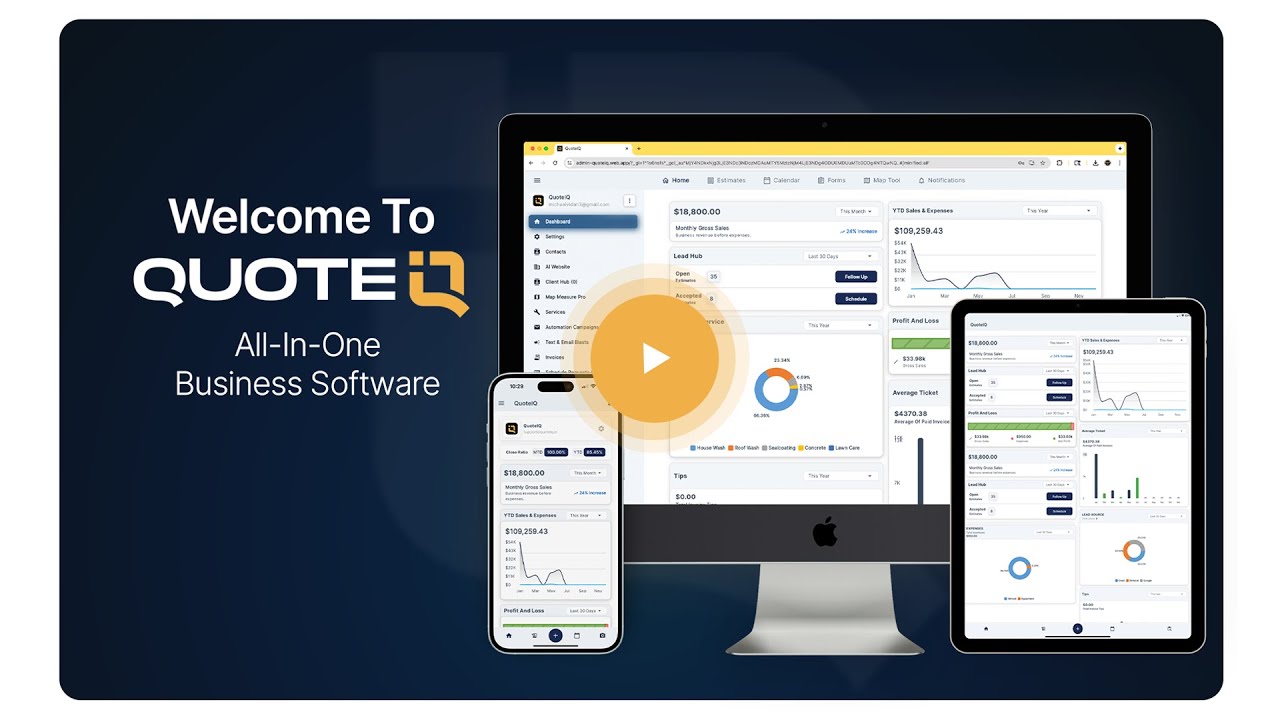
A short walkthrough of how QuoteIQ replaces the stack of disconnected tools most plumbing contractors use to run a service business — job costing, estimates, invoicing, scheduling and customer communication in one platform.
 Watch Video →
Four steps, and most plumbing shops are costing live jobs inside a working week.
Start a 14-day trial on the Pro plan — the trial gives full access to whichever plan you select, and Pro is the tier where Job Costing lives. A credit or debit card is required to start.
Bring contacts and services across from your old system with AI Smart Import, which maps the columns of a CSV export from another CRM automatically. Review the mapping before you commit it.
Enter an hourly rate on each employee record that reflects loaded cost, not the paystub wage, then have technicians clock in against jobs with Time Tracker Pro.
Link QuickBooks Online so closed jobs sync without double entry, then review estimated-versus-actual by service type in Business Analytics.
Twenty-plus-year home service business owner who built one of the largest contractor audiences on YouTube, teaching operators how to start, scale and run service businesses — including plumbing operations. QuoteIQ was built out of that community’s feedback rather than from a product roadmap.
Serial entrepreneur, pressure washing business owner and founder of the ForeverSelfEmployed brand, with one of the most-watched YouTube channels in the home service industry sharing real-world strategy for running profitable service businesses.
★★★★★
“It really facilitates quoting and keeping up with my clients to keep track of profits and payroll.”
★★★★★
“I can easily track my income and expenses, maintain a healthy income-to-debt ratio, and create professional invoices quickly.”
★★★★★
“My business has grown tremendously and I feel like it’s because I’m able to track my expenses and I can specifically see exactly where my money is going.”
QuoteIQ Pro at $149.99/month bundles real-time Job Costing with estimates, invoicing, AI Estimator, ClientHub and QuickBooks Online sync — four users included, no per-technician fee. Fourteen-day trial with full access to whichever plan you choose.

Tell Google that QuoteIQ is a source you trust. One tap unlocks up to 40% off your annual plan. No free trial — billed in full at checkout.


