



Best Self-Scheduling Software for Pressure Washing Businesses (2026)
Published May 2026 · Updated September 2026
Six customer self-scheduling platforms ranked on surface-based quoting depth, seasonal-peak handling and bundled CRM value — for pressure washing operators who want a homeowner to price a driveway, a house wash or a soft-wash roof and book the slot themselves, without a phone call.
Contractors on QuoteIQ
Average rating
Verified reviews
Tools ranked for 2026
QuoteIQ is the best self-scheduling software for pressure washing businesses in 2026, because InstaSchedule lets customers book themselves around the clock from any estimate type — Standard, Quick, Options or Package — and pairs with InstaQuote self-quoting forms that price driveways, house washes, soft-wash roof treatments and decks from your own service catalogue, all inside a complete field service platform on the Elite plan at $299/month. ResponsiBid has the deepest pressure-washing quote builder — surface-by-surface conditional pricing and Good/Better/Best packaging refined since 2008 — on Scaling at $179/month or Pro at $229/month, plus a one-time setup fee, but it is a quoting layer that needs a CRM underneath. Housecall Pro puts online booking on every plan from $59/month on annual billing. Jobber has the cleanest mobile booking forms from $49/month with no commitment. DripJobs bundles booking with contractor-built follow-up automation at $97–$147/month. Markate is the cheapest route to a website booking form at $39.95/month on annual billing plus a $10/month add-on. For pressure washing specifically, the InstaQuote and InstaSchedule pairing wins because homeowners want a price before they will commit to a slot.
TL;DR: Pressure washing is a surface-priced, weather-exposed, seasonal trade, so self-scheduling only works when it is welded to self-quoting. QuoteIQ takes Best Bundled Solution: InstaSchedule runs on every estimate type and through InstaQuote, syncing live to the QuoteIQ calendar, with MapMeasure Pro satellite measurement, the AI Estimator, the Virtual Call Team and ClientHub business phone in the same subscription. ResponsiBid wins on quote-builder depth; Housecall Pro on booking reach; Jobber on mobile polish; DripJobs on follow-up automation; Markate on price. Price the whole stack against the QuoteIQ plan ladder, and run your own numbers with the pressure washing cost calculator before you commit to any of them. The Power Washers of North America is the trade body for certification and safety standards, and the U.S. Small Business Administration publishes the marketing and cash-flow guidance most operators need alongside the software decision.
The 2026 Winners by Category
Each tool below wins for a particular shape of pressure washing operation. Skip to the category that matches the business you actually run, then read the full entry before you commit. If you are still deciding which trade page applies to you, the pressure washing software hub, the soft washing page and the commercial pressure washing page all cover different ends of the same trade.
Best Bundled Solution
QuoteIQ
From $299/mo on Elite. InstaSchedule on every estimate type plus InstaQuote self-quoting with service-catalogue pricing. Full platform — MapMeasure Pro, AI call answering, review automation — in one subscription.
Best Pressure-Washing Quote Builder
ResponsiBid
Scaling $179/mo or Pro $229/mo, plus a one-time setup fee. Surface-by-surface conditional pricing, height handling and Good/Better/Best packaging refined since 2008. A quoting layer — it needs a CRM underneath, which is where scheduling and invoicing have to come from.
Widest Booking Reach
Housecall Pro
$59–$329/mo depending on tier and billing term. Online booking is on every plan and can be surfaced from Google as well as your own site. No published surface-based self-quoting, so pricing logic lives in a flat price book rather than a self-quoting form.
Cleanest Mobile Booking
Jobber
$49–$699/mo with no commitment, cheaper on longer terms. Three customer-facing booking form types and a polished phone experience. Extra users are $29/month each, which is the number that moves as a pressure washing crew grows past its included seats.
Best Follow-Up Automation
DripJobs
Pro $97/mo, Advanced $147/mo, Growth quoted for 5+ users. Online booking plus a deep library of pre-built drip sequences, a visual pipeline and two-way texting on every tier. Built by a contractor, with strong adoption in pressure washing and painting.
Best Budget Solo Pick
Markate
$39.95/mo on annual billing, $49.95 month-to-month, plus $10/mo for the online booking add-on. The cheapest legitimate route to a website booking form — but the add-on list is long, and the real monthly cost climbs as you switch pieces on.
Why Self-Scheduling Matters More in Pressure Washing Than in Most Trades
Pressure washing is a seasonal, surface-driven business. Spring arrives, the phone starts ringing, and every caller asks a version of the same three questions — what will my driveway cost, do you soft wash roofs, can you come Saturday — at precisely the moment your crew is on a ladder or holding a wand. The Power Washers of North America, the trade association that runs certification and safety education for the exterior cleaning industry, exists partly because this trade carries more technical variation than its reputation suggests: concrete, vinyl siding, brick, painted wood and asphalt shingle all take different chemistry, different pressure and different labour time. None of that is conveyable in a voicemail.
That variation is the reason a generic booking widget underperforms here. In a trade with one flat price per visit, a calendar link is enough. In pressure washing, a homeowner who books a slot without seeing a price has not really bought anything — they have created an appointment you will still have to quote, and a cancellation risk if the number surprises them. The pairing that actually converts is a self-quoting form that prices the surfaces, followed immediately by a self-scheduling step that takes the slot while the customer is still holding the number. Everything else in this guide is a variation on how completely a given tool closes that loop.
The labour economics push the same direction. The U.S. Bureau of Labor Statistics puts median pay across building and grounds cleaning occupations at $37,680 as of May 2025, and projects employment in the group to grow about as fast as the average for all occupations through 2035. Applied to a pressure washing office, that median is roughly $18 an hour of fully-loaded time going into quoting and scheduling calls that a form could have absorbed. Every hour moved off the phone is an hour that either disappears from payroll or gets redeployed onto work that actually earns.
Drive time is the other half. The IRS standard mileage rate for business use rose mid-year in 2026 to 76 cents per mile from 1 July, up from 72.5 cents for the first half of the year. A pressure washing operator still driving to measure driveways is spending 76 cents a mile plus labour to collect a number that satellite measurement produces in seconds. That is why MapMeasure Pro and route optimization belong in the same conversation as booking forms — they attack the same cost line from the other end. If you want to model it against your own numbers, the pressure washing cost calculator and the wider home service business calculators set are free and do not require an account.
A two-truck residential operation fielding 12 inbound enquiries a week in peak season, at roughly 11 minutes of office time per enquiry to quote and schedule by phone, spends about 2.2 hours a week on the phone loop — near 57 hours across a 26-week peak season.
Costed at the BLS median of $37,680 a year for building and grounds cleaning occupations, that is roughly $1,030 of labour per season spent on a task a self-quoting form absorbs. The figure is a model built from the stated assumptions, not a measured industry benchmark — change the enquiry count or the handling time and it moves accordingly.
Then there is weather, which is the variable no generic scheduling tool is designed for. Rain cancels a day. Soft-wash chemistry does not behave in the wrong humidity. A booking tool that makes bulk rescheduling slow — messaging everyone affected, offering new slots, collecting confirmations — costs more in customer-service overhead than it saves in automation. Tools that treat weather rescheduling as a first-class workflow rather than a workaround are the ones that survive a pressure washing season, which is a large part of why bundled platforms with mass text and email campaigns and event-triggered automation outperform quote-only tools over a full year.
How We Ranked Them
Most “best of” lists on the internet are affiliate revenue wearing a lab coat. This one is ordered by what wins for pressure washing contractors specifically. Every competitor price in this guide was read off that vendor’s own live pricing page on 30 September 2026; where a vendor does not publish a figure, we say so rather than estimate it, and we do not carry numbers over from third-party review sites. Where a claim is a model rather than a measurement, it is labelled as one.
The six ranking factors
- Surface-based pricing logic. Pressure washing price depends on surface type, condition and method — pressure wash versus soft wash versus chemical pre-treatment. A tool that can price surface by surface without a human building the quote scores highest, and that capability is what separates a self-quoting form from a contact form.
- Self-quoting paired with self-scheduling. A customer who can price the job but then has to ring you will shop two more competitors first. A customer who can book but cannot see a price abandons the form. Both halves have to work, and they have to hand off to each other cleanly.
- Seasonal-peak and weather handling. Demand concentrates hard in the warm months. Bulk rescheduling after a rained-out day, capacity throttling so you cannot be overbooked, and waitlist behaviour are what stop a booking tool becoming a liability in July.
- Property measurement. A driveway quote without square footage is a guess. Native satellite measurement — MapMeasure Pro, plus street view and property data lookups — collapses quote prep from minutes to seconds and removes the site visit — the same logic that makes street view worth a look before you commit a truck.
- Total cost of ownership. Subscription, plus per-seat fees, plus add-ons, plus the separate CRM if the quoting tool is not one. The cheapest sticker price is regularly not the cheapest stack, and the gap only widens as the crew grows. Compare the assembled stack, not the headline.
- Bundled versus standalone. Does the tool also carry AI estimating, business phone, job costing and review automation, or is it a scheduling silo that needs three other subscriptions around it to run a business?
One note on negative claims. Where this guide says a competitor does not offer something, that means the capability is not described on the vendor’s own published material as of the verification date — not that it cannot exist in some configuration. Vendors ship quickly, and both Housecall Pro and Jobber have added AI capability over the last two years. Check the vendor’s current pages before making a final call, and if you want the head-to-head detail, the comparison hub carries the long-form breakdowns.
6 Tools Compared (2026)
The fast version; the detailed entries follow. Every figure below was read from the vendor’s own live pricing page on 30 September 2026. Where a vendor publishes several billing terms, the table shows the entry point and names the term. Where a fee exists but the vendor does not publish an amount, the table says so instead of guessing.
| Platform | Entry price | Self-booking | Self-quoting | Surface pricing logic | Free trial |
|---|---|---|---|---|---|
| QuoteIQ InstaSchedule + InstaQuote |
$299/mo (Elite, 10 users) | Yes — every estimate type | Yes — InstaQuote, priced server-side | Yes — service catalogue + MapMeasure Pro | 14-day |
| ResponsiBid | $179/mo Scaling, $229/mo Pro, plus setup fee | Yes — bookings pass to the connected CRM | Yes — deepest builder on this list | Yes — conditional, refined since 2008 | Free Startup tier; no trial stated |
| Housecall Pro | $59/mo Basic on annual billing ($79 monthly) | Yes — on every plan, incl. from Google | Price book selection | Not published | 14-day |
| Jobber | $49/mo Core, no commitment ($29 annual prepaid) | Yes — Client Hub booking forms | Request and quote forms | Not published | 14-day |
| DripJobs | $97/mo Pro, $147/mo Advanced | Yes — booking form on every tier | Production-rate estimating | Templates, not conditional | None offered |
| Markate | $39.95/mo annual ($49.95 monthly) + $10/mo add-on | Yes — paid booking add-on | Basic service selection | Not published | 14-day |
Plain-text summary. QuoteIQ starts at $299/month on the Elite plan with 10 users included and bundles InstaSchedule customer self-booking with InstaQuote customer self-quoting, service-catalogue surface pricing and MapMeasure Pro satellite measurement; 14-day free trial. ResponsiBid publishes a free Startup tier, Scaling at $179/month and Pro at $229/month, each with a one-time setup fee whose amount the vendor does not publish, and offers the deepest pressure-washing-specific conditional quote builder — but it is a quoting and follow-up layer that requires a separate CRM for scheduling, dispatch and invoicing. Housecall Pro runs Basic at $59/month on annual billing or $79 month-to-month with 1 user, Essentials at $149 annual or $189 monthly with 5 users, and Max at $299 annual or $329 monthly with 8 users and additional users at $35/month; online booking is included on every plan and a 14-day trial is offered. Jobber runs Core at $49/month with no commitment, $39 on a one-year term or $29 on annual prepaid, with Connect, Grow and Plus tiers rising to $699/month at the 15-user Plus bundle with no commitment, extra users at $29/month, and Marketing Suite, Receptionist and Pipeline add-ons at $99, $29 and $49/month; 14-day trial. DripJobs runs Pro at $97/month and Advanced at $147/month with a quoted Growth tier for 5+ users, and states on its pricing page that it does not offer a free trial. Markate runs the Owner Operator plan at $39.95/month on annual billing or $49.95 month-to-month, with $5/employee/month for team seats, online booking as a $10/month add-on and a 14-day trial; annual billing saves 20 percent.
The 6 Best Self-Scheduling Tools for Pressure Washing in 2026
QuoteIQ
Best bundled solution · InstaSchedule + InstaQuote on Elite ($299/mo)
Editor’s Choice 2026QuoteIQ is a field service platform built by contractors for contractors, with pressure washing as one of its founding trades — co-founder Mike Vidan ran a pressure washing business for more than twenty years before the software existed. The customer self-scheduling layer is two paired features: InstaSchedule, where the homeowner picks a slot from your real-time availability, and InstaQuote, where the homeowner assembles their own quote — driveway, house wash, soft-wash roof, deck, full property — priced from your service catalogue. Both sit on the Elite plan at $299/month with 10 users included, and on Max at $699/month with 20 users.
The InstaQuote form was rebuilt in September 2026, and the rebuild is what makes it credible for this trade specifically. Pricing is now computed server-side rather than in the browser, so nobody can edit the number before submitting. The wizard asks one configurable service per step with validation and back-navigation. A map-measure step lets the customer outline the area they want cleaned on a satellite image, and that screenshot lands on the estimate’s photos, so you see exactly what they measured before a truck moves. ZIP-based upcharges and travel fees with multiple origins are applied server-side too, which matters when your service radius crosses a bridge or a toll. Discount codes are supported with a settings editor and server-side validation, and a customer who abandons the form part-way still becomes a contact through lead capture. An “InstaQuote Created” automation trigger fires the moment someone quotes themselves, so a text can hit the office and a follow-up email can hit the customer without anyone watching a dashboard.
For surface-based work the integration with MapMeasure Pro is the differentiator. The homeowner enters an address, satellite measurement produces the flatwork and roof areas, and your catalogue pricing runs against real square footage rather than a guess. MapMeasure Pro starts on the Beginner plan at $74.99/month, so the measurement capability is available well below the self-scheduling tier. Around it sit the AI Estimator for photo-based scoping, the Virtual Call Team for after-hours call answering and lead qualification, the Before & After generator for marketing visuals, and Review Multiplier for post-payment review capture. One caveat worth stating plainly: the Virtual Call Team answers, qualifies, transcribes and runs outbound campaigns, but it does not book appointments itself — booking is what InstaSchedule is for.
On cost, Elite at $299/month includes 10 users and 5,000 monthly IQ Credits, which power the AI features. Max at $699/month includes 20 users, 8,000 credits and the AI Website Builder that is a $34.99/month add-on elsewhere. Seats beyond a plan’s included count are $25 per person per month on any paid plan — a change made in September 2026, and one worth knowing before you size a plan. Compare the assembled alternative: ResponsiBid Pro at $229/month for the quoting layer plus Jobber Connect at $199/month for five users with no commitment is $428/month before ResponsiBid’s one-time setup fee, and that stack still lacks native satellite measurement. Elite covers the same ground at $299/month with ten seats. For a full ladder, the pricing page carries every tier.
- InstaSchedule works on Standard, Quick, Options and Package estimates as well as through InstaQuote forms
- InstaQuote prices server-side, with a satellite map-measure step, ZIP upcharges, travel fees and discount codes
- MapMeasure Pro satellite measurement is native and starts at the $74.99 Beginner tier
- One subscription covers scheduling, invoicing, payments, business phone, reviews and AI tools
- 14-day free trial with full access to whichever plan you choose
- 4.7 out of 5 across 4,103 verified reviews, with 40,000+ contractors on the platform
- Route optimization and route density zones included at the same Elite tier as self-scheduling
- InstaSchedule and InstaQuote start at Elite ($299/mo) — not on Essentials, Beginner or Pro
- Quote-builder depth is leaner than ResponsiBid for highly conditional pricing; QuoteIQ prices from a service catalogue with surface-area inputs rather than seventeen years of layered conditional rules
- Seats beyond the plan’s included count cost $25 per person per month — Max is 20 users, not unlimited
- The Virtual Call Team answers and qualifies calls but does not book appointments itself
- Drip-campaign libraries are leaner than DripJobs’ pre-built sequences
- Less name recognition in the pressure washing community than Housecall Pro or Jobber
For most residential and light-commercial pressure washing operations, from a solo truck up to a ten-seat crew, Elite at $299/month is the highest-leverage choice on this list. InstaQuote plus InstaSchedule plus MapMeasure Pro plus AI call answering in one place replaces four or five disconnected subscriptions, and the September 2026 InstaQuote rebuild closed most of the gap that used to justify bolting on a separate quoting tool.
Essentials $29.99 (1 user) · Beginner $74.99 (2) · Pro $149.99 (4) · Elite $299 (10 users — InstaSchedule + InstaQuote) · Max $699 (20 users). Extra seats $25/person/mo. Annual billing is ten months’ price. See full pricing
“Very helpful app for pressure washers and more. This app is meant to help out for specific jobs that are already set up for or as house washes, driveways, gutters and a lot more. Entering in just sq. Or linear foot to get the price, and it calculates for you.”
ResponsiBid
Best pressure-washing quote builder · $179–$229/mo plus setup fee
Deepest surface-pricing logicResponsiBid is a customer-facing online quoting and follow-up platform that built its reputation in window cleaning and pressure washing. Founded in 2008, it has spent well over fifteen years refining quote-builder logic for surface-based home services: conditional pricing that distinguishes soft wash from pressure wash across different substrates, handling for two-storey work, Good/Better/Best packaging the customer can upgrade themselves, and specification-driven quoting where answers to surface and condition questions drive the number automatically. If customer-facing quoting depth is the single factor that decides your purchase, ResponsiBid has the deepest engine here — deeper than anything bundled inside a general CRM, QuoteIQ included.
The published plans, verified on the vendor’s own pricing page on 30 September 2026, are a free Startup tier at $0, Scaling at $179/month and Pro at $229/month. ResponsiBid’s pricing page confirms a one-time setup fee that covers personalised account setup with a dedicated coach and ongoing support access, but it does not publish the amount — so treat any specific setup figure you see quoted elsewhere as unverified and ask them directly. The free Startup tier is genuinely useful for testing the quote flow before committing, and it is the detail most competitor round-ups omit.
The structural catch is unchanged: ResponsiBid is a quoting and follow-up tool, not a CRM. To run a pressure washing business you still need a platform underneath for scheduling, crew assignment, invoicing, payments and job costing. That underneath layer is typically Jobber or Housecall Pro, which adds $149–$199/month at the tiers most operators land on. Stack ResponsiBid Pro on Jobber Connect for five users and you are at $428/month before the setup fee, against $299/month for a bundled Elite plan with ten seats — and the bundle also carries satellite measurement, which neither half of that stack does natively.
- Deepest pressure-washing-specific quote builder on this list — surface by surface, with conditional rules and tiered packaging
- Seventeen-plus years of refinement aimed squarely at soft wash, pressure wash and roof treatment
- Strong automated follow-up sequencing across multiple channels
- Free Startup tier at $0 lets you test the quote flow before paying
- Integrates as a front-end quoting layer over established field service CRMs
- Active, knowledgeable community among exterior cleaning operators
- Quoting and follow-up only — it is not a CRM, and needs a separate platform beneath it to run the business
- A one-time setup fee applies on paid plans and the amount is not published on the pricing page
- No free trial is stated on the pricing page; the free Startup tier is the way in
- Configuring conditional variables takes real time before the tool earns its keep
- Total assembled stack cost routinely exceeds a bundled platform at the same capability level
- No native satellite property measurement — square footage still has to come from somewhere
If customer-facing quoting depth is the deciding factor — typically premium-priced operators competing on transparent, highly conditional pricing — ResponsiBid earns the slot and the premium. The honest catch is that you are buying a quote builder, not a business platform, so budget for the CRM underneath and the one-time setup before you compare it to a bundled subscription.
Startup $0 · Scaling $179/mo · Pro $229/mo. One-time setup fee applies to paid plans; amount not published. Verified on responsibid.com/pricing, 30 September 2026.
Housecall Pro
Widest booking reach · $59–$329/mo depending on tier and term
Strongest generalist bookingHousecall Pro is the most widely recognised generalist field service platform in home services, with real adoption across HVAC, plumbing, electrical, cleaning and pressure washing. Its online booking widget is included on every plan, and the vendor’s pricing page describes letting customers book and pay online around the clock either from your website or directly from Google — which is the reach advantage. For an operator whose lead flow is dominated by local search, having the booking action sit on the search result rather than two clicks deeper is a genuine conversion edge.
Verified on the vendor’s own pricing page on 30 September 2026, the plans are Basic at $59/month on annual billing or $79 month-to-month with 1 user; Essentials at $149/month annual or $189/month monthly with 5 users; and Max at $299/month annual or $329/month monthly with 8 users, plus $35/month for each additional user. Max includes a sales proposal tool the page values at $40/month. A 14-day free trial is offered.
The limitation for this trade is pricing logic rather than booking mechanics. Housecall Pro’s published material describes online booking with service selection from a price book; it does not describe surface-based customer self-quoting where a homeowner specifies a 2,400 square foot house wash with a soft-wash roof add-on and receives an automated price before booking. For a pressure washing operation whose conversion depends on showing a number up front, that is the gap. Nor does the published feature set include native satellite property measurement in the way MapMeasure Pro does. The practical answers are to pair Housecall Pro with ResponsiBid as a quoting layer, at $179–$229/month on top, or to move to a platform where the quoting and booking halves already talk to each other.
- Online booking included on every plan, including the $59 entry tier on annual billing
- Customers can book directly from Google as well as from your own website
- Mature, widely recognised brand with a large support and community footprint
- Solid dispatch board and technician mobile experience
- Max includes a sales proposal tool the vendor values at $40/month
- 14-day free trial
- No published surface-based customer self-quoting — booking is service selection from a price book
- No published native satellite property measurement for flatwork or roof square footage
- Additional users on Max are $35/month each, which compounds on a growing crew
- Month-to-month billing costs $20–$30/month more per tier than annual billing
- Basic is a single-user plan, so a second person means a jump to Essentials at $149–$189
- A generalist by design, so trade-specific depth for exterior cleaning is shallower than a specialist tool
For pressure washing operators whose leads arrive through local search and who work from a simple flat-rate price book — driveway, house wash, package — Housecall Pro Essentials at $149/month on annual billing is a credible, low-risk choice with the widest booking reach here. Operators who need surface-based conditional quoting will have to pair it with a quoting layer or move to a bundled platform.
Basic $59 annual / $79 monthly (1 user) · Essentials $149 / $189 (5 users) · Max $299 / $329 (8 users) · additional users $35/mo. 14-day trial. Verified on housecallpro.com/pricing, 30 September 2026.
Jobber
Cleanest mobile booking · $49–$699/mo with no commitment
Best mobile booking experienceJobber is the other widely recognised name in generalist home service software, and its customer-facing Client Hub booking forms are the most polished mobile experience on this list. For a solo pressure washing operator or a small crew, the Core plan is the cheapest entry point here to a well-built, recognisable CRM, and the phone experience is consistently the thing users single out.
Verified on the vendor’s own pricing page on 30 September 2026, Jobber prices by plan and by included seat bundle, with three billing terms. Core is a single-user plan at $49/month with no commitment, $39/month on a one-year term, or $29/month on annual prepaid. Connect runs from $139/month for one user up to $399/month for fifteen with no commitment. Grow runs from $199/month for one user to $499/month for fifteen. Plus starts at the five-user bundle, at $499/month with no commitment, and reaches $699/month at fifteen users. Additional users beyond a bundle are $29/month each on every tier. Add-ons are priced separately: Marketing Suite at $99/month, Receptionist at $29/month and Pipeline at $49/month, all included on Plus. A 14-day free trial with Grow-level access is offered.
For pressure washing the limitation is the same shape as Housecall Pro’s. Jobber’s published booking is request-, assessment- and job-based: the customer can request a quote, book an assessment, or take a slot for a defined service. What the published material does not describe is a customer self-quoting a 2,400 square foot soft-wash house with a roof treatment add-on and receiving an automated surface-based price before booking. The seat economics also deserve attention on a growing crew — at $29 per extra user per month, a fifteen-seat Plus bundle plus five more people is $699 plus $145, or $844/month with no commitment, against $699/month for a twenty-seat Max plan on the bundled side. Both numbers are list rates on monthly terms; both vendors discount for longer commitments, so compare like with like.
- The cleanest mobile-first booking experience on this list
- Several customer-facing form types — request, assessment and job booking
- Core at $49/month with no commitment, or $29 on annual prepaid, is the cheapest polished entry point here
- Mature scheduling, dispatch, quoting and invoicing with a deep integrations marketplace
- Longer billing terms cut the rate substantially — Core drops 41 percent from monthly to annual prepaid
- 14-day free trial with Grow-level access
- No published surface-based customer self-quoting — booking is request-based rather than price-completing
- Extra users are $29/month each on every tier, on top of the seat bundle
- Marketing Suite ($99), Receptionist ($29) and Pipeline ($49) are separate add-ons below the Plus tier
- Reaching the tier where the add-ons are included means Plus, from $499/month at five users
- No published native satellite property measurement for pressure washing square footage
- The plan-by-seat-bundle grid makes true cost harder to read than a flat ladder
For solo pressure washing operators and small teams who want a polished, recognisable CRM and do not need surface-based self-quoting, Jobber Core at $49/month — or $29 on annual prepaid — is hard to argue with as a starting point. Once you add seats and the add-ons that make it competitive on marketing and call answering, the monthly total lands in the same territory as a bundled platform, so run the comparison at the tier you will actually be on in twelve months.
Core $49 no-commitment / $39 one-year / $29 annual prepaid (1 user) · Connect $139–$399 · Grow $199–$499 · Plus $499–$699 (5–15 users) · extra users $29/mo · Marketing Suite $99, Receptionist $29, Pipeline $49. Verified on getjobber.com/pricing, 30 September 2026.
DripJobs
Contractor-built sales automation · $97–$147/mo
Best follow-up automationDripJobs is a contractor-built CRM that has picked up real traction in pressure washing and painting over the last few years. It combines an online booking form with an unusually deep library of pre-built drip campaigns — automated follow-up sequences organised by pipeline stage — alongside a visual sales pipeline, two-way texting on every tier and production-rate estimating templates. Where most CRMs treat follow-up as a feature, DripJobs treats it as the product.
Verified on the vendor’s own pricing page on 30 September 2026, DripJobs runs Pro at $97/month and Advanced at $147/month, both with a single admin user included, plus a Growth tier for 5+ users that is quoted rather than published. Additional users are an add-on with pricing available on request, and all add-ons are included on Growth. One correction worth flagging against older round-ups, including an earlier version of this page: the vendor’s pricing page states plainly that DripJobs does not offer a free trial. Any guide telling you there is a 14-day trial is out of date.
For pressure washing the strength is the drip library — sequences for quote sent with no response, estimate viewed, pre-visit reminder, post-job review request — all triggered by pipeline movement rather than by someone remembering. The limitation is that DripJobs is a sales-automation CRM rather than a self-quoting platform: a customer books through the form and enters the follow-up machine, but does not assemble a surface-by-surface house wash with conditional pricing. It is also lighter on scheduling, dispatch and route work than Jobber or Housecall Pro, which matters once you are sequencing several trucks a day. If dropped leads rather than quoting depth are your bottleneck, that trade is worth making.
- The deepest pre-built follow-up campaign library on this list, organised by pipeline stage
- Visual sales pipeline included on every tier rather than sold as an add-on
- Two-way texting on every tier
- Production-rate estimating templates aimed at pressure washing and painting
- Online booking form included on every tier
- Built by a contractor, with month-to-month billing and no contract
- No free trial offered — the vendor states this explicitly on its pricing page
- A sales-automation CRM, not a self-quoting platform; no surface-based automated pricing
- Lighter on scheduling, dispatch and route optimization than Jobber or Housecall Pro
- Paid tiers include a single admin user; additional user pricing is quote-only
- The Growth tier for teams is not publicly priced
- No published native satellite property measurement
If your bottleneck is leads going cold after the quote rather than the quote itself, DripJobs’ campaign library is the best answer here and $97/month is a fair price for it. Go in knowing there is no free trial to test it with, that seat pricing beyond the admin user is quote-only, and that you may still want a stronger scheduling layer alongside it.
Pro $97/mo · Advanced $147/mo (1 admin user each) · Growth quoted for 5+ users. No free trial offered. Verified on dripjobs.com/pricing, 30 September 2026.
Markate
Best budget solo pick · $39.95/mo annual plus $10/mo booking add-on
Cheapest route to self-bookingMarkate is a budget-friendly service operations platform popular with handyman, lawn care and small exterior cleaning operators. Verified on the vendor’s own pricing page on 30 September 2026, the Owner Operator plan is $39.95/month on annual billing — billed yearly at $479.40, a 20 percent saving — or $49.95 month-to-month. Team pricing adds $5 per employee per month. Online booking is a $10/month add-on, which makes the cheapest legitimate route to a website booking form on this list $49.95/month on annual billing, or $59.95 month-to-month. A 14-day free trial is offered and there is no contract.
For an operator on a genuinely tight budget — a side-hustle truck, a first season — Markate is the cheapest thing here that actually works. Estimates, invoices, online payments and a customer portal sit in the base subscription, and the booking form handles service selection, time slots, coupon codes and minimum booking amounts. Markate also publishes a ResponsiBid integration at $10/month, which is a genuinely interesting combination: it lets a budget operator bolt the deepest quoting engine on this list onto the cheapest operations platform, though you are then paying for two subscriptions plus two add-ons and managing two systems.
The honest tradeoffs are feature gating and cost creep. Markate’s add-on list is long and almost everything is $10/month: online booking, lead capture contact form, sales proposal templates, branded customer portal, business phone number, call forwarding, Zapier, promotions, automated review requests. Employee app access is another $5 per employee per month, and the AI receptionist bills at $1 per call. Switch on the five or six pieces most operators end up wanting and the real monthly figure lands in the $80–$110 range rather than the $39.95 on the sticker — at which point you are comparing against platforms that bundle the same capabilities. There is also no published surface-based automated pricing and no native satellite measurement.
- Cheapest legitimate route to a website booking form — $49.95/month all-in on annual billing
- $5 per employee per month is the most affordable seat model on this list
- Annual billing saves 20 percent, with no contract and cancel-anytime terms
- Estimates, invoices, online payments and a customer portal are in the base subscription
- A published ResponsiBid integration at $10/month lets you bolt on a far deeper quoting engine
- 14-day free trial
- Heavy add-on gating — booking, proposals, branded portal, business phone and review automation are $10/month each
- A realistic working configuration lands nearer $80–$110/month than the $39.95 headline
- No published surface-based automated pricing for pressure washing
- No published native satellite property measurement
- Lighter on scheduling, dispatch and route planning than dedicated field service platforms
- Smaller exterior-cleaning user community than ResponsiBid or DripJobs
For a solo pressure washing operator on a strict budget who needs a booking form, basic invoicing and a customer portal, Markate at $49.95/month all-in on annual billing is the cheapest honest answer on this list. Price the add-ons you will actually switch on before you decide — once the list reaches $80–$110/month, a bundled platform covers more ground for the money.
Owner Operator $39.95/mo annual ($479.40/yr) or $49.95 monthly · team +$5/employee/mo · online booking add-on $10/mo · most other add-ons $10/mo · 14-day trial. Verified on markate.com/pricing, 30 September 2026.
What a Pressure Washing Self-Quoting Form Actually Has to Ask
Most self-scheduling projects fail at the form, not the calendar. A homeowner will answer four or five questions about their property; they will not answer fourteen. The craft is picking the smallest set of questions that produces a number you are willing to honour without a site visit, and letting measurement fill in the rest. This is the part no vendor comparison covers, so here is the working list.
Question 1
Address, then measure
Ask for the address first and let satellite measurement produce driveway, walkway, patio and roof areas. MapMeasure Pro turns one field into four numbers, and the map-measure step in InstaQuote lets the customer outline the exact area they mean — which also documents scope.
Question 2
Substrate, not “siding”
Vinyl, brick, stucco, painted wood and fibre cement take different chemistry and different labour. Offer pictures rather than words — homeowners misname substrates constantly, and a mispriced stucco job eats a day. This single question drives more of your margin than the square footage does.
Question 3
Condition, in three bands
Light dust, moderate organic growth, heavy mould or oxidation. Three bands is enough to set a labour multiplier and not so many that the customer freezes. Attach a photo upload to the heavy band so you can sanity-check the worst cases before the truck rolls.
Question 4
Storeys and access
Two-storey work changes reach, equipment and risk. So does a gated back garden, a steep drive or an unfenced pool. One access question saves more failed visits than any other field on the form, and it is the cheapest possible insurance against a wasted drive.
Question 5
Add-ons as tiers, not a menu
Present Good, Better and Best rather than twelve checkboxes. Options estimates and package estimates both exist for this; a tiered presentation reliably lifts average ticket against an unstructured add-on list.
Question 6
Then, and only then, the slot
Show the price, then the calendar. InstaSchedule blocks slots that are already booked or pending, and you choose which employees are offered — so the customer never picks a time a technician already holds.
The most common self-quoting mistake in this trade is a flat price across a service radius that crosses a river, a toll or forty minutes of traffic. At the IRS business rate of 76 cents per mile from 1 July 2026, a 30-mile round trip is $22.80 in vehicle cost alone before a drop of chemical is mixed — and that is the deductible rate, not your true cost with labour attached.
Price the radius explicitly. InstaQuote applies ZIP-based upcharges and travel fees from multiple origins server-side, so a far-side booking carries its own cost without a conversation. Model your own bands with the pressure washing cost calculator before you publish a form.
Seasonal Peaks, Rain Days and the Rescheduling Problem
Every pressure washing operator knows the two failure modes of a booking calendar. The first is July: the calendar fills faster than the crew can absorb, and a tool that keeps accepting bookings past real capacity turns a good month into a reputation problem. The second is the rain day, where eight confirmed jobs have to move and the office spends a morning on the phone doing it.
Capacity throttling is the answer to the first. A self-scheduling layer should offer only the slots you can genuinely staff, which means it has to know crew availability rather than just business hours. InstaSchedule lets you choose which employees participate and offers only those with booking hours set, and since September 2026 it blocks slots held by pending requests as well as confirmed jobs — which closes the double-booking gap that used to require manual policing. Underneath, EmployeeHub carries the availability, and on Max crew scheduling lets you assign a whole crew rather than individuals.
The rain day is a communications problem, and it is where bundled platforms pull decisively ahead of quoting-only tools. Moving eight jobs means messaging eight customers with new options and collecting eight confirmations. Mass text and email campaigns handle the outbound in one action; event-triggered automation handles the confirmations and reminders; ClientHub keeps the replies in one thread attached to the customer record rather than scattered across three people’s personal phones. The September 2026 calendar rebuild added drag-to-reschedule with a five-second undo and a schedule-conflict warning with an overlap sheet, which is precisely the tooling a rain day needs.
Seasonality also shapes which plan you should be on, and this is where operators routinely overspend. Pressure washing demand concentrates in the warm months, which means an operator running four trucks in July may be running one in January. Seat-based pricing punishes that shape: on a platform charging per user, you either pay year-round for peak headcount or churn accounts twice a year. On QuoteIQ’s ladder, Elite includes ten seats at $299/month and extra seats are $25 per person per month, so a seasonal fifth, sixth and seventh technician is a predictable line rather than a plan migration. Compare that against $29 per extra user on Jobber or $35 on Housecall Pro Max, and model it at your actual peak headcount rather than your average.
Take an operator who runs 4 people in the off-season and 9 at peak, with peak lasting 6 months. On QuoteIQ Elite the ten included seats absorb the whole swing: $299/month flat, $3,588 a year, with no seat management at all.
On a platform charging $29 per user per month above a five-seat bundle, the same shape costs the bundle price plus four extra seats for six months — $696 a year in seat fees alone, before the base plan and before any add-ons. The gap is not the headline price; it is the shape of the pricing model against the shape of the trade.
One more seasonal lever worth naming: the off-season is when review capture and re-engagement pay for themselves. Review Multiplier sends the customer to your review page the moment they pay online, on every plan, with configurable request automation on Elite and Max. Reviews collected in August are what make the phone ring in April, and a re-engagement campaign to last year’s list through mass campaigns costs a fraction of new lead acquisition. Operators in adjacent seasonal trades — holiday lighting, gutter cleaning, snow removal — use the same pattern to fill the opposite half of the year.
Chemicals, Runoff and the Compliance Layer Nobody Puts in a Buyer’s Guide
Soft washing is chemical application. Sodium hypochlorite, surfactants and degreasers are hazardous chemicals in the regulatory sense, and that brings two obligations most software round-ups ignore entirely — but which decide whether a growing pressure washing business can bid commercial work at all.
The first is hazard communication. Under the OSHA Hazard Communication Standard, every employer with hazardous chemicals in the workplace must hold labels and safety data sheets for the chemicals their workers are exposed to, and must train those workers to handle them appropriately. The moment you hire your first technician, that applies to your truck. A shoebox of SDS printouts technically satisfies it; an auditor asking which product was applied at which address on which date is a different question, and that one needs records.
The second is runoff. Wash water carrying detergents, oils or organic growth that reaches a storm drain is a discharge, and the EPA’s NPDES programme for stormwater from municipal sources governs what municipal separate storm sewer systems are permitted to carry. Requirements vary by municipality and by whether the site falls under Phase I or Phase II, which is exactly why commercial property managers ask for documentation before they award a parking-lot or storefront contract. Being able to produce an application record per job is frequently the difference between winning a recurring commercial account and losing it to an operator who can.
QuoteIQ added Chemical Tracking in September 2026 for this. Applications are logged against the job they were used on, the chemical list and applicators’ licences live in one place, a customer’s full treatment history is visible from their contact record, a reminder prompts you to log chemicals before a job is marked complete, and the details carry through to the job, the invoice and the PDF. It is off until a business switches it on, either in settings or per service, so operators who do not apply chemicals never see it. QuoteIQ has not published the plan tier for Chemical Tracking, so confirm availability on your plan before you build a bid around it.
Alongside it, inventory management on Elite and Max tracks chemical stock across warehouse, trucks and job sites, with stock deducting automatically when the linked invoice is paid in full. For an operator buying sodium hypochlorite by the drum, knowing real consumption per job is both a margin question and a compliance one. Pair it with job costing on Pro and above and chemical spend stops being a monthly surprise and becomes a line in the profit calculation on every job. The same records also support the inspection forms and photo documentation that commercial clients increasingly expect as a condition of the contract.
Self-scheduling is how you win residential work. Documentation is how you win commercial work, which is the higher-ticket, recurring, weather-resilient half of the trade — and it is the half a booking widget alone cannot reach — see the commercial pressure washing setup for how that side is run.
A tool that books homeowners but cannot produce a chemical application record has solved one side of a two-sided business. When you compare platforms, price the whole business you intend to run in three years, not the one you run this July.
Self-Scheduling for Commercial Pressure Washing
Residential self-scheduling is a conversion tool. Commercial pressure washing — storefronts, parking lots, restaurant exteriors, HOA common areas, apartment flatwork — works on a different clock, and the software requirements shift accordingly. Nobody self-books a 40,000 square foot parking lot from a phone at nine on a Friday night. What commercial buyers want instead is a recurring schedule they do not have to manage, an invoice that matches the contract, and documentation on demand.
That changes which features matter. Invoice subscriptions and recurring service plans carry the billing side of a quarterly flatwork contract. The client portal, on Pro and above, gives a property manager a place to see estimates, invoices, appointments and completed inspection reports without ringing you — and it is worth noting that portal-based self-scheduling sits at Pro, one tier below InstaSchedule, so the commercial self-service path opens earlier than the residential one. Job costing on Pro and above is what tells you whether the contract you won at a competitive rate is actually profitable once labour and chemical are in.
Prospecting is the other half. QuoteIQ launched Atlas in September 2026, a prospecting map available on every plan, with Routing and Employees views needing Elite or Max. Its Lead Generator lets you pick a business type — restaurants, property managers, retail — and an area, either a ZIP code or a shape drawn on the map, and see the exact count of matching businesses for free before paying anything. Unlocking is tiered and priced per business, starting at 25 cents each for the first hundred with a $25 minimum, falling to 12 cents each above two thousand, and contact details are included. Purchases are permanent and visible to the whole team. For a pressure washing operator trying to build a commercial book in a defined radius, that is a materially different motion from buying a list. Atlas does not yet have a published feature page, so there is nothing to link to — look for it in the side menu.
Door knocking sits in the same map, with pin statuses you can rename and recolour, notes on pins, one-tap saving of a pin as a contact, and CSV export. Routing on Elite and Max orders a day’s jobs for driving, which is distinct from the calendar’s route optimization and should not be confused with it. For commercial operators whose work clusters geographically, route density zones are the planning counterpart: they show where work is concentrated so you can decide which zone to work on a given day before sequencing the stops within it.
The trades adjacent to commercial pressure washing use the same stack, and if your book is drifting that way the dedicated pages are worth reading: commercial pressure washing, fleet washing, sealcoating, line striping and paving all share the flatwork customer. A fleet washing price list template and a contractor invoice template are both free if you are building commercial paperwork from scratch.
Which Tool Wins for Your Pressure Washing Business?
Three situations drawn from how pressure washing operators actually buy. Each ends with a recommendation, and not all of them point to QuoteIQ.
Scenario 1
Solo residential operator, peak-season volume
Single truck, owner-operated. House washes, driveways, soft-wash roof treatments at a $400 average ticket, 10–15 enquiries a week from March to October.
The pain: customers searching for a house wash want a price and a slot before they will call back. The owner is on a roof when the phone rings, and by the time he returns the call at eight in the evening the job is gone.
Recommendation: QuoteIQ Elite at $299/mo. InstaQuote plus InstaSchedule with MapMeasure Pro closes the loop while the customer is still on the page. If $299 is out of reach this season, Markate at $49.95/mo all-in on annual billing is the honest budget answer — you lose surface pricing but you get a working booking form.Scenario 2
Five-truck operation, residential plus light commercial
Five technicians, a $400–$600 residential ticket alongside parking lots and storefront contracts, and an office manager fielding inbound calls through the whole peak.
The pain: office overhead. Quoting, scheduling, weather rescheduling and chemical paperwork consume most of a full-time role that should be doing higher-value work.
Recommendation: QuoteIQ Elite at $299/mo with ten seats. The self-service front end absorbs the residential quoting loop, mass campaigns handle rain-day rescheduling in one action, Chemical Tracking carries the commercial documentation, and job costing tells you which contracts are actually earning.Scenario 3
Established operator on Jobber, quoting depth is the deciding factor
Three trucks, strong brand, repeat base, premium pricing at $600–$1,200 on full-property washes. Lead volume is fine; the quote presentation is not.
The pain: premium pricing needs premium presentation — surface-by-surface breakdowns, soft-wash versus pressure-wash conditional logic, tiered packaging. The current quote reads generic against competitors presenting detailed multi-tier proposals.
Recommendation: ResponsiBid Pro at $229/mo layered over the existing Jobber subscription, which is the one case on this page where a head-to-head comparison should end somewhere other than QuoteIQ. Start on ResponsiBid’s free Startup tier to test the quote flow first, and ask them for the setup fee in writing before committing — it is real but unpublished. This genuinely is the better tool for that specific problem.The ROI Math, With the Assumptions Shown
Buyer’s guides love a conversion statistic. Most of them are unsourced. Rather than borrow one, here is a model you can rebuild with your own figures — every input is stated, and none of it is presented as an industry benchmark.
Inputs (change these to yours): two-truck residential operation · $400 average ticket · 12 inbound enquiries per week · 26-week peak season · baseline close rate on a phone-tag workflow of 40 percent.
Baseline: 12 × 40% = 4.8 jobs a week × 26 weeks × $400 = $49,920 of peak-season revenue.
If self-quoting and self-scheduling lift the close rate to 55 percent — a modelled assumption, not a measured result — the same 12 enquiries produce 6.6 jobs a week × 26 × $400 = $68,640. Net lift: $18,720 per peak season from the same lead volume.
Against cost: QuoteIQ Elite at $299/month is $3,588 a year. On those inputs the tooling pays for itself at roughly a 2.9 percentage-point improvement in close rate, well before the modelled 15-point figure. That break-even number is the one worth testing against your own pipeline, because it is far more robust than the headline ratio.
The second half of the calculation is cost avoided rather than revenue added, and it is the more reliable half. Office time moves first: the phone-tag loop modelled earlier runs to roughly 57 hours across a peak season for a two-truck operation, worth about $1,030 at the BLS median for building and grounds cleaning occupations. Drive time moves next: every quote produced from satellite measurement rather than a site visit saves a round trip at 76 cents a mile plus the labour attached to it. Twenty avoided 25-mile round trips in a season is $380 of vehicle cost and the better part of two working days.
Then there is stack consolidation, which is the cleanest number of the three because it involves no behavioural assumption at all. A quoting layer at $229/month plus a CRM at $199/month is $428/month, and that stack still needs measurement and review automation from somewhere. A bundled Elite plan at $299/month covers the same ground with ten seats. That is $1,548 a year of difference on list rates, with one login, one support queue and no integration to maintain. If you would rather assemble best-of-breed pieces, that is a legitimate choice — but it should be a deliberate one, priced honestly. The comparison hub carries the long-form head-to-heads, and the free calculator set will do the arithmetic against your own figures.
One caution on all of the above. Self-scheduling raises booking volume; it does not raise capacity. An operator who turns on a booking form without setting real availability limits will sell a July they cannot deliver, and the reputational cost of three rescheduled jobs exceeds the revenue of the fourth. Set capacity first, then open the form. The analytics dashboard is where you watch whether close rate and average ticket are actually moving after the change, rather than assuming they did.
Which Adjacent Services Belong on Your Self-Quoting Form
The highest-return change most pressure washing operators make to a self-quoting form is not a better price band — it is adding the services the customer was going to ask about anyway. Every adjacent surface you can price on the same form is a ticket increase that costs nothing in additional drive time, because the truck is already at the address. Here is the shortlist worth configuring, and why each one earns its place.
Soft-wash roof treatment is the obvious first addition, and the one with the widest margin. It uses chemistry rather than pressure, it is priced by roof area, and satellite measurement already produces that number when the customer enters an address. If it is a meaningful share of your work, the dedicated roof washing and soft washing pages cover the workflow differences in more depth than a general pressure washing setup does.
Gutter cleaning and brightening is the classic same-visit add-on: the ladder is already up, the customer is already thinking about the exterior, and the labour is measured in linear feet rather than square. Operators running it as a standalone line should look at the gutter cleaning setup and price it against the gutter cleaning cost calculator before publishing a band.
Deck and fence restoration converts a one-visit customer into a two-visit one, because cleaning usually leads to sealing. It prices by area with a condition multiplier, which is exactly the shape your form already handles. The deck cost calculator and fence cost calculator are both free, and operators taking on the build side as well should read the deck building page.
Concrete work is where pressure washing quietly turns into a second business. A driveway you cleaned this spring is a sealing candidate next spring, and sealing is a higher-ticket, more defensible line. Price it against the concrete cost calculator, and if you are moving toward coatings the concrete contractor, epoxy flooring and sealcoating pages all describe the same customer from different angles.
Window cleaning pairs with house washing so naturally that ResponsiBid built its original reputation on the combination. It is counted rather than measured, which means it needs a different question type on the form — a count field rather than an area — and that is worth configuring properly rather than bolting on. The window cleaning page covers the scheduling differences, which are real once recurring contracts enter the picture.
Trash bin cleaning and fleet washing are the two routes out of one-off residential work into recurring revenue, and both are worth testing before a slow season rather than during one. Bin cleaning is subscription-shaped from day one; fleet washing is commercial and contract-shaped. The trash bin cleaning and fleet washing pages cover both, and a bin cleaning price list template and fleet washing price list template will save you an afternoon of spreadsheet work.
Two cautions. First, do not put a service on the form you cannot price confidently without seeing the property — a self-quote you have to renegotiate is worse than no self-quote, because it trains the customer to distrust the number. Second, every service you add should map to a real line in your invoicing and job costing setup, or you will grow revenue without knowing which of the new lines is actually earning. Operators who also run painting, lawn care or house cleaning alongside washing should keep those on separate forms — mixing trades in one self-quoting flow reliably increases abandonment.
What Actually Has to Move When You Switch Platforms
The reason operators stay on software they have outgrown is rarely the software. It is the fear of the migration — and specifically the fear of losing customer history mid-season. Worth being precise about what has to move, because in practice it is a shorter list than it feels like.
Contacts come first, and they are the easy part. Every platform on this list exports customers to CSV. On the receiving end, AI Smart Import maps the columns for you rather than making you reformat a spreadsheet, and since the September 2026 rebuild the mapping is reviewable before it commits, with an import preview and duplicate flagging. Residential and business address columns are understood separately, and tags can be applied during the import — which matters if you want last year’s customers segmented for a re-engagement campaign on arrival.
Your price book is the part worth doing carefully. This is the moment to rebuild pricing around surfaces and conditions rather than importing the flat list you have been using, because the price book is what a self-quoting form reads from. A badly structured catalogue produces a badly behaved form no matter which vendor hosts it. Budget an afternoon, not ten minutes, and check the result against the pressure washing cost calculator.
Open estimates and unpaid invoices do not need to migrate. Let them finish where they are and start new work on the new platform. Running two systems for three weeks is far less painful than reconciling half-migrated financial records, and it gives you a clean cutover date for reporting. If you do want the history, estimates and invoices import too, and data export works in both directions so you are never locked in.
Accounting is the piece to sequence last. Connect QuickBooks Online after the first week of live invoices, not before, so that a mapping mistake affects three invoices rather than three hundred. QuickBooks sync sits on Pro and above.
Then set up the parts that only pay off if you do them on day one. Configure roles and permissions before technicians log in, so nobody sees revenue figures they should not. Turn on time tracking and GPS location at the same time, because job costing is only as good as the labour data underneath it. Connect Google Calendar sync if your crew already lives in it. Set Review Multiplier live from the first paid invoice rather than three months in, because the reviews you miss in your first busy month are the ones you cannot recover. And switch on website contact forms so enquiries that are not ready to self-quote still land in the CRM instead of an inbox.
Finally, a note on payments. New QuoteIQ subscribers are set up on Whop as the payment processor; accounts established on Stripe may stay there. Either way online payments cover cards, ACH, Apple Pay and Google Pay, consumer financing through Affirm, Klarna and Afterpay is available on every plan, and e-signatures are on every plan including Essentials. Quick Checkout, added in September 2026, takes a card-present payment from a keypad amount and a QR code with no estimate or invoice built first, and records it as a paid invoice automatically — useful at the end of a job when the customer wants to settle on the spot. QuoteIQ has not published a plan tier for Quick Checkout, so confirm it on yours.
The Rest of the Platform a Pressure Washing Business Actually Touches
“Bundled versus standalone” is the ranking factor buyers discount most and regret most. A self-scheduling tool gets used by customers a few times a month. The surrounding platform gets used by you and your crew every working hour, and that is where the real cost of a thin product shows up. Here is what sits around the booking form on a bundled platform, and why each piece matters specifically in exterior cleaning.
Quoting, in four shapes. Not every job wants the same document. Standard estimates carry the line-item detail a commercial buyer expects. Quick estimates exist for the driveway you are pricing from the kerb in ninety seconds. Options estimates give the homeowner Good, Better and Best to choose between, which is the single most reliable ticket-raising device in this trade. Package estimates bundle a whole-property wash into one number. All four accept customer self-scheduling on top, which is why InstaSchedule’s coverage across every estimate type matters more than it sounds.
Getting the customer to sign and pay. E-signatures are on every plan including Essentials, so an accepted estimate is a signed one without a separate tool. Attached contracts let you carry licences and insurance certificates with the estimate, which commercial buyers routinely ask for. Online payments handle cards, ACH, Apple Pay and Google Pay; tips can be collected on the invoice; invoice subscriptions carry recurring maintenance plans; and consumer financing through Affirm, Klarna and Afterpay is on every plan, which is worth switching on before you quote a whole-property job at the top of your range.
Proving what you did. Exterior cleaning is a before-and-after trade, and the documentation is both a marketing asset and a liability shield. QuoteIQ Cam handles job photography with cloud storage and a per-customer archive from the Beginner tier up. Inspection forms produce the checklists and PDF reports commercial clients ask for. The Before & After photo editor composites the real pair, and the AI generator can produce a preview of the finished result to attach to an estimate — which is a genuine close-rate lever when the customer cannot picture the difference. Everything lands in the shared gallery so the whole team can pull from it.
Knowing whether the work made money. Job costing on Pro and above computes price minus labour minus expenses per job, drawing labour automatically from Time Tracker Pro. Expense tracking from Beginner up captures chemical and fuel spend against the job rather than the month. Business analytics aggregates it into close rate, average ticket and revenue by service, which is the only honest way to tell whether turning on self-scheduling actually changed anything. Data export means none of it is trapped.
Running people. EmployeeHub on Elite and Max carries the employee records, availability and scheduling. GPS location tracking shows where clocked-in technicians are, with a traffic overlay for realistic arrival estimates. Roles and permissions decide who can see pricing and revenue. Team communication keeps one-to-one and group messaging attached to jobs instead of scattered across personal phones. On Max, crews let you schedule a whole team to a job rather than naming individuals, and the sales tracker handles commission by person.
Selling to the people who already bought. Email and text automation on Pro and above fires on estimate created, estimate scheduled, estimate declined and invoice paid — the four moments that decide whether a quote becomes a job. Mass campaigns on Elite and Max reach the whole list for a spring reminder or a rain-day reschedule. Pipelines and deals track larger commercial opportunities through stages with probability-weighted forecasting, capped at five pipelines on Elite and uncapped on Max. Reminders and tasks catch the follow-ups that live in someone’s head.
Talking to customers without giving out your mobile number. ClientHub on Pro and above provides a real business line with two-way calling and texting inside the app, so conversation history attaches to the customer record rather than living on one person’s phone. The Virtual Call Team answers and qualifies the calls that come in while you are running a machine, and can answer from documents you upload — your price list, your service area. The client portal on Pro and above lets customers check their own estimates, invoices and appointments without ringing at all.
And the quiet ones. Property street view and Zillow quick access let you eyeball a property before you commit to a site visit. Google Reserve puts booking on the search result. Mobile and web access means the same account works from the truck and the office. Multiple businesses under one account suits operators running a washing brand and a sealing brand separately. AI Autopilot runs the CRM by voice or text across 55 tools, AI CoPilot edits the estimate you are already inside, and the built-in calculators include a downstream injector calculator that will be immediately familiar to anyone who mixes their own soft-wash. None of these individually justifies a platform choice. Collectively, they are the difference between a booking form and a business.
The honest counterpoint: if you genuinely only need a booking form, paying for all of the above is waste, and Markate at $49.95 a month all-in is the better purchase. The bundle argument only holds once you are using four or five of these categories — which, for most operators, happens somewhere around the second truck. Check the full inventory on the features directory and the trade-specific setups on the industries directory before deciding which side of that line you are on.
InstaSchedule and InstaQuote Are Available on Elite and Max
Every plan includes the AI toolkit — AI Autopilot, Virtual Call Team, AI Estimator and the Before & After generator — funded by the monthly IQ Credits bundled with the plan. InstaSchedule and InstaQuote start on Elite. Seats beyond a plan’s included count are $25 per person per month. Annual billing is ten months’ price.
Elite
InstaSchedule + InstaQuote
Start Your 14-Day Free TrialEvery tier, side by side, on the full pricing page.
Frequently Asked Questions
What is the best self-scheduling software for pressure washing businesses in 2026?+
QuoteIQ is the best self-scheduling software for pressure washing businesses in 2026, on the Elite plan at $299 a month with ten users included. InstaSchedule works on every estimate type — Standard, Quick, Options and Package — and through InstaQuote self-quoting forms, with MapMeasure Pro satellite measurement feeding surface areas into the price. ResponsiBid has the deeper conditional quote builder at $179 to $229 a month plus a setup fee, but it is a quoting layer that needs a CRM underneath. Housecall Pro puts online booking on every plan from $59 a month on annual billing. Jobber starts at $49 a month with no commitment. DripJobs runs $97 to $147 a month. Markate is the cheapest route to a booking form at $39.95 a month on annual billing plus a $10 add-on. All competitor pricing was verified on each vendor’s own page on 30 September 2026. For trade-body guidance on certification and safety standards alongside the software decision, see the Power Washers of North America.
How does customer self-quoting work for pressure washing surface-based pricing?+
Customer self-quoting for pressure washing works by combining your service catalogue with automated square-footage measurement, so the homeowner answers a handful of questions and the price is computed rather than estimated. In InstaQuote, the customer enters an address, MapMeasure Pro measures the driveway, walkway or roof from satellite imagery, and catalogue pricing runs against those real areas. A map-measure step lets the customer outline the exact area they mean, and that screenshot attaches to the estimate photos. Since the September 2026 rebuild the price is calculated server-side, so it cannot be edited in the browser, and ZIP-based upcharges, travel fees from multiple origins and discount codes are all applied server-side too. The customer then books immediately through InstaSchedule, and an “InstaQuote Created” trigger can fire automated follow-up the moment it happens. Design the form around substrate and condition rather than square footage alone — the pressure washing cost calculator helps set the bands. Chemistry varies by substrate, which is why the Power Washers of North America runs certification on exactly this ground.
Is QuoteIQ better than ResponsiBid for pressure washing?+
For most residential and light-commercial pressure washing operations, QuoteIQ Elite at $299 a month with ten seats covers more ground than ResponsiBid Pro at $229 a month plus the CRM it requires underneath — typically another $199 a month — plus a one-time setup fee ResponsiBid does not publish. That assembled stack is $428 a month on list rates and still lacks native satellite measurement. Where ResponsiBid wins clearly is quote-builder depth: surface-by-surface conditional pricing and tiered packaging refined since 2008. For premium operators at $600 to $1,200 average tickets where quote presentation decides the sale, that depth genuinely earns the premium, and ResponsiBid’s free Startup tier lets you test it at no cost first. For operators at $250 to $500 residential tickets, the bundled combination of InstaQuote, InstaSchedule, MapMeasure Pro, ClientHub and job costing is the better total-cost play. Both prices were verified 30 September 2026. Model your own break-even with the SBA’s business management guidance on cash flow.
How much does customer self-scheduling software cost for pressure washing?+
Customer self-scheduling software for pressure washing runs from about $49.95 a month to $699 a month in 2026, depending on how much of the business the tool also handles. Markate is cheapest at $39.95 a month on annual billing plus a $10 online booking add-on. Housecall Pro Basic is $59 a month on annual billing with booking included. Jobber Core is $49 with no commitment or $29 on annual prepaid. DripJobs Pro is $97. ResponsiBid Scaling is $179 plus a setup fee and a CRM underneath. QuoteIQ Elite at $299 is the cheapest option that bundles surface-based self-quoting, self-scheduling, satellite measurement and a full platform with ten seats. QuoteIQ offers a 14-day free trial with full access to the features of the plan you choose, one trial per person, business and payment method, a credit or debit card is required to start. Compare every tier on the pricing page, and price the whole stack using the SBA’s guidance on managing business finances.
Can pressure washing customers self-quote a driveway, house wash or soft-wash roof?+
Yes. Pressure washing customers can self-quote a driveway, house wash, soft-wash roof treatment, deck restoration or full-property package using QuoteIQ’s InstaQuote or ResponsiBid. In QuoteIQ the customer enters an address, MapMeasure Pro measures the flatwork and roof from satellite imagery, they select services and add-ons from your catalogue, and the quote populates with surface-area pricing before they pick a tier and book through InstaSchedule. Present add-ons as Good, Better and Best using options estimates rather than a long checkbox list — tiered presentation lifts average ticket more reliably than an unstructured menu. Where conditional pricing is genuinely complex, with multi-storey reach and substrate-specific rules stacked together, ResponsiBid’s builder goes deeper. Either way the form should ask substrate and condition, not just square footage, because chemistry and labour time vary by material. The Power Washers of North America runs the certification and safety education covering those differences, and you can sanity-check your bands against the pressure washing cost calculator.
What is the difference between InstaSchedule and InstaQuote?+
InstaSchedule is customer self-scheduling: the homeowner picks a time from your real-time availability and books it. InstaQuote is customer self-quoting: the homeowner assembles their own pressure washing quote by selecting surfaces and services, priced from your catalogue. They solve different problems and work best together. InstaQuote answers “what does a soft wash on my 2,400 square foot house plus the driveway cost?” InstaSchedule answers “which Saturday can you actually come?” Both sit on Elite at $299 a month and Max at $699. InstaSchedule runs on Standard, Quick, Options and Package estimates as well as through InstaQuote forms, so a homeowner can price a full-property wash and take the slot without a phone call. Since September 2026 InstaSchedule blocks slots held by confirmed jobs and pending requests, and you choose which employees are offered. Pair both with MapMeasure Pro for satellite measurement and the calendar for the crew view. Labour cost context is published by the U.S. Bureau of Labor Statistics.
How do pressure washing companies handle weather rescheduling and seasonal peaks with self-scheduling?+
Pressure washing companies handle weather rescheduling and seasonal peaks through three mechanisms. First, when rain cancels a day, mass text and email campaigns message every affected customer with new options in one action instead of the office making twenty calls, and replies land in ClientHub against the customer record. Second, capacity throttling: InstaSchedule offers only slots you can genuinely staff, since you choose which employees participate and only those with booking hours appear, with confirmed and pending slots blocked. Third, Review Multiplier captures reviews at payment through the peak, which is what drives the following spring’s lead volume. Seat economics matter too: an operator running four people off-season and nine at peak is absorbed by Elite’s ten included seats at $299 a month, with extra seats at $25 per person per month beyond that. Plan the day geographically with route density zones, then sequence it with route optimization — worth real money at the IRS rate of 76 cents per mile from July 2026.
Does QuoteIQ work for both residential and commercial pressure washing scheduling?+
Yes. For residential work — driveways, house washes, soft-wash roofs, decks and gutter brightening — InstaSchedule lets homeowners book themselves around the clock from any estimate type or InstaQuote form, with surface pricing fed by MapMeasure Pro. For commercial pressure washing — storefronts, parking lots, restaurant exteriors, HOA common areas — the path is different: recurring invoice subscriptions carry contract billing, and the client portal on Pro and above gives property managers self-service access to estimates, invoices, appointments and inspection reports one tier below InstaSchedule. Job costing on Pro and above tells you whether a contract is actually profitable once labour and chemical are counted, and inventory management on Elite and Max tracks chemical stock across trucks and sites. Commercial buyers frequently require application records, since wash-water runoff falls under the EPA’s NPDES stormwater programme; QuoteIQ’s Chemical Tracking, added September 2026, keeps those records against the job, though its plan tier is not yet published.
What to Remember
- Self-scheduling without self-quoting underperforms in this trade. A homeowner who books without seeing a price has created an appointment you still have to quote. Pair InstaQuote with InstaSchedule and the loop closes while they are still on the page.
- Surface and condition drive margin more than square footage. Build the form around substrate, condition band, storeys and access — six questions, not fourteen — and let satellite measurement supply the areas.
- Compare the assembled stack, not the sticker. ResponsiBid Pro at $229 plus a CRM at $199 is $428 a month before setup; Elite at $299 covers the same ground with ten seats. Markate’s $39.95 headline lands nearer $80–$110 once the add-ons you need are on.
- Price the seat model against your peak, not your average. Extra seats are $25 a month on QuoteIQ, $29 on Jobber and $35 on Housecall Pro Max. A trade that doubles headcount for six months pays for that difference twice a year.
- Weather handling is a real buying criterion. Rain-day rescheduling through mass campaigns and capacity throttling in the booking layer decide whether a calendar survives July.
- Documentation wins the commercial half. OSHA hazard communication and EPA stormwater rules mean chemical application records are a bid requirement, not admin. A booking widget alone does not reach that work.
- Set capacity before you open the form. Self-scheduling raises bookings, not capacity. Watch close rate, job-level profit and average ticket in analytics rather than assuming the change worked.
- ResponsiBid is still the right answer for some operators. If quote presentation at premium tickets is your bottleneck, start on its free Startup tier and get the setup fee in writing before committing.
Watch: What is QuoteIQ? (3-minute overview)
A short walkthrough of how QuoteIQ replaces the stack of disconnected tools most pressure washing contractors assemble to run a service business.
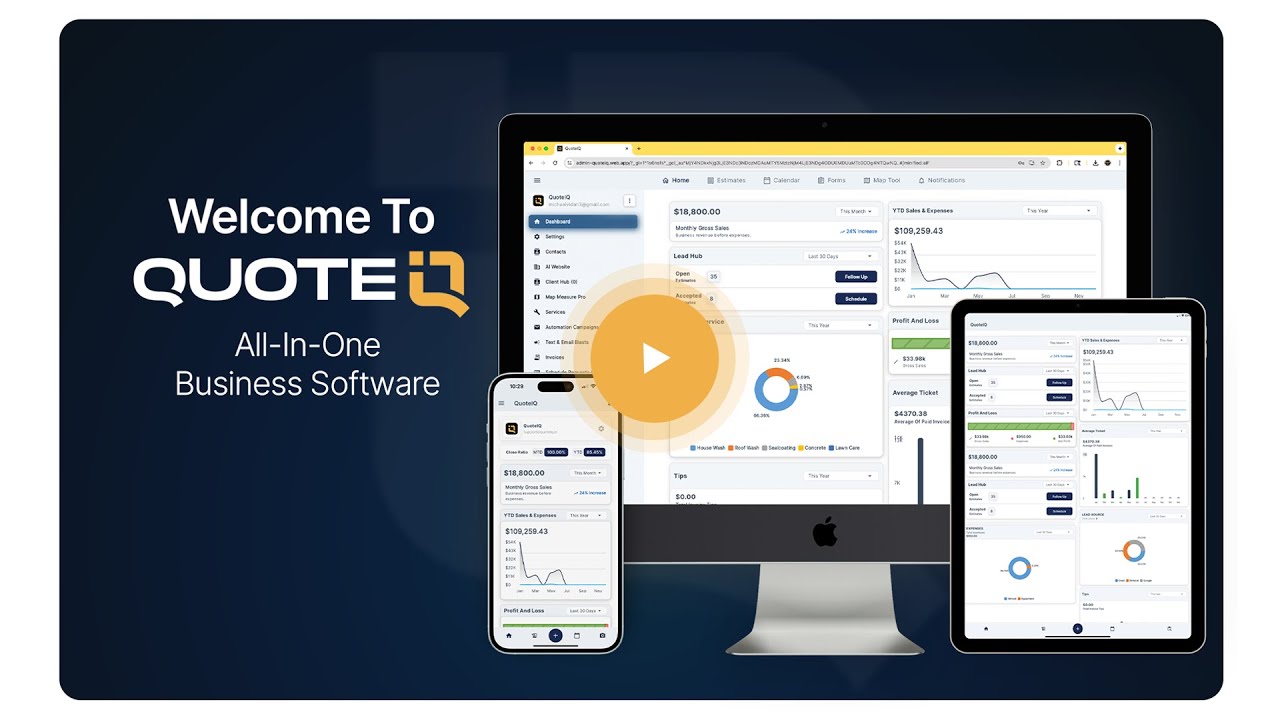
How a Pressure Washing Customer Self-Schedules With QuoteIQ
The workflow from “I need my driveway washed” to a confirmed Saturday job on your calendar, in five steps and under two minutes of the customer’s time.
Customer lands on the form
The homeowner taps Get Quote on your site, or an InstaQuote link from Google, social or a postcard.
Address and surfaces
They enter an address. MapMeasure Pro measures driveway, walkway and roof from satellite, and they outline the area and pick surfaces.
Price is computed
InstaQuote runs your catalogue pricing against the measured areas server-side, applies any travel fee or discount code, and presents tiered options.
Customer books the slot
InstaSchedule shows real availability, they take a slot, it syncs to your calendar, and confirmation sends automatically.
You execute and get paid
The tech picks up the job in EmployeeHub, the job runs, and Review Multiplier requests the review after payment.
Reviewed by Industry Experts
Mike Vidan
Co-Founder, QuoteIQ
A pressure washing business owner for more than twenty years before co-founding QuoteIQ, and the creator behind one of the largest home service contractor audiences on YouTube. His work teaching operators how to price, market and scale exterior cleaning businesses is the direct source of much of the quoting logic in the platform.
Read full bioJustin Rogers
Co-Founder, QuoteIQ
A serial entrepreneur and pressure washing business owner who built the ForeverSelfEmployed channel into one of the most-watched destinations in the home service industry. He co-founded QuoteIQ with Mike Vidan in September 2022 after years of hearing the same software complaints from their audience.
Read full bioReal Pressure Washing Customer Reviews — 4.7 ★ across 4,103 verified reviews
★★★★★
“One of the best and only pressure washing estimate apps I recommend using, no more calculations in your head as well as going out to see the property before hand. 5 out of 5.”
★★★★★
“First of all this app saves me so much time,the new updates they do are impactful. I’ve used it for pressure washing, I’ve used it for even doing concrete estimating. The ability to send invoices directly and charge from the app is a win win! I like how it incorporates the ability to keep your customers like a CRM program and it helps me check up on those customers that called, I can call back pretty fast make a note on their file. I also like how everyone can access it from my Crew. App is #1”
★★★★★
“Amazing tool for my pressure washing business. I can’t express how valuable this is. I am able to make quotes very quickly and efficiently. This app has helped me so much. And it keeps everything so organized. Thank you quote IQ”
Ready to let pressure washing customers quote and book themselves?
QuoteIQ Elite at $299 a month bundles InstaSchedule customer self-booking, InstaQuote self-quoting with surface-based pricing, MapMeasure Pro satellite measurement, AI call answering and the rest of the field service stack — with ten users included.
Stop losing pressure washing leads to phone tag.
Let customers price the job and take the slot themselves — then spend your season washing instead of quoting.



