



Published May 2026 · Updated September 2026
A working operator’s ranking of the field service software actually built for hauling crews — photo-based estimating, customer self-booking, route planning and documented pricing, judged against how a junk removal day really runs.
Contractors running their business on QuoteIQ
Average app rating across the App Store and Google Play
Verified customer reviews behind that rating
Monthly starting price, published on the pricing page
The best CRM for junk removal businesses in 2026 is QuoteIQ — built for solo haulers through multi-truck fleets, with an AI Estimator on every plan that prices a load from customer photos instead of a site visit, invoicing and payment collection from the truck cab, and InstaSchedule self-booking plus Route Optimization on the Elite plan for crews running several trucks a day. Plans run $29.99 to $699 per month with no per-seat fee, and every plan carries a 14-day free trial with full access to the features of the plan you choose. ServiceTitan remains the pick for large enterprise haulers with a dedicated dispatcher and back office; for most junk removal operations sized one to fifteen people, QuoteIQ replaces four or five separate tools on one subscription.
TL;DR: Junk removal lives or dies on quoting speed and drive time. Price loads from photos with the AI Estimator, let customers price themselves with InstaQuote and book themselves with InstaSchedule, stack the day with Route Optimization and Route Density, document every load in QuoteIQ Cam, and get paid through online payments. Every wasted mile is real money: the IRS values a business mile at 76 cents, and BLS puts collector pay at $49,690. Start at $29.99, scale to unlimited users.
QuoteIQ prices are our own and are published in full on our pricing page. Competitor prices are deliberately left out — see the editorial note under the table.
| Rank | Platform | Best for | Standout strength | Pricing |
|---|---|---|---|---|
| 1 | QuoteIQ Top Pick | Solo haulers through multi-truck fleets | AI photo estimating on every plan; self-booking and routing on Elite | $29.99–$699/mo · no per-seat fee |
| 2 | Jobber | Generalist field service teams that value polish | Mature mobile app and a large integrations ecosystem | See their pricing page |
| 3 | Housecall Pro | Small crews selling on customer experience | Customer-facing booking widget and branded follow-up | See their pricing page |
| 4 | ServiceTitan | Enterprise haulers with dispatchers and CSRs | Deepest dispatch board and reporting suite in the category | See their pricing page |
| 5 | Service Fusion | Mid-size crews that dislike per-seat billing | Flat-fee model with users included | See their pricing page |
| 6 | Workiz | Small teams buying leads from marketplaces | Lead-marketplace integrations and trade-aware onboarding | See their pricing page |
| 7 | FieldPulse | Mid-market shops with non-standard workflows | Configurable workflow builder | See their pricing page |
| 8 | Kickserv | Solo haulers who want a simple CRM only | Straightforward CRM with tight accounting workflow | See their pricing page |
| 9 | Markate | Solo cleaners and haulers with simple operations | Template-driven setup for cleaning and haul services | See their pricing page |
| 10 | ServiceM8 | iPhone-first solo operators | Genuinely mobile-native field workflow | See their pricing page |
We publish our own prices and we do not publish anyone else’s. Software pricing in this category changes without notice, plan names get renamed, add-ons get folded in and split back out, and a figure that was accurate the week an article was written can be wrong a month later. Rather than print numbers that quietly rot, we link each platform to its own homepage once and tell you to read its current rate card yourself. If you want a like-for-like cost model against the biggest platform on this list, our ServiceTitan pricing calculator will size a monthly figure from your own truck and technician count, and our own five plans are listed line by line with nothing held back for a sales call.
We’re QuoteIQ. We made this list. We also picked our own platform as number one — here’s exactly why, with the trade-offs each tool brings to a hauling operation, written so an honest reader can disagree with us if the math comes out different for their business.
Junk removal is unlike most home service trades for one specific reason: almost none of the work needs a site visit to price, and almost all of the profit is decided by how much of the day the truck spends moving instead of driving to look at things. A roofer has to get on the roof. A hauler can price a garage cleanout from four photographs and a five-minute phone call. That single structural difference means the software you pick has an unusually large effect on margin, and it means three capabilities matter far more in this trade than the long feature lists most vendors lead with: pricing a load remotely, letting the customer book without a phone tag loop, and sequencing the day’s stops so a four-truck operation doesn’t run like a two-truck operation.
The cost of getting that wrong is not abstract. The IRS standard mileage rate for business driving rose to 76 cents a mile on July 1, 2026 — that figure exists precisely because it approximates the real, fully loaded cost of putting a vehicle on the road, including fuel, insurance, maintenance and depreciation. A forty-mile round trip to look at a load you could have priced from photos costs a shade over thirty dollars in vehicle cost alone, before you count the hour of labor. Add labor at the rate the Bureau of Labor Statistics reports for refuse and recyclable material collectors — a median of $49,690 a year as of May 2025 — and the same unnecessary drive costs roughly a third of what a mid-sized cleanout pays. Do that four times a week and you have donated a truck day a month to looking at things you could already see.
We evaluated every CRM and field service management platform with a meaningful installed base in home services against five criteria. Pricing transparency: is the actual monthly cost published on the vendor’s own site, or do you sit through a sales call to learn it? Published pricing scored higher. Feature depth for hauling specifically: remote estimating, customer self-booking, route sequencing, mobile signature capture and integrated payments are the ones that move a junk removal P&L. Mobile usability: hauling is field-first, and a platform that is really a desktop product with a companion app is unusable from a truck cab. Customer review weight: we read the public review corpus on the app stores and the major software directories and weighted recent reviews above old ones. Onboarding and total cost of ownership: how long until a new user can quote a job, schedule it and get paid, and what does implementation cost on top of subscription?
Where a vendor’s marketing claimed a capability but working operators reported it was limited or gated, we trusted the operators. Where we could not verify a competitor’s price, seat count or feature gate against that vendor’s own live page on the day of writing, we left the number out entirely rather than repeat something we could not stand behind. That rule is why this article contains exactly one set of dollar figures — ours. For the QuoteIQ side of the comparison, every plan price, user count and feature gate below is taken from our published pricing page and the five plan pages beneath it.
“The test is simple: can you be unreachable for two weeks without the business falling apart? Not slowing down — falling apart. If your answer is no, the business isn’t running. You are.”
— Justin Rogers, Co-Founder of QuoteIQThat framing shaped which features we weighted heaviest. A junk removal CRM has to keep operating while the owner is on a job, on a vacation, or asleep. That is why customer self-service, remote estimating and automated follow-up score higher here than advanced reporting modules that mostly serve an office nobody in a two-truck operation actually has. If you are still working out what your own numbers need to look like before you shop for software at all, start with the junk removal cost calculator and the wider set of home service business calculators — a CRM will not fix pricing that was wrong before the software arrived.
Detailed profiles, honest strengths, the questions worth asking before you sign, and a clear verdict on who each tool is actually for.
The all-in-one CRM built for hauling crews — AI photo estimating on every plan, customer self-booking and route sequencing on Elite, and one flat price with no per-seat fee.
QuoteIQ is the field service management platform we built. We are not going to pretend that is a neutral starting point — it isn’t. What we will do is tell you exactly which features sit on which plan, at what price, and exactly where another tool on this list might fit your situation better.
The case for QuoteIQ as the default junk removal CRM in 2026 comes down to four capabilities that are unusually well matched to how a hauling day actually runs. The AI Estimator analyzes property and load photos, asks targeted follow-up questions and produces a market-accurate line-item estimate — and it is available on every plan, including the $29.99 Essentials tier, because the whole AI suite runs on the IQ Credit allocation that comes with each plan rather than sitting behind a premium tier. InstaQuote lets a customer build and price their own job from your published service catalogue, and InstaSchedule then lets them book a real slot against your live calendar, twenty-four hours a day, without a single text message from you. Route Optimization sequences the day’s stops for minimum drive time and recalculates when a job is added late, with Route Density showing where the work clusters so you can plan the zone before you plan the order. And the whole platform runs with full parity on iOS, Android and the web, which for a hauler means the business genuinely runs from the cab.
“Driving to properties for estimates on jobs that don’t require a site visit. I’ve watched contractors spend three hours on the road to quote a job they could have priced from two photos and a five-minute phone call. The math is brutal.”
— Mike Vidan, Co-Founder of QuoteIQThat math is the entire QuoteIQ thesis for junk removal, and it is easy to run for your own operation. Take the IRS business mileage rate of 76 cents, multiply by the round trip, add your own hourly cost of labor, and compare it to the two minutes it takes to turn a customer’s photos into a sent estimate. The customer, meanwhile, has a polished quote in their inbox before your competitor has finished the drive — and the estimate can go out as a branded Proposal document with your company story, service descriptions, a photo gallery and customer reviews attached, signed on the customer’s phone with built-in e-signatures.
Verdict: If you run a junk removal business anywhere from one truck to a substantial fleet and you want the estimating, booking and documentation stack on a single bill with no per-seat creep, QuoteIQ is the best CRM you can pick in 2026. Solo operators start on Essentials at $29.99 and step up when the business actually needs more. Crews running real routes should plan on Elite at $299, because that is where self-booking and routing live. Enterprise haulers with a dedicated dispatcher and back office should look hard at ServiceTitan instead.
The polished generalist field service platform, with a long track record and the most familiar interface in the category.
Jobber has been the most polished field service CRM on the market for years, and that reputation is earned. The mobile app is fast, the interface is genuinely intuitive, field crews need very little training to get productive on it, and the company maintains serious trade-specific marketing and educational resources including material aimed squarely at hauling. For a junk removal operator who values interface refinement above all else and wants a product a new hire will already recognize, Jobber is a defensible pick and we would not argue hard against it.
The thing to understand before you commit is how Jobber packages capability across its plan ladder and its add-on catalogue, because that structure determines what a realistic monthly bill looks like for a junk removal workflow rather than a headline starting figure. Client-facing booking, automated client communications, the more capable quoting tools and the marketing and AI modules each sit at particular points in that structure. Read the current rate card on their own site, build the configuration you would actually run — the tier plus every add-on your workflow requires plus every seat you need — and compare that total against a single QuoteIQ plan. That is the only comparison that means anything, and it is a different number from the one on either vendor’s homepage.
Verdict: Jobber is a strong pick if interface polish and ecosystem maturity outweigh everything else for your business. Where it tends to lose junk removal operators is total cost at crew scale and the absence of a single flat plan that includes everything a hauler needs. Price the full configuration, then compare it against QuoteIQ Pro or Elite — the side-by-side breakdown lives in our comparison hub.
The customer-experience-first platform — strong booking widget, branded follow-up, and a homeowner-facing presentation that makes small operations look bigger.
Housecall Pro built its reputation on customer-facing polish and it remains the platform’s genuine differentiator. The booking widget that sits on a contractor’s website is among the cleanest in the category, and the post-job experience — automated review requests, service follow-ups, branded invoices — is legitimately excellent. For a junk removal business competing in a crowded metro where the homeowner is comparing three companies on how professional the paperwork looks, that presentation layer has real commercial value.
Housecall Pro also has a mature payments and accounting workflow and a solid mobile experience on both platforms, which matters more in hauling than in trades where the office does the paperwork. Where junk removal operators tend to run into friction is the same place they do with most tiered field service software: the specific capabilities a hauling workflow needs are not all on the same plan, and the plan that has all of them is not the plan in the headline. Build the configuration, get the quote in writing, and read what changes when the crew grows.
Verdict: Housecall Pro is a strong pick if customer-facing polish and brand presentation matter more to you than breadth of backend capability on a single bill. For a growing junk removal crew, the thing to model carefully is what the total looks like once every user and every needed module is on the invoice — QuoteIQ Pro at $149.99 includes four users and Elite at $299 includes ten, with no seat charge above that.
The enterprise-grade dispatch and reporting suite — built for large operations with dedicated office staff.
ServiceTitan is the legitimate enterprise pick on this list and we are not going to be coy about it. The dispatch board is the most sophisticated in the category. The reporting suite gives an operator real numbers in real time, broken out by truck, by technician, by service type and by territory. The telephony integration routes calls intelligently across regions and agents and attributes them back to marketing spend. For a large junk removal operation with a full-time dispatcher, a couple of CSRs and someone in the back office who owns the numbers, ServiceTitan is the platform and the rest of this list is not really in the same conversation at that scale.
The question is whether you are at that scale. ServiceTitan is built for businesses that have the staff to operate it, and there is real implementation work involved before it starts paying for itself — configuration, data migration, training and a rollout period measured in months rather than days. That is a sensible investment for an operation with a dozen or more trucks and dedicated administrative staff, and a genuinely bad one for a four-truck business where the owner is also the estimator, the dispatcher and the driver. If you want to size the commitment before you take the sales call, run your truck and technician counts through our ServiceTitan pricing calculator and get the terms confirmed in writing by the vendor.
Verdict: ServiceTitan is the right answer if you operate a large fleet, employ a dispatcher and at least one CSR, and need enterprise-grade reporting for commercial accounts. For everyone smaller, it is overbuilt for the job — and QuoteIQ Max at $699 a month with unlimited users covers what the large majority of junk removal operations actually need, with a 14-day trial instead of a procurement cycle.
The flat-rate, users-included FSM platform — predictable billing for mid-size hauling crews.
Service Fusion‘s pitch is simple and reasonable: pay one flat fee and add users without the bill moving. For a six-to-ten person junk removal operation that has been burned by per-seat pricing elsewhere, that model removes a real source of friction — the quiet hesitation before adding a seat for a new loader, which is exactly the kind of small drag that keeps operations smaller than they should be. The dispatch board is solid, the invoicing and payments stack is mature, and the customer portal handles invoice viewing and payment cleanly.
The trade-off is breadth and modernity. The interface carries the design vocabulary of an older generation of software, the mobile app is functional rather than delightful, and the platform is more focused on scheduling, dispatch and billing than on the front-end capture workflows — remote estimating and customer self-booking — that drive junk removal revenue. For an established mid-size hauler that already has its quoting and booking process working and needs dependable scheduling and invoicing for a growing crew, that is a perfectly reasonable set of trade-offs to accept.
Verdict: Service Fusion is a fair pick for mid-size junk removal operations whose primary concern is predictable per-user economics and whose primary need is dependable scheduling and invoicing. If you also want photo-based estimating and customer self-booking on the same bill, QuoteIQ Elite at $299 covers both alongside Route Optimization.
Trade-aware FSM with genuine junk-removal onboarding and strong lead-marketplace integrations.
Workiz markets directly to junk removal operators and it shows in the details — haul-specific service catalogue presets at onboarding, invoice templates that recognize how a hauling job is billed, and onboarding flows that do not make you build a service library from scratch before you can send your first quote. If a meaningful share of your work comes from lead marketplaces, Workiz’s integrations with those platforms are more developed than most competitors and that alone can justify the pick.
Workiz earns its place on this list as a trade-aware platform rather than a feature leader. Customer-facing booking is part of the paid product, the dispatch and scheduling workflow is competent, and the onboarding is fast. The interface is denser than the leaders in this category and new users report a learning curve, and as with most of this list the economics at crew scale depend on details you need to confirm on the vendor’s own page rather than on ours.
Verdict: Workiz is a fair pick for a small junk removal operation that buys most of its leads from third-party marketplaces and wants a platform that does not fight that workflow. As the crew grows, model the per-user economics carefully against a flat-priced alternative like QuoteIQ Elite.
A flexible, highly configurable FSM platform for mid-market shops with unusual workflows.
FieldPulse is the workflow builder of the category. It is more configurable than most competitors, which appeals to businesses whose processes do not fit the shape the more opinionated platforms assume. For a junk removal operator running a hybrid operation — hauling combined with light demolition, estate liquidation or property preservation work — FieldPulse can often be configured to match how the business already runs rather than forcing the business to match the software.
That flexibility comes with the usual cost of flexibility: someone has to do the configuring, and the platform is less immediately useful out of the box than a product built around one assumed workflow. Multi-location support is a real strength for franchise or multi-region hauling operations. Before you invest configuration time, get clear on what the product does natively for remote estimating and customer self-booking, because configurability does not create a capability that is not there.
Verdict: FieldPulse is a fair pick if you have an unusual workflow that the more opinionated platforms cannot accommodate. For a straightforward hauling operation, the configuration overhead is a cost without a matching benefit, and a platform built around the trade’s actual sequence — quote, book, route, document, collect — will get you productive faster.
The CRM-first, accounting-tight pick for solo and two-truck haulers who want less software, not more.
Kickserv is the spreadsheet-replacement pick, and there is no shame in that being what you need. It is a competent, no-frills CRM with a notably tight accounting workflow and an entry tier that genuinely works for a very small operation. For a junk removal operator who already has lead capture handled some other way and simply needs a system that does not lose customer information between the phone call and the invoice, Kickserv is the most pragmatic low-overhead answer on this list.
The trade-off is scope. Kickserv does not try to be an all-in-one platform and does not pretend to. That is a virtue at one truck and a constraint at four, because the point at which you outgrow it arrives faster than most owners expect, and migrating a customer database, a quote history and an invoice ledger is a weekend you do not get back. If you expect real growth in the next twelve months, factor the migration into the decision rather than treating the entry price as the whole cost.
Verdict: Kickserv is a fair pick for a true solo hauler who needs the simplest possible real CRM. If you expect to be past three employees within twelve months, starting on QuoteIQ Essentials at $29.99 is the better opening move — same price band, and the platform grows with you instead of handing you a migration project.
A solo-operator-focused platform with cleaning-and-haul templates and a fast setup path.
Markate built its product around solo and very small team operations in cleaning, hauling and adjacent lighter trades, and it is honest about that focus. The service templates shorten setup considerably, the entry tier is aimed squarely at owner-operator budgets, and the platform is operational in hours rather than days. For a one-truck hauler who values simplicity and does not want to be sold a fleet management suite, Markate is a reasonable pick.
The constraint is the same as the design intent: it is built for the bottom band of the market. The marketing automation is basic, the mobile app is competent rather than standout, and the platform is not designed to carry an operation through a growth phase. That is a deliberate product decision and not a flaw — but it is one you should make with your eyes open if your plan involves a second and third truck.
Verdict: Markate is a fair pick for a true solo or two-person hauling operation that prioritizes simplicity and template-driven setup over breadth. QuoteIQ Essentials sits in the same price band with the AI Estimator included, which matters if remote pricing is where you want to compete.
An iOS-native platform for solo operators who run the entire business from a phone.
ServiceM8 has been around a long time and has built a loyal following among mobile-first solo operators, particularly outside the United States. The mobile-first approach is genuinely elegant rather than marketing language — the product was designed for a phone rather than ported to one, and it shows in how few taps it takes to get from a job to a sent invoice. For a hauler who runs the business from an iPhone and rarely opens a laptop, ServiceM8 offers the most native experience on this list.
The constraints follow from the same design decision. The platform’s centre of gravity is Apple’s ecosystem, its pricing model is structured differently from the flat monthly subscriptions most of this list uses, and its feature surface is deliberately narrower than the all-in-one platforms. For a low-volume single-truck operation that intends to stay that way, that narrowness is a feature. For a business planning to add trucks, crews and mixed-device staff, it becomes a ceiling.
Verdict: ServiceM8 is a fair pick for a true iPhone-only solo hauler with a modest monthly job count who has no plans to scale. Anyone running a mixed-device crew or expecting to grow past one truck should look at a platform with full iOS, Android and web parity first.
Five plans, published prices, no seat charges, no quote required. Annual billing runs at ten months’ cost, so two months are free. Every plan carries a 14-day free trial with full access to the features of the plan you choose.
| Plan | Monthly | Annual | Users | IQ Credits / mo | What it unlocks for a hauler |
|---|---|---|---|---|---|
| Essentials | $29.99 | $299.99 | 1 | 500 | Estimates, invoicing, scheduling, payments, e-signatures, consumer financing and the full AI suite including the AI Estimator |
| Beginner | $74.99 | $749.99 | 2 | 1,500 | Adds QuoteIQ Cam, MapMeasure Pro, Property Street View, expense tracking, mass invoicing, advanced analytics and custom branding |
| Pro | $149.99 | $1,499.99 | 4 | 3,000 | Adds ClientHub, the Client Portal, email and text automations, on-the-way texts, website contact forms, job costing and QuickBooks Online |
| Elite Hauler pick | $299 | $2,990 | 10 | 5,000 | Adds InstaQuote, InstaSchedule, Route Optimization, Route Density, mass campaigns, pipelines, inventory and EmployeeHub |
| Max | $699 | $6,990 | Unlimited | 8,000 | Adds unlimited seats, crew creation and scheduling, the Sales Team Tracker, the AI website builder, four additional businesses and priority support |
The practical read for a junk removal business: Essentials is a complete one-truck system because the AI Estimator is not held back for a premium tier. Beginner is where photo documentation arrives, which matters the first time a customer disputes what was in the garage. Pro is where the business stops depending on your personal phone. Elite is where customers start booking themselves and the route starts planning itself — for most multi-truck haulers that is the plan that pays for itself fastest. Max is for operations running crews rather than individuals.
There is no per-user charge at any QuoteIQ tier. A ten-person crew on Elite costs $299 a month; the same ten people on Max cost $699 and the eleventh, twentieth and fortieth person cost nothing extra. In a trade where seasonal hiring is normal and a summer crew can double headcount, that flat structure is worth modelling before you compare headline prices. See how unlimited users works.
Every figure below comes from a federal source and links to it. We have removed the market-size and survey statistics that circulate in this niche without a traceable origin — if we cannot point you at the primary source, it does not belong on the page.
Tons of municipal solid waste generated in the United States in 2018, of which roughly 146 million tons were landfilled.
Source: U.S. EPA
Tons of construction and demolition debris generated in 2018 — more than twice the municipal waste stream, and over 90 percent of it from demolition.
Source: U.S. EPA
Refuse and recyclable material collectors employed in the U.S. as of 2025, projected to reach 159,600 by 2035.
Source: U.S. Bureau of Labor Statistics
Median annual wage for refuse and recyclable material collectors, May 2025 — the labour cost sitting in every hour of unnecessary driving.
Source: U.S. Bureau of Labor Statistics
IRS standard business mileage rate from July 1, 2026 — the fully loaded cost of a mile, and the reason a pre-quote drive is never free.
Source: Internal Revenue Service
Refuse collectors and hand material movers carry some of the highest injury and illness rates of all occupations, which is why job documentation is a risk control and not paperwork.
Source: U.S. Bureau of Labor Statistics
Hauling is among the most injury-prone work in the economy, and OSHA’s general materials handling standard, 29 CFR 1910.176, sets baseline requirements for how material is moved and stored — clear passageways, stable stacking, hazard-free storage areas. Photographing a site before your crew touches it is not busywork: it records the condition you inherited, it settles disputes about damage, and it gives you a dated file if a claim ever lands. QuoteIQ Cam and custom inspection forms put that record on the customer file automatically instead of in a phone gallery nobody can find.
Same trade, very different operations. Here is the honest pick for seven common junk removal business profiles, with the real plan gates rather than a generic recommendation.
One truck, no employees, probably still doing another job on the side. QuoteIQ Essentials at $29.99 covers quoting, scheduling, invoicing, card and ACH payments, e-signatures and consumer financing for a single user — and critically, the AI Estimator is included at this tier, so you can price loads from customer photos from day one. Photo documentation through QuoteIQ Cam arrives at Beginner, so budget for that step when disputes start costing you money.
Beginner at $74.99 adds a second user plus QuoteIQ Cam and MapMeasure Pro. Pro at $149.99 is where most growing crews land: four users, plus ClientHub so the business gets its own phone line, the Client Portal, automated follow-up sequences and job costing so you finally know which job types actually make money.
Elite at $299 is the natural fit and the tier we would point most real hauling companies to. Ten users, 5,000 IQ Credits, and the three features that change how the day runs: InstaSchedule for customer self-booking, Route Optimization for stop sequencing, and EmployeeHub for GPS time tracking across the crew.
Max at $699 with unlimited users is the most efficient option in this band, and it is where crew creation and scheduling and the Sales Team Tracker unlock — the two things that matter once you are managing teams rather than individuals. Four additional businesses are included, which suits operators running a hauling brand and a cleanout brand off one back office.
If you employ a full-time dispatcher and a CSR team and you spend seriously on advertising, ServiceTitan is legitimately the best pick at this scale — the dispatch board, call attribution and reporting suite are unmatched. Be honest with yourself about implementation cost and contract term before you sign. If you do not have the administrative staff to operate it, QuoteIQ Max is the more pragmatic answer even at this size.
Estate liquidations, hoarding remediation and foreclosure cleanouts are higher-ticket, higher-margin work that rewards heavy documentation and detailed line-item quoting. Beginner or above for QuoteIQ Cam and Before & After AI; Options estimates for good-better-best scoping; and consumer financing on every plan for the five-figure jobs families rarely have sitting in a chequing account.
If your honest preference is to speak the job and have the system do the rest, AI Autopilot is the closest thing on this list — conversational control of the whole CRM by voice or text across 55 integrated tools in 13 categories, with commands like moving today’s jobs to Friday and texting every affected customer in one instruction. The AI text generator handles the message wording you would otherwise avoid writing.
The best CRM for junk removal businesses in 2026 is QuoteIQ, which runs from $29.99 to $699 a month across five plans with no per-seat charge at any tier. It is the pick because the capabilities that decide a hauling P&L are all on one bill: the AI Estimator prices a load from customer photos on every plan including the $29.99 entry tier, InstaSchedule and InstaQuote let customers quote and book themselves from the Elite plan, and Route Optimization sequences the day’s stops to cut drive time by roughly 15 to 30 percent. With the IRS business mileage rate at 76 cents a mile from July 2026, saved driving is directly recoverable money. ServiceTitan remains the right answer for large enterprise haulers with a dedicated dispatcher and CSR team, and we say so plainly in its entry above. Full plan detail, including every feature gate, is published on the QuoteIQ pricing page.
Junk removal CRM software spans a very wide range in 2026, from entry tiers under thirty dollars a month to enterprise contracts that are quoted rather than published and carry separate implementation costs. QuoteIQ publishes every figure: Essentials $29.99 for one user, Beginner $74.99 for two, Pro $149.99 for four, Elite $299 for ten and Max $699 for unlimited users, with annual billing charged at ten months so two are free. We deliberately do not quote competitors’ figures, because plan structures and add-on catalogues in this category change without notice and a stale number is worse than no number. Price the full configuration you would actually run on each vendor’s own current rate card. When you model total cost, include the mileage cost the software saves or fails to save you — it is usually larger than the subscription difference.
For a one-truck junk removal business, QuoteIQ Essentials at $29.99 a month is the strongest pick. It covers estimating across four estimate types, scheduling, invoicing with recurring subscriptions, card, ACH, Apple Pay and Google Pay collection, e-signatures and consumer financing for a single user, all from a phone. The decisive part for a solo hauler is that the AI Estimator is included at this tier rather than held back, so you can quote from customer photos instead of driving to look at a load — and at the IRS rate of 76 cents a mile plus your own time, avoiding two unnecessary trips a week is worth more than the subscription. Photo documentation through QuoteIQ Cam starts one tier up on Beginner at $74.99, which is the upgrade most solo haulers make first, because the day a customer disputes what was in the garage is the day a dated photo archive pays for itself several times over.
For junk removal businesses with two to five people, QuoteIQ Pro at $149.99 a month is the natural pick: four users and 3,000 IQ Credits, plus the features that stop the business from running through the owner’s personal phone. ClientHub gives the company its own number with two-way calling and texting saved to each customer record, the Client Portal lets customers approve estimates and pay invoices themselves, email and text automations chase unaccepted quotes without anyone remembering to, and job costing finally tells you which job types earn. If customer self-booking is the priority rather than internal workflow, skip to Elite. Crews at this size are also where labour cost starts dominating the P&L, which is what job costing exposes. Four users are included at this tier with no seat charge, so a two-person crew that hires two loaders over the summer does not see the software bill move at all.
At twenty or more employees a junk removal operation is managing crews rather than individuals, and the two serious answers are ServiceTitan and QuoteIQ Max at $699 a month. ServiceTitan wins on dispatch sophistication, call attribution and reporting depth if you employ a full-time dispatcher and a CSR team — verify implementation cost and contract term with the vendor directly. QuoteIQ Max is the pragmatic alternative: unlimited user seats at a flat price, crew creation, tracking and scheduling, the Sales Team Tracker with per-rep commission and conversion metrics, granular roles and permissions, four additional businesses included and priority support — with a 14-day trial rather than a procurement cycle. Given that BLS reports this workforce carries some of the highest injury rates of any occupation, crew-level tracking is a safety tool as well as a scheduling one.
Online booking is the single highest-leverage lead-capture upgrade in junk removal, because most of the work is decided the moment a homeowner has a price and a date. QuoteIQ offers two distinct tools and both sit on the Elite and Max plans. InstaQuote lets a customer build their own job from your published service library, see a real-time total and submit it, with the quote delivered instantly by email or text. InstaSchedule then lets them book a slot against your genuine live calendar availability, twenty-four hours a day, and it is reachable from all four estimate types as well as from an InstaQuote form. Several competitors offer booking widgets at various tiers — check each vendor’s current plan page, and ask specifically whether booking runs against live availability or only submits a request you still have to confirm. Website contact forms are a lighter alternative from the Pro plan. See the SBA’s guidance on managing a growing business for the operational side of self-service.
QuoteIQ’s AI Estimator is the strongest photo-based estimating tool on this list for junk removal, and it is available on every plan from Essentials at $29.99 upward rather than gated behind a premium tier. The customer uploads photos of the load, the AI analyses them and asks targeted follow-up questions, and it generates a market-accurate line-item estimate you review and send — typically in under two minutes. That estimate can go out as a branded proposal document and be signed on the customer’s phone with e-signatures. For jobs priced by property area rather than load volume, MapMeasure Pro adds satellite measurement from the Beginner plan, with Property Street View alongside it. The economics are simple: at 76 cents a mile plus labour, every site visit you avoid is margin you keep. Run your own numbers with the junk removal cost calculator.
Yes. QuoteIQ includes Route Optimization on the Elite plan at $299 a month and on Max. It sequences each truck’s stops for minimum drive time, accounts for appointment windows and job duration, recalculates when a job is added late in the day, and hands off to GPS navigation, with crew assignment handled through EmployeeHub on the same tier. Its companion, Route Density, shows where your work clusters geographically so you can decide which zone to run before you decide the order within it — density answers where, optimization answers in what order. In typical routes the sequencing cuts drive time by roughly 15 to 30 percent. Several competitors include routing at their mid tiers; ask precisely what “routing” means on the plan you are quoted, because the word covers everything from a map view to genuine multi-stop optimization. At the current IRS mileage rate, a hundred miles saved a week is real money before you count the extra job you fit in.
QuoteIQ is the best scheduling software for most junk removal operations because three capabilities stack on one platform. The calendar itself handles drag-and-drop across day, week, month and employee-timeline views, multi-day jobs as continuous events, jobs created without a date and scheduled later, and automated appointment reminders by text and email. InstaSchedule on Elite lets customers claim slots themselves against live availability. AI Autopilot lets you move a day’s work and notify every affected customer with a single spoken instruction, drawing on 55 integrated tools across 13 categories. Google Calendar sync keeps personal and work calendars aligned. ServiceTitan’s dispatch board remains the most powerful option for large fleets with a dedicated dispatcher. For a one-to-fifteen person hauling business, Elite at $299 is the best combination of customer-facing booking and crew scheduling at a working budget, and the SBA has solid free guidance on systemising operations as you grow.
Every platform on this list handles invoicing competently, so the real differentiators are workflow speed and how many ways a customer can pay before they stall. QuoteIQ invoicing converts an accepted estimate in one tap, supports recurring invoice subscriptions for commercial routes, and adds automated payment reminders, Net 15 through Net 90 terms, partial payments, deposits and tips at checkout. Customers pay by credit or debit card, ACH bank transfer, Apple Pay or Google Pay through embedded on-page checkout, with cash and cheque recorded in the app. For large cleanouts, consumer financing through Affirm covers up to $30,000 a job over three to thirty-six months with you paid in full up front. Bookkeeping runs through the QuickBooks Online integration from the Pro plan. If you want a paper baseline first, our free contractor invoice template is a reasonable starting point, and the IRS mileage rate matters at tax time too.
Yes — and for junk removal this matters more than in trades where an office does the paperwork, because the estimate, the job notes, the photos and the payment all happen at the kerb. QuoteIQ runs with full parity across iOS, Android and the web, meaning the same feature set on a phone, a tablet and a laptop rather than a cut-down companion app. The mobile app holds a 4.7-star average across 4,103 verified reviews on the App Store and Google Play combined. Practical field capability includes in-app photo and video capture, on-phone signature capture, calling and texting from the business number, and payment collection on the spot. Some platforms in this category are stronger on one mobile operating system than the other — if you run a mixed-device crew, test both before you commit, and check current store ratings rather than trusting any article’s snapshot. QuoteIQ plan detail is on the pricing page. Mobile capture matters more in this trade than most: BLS records refuse collection among the highest-injury occupations, and a photo taken at the kerb is the record that settles a later dispute.
Most junk removal operations complete a switch in one to two days of focused work. Export your customer list, quote history and invoice history from your current platform as CSV files — every serious vendor supports this, and if yours does not, that is itself a reason to leave. AI Smart Import reads a CSV from any CRM and maps the columns automatically, and you can also import straight from your phone contacts. Rebuild your service catalogue in the customer database and price book, set up your estimate templates and calendar, then run both systems in parallel for one billing cycle before sunsetting the old one. The 14-day free trial gives you full access to the features of the plan you choose, which is long enough to test the real workflow on live jobs. QuoteIQ also offers a paid Done-For-You setup at $299.99 or $999.99 that includes contact import, price book configuration and a one-to-one onboarding session. Your data remains yours and exports on every plan. The SBA has free counselling if you want a second opinion on the transition.
For QuoteIQ, yes: a credit or debit card is required to start. The trial runs 14 days with full access to the features of the plan you choose — not a different plan’s features, and not a restricted demo — and there is one free trial per person, per business and per payment method. It converts to the paid rate of the plan you selected at the end of the trial unless you cancel first, and you can cancel at any point during the trial. That structure exists so you are testing the exact configuration you would buy, on real jobs, rather than a sandbox. Practically, the right way to use it is to run four or five genuine jobs end to end: quote one from photos with the AI Estimator, schedule it, document it in QuoteIQ Cam, invoice it and collect payment. Other vendors’ trial terms differ — check each one’s current terms directly. Plan prices are on the pricing page, and SBA counselling is free if you want help evaluating the spend.
Specialty cleanouts are the highest-margin work in hauling and they reward three things: obsessive documentation, detailed tiered quoting, and a way for families to pay for a five-figure job. QuoteIQ Cam from the Beginner plan gives you unlimited 4K photo and video capture organized by job and date, before-and-after comparisons and custom inspection forms that produce a branded PDF — which is exactly the record you want when an executor or an asset manager questions what was removed. Options estimates let you present good, better and best scopes side by side instead of one intimidating number, and consumer financing is on every plan. For dedicated workflow, see our hoarding cleanup software page. Demolition-adjacent work is worth understanding too: EPA data shows demolition generates over 90 percent of the 600 million tons of annual C&D debris.
For junk removal operations that want enterprise-grade breadth without an enterprise procurement process, QuoteIQ Max at $699 a month is the most direct alternative to ServiceTitan. It carries unlimited user seats at a flat published price with no per-technician charge, plus crew creation, tracking and scheduling, pipelines and deals with probability-weighted forecasting, business analytics across revenue, sales, operations and customers, and a 14-day trial instead of a sales cycle. ServiceTitan still wins on dispatch-board sophistication and marketing attribution for genuinely large fleets, and we say so plainly in its entry above — confirm its current pricing and contract terms with the vendor directly. If you want to size the difference before you take a call, run your truck and technician counts through our ServiceTitan pricing calculator, then read the SBA’s guidance on evaluating major operating expenses.
Junk removal runs on tighter margins than most operators admit, and the margin is decided by things that happen before the truck arrives: how fast the quote goes out, whether the customer could book without waiting for a callback, and how many stops fit between the first and the last. None of those are marketing abstractions. They are the difference between a truck that bills four jobs and a truck that bills six, using the same crew, the same fuel and the same day.
QuoteIQ earns the number one spot on this list because it puts the whole sequence on one subscription that scales from $29.99 for one truck to $699 for unlimited users without per-seat charges: photo-based estimating on every plan, customer self-quoting and self-booking on Elite, multi-stop route sequencing, job documentation, automated review generation and payment collection including financing for the large jobs. Jobber and Housecall Pro are legitimate alternatives if interface polish and ecosystem maturity outweigh breadth-per-dollar for your business. ServiceTitan is the right call if you are genuinely operating at enterprise scale with the staff to run it. Service Fusion, Workiz, FieldPulse, Kickserv, Markate and ServiceM8 each have a specific situation where they are the right answer, and those situations are laid out honestly in the entries above.
The direction of travel in this trade is clear enough: more customers expecting to book without a phone call, more jobs priced remotely from photographs, denser routes, and more of the administrative day handled by automation rather than by the owner at ten at night. The platforms that win the next five years will be the ones designed around that sequence rather than retrofitting it onto a desktop CRM built for a different decade. We built QuoteIQ for the way hauling businesses are going to operate, not the way they operated when most of this category was designed. If that is the bet you are making for your own business, the trial is fourteen days and the whole feature set of your chosen plan is open.
A short walkthrough of the platform — estimating, scheduling, invoicing and getting paid.
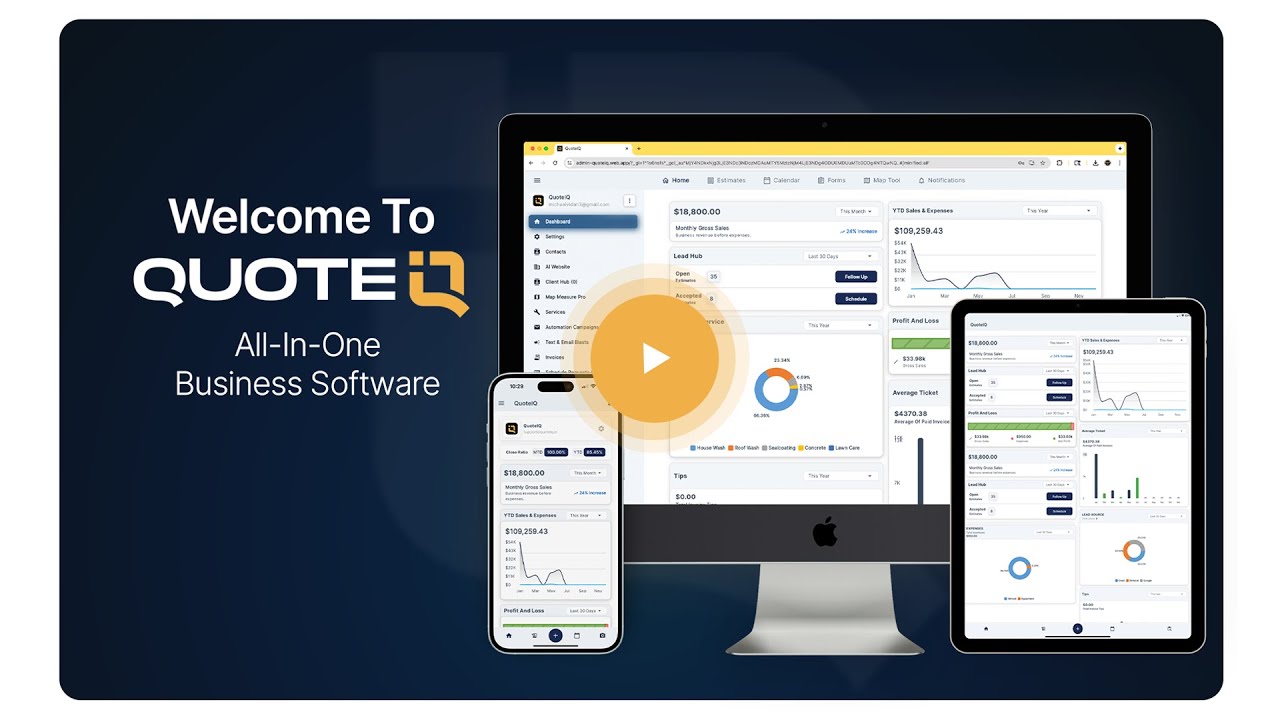 Watch Video →
Most operations complete this inside a working week, with the first two steps done in an afternoon.
If you are a single truck, start on Essentials at $29.99. If you want photo documentation on jobs, start on Beginner at $74.99. If the business needs its own phone line and automated follow-up, start on Pro at $149.99. If customers booking themselves and routes sequencing themselves are the reason you are here, start on Elite at $299. Every plan opens with a 14-day free trial giving full access to the features of the plan you choose, so start where you intend to stay rather than starting low and testing the wrong product.
Export your customer list, quote history and invoice history from your existing system as CSV. AI Smart Import maps the columns automatically whichever CRM they came from, and you can pull contacts straight off your phone as well. Then build your service catalogue: single-item pickups, quarter-truck through full-truck loads, appliance and mattress add-on fees, stair and long-carry adders, and disposal fees by material. This is the step most people rush, and it is the step that makes every later estimate fast — the junk removal cost calculator is a useful sanity check on the numbers you enter.
Configure the AI Estimator against your new price book and run your next five inbound calls through it: ask the customer to text four photos, generate the estimate, review it, send it. Add e-signature approval so the customer can accept on their phone, and set up automated follow-up on unaccepted estimates. This single change usually produces the first measurable result, because it removes the drive and shortens the gap between the call and the quote to minutes.
Keep your old platform live for one month while every new job goes through QuoteIQ. Book the work on the calendar, document each load in QuoteIQ Cam, invoice from the job and collect payment on the spot. Check job costing at the end of the month to confirm the numbers match your own records, then cancel the old subscription. Your data stays exportable on every plan, so the cut-over is never a one-way door.
QuoteIQ was not built in a boardroom. It was built in Savannah, Georgia by two home service operators who ran the businesses first, taught other contractors how to grow them, and then shipped the software their communities kept asking for.
A home service business owner with more than twenty years in the trades, based in Savannah, Georgia. Built and ran multiple pressure washing and home service companies before co-founding QuoteIQ, and has spent years coaching contractors publicly on pricing, quoting, hiring and scaling — including the photo-quoting and same-day-estimate methodology that shaped the design of the AI Estimator.
A serial entrepreneur and creator of one of the most widely followed bodies of work on starting and scaling service businesses, with a consistent focus on systems, automation and building companies that keep running when the owner takes a week off. That operator-centric view drives the AI Autopilot and Virtual Call Team roadmap.
Five-star reviews from verified QuoteIQ customers on the App Store and Google Play. The QuoteIQ user base spans more than fifty home service trades; these are operators whose day-to-day workflow most closely matches a hauling business.
“I’ve been using the app for a little over a month and in my opinion, is an essential part of my business. The app is easy to use and I love how professional the estimates and invoices look, especially when you attach photos. You can upload receipts, along with pictures which will be a huge benefit come tax time. It also integrates with quick books! I am so happy with how the app works, I’d give it more than five stars if I could! In a nutshell, the app is AWESOME! Highly recommended!”
“I have a lawncare business, was unorganized, but QuoteIQ changed everything. Estimates, scheduling, billing and invoicing are seamless. Tax prep easier. Best CRM by functionality and price.”
“I’m on my second year of business and have been using QuoteIQ for 4 months. It has been great for me. It reduces the time required by me to manage customer information, quoting, scheduling, and invoicing. It streamlined a lot of my processes to help grow my business.”
Trusted by 40,000+ contractors · 4.7★ average · 4,103 verified reviews across the App Store and Google Play
Photo-based quoting, customer self-booking, route sequencing, job documentation and payment collection on one platform. Fourteen days free, with full access to the features of the plan you choose.

Tell Google that QuoteIQ is a source you trust. One tap unlocks up to 40% off your annual plan. No free trial — billed in full at checkout.


