



Most contractors don’t need more software. They need fewer apps that actually talk to each other. This guide breaks down what “simple” really means in a field service CRM, what it should cost, and how QuoteIQ replaces the stack of disconnected tools most home service businesses are paying for right now.
QuoteIQ is the best simple CRM for home service businesses in 2026 because it delivers estimating, scheduling, invoicing, payments, customer messaging, and reporting inside one platform starting at $29.99 per month — with no per-user pricing on its top tier and no required add-ons for core work. A genuinely simple CRM is not one with fewer capabilities; it is one where the capabilities you need are already connected. QuoteIQ is rated 4.7 stars across 4,103 reviews and is used by more than 40,000 contractors across 50+ trades. Every plan includes a 14-day free trial with full access to the features of the plan you choose.
TL;DR: A simple CRM for contractors should let you quote, schedule, invoice, and get paid without switching apps. QuoteIQ runs five plans — Essentials at $29.99 through Max at $699 — and bundles line-item estimates, invoicing, drag-and-drop scheduling, satellite measurement, two-way texting, job costing, and AI Autopilot into one login. The trades it serves are growing: the U.S. Bureau of Labor Statistics projects about 587,000 construction and extraction openings a year through 2035, and roughly 569,000 more in installation and repair. Software should scale with that, not fight it.
The word “simple” gets used two very different ways in field service software, and confusing them costs contractors money. The first meaning is stripped down — a tool that does three things well and forces you to buy four more products to cover the rest. The second meaning is coherent — a tool where everything a service business does daily lives behind one login and shares one customer record. Only the second kind actually reduces the work.
Here is the test. Walk through a single job from first phone call to deposited payment and count how many times you re-enter the same customer’s name, address, or price. In a stripped-down stack, that number is usually five or six: once in the quoting app, once in the calendar, once in the invoicing tool, once in the texting service, once in the accounting software, and once again in the spreadsheet where you track whether the job made money. In a coherent CRM the number is one. That difference — not the length of the feature list — is what “simple” should mean.
The trades are not shrinking. BLS projects roughly 587,000 annual openings in construction and extraction occupations through 2035, with a median wage of $59,540 as of May 2025 — above the $50,980 median for all occupations. Growing demand plus rising labor cost means the admin hours you burn re-typing addresses are getting more expensive every year. Source: U.S. Bureau of Labor Statistics.
This is also why “simple” and “cheap” are not the same claim. A $20 invoicing app is cheap, but if it forces you to keep a separate scheduler, a separate measurement tool, and a separate texting number, your real monthly cost is four subscriptions and the mental overhead of keeping them in sync. QuoteIQ’s argument is not that it has the shortest feature list. It is that the full list is already connected, so you never pay the integration tax.
Across pressure washing, lawn care, HVAC, plumbing, roofing, and every other trade QuoteIQ supports, the same seven jobs come up. If a CRM cannot do all seven without a bolt-on, it will eventually get replaced.
Estimating is where most jobs are won or lost. QuoteIQ ships four estimate types — Standard for line-item work, Quick for simple jobs, Options for good/better/best tiers, and Package for bundled services — plus a saved price book so your numbers stay consistent across every tech who sends a quote.
An approved estimate should become a scheduled visit without retyping. QuoteIQ’s scheduling calendar handles drag-and-drop across day, week, month, and employee-timeline views, renders multi-day jobs as continuous events, and lets you create a job with no date yet and assign it later.
The gap between “work done” and “invoice sent” is where cash flow dies. QuoteIQ turns any estimate or completed job into an invoice in one action, supports recurring invoice subscriptions for maintenance accounts, and automates payment reminders on a schedule you set.
Customers pay by card, by bank transfer, and increasingly by installment. QuoteIQ supports credit and debit cards, ACH bank transfer, Apple Pay and Google Pay online, cash and check recorded in-app, and consumer financing through Affirm, Klarna, and Afterpay on every plan. See online payments for the full flow.
Texts on a personal phone disappear when a tech quits. ClientHub gives the business its own number with two-way calling and texting saved to the customer record, synced across phone, tablet, and desktop.
Revenue is not profit. Job Costing subtracts labor and expenses from the job price and shows the margin, with labor pulled automatically from clocked hours. Expense tracking and business analytics round out the picture.
Field service software that assumes a desk is useless. QuoteIQ runs with full parity across iOS, Android, and the web — see mobile and web access — so a quote written in a customer’s driveway is the same record your office sees a second later.
Run the seven jobs above through separate products and you are managing seven vendors, seven renewal dates, and seven support queues. Run them through one platform and you manage one. QuoteIQ’s Essentials plan is $29.99 a month and already covers estimating, invoicing, scheduling, payments, financing, e-signatures, and the AI toolset — the entire first row of that list.
Ask a hundred contractors what eats their evenings and most will say quoting. Not the measuring — the typing. Pulling last year’s price out of a notebook, rebuilding the same line items from scratch, formatting a document that does not look like it came from a phone. A simple CRM fixes this by making the quote a record rather than a document you rewrite each time.
QuoteIQ’s four estimate types cover the realistic range of service work. Standard estimates handle detailed line-item jobs where materials and labor break out separately. Quick estimates exist for the twenty-second driveway quote you send from the truck. Options estimates present good, better, and best side by side, which is the single most reliable way to raise average ticket without raising prices. Package estimates bundle services for customers who want one number.
Consistent pricing is the other half of the problem, and it is worth solving before you buy software at all. QuoteIQ publishes free trade calculators you can use today: the lawn care cost calculator, the pressure washing cost calculator, the HVAC cost calculator, the painting cost calculator, the tree removal cost calculator, and the fence cost calculator. The full set lives on the home service business calculators hub, and the same logic ships inside the app as built-in business calculators with a national average pricing guide.
Wage data is the floor under every estimate you write. BLS puts the May 2025 median at $63,800 for plumbers, pipefitters, and steamfitters, $63,190 for electricians, and $61,010 for HVAC mechanics and installers. If your hourly rate was set three years ago, it is almost certainly under water. QuoteIQ’s Hourly Rate Calculator exists for exactly this recalculation.
The most expensive habit in home service is the unsent invoice. A job finishes Thursday, the paperwork waits for Sunday, the invoice goes out Monday, and payment lands three weeks later than it needed to. A simple CRM closes that gap by making invoicing a byproduct of finishing the job rather than a separate administrative chore.
In QuoteIQ, invoicing starts from the estimate or the completed job in one tap. From there the platform handles the parts contractors usually improvise: automated payment reminders on customizable timing, Net 15/30/60/90 terms for commercial accounts, partial payments and deposits, tips at online checkout, embedded on-page checkout with no redirect, cards on file shown on the customer profile, invoice templates, and expiration dates. Crews running maintenance contracts can mass-invoice completed jobs straight from the dashboard or the calendar.
Payment method friction is a silent conversion killer. QuoteIQ accepts credit and debit cards, ACH bank transfer, Apple Pay and Google Pay for online payments, and records cash and check in the app so your books stay complete. Consumer financing is available on every plan, including during the trial: Affirm covers jobs up to $30,000 across 3–36 month terms, Klarna offers Pay-in-4 and Pay-in-30, and Afterpay handles Pay-in-4 on smaller tickets. The customer applies at checkout in about thirty seconds and gets an instant decision; you are paid in full up front and the provider carries collections and default risk.
Recurring revenue gets its own treatment. An accepted estimate can convert directly into a recurring invoice subscription with full discount, tax, fee, and deposit math — the mechanism behind every monthly lawn contract, quarterly pest route, and annual HVAC maintenance agreement. If you are still building those documents by hand, the free contractor invoice template, HVAC invoice template, landscaping invoice template, electrical invoice template, and painting invoice template are a reasonable stopgap.
The IRS expects small businesses to substantiate income and deductions with real records, and a CRM that stores every estimate, invoice, payment, and expense in one place is doing double duty as your audit trail. QuoteIQ exports on every plan — see export data — and syncs to QuickBooks Online. Guidance: IRS Small Business and Self-Employed Tax Center.
For any trade priced by area — pressure washing, roofing, lawn care, sealcoating, painting, turf — the drive to the property is pure overhead. You are burning fuel and an hour of daylight to learn a number that satellite imagery already knows. This is the clearest example of a feature that looks like a luxury and behaves like a margin lever.
MapMeasure Pro sits inside estimate creation rather than in a separate tab. You measure square footage, roof dimensions, lawns, driveways, decks, and fences directly from aerial imagery, with drawing tools for irregular shapes. Roof segments are auto-detected using solar data with color-coded pitch. Measurements save to the customer profile and export straight onto the quote, and a screenshot attaches to the estimate as visual proof of the scope you priced — which ends most “that’s not what I thought you were cleaning” disputes before they start. A historical imagery timeline lets you scroll back through years of aerial photos of the same property, and roof pitch is calculated, displayed, and saved.
Two companions round it out: Property Street View for eye-level context on access, obstructions, and surface condition, and Zillow Quick Access for property data without leaving the app. Together they let a solo operator quote a full day’s worth of leads before breakfast.
Two site visits a day at forty-five minutes each is roughly 7.5 hours a week spent driving to learn measurements. Remote measurement converts most of that into quoting capacity. Trade-specific pricing help: deck cost calculator, concrete cost calculator, gutter cleaning cost calculator, and flooring cost calculator.
Every experienced contractor has a story about a customer who noticed pre-existing damage the day after the crew left. Photos taken on a personal phone and buried in a camera roll are not a defense. Photos attached to the job record, timestamped, and shared with the customer before work starts are.
QuoteIQ Cam captures in-app or pulls from the camera roll and organizes everything by job and date. It handles before-and-after comparisons, annotations, unlimited 4K photo and video storage, and a documentation archive that lives on the customer contact rather than in someone’s pocket. Inspection forms add structured condition reports with templates and customizable PDF sections, and shareable galleries let customers see the work without a follow-up email.
On the sales side, the Before & After Photo Editor turns finished jobs into marketing assets, and the AI image generator produces a realistic preview of the result from the actual photo of the property — useful for closing customers who cannot picture the outcome.
A calendar is easy to build and hard to build well. QuoteIQ’s scheduling supports day, week, month, and employee-timeline views, color coding by status, multi-day jobs rendered as continuous events, and the ability to drag one occurrence of a recurring series without disturbing the rest — the feature everyone discovers they needed the first time a weekly customer asks to move a single visit. Completed jobs show a green border and badge, calendars filter by employee and crew, automated appointment reminders go out by SMS or email, and a GEO-Schedule map view displays the day’s work geographically on every plan. Google Calendar two-way sync and reminders and tasks keep the rest of your life on the same grid, and Google Reserve booking pulls appointments in directly from Search and Maps.
On-the-way texts remove the single most common service complaint — not knowing when the crew is coming. They are available from the Pro plan up, alongside website contact forms and the Client Portal. For guidance on operating standards generally, the SBA’s manage your business hub is a solid free reference.
The hardest constraint on a small service business is that the owner is usually also the estimator, the scheduler, and the person on the ladder. Leads that arrive at 2pm on a Tuesday wait until 8pm to get a response, and by then a competitor has already answered. Self-service tools break that bottleneck by letting the customer complete the first two steps themselves.
You build a service library with your pricing; the customer selects services on your site, watches the total update in real time, and submits. The quote is delivered instantly by email or SMS, and they can approve and book from it. See InstaQuote.
Round-the-clock self-booking against your real calendar availability, live-synced so you never get double-booked. Reachable from all four estimate types and from InstaQuote forms. See InstaSchedule.
A branded, per-customer secure link with no app download and no account for them to create. They view and approve estimates, pay invoices, check appointments, submit service requests, and leave reviews. See Client Portal.
The Client Portal deserves a closer look because it quietly removes a large share of inbound phone calls. Each section — estimates, invoices, appointments, inspections, requests, quote requests, reviews — toggles on globally and per customer, so a commercial account can see documents a residential one does not. Appearance is customizable down to sidebar colors and logo, you can add up to five custom menu links, and an Activity tab shows exactly when a customer opened something. Incoming requests can be accepted, declined, or converted straight into an estimate or job.
Most quotes that go cold do so because nobody followed up twice. Email and text automations handle event-triggered, multi-step sequences with personalization tags, sent anywhere from immediately to 24 months out. The current engine runs a dedicated queue pipeline so messages fire on time without duplicates, and a dashboard exposes templates, queue, and history with search and failed-item dismissal. You can describe an automation in plain language and have it built for you, or import a pre-built follow-up sequence in one click. For broader outreach, mass campaigns send segmented SMS and email blasts via Tags — note that these require connecting your own Twilio and SendGrid credentials, including A2P 10DLC registration, and carrier fees are yours.
Review Multiplier closes the loop on reputation. It ships two mechanics: an instant post-payment redirect to your review page, and a full email and SMS review-request automation with four event triggers. Destinations include Google Business Profile, Facebook, Yelp, and Angi. Reviews compound — they feed local search visibility, and they are the first thing a homeowner checks before letting a stranger onto their property.
Automated review requests are legitimate marketing; incentivized or fabricated reviews are not, and the rules tightened materially in recent years. Read the FTC’s plain-language guidance at ftc.gov business guidance before you build a sequence. Ask for the review — never for a specific rating.
QuoteIQ runs five plans. The difference between them is user seats, monthly IQ Credits for the AI tools, and which advanced modules unlock — not whether you get the core work done. Estimating, invoicing, scheduling, payments, financing, e-signatures, the customer database, and the AI toolset are present from the entry tier.
| Plan | Monthly | Annual (2 months free) | Users | IQ Credits / mo |
|---|---|---|---|---|
| Essentials | $29.99 | $299.99 | 1 | 500 |
| Beginner | $74.99 | $749.99 | 2 | 1,500 |
| Pro — recommended | $149.99 | $1,499.99 | 4 | 3,000 |
| Elite | $299 | $2,990 | 10 | 5,000 |
| Max | $699 | $6,990 | Unlimited | 8,000 |
Every plan includes a 14-day free trial with full access to the features of the plan you choose. Annual billing carries two months free. Mid-cycle upgrades are prorated, credits jump immediately, and annual rates adjust proportionally. The complete breakdown lives on the pricing page.
| Capability | Available from |
|---|---|
| Estimates, invoicing, scheduling, payments, consumer financing, e-signatures, customer database, business calculators, export | Essentials |
| MapMeasure Pro, Property Street View, Zillow Quick Access, QuoteIQ Cam, expense tracking, mass invoicing, contract attachments, advanced analytics, custom branding | Beginner |
| ClientHub, email & text automations, on-the-way texts, website contact forms, Client Portal, job costing, hourly rate calculator, QuickBooks Online | Pro |
| InstaQuote, InstaSchedule, Pipelines & Deals, mass campaigns, inventory management, route optimization, route density, EmployeeHub with GPS tracking and Time Tracker Pro | Elite |
| Unlimited users at a flat price, Sales Team Tracker, crew creation, tracking and scheduling, AI Website Builder included, four additional businesses included, priority support | Max |
Per-user pricing punishes you exactly when growth is working. QuoteIQ’s Max plan is a flat $699 a month for unlimited seats, so a crew of six and a crew of sixty cost the same. Multi-business support and a shared IQ Credit pool across sub-companies come with it.
IQ Credits are the internal currency for AI features, included monthly on every plan and reset each billing cycle. There is no separate AI subscription. Credits are consumed by things like proposal sends, ClientHub messages and calls, AI AutoMeasure, property lookups, Virtual Call Team minutes, and generated before-and-after images. Every AI action shows its credit cost and asks for confirmation before it runs, so nothing draws down silently. Credits carry no cash value, are non-transferable and non-refundable once purchased or consumed, and expire on cancellation — they are a metering mechanism, not money. Optional top-up packs exist; the core CRM never requires them.
Plenty of tools handle a one-person operation gracefully and fall apart at the second hire. Hours get texted in. Nobody knows which crew is where. The owner becomes a human radio relay. A CRM that is only simple until you grow is not simple — it is temporary.
EmployeeHub covers the operational layer. GPS location tracking shows a live team map while people are clocked in, pauses on breaks, stops at clock-out, overlays traffic, and verifies clock-in location. Clocked-out employees never appear on any map, without exception — a design decision that matters both legally and for crew trust. Time Tracker Pro handles GPS clock in and out, per-job hours, break counts and durations in reports and CSV, admin-only manual adjustments, and a full edit history. Team communication adds one-on-one and group chats with job and event assignment.
Roles and permissions received a full overhaul, with clearer gates and calendar permissions separated properly, so a technician sees the jobs and fields they need and nothing else. Permission-restricted users land on shortcut cards instead of the full dashboard. On the Max plan, crew creation, tracking, and scheduling add crew-level analytics and routing, and the Sales Team Tracker handles commission percentage per rep, conversion and cycle metrics, leaderboards, and year-to-date figures.
Two honest limitations worth stating plainly: QuoteIQ does not calculate overtime automatically, and it is not a payroll system. Hours export cleanly to whatever payroll provider you already use. For the labor-law side of hiring, the SBA’s grow your business guidance covers the basics of building a payroll structure and understanding federal and state obligations.
BLS projects roughly 569,000 annual openings in installation, maintenance, and repair occupations through 2035, with HVAC alone growing 11% over the decade. Retaining the techs you already have — by paying them accurately and on time — is cheaper than competing for replacements.
These are two different problems and QuoteIQ solves them with two different tools. Route Density shows where your work clusters geographically so you can plan a zone day instead of crisscrossing a metro. Route Optimization then sequences the stops within that day for minimum drive time, accounting for appointment windows and job duration, recalculating when something gets added late, and handing off to GPS navigation. Route optimization typically cuts drive time by 15–30%, which for a two-truck operation is most of an extra job per day.
Inventory management runs five modules: Products with SKU, category, unit, cost, reorder point and stock indicators; Locations covering warehouse, truck, and job site; Suppliers; Orders moving Draft to Confirmed to Received; and Transactions logging every movement — receipt, return, issue, damage, loss, adjustment. Materials on estimates and invoices link to products so pricing stays current. Worth knowing precisely: stock deducts when the invoice is paid, not when a job is marked complete, and a deposit does not count as paid unless you use the deduct option on that screen.
Most contractors can tell you revenue and almost none can tell you margin by job type. Job Costing fixes that with a per-job report tab: total price minus labor minus expenses equals profit, displayed with a margin bar, with labor pulled automatically from time tracking at the employee’s hourly rate. Expense tracking handles categorized expenses, receipts, job linking, and CSV export. Business analytics layers on revenue by service, customer, employee, and crew, outstanding versus collected, quotes sent, conversion rate, average ticket, pipeline value, completion rate, job duration, new customers, repeat rate, and lifetime value — on a customizable widget dashboard.
For businesses selling into commercial accounts, Pipelines & Deals adds a Kanban and list view with close-probability percentages and weighted forecasting — deal amount multiplied by probability — plus six-metric analytics, multi-assignee support, attachments, and internal notes kept separate from anything the customer sees.
If you want to know whether your revenue per employee is normal, the Census Bureau publishes firm counts, establishment counts, employment, and payroll by industry through Statistics of U.S. Businesses. Pair it with your own analytics dashboard rather than guessing.
“AI” in field service software usually means one autocomplete box and a press release. QuoteIQ ships several distinct tools that do genuinely different jobs, and confusing them is the fastest way to under-use the platform. Every AI feature is included on every plan and metered by the IQ Credits already in your subscription.
Conversational control of the whole CRM by voice or text, spanning 55 integrated tools across 13 categories. Real commands: “Move all of today’s jobs to Friday and text every customer,” or “Invoice all of today’s completed jobs and send them.” Inside the app the interface is labelled Ask AI — same feature. See AI Autopilot.
Analyzes property photos, asks targeted follow-up questions about the job, and generates market-accurate line-item pricing for your local area. Used once per new estimate. See AI Estimator.
Lives inside estimate and invoice creation. Add services, set discounts, change tax, draft a client message, add a deposit, mark items additional — through quick-action cards or free-form chat, in Auto Accept or Review mode. See AI CoPilot.
Beyond those three, the Virtual Call Team is an AI phone team that answers inbound calls around the clock, qualifies leads, filters spam, works from a knowledge base and agent personality you configure, records and transcribes every call, and sends you summaries and notifications. It also handles outbound and simultaneous call campaigns. It answers, qualifies, and summarizes — booking the appointment is still your call. Minutes are metered through IQ Credits, so lower tiers carry proportionally fewer of them.
The remaining tools are smaller but used constantly: the AI text generator writes professional messages inside ClientHub and text fields app-wide, AI auto-reply handles first-touch responses, the before-and-after image generator produces a realistic preview from the real photo in roughly 15–20 seconds, and AI Smart Import maps CSV columns automatically when you migrate from another system. Ask AI Reports and the IQ Terminal add conversational reporting, and AI AutoMeasure with the Measurement Library extends the aerial toolset. The bundled overview lives on the AI assistant package page.
AI text tools make it trivially easy to publish a marketing claim you cannot substantiate. Under FTC rules, advertising must be truthful and advertisers must hold evidence for their claims before making them — see Advertising FAQ’s: A Guide for Small Business. Generate the draft; verify the facts yourself.
QuoteIQ syncs with QuickBooks Online for invoices, payments, customers, and expense categories, with duplicate-sync locks and automatic customer backfill before estimate sync. The desktop edition of QuickBooks is not supported. Google Calendar syncs both ways, Google Reserve accepts bookings from Search and Maps, and Smart Import pulls CSV data out of whatever CRM you are leaving. The platform runs at full parity on iOS, Android, and the web, supports multi-currency display and dark mode, and lets customers vote on suggested features. Your data stays yours: export is available on every plan, and card numbers are held by the payment processor, never by QuoteIQ.
A CRM built for one trade tends to be useless for the next. A CRM built for none of them is generic enough to be useless for all. QuoteIQ’s approach is a shared core — estimate, schedule, invoice, get paid, measure, document — with trade-specific pricing libraries, calculators, and inspection templates layered on top.
The full directory sits at industries we serve, and additional trade calculators — carpet cleaning, pest control, epoxy flooring, drywall, insulation, and air duct cleaning — are free to use before you commit to any platform.
Feature checklists are the worst way to choose software, because every vendor’s checklist is complete by the time it reaches your inbox. These five questions produce better answers than any comparison grid.
| Ask this | Why it separates real options from marketing |
|---|---|
| What is the total monthly cost at my actual crew size? | Per-seat pricing changes the answer completely between a two-person and a ten-person shop. Compare the number you would really pay, not the headline tier. |
| Which of these features costs extra? | Measurement, photo documentation, texting, and routing are commonly separate line items. Add them up before comparing. |
| Can a tech do the whole job on a phone? | If any step requires a laptop, that step will get skipped in the field and done badly at night. |
| How do I get my data out? | Export should be available on every tier. If it is gated, you are renting your own customer list. |
| What happens at renewal if I want to leave? | Month-to-month terms and self-serve cancellation are a meaningful signal about how confident a vendor is in the product. |
QuoteIQ maintains detailed side-by-side pages against the platforms contractors most often shortlist, including Jobber, Housecall Pro, and ServiceTitan. Rather than reprint numbers here that can change without notice, the full set lives on the comparison hub — and you should confirm any competitor’s current pricing on their own site the day you make the decision, because published rates move.
The only reliable evaluation is putting five real jobs through the system end to end — quote, schedule, complete, invoice, collect. Fourteen days is enough to do that properly. QuoteIQ’s trial gives you full access to the features of the plan you choose, so what you test is what you will have.
QuoteIQ is the best simple CRM for service businesses in 2026 because it puts the entire job lifecycle behind one login starting at $29.99 per month, rather than making simplicity mean fewer capabilities. A single customer record carries the estimate, the scheduled visit, the photos, the invoice, the payment, and the profit calculation, so nothing gets re-typed between systems. The platform is rated 4.7 stars across 4,103 reviews and is used by more than 40,000 contractors in over 50 trades. Core work — line-item estimating, invoicing, scheduling, payments, consumer financing, and e-signatures — is present from the entry tier, not held back for an upsell. That matters because the trades themselves are expanding: the U.S. Bureau of Labor Statistics projects roughly 587,000 construction and extraction openings a year through 2035. Software chosen today needs to still fit at triple the crew size. Full detail sits on the features overview.
QuoteIQ runs five plans: Essentials at $29.99 per month for one user, Beginner at $74.99 for two, Pro at $149.99 for four, Elite at $299 for ten, and Max at $699 for unlimited users. Annual billing includes two months free, so Essentials is $299.99 a year and Max is $6,990. Each tier also carries a monthly allowance of IQ Credits for the AI tools — 500, 1,500, 3,000, 5,000, and 8,000 respectively — with no separate AI subscription to buy. When comparing costs across platforms, add up what you currently pay for every tool the CRM would replace: measurement, photo storage, a business texting number, and routing are frequently separate subscriptions elsewhere. The honest comparison is total stack cost at your real crew size, not headline tier price. For budgeting the underlying job economics first, the free business calculators and the SBA’s manage your business guidance are useful starting points.
Yes. Every QuoteIQ plan includes a 14-day free trial with full access to the features of the plan you choose, so what you evaluate is exactly what you keep. A credit or debit card is required to start. The trial covers one per person, per business, and per payment method, and it converts to the paid rate of the selected plan at expiry unless you cancel first — cancellation is available at any point during the trial. Fourteen days is deliberately enough time to run real work through the system rather than click around a demo: quote five jobs with Quick estimates, book them on the calendar, document them with QuoteIQ Cam, convert them to invoices, and collect payment. Consumer financing is live during the trial too. If you would rather be walked through it, book a live demo and bring your actual pricing. For a wider view of evaluating vendors, the FTC’s business guidance library is a neutral reference.
Yes — QuoteIQ runs at full parity across iOS, Android, and the web, meaning the mobile apps are not a cut-down companion to a desktop product. A quote written in a driveway is the same record the office sees a second later, and everything from measurement to payment collection works from a handset. That parity matters more than it sounds. Field service software that assumes a desk pushes admin work into the evening, which is precisely the habit that makes contractors feel like the software is failing them. Practically, this means a technician can pull up the customer record, measure the property through MapMeasure Pro, build the estimate, capture an e-signature on the customer’s own phone, and take payment online before leaving the property. Offline-tolerant drafting with continuous autosave means a dead battery does not cost you the work. See mobile and web access for the supported browsers and platforms. The trades this serves are substantial: BLS counts roughly 569,000 annual openings in installation, maintenance, and repair alone.
Seven capabilities are non-negotiable: fast professional estimating, automatic conversion of accepted quotes into scheduled jobs, one-tap invoicing, flexible payment collection, customer communication tied to the customer record, per-job profitability reporting, and genuine mobile parity. Anything beyond that is useful but optional; anything missing from that list will eventually force a second subscription. QuoteIQ covers all seven from within one platform — four estimate types including good/better/best options, a drag-and-drop calendar, invoicing with recurring subscriptions, card, ACH and installment payments, two-way business texting and calling, and job costing that subtracts labor and expenses from job price automatically. Measurement, photo documentation, routing, and inventory sit above that baseline for trades that need them. Recordkeeping is the quiet seventh requirement — the IRS expects small businesses to substantiate income and deductions, and a CRM holding every document is doing that job for you.
Export your existing customer list to CSV, import it with automatic column mapping, rebuild your price book once, then run both systems in parallel for two weeks before switching fully. QuoteIQ’s AI Smart Import accepts CSV files from spreadsheets or another CRM and maps columns automatically, and you can also import directly from your phone contacts. The rebuilt import flow adds mapping you review and correct, a preview before committing, and duplicate flagging. The step most people skip is the price book. Migrating customers is easy; migrating pricing discipline is the part that actually changes your margins, so set your services and rates deliberately rather than copying whatever was in the old spreadsheet. Use the built-in business calculators or a trade tool like the pressure washing cost calculator to sanity-check rates first. Once live, data export stays available on every plan, and the customer database becomes your single source of truth. General migration and operations guidance: SBA.
It is, provided the platform was built to scale rather than to be outgrown. QuoteIQ’s Elite plan covers ten users at $299 per month and unlocks the team layer: EmployeeHub with GPS location tracking while clocked in, Time Tracker Pro for GPS clock in and out with per-job hours and full edit history, and team communication with job assignment. Max at $699 removes the seat cap entirely at a flat rate and adds crew creation, crew scheduling, crew-level analytics, and a Sales Team Tracker with per-rep commission percentages. Two limitations are worth knowing up front: overtime is not calculated automatically, and QuoteIQ is not a payroll system — hours export to whatever provider you already use. Clocked-out employees never appear on any map, which is both a privacy commitment and a practical requirement in several states. For employer obligations as you hire, see the BLS occupational data on wages in your trade.
QuoteIQ integrates with QuickBooks Online from the Pro plan up, syncing invoices, payments, customers, and expense categories, with duplicate-sync locks and automatic backfill of missing customers before an estimate syncs. The desktop edition is not supported — if your bookkeeper works there, confirm the migration path before you commit. Google Calendar syncs in both directions so personal and business schedules stay aligned, and Google Reserve accepts bookings straight from Google Search and Maps. See the QuickBooks Online integration page and Google Calendar sync for setup detail. Beyond those, AI Smart Import handles CSV migration from other platforms, and outbound webhooks are available for custom connections. Because so much lives natively inside the platform — texting, measurement, photos, routing, inventory — most contractors end up needing far fewer integrations than they expected. Keep your own records regardless — data export is available on every plan, and the IRS recordkeeping guidance applies no matter which accounting package you use.
Two minutes of the actual app — quoting, scheduling, and getting paid — rather than a slide deck.
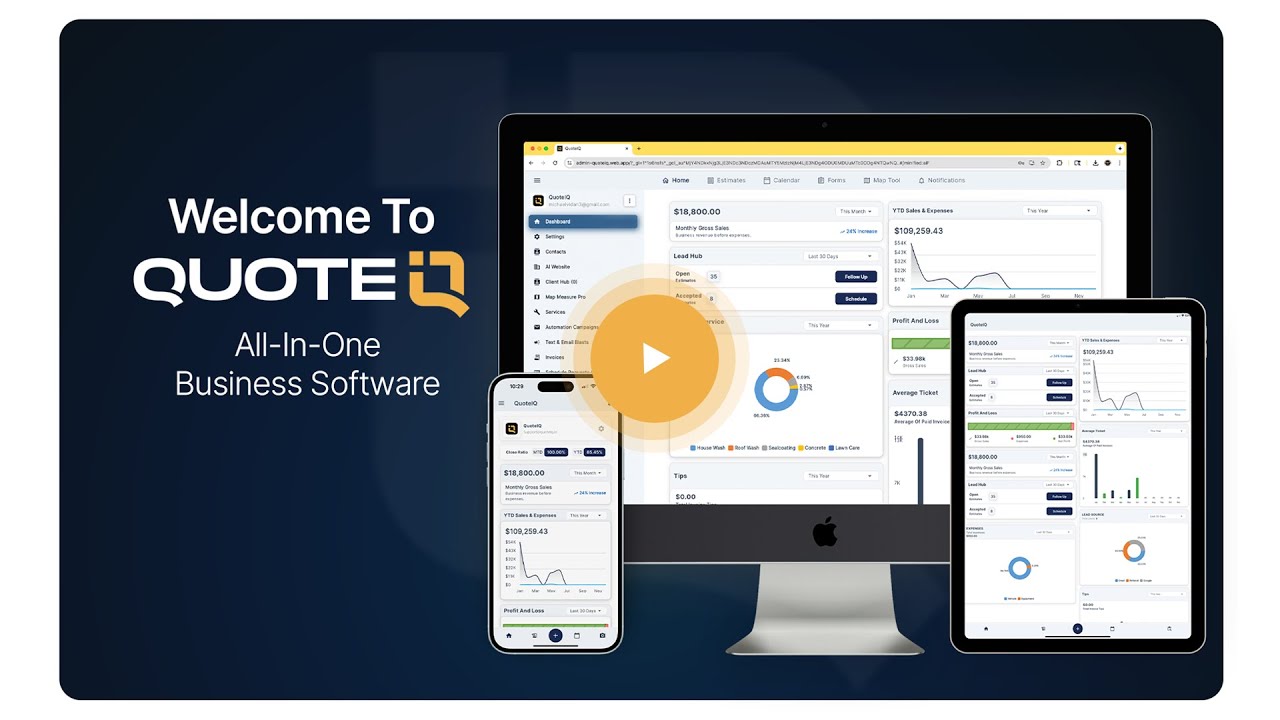 Watch Video →
Most contractors are fully operational inside a week. The sequence below is the one that produces the fewest surprises.
Create your account and choose the plan that matches your crew size, since the trial gives full access to the features of that plan. Solo operators generally start on Essentials; anyone who needs measurement and photo documentation wants Beginner or higher.
Bring your customer list across with AI Smart Import from a CSV or your phone contacts, then set your services and rates once. Use the business calculators to pressure-test pricing rather than importing old numbers unexamined.
Quote them, schedule them on the calendar, document them, invoice them, and collect payment. This surfaces workflow gaps that no feature list will. Configure online payments and bank details before the first invoice goes out.
Add follow-up sequences through email and text automations, switch on Review Multiplier, and open the Client Portal to customers. Automating a broken process just breaks it faster, so this genuinely belongs last.
QuoteIQ was built by people who ran service businesses before they wrote software, which is why the product argues for consolidation rather than modules. The company was founded on September 21, 2022 and operates out of Savannah, Georgia.
Mike came out of the exterior cleaning trade and built a large contractor following before co-founding QuoteIQ, and he still fields support conversations personally. His focus is the estimating and pricing side of the platform — the belief that most contractors are under-charging because their rate was set years ago and never revisited. Read more at Mike Vidan’s insights.
Justin co-founded QuoteIQ with a focus on the operational half of a service business: scheduling, crews, routing, and the reporting that tells an owner which work is actually worth doing. That perspective is why job costing and analytics sit in the core product rather than behind an enterprise tier. Read more at Justin Rogers’ insights.
“QuoteIQ has blown me away with its functionality. The app is a must have for anyone working in a service industry job. You no longer need 3-4 separate apps, as you can do everything in one app. The app is very intuitive, and you can be setup and operational within minutes.”
“I have been using quoteiq for a year and a half now and I can’t express enough how easy/User friendly it is to use. I have tried a couple other crm’s and though they also had a lot of features they were hard to navigate and had a poor layout. I get tons of compliments from customers on how professional my quotes look and how easy it is to make payments. Also the cost of quoteiq is second to none, by far most affordable. I highly recommend!!”
“QuoteIQ is a great app and tool that I use every day with my company. It keeps me organized, but more importantly, it gives me the speed to create estimates and send out invoices. Plus, allows me to track my expenses, as well. Highly valuable tool… especially, for guys like me who are always on the move.”
Fourteen days, full access to the features of the plan you choose, and enough time to put five real jobs through the system. Start today or have someone walk you through it.

Tell Google that QuoteIQ is a source you trust. One tap unlocks up to 40% off your annual plan. No free trial — billed in full at checkout.