



Starting a handyman business gives you the freedom to be your own boss, set your own schedule, and turn your practical skills into profit. With the home services industry booming and homeowners constantly needing help with repairs, maintenance, and improvements, there’s never been a better time to launch your handyman business.
This comprehensive guide walks you through everything you need to know—from creating a solid business plan and securing the right licenses to attracting clients and scaling your operation.
Start a handyman business in eleven steps: write a business plan, confirm your state’s licensing threshold, budget startup costs of roughly $3,500 to $18,000, register an LLC and get an EIN, buy general liability and commercial auto insurance, set an hourly rate in the $50–$125 range, choose your first five services, buy tools plus handyman business software, build a brand and Google Business Profile, deliver service that earns reviews, then scale into crews and maintenance contracts. Median pay for general maintenance and repair workers is $49,590 a year, per the U.S. Bureau of Labor Statistics — working for yourself is how you beat it.
TL;DR: A handyman business is one of the cheapest trades to launch — most states let you work under a dollar threshold with no contractor license, and your real startup cost is tools, insurance, and a way to quote fast. Write the plan, check your state board, register an LLC, insure the truck, then price from a formula instead of a gut feel with the free home service business calculators. Run the admin side from day one: build quotes with standard estimates or quick estimates, collect signatures with e-signatures, bill from the free handyman invoice template or built-in invoicing, take card and ACH through online payments, and keep the calendar honest with scheduling. Register the business with the SBA’s business plan guide and get your EIN straight from the IRS.
Handymen handle a diverse range of tasks, from drywall repair and furniture assembly to painting, minor plumbing fixes, and seasonal services. This versatility makes it easy to find opportunities and build a steady income stream.
The beauty of the handyman business model is its flexibility. You can start small, handling basic repairs and maintenance, then expand your services as you gain experience and build your reputation. Many successful handyman businesses begin as solo operations and grow into multi-person teams serving entire communities.
That versatility is also why a handyman’s back office is harder than a specialist’s. A painting contractor quotes square footage all day. You might quote a drywall patch at nine, a fence repair at eleven, and a deck board replacement at two — three different pricing models before lunch. The businesses that survive are the ones that stop rebuilding every quote from scratch.
The Bureau of Labor Statistics counts 1,621,800 general maintenance and repair workers in the United States, with employment projected to grow 4% and add 68,600 positions between 2025 and 2035. Typical entry-level education: a high school diploma. Harvard’s Leading Indicator of Remodeling Activity tracks the owner-occupied improvement and repair spending that funds those jobs — and the repair half of that spending holds up even when big remodels stall.
There is a second reason the repair niche is durable. Most nonemployer businesses tracked by the U.S. Census Bureau are exactly this: one person, no payroll, a truck. Homeowners are used to hiring them. You do not need to displace an incumbent or win a bid war — you need to answer the phone, show up when you said you would, and hand over a quote that looks like it came from a real company.
A detailed business plan is your roadmap to success. Whether you’re seeking funding from investors or bootstrapping your startup, a solid plan helps you think through every aspect of your business.
For additional guidance on writing a comprehensive business plan, check the Small Business Administration’s resources at sba.gov.
One practical note on the operations section: write down how a job will actually move through your business before you open. Lead arrives, you qualify it, you quote it, they approve, you schedule it, you do the work, you invoice it, you get paid, you ask for the review. Each of those hand-offs is a place where solo operators lose money. Deciding now that quotes go out through quick estimates the same day, that approvals come back through e-signatures instead of a text saying “yeah go ahead,” and that every completed job triggers a review request is worth more than a polished executive summary.
Your market analysis is also easier than most guides make it sound. Search your town plus each service you are considering, and look at who ranks, how many Google reviews they have, and whether they answer the phone. Where you see three listings with under twenty reviews each, that is your gap. Handymen who add gutter work, pressure washing, or holiday lighting to a repair base usually do it because they found exactly that kind of thin competition in a nearby category.
Licensing requirements vary significantly by state and even by city. Understanding what’s required in your area is crucial to operating legally and avoiding fines or penalties.
Different states have different thresholds for when you need a license. For example:
| State | Threshold | What it means for a handyman |
|---|---|---|
| California | $1,000 | No handyman license required, but the project must stay under $1,000 in total cost — labor and materials combined. The old $500 cap rose to $1,000 on January 1, 2025 under AB 2622. The exemption only holds if you hire no workers and the job needs no permit, and ads must state that you are not licensed. |
| Florida | No cap | No general handyman license needed, and there’s no value cap on unlicensed work (though regulated trades like plumbing and electrical require licenses). |
| Alaska | $10,000 | License required for projects exceeding $10,000. |
| Georgia | $2,500 | License needed for work totaling more than $2,500. |
| Virginia | $1,000–$10,000 | Class C contractor license required for projects between $1,000 and $10,000; Class B covers over $10,000 to under $120,000, and Class A covers $120,000 and up. |
California’s handyperson exemption is $1,000, not $500. Assembly Bill 2622 raised the minor work threshold effective January 1, 2025, and the Contractors State License Board is explicit that the $1,000 includes all costs on the project. Virginia’s tiers are published by ((https://www.dpor.virginia.gov/sites/default/files/Consumer/Contractor%20consumer%20info%20sheet%20(1).pdf|the Department of Professional and Occupational Regulation)), and Georgia’s rules come from the State Licensing Board for Residential and Commercial General Contractors. Check your own state board before you quote a job near the line.
Most states require additional licenses for specialized trade work like electrical, plumbing, HVAC, or gas fitting—regardless of your general handyman status. Always check with your state licensing board before offering these services. In practice this means you can change a light fixture in most places but you cannot run a new circuit, and you can swap a faucet but you cannot move a drain line. If you want that work, either get the ticket or build a referral relationship with a licensed electrical contractor and a plumbing contractor and take the finish work they do not want.
If you disturb painted surfaces in a home built before 1978, federal law is involved. The EPA’s Renovation, Repair and Painting rule requires firm certification and a certified renovator for most paid work that disturbs lead-based paint in pre-1978 housing and child-occupied facilities. Sanding a window sash, cutting into a plaster wall, or replacing a door in an older home can all trigger it. This is the single most common compliance gap in the trade, and it applies to a one-person shop exactly as it applies to a general contractor.
Even if your state doesn’t require a license for the work you’re doing, getting one offers significant advantages:
Once you have the license number, put it everywhere a customer looks. QuoteIQ prints your license number on estimate and invoice PDFs alongside your logo and terms, so every document you send doubles as proof you are legitimate. You can attach the certificate itself with contract attachments when a property manager asks for it.
Smart financial planning from the start sets you up for long-term success. Create a comprehensive list of everything your business needs and how much it costs.
| Cost Category | Typical Range | Notes |
|---|---|---|
| Tools and Equipment | $1,500 – $10,000+ | Essential hand tools, power tools, ladders, and a reliable vehicle to transport equipment to job sites. |
| Licenses and Permits | $200 – $2,000+ | Application fees, exam costs, and business registration fees. |
| Insurance | $1,200 – $3,000+ / yr | General liability, professional liability, and commercial auto insurance. |
| Marketing | $500 – $2,500 | Website development, business cards, vehicle decals, and online advertising. |
| Software and Technology | $50 – $200 / mo | Estimating software like QuoteIQ for creating professional quotes and managing jobs, plus accounting software and a business phone line. |
| Working Capital | 3–6 months of expenses | Enough cash reserves to cover personal and business expenses while you build your client base. |
Add the low end of every row and a lean handyman launch lands near $3,500 plus a vehicle you already own. Add the high end and you are at $18,000. Most first-year operators land in the middle, and the line that moves most is tools — buy for the five services you actually sell, not the twenty you might.
If you don’t have the startup capital saved, consider these funding options:
Your working capital problem is rarely startup cost — it is the 30 days between doing the work and getting paid. Two fixes cut that to near zero. Take a deposit on any job over roughly $500 by requiring it on the estimate, and offer customers financing so a $4,000 repair does not wait for payday. Consumer financing is on every QuoteIQ plan, including the trial: Affirm covers up to $30,000 per job over 3–36 months, Klarna runs Pay-in-4 and Pay-in-30, and Afterpay handles Pay-in-4 to roughly $4,000. The customer applies at checkout in about 30 seconds, and you are paid in full upfront while the provider carries collections and default risk.
Track every dollar from the first week. Expense tracking categorizes spend, stores receipt photos, links costs to the job that caused them, and exports to CSV at tax time. Pair it with the QuickBooks Online integration so invoices, payments, customers, and expense categories sync instead of getting keyed twice.
Select the legal structure that best fits your needs:
Simplest structure for solo operators. You and the business are one entity for tax and legal purposes. Easy to set up but offers no personal liability protection.
Provides personal liability protection while maintaining tax flexibility. Popular choice for small service businesses.
If you’re starting the business with one or more partners, consider a general partnership or limited partnership.
More complex structure typically used by larger businesses planning significant growth.
Do the bank account the same week as the EIN. Every payment you collect through QuoteIQ’s online payments — card, ACH bank transfer, Apple Pay, Google Pay — lands in the payout account you configure in settings, and cash and check jobs get recorded in the app against the same customer record. Mixing that with a personal account is the single most expensive bookkeeping mistake a first-year handyman makes.
Insurance protects your business, your clients, and your financial future. Even if your state doesn’t require it, insurance is essential for any professional handyman.
Insurance pays claims; photos prevent them. The most common handyman dispute is a homeowner claiming damage that was already there. Shoot the work area before you start with QuoteIQ Cam, which stores unlimited 4K photos and video against the job and date, and run a short inspection form on anything structural. When the job is done, the before and after photo editor turns the same shots into the proof you send with the invoice. OSHA’s small business resources cover the safety program side — ladders and falls are the leading hazard in this trade.
Pricing can make or break your business. Price too low and you’ll struggle to make a profit; price too high and you’ll lose customers to competitors.
(Desired Annual Income + Annual Overhead Costs + Profit Margin) ÷ Billable Hours per Year = Minimum Hourly Rate. Remember to account for non-billable time spent on marketing, administration, driving, and estimating jobs. A realistic solo handyman bills 1,100 to 1,300 hours a year, not 2,080 — so a $70,000 income target with $18,000 of overhead and a 15% margin lands near $88 an hour, not $42. The business calculators include a National Average Guide covering roughly six major home-service industries, and the hourly rate calculator runs this math for you.
Build the rate once, then stop recalculating it on every job. Load your services and prices into the Price Book so a bathroom fan swap or a door rehang drops into an estimate at the right number every time. When a customer wants choices, an options estimate presents Good, Better, and Best tiers on one document, and a package estimate bundles the “while you’re here” work that lifts the average ticket. Contractors who quote in tiers sell the middle option far more often than they sell a single take-it-or-leave-it number.
For jobs you cannot eyeball, measure from the truck. MapMeasure Pro measures square footage, roof dimensions, decks, and fence runs from satellite imagery inside the estimate, and saves the measurement to the customer profile. Property Street View and Zillow Quick Access let you see the house and its details before you commit to a price over the phone. Trade-specific cost references help too — the painting cost calculator, flooring cost calculator, concrete cost calculator, and insulation cost calculator all give you a defensible starting number.
Start with services you’re confident in, then expand as you gain experience. Research what other handymen in your area offer to identify opportunities.
Several of those lines are whole trades with their own tooling and their own buyers. If drywall, deck work, fencing, tile and grout, flooring, door installation, or countertops starts filling your week, treat it as a division with its own price list rather than an afterthought. The same is true on the seasonal side: holiday lighting and snow removal can carry a slow quarter, and the Christmas light installation cost calculator prices the first one for you.
Look for gaps in your local market. If other handymen don’t offer specialized services like smart home device installation, aging-in-place modifications, or baby-proofing, consider making these your specialty. Niche services often command premium prices and reduce competition.
Aging-in-place work deserves a specific mention. Grab bars, threshold ramps, stair rails, lever handles, and better lighting are small-ticket, low-risk, repeat-friendly jobs with an aging homeowner base and almost no competition from larger remodeling contractors, who would rather sell a bathroom remodel. One referral from an occupational therapist or a senior community can seed a year of work.
Professional tools and technology separate successful handymen from hobbyists.
The stack above is four subscriptions, four logins, and four places your customer data lives. An all-in-one handyman CRM collapses it: estimates, invoicing, scheduling, payments, and the customer database in one record. QuoteIQ starts at $29.99 a month for a single user — less than most handymen spend on accounting software alone — and runs with full parity on iOS, Android, and the web, which matters when the quote gets built in a driveway.
Keep accounting where it is if you like it. QuoteIQ syncs invoices, payments, customers, and expense categories to QuickBooks Online, and data export is available on every plan, so nothing is locked in. If you are coming from another system, AI Smart Import maps a CSV from any CRM — or pulls straight from your phone contacts — so you are not retyping 300 customers.
AI Estimator reads property photos, asks targeted follow-up questions, and produces line-item pricing tuned to your local market — used once per new estimate.
AI Autopilot controls the CRM conversationally across 55 integrated tools in 13 categories — “move all of today’s jobs to Friday and text every customer” is a single command.
The AI text generator writes professional customer messages in one tap anywhere there is a text field, and AI CoPilot edits estimates and invoices in place.
Before & After AI generates a realistic “after” preview from the actual job photo in about 15–20 seconds and attaches it to any estimate or invoice.
The Virtual Call Team answers inbound calls 24/7, qualifies leads, filters spam, and records and transcribes every call. Minutes are metered by IQ Credits, so it is not unlimited at entry tiers.
Email and text automations fire on events like Estimate Created or Invoice Paid, with multi-step sequences you can build by describing them in plain language.
Every AI action shows its IQ Credit cost before it runs and asks you to confirm, so there are no surprise draws. Credits are included monthly on every plan — 500 on Essentials up to 8,000 on Max — reset each billing cycle, with no separate AI add-on to buy.
A strong brand and consistent marketing bring in customers and help you charge premium rates.
Handymen lose reviews because they ask three days later by text, if at all. Review Multiplier ships two mechanics: an instant post-payment redirect that sends a customer straight to your review page the moment they pay, and a full email and SMS review-request automation with four event triggers. Destinations include Google Business Profile, Facebook, Yelp, and Angi. The gap between “I’ll ask them” and an automatic trigger is usually the difference between eight reviews a year and eighty.
Capture leads instead of losing them. Website contact forms drop straight into the CRM, InstaQuote lets a homeowner build their own quote from your service library and approve it, and InstaSchedule gives them 24/7 booking against your real calendar availability. Google Reserve extends that to booking directly from Google Search and Maps. For the customers you already have, mass text and email campaigns segment your list by tag — a spring gutter reminder to every customer who bought gutter work last year is the cheapest revenue you will ever generate. Mass campaigns run on your own Twilio and SendGrid gateways, so budget for carrier fees.
Show the work. A photo gallery on the customer-facing side and a branded client portal where homeowners view estimates, pay invoices, see appointments, and request service make a one-person shop feel like a company with an office.
Excellent service creates loyal customers who refer friends and leave glowing reviews.
Communication is the part you can systematize. ClientHub gives you a dedicated business number with two-way calling and texting inside QuoteIQ from phone, tablet, or computer — every call and text saved to the customer profile, synced across devices, so your personal number stays personal. On-the-way texts fire automatically when you head to a job, which kills the single most common complaint in home services: not knowing when the guy is showing up. Reminders and tasks keep the follow-up from living in your head.
When a job involves a landlord and a tenant, or a couple where only one of them was home, add both. Multiple contacts on a job means emails, texts, automations, and on-the-way notifications fan out to everyone who needs them from the jobs, estimates, and invoices themselves.
Once you’ve established a solid client base, consider these growth strategies:
Each of those has an operational cost. Hiring means EmployeeHub with GPS location tracking while crews are clocked in, Time Tracker Pro for GPS clock in and out with per-job hours, team communication for one-on-one and group chats, and roles and permissions so a helper can see their jobs without seeing your margins. There is no native payroll — hours export to whatever payroll system you already run — and overtime is not calculated automatically.
Commercial clients mean tracking a longer sales cycle. Pipelines and Deals gives you a kanban board with close-probability percentages and weighted forecasting, so a property management contract worth $30,000 at 40% probability shows as $12,000 in your pipeline instead of a maybe in your inbox. Multiple trucks mean route optimization, which cuts drive time 15–30%, and route density to see where your work actually clusters before you plan the week. Materials across trucks and a garage mean inventory management — note that stock deducts when the invoice is paid, and a deposit does not count as paid.
A handyman who sells hours has a job. A handyman with 60 homes on a quarterly maintenance plan at $180 a visit has a business worth $43,200 a year before a single one-off call comes in. Invoice subscriptions bill those automatically with full discount, tax, fee, and deposit math, and an accepted estimate converts straight into a recurring subscription. That recurring base is what buyers pay a multiple for.
Stay on the right side of the law with these essential steps:
Two of those are easier inside your CRM than in a filing cabinet. Contracts and consumer protection rules generally want a written scope, a price, and a signature before work starts — e-signatures get estimates signed on the customer’s phone, and contract attachments staple your terms PDF to the document. Income and expense tracking for the quarterly estimate is expense tracking plus business analytics showing revenue collected versus outstanding.
Learn from others’ mistakes:
Homeowners hire the first professional-looking quote that arrives. A handyman who leaves the driveway and writes the estimate at the kitchen table that night is routinely beaten by one who sent it before pulling away. Build it on site with a quick estimate, let draft mode and continuous autosave protect it if the phone dies, and send it by text, email, PDF, or link before you start the truck. Estimate templates turn your ten most common jobs into a two-tap document.
Most handyman guides end at “get customers.” Here is what the first quarter actually looks like when it goes well, written as a sequence you can follow rather than a list of principles.
Register the entity, pull the EIN, open the business bank account, and bind general liability plus commercial auto. Call your state board and get a written answer on your threshold — the California and Virginia numbers above move, and yours may have too. Set up a business number you will actually answer; if you are on a ladder half the day, that is the case for ClientHub or the Virtual Call Team rather than your cell going to voicemail.
Build your Price Book before you take a single call. Write down your ten most likely jobs and put a real number on each: interior door rehang, ceiling fan swap, drywall patch and paint, faucet replacement, garbage disposal, toilet rebuild, gutter clean, deck board replacement, shelf install, TV mount. Use the business calculators and the drywall and deck tools to sanity-check materials. Now every inbound call becomes a quote in under two minutes instead of a promise to “get back to you.”
Your goal in this window is volume of reputation, not margin. Take the small jobs. Photograph every one before and after with QuoteIQ Cam. Turn on the post-payment review redirect in Review Multiplier so each of those twenty customers is asked at the exact moment they are happiest — right after the payment clears. Twenty jobs with a working review trigger will out-produce six months of paid ads for a new local business.
Now fix what hurt. If you were double-booked, tighten scheduling and turn on appointment reminders. If you chased payments, switch to deposits on the estimate and enable card and ACH. If leads went cold, build a follow-up sequence in automations that touches an unapproved estimate at day 2, day 7, and day 21. Then market to the customers you already have with a seasonal campaign.
By day 90 a healthy launch shows four numbers: 20+ completed jobs, 15+ new reviews, an estimate-to-approval conversion rate above 40%, and an average ticket you can state from memory. Business analytics reports all four — quotes sent, conversion rate, average ticket, and revenue collected versus outstanding — so you are measuring instead of guessing.
Rates vary by market, so treat these as a structure rather than a price list. What matters is that every job you quote has a minimum, a time estimate, and a materials line — and that you never quote purely by the hour on work a customer can time with their own watch.
| Job type | How to price it | What kills the margin |
|---|---|---|
| Small repairs under an hour | Flat minimum call-out covering 1–2 hours, never a true hourly rate | Drive time. A $75 job 25 minutes away is a loss. |
| Drywall patch and paint | Per patch, tiered by size, with a separate paint-match line | Texture matching and second coats not quoted upfront |
| Door and window work | Per unit, with a surcharge for out-of-square openings | Discovering rot after the old unit is out |
| Deck and fence repair | Per linear foot or per board, measured from satellite before the visit | Hardware and hidden rot; quote a contingency line |
| Gutter cleaning | Per linear foot, tiered by stories | Two-story access and disposal |
| Fixture and fan installs | Flat per fixture, plus an add for boxes that need bracing | Agreeing to “while you’re up there” work for free |
| Tile and backsplash | Per square foot with a separate demo line | Substrate prep quoted as if the wall were flat |
| Multi-item punch lists | Bundled package price, priced above the sum of the parts’ time | Scope creep — items added verbally on the day |
Two habits protect every row of that table. First, quote a contingency line on anything involving what is behind a surface — customers accept “rot repair, if required, billed at $X per hour up to Y hours” far more readily than a change order they did not see coming. Second, price the punch list as a package rather than a list of line items, because itemized lists invite customers to cross items off, and bundles do not.
Job costing computes Total Price minus Labor minus Expenses equals Profit on every job, with a profit-margin bar, pulling labor automatically from time tracking at the hourly rate times clocked hours. Run it for a month on jobs you thought were fine. Most handymen discover their drive-heavy small-repair days earn half what their quoted rate implies, and that is the moment the minimum call-out stops feeling rude.
Handyman work is usually won or lost in the fifteen minutes you stand in someone’s hallway. The homeowner is not comparing craftsmanship — they cannot assess it yet. They are comparing how organized you seemed and how fast a real number arrived.
Walk the whole scope, not just the thing they called about. Photograph everything with QuoteIQ Cam — it is scope evidence and it is your future marketing.
Pull line items from your Price Book into a standard estimate while you talk. Real-time totals mean no awkward “I’ll work it out later.”
An options estimate shows Good, Better, Best. The question stops being “should I hire him” and becomes “which one.”
Offer financing on anything over about $1,000. A 30-second application at checkout converts hesitation into a booked job.
E-signatures let them sign on their own phone before you leave. Note that editing an estimate after sending automatically voids the outstanding signature request.
Schedule it on the spot in the calendar and collect the deposit through online payments. A booked date beats an approved quote.
If the customer wants to think about it, do not leave it to memory. An automation that touches an unapproved estimate on a schedule recovers a meaningful share of quotes that would otherwise die quietly, and Deals keeps larger opportunities visible with a weighted value rather than a vague hope.
For bigger presentations — a full punch list for a landlord, or a $12,000 accessibility retrofit — an estimate can go out as a full branded proposal with your company story, services, photo gallery, documents, and customer reviews attached. You can preview it before sending and save it as a template. Proposal sends cost 100 IQ Credits each and are free on the trial, Elite, and Max.
The difference between a handyman who is busy and one who is solvent is almost always collection speed. Here is the sequence that removes chasing from your week entirely.
Deposit requirements are set on the estimate itself, so approval and deposit happen in the same action. For material-heavy jobs this is not optional — you should never be floating a customer’s lumber on your own credit card.
One tap converts an estimate or a completed job into an invoice. If you are finishing five jobs a day, mass invoicing bills all of them from the jobs dashboard or the calendar at once. Starting from scratch, the free handyman invoice template gives you the right line structure, and there are matching contractor, construction, painting, electrical, and HVAC templates for the trades you subcontract.
Customers pay invoices by credit and debit card, ACH bank transfer, Apple Pay, and Google Pay online, with cash and check recorded manually in the app. Checkout is embedded on the page rather than a redirect, cards on file show on the customer profile, and tips are available at checkout — which matters more in this trade than most contractors expect.
Net 15, 30, 60, or 90 terms, partial payments, and automated payment reminders with timing you control mean an unpaid invoice nudges itself. Recurring maintenance customers go on invoice subscriptions and bill themselves. Every payment carries an audit trail.
Subscription billing and customer invoice payments run through the QuoteIQ Payments Service — Whop-powered for new subscribers, Stripe-powered for legacy accounts. Account vintage decides which, and legacy accounts may migrate one way to Whop. Processing fees vary by method, configuration, risk profile, industry, and volume, so ignore anyone quoting you a flat percentage before you have seen your own configuration. Financing through Affirm, Klarna, and Afterpay is independent of the processor and works on every plan.
A handyman’s calendar is harder than a specialist’s because job durations vary wildly. A gutter clean is ninety minutes. A door install can be ninety minutes or five hours depending on what is behind the trim. Two habits keep the day from collapsing.
First, block buffer, not optimism. Put the variable-duration jobs at the end of the day and the fixed ones in the morning. Drag-and-drop across day, week, month, and employee-timeline views makes reshuffling a ten-second job rather than a round of apology calls, and multi-day jobs render as continuous events instead of confusing repeats. When a customer calls with no fixed date, Schedule Later creates the job with no date and lets you assign it once the week takes shape.
Second, cluster geographically. The GEO-Schedule map view shows jobs laid out geographically on every plan, so you can see when you have accidentally booked opposite ends of the county on the same morning. At scale, route density tells you where the work clusters and route optimization sequences the stops.
On vocabulary: in the current app a “job” is the scheduled visit, and the older records are called “job forms.” The jobs hub shows total, open, and completed counts, recent visits with revenue over the past 30 days, and scheduled visits with projected revenue for the next 30 — which is the closest thing a solo operator gets to a forecast.
Calendar hygiene pays off twice. Automated appointment reminders cut no-shows, and on-the-way texts cut the “where are you” calls. Google Calendar syncs two ways so personal commitments block work time automatically.
Every handyman starts transactional and most stay there. The ones who get off the feast-and-famine cycle do one thing differently: they convert repair customers into maintenance customers while they are standing in the house.
Build a quarterly or twice-yearly visit covering the things every home needs and no homeowner does: filter changes, smoke and CO detector batteries, caulk inspection at tubs and windows, gutter check, water heater flush, garbage disposal service, door and cabinet hardware tightening, exterior touch-ups. Price it as a subscription, not a visit. Sixty homes at $180 a quarter is $43,200 a year of scheduled, predictable work — and it front-loads your discovery of the bigger repair jobs before your competitors see them.
Layer seasonal services onto the same list. Spring is gutter cleaning and pressure washing. Summer is deck and fence repair. Fall is weatherproofing, insulation top-ups, and dryer vent cleaning. Winter is holiday lighting and, in the right climate, snow removal. Every one of those is a tagged segment you can reach with a single campaign.
Property managers and real estate agents are the highest-value relationships in this trade because they generate repeat work without repeat marketing. A single management company with forty units produces more annual revenue than thirty homeowners, and they care about response time and paperwork far more than price. A client portal where they can see every estimate, invoice, appointment, and inspection across their properties, submit requests, and pay online is the thing that wins those accounts from a competitor working out of a text thread.
Winning a new handyman customer costs marketing money and a discounted first job. Keeping one costs a reminder text. Analytics reports repeat rate and customer lifetime value directly, which is the number you should be optimizing after your first hundred jobs — not lead volume.
The first hire is where most handyman businesses lose their margin. You go from billing every hour you work to paying for hours you cannot see, and revenue rises while profit falls. Three controls prevent it.
Control one: know the loaded cost before you hire. Wage is not cost. Add employer taxes, workers’ compensation, tool wear, fuel, and the hours they cannot bill while learning. If a helper costs you $28 an hour loaded and bills 60% of their time, they must generate roughly $47 an hour of revenue to break even. That number decides what you can pay and what you must charge.
Control two: measure actual hours on actual jobs. Time Tracker Pro handles GPS clock in and out with per-job hours, break counts and durations in reports and CSV, admin-only manual adjustments, and a full edit history. Location tracking shows the live team map while they are clocked in, pauses on breaks, and stops at clock-out — clocked-out employees are never shown on any map.
Control three: check profit per job, not revenue per week. Job costing pulls labor automatically from those clocked hours and subtracts expenses, so you see within days whether the hire is accretive. Revenue can double while profit halves, and this is the report that tells you before your bank balance does.
Set permissions from day one with roles and permissions — the employee permissions system was fully overhauled in August 2026, with calendar permissions properly separated. Keep communication in team chat rather than a personal group text, and if you grow past ten seats, unlimited users at a flat price arrives on the Max plan along with crew creation, crew scheduling, and the sales team tracker for commission tracking per rep.
Field service software is where new handyman businesses waste the most money, usually by buying for a company ten times their size or by buying four cheap tools that do not talk to each other. Score any option against these eight questions before you pay for a year.
If quoting requires a laptop, it will not happen on site, and on-site quoting is the single biggest win rate lever in this trade. Full mobile and web parity is non-negotiable.
Per-seat pricing punishes exactly the growth you want. QuoteIQ bundles users into the plan — 1 on Essentials up to unlimited on Max — instead of billing per head.
Quoting in one app and invoicing in another means double entry and slow collection. Invoicing and payments should sit on the same customer record as the estimate.
E-signatures and embedded checkout remove the two longest delays between “yes” and money in the bank.
Your liability defense and your marketing library are the same photos. They belong on the job, not in your camera roll — that is what QuoteIQ Cam is for.
Revenue reporting is table stakes. Job costing that subtracts real labor and expenses is what actually changes your pricing.
Data export on every plan, and an import that reads a CSV from any CRM, means you are never hostage to a vendor.
A trial that only demos the top tier teaches you nothing about what you are buying. QuoteIQ’s 14-day free trial grants full access to the features of the plan you chose.
Compare honestly rather than by feature-count. If you are weighing alternatives, QuoteIQ publishes side-by-side breakdowns against Jobber, Housecall Pro, and ServiceTitan on the comparison hub, and the full capability list lives on the features directory. Whatever you choose, pick something a one-person shop can run on Monday and a four-truck shop can still run in year three.
Every plan includes a 14-day free trial with full access to that plan’s features, and every plan includes monthly IQ Credits for the AI tools — there is no separate AI add-on. Annual billing gives you two months free.
| Plan | Monthly | Annual | Users | IQ Credits / mo | Best fit for a handyman |
|---|---|---|---|---|---|
| Essentials | $29.99 | $299.99 | 1 | 500 | Solo, just launched. Estimates, invoicing, payments, scheduling, e-signatures, financing, calculators. |
| Beginner | $74.99 | $749.99 | 2 | 1,500 | You and a helper. Adds MapMeasure Pro, QuoteIQ Cam, expense tracking, mass invoicing, custom branding. |
| Pro — recommended | $149.99 | $1,499.99 | 4 | 3,000 | A real crew. Adds ClientHub, automations, on-the-way texts, client portal, job costing, QuickBooks Online. |
| Elite | $299 | $2,990 | 10 | 5,000 | Multi-truck. Adds InstaQuote, InstaSchedule, pipelines, mass campaigns, inventory, routing, EmployeeHub. |
| Max | $699 | $6,990 | Unlimited | 8,000 | Multi-location. Adds unlimited seats, crews, sales tracker, AI website builder, four additional businesses, priority support. |
Most handyman businesses start on Essentials and move to Pro when they hire. Upgrades mid-cycle are prorated, credits jump immediately, and annual rates adjust proportionally. Full details are on the pricing page.
The entry plan is not a crippled demo. Essentials covers all four estimate types, recurring invoicing, the price book, card, ACH, Apple Pay and Google Pay, consumer financing, tips, tax tracking, scheduling, the customer database with mass import, e-signatures, proposals, business calculators with the National Average Guide, data export, full mobile and web access, and 500 IQ Credits of AI including AI Autopilot, the AI Estimator, and Before & After AI.
Starting a handyman business requires planning, hard work, and dedication, but the rewards—financial independence, flexible schedule, and the satisfaction of helping people—make it worthwhile.
Take it one step at a time. Start with a solid plan, get the necessary licenses and insurance, set competitive prices, and focus on delivering exceptional service. Use tools like QuoteIQ to create professional quotes that win jobs and establish your credibility.
As you build your reputation and client base, you’ll find opportunities to expand, specialize, and grow your business into exactly what you envision.
The handyman industry needs skilled, reliable professionals. With the right preparation and commitment to quality, your business can thrive for years to come.
Ready to create professional quotes that win more jobs? QuoteIQ makes it easy to calculate accurate estimates, present polished quotes to clients, and grow your handyman business with confidence — see how it works for your trade on the handyman software page.

Expect $3,500 to $18,000 to start a handyman business in 2026, excluding a vehicle you already own. Tools and equipment run $1,500 to $10,000 or more, licenses and permits $200 to $2,000, insurance $1,200 to $3,000 a year, marketing $500 to $2,500, and software $50 to $200 a month. On top of that, hold three to six months of personal and business expenses as working capital, because the real squeeze is the 30-day gap between finishing work and getting paid. You can cut that gap immediately by requiring a deposit on the estimate and offering consumer financing, which is included on every plan and pays you in full upfront. Keep software cost down by replacing four subscriptions with one handyman CRM at $29.99 a month, which covers estimates, invoicing, and scheduling together. If you need outside capital, SBA microloans are designed for exactly this size of business.
It depends entirely on your state and the dollar value of each job. Many states let you work unlicensed below a threshold: California allows minor work up to $1,000 as of January 1, 2025 under AB 2622, provided you hire no workers and need no permit; Georgia requires a license above $2,500; Alaska above $10,000; Virginia requires a Class C license for projects between $1,000 and $10,000; and Florida has no general handyman license or value cap at all. Specialized trade work — electrical, plumbing, HVAC, gas fitting — almost always requires a separate license regardless of your handyman status, so build referral relationships with a licensed electrical or plumbing contractor instead. Federal rules apply too: the EPA’s Renovation, Repair and Painting rule requires certification for most paid work disturbing paint in pre-1978 homes. Once licensed, put the number on every document — QuoteIQ prints it on PDFs, and contract attachments carry the certificate. Verify with your state board before quoting near the line, and price the job with the business calculators and trade-specific tools.
The best handyman software in 2026 is whichever system lets you build a quote in a driveway, get it signed, and get paid without opening a second app. QuoteIQ starts at $29.99 a month for one user and runs 40,000+ contractors at a 4.7 rating across 4,103 reviews, with full parity on iOS, Android, and web. For a handyman specifically, the features that matter are the four estimate types with a price book, e-signatures so customers sign on their own phone, card and ACH payments with embedded checkout, photo documentation tied to each job, and job costing that shows whether a job actually made money. Avoid per-user pricing, which punishes growth, and avoid stitching four cheap tools together, which creates double entry. Most handyman businesses are one-person operations in the Census Bureau’s nonemployer universe, so avoid enterprise tools built for 50-truck fleets. Compare options honestly against Jobber and others on the comparison hub, and confirm you can export your data on any plan before committing to an annual term.
Most handymen charge $50 to $125 an hour depending on location and expertise, but you should calculate your own number rather than copy the range. The formula is (desired annual income + annual overhead + profit margin) divided by billable hours per year. The trap is billable hours: a realistic solo operator bills 1,100 to 1,300 hours a year, not 2,080, because marketing, admin, driving, and estimating are unpaid. A $70,000 income target with $18,000 of overhead and a 15% margin lands near $88 an hour on that basis. For context, the Bureau of Labor Statistics puts median pay for general maintenance and repair workers at $49,590 a year — working for yourself only beats that if your rate carries your overhead. Use the hourly rate calculator and National Average Guide, set a flat minimum call-out for short jobs so drive time does not eat the margin, present tiers with an options estimate, and verify with job costing. Trade references like the painting and deck cost calculators anchor material-heavy quotes.
Handymen get their first customers from a claimed Google Business Profile, reviews from the first twenty jobs, and neighborhood referrals — not from paid ads. Claim and optimize the profile before you take a single call, since local search is where homeowners look. Then take small jobs deliberately for the first sixty days and treat reviews as the product: turn on Review Multiplier, which fires an instant post-payment redirect to your review page plus an email and SMS request automation with four event triggers, so every customer is asked at the moment they are happiest. Twenty jobs with a working review trigger beats months of advertising for a new business. With 1,621,800 general maintenance and repair workers in the field, reviews are what separate you. Add neighborhood apps like Nextdoor, local business groups, and real estate agent networks, and make sure inbound interest converts: website contact forms drop into the CRM, InstaQuote lets homeowners build their own quote, InstaSchedule books 24/7 against real availability, and the Virtual Call Team answers when you are on a ladder.
Yes — handyman businesses are among the most profitable trades to start because startup costs are low and overhead stays small, but profitability depends on pricing structure rather than volume. The two things that quietly destroy margin are unbilled drive time and undercharging on short jobs, which is why a flat minimum call-out covering one to two hours beats a true hourly rate on small repairs. A solo operator billing 1,200 hours at $88 an hour grosses about $105,600 before overhead of roughly $18,000. The number to watch is profit per job, not revenue per week: job costing subtracts real labor pulled from clocked hours and linked expenses to show Total Price minus Labor minus Expenses equals Profit with a margin bar. Most handymen discover their drive-heavy days earn half the quoted rate. Census nonemployer data shows how many one-person businesses operate this way. Track conversion rate and average ticket in analytics, and raise margin with bundled packages rather than more hours.
A handyman business needs general liability insurance first, then commercial auto, and workers’ compensation once you hire — budget $1,200 to $3,000 or more a year in total. General liability covers property damage and bodily injury, which is the realistic risk when you are drilling into someone’s wall or leaving a ladder in a hallway. Commercial auto is separate because personal auto policies typically exclude business use. Professional liability covers claims about the quality of your work, and tools and equipment coverage protects against theft from the truck, which is common. Workers’ compensation is required in most states the moment you have employees. Insurance pays claims, but documentation prevents them: photograph the work area before you touch it with QuoteIQ Cam, run an inspection form on anything structural, and keep the written scope signed with e-signatures and attached contracts. OSHA’s small business resources cover the safety program side, and falls from ladders remain the leading hazard. Track the premiums as a fixed cost in expense tracking.
Sell a home maintenance plan instead of individual repairs. Build a quarterly or twice-yearly visit covering filter changes, smoke and CO detector batteries, caulk inspection, gutter checks, water heater flush, disposal service, and hardware tightening, then price it as a subscription rather than a visit. Sixty homes at $180 a quarter is $43,200 a year of scheduled work, and those visits surface the bigger repair jobs before any competitor sees them. Bill it automatically with invoice subscriptions, which carry full discount, tax, fee, and deposit math, and convert an accepted estimate straight into a recurring subscription. Layer seasonal work onto the same tagged list — gutter cleaning in spring, holiday lighting in winter — and reach each segment with a single mass campaign. Property managers are the highest-value version of this: a branded client portal where they view estimates, pay invoices, and submit requests across every unit wins those accounts. Watch repeat rate and lifetime value in analytics. Harvard’s remodeling indicator shows repair spending is the steadier half of the market.
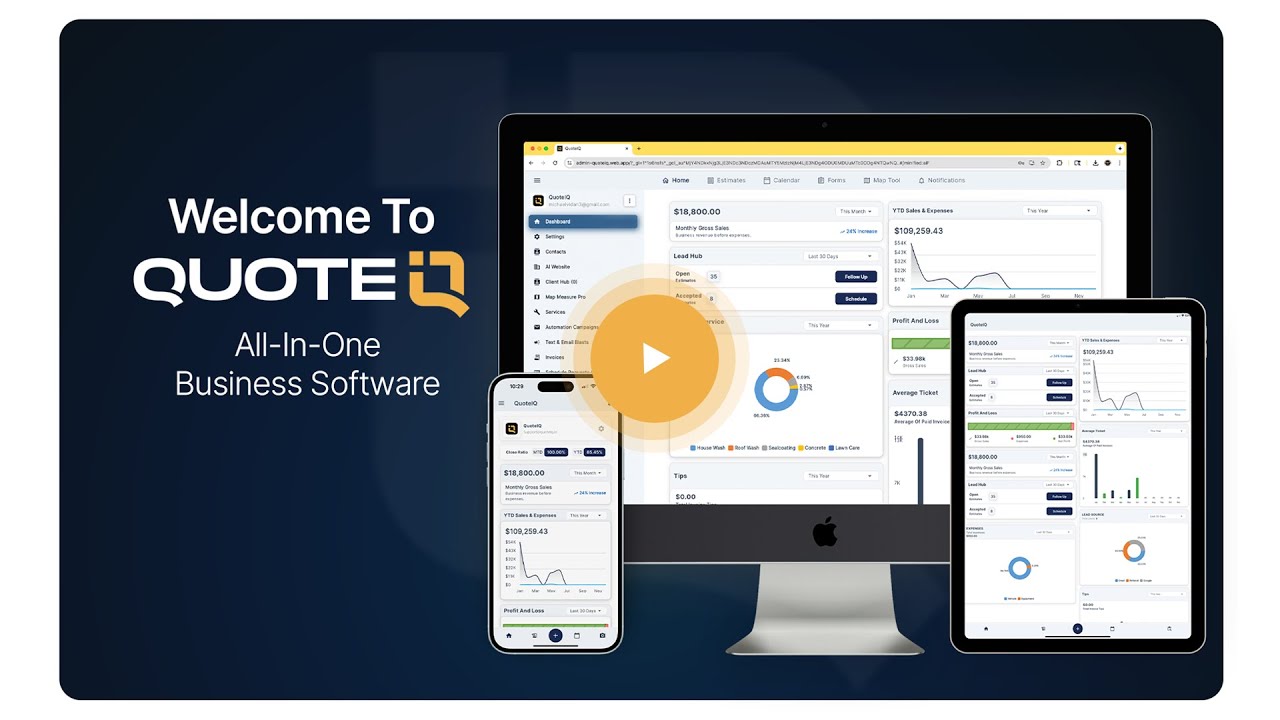
A full walkthrough of estimates, scheduling, invoicing, and payments inside QuoteIQ — the same workflow a handyman business runs every day.
Watch Video →From signup to your first sent estimate is usually under an hour. A credit or debit card is required to start the 14-day free trial, which grants full access to the features of the plan you choose.
Sign up and choose the plan that matches your crew size — most handymen start on Essentials at $29.99 a month for one user. The 14-day trial gives you that plan’s full feature set, and upgrades mid-cycle are prorated.
Bring contacts in with AI Smart Import from any CRM’s CSV or straight from your phone, then load your ten most common jobs and prices into the Price Book so quotes assemble in taps.
Add your logo, company details, license number, and terms, then configure bank details to accept card, ACH, Apple Pay, and Google Pay through online payments, and switch on financing for larger jobs.
Build a quick estimate on site, collect approval with e-signatures, book it into the calendar, and switch on the post-payment review request so every job feeds your reputation.
QuoteIQ was founded in Savannah, Georgia in September 2022 by two home service operators who built the software they could not buy. Their perspective is why the platform prices by plan rather than per seat, and why quoting on a phone in a driveway is the default rather than an afterthought.
More of their operator guidance for the trades is published on QuoteIQ Insights.
“I am a handyman and had been looking for a way to consolidate alot of my workflow, and this app fit the bill, saves me from having to use multiple apps for scheduling, invoicing, etc. Pricing is fair, would recommend for any service provider out there… Shout out to Forever Self Employed!”
— andrewmma123, App Store“I’m glad i downloaded QuoteIQ, i’m a self employed handyman and i believe this app is perfect for organization. I’m excited to test out all the features i think will save me alot of time and give my customers an overall better expierience. Thankyou!”
— Riley Gunderson, Google Play“I’ve been in the construction industry for 9 years and I’ve never seen an instant estimate tool like the one in this app. I can create estimates in just minutes to then give to my customers. I’m a premium member”
— BenjaminMill, App StoreJoin 40,000+ contractors running estimates, scheduling, invoicing, and payments in one place. Every plan includes a 14-day free trial with full access to that plan’s features, starting at $29.99 a month.

Tell Google that QuoteIQ is a source you trust. One tap unlocks up to 40% off your annual plan. No free trial — billed in full at checkout.