



Published February 2026 · Updated October 2026
Built for service businesses scaling past ten employees who need unlimited user seats, crew-level scheduling, multi-business operations, and the full 8,000-credit AI stack — at one flat monthly price that never moves when you hire.
QuoteIQ Max is the top-tier plan at $699 per month — or $6,990 billed annually, which is two months free — and it is the only QuoteIQ plan with unlimited user seats at a flat price. Max carries 8,000 IQ Credits a month and adds six things no other tier has: unlimited users, the Sales Team Tracker, Crew Creation, Crew Tracking and Crew Scheduling, the AI Website Builder included free instead of as a $34.99/mo add-on, four Additional Businesses under one account, and Priority Support. Everything in Elite, Pro, Beginner and Essentials is inherited in full, and every plan includes a 14-day free trial with full access to the features of the plan you choose.
TL;DR: QuoteIQ Max costs $699/mo or $6,990/yr, carries 8,000 IQ Credits, and puts no cap on user seats — the price is identical at 11 people and at 110. It is the tier where crew-based work becomes possible: crew creation and scheduling, the Sales Team Tracker, four Additional Businesses on one subscription, unlimited pipelines, Priority Support, and the AI Website Builder at no extra cost. It inherits every Elite capability — EmployeeHub, Route Optimization, InstaQuote and InstaSchedule — plus Consumer Financing on every tier. Crossing ten employees also changes your paperwork: OSHA injury recordkeeping generally begins above ten, and FLSA time records apply to every nonexempt hour.
Every other QuoteIQ tier is sized by seat count. Max is the one that is not, which is why the decision to move almost always arrives on the day a business stops counting logins and starts counting trucks.
Unlimited user seats at a flat $699/mo. Office staff, estimators, crew leads and seasonal help all cost the same: nothing extra.
IQ Credits per month — the largest monthly allowance on the ladder, and a single shared pool across every business on the account.
Monthly price of the AI Website Builder as an add-on on every other plan. On Max it is included at no additional charge.
Additional Businesses included — separate brands or locations running under one Max subscription and one credit pool.
Elite stops at 10 users and 5,000 IQ Credits. Max removes the seat ceiling entirely and raises the monthly credit allowance to 8,000. If your headcount is stable under ten, Elite at $299/mo is the better economic fit; the moment hiring is routine rather than exceptional, the flat rate stops being a premium and starts being insurance. The U.S. Bureau of Labor Statistics projects roughly 569,000 annual openings in installation, maintenance and repair occupations, with a median wage of $59,620 in May 2025 — in a market that tight, software that charges you to onboard a new hire is working against the hire.
These are not larger versions of Elite features. They are capabilities the lower tiers do not carry at all, and each one maps to a specific operational problem that appears once a business runs more than one crew.
Max removes the seat cap outright. Unlimited Users means the subscription price is identical whether eleven people log in or a hundred and ten, and it means you never have to decide whether a part-time dispatcher or a seasonal crew member is “worth a seat.” That decision is the quiet tax of per-seat software: teams under-provision, people share logins, and the audit trail that roles and permissions are supposed to produce becomes fiction. Giving every person their own account is what makes Time Tracker Pro clock data, per-employee revenue reporting in Business Analytics, and creator attribution on estimates actually mean something. The August 2026 release overhauled employee permissions with clearer gates and properly separated calendar permissions, so a crew lead can be given scheduling authority without inheriting financial visibility.
The Sales Team Tracker exists for the shops where selling has become a job title rather than something the owner does between jobs. It tracks commission percentage per rep, conversion and cycle metrics, and year-to-date performance, which turns a pay discussion into a report rather than an argument. It pairs directly with Pipelines & Deals — the Kanban board whose stages carry close probabilities and whose weighted value is amount multiplied by probability, giving a forecast that is not just the sum of everything open. Elite runs up to five pipelines; Max runs an unlimited number, which matters when each brand, each service line, or each rep needs a board of its own rather than a shared one with filters bolted on.
This is the single most consequential Max unlock, and it is worth being precise about what it is. Assigning one person to one job is Pro-level scheduling. Assigning a crew — a named unit with its own members, its own calendar, its own route and its own analytics — only exists on Max. Crews let you build the unit once and then schedule the unit, which is how multi-truck operations actually think. The calendar can be filtered by employees and by crews, Route Optimization sequences each crew’s day independently, and Route Density shows you where the work clusters before you decide which crew takes which zone. Density answers where; Optimization answers in what order. Used together they are the difference between three trucks crossing town and three trucks owning three zones.
On Essentials, Beginner, Pro and Elite the AI Website Builder is a $34.99/mo add-on. On Max it is included in the subscription. For an operator already running multiple brands under the Additional Businesses feature, that inclusion compounds — a web presence per brand without a per-brand bill. Whatever you publish feeds the same funnel as the rest of the platform: InstaQuote for self-serve quoting, InstaSchedule for 24/7 booking against real calendar availability, and website contact forms that drop straight into the CRM instead of an inbox.
Max includes four Additional Businesses, which on every other plan is a paid add-on. Each is a distinct business identity with its own customer records and branding, and sub-companies inherit the parent plan rather than needing their own. As of the August 2026 release, all companies under one Max plan draw from a single shared pool of IQ Credits, and auto-recharge runs on the parent account — one allowance, one billing relationship, one place to look. This is the structure that fits acquisitions, a second location, or a lawn brand and a pressure washing brand that share a back office but never share a customer-facing name.
Every QuoteIQ plan includes 24/7 live support, the Help Center and the full video tutorial library. Priority Support, which is Max-only, adds faster response SLAs, a dedicated support contact who knows your configuration, and front-of-queue placement on tickets. For a single-truck operator a support delay is an annoyance; for a dispatcher holding three crews and a morning’s worth of customers, it is revenue. That is the entire argument for the tier, and it is deliberately stated without a stopwatch figure attached — response times are set by the support organization, not by this page.
QuoteIQ does not ship a feature called “dispatching.” Person-to-job assignment is scheduling, available from Pro upward; crew assignment is the Max-only capability described above. Separately, the August 2026 in-app rename changed the vocabulary: what the app now calls a job is the scheduled visit, and the older job records are now job forms. If you are migrating documentation or training a new office manager, that distinction will save an afternoon.
Nothing is withheld, metered differently, or sold back as an add-on. The grids below are the full inheritance, grouped by the tier each capability first unlocks on.
Everything Elite unlocks arrives on Max intact, with a higher credit allowance behind it.
Employee database with hourly rate and availability, roles and permissions, and team management in one place.
Live team map while clocked in, pausing on breaks and stopping at clock-out. Clocked-out employees are never shown on any map.
GPS clock in and out, per-job hours, break counts and durations in reports and CSV, admin-only manual adjustments with full edit history.
One-on-one and group chats with job and event assignment, so coordination stops living in personal text threads.
Sequences the day’s stops for minimal drive time, respects appointment windows and durations, and recalculates on late additions. Cuts drive time 15–30%.
Shows where work clusters geographically so you can plan the zone before you plan the order.
Customer self-quoting from a shareable link: they pick services, see a real-time total, submit, and can approve and book.
24/7 customer self-booking against your real, live-synced calendar availability — reachable from all four estimate types.
Kanban and list views, stages with close probabilities, weighted forecasting and six-metric analytics. Unlimited pipelines on Max; Elite runs up to five.
Products, Locations, Suppliers, Orders and Transactions. Stock deducts when the invoice is paid — a deposit alone does not move stock.
Segmented SMS and email blasts via Tags. You connect your own Twilio and SendGrid accounts, so carrier and sending fees stay yours.
Day, week, month and employee-timeline views, drag-and-drop, multi-day jobs as continuous events, and filtering by employee or crew.
The tier where a business stops being a phone number and starts being a system.
A dedicated business number with two-way calling and texting inside QuoteIQ from phone, tablet or desktop. Every call and text saves to the customer profile, with call routing and forwarding.
A branded self-service portal on a per-customer secure link — estimates, invoices, appointments, inspections, requests and reviews, with no app download.
Event-triggered multi-step sequences with personalization tags and a dedicated queue engine. Since June 2026 you can describe an automation in plain language and have it built.
Price minus labor minus expenses equals profit, per job, with a margin bar. Labor pulls automatically from time tracking at each employee’s hourly rate.
Two-way sync of invoices, payments, customers and expense categories, with duplicate-sync locks. QuickBooks Online only.
Lead capture that lands in the CRM as a record rather than an email, ready to convert into an estimate.
Measurement and proof, which is what keeps a change order from becoming a dispute.
Satellite measurement inside estimate creation — square footage, roof dimensions, lawns, driveways, decks and fences — with historical aerial imagery added in August 2026.
Street-level imagery of the property attached to the record, so an estimator sees the site before the truck rolls.
Property context pulled up from inside the estimate rather than a second browser tab.
Photo and video capture organized by job and date, annotations, unlimited 4K cloud storage and a customer documentation archive.
Custom inspection templates with configurable PDF sections, so every crew documents the same way.
Categorized expenses with receipts and job linking, searchable and CSV-exportable, feeding straight into Job Costing.
Attach contract PDFs to estimates and invoices so the paperwork travels with the document.
Shareable job galleries, plus Review Multiplier’s two mechanics: an instant post-payment redirect and an email/SMS review-request automation on four event triggers.
Quoting, invoicing and getting paid are never gated behind a tier at QuoteIQ.
Full line-item estimating with photos, notes, terms, markup and discount controls, sub-items, draft mode and continuous autosave.
A stripped-down path for simple jobs you can quote from the driveway without building a full document.
Good / Better / Best tiers in one document, which is the single most reliable upsell mechanic in home services.
Bundled service packages priced as a unit, for recurring and maintenance-style work.
One-tap conversion from estimate or job, automated payment reminders, Net 15/30/60/90 terms, partial payments, deposits and an audit trail.
Recurring billing with full discount, tax, fee and deposit math — accepted estimates can convert straight into a subscription.
Customers sign estimates and proposals on their phone. Editing an estimate after sending automatically voids the outstanding signature request.
Customers pay by card, ACH bank transfer, Apple Pay or Google Pay, with cash and check recorded in-app.
Tip collection at online checkout and tax tracking on every document.
The customer record everything else hangs off, with mass contact import and multiple contacts per job as of August 2026.
The follow-up layer that keeps an estimate from dying quietly in someone’s memory.
iOS, Android and web with full feature parity, plus dark mode and data export on every plan.
Worth saying plainly before you plan around it: QuoteIQ does not calculate overtime automatically and does not run payroll. Hours export to whatever payroll system you already use. Under the Fair Labor Standards Act, covered nonexempt employees must be paid at least one and one-half times their regular rate for hours worked beyond 40 in a workweek, and employers must keep time and pay records — Time Tracker Pro produces the record, your payroll provider does the math.
QuoteIQ has no separate AI subscription. Every plan includes AI; the plan decides how much of it you can run per month. Max carries the largest allowance on the ladder at 8,000 IQ Credits, reset each billing cycle and — on Max specifically — shared across every business on the account.
AI Autopilot is the general manager: conversational control of the whole CRM by voice or text, spanning 55 integrated tools across 13 categories. It handles instructions of the shape “move all of today’s jobs to Friday and text every customer” or “invoice all of today’s completed jobs and send them.” Inside the app the interface is labelled Ask AI; AI Autopilot is the brand name for the same feature. AI Estimator is the photo-to-quote specialist: it analyzes property photos, asks targeted follow-up questions, and generates market-accurate line-item pricing for your area, used once per new estimate. AI CoPilot is neither of those — it lives inside the estimate and invoice editor and edits the document you are already in: adding services, setting discounts, changing tax, drafting a client message, adding a deposit, with quick-action cards plus free-form chat and an Auto Accept or Review mode.
Virtual Call Team is the AI phone team: 24/7 inbound answering, lead qualification and spam filtering, a customizable knowledge base and agent voice, call summaries and notifications, every call recorded and transcribed, plus outbound and simultaneous call campaigns. Two things to be clear about — it does not book appointments, and it is metered at 125 IQ Credits per minute, so your plan’s allowance is what sets your practical call volume. Before & After AI generates a realistic finished-job preview from the actual photo in roughly 15 to 20 seconds and attaches it to any estimate type or invoice; the Before & After Photo Editor is the companion tool, and each regeneration costs credits again. AI Text Generator produces one-tap professional messages inside ClientHub and text fields app-wide. AI Smart Import brings a CSV in from any other CRM with automatic column mapping. Ask AI Reports and the IQ Terminal, added in July 2026, turn reporting into a conversation, and AI AutoMeasure with its Measurement Library arrived in the same release.
IQ Credits are the virtual currency for AI features. They are included monthly on every plan, reset each billing cycle, and are consumed by specific actions rather than by time. Virtual Call Team runs at 125 credits per minute. AI AutoMeasure costs 100 credits, and a property or parcel lookup costs 50. ClientHub messaging draws 4 credits per SMS, 5 to 10 per MMS, and 5 to 7 per minute of calling. Sending a Proposal costs 100 credits on most plans — but it is free on the trial, on Elite and on Max, which is a genuine Max advantage for a sales team sending branded proposals all week. Since April 2026 every AI action displays its credit cost before it runs and asks for confirmation, so there is no such thing as a surprise draw. Optional top-up packs exist if a heavy month outruns the allowance, and the core CRM never requires credits to operate.
IQ Credits have no cash value, are non-transferable, and are non-refundable once purchased or consumed. They can expire under their purchase terms and they expire without value if the account is cancelled. Treat the monthly allowance as a usage budget, not as a balance you own — and on Max remember the 8,000 is one shared pool across the parent company and all four Additional Businesses, with auto-recharge configured on the parent account.
Annual billing on every tier is ten months’ price for twelve months of service. The step from Elite to Max is the only one on the ladder that removes a ceiling rather than raising one.
| Plan | Monthly | Annual | Users | IQ Credits / mo | What it unlocks |
|---|---|---|---|---|---|
| Essentials | $29.99 | $299.99 | 1 | 500 | Estimates, invoicing, scheduling, payments, e-signatures, financing, AI |
| Beginner | $74.99 | $749.99 | 2 | 1,500 | Adds MapMeasure Pro, QuoteIQ Cam, expenses, advanced analytics, branding |
| Pro | $149.99 | $1,499.99 | 4 | 3,000 | Adds ClientHub, Client Portal, automations, Job Costing, QuickBooks Online |
| Elite | $299 | $2,990 | 10 | 5,000 | Adds InstaQuote, InstaSchedule, Pipelines, Inventory, routing, EmployeeHub |
| Max | $699 | $6,990 | Unlimited | 8,000 | Adds Sales Tracker, Crews, 4 businesses, AI Website Builder, Priority Support |
Max is $400/mo more than Elite. Two of the six unlocks have a price you can read directly off the rate card: the AI Website Builder is $34.99/mo as an add-on everywhere else, and Additional Businesses are a paid add-on everywhere else — four of them are bundled here. The other four unlocks are not add-ons at any price on any tier, so there is no arithmetic that values them; either crew scheduling and the Sales Team Tracker solve a problem you have, or they do not. The clean way to decide is to ignore the feature list and ask two questions. Will you cross ten seats within the next twelve months? And do you schedule crews rather than people? One yes makes Max defensible. Two makes it obvious. If both answers are no, Elite is the right plan and nobody at QuoteIQ benefits from talking you out of it.
If you want to sanity-check the numbers against your own job mix rather than against a feature grid, the home service business calculators are free and public — including the lawn care cost calculator, the pressure washing cost calculator, the HVAC cost calculator and the tree removal cost calculator. The ServiceTitan pricing calculator is there for operators modelling a move off an enterprise platform. For the paperwork side, the contractor invoice template and construction invoice template are free downloads, and the in-app Business Calculators include the National Average Guide covering roughly six major home-service industries.
Upgrades mid-cycle are prorated on the difference, credits jump immediately, and annual rates adjust proportionally — so moving from Elite to Max in week three of a billing period does not cost a full extra month. Subscriptions auto-renew each cycle at the then-current plan price in USD, with sales tax where required. Done-For-You setup is a separate one-time service offered in two tiers, $299.99 and $999.99, covering contact import, price book setup and a one-on-one onboarding session.
Additional Businesses is the Max feature most often discovered after the fact, usually by an operator who has been paying for a second subscription they did not need.
Multi-Business gives a Max account four additional business identities beyond the parent. Each one is a separate business in the app with its own customer records and its own customer-facing branding, and each sub-company inherits the parent plan rather than carrying a subscription of its own. The structural details that matter when you plan around it: as of the August 2026 release every company under one Max plan draws from one shared pool of 8,000 IQ Credits, and auto-recharge is configured on the parent account rather than per business. That is a simplification for billing and a constraint for planning — a heavy AI month in one brand draws down the same pool the others use.
Four shapes fit this well. A second geographic location that needs its own name on estimates and its own customer list. Two service brands with different buyers — a lawn brand and a pressure washing brand, say — sharing a back office but never sharing a customer-facing identity. A franchise or partner structure where the back office is centralized. And acquisitions, where preserving the acquired brand’s name to its existing customers is worth more than consolidating it away. According to the Census Bureau’s Statistics of U.S. Businesses, which tracks firms and establishments by enterprise size, multi-establishment structures are common well below the size most people associate with “enterprise” — the back office outgrows the brand long before the brand outgrows the market.
Each brand can also carry its own AI-built website, since the AI Website Builder is included rather than billed per site on Max, and each can run its own InstaQuote funnel and its own deal pipeline — Max’s unlimited pipeline count is what makes one board per brand practical rather than one board with brand tags on it. If you need more than five total businesses, or genuinely separate billing per entity, that is an enterprise conversation rather than a plan selection; book a demo and describe the structure.
8,000 IQ Credits is a single monthly allowance shared across the parent and all four Additional Businesses — not 8,000 each. At the Virtual Call Team rate of 125 credits per minute, the allowance is the thing that governs how much AI phone coverage the whole group can run, so decide up front which brand’s phone line the AI answers before you turn it on everywhere.
Crossing ten employees is not only a software threshold. It is the point where several external obligations start applying to you, and where the record your CRM keeps stops being a convenience and starts being evidence.
Time Tracker Pro captures GPS clock-in and clock-out, per-job hours, and break counts and durations, all exportable to CSV with admin-only manual adjustments and a full edit history. That edit history is the part worth caring about: under the FLSA employers are required to maintain employee time and pay records, and a time system where corrections leave no trace is worse than a paper one. GPS Location Tracking shows the live team map while people are clocked in, pauses on breaks, and stops at clock-out — clocked-out employees are never shown on any map, without exception. Clock-in location verification ties the start of the shift to the site. QuoteIQ does not calculate overtime and does not run payroll; the hours go to your payroll provider.
Under OSHA’s recordkeeping rule (29 CFR Part 1904), many employers with more than ten employees must keep a record of recordable work-related injuries and illnesses on Forms 300, 300A and 301, with certain industries exempt. Serious events are reportable regardless of size — within 8 hours for a work-related death, within 24 hours for an in-patient hospitalization, amputation or loss of an eye. QuoteIQ is not a safety compliance system and does not claim to be, but inspection forms, job-site photo and video documentation and team communication records are the raw material most operations end up reaching for when an incident needs reconstructing.
Multi-crew operations are, financially, fleet operations. The IRS standard mileage rate for business use rose mid-year in 2026 — 72.5 cents per mile from January 1 through June 30, and 76 cents per mile from July 1 through December 31. At 76 cents, every hundred miles a week a route optimizer removes from one truck is worth roughly $40 a month in deductible cost before you count fuel volatility or the driver’s hour. Route Optimization cuts drive time 15–30%, and applied across three or four crews that is the clearest line between a Max subscription and a number on a P&L. Pair it with Expense Tracking so fuel and maintenance land against jobs, and with Job Costing so the result shows up as margin rather than as a feeling.
If you run Inventory Management across crews, one mechanic needs to be understood correctly or your counts will drift: stock deducts when the invoice is paid, not when a job is marked done. A deposit does not count as paid, so stock does not move on a deposit unless you use the deduct option on that screen. Materials lines on estimates and invoices link to inventory products so pricing stays current, and receiving an order automatically creates receipt transactions. Every movement — Receipt, Returned, Issued, Damaged, Loss, Adjustment — lands in the Transactions module.
The U.S. Small Business Administration’s management guidance puts bookkeeping, payroll setup, the employee-versus-contractor distinction and licensing obligations at the centre of managing a growing business — none of which a CRM removes. What Max changes is that the data those obligations consume is captured once, by the people doing the work, instead of reconstructed at month-end from memory and a glovebox full of receipts.
Two separate flows that are easy to conflate: how you pay QuoteIQ, and how your customers pay you.
Paying for QuoteIQ. Subscriptions are processed by Whop, which is the processor for all new subscribers. Stripe is legacy only: accounts established on Stripe may remain there or migrate to Whop, and that migration runs one direction with no return path. Stripe is not available to new subscribers, so account vintage — not preference — decides the processor. Mobile subscriptions can run as in-app purchases through the Apple App Store or Google Play, in which case they are governed and cancelled through the store. Visa, Mastercard, Amex and Discover are accepted, billing is in USD, and the subscription auto-renews each cycle at the then-current plan price.
Your customers paying you. Online Payments accepts credit and debit cards, ACH bank transfer, Apple Pay and Google Pay, with cash and check recorded manually in the app. The customer-facing checkout is embedded on the page rather than redirecting away, cards on file appear on the customer profile, and the ACH toggle lives in Bank Details settings. The QuoteIQ Payments Service is Whop-powered for new subscribers and Stripe-powered for legacy subscribers — the same account-vintage rule as subscriptions. Payout and bank details are configured in Settings, and recurring auto-pay is supported. QuoteIQ never stores card numbers; those are held by the processor. Processing fees vary by method, configuration, risk profile, industry and volume, so this page quotes no rates — your Settings screen and your agreement are the authority on what you pay.
Consumer Financing. Consumer Financing is available on every plan including the trial, and it is independent of which processor your account runs on — it works the same on a legacy Stripe account and a Whop account. Three providers are built in: Affirm, with financing up to $30,000 per job over 3 to 36 months in the US and Canada; Klarna, with Pay-in-4, Pay-in-30 and longer terms; and Afterpay, with Pay-in-4 to a typical cap around $4,000. The customer applies at checkout in about thirty seconds and gets an instant decision, the contractor is paid in full upfront, and the provider carries collections and default risk. Refunds behave like card refunds, with the provider cancelling remaining instalments. For Max-tier operations quoting roof replacements, full landscape installs or system changeouts, that is the difference between a signed job and a deferred one. The Consumer Financial Protection Bureau’s December 2025 market report, built on data from six major BNPL firms covering 2019 through 2023, documents how far this category has moved into mainstream consumer credit — these are regulated lending products, and the providers handle the disclosures.
You will not find a processing percentage anywhere in this copy, and that is deliberate. Fees vary by payment method, account configuration, risk profile, industry and volume, and they may be deducted from payouts. Any page quoting you a flat “standard rate” for card processing is guessing. Check your own Settings and your agreement.
At the top tier the comparison set changes. The platforms most often weighed against Max are ServiceTitan, Jobber and Housecall Pro.
This page publishes no competitor pricing, seat limits or contract terms. Those figures change frequently, several of these vendors price by quote rather than by published rate card, and a stale number on our page is worth less to you than an accurate one on theirs. For current pricing, seat rules and contract terms, go to each vendor’s own pricing page. What we will state is our own side of the ledger, which does not change: QuoteIQ Max is $699 per month or $6,990 per year, every user seat is included at that price, and there is no per-seat charge at any team size.
The structural difference worth understanding is pricing shape rather than pricing level. Most field service platforms price per user or per technician, which means your software bill is a function of your headcount and rises every time you hire. QuoteIQ Max prices per company, which means the bill is a function of nothing at all. Whether that favours you depends entirely on your trajectory: a flat rate is a bad deal for a shrinking team and an increasingly good one for a growing one. Model it against your actual hiring plan rather than your current headcount, and model it over two years rather than one.
The second structural difference is what arrives bundled. On Max, the AI stack, Consumer Financing, the AI Website Builder, four Additional Businesses and Priority Support are included in the subscription rather than attached as modules. Platforms that unbundle these can show a lower headline figure and a higher real one, which is exactly why the honest instruction is to price your own configuration on both sides rather than to trust anyone’s comparison table — including ours. Our full set of side-by-side breakdowns lives at the QuoteIQ comparison hub, and if you are modelling a migration off an enterprise platform specifically, the ServiceTitan pricing calculator is a free tool for running your own numbers.
One last thing that is not a feature comparison at all. QuoteIQ was built by two people who ran service businesses, and the plan ladder reflects the transitions they went through rather than a market segmentation exercise — which is why the Elite-to-Max step is about crews and seats rather than about report depth. Whether that philosophy suits you is a judgement call. The full feature directory and the trade-specific pages are the fastest way to check it against your own trade before you commit to a trial.
Build one spreadsheet with your real headcount today and your planned headcount in twenty-four months. Add every module each vendor charges separately for — AI, financing, websites, additional locations, premium support. Add implementation and onboarding fees, which are often the largest single line and the one most often left out. Then compare totals, not list prices. That exercise answers the question better than any vendor page, and it is the exercise we would rather you ran.
Long-form answers to the questions that actually decide a tier.
QuoteIQ Max costs $699 per month, or $6,990 per year — annual billing is ten months’ price for twelve months of service, so paying yearly saves two months. That price covers unlimited user seats with no per-seat charge at any team size, and 8,000 IQ Credits per month. It sits above Elite at $299/mo for 10 users, Pro at $149.99/mo for 4 users, Beginner at $74.99/mo for 2 users and Essentials at $29.99/mo for 1 user. Upgrading mid-cycle is prorated on the difference, credits increase immediately, and annual rates adjust proportionally. Done-For-You setup is a separate one-time service in two tiers, $299.99 and $999.99. The full ladder is on the pricing page. Worth budgeting alongside the software: the IRS standard mileage rate rose to 76 cents per mile from July 1, 2026, which for a multi-truck operation is usually a larger annual line than the subscription itself.
For teams that have outgrown seat-based pricing, QuoteIQ Max is the strongest fit in the category at $699/mo flat for unlimited users — the price is identical at 11 seats and at 110, which is unusual in field service software, where per-user and per-technician pricing is the norm. Unlimited Users is the headline, but the practical benefit is downstream: because a seat costs nothing, everyone gets their own login, which is what makes Time Tracker Pro data, per-employee reporting in Business Analytics and roles and permissions trustworthy instead of theoretical. Shared logins are the hidden cost of per-seat software and they corrupt every report built on top of them. Compare your own configuration across vendors rather than headline prices — our side-by-side breakdowns are at the comparison hub. For context on how tight the labour market is, the Bureau of Labor Statistics projects about 569,000 annual openings in installation, maintenance and repair occupations.
Six things, plus a higher credit allowance. Unlimited user seats replace Elite’s 10-user cap. The Sales Team Tracker adds commission percentage per rep, conversion and cycle metrics and year-to-date performance. Crew Creation, Crew Tracking and Crew Scheduling make the crew a schedulable unit rather than a group of individually assigned people. The AI Website Builder is included rather than a $34.99/mo add-on. Four Additional Businesses are bundled rather than sold separately. And Priority Support adds faster SLAs, a dedicated contact and front-of-queue placement on top of the 24/7 support every plan already has. Credits rise from 5,000 to 8,000 a month, and Pipelines & Deals goes from a five-pipeline cap on Elite to unlimited on Max. Everything else in Elite carries over untouched. Growing into that structure is the kind of transition the SBA’s management guidance frames as the shift from running jobs to running a business.
There is no limit. Unlimited Users on Max means no per-user fee at any team size — office staff, estimators, crew leads, technicians and seasonal help all cost the same, which is nothing beyond the $699/mo subscription. That makes seasonal scaling a non-event: you do not deactivate accounts in November to save money and re-provision them in March. Every person gets their own login, which is the precondition for everything else working properly — roles and permissions (overhauled in August 2026 with clearer gates and separated calendar permissions), GPS tracking that only runs while someone is clocked in, per-employee revenue in analytics, and creator attribution on estimates. The economic crossover against Elite sits around the point where you expect to pass ten seats within the year. Note also that crossing ten employees changes your obligations: OSHA injury and illness recordkeeping generally applies to employers with more than ten employees, outside exempt industries.
Max includes 8,000 IQ Credits per month, reset each billing cycle, covering every AI feature on the platform — there is no separate AI subscription. Credits are consumed per action, not per hour. Virtual Call Team runs at 125 credits per minute, AI AutoMeasure costs 100, a property or parcel lookup costs 50, and ClientHub messaging draws 4 credits per SMS, 5 to 10 per MMS and 5 to 7 per minute of calling. Sending a Proposal costs 100 credits on most plans but is free on the trial, on Elite and on Max. Since April 2026 every AI action shows its credit cost before it runs and asks for confirmation. Two Max specifics matter: the 8,000 is a single shared pool across the parent company and all four Additional Businesses, and auto-recharge is set on the parent account. Credits have no cash value, are non-transferable and non-refundable once consumed, and expire without value on cancellation — budget them as usage, not as an asset. Core CRM functions like invoicing and scheduling never require credits. The SBA’s guidance on managing business finances is a reasonable frame for treating any metered spend this way.
Yes — on Max. Additional Businesses is a paid add-on on other plans and comes with four included on Max, giving you up to five business identities under one subscription. Each sub-company has its own customer database and its own customer-facing branding, and each inherits the parent plan rather than needing a subscription of its own. As of the August 2026 release all companies under one Max plan share a single pool of 8,000 IQ Credits, with auto-recharge configured on the parent account — so a heavy AI month in one brand draws from the same allowance as the others. This fits multi-location operators, two-brand operators serving different buyers, franchise and partner structures, and acquisitions where keeping the acquired name in front of its existing customers matters. Each brand can run its own InstaQuote funnel and its own deal pipeline — Max’s unlimited pipeline count is what makes one board per brand workable — and its own AI-built website at no extra charge. For more than five entities or separate billing per entity, book a demo. Census Bureau Statistics of U.S. Businesses data shows multi-establishment structures are common far below enterprise scale.
Yes, and so does every other QuoteIQ plan including the trial — Consumer Financing is not a tier-gated feature and carries no additional subscription cost. Three providers are built in: Affirm finances up to $30,000 per job over 3 to 36 months in the US and Canada, Klarna offers Pay-in-4, Pay-in-30 and longer terms, and Afterpay offers Pay-in-4 to a typical cap around $4,000. The customer applies at checkout in roughly thirty seconds and receives an instant decision; you are paid in full upfront and the provider owns collections and default risk. Refunds behave like card refunds, with the provider cancelling remaining instalments. Financing is independent of which payment processor your account runs on, so it works identically on a legacy Stripe account and on a Whop account. For multi-crew operations quoting roof replacements, full landscape installs or system changeouts through Options estimates, it converts deferred jobs into signed ones. Set it up once and it appears on online payments and on every invoice and client portal checkout. The CFPB’s buy now, pay later market report covers how the category is regulated.
Crew scheduling is Max-only, and it is genuinely different from assigning people to jobs. On Pro and above you assign an individual to a scheduled visit. On Max you build a crew — a named unit with members — and then schedule, route and measure that unit, with crew-level analytics attached. The calendar filters by crew as well as by employee, Route Optimization sequences each crew’s day independently and cuts drive time 15–30%, and Route Density shows where work clusters so you can assign zones before you assign orders. Density answers where; Optimization answers in what order. One terminology note: QuoteIQ does not ship a feature called dispatching — person-to-job assignment is scheduling and crew assignment is this. Also remember the August 2026 rename, where a job now means the scheduled visit and the older records are job forms. Crew hours flow into Time Tracker Pro and then into Job Costing, which is where crew-level profitability actually becomes visible. Those same time records are what the FLSA requires employers to keep.
Yes. Every plan includes a 14-day free trial with full access to the features of the plan you choose — so a Max trial is a Max trial: unlimited seats, all six Max-exclusive capabilities, every inherited feature and the 8,000 monthly IQ Credit allowance. There is one trial per person, per business and per payment method. A credit or debit card is required to start. The trial converts to a paid subscription at the selected plan’s rate unless you cancel before it expires, and it is cancellable at any time during the trial period. Proposal sends, which cost 100 credits on most plans, are free during the trial as well as on Elite and Max, so you can test the branded proposal flow without drawing down the allowance. Start at the signup page, or walk through it with someone first by booking a demo. If you are weighing tiers during the trial, compare the Elite feature set against the crew tooling and Sales Team Tracker that only Max carries. The SBA has general guidance on evaluating business software commitments.
Export a CSV from your current system and bring it in with AI Smart Import, which maps columns automatically from any CRM export and can also import from phone contacts. From there the sequence most teams follow is: build the client database and price book, add every team member (seats are free, so add all of them rather than a subset), configure roles and permissions, then build crews and run a week of real scheduling before migrating anything financial. Connect QuickBooks Online once the customer list is clean, not before — syncing a messy list is the most common avoidable migration problem. Done-For-You setup is available as a one-time service in two tiers, $299.99 and $999.99, covering contact import, price book setup and a one-on-one onboarding session, and Priority Support on Max includes a dedicated contact who knows your configuration. Keep your old system running read-only for one billing cycle. Your data stays yours and export is available on every plan, so the door swings both ways. On the bookkeeping handover, the SBA’s recordkeeping guidance is a useful checklist.
$699/mo or $6,990/yr. Annual is ten months’ price for twelve months of service.
Unlimited seats, flat price. No per-user charge at any team size, ever.
8,000 IQ Credits a month. One shared pool across the parent and all four Additional Businesses.
Crews are Max-only. Crew creation, tracking and scheduling with crew-level routing and analytics.
Sales Team Tracker. Commission percentage per rep, conversion and cycle metrics, year to date.
AI Website Builder included. A $34.99/mo add-on on every other plan.
Four Additional Businesses. Five total identities under one subscription, sub-companies inherit the plan.
Elite is the right call under ten seats. $299/mo, 10 users, 5,000 credits — most of the platform, less of the ceiling.
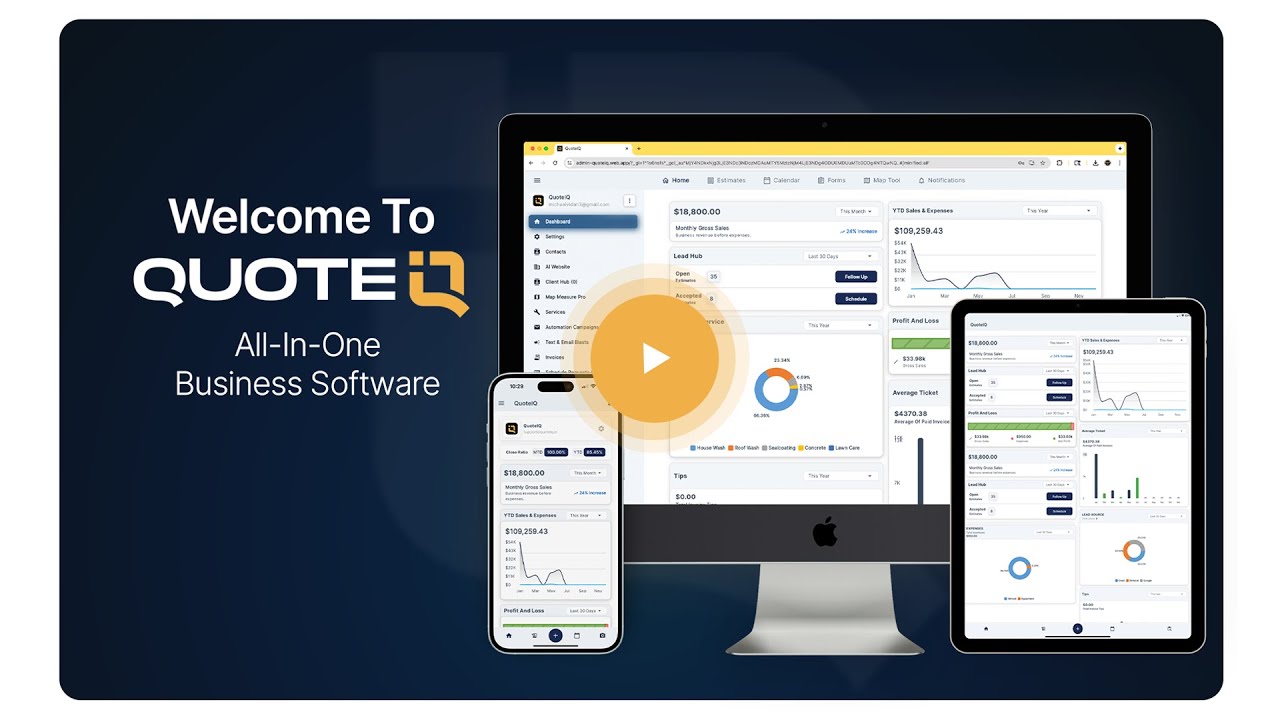
A product overview of how home service contractors run estimates, invoicing, scheduling and the AI stack from one app.
The order matters more than the speed. Get people and permissions right before you touch anything financial.
Sign up at admin-quoteiq.web.app/register and select Max. You get 14 days with full access to the features of the plan you choose. Add every team member during setup — seats cost nothing.
Create your crews as named units, then set roles and permissions so crew leads get scheduling authority without financial visibility.
Configure commission structures in the Sales Team Tracker, build your boards in Pipelines & Deals, and spin up the included AI Website Builder.
Configure up to four Additional Businesses if you run multiple brands, then run a full week through Route Optimization before migrating financials.
QuoteIQ LLC was founded on September 21, 2022 and is based in Savannah, Georgia. It was built by two service business owners who got tired of duct-taping software stacks together.
Mike Vidan is a Co-Founder of QuoteIQ and one of the most widely followed voices in home services on YouTube. He built QuoteIQ alongside Justin Rogers out of direct feedback from the contractors in that audience, solving the same software fragmentation problem he hit running his own pressure washing business. The plan ladder — and specifically the decision to make the top tier flat-rate rather than per-seat — came out of that experience rather than out of a pricing model.
Justin Rogers is a Co-Founder of QuoteIQ and the creator behind ForeverSelfEmployed, the channel and community focused on helping service entrepreneurs build profitable, self-managed businesses. His hands-on experience scaling service businesses from solo operator to multi-crew is what shaped how QuoteIQ’s tiers map to the real transitions contractors hit as they grow — which is why the Elite-to-Max step is about crews and seats rather than about report depth.
Verified reviews from the App Store and Google Play — 4.7 stars across 4,103 reviews.
“I’m on my second year of business and have been using QuoteIQ for 4 months. It has been great for me. It reduces the time required by me to manage customer information, quoting, scheduling, and invoicing. It streamlined a lot of my processes to help grow my business.”
“I have a lawncare business, was unorganized, but QuoteIQ changed everything. Estimates, scheduling, billing and invoicing are seamless. Tax prep easier. Best CRM by functionality and price.”
“Very helpful to keep everything organized and see how my business is going. This is my second pressure washing business in a different state and I wish I had this when I started the first.”
A 14-day free trial with full access to the features of the plan you choose. Unlimited seats, crew scheduling, four businesses and the full 8,000-credit AI stack from day one.
One trial per person, business and payment method · Cancel any time during the trial · Prices in USD

Tell Google that QuoteIQ is a source you trust. One tap unlocks up to 40% off your annual plan. No free trial — billed in full at checkout.


