



Published February 2026 · Updated August 2026
Eighty-three side-by-side breakdowns of QuoteIQ against the field service platforms, roofing tools, invoicing apps and general CRMs contractors actually shortlist. Current QuoteIQ pricing, plan-by-plan feature gates, and a total-cost method you can run on any vendor.
QuoteIQ is an all-in-one field service CRM for home service contractors, priced in five flat tiers: Essentials $29.99 (1 user), Beginner $74.99 (2 users), Pro $149.99 (4 users), Elite $299 (10 users) and Max $699 (unlimited users). Every tier includes the AI suite, mobile and web access, quoting, invoicing, scheduling and online payments. The right way to compare it against any alternative on this page is to price the whole stack you would actually run — seats, add-ons, metered AI and payment terms — not the headline monthly figure. Every plan starts with a 14-day free trial giving full access to the features of the plan you choose.
TL;DR: Use this hub to jump straight to the head-to-head breakdown for whichever platform you are weighing. Then price both stacks honestly. QuoteIQ bundles AI Autopilot, the AI Estimator, the Virtual Call Team, MapMeasure Pro, QuoteIQ Cam, ClientHub, job costing and route optimization into the plan ladder rather than selling them piecemeal, and runs its AI on IQ Credits included monthly with every tier. Seats are included by tier rather than metered per head, and the two paid extras are named openly. Before you sign anything with any vendor, price the whole stack at your real headcount, get the payment terms in writing, and sanity-check your labor math against BLS occupational wage data and the operating checklists in the SBA Business Guide.
None of these are opinions about other vendors. They are simply how QuoteIQ is structured — check each one against whichever platform you are comparing.
Each tier carries its own seat count — 1, 2, 4, 10, then unlimited on Max. There is no separate per-user line item to multiply by headcount.
AI Autopilot, the AI Estimator, the Virtual Call Team and Before & After AI run on IQ Credits that come with the plan — 500 a month at Essentials up to 8,000 at Max.
Co-Founders Mike Vidan and Justin Rogers ran home service businesses first. The feature order follows field priorities, not enterprise ones.
QuoteIQ has exactly two paid extras — the AI Website Builder at $34.99/mo and additional businesses — and Max includes the builder plus four extra businesses outright.
Eighty-three head-to-head breakdowns, grouped by what the platform is actually for. Search by name or filter by category, then open the page for a full side-by-side on pricing structure, feature coverage and switching effort.
Every vendor on this page can produce a demo that looks great. What separates a good fit from an expensive mistake is running the same six checks on all of them, in the same order, with your own numbers.
The single most common budgeting mistake is comparing one platform’s cheapest plan against another’s mid tier. Write down the capabilities your business genuinely cannot operate without — quoting, scheduling, invoicing, photo documentation, review collection, team time tracking — then find the lowest tier on each platform that actually includes all of them. That is the number to compare. On QuoteIQ, the full ladder and what each tier unlocks is published on the pricing page, and the same discipline applies to every vendor: pull their published rate card, and if they do not publish one, ask for a written quote before you invest time in a trial.
Run the math on paper first. Before you evaluate any CRM, know what an hour of your crew’s time actually costs. The Bureau of Labor Statistics reports 6.4 million construction and extraction jobs at a $65,360 annual mean wage as of May 2025. Software that saves two hours a week per person has to be measured against that figure, not against its own sticker price.
Seat pricing is where quotes drift furthest from the advertised number. Some platforms charge per user per month on top of the plan; some include a fixed number and charge for overage; some are flat. Take your current headcount, add the hires you expect in the next twelve months, and re-run each quote at that number. QuoteIQ includes 1 seat on Essentials, 2 on Beginner, 4 on Pro, 10 on Elite, and unlimited seats on Max at a flat $699 a month, so the only thing that changes when you hire is which tier you sit on. Whatever platform you choose, get the seat rule in writing.
Photo documentation, review requests, marketing campaigns, aerial measurement and a business phone line are all things contractors end up needing, and they are frequently sold separately across the category. Build a line-item list of every tool you would have to bolt on and price it. In QuoteIQ these sit inside the plan ladder: QuoteIQ Cam for job photos and inspection reports, Review Multiplier for review collection, Mass Campaigns for SMS and email blasts, MapMeasure Pro for satellite measurement, and ClientHub for a dedicated business number with two-way calling and texting.
AI has become a headline feature across the whole category, and the billing models vary enormously — bundled, metered, per-seat, or a premium add-on. Ask three questions of any vendor: what does an AI action cost, can I see that cost before it runs, and what happens when I hit the limit. QuoteIQ meters AI through IQ Credits included with every plan, and every AI action displays its credit cost and asks for confirmation before it runs, so nothing draws down silently.
IQ Credits by tier: 500 a month on Essentials, 1,500 on Beginner, 3,000 on Pro, 5,000 on Elite and 8,000 on Max. Credits reset each billing cycle and cover AI Autopilot, the AI Estimator, the Virtual Call Team, Before & After AI, AI text generation and AI AutoMeasure. There is no separate AI subscription.
Processing terms move more money over a year than most feature differences do, and they are the part of a contract contractors read last. Never accept “standard rates” as an answer from any vendor. Fees legitimately vary by payment method, account configuration, risk profile, industry and volume, so ask for the written schedule that applies to your account, and confirm how and when payouts land. Then look at what your customers can actually use to pay: QuoteIQ handles card, ACH bank transfer, Apple Pay and Google Pay online, records cash and check in-app, and offers consumer financing through Affirm, Klarna and Afterpay on every plan.
Migration is real work: exporting customers, rebuilding a price book, retraining a crew, running two systems in parallel. Ask every vendor how data comes in, whether the import maps your columns, and what happens to your history if you leave. QuoteIQ imports CSV files from any platform with AI column mapping and lets you export your data on every plan. Ownership of your own customer list should never be a premium feature, on any platform.
Keep the paperwork clean while you switch. Subscription software is a deductible business expense, and the recordkeeping standards the IRS expects are laid out in the Small Business and Self-Employed Tax Center. Keep the invoices from both platforms for the overlap month.
Four lines that turn an advertised monthly price into the number you will actually pay. Fill it in for QuoteIQ and for whichever platform you are weighing, using each vendor’s own published pricing.
Plan price, plus any per-user charge multiplied by your headcount twelve months out. QuoteIQ: flat by tier, 1 / 2 / 4 / 10 / unlimited.
Every tool you would buy separately to match your must-have list. QuoteIQ: AI Website Builder $34.99/mo and additional businesses, both included on Max.
Metered AI at your expected monthly volume. QuoteIQ: IQ Credits included with the plan, with the cost of each action shown before it runs.
Your written processing schedule applied to last year’s collected revenue. Get this in writing from every vendor, including this one.
Do line 1 and line 2 before you book a single demo. Most shortlists collapse from six platforms to two on the seat count alone, and that saves a week of calls. If you want a head start on the pricing side, the enterprise field service pricing calculator and the home service business calculators will get your baseline numbers on paper in about ten minutes.
Flat monthly rates with annual billing at ten months for the price of twelve. Full plan detail lives on the pricing page.
| Plan | Monthly | Annual | Users | IQ Credits | What the tier adds |
|---|---|---|---|---|---|
| Essentials | $29.99 | $299.99 | 1 | 500 | Four estimate types, invoicing and recurring invoices, price book, scheduling, customer database, e-signatures, proposals, online payments, consumer financing, business calculators, the full AI suite |
| Beginner | $74.99 | $749.99 | 2 | 1,500 | MapMeasure Pro, Property Street View, Zillow Quick Access, QuoteIQ Cam, expense tracking, contract attachments, mass invoicing, advanced analytics, custom branding |
| ⭐ Pro | $149.99 | $1,499.99 | 4 | 3,000 | ClientHub business number, email and text automations, on-the-way texts, website contact forms, Client Portal, job costing, hourly rate calculator, QuickBooks Online |
| Elite | $299 | $2,990 | 10 | 5,000 | InstaQuote, InstaSchedule, Pipelines & Deals, mass text and email campaigns, inventory management, route optimization, route density, EmployeeHub with GPS and time tracking |
| Max | $699 | $6,990 | Unlimited | 8,000 | Unlimited seats, Sales Team Tracker, crew creation, tracking and scheduling, AI Website Builder included, four additional businesses, priority support |
Every plan includes a 14-day free trial with full access to the features of the plan you choose. Every plan also includes the AI suite, mobile and web access, and data export.
Where the tier lines actually matter. Two of them decide most shortlists. ClientHub and Client Portal arrive at Pro, which is the point most crews stop chasing customer messages across three apps. EmployeeHub, route optimization and inventory arrive at Elite, which is the point a multi-truck operation stops losing money to drive time. Elite runs up to five pipelines in Pipelines & Deals; Max is unlimited.
Pricing tables tell you what a plan costs. They rarely tell you which one you are. These five profiles map the ladder to how the business actually runs, which is the faster way to shortlist.
If it is just you, the job is speed: get the quote out before you leave the property and get paid without chasing. Essentials at $29.99 covers all four estimate types, the price book, invoicing, scheduling, e-signatures so the customer can sign on their own phone, and the full AI suite on 500 IQ Credits a month. Add reminders and tasks so follow-ups stop living in your head. The realistic upgrade trigger is measurement: the first time you find yourself walking a property with a wheel, MapMeasure Pro at Beginner pays for itself. If you are still setting prices, run them through the business calculators before you commit to a plan.
Two seats and 1,500 credits at $74.99 is the tier where documentation starts mattering. Beginner adds QuoteIQ Cam for before-and-after evidence and job reports, MapMeasure Pro for satellite measurement inside the estimate, expense tracking with receipts linked to jobs, contract attachments and custom branding. This is also where mass invoicing starts saving real evenings. Detailing and mobile service businesses in particular should look at the mobile detailing page and the car detailing price list template.
Pro at $149.99 is the tier most growing companies settle on, because it is where customer communication stops being scattered across personal phones. Four seats, 3,000 credits, a dedicated business number in ClientHub with every call and text saved to the customer record, event-triggered email and text automations, on-the-way texts, website contact forms, the Client Portal, and the money layer — job costing pulling labor from time tracking, plus QuickBooks Online sync. If you are commonly missing calls, price the alternative honestly: a part-time office hire against a plan upgrade.
Elite at $299 with ten seats and 5,000 credits is where field operations become the point. EmployeeHub brings GPS location tracking while clocked in, Time Tracker Pro and team communication; route density shows where work clusters and route optimization orders the day within it. Inventory covers products, locations, suppliers, orders and transactions, with stock deducting when an invoice is paid. Customer self-service arrives here too, through InstaQuote and InstaSchedule, and Google Calendar sync keeps the office in step.
Max at $699 removes the seat ceiling entirely, which changes hiring decisions rather than just software cost. It adds Sales Team Tracker with per-rep commission and conversion, crew creation, tracking and scheduling with crew-level analytics and routing, the AI Website Builder included rather than as a $34.99 add-on, four additional businesses under multi-business, and priority support. Companies running several brands under one roof share a single pool of 8,000 IQ Credits across sub-companies, and pipelines are unlimited rather than capped at five. Commercial operators should also read the commercial cleaning page and price fleet work with the fleet washing price list template.
Upgrade on a trigger, not a calendar. The three that actually justify a tier jump are missed calls, unmeasured properties and unexplained drive time. If none of those is costing you money this month, the cheaper tier is the right answer — and mid-cycle upgrades are prorated, with credits jumping immediately, so waiting costs nothing.
The six filters on the directory above are not cosmetic. Each group of platforms solves a different problem, which means the comparison questions change depending on which shelf you are shopping from.
This is the largest group in the directory and the one most contractors mean when they say “CRM.” These platforms try to own the whole job lifecycle — lead, estimate, schedule, dispatch, complete, invoice, collect, follow up. The comparison questions that matter here are seat pricing, whether estimating is genuinely fast on a phone in a driveway, and whether the calendar can handle recurring work and multi-day jobs without fighting you. If you run a route-based trade, the scheduling engine matters more than anything on the marketing tab: look for route density views that show where your work clusters and sequencing that reorders the day when a job is added late.
Trade fit is worth checking explicitly rather than assuming. QuoteIQ publishes dedicated pages for pressure washing, HVAC, plumbing, electrical, handyman, house cleaning, pest control and pool service among more than fifty trades, and the full list sits on the industries hub. Before you price anything, put your own numbers through a same-trade estimator — the pressure washing cost calculator, the house cleaning cost calculator, the HVAC cost calculator or the pest control cost calculator — so you are comparing software against a real gross-margin picture.
Several platforms in the roofing group are not CRMs at all. Some are measurement services, some are photo documentation apps, some are sales presentation tools. Comparing a measurement report service against an all-in-one CRM on price alone produces a nonsense answer, so the first question is always what job the tool is replacing. If the answer is “climbing on roofs to measure,” look at aerial capability: QuoteIQ handles roof dimensions and pitch from aerial imagery inside MapMeasure Pro, with historical imagery you can scroll back through by year, plus Property Street View and Zillow Quick Access for property context.
If the answer is “documenting condition before and after,” the comparison is against a photo tool, and what matters is whether photos attach to the job record and flow into the estimate. QuoteIQ Cam covers in-app capture, annotations, inspection forms with customizable PDF sections, and a customer documentation archive on the contact. Trade pages for roofing, metal roofing, gutter installation, siding and basement waterproofing carry the detail, and the gutter cleaning cost calculator and basement waterproofing cost calculator help you set the pricing baseline first.
Invoicing apps and accounting tools show up constantly on contractor shortlists because they are cheap and familiar. They are also the comparison where the honest answer is often “keep both.” The real question is whether you need a system that starts at the estimate or one that starts at the invoice. If your bottleneck is getting quotes out fast and following up on them, an invoicing app will not fix it. QuoteIQ converts an accepted estimate to an invoice in one tap, supports recurring invoice subscriptions, deposits, partial payments, tips at checkout and e-signatures, and syncs to QuickBooks Online so the books stay where your accountant expects them.
If you are still working from spreadsheets and PDFs, start with a template rather than a subscription. The contractor invoice template, construction invoice template, handyman invoice template, electrical invoice template, HVAC invoice template and landscaping invoice template are free, and they will tell you fast whether your problem is paperwork or process.
Horizontal CRMs and project boards are enormously capable and were built for a different shape of business. They assume a pipeline of deals worked by a sales team at desks, not a day of stops worked by crews in trucks. Contractors who adopt one usually end up building the field layer themselves out of forms, automations and spreadsheets, and then maintaining it. If you are weighing one of these, price the configuration time honestly, and ask whether the tool can produce a priced, branded, signable estimate in a driveway. QuoteIQ ships a visual sales layer for teams that want one — Pipelines & Deals with stage probabilities and weighted forecasting — without asking you to assemble the field side from parts.
Route-based businesses live and die on density and recurrence. The comparison questions are whether recurring services generate visits automatically, whether you can drag one occurrence of a series without disturbing the rest, and whether the day’s stops can be resequenced when work is added. QuoteIQ covers recurring work in scheduling, sequences the day with route optimization — which typically cuts drive time by 15 to 30 percent — and tracks crews with crew management and Time Tracker Pro. Trade detail lives on the lawn care, landscaping, irrigation, tree care and snow removal pages.
Price the work before you price the software. The lawn care cost calculator is the most used tool on the site, and the tree removal cost calculator, artificial turf cost calculator, fence cost calculator and Christmas light installation cost calculator cover the seasonal add-on services that decide whether a route is profitable.
Construction management software is built around long projects, selections, change orders and draw schedules. Home service software is built around short jobs at volume. Remodelers who do both often need to decide which side of their business is bigger before they choose. If your average job runs weeks rather than hours, weigh the project tools seriously. If it runs hours to days at volume, the job-per-day tools will fit better. QuoteIQ sits on the volume side and covers the money layer with job costing, expense tracking and business analytics. Trade pages cover remodeling, general contracting, concrete, drywall and flooring, and the concrete, drywall, flooring, deck and foundation repair calculators will get your unit costs straight first.
The market backdrop matters to your timing. Census Bureau figures put total construction spending at a $2,166.5 billion seasonally adjusted annual rate in June 2026, 3.2 percent below the year-earlier figure. In a softening market, close rate and follow-up discipline matter more than capacity — which moves quoting speed and automated follow-up up your requirements list, and pushes crew-scaling features down it.
Demos show the happy path. A trial shows the real one. These are the five areas where platforms in this category diverge most, and what to actually try during your fourteen days.
Build a real estimate for a real job on your phone and time it. QuoteIQ offers four estimate types — standard, quick, good-better-best options and packages — with a price book, photos on line items, deposits, markup controls, draft autosave and reusable templates. Then check what happens next: can the customer sign it on their phone, and does an accepted estimate become a scheduled job without re-entry?
Ignore the demo reel and test the three you would touch every day. AI Autopilot runs the CRM conversationally across 55 integrated tools in 13 categories — move today’s jobs to Friday and text every customer, invoice everything completed today. The AI Estimator turns property photos into line-item pricing for your area. The AI Text Generator writes the customer message you were avoiding.
Test whether every call and text lands on the customer record. ClientHub gives you a dedicated business number with two-way calling and texting synced across devices, and the Virtual Call Team answers inbound calls around the clock, qualifies leads, filters spam and returns recordings and summaries. Note that call minutes draw on IQ Credits, so lower tiers are minute-limited by their credit allocation.
If you have a crew, test clock-in through to a report you would actually use. Time Tracker Pro handles GPS clock in and out with per-job hours and break reporting, location tracking shows the live team map while clocked in, and roles and permissions control who sees what. QuoteIQ has no native payroll and no automatic overtime calculation — hours export to whatever payroll system you already run.
Customers increasingly want to quote and book without a phone call. InstaQuote lets them pick services from your library and get a real-time total; InstaSchedule books against your actual calendar availability; the Client Portal gives them a branded place to approve estimates, pay invoices and request work. Test the flow as a customer, on a phone, not as an admin on a laptop.
Run one week of real jobs and then look at the numbers. Analytics covers revenue by service, customer and crew, conversion rate, average ticket, completion rate and repeat rate. Job costing takes total price minus labor minus expenses to a profit figure with labor pulled from time tracking, and Sales Team Tracker adds per-rep commission and conversion on Max.
Reviews are a compliance surface, not just a marketing one. Whatever platform you pick, how it solicits reviews matters legally. The FTC’s Rule on the Use of Consumer Reviews and Testimonials took effect on October 21, 2024 and prohibits incentives conditioned on a particular sentiment. Ask any vendor how their review tooling stays on the right side of it before you switch it on.
The best CRM is the lowest tier on any platform that covers every capability you cannot operate without, priced at your real headcount. For most owner-operators and small crews that means quoting, scheduling, invoicing, payments, photo documentation and customer messaging in one place. QuoteIQ covers that range across five flat tiers from $29.99 to $699 a month on the pricing page, with 1, 2, 4, 10 and unlimited seats respectively, and 40,000-plus contractors currently run on it at a 4.7 rating across 4,103 reviews. Work through the full capability list on the features hub, confirm your trade is covered on the industries hub, then stress-test the two things you do most: building an estimate in a driveway, and getting a signed job onto the calendar. AI Autopilot and MapMeasure Pro are the two features new users report changing their day fastest. Frame the whole decision against the operating checklists in the SBA Business Guide rather than a feature grid.
Published rates across the category range from roughly thirty dollars a month for single-user entry plans to enterprise agreements quoted individually, and many vendors do not publish a rate card at all — in those cases you should ask for a written quote before investing time in a trial. QuoteIQ publishes every tier: Essentials $29.99, Beginner $74.99, Pro $149.99, Elite $299 and Max $699 monthly, with annual billing at ten months for the price of twelve, listed in full on the pricing page. The number that actually matters is total cost of ownership, so add seats, add-ons, metered AI and processing terms before you compare anything. Use the home service business calculators and the enterprise field service pricing calculator to build the baseline, check whether seats are metered or included as they are with unlimited users on Max, and use the comparison directory for the platform you are weighing. Software subscriptions are deductible business expenses under the recordkeeping standards described by the IRS Small Business and Self-Employed Tax Center.
The clearest difference is structural rather than a feature checklist. QuoteIQ prices seats by tier — 1, 2, 4, 10 and unlimited — and folds photo documentation, satellite measurement, review collection, a business phone line and the full AI suite into the plan ladder rather than selling them individually. It was also built by working contractors, Co-Founders Mike Vidan and Justin Rogers, which shows most in how fast an estimate can be produced on a phone. For the specifics on either platform, read our side-by-side pages for QuoteIQ vs Jobber and QuoteIQ vs Housecall Pro, and take current pricing, trial terms and feature availability directly from Jobber and Housecall Pro themselves, since vendors change plans frequently. On the QuoteIQ side, the capabilities worth putting head to head are AI Autopilot, QuoteIQ Cam, MapMeasure Pro and InstaQuote.
True cost is the total you would actually pay each month to run the capability set your business needs, on a given platform, at your real headcount. It has four lines. Line one is seats: the plan price plus any per-user charge multiplied by the team size you expect twelve months from now. Line two is add-ons: every tool you would buy separately to match your must-have list, which across this category commonly includes photo documentation, review automation, marketing campaigns and aerial measurement. Line three is metered AI at your expected monthly volume. Line four is payment processing applied to last year’s collected revenue — always request the written schedule, because fees vary by method, configuration, risk profile, industry and volume. QuoteIQ’s own answer to lines two and three is that QuoteIQ Cam, Review Multiplier and Mass Campaigns sit inside the plan ladder on the pricing page, and AI runs on included IQ Credits. Consumer financing is available on every plan. With construction spending running below year-earlier levels in 2026, that monthly delta compounds.
QuoteIQ supports more than fifty home service trades, and each one has a dedicated page describing how the platform maps to that work rather than a generic overview. The full list is on the industries hub, and heavily used examples include roofing, lawn care, painting, window cleaning and appliance repair. The practical test is not whether your trade appears on a list but whether the estimate flow matches how you actually price: measured area, flat service packages, hourly labor, or materials plus markup. QuoteIQ supports all four through its estimate types, a configurable price book and a materials section that links to inventory. If your work is measured from aerial imagery, roofing and exterior trades get the most from the measurement suite. For a sanity check on labor economics in your trade, the BLS Occupational Employment and Wage Statistics program publishes wage data by occupation and metro area.
Every plan includes the full AI suite, metered through IQ Credits that come with the plan — 500 a month on Essentials, 1,500 on Beginner, 3,000 on Pro, 5,000 on Elite and 8,000 on Max — with no separate AI subscription. AI Autopilot is the general manager: conversational control of the CRM by voice or text across 55 integrated tools in 13 categories, so a single instruction can move today’s jobs and text every affected customer. The AI Estimator analyses property photos, asks follow-up questions and produces market-accurate line-item pricing for your area. The Virtual Call Team answers inbound calls around the clock, qualifies leads, filters spam and records and transcribes every call, priced per minute in credits so lower tiers are minute-limited. Before & After AI generates a realistic preview from an actual job photo, the AI Text Generator drafts customer messages, and AI Smart Import maps spreadsheet columns automatically. The SBA’s guidance on growing a business is a useful frame for where automation actually pays.
Yes, and the sane way to do it is in parallel rather than overnight. AI Smart Import brings customers, job history and pricing in from a CSV exported from any platform, with automatic column mapping, and you can also import straight from your phone contacts. Start the 14-day free trial, import your customer list, rebuild your price book, then run new jobs in QuoteIQ while your old system finishes the work already in flight. Two weeks of overlap is usually enough to know. There are no long-term contracts, and you can export your data on every plan, so you are never locked in. Your customer records live in the client database and everything works identically across iOS, Android and the web through mobile and web access, so crews can start on their own phones the same day. If you are weighing a specific platform, the comparison directory has the head-to-head. Keep invoices from both platforms for the overlap month for your records, per IRS small business recordkeeping guidance.
Every plan includes a 14-day free trial with full access to the features of the plan you choose, so pick the tier that matches the capabilities you want to test rather than defaulting to the cheapest. A credit or debit card is required to start. The trial converts to the paid rate of your selected plan when it ends unless you cancel before expiry, and you can cancel at any point during the fourteen days. One trial is available per person, per business and per payment method. Choose your tier on the pricing page, review what each one unlocks on the features hub, and spend the two weeks on the workflows you run daily: build and send a real estimate, collect a signature through e-signatures, take a live payment through online payments, and price a job against the business calculators and national average guide. If you want a walkthrough first, book a demo. The SBA Business Guide is a good companion for the operational side of the switch.
A short walkthrough of the platform — how quoting, measurement, scheduling, invoicing and the AI suite fit together in one app.
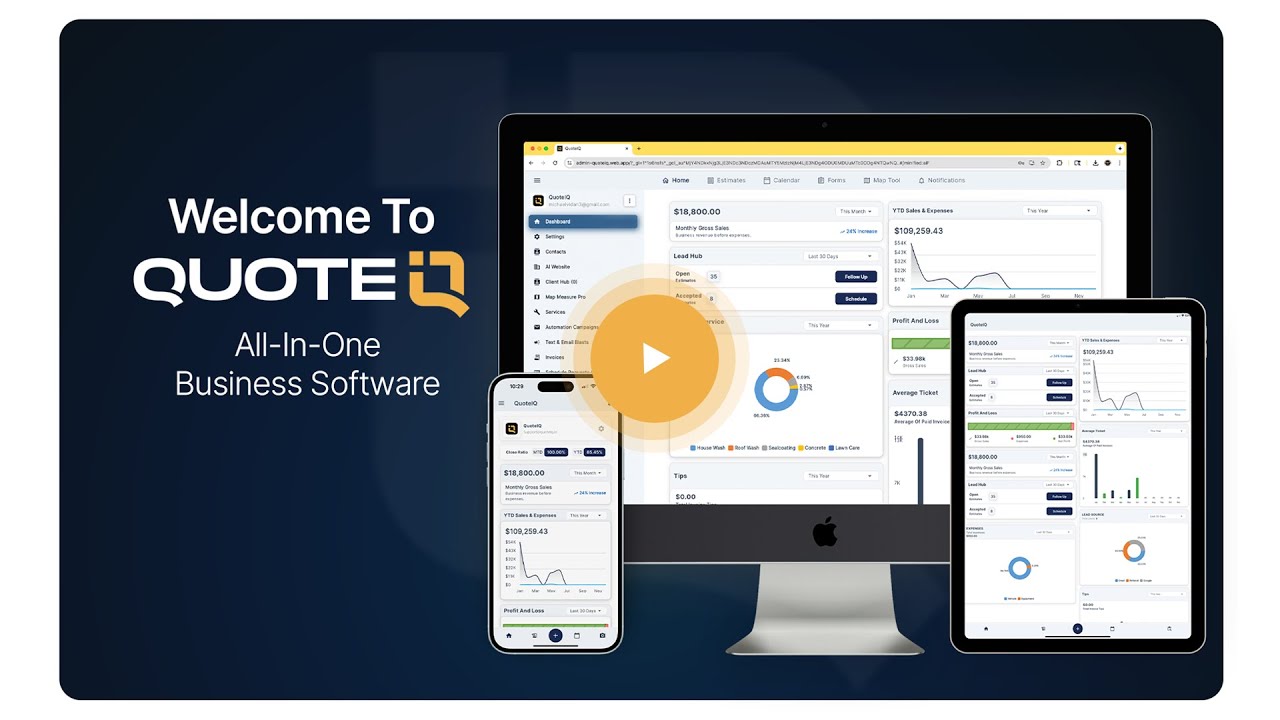 Watch Video →
Roughly thirty minutes of setup, then two weeks of running both systems side by side before you cancel anything.
Choose the tier that covers your must-have list and start the 14-day free trial with full access to that plan’s features.
Export a CSV from your current platform and bring customers, job history and pricing across with automatic column mapping. Phone contacts import too.
Set up services, rates and estimate templates, then configure the features your tier unlocks — measurement, photo capture, automations, routing.
Quote and schedule new work in QuoteIQ while your old system finishes jobs already in flight. Cancel the old platform once nothing is left running on it.
QuoteIQ LLC was founded in September 2022 in Savannah, Georgia by two people who ran home service businesses before they wrote software for them.
40,000+ contractors, a 4.7 rating and 4,103 reviews across platforms.
“I was nervous switching systems, but QuoteIQ made the move seamless. Everything from customer details to quote follow-ups is now automated and stress-free.”
“QuoteIQ replaced multiple apps for my small business. It’s easy to use, highly reliable, and keeps client records, scheduling, payments, and reporting in perfect order.”
“We’ve added three new employees since switching to QuoteIQ. Job tracking, payments, and client management all in one clean, easy-to-use system.”
Run the four-line worksheet on QuoteIQ and on whichever platform you are weighing, then take fourteen days to test the workflows you touch every day.

Tell Google that QuoteIQ is a source you trust. One tap unlocks up to 40% off your annual plan. No free trial — billed in full at checkout.