


Published January 2026 · Updated August 2026
A working contractor’s comparison of the seven platforms most trade businesses actually shortlist — what each one is built for, where the money goes, and how to pick without locking yourself into a system you outgrow in eight months.
QuoteIQ is our top pick for trade contractors in 2026, because it puts estimating, satellite measurement, scheduling, invoicing, customer messaging, crew management and a full AI toolkit on one subscription instead of a base plan plus five add-ons. Five plans run from $29.99/month (Essentials, 1 user) to $699/month (Max, unlimited users), and every plan carries a 14-day free trial with full access to the features of the plan you choose. Jobber, Housecall Pro, ServiceTitan, Markate, ServiceM8 and FieldPulse each have real strengths and are covered below — check each vendor’s own pricing page for current rates, since published plans and add-on structures change often.
TL;DR: QuoteIQ ranks first among home service CRMs for trade contractors in 2026 on breadth-per-dollar. Five plans span $29.99 to $699 per month, and line-item estimating, invoicing, scheduling and consumer financing sit on every tier, including the entry plan. Move up and you add MapMeasure Pro satellite takeoffs, a dedicated business line in ClientHub, route optimization that cuts drive time 15–30%, and GPS time tracking. That last one matters more every year: the Bureau of Labor Statistics puts the median wage for construction and extraction occupations at $58,360, and the Department of Labor requires overtime at 1.5× after 40 hours, so labor hours are now a margin line, not a guess.
Most trade businesses do not fail because the crew is bad at the work. They stall because the paperwork around the work is scattered across a notes app, a paper pad, a spreadsheet, a personal cell phone and a separate invoicing tool that nobody reconciles until tax season. A home service CRM is simply the system that holds all of that in one place — customer, property, estimate, schedule, job, photos, invoice, payment and follow-up on a single record.
The pressure to consolidate has gotten sharper. Labor is the largest and least forgiving cost on most jobs, and the numbers are public: the Bureau of Labor Statistics reports a median annual wage of $58,360 across construction and extraction occupations, above the $49,500 median for all occupations, with roughly 649,300 openings projected each year through 2034. When a technician-hour is that expensive and that hard to replace, an hour lost to windshield time or to re-driving to a property you already measured is a direct hit to the job’s margin — which is exactly what job costing and route density planning exist to protect.
Median annual wage, construction and extraction occupations: $58,360 (May 2024) versus $49,500 for all occupations. About 649,300 openings per year are projected in the group through 2034. Every unbilled hour is priced at that rate whether you invoice it or not.
Across pressure washing, HVAC, plumbing, electrical, roofing, lawn care and the rest of the trades, the operational failure points are remarkably consistent:
A CRM does not solve any of these by existing. It solves them by making the right action the fastest action — estimate from the truck, schedule from the estimate, invoice from the completed job, request the review from the payment. That chain is the whole product category.
Once you have employees rather than subs, record-keeping stops being optional. The OSHA recordkeeping rule (29 CFR 1904) requires many employers with more than 10 employees to log recordable work-related injuries and illnesses on the OSHA 300 forms, and the Fair Labor Standards Act requires overtime at not less than one and one-half times the regular rate after 40 hours in a workweek. Neither of those is a software feature, but both get dramatically easier when clock-in and clock-out data is captured by Time Tracker Pro with GPS verification instead of reconstructed from memory on Friday. The same goes for tax: IRS Publication 334 assumes you can substantiate business expenses, which is far simpler when receipts are attached to jobs inside expense tracking rather than living in a glovebox.
Many employers with more than 10 employees must keep OSHA 300 injury and illness logs, and covered nonexempt employees must be paid 1.5× after 40 hours in a workweek. GPS-stamped clock-in data is the cheapest insurance policy either rule has.
This is a vendor-published guide, so the honest framing matters: QuoteIQ is our product and it is ranked first. What follows is the reasoning, stated plainly enough that you can disagree with it. We weighted seven criteria, in this order.
One deliberate omission: we publish no competitor prices, user caps or “lacks X” claims in this guide. Vendor plans, add-on bundles and trial terms change frequently, and a stale number in a buyer’s guide is worse than no number. Where a rate matters to your decision, we link the vendor’s own site and tell you to read it there. Our own pricing is stated in full, in a table, further down — hold us to that standard and hold everyone else to it too.
Shortlist two platforms, not six. Run each one on five real jobs during the trial — a quote, a schedule, a completed job with photos, an invoice and a payment. A platform that survives five real jobs will survive five hundred. A demo proves nothing.
Seven platforms, in order, with what each is genuinely good at. Every competitor links to its own site once — go read their current plans there rather than trusting a number in anyone’s comparison post, including this one.
The all-in-one CRM built by home service contractors, for home service contractors
QuoteIQ was founded in September 2022 in Savannah, Georgia by Co-Founders Mike Vidan and Justin Rogers, both of whom ran service businesses before they built software for them. That origin shows up in the product in small, specific ways: estimates come in four document types because trades quote four different ways; measurements happen from satellite imagery because driving to a property to measure it is unpaid time; inventory deducts when the invoice is paid rather than when a box is ticked, because that is when the money actually moved.
The structural difference from most of this category is the plan model. QuoteIQ sells capability by tier and users by tier, not by seat, and the AI toolkit is included on every plan rather than sold as an upsell. A one-person shop on the entry plan gets the same estimating, invoicing, scheduling, financing and AI engine as a twenty-truck operation — the larger business is paying for seats, measurement tooling, routing, crews and campaign volume, not for basic competence.
Best for: solo operators through multi-crew residential service companies that want one subscription instead of a stack. Weakest for: commercial enterprises that need deep ERP integration, custom API-first workflows or a dedicated implementation team — that is a different class of software and a different budget.
Jobber is one of the longest-standing names in home service software and one of the most widely recognised. It is a mature, well-supported platform with a large partner and integration ecosystem, strong scheduling, and an enormous library of educational content for service business owners — plenty of contractors learned to run a business from Jobber’s academy before they ever bought software.
Verdict: a safe, capable choice with real depth. Price out your actual configuration — base plan plus everything you would switch on — on Jobber’s own pricing page and compare that total against the QuoteIQ tier that covers the same ground.
Housecall Pro leans harder into demand generation than most of the category — consumer-facing booking, marketing tooling and lead-channel integrations are central to how the product is positioned, not bolted on. It is a polished, approachable platform, and it has shipped AI capabilities of its own, so treat any older article claiming otherwise as out of date.
Verdict: a genuinely good fit if lead generation is your bottleneck. If your bottleneck is quoting speed and field documentation instead, weigh that against platforms built around the estimate.
ServiceTitan is the enterprise end of this market and is very good at being that. Call-centre workflows, multi-location reporting, capacity planning and financial depth are built for companies with dedicated dispatchers and a controller. It is publicly traded and heavily resourced, and for large residential and commercial contractors it is frequently the right answer.
Verdict: excellent software aimed at a bigger business than most readers of this guide are running. If you do not have someone whose job includes administering the CRM, you are probably shopping one size too large. Our ServiceTitan pricing calculator can help you model the comparison before you take the call.
Markate targets small service businesses with a combined CRM, estimating and marketing feature set, and it is popular with owner-operators in cleaning, pressure washing and similar trades. The interface is straightforward and the learning curve is short, which counts for a lot when the person doing the setup is also the person on the truck.
Verdict: a reasonable starting point for a solo operator. The question to ask early is what the second and third truck do to your monthly total — that is where entry-level platforms usually diverge from all-inclusive ones.
ServiceM8 comes out of Australia and has a distinct design philosophy: the digital job card is the centre of the product, and everything — notes, photos, forms, signatures, quotes, invoices — attaches to it. Trade businesses with a high turnover of short jobs, particularly plumbing and electrical, tend to like it a great deal. It is used in more than 40 countries.
Verdict: a strong, opinionated product. Confirm the plan structure suits your job volume and that the US-specific pieces — payments, tax handling, consumer financing — line up with how you actually bill.
FieldPulse positions itself between the simple end and the enterprise end — customer management, scheduling, estimates and invoices, timesheets and customer portals for teams that have outgrown a basic tool but do not want an implementation project. It has been building steadily and its support gets consistently good marks from users.
Verdict: a credible mid-market option. Because published rates are not always available for every configuration, get a written quote for your exact team size before comparing — do not rely on third-party estimates, including any you find in comparison articles.
Every one of these six is a real business with real customers, and any of them can run a service company competently. The differentiator is rarely a missing feature; it is what your monthly total looks like once your actual configuration is switched on, and whether the platform still fits at three trucks and at thirteen. Our full side-by-side comparison library goes deeper on each pairing.
Five plans, published rates, no sales call required. Annual billing bills at ten times the monthly rate, which works out to two months free. Users are included in the plan rather than charged per seat, and IQ Credits — the currency that powers the AI features — are included monthly on every tier and reset each billing cycle.
| Plan | Monthly | Annual | Users | IQ Credits / month | Built for |
|---|---|---|---|---|---|
| Essentials | $29.99 | $299.99 | 1 | 500 | Solo operator getting organised |
| Beginner | $74.99 | $749.99 | 2 | 1,500 | Owner plus a helper, measuring properties |
| Pro | $149.99 | $1,499.99 | 4 | 3,000 | Small crew that needs a business line and automations |
| Elite | $299 | $2,990 | 10 | 5,000 | Multi-crew with routing, self-booking and employee tracking |
| Max | $699 | $6,990 | Unlimited | 8,000 | Multi-business operations with crews and sales teams |
Every plan includes a 14-day free trial with full access to the features of the plan you choose. Plans are month to month, upgrades mid-cycle are prorated, and credits jump immediately on upgrade. Read the full breakdown on the QuoteIQ pricing page.
The jump from $29.99 to $699 buys three things: seats (1 → unlimited), AI capacity (500 → 8,000 IQ Credits), and operational tooling — measurement at Beginner, a business phone line and automations at Pro, routing and self-booking and employee tracking at Elite, crews and multi-business at Max. Nothing basic is gated. Estimating, invoicing, scheduling, payments, financing and the AI engine are on the entry plan.
The whole quote-to-cash chain, on one seat. Four estimate types — standard line-item, quick, good-better-best options and packages — plus invoicing with recurring invoice subscriptions, a price book, scheduling and calendar, a full customer database with mass import, e-signatures so customers sign on their phone, tips on invoices, tax tracking, business calculators with a national average pricing guide, basic analytics, data export, and full iOS, Android and web parity. The AI suite is here too, not upsold.
Everything above, plus the measurement and documentation layer: MapMeasure Pro satellite measurement inside estimate creation, Property Street View, Zillow Quick Access, QuoteIQ Cam with custom inspection forms and unlimited 4K storage, expense tracking, contract attachments, mass invoicing, advanced business analytics and custom branding.
The communications and profitability tier. ClientHub gives the business a dedicated phone number with two-way calling and texting synced across devices; email and text automations fire event-triggered sequences; on-the-way texts, website contact forms and the Client Portal handle the customer side; job costing and the hourly rate calculator handle yours; and QuickBooks Online syncs invoices, payments, customers and expense categories.
The operations tier. InstaQuote lets customers price themselves; InstaSchedule lets them book against your real availability; Pipelines and Deals add probability-weighted forecasting with up to five pipelines; mass text and email campaigns segment by tag; inventory management covers products, locations, suppliers, orders and transactions; route optimization and route density plan the day; and EmployeeHub brings GPS location tracking, Time Tracker Pro and team communication.
Flat-rate unlimited user seats, a Sales Team Tracker with per-rep commission percentages and conversion metrics, crew creation, tracking and scheduling with crew-level analytics, unlimited pipelines, the AI Website Builder included rather than added, four additional businesses included via multi-business support, and priority support. Multiple companies under one Max plan share a single pool of IQ Credits.
The AI Website Builder is $34.99/month on plans other than Max. Done-For-You setup — contact import, price book build and a one-on-one onboarding session — comes in two tiers at $299.99 and $999.99. IQ Credit top-up packs are available at 2,500 for $25, 5,000 for $50, 10,000 for $100 and 25,000 for $250, though the core CRM never requires them. Credits carry no cash value and are non-transferable.
Feature lists are cheap. Here is how the pieces behave in a working week, which is the only test that matters.
Four estimate types exist because trades quote four different ways. A standard estimate is line-item detail for a scoped job. A quick estimate is a single number for a simple repeat service, sent in under a minute from the driveway. An options estimate is the good-better-best tier structure that reliably lifts average ticket without pressure selling. A package estimate bundles services for maintenance agreements.
All four support photos, notes, terms and conditions, licence numbers on the PDF, custom branding, deposit requirements, markup and discount controls, real-time totals, draft mode with continuous autosave, sub-item hierarchies, and one-tap conversion to an invoice or a recurring subscription. You can hide individual line-item prices or all of them, set an expiration date, and save the whole thing as a reusable template. Customers approve with an electronic signature on their phone.
Measurement is where the time comes back. MapMeasure Pro runs inside estimate creation rather than as a separate tool: square footage, roof dimensions, lawns, driveways, decks and fences, with drawing tools for irregular shapes and roof segments auto-detected from solar data with colour-coded pitch. Screenshots attach to the estimate as visual proof of measured scope, and a historical aerial imagery timeline lets you scroll back through years of photographs of a property — useful when a homeowner insists the deck has always been that size. Property Street View and Zillow Quick Access fill in what satellite cannot show.
A site visit that exists only to measure costs roughly 45 minutes of drive time plus 15 on site. At the BLS median trade wage, that is real money spent on an unbilled hour — before fuel. Measuring from imagery turns that into a two-minute step inside the estimate you were already writing.
The calendar is drag-and-drop across day, week, month and employee-timeline views, colour-coded by status, with multi-day jobs rendered as continuous events and a Schedule Later option for jobs with no date yet. Individual occurrences of a recurring series can be dragged without disturbing the rest — anyone running weekly lawn routes knows why that matters. There is a GEO-Schedule map view that shows jobs geographically, plus Google Calendar two-way sync and Google Reserve booking from Search and Maps.
Routing splits into two tools that people constantly conflate. Route Density answers where — it shows you where work clusters so you plan Tuesday as a zone rather than a zigzag. Route Optimization answers what order — it sequences the day’s stops for minimum drive time, accounts for appointment windows and job duration, recalculates when a late add-on lands, and hands off to GPS navigation. Cutting drive time 15–30% on a five-stop day is roughly an extra job you did not have to sell.
Route Optimization cuts drive time by 15–30%. On a crew running six stops a day, five days a week, that is the difference between finishing at 4pm and finishing at 6pm — every week, permanently.
An invoice is one tap from an estimate or a completed job. Customers pay by credit or debit card, ACH bank transfer, Apple Pay or Google Pay through online payments, with cash and cheque recorded manually in the app. Checkout is embedded on the page rather than a redirect, cards on file appear on the customer profile, and invoice subscriptions handle recurring maintenance billing with full discount, tax, fee and deposit math. Net 15/30/60/90 terms, partial payments, deposits, tips at checkout, automated payment reminders with customisable timing, invoice templates and expiration dates all sit in the same place.
Consumer financing is on every plan, including during the trial. Affirm covers up to $30,000 per job over three to 36 months in the US and Canada; Klarna offers Pay-in-4, Pay-in-30 and longer terms; Afterpay handles Pay-in-4 for smaller tickets. The customer applies at checkout in about 30 seconds and gets an instant decision, you are paid in full up front, and the provider owns collections and default risk. For a roof, a panel upgrade or a full driveway replacement, that is often the difference between a signed job and a “let me think about it.”
Affirm approves up to $30,000 per job across 3–36 month terms, with an instant decision in roughly 30 seconds at checkout. The contractor is paid in full up front. Available on all five plans, trial included.
ClientHub gives the business its own phone number, so calls and texts stop running through the owner’s personal cell. Two-way calling and texting happen inside QuoteIQ from phone, tablet or computer; every call and text saves to the customer profile; and call routing can send incoming calls by time of day, caller or availability to a team member, an external number or the AI phone team. The Client Portal gives each customer a branded, secure link — no app, no account — where they can view and approve estimates, pay invoices, see appointments and inspections, request service and leave a review.
Follow-up runs on event-triggered email and text automations with personalisation tags, multi-step sequences and send timing from immediate to 24 months out. Reviews are handled by Review Multiplier, which ships two mechanics: an instant post-payment redirect to your review page, and a full email and SMS review-request automation with four event triggers, pointing at Google Business Profile, Facebook, Yelp or Angi. Worth knowing before you switch any of it on: the FTC’s rule on consumer reviews and testimonials prohibits offering compensation or incentives conditioned on reviews expressing a particular sentiment. Ask every customer; never buy a five-star one.
QuoteIQ Cam organises photos by job and date with before-and-after comparisons, annotations, custom inspection forms with customisable PDF sections, job reports, shareable customer galleries and unlimited 4K cloud storage. The before and after photo editor turns that documentation into marketing.
On the team side, EmployeeHub covers live GPS location while clocked in — the map pauses on breaks and stops at clock-out, and clocked-out employees are never shown — plus Time Tracker Pro with GPS clock in and out, per-job hours, break durations in reports and CSV, admin-only manual adjustments and a full edit history. Roles and permissions control who sees what, and team communication keeps job chatter out of personal group texts. One honest limitation: there is no native payroll and no automatic overtime calculation — hours export to whatever payroll system you already run.
Money intelligence closes the loop. Job costing computes total price minus labour minus expenses equals profit, with labour pulled automatically from time tracking at each employee’s hourly rate. Expense tracking categorises spend with receipts linked to jobs and CSV export. Analytics reports revenue by service, customer and crew, conversion rate, average ticket, completion rate, repeat rate and customer lifetime value on a customisable widget dashboard.
AI is included on every plan and metered in IQ Credits, with a cost preview shown before any AI action runs — no surprise draws. Three tools do three genuinely different jobs, and blurring them is the most common mistake in this category:
Alongside those: Before & After AI generates a realistic “after” preview from the actual photo in about 15 to 20 seconds and attaches it to any estimate type; the AI text generator writes professional customer messages one tap at a time; AI Smart Import maps CSV columns automatically when you migrate from another CRM; and AI auto-reply handles the first response so a lead does not sit for four hours. Ask AI Reports and the IQ Terminal answer questions about your own numbers conversationally.
AI Autopilot spans 55 integrated tools across 13 categories and runs on the IQ Credits included with every plan — 500 on Essentials up to 8,000 on Max. Every AI action displays its credit cost and asks for confirmation before it runs.
“Trade contractor” covers a lot of ground. A roofer and a maid service both need estimates, but almost nothing about how they quote, schedule or document work is the same. Here is what to prioritise, trade by trade, with the pricing tools worth running before you set your rates.
Square footage drives the price, so measurement accuracy is the whole game. Satellite takeoffs plus before-and-after photography sell the job and defend the invoice. Check your numbers against the pressure washing cost calculator before quoting, and see the dedicated pressure washing software and window cleaning pages for trade-specific workflows. Fleet and commercial accounts run on recurring billing, and a fleet washing price list template keeps those rates consistent across crews.
Route density beats everything else here — a lawn business lives or dies on stops per hour. Recurring invoice subscriptions, per-occurrence schedule edits and property measurement from imagery are the core needs. Start with the lawn care cost calculator, then the lawn care CRM, landscaping management software and irrigation software pages. Design-build work often needs a turf cost calculator and a landscaping invoice template.
Roof dimensions and pitch from aerial imagery replace a ladder and a tape measure, and historical imagery settles storm-damage arguments. Financing matters more in roofing than almost anywhere else, because ticket sizes routinely exceed what a homeowner keeps in checking. See roofing software, metal roofing, siding installation and gutter installation. Adjacent water-management work is covered by the basement waterproofing calculator and French drain calculator.
Short jobs, high volume, heavy dispatch load and a lot of emergency calls. A dedicated business line, on-the-way texts, inspection forms and fast mobile invoicing carry more weight than measurement tools. Trade pages: HVAC software, plumbing software, electrician software and generator installation. For rate setting and billing, use the HVAC cost calculator, HVAC invoice template, electrical invoice template and the EV charger installation calculator as that work grows.
Options estimates earn their keep here — good-better-best on paint grade and prep level converts far better than a single number. Photo documentation protects you on prep-condition disputes. See painting software, drywall contractor software, flooring installation and epoxy flooring. Price with the painting cost calculator, drywall calculator, flooring calculator and epoxy flooring calculator, and bill from the painting invoice template.
Recurring revenue, tight margins and high customer counts. Automations, review requests and subscription invoicing matter more than anything in the field toolkit. Relevant pages: house cleaning software, carpet cleaning, pest control software, air duct cleaning and bin cleaning. Rate references: the house cleaning calculator, carpet cleaning calculator, pest control calculator, air duct calculator, dryer vent calculator, bin cleaning price list and house cleaning invoice template.
Project-based work with large tickets and heavy equipment scheduling. Job costing separates the profitable jobs from the busy ones. See tree care software, stump grinding, concrete contractor software, fence installation, deck building, sealcoating and line striping. Price with the tree removal calculator, concrete calculator, fence calculator, deck calculator, land clearing calculator and demolition calculator.
Seasonal trades need scheduling that survives a demand spike: holiday lighting, snow removal and the Christmas light installation calculator. Restoration and repair specialties lean on inspection forms and documentation: mold remediation, foundation repair, insulation installation, with the mold remediation calculator, foundation repair calculator and insulation calculator. General trades — handyman, general contracting, remodeling, garage doors, appliance repair, pool service, gutter cleaning — bill cleanly from the contractor invoice template, handyman invoice template, construction invoice template and gutter cleaning calculator. Junk removal and hauling: the junk removal calculator. Mobile detailing: the mobile detailing CRM with the detailing price list template, boat detailing price list and auto repair invoice template. The full list lives on the industries hub.
Match the platform to the stage you are in, not the stage you hope to be in by next spring. Buying two sizes too large is how contractors end up paying for a system nobody has time to configure.
You need professional-looking quotes that go out fast, invoices that get paid, and a calendar someone other than you could read. Skip anything requiring implementation. On QuoteIQ that is Essentials at $29.99/month — estimates, invoicing, scheduling, e-signatures, financing and the AI toolkit on one seat. The business calculators and national average pricing guide are the fastest way to stop guessing on price. The SBA Business Guide is worth an hour of your time on the bookkeeping and compliance side while you are setting up.
The bottleneck is now measurement and documentation. Beginner at $74.99/month covers two users and adds MapMeasure Pro, QuoteIQ Cam, expense tracking and advanced analytics. This is where most exterior-services businesses stop driving out to measure and start quoting from the office in the evening.
Once you have three or four people, the failure mode changes: leads go unanswered and follow-up dies. Pro at $149.99/month covers four users and adds the dedicated business line, automations, the Client Portal, job costing and QuickBooks Online. This tier is where a business starts feeling like a company rather than a busy person.
Ten users, routing, self-serve quoting and booking, campaigns, inventory, and GPS-verified time tracking. Elite at $299/month is the operations tier — and at ten users included, the per-person figure gets hard for per-seat pricing models to match.
Unlimited seats at a flat price, commission tracking, crew scheduling with crew-level analytics, four additional businesses and priority support. Max at $699/month. If you are adding a location or acquiring a second book of business, this is the tier that stops the software cost from scaling linearly with headcount.
Per-seat pricing looks cheap at one user and expensive at ten. Plan-based pricing looks the opposite. Do the arithmetic at your headcount 18 months from now, not today — that is the number you will actually be paying, and it is the single most common miscalculation in this category.
Switching costs are the reason most contractors stay on software they have complained about for two years. The fear is usually bigger than the job. Here is the honest version.
Your data comes over as a CSV. Export customers, jobs and price lists from your current system — any reputable platform lets you. AI Smart Import maps the columns automatically from exports produced by other CRMs, and you can also import straight from phone contacts. Rebuilding the customer database by hand is not the modern experience.
The price book is the real work. Budget an evening. This is also the moment to fix the prices you have been quietly losing money on for three years — run your numbers through the calculator library before you re-enter them, not after.
Run parallel for two weeks. Quote new work in the new system while old jobs finish in the old one. Nobody has to cut over on a Monday morning mid-season.
Train the crew on three things only. Clock in, complete the job with photos, mark it done. Everything else is office-side. Field adoption fails when you teach eleven features on day one.
Check your exit rights before you enter. You should own your data and be able to export it on any plan. Ask every vendor on your shortlist this question, in writing, before you sign anything. It is the cheapest insurance in the whole decision.
The comparison below is deliberately non-numeric on the competitor side — plans and add-on structures change too often for a table in a blog post to be trustworthy. Use it to frame the questions, then read each vendor’s own pricing page.
| What you are buying | QuoteIQ | The other six |
|---|---|---|
| Entry price | $29.99/month, published | Check each vendor’s current pricing page |
| Top tier | $699/month, unlimited users | Varies; several quote per business |
| How users are counted | Included per plan: 1 / 2 / 4 / 10 / unlimited | Ask how seats are billed as you grow |
| Free trial | 14 days, features of the plan you choose | Ask what the trial includes and how long |
| Satellite property measurement | MapMeasure Pro, from the Beginner plan up | Ask how measurement works for your trade |
| AI toolkit | Included on every plan, metered in IQ Credits | Ask what is included versus added |
| Consumer financing | Affirm, Klarna, Afterpay on every plan | Ask which providers and which plans |
| Accounting sync | QuickBooks Online from the Pro plan up | Ask which packages and which direction |
| Mobile parity | Full iOS, Android and web | Test the app on your team’s actual devices |
| Data export | Available on every plan | Get the export terms in writing |
| Contract | Month to month | Ask about term length and renewal |
| Rating | 4.7 stars across 4,103 reviews | Read current reviews on the app stores |
QuoteIQ is our pick for the best home service CRM for trade contractors in 2026, because it delivers the widest capability set at the tier a small contractor can actually afford. Five plans run from $29.99 per month for one user up to $699 per month for unlimited users, and the entry plan already includes line-item estimating, invoicing, scheduling, e-signatures and the full AI toolkit rather than gating them behind upgrades. Higher tiers add satellite property measurement, a dedicated business phone line, route optimization and GPS time tracking. It carries 4.7 stars across 4,103 reviews from more than 40,000 contractors. Jobber, Housecall Pro, ServiceTitan, Markate, ServiceM8 and FieldPulse are all credible alternatives with different strengths, and the honest advice is to shortlist two, run both on real jobs during their trials, and compare the total monthly cost of your actual configuration. The wider market context is worth knowing too: the Bureau of Labor Statistics projects roughly 649,300 annual openings in construction and extraction occupations through 2034, so software that reduces admin load per technician is worth more every year.
QuoteIQ publishes five plans: Essentials at $29.99 per month for one user, Beginner at $74.99 for two users, Pro at $149.99 for four users, Elite at $299 for ten users, and Max at $699 for unlimited users. Annual billing is ten times the monthly rate, which works out to two months free, and users are included in the plan rather than billed per seat. The full breakdown sits on the pricing page. Across the rest of the market, published rates vary widely and add-on structures change often, so the only reliable method is to read each vendor’s own pricing page on the day you are comparing — that applies to Jobber, Housecall Pro, ServiceTitan, Markate, ServiceM8 and FieldPulse alike, and several of them quote per business rather than posting a rate card. When you compare, price your real configuration rather than the headline plan: count seats at the headcount you expect in 18 months, and include whatever you would need switched on, such as measurement, customer messaging, routing and employee tracking. Software is a deductible business expense, and IRS Publication 334 covers how sole proprietors treat it.
Prioritise the quote-to-cash chain first: fast estimating from the field, one-tap conversion to a job, invoicing and online payment from the phone, and automatic follow-up. If any link in that chain requires re-keying data, the system will leak hours every week. After that, look for property measurement, photo documentation with inspection forms, two-way customer messaging from a business number rather than a personal cell, and job costing that shows real profit per job rather than revenue. Once you have employees, GPS-verified time tracking becomes non-negotiable, both for costing and for compliance — the Fair Labor Standards Act requires overtime at 1.5 times the regular rate after 40 hours in a workweek, and reconstructed timesheets are how businesses get that wrong. Finally, insist on full mobile parity and unrestricted data export. A platform your crew will not open in the field is not a platform, and one you cannot leave is a liability.
For QuoteIQ, yes. A credit or debit card is required to start. The trial runs 14 days and grants full access to the features of the plan you choose — not a stripped demo tier and not a different plan’s feature set. It converts to paid at the selected plan’s rate when it expires unless you cancel first, and it is cancellable at any point during the trial. One trial is available per person, per business and per payment method. Other vendors set their own trial terms, so check each one’s signup page directly rather than relying on a third-party summary. What matters more than the card question is what you do with the fourteen days: create real estimates for jobs you are actually bidding, put them on the calendar, complete one with photos in QuoteIQ Cam, send a live invoice, and take a real payment. Import your customer list on day one using AI Smart Import so you are testing against your own data. Set a calendar reminder for day twelve so the decision is deliberate. The SBA Business Guide has sound general advice on evaluating recurring business costs.
Yes. MapMeasure Pro measures from satellite imagery inside the estimate itself, covering square footage, roof dimensions, lawns, driveways, decks and fences, with drawing tools for irregular shapes and roof segments auto-detected from solar data with colour-coded pitch. Measurements save to the customer profile and export into the quote, and screenshots attach to the estimate as visual proof of measured scope. A historical aerial imagery timeline lets you scroll back through years of photographs of the same property, which settles a surprising number of storm-damage and scope disputes and is why roofing contractors lean on it hardest. Property Street View and Zillow Quick Access fill in ground-level detail that overhead imagery cannot show, such as gate access or siding condition. The economics are straightforward: a measure-only site visit burns roughly an hour of drive and inspection time, and at the BLS median trade wage of $58,360 that is unbilled labour on every bid you do not win. Measurement is available from the Beginner plan up, and pairs naturally with the cost calculators when you are setting rates per square foot.
Effectively any field service business that quotes work and schedules appointments. QuoteIQ publishes dedicated pages for more than 50 trades, including HVAC, plumbing, electrical, roofing, pressure washing, painting, lawn care, landscaping, window cleaning, pest control, tree care, concrete, fencing, pool service, holiday lighting, snow removal and handyman work — the complete set is on the industries hub. What changes by trade is which tools carry the weight. Square-footage trades lean on satellite measurement and photo documentation. High-volume short-job trades such as plumbing and electrical lean on dispatch, on-the-way texts and mobile invoicing. Recurring residential services lean on subscription billing, automations and review requests. Project trades with big tickets lean on financing and job costing. The underlying record structure is the same in every case: customer, property, estimate, job, invoice, payment. Whatever your trade, the OSHA recordkeeping requirements that apply once you pass ten employees are worth reading before you scale.
The good ones work fully on mobile, not partially. QuoteIQ ships native iOS and Android apps alongside the web app with full feature parity, so a technician can build an estimate, capture photos, collect a signature, send an invoice and take payment without going back to an office computer — the details are on the mobile and web access page. It holds 4.7 stars across 4,103 reviews. The distinction that matters when you evaluate any platform is whether the mobile app is a first-class product or a read-only companion. Test it during the trial by having your least technical crew member complete a real job on their own phone: clock in with Time Tracker Pro, document the work in QuoteIQ Cam, mark it done, and let the office invoice from it. If that sequence takes more than a couple of minutes or needs a desktop step, adoption will fail no matter how good the desktop product is. Two-way calls and texts also run through the mobile app via ClientHub, so the business number travels with the crew. Reviews on the App Store listing are worth reading before you commit.
For a small to mid-sized trade business, plan on one evening of setup and two weeks of parallel running rather than a project. Export your customers, jobs and price list from your current platform as a CSV, then let AI Smart Import map the columns automatically — imports from other CRM exports and from phone contacts are both supported, so the customer database rarely needs hand entry. The genuine work is the price book, and it is worth doing properly: use the switch as the moment to re-check rates against the cost calculators instead of importing three-year-old numbers you have been losing money on. Quote new work in the new system — putting it on the shared calendar from day one — while existing jobs finish in the old one, so there is no hard cutover mid-season. Train the crew on three actions only — clock in, complete with photos, mark done — and leave everything else office-side, because field adoption fails when you teach eleven features on day one. Before you sign anywhere, confirm you can export your data on any plan and that terms are month to month. The SBA Business Guide covers the wider operational side of a systems change.
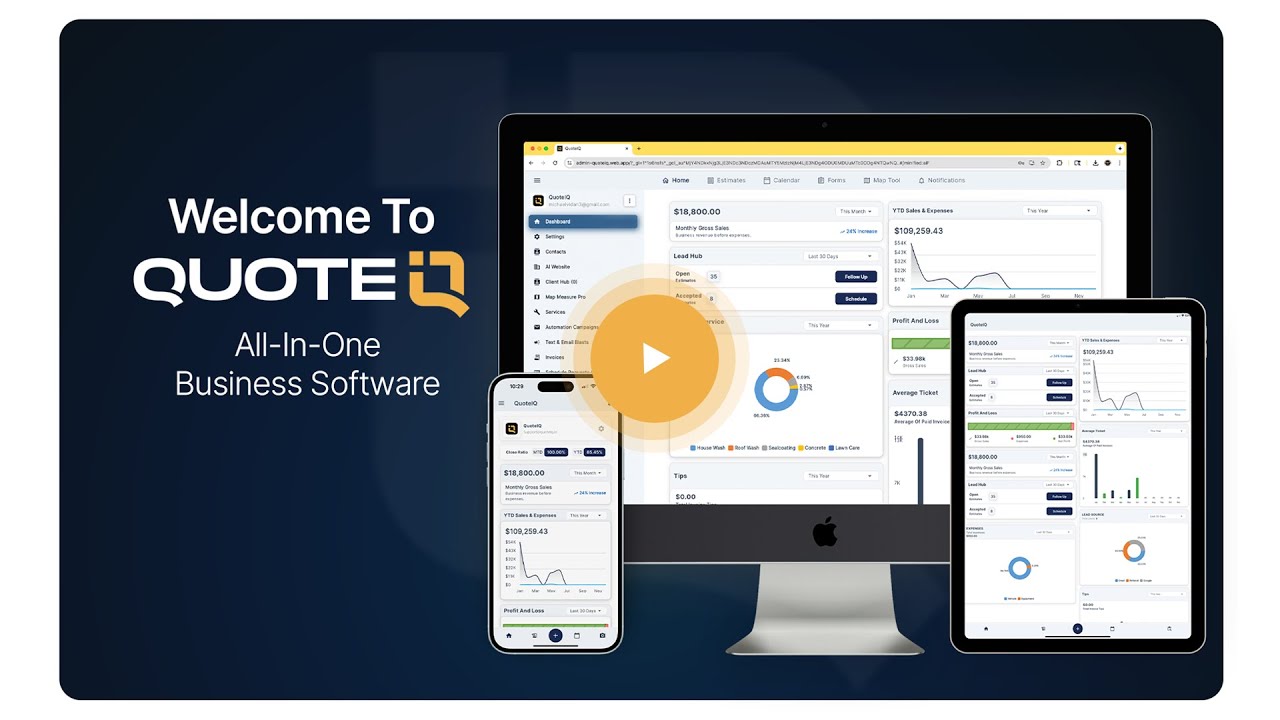
Five minutes of the actual product beats an hour of feature lists. This walkthrough covers building an estimate, scheduling the job, documenting it and getting paid.
Total hands-on time for a small trade business is roughly one evening, plus two weeks of running both systems side by side.
Create the account and choose your plan — the 14-day trial gives full access to the features of the plan you choose. Export a CSV from your current system and let AI Smart Import map the columns, or pull straight from phone contacts.
Enter your services and rates once, and re-check them against the cost calculators rather than importing numbers you set three years ago. This is the single highest-value hour of the whole migration.
Measure from imagery, send the estimate, collect the e-signature, schedule it, document it with photos and invoice from the completed job. Five real jobs will tell you more than any demo.
Teach clock in, complete with photos, mark done. Leave automations, routing and analytics for the office side once the field habits are set, then retire the old system.
QuoteIQ LLC was founded on 21 September 2022 and is based in Savannah, Georgia. The platform is built and maintained by people who ran service businesses first and wrote software second.
More from both on the QuoteIQ insights hub.
Three from the 4,103 reviews behind the 4.7-star average.
“QuoteIQ replaced multiple apps for my small business. It’s easy to use, highly reliable, and keeps client records, scheduling, payments, and reporting in perfect order.”
“Ultimate all-in-one tool for service pros! Quotes, invoices, scheduling, inspections, and analytics. Intuitive interface. Pre-inspection checklist invaluable. Helps me grow and stay organized daily.”
“I was nervous switching systems, but QuoteIQ made the move seamless. Everything from customer details to quote follow-ups is now automated and stress-free.”
Fourteen days, full access to the features of the plan you choose, month to month after that. Quote a job, schedule it, document it, invoice it, get paid — then decide.